
In defence of ASUU strike (I)
By Nura Jibo
During my university days in one of Nigeria’s best and leading universities, I was a victim of the Academic Staff Union of Universities (ASUU) strike. As a result, we were stricken academically and made to stay at home for an entire year.
The ASUU-Federal Government face-off continued to linger. We were affected by another two-year strike at different times. Then I wrote a full page in the Daily Trust opinion column of 2 May 2003 titled, “ASUU/FGN Face-Off: Point Blank”.
I don’t really blame ASUU for all the strike actions. Because I know even then, the moribund status of the Nigerian education system had reached its comatose stage. We were given lectures in two of the biggest lecture theatres at my university. And the mammoth student crowd was so overwhelming that one had to sit on the floor to listen to lectures. There was a lack of seats and spaces to patch on and receive lessons. That was nineteen (19) years ago!
Now I don’t want to be lengthy today. Anybody that wants to know the solutions I proffered then could search Google or take time to read my book chapter on Nigeria. It is there on Amazon
To cut the story short, I listened to the haggard-looking and frustrated ASUU President with a sympathetic mind. I saw how Seun of Channels Television tried to balance his reporting with Festus Keyamo’s verbal diarrhoea.
First, anybody watching Keyamo’s take on ASUU knows he is lying! He sounded a pathological one, for that matter. But I don’t blame him because that’s what some Nigerian politicians do to make ends meet! However, as a lawyer and former human rights activist, Keyamo ought to have been careful by minding his language as a custodian of justice.
I am happy the ASUU President debunked and dismissed Keyamo as one of those ‘chop-chop’ guys that rants on government, but after having a lucrative position, they eat and dine from it. And their so-called activism ends there!
Second, Adamu Adamu’s Nigeria’s Federal Ministry of Education is one of the most corrupt ministries in the world. A verifiable proof and evidence of this is vivid when one wants attestation of their academic documents. The entire people in charge of attestation of university documents are all fantastically corrupt. They charge and collect kick-backs from left, right, back, front and centre! And they would tell you there is no actual price for attestation of one’s academic documents.
Very recently, a very shocking incident happened. Someone was kept aside, probably a former staff of the Ministry, that specialises in being a money liaison negotiator between one of the women directors that work in that attestation section in the Ministry and anybody that comes for attestation of documents. That guy (name withheld for now but will be released in my subsequent analysis) is extraordinarily corrupt and charges a considerable amount of money in the name attestation!
I wanted to expose these ills and terrible ineptitudes to Adamu Adamu by intending to painstakingly go and meet him personally at his office the way we used to meet at late Dr Mamud’s Tukur house in Kaduna at Raba Road. But I decided not to because he may ask his secretaries not to usher me in. The rest of this story is a menu for another day. Now let’s come back to ASUU Strike.
As it is, Adamu Adamu has lost respect and the so-called radical reformer he thinks he was. Because for him to preside over an education ministry that is the biggest in Africa and allow corruptible ministerial staff to keep reigning and painting a terrible image of Nigeria in the name of attestation of documents shows a lack of concern and total negligence of holding public office on Adamu’s part!
Therefore, little wonder when he ignores ASUU’s demands because during his struggle days to make both ends meet, he was an ardent ASUU supporter. But now, he has joined the bandwagon of Keyamo’s “Kiya Kiya” in the name of public service!
Third, I respect my university teachers very well. They earn my respect any day. Because despite all odds, they made me who I am educationally (academically), politically, socially, realistically, genuinely, “temeritically”, hopefully, audaciously, respectfully, fearlessly, confrontationally, and above all analytically and scientifically savvy.
Ditto Adamu Adamu and the Keyamo’s of this world!
They were well trained and educated by those university lecturers that they betray today in the name of public office.
To be continued!
Nura Jibo is a Lifetime Member of the West African Research Association (WARA), African Studies Centre, Boston University, United States. He can be reached via jibonura@yahoo.com.
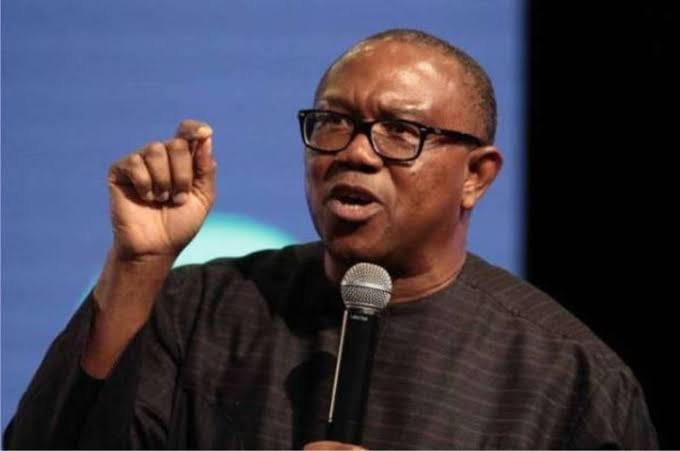
Opponents spread fake news, attribute them to me – Peter Obi
By Uzair Adam Imam
The Labour Party Presidential Candidate, Peter Obi, has accused the way his opponents adopted a negative strategy of trolling and insinuating fake news and misinformation against him and his party.
Obi said this Thursday in his verified Tweeter handle, adding that his opponents create misinformation on social media and deliberately attribute them to him and his party.
The Daily Reality recalls that Obi and the APC Presidential Candidate, Bola Ahmed Tinubu, were engaged in a serious war of words last week.
Obi tweeted, “As we approach the official kick off of the 2023 election campaign, it has become evident that the opposition have adopted a negative strategy of trolling and insinuating fake news and misinformation in the social media space and blaming the Labour Party, its presidential candidate and their supporters of same.
“We remain resolute in our commitment to an issue-based and clean campaign. We will also rebuff all such ploys of deceit and calumny meant to create disaffection among Nigeria’s voting population, who desire credible leadership change. – PO,” he said.
On his part, Tinubu also blamed Obi supporters for mudslinging and spreading fake news against him and other candidates ahead the 2023 general election.

Court remands two for allegedly raping 14-year-old girl
James Thomas, 35 and Segun Adesina, 61, were remanded on Thursday by Chief Magistrate Patricia Adetuyibi at a family court in Iyaganku, Ibadan, for the alleged rape of a 14-year-old girl.
According to NAN, Adetuyibi, who declined to accept the defendants’ plea due to a lack of jurisdiction, ordered their custody to the Abolongo Correctional Facility in Oyo Town.
She gave the order to forward the case file for review to the Oyo State Ministry of Justice’s Director of Public Prosecutions. The matter was postponed to October 20 for mention by Adetuyibi.
Thomas allegedly had illicit sexual contact with the girl between January and July at Oke-Ola in the Ejioku neighbourhood of Ibadan, according to the prosecution’s attorney, Insp. Folake Ewe.
Ewe claimed the defendant violated the girl’s rights by allegedly committing the crime.
She claimed that Adesina is also accused of engaging in unlawful sexual activity with a woman against her will sometime in 2021 at the same home.
Ewe claimed that the offences were in violation of Section 34 of the 2006 Oyo State Child Rights Law.
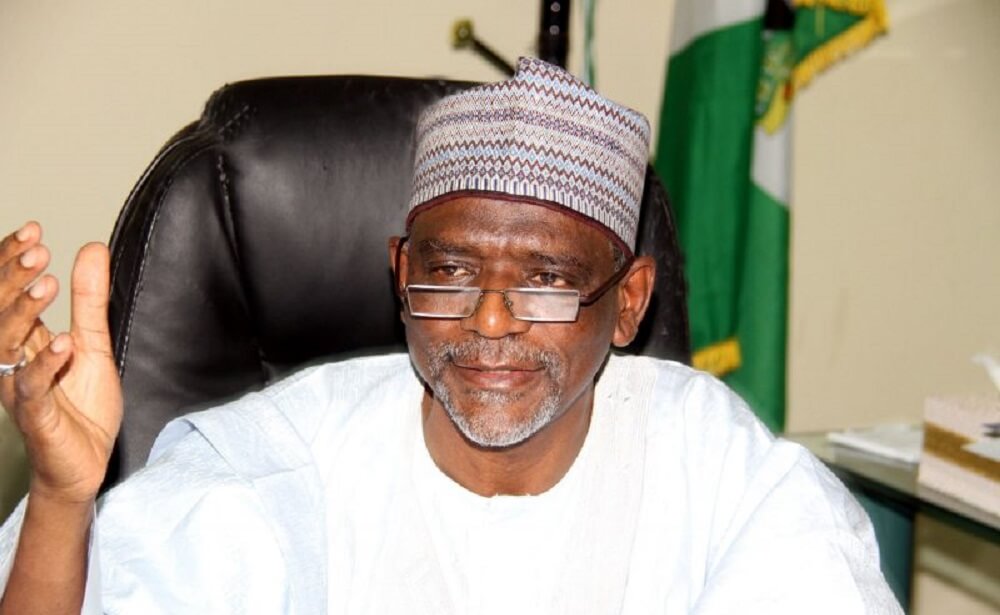
One condition stops FG and ASUU from reaching agreement
By Uzair Adam Imam
The Minister of Education, Malam Adamu Adamu, said the Federal Government has sorted out issues with the Academic Staff Union of Universities (ASUU), adding that the ‘no-work-no-pay’ policy is the only condition delaying the truce.
The minister said this Thursday at the 47th session of the State House Briefing organised by the Presidential Communications Team in Abuja.
According to him, four of five unions in the tertiary institutions across the country had agreed to call off strike within the next week.
Regarding compensating students for time wasted from the six-month strike, the minister said ASUU should be held responsible for that.
The minister stated, “the affected students should ‘take ASUU to court’ to get compensated for the time wasted.”

Man who kills wife for requesting divorce sentenced to death by hanging
By Uzair Adam Imam
A wrestler who murdered his wife for requesting a divorce letter has been sentenced to death by Adamawa State High Court.
The man, identified as Thank-You Grim, was said to be a renowned wrestler from the Silli community in Guyuk Local Government Area of Adamawa state.
The Chief Judge, Justice Nathan Musa, while delivering the judgment on Tuesday, said the prosecution had convinced the court that the man had committed the offence and the court, therefore, sentenced him to death by hanging.
Narrating the incident, some residents told journalists that Grim had thrown his wife, Kwalla, on the ground before using a pestle to hit her in the head, which led to her death.
It was gathered that the couple had lived separately since January 2018 following irreconcilable differences.
However, when the deceased fell in love with another man and wanted to remarry, she asked Grim for a divorce letter, a development that frustrated him.
The resident disclosed that instead of granting her request, the wrestler lured the deceased to come over to collect the letter.
At she arrived, the man started pleading with her to return to him, a proposal she outright rejected.
That was said to be the start of their argument, resulting in him hitting her with a pestle, leading to her death.
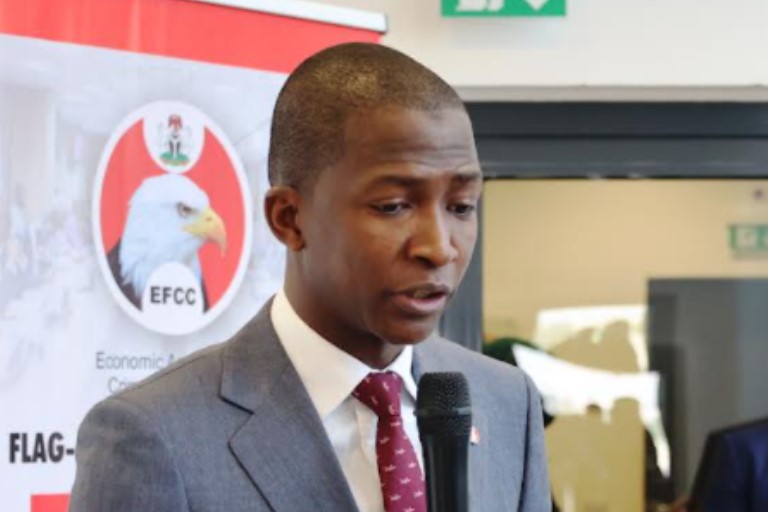
EFCC urges media to stop promoting corrupt citizens
By Uzair Adam Imam
The Economic and Financial Crimes Commission (EFCC) has urged media houses in the country to stop promoting corrupt citizens.
EFCC stated that the media sometimes portrayed the approach of the commission in fighting cybercrime as draconian.
Abdurasheed Bawa, the chairman of the anti-graft agency, disclosed this Wednesday in Abuja at the opening of a workshop on financial crime reporting organised for the journalists covering its activities.
Bawa stated that the reportage was perhaps borne out of a poor understanding of the anti-graft agency’s modus operandi.
He added, “I want to use this opportunity to further urge media practitioners to put the interest of our country at heart, particularly as it relates to a conscientious effort not to celebrate the corrupt in our midst.
“I urge you to expose them on the pages of your newspapers, screens of television or on your various online platforms.
“The war against corruption is a worthy fight for the soul of Nigeria and for the future generation; it should not be left to the EFCC alone,” he said.
The workshop was said to be one of the interventions by the commission to improve the capacity of the media to deliver on its constitutional mandate.

A Generational Discontent: A tribute to Mallam Ali Garba
By Adamu Tilde, PhD
This tribute should have come earlier. I have tried to write something about Mallam Ali Garba several times, but it always ended in a stalemate. Not that I can capture the essence of Mallam in a few paragraphs, but I, nevertheless, will share what Mallam meant to me.
It is trite to discuss the mutual distrust between the few Western-educated elites and the remaining populace of the Muslim North. The condescending looks the former harbour for the latter has inadvertently led to animosity, disdain, estrangement, and suspicion. This mutual distrust has stalemated the needed cultural and social changes and transformation for growth and development.
For long, the ordinary populace cannot find reasons to associate with the educated elites; the elites, on the other hand, cannot understand why the public views them with utter cynicism. In my view, the effortless meandering of this contradiction tells the essence of Mallam.
Mallam was educated in Kent up to PhD level, published books and articles in reputable journals, worked in some elite organizations and finally settled in Bayero University Kano (BUK), Department of Business Administration, until his demise. This impressive resumé only made Mallam more courteous, down-to-earth, and humble. So, how did he surmount what appears to be an insurmountable challenge? I will come back to that later.
I first met Mallam in 2014 at Kano Central Hotel. I was selected for a workshop on entrepreneurship by Hajiya Amina Ado Kurawa. Mallam was one of the resource persons. Given how Hajiya Amina praised Mallam Ali, we waited with bated breath for this all-important resource person. We were not disappointed. Mallam delivered a flawless presentation. I could not wait to engage him after the presentation, only for Mallam to excuse himself for another engagement. I later searched for his name on Facebook.
Mallam interspersed his discussions, teachings and writings with ‘barkwanci’ (humour). This invited a lot of traffic to his wall; it also made his students and followers feel at ease in his presence which thus facilitated two-way communication. You would feel confident asking Mallam anything.
Another charming trait that won Mallam many hearts was the extent to which he would reach to correct you without belittling you or making you look/sound foolish. This all the more made him endearing and welcoming.
Mallam knew he had a lot to share, and we were not making better use of his knowledge and experience. He looked at us (Tijjani, Marzuq, and I) in one instance and said: “Use me.” In another instance, during our first visit to his house, he invited us upstairs, introduced us to his wives, and finally said to us: “This is your house. Come whenever you want.” We were not alone. He did this to many. This unassuming and welcoming personality made Mallam a darling to many and led to the birth and polishing of innovative business ideas. Maryam Gatawa’s Gatmeals is one example.
Muslim North has no shortage of brilliant minds bristling with excellent ideas that can transform its economic prospects into reality. However, I suspect that the knowledge of how to harness and translate these innovative, transformative ideas into reality is in short supply.
One way of achieving this is to bridge the gap of access between the two aforementioned mutually distrusting classes. This is the essence of Mallam Ali Garba. And this was what Dr Waziri Junaidu cautioned us against in 1971: “Let not your degrees, research and publications be an excuse to feel haughty amongst your own people. Knowledge is at best when it is universally useful, and the best scholars are those whom the ordinary man fears neither to encounter nor to address.”
Adieu, Professor Ali Muhammad Garba.
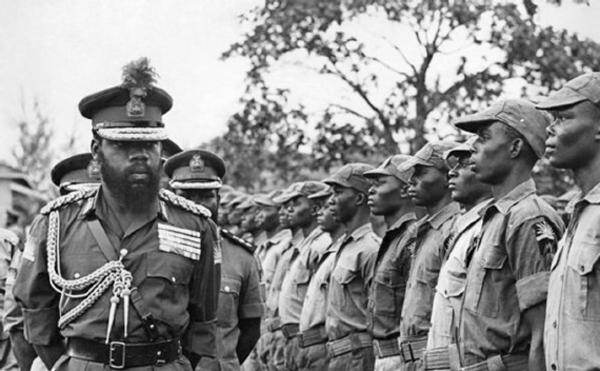
Nigeria Civil War: Conspiracies and interest of the World Powers
By Tijjani Hassan
War is a business of interest. Like the Russian invasion of Ukraine over the fear of western domination of the geopolitics of the defunct Soviet Union, Nigeria had her fair share of international politicking of how the superpowers wrestle for relevance in the post-World War II era, climaxing into the Nigerian-Biafran Civil war of secession.
As Chinua Achebe summarily spelt out in his book There was a Country, Harold Wilson, the PM of Britain, maintained a firm stance about one of the Queen’s priced colonies. The UK would not support the breaking away of Nigeria in the guise of secession. That would mean challenging their preplanned neocolonialism programme.
The BBC’s Rick fountain, in a story on Monday, January 3, 2000, titled “Secret papers reveals Biafra intrigue,” shows how Britain would and currently was more interested in her oil holding than a “united Nigeria”. The Cold War would see Britain and the Soviet Union wrestling for supplying the largest cache of ammunition to General Yakubu Gowon-led Federal government.
Russia, part of the former USSR, took a step further by sending MiG fighters and technical assistance to Nigeria. Moscow later expanded her bilateral relation with Nigeria with an eye on the Ajaokuta Steel Company. As a result, a $120 million contract was signed in 1969. However, the Steel Company, situated in present-day Kogi State, North Central Nigeria, remained a testament to the elephant project without producing steel for the manufacturing needs of Nigeria to date.
The UK was, however, much concerned about France’s secret antics.
France, the other big player in the dark colonial days in Africa, was secretly shipping weapons and ammunition to the Biafran enclave through their former colony of Ivory Coast and Gabon. Moreover, France has always been sceptical of Nigeria’s growing domination and influence over the Paris Francophone clients in the West Africa Subregion. The Size of Nigeria is intimidating to her French neighbours of Cameroon, Niger, Chad, Benin Republic, and others in the geography of the West Africa sub-region.
The Caribbean Island of Haiti was the first to make a rush in granting full diplomatic relations with the breakaway Biafra Republic in 1969. That means a little to Nigeria anyways. It was, however, a moment of celebration in Biafra as it rekindled the hope for the sovereign Biafra Republic.
France, who openly claimed to be neutral in her initial response to the crisis, issued a statement from the Council of Ministers in July 1968 sympathizing over the heart-trembling development in the heartland of Biafra. It was orchestrated by Charles de Gaulle, the French President who led Paris’s resistance against the Nazis in World War II.
Like the UK, it was about resource control. Paris has already hatched a plan for her multinational corporation, Elf Aquitaine, to become later the primary explorer of the crude oil deposit in West Africa. Nigeria’s oil in the old Eastern region would be the spoil of war.
While the war ragged, the United States of America openly looked elsewhere, neither supporting Nigeria nor Biafra. Instead, they advocated for a united “One Nigeria”. President Lyndon Johnson toed the line of Britain until Richard Nixon. Upon his assumption of office, President Nixon called on the Nigerian Military Forces to cease hostility to ease the suffering in Biafra.
The Portuguese were much more clever as they paved the way for Lt. Col. Emeka Odumegwu Ojukwu to land Biafran planes in Sao Tome, a Portuguese colony. The agreement was, however, shrouded in secrecy.
The Chinese were not left out of the Civil war politics in Nigeria. Although Biafra got most of her weapons from the black market and produced a few locally, China later provided military equipment to the breaking away part of Nigeria.
African leaders were not left out too. Despite the organization of Africa Unity (OAU)’s efforts to reconcile Gowon and Ojukwu, Julius Nyerere of Tanzania, on April 13, 1968, openly declared Dar-es-Salaam’s recognition of the Republic of Biafra. Tanzania was the first African country to take this overt stance. Gabon, Ivory Coast and Zambia would later follow the footsteps of Tanzania.
In sum, it was more about international politics and the desire to have a share of Nigeria’s resources in colossal oil deposits. As a result, western powers contributed less towards ending the Civil War, which ended in 1970.
Tijani Hassan A. wrote from Kano, Nigeria. He can be reached via tijanihassan2020@gmail.com.

The English teacher who failed kinds of nouns
By Ishaka Mohammed
Sometime in April 2021, an interviewer told me that there were only five kinds of nouns. She went further to reject some of the concepts I used while trying to disagree with her. For example, she claimed that neither ‘uncountable’ nor ‘mass’ could be used while discussing kinds of nouns. Surprisingly, however, she accepted ‘countable’. Before I could say anything further, she had mentioned her qualifications, perhaps to prove her superiority to me. Although I apologised to her, I wished I hadn’t encountered such a drama, thanks to Covid-19. I’ll explain this in the following story.
Due to my observation of many state civil servants, especially teachers, I’m usually afraid of relying on a state government job in Nigeria. Although I’ve applied for some government jobs in Kaduna State, I’ve never thought of depending totally on any (if employed). Besides, it’s highly unwise to rely on a single source of income.
However, as a private school teacher, my Covid-19 lockdown experience made me see one advantage of government jobs. Government workers received their salaries despite being away from work for months. Unfortunately, it was a different story for most of us (especially teachers) in the private sector.
Most schools in Kaduna had been on lockdown even before the federal imposed the same. I thought normalcy would return within a short time, but I was wrong. I had to stay for five months without a salary but not without food. To complement the assistance from some friends and relatives, I did some menial jobs until I decided to post my story on Nairaland. All I needed was a daily income of N500.
About an hour after posting the story, a lady responded and asked me to chat with her via WhatsApp. I wasted no time, and we reached an agreement. She would send snapped or scanned copies of handwritten notes from Ibadan, and I would type them on my phone and send them to her. We agreed on N30 per page, but she usually paid me higher than that. However, the biggest amount of money I received at the time was N1,200, and it took me three days to complete the task. Moreover, it was difficult typing the contents of the photos on the same phone containing them (the images).
With the lockdown experience, I became so much interested in government jobs. So, when the Kaduna State Teachers’ Service Board (KSTSB) advertised teaching vacancies in December 2020, I responded at once. I was shortlisted for a test, and owing to my high score, my hopes were high. So, expectedly, I was invited for an interview.
I prepared well and looked forward to facing the interview panel, but little did I know that I would be asked a question similar to the number of times President Muhammadu Buhari has been shocked. By the way, despite answering the last three questions correctly, the first one had already created friction between a member of the panel and me.
The woman insisted that there were only five kinds of nouns. I immediately disagreed with her and mentioned more than eight. Surprisingly, she accepted ‘countable nouns’ but rejected ‘uncountable nouns’. I quickly drew her attention to the fact that uncountable nouns are also called mass nouns, but my assertion infuriated her. She claimed that she had never come across ‘mass nouns’, and to prove her authority, she had to boast of the number of degrees she had, with the first being in language arts. I kindly said, “I’m sorry, ma.” However, that was like appointing a campaign director after one has already lost an election. I didn’t get the job.
Since then, I’ve consulted many sources to know how many kinds of nouns there are, but I have
yet to get a definite answer. Should you have an answer to that question, please share it with me.
Ishaka Mohammed wrote from Kaduna. He can be reached via ishakamohammed39@gmail.com.
The imperatives of Nigeria’s war against poverty (I)
By Lawi Auwal Yusuf
Some say that all poverty alleviation programmes would be a failure. Unfortunately, given the dispositions of our politicians, this is to a significant extent true because it suggests that they are not genuinely committed to dispelling all forms of deprivation. And this severe material lacking happens to reach its pinnacle that the idea of affluence is a contrived mirage, compromising the economic firmament upon which everything else must rest.
Poverty is the scarcity of material resources or the meagerness of the money needed to acquire those commodities believed to be required to maintain an acceptable living standard. Its a condition of severe deprivation of the basic human needs that include food, safe drinking water, healthcare, education, housing and sanitation facilities. It depends not only on income but also on access to services.
Poverty is deeply entrenched in Nigeria and ravages people’s lives devastatingly. It must be conquered because it leads to cycles of deprivation, whereas poverty is bequeathed from one generation to the other. However, any government that is not making genuine efforts to fight poverty is consciously pushing people deeper into it. This is because government policies significantly influence the extent of poverty. Therefore, impoverished Nigerians and the socially excluded must be helped to alleviate their plight.
Though welfare institutions have been designed to deal with the situations, at least on paper, the attempt to change the conditions of the poor fails because they are but dismal efforts, if not baseless paperwork. Inadequacy of the welfare state and the structure of society are responsible for poverty amid prosperity.
The welfare state is seen as the best remedy for overcoming poverty. Some social workers postulated that it helps tremendously in extirpating poverty and social exclusion and contended that it’s essential in solving many social problems. Therefore, full employment with prospects and increased welfare benefits would soon eradicate these intractable problems through redistributing wealth from the rich to the poor and significantly raising working-class living standards. However, critics argue that it does little to wipe it and even suggest it as a cause.
Asa Briggs said that “the welfare state exists where governments decide that the private enterprise is failing to meet the needs of its citizens. The welfare state might intervene to meet such needs by providing services such as health care, education, social housing, transport and social services; or by redistributing resources to those in need through benefits system.” This means that money can be redistributed to the poor through the benefits system, and welfare services can be used to minimise poverty.
The main problem with poverty eradication policies in this country is that they reduce the amount of poverty that truly exists. Hence, authorities attempt to deal with it through unfounded poverty alleviation programmes, frivolous economic empowerment schemes or even minor reforms. But, contrarily, its widespread are ruining Nigerians’ lives leading to social disorganisation, while deft changes are necessary to extricate it. Therefore, Nigerian policymakers must examine the problems in defining and measuring poverty and social exclusion, their causes and most importantly, the possible solutions.
Poverty is measured either in an absolute or relative term. Absolute poverty is usually based upon the notion of subsistence. This means that individuals are said to be poor if they lack the wherewithal to live decent lives. It is a judgment of basic human needs and is measured in terms of the resources needed for such living. Hence, it is much more concerned with establishing the quality and amount of food, shelter, clothing etc., deemed necessary to maintain physical, material, social and psychological wellbeing. On the other hand, when measuring poverty in relative terms, the prosperity of that society at a particular time must be considered before fixing its threshold.
The money needed for the subsistence level of existence must cover food, clothing, rent, schooling, fuel and light, and household and personal items. This must be adjusted according to family size.
Another contentious issue is whether poverty should be seen purely in material terms or must go beyond that. Supporters of the former view assume that poverty consists of insufficient material resources considered necessary to maintain a good everyday life. But, followers of the latter view believe it involves much more than material dearth. They see it as multiple deprivations with different dimensions.
For instance, there is a lack of educational opportunities, professional training or adverse working conditions. None of these conditions is directly related to an individual’s material possessions. It signifies radical societal changes rather than simply raising the income of the worst-off members. Tackling poverty in this sense would require a fairer redistribution of income, but also, it would require fundamental changes in the social structure.
Lawi Auwal Yusuf
Kano, Nigeria.