
NNWS elects new executives
By Khalid Imam
The Northern Nigerian Writers’ Summit (NNWS) elects new Executive officers to pilot its affairs for a two year term.
The election held at Katsina State Secretariat Conference Hall on 11st September, 2022 was conducted by a Four Man Electoral Committee under the able leadership of Professor Idris Amali, the DVC Admin., Federal University, Lafia. Professor Albishak, MON and Professor Yusuf Adamu served as Members with Zahradeen Ibrahim Kalla, former Treasurer of NNWS serving as the Secretary. At the end of the Congress, members of NNWS in attendance voted in new officials.
Those elected and their portfolios included Dr. Bashir Abu Sabe as the new Chairman, Isyaku Bala Ibrahim as Vice Chairman, Khalid Imam as the General Secretary, while Isma’ila Bala is to serve as the Ass. Gen. Sec..
Other included the Financial Secretary, Dr. Shamsudeen Bello, Treasurer, Abubakar Zukogi, PRO North Central
Tim Cuttings, PRO North West, Dr. Murtala Uba Mohammed, PRO North East, Legal Adviser
Ogbe Benson Aduojo Esq., Auditor Fatima Bello and an Ex-Officio, Auwal Gata
Soon after taking oath of office, swiftly administered by the reelected Legal Adviser, the reelected Chairman, Dr. Bashir Abu Sabe delivered a brief acceptance speech in which he thanked call members for their votes of confidence and giving him new mandate. He also appealed to all new Executives to put all hands on deck for them to reinvigorate the association. He concluded by calling on all members and other stakeholders to support him to provide the desired leadership the association needs to attain greater hight.
The election coming on the second day of the Two Day Conference and the first Arewa Literary Awards the NNWS organized. Thereafter what followed immediately was the illuminating papers presentation by carefully selected literary scholars and some writers from different regions of the North with papers presented in Fulfulde, Hausa, Nupe and Tiv indigenous languages.Prior to that, the Keynote Address was presented by Professor Saleh Abdu, former DVC, Federal University, Kashere after the conference was declared officially openned by His Excellency, Right Honourable Aminu Bello Masari who was ably represented by Honorable Abdulkarim Sirika, the Commissioner of Information, Culture and Home Affairs.
The unveiling of “Tulu: A Multilingual Anthology of Northern Nigerian New Writings” was the hallmark of events held on the opening day of the Two Day Conference on Northern Nigerian Indigenous Literatures and Languages themed: ‘ Indigenous Literatures and Languages as Vehicle for Taming Insecurity in Northern Nigeria”.
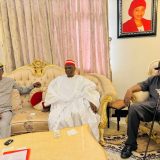
A powerful delegation of NNWS led by Professor Idris Amali were warming received by His Excellency, the Right Honourable Aminu Bello Masari, the Governor of Katsina State at his residence.
On Day Two, participants toured some fascinating historic sites in Katsina and the Daura Emir’s Palace.
International Musabaqa: Nigeria moves into final round
By Ibrahim Siraj Adhama in Mecca
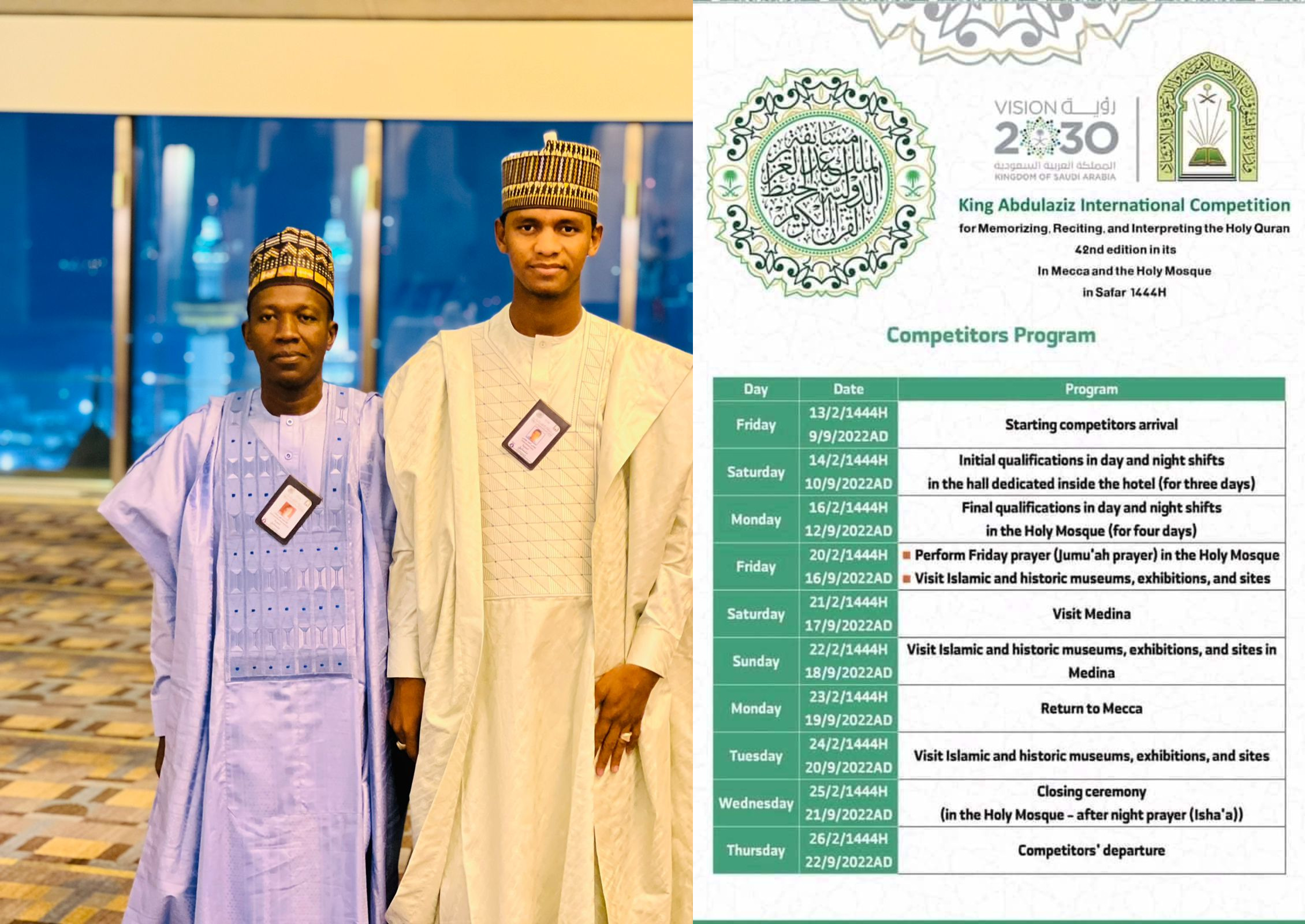
Nigeria’s participants at the 42nd King Abdulaziz International Competition for Memorizing, Recitating and Interpreting the Holy Quran taking place in Mecca, Saudi Arabia, have qualified for the final round of annual international contest.
Baba Sayinna Goni Mukhtar and Musa Ahmad Musa, both from Borno State, are competing in the second and third categories of the competition, respectively.
The preliminary stage was held between Saturday and Sunday in the hotel where all the participants are lodged and only successful reciters will make it to the final stage which will be conducted under full public glare within the precincts of the Grand Holy Mosque starting Monday.
Participants in the competition were drawn from Muslim countries around the world as well as representatives of minority Muslim communities.
The International Competition, which is returning after two years suspension due to the Covid-19 pandemic, promises to be exciting with the introduction of Qira’at category (now first category) and an upward review of cash prizes to be won.
Highlights of this year’s competition include visits to important religious sites in Mecca and Medina.
The competition will draw to a close on September 21 with the announcement of winners and distribution of prizes.
Fund Raising: Kebbi govt donates N100m to Hisbah
By Uzair Adam Imam
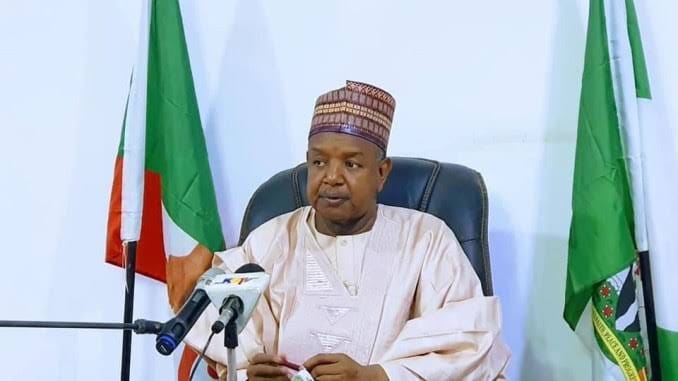
Kebbi State Government has donated N100 million to the state Hisbah Committee to strengthen its activities of promoting moral values and tackling social ills.
The donation was made known by the state governor, Atiku Bagudu, at a fund raising event to mark twenty years anniversary of the committee on Sunday.
The Daily Reality reporters gathered that the committee, whose doggedness was commended by all, was hoping to raise N120 million for its service.
The Minister of Justice and Attorney-General of the Federation, Abubakar Malami (SAN) acknowledged the performance of the committee.
The minister made a donation of N5 million to the Hisbah committee while the state APC gubernatorial candidate, Dr Nasir Idris, donated N500,000.
Many people who have commended Kebbi State Government believed that this gesture is worth emulating to strengthen the activity of the Hisbah in other states.

FG meets striking ASUU in Industrial Court today
By Uzair Adam Imam
The Federal Government meets the striking Academic Union of Universities (ASUU) at the Industrial Court of Nigeria (NICN) for adjudication over incessant strike on Monday.
The Daily Really recalls that ASUU has been on strike since February 14, 2022, resulting to a total closure of all Nigerian public universities for over seven months now.
The union is protesting against alleged infrastructure decay at various institutions, as well as neglect of its members’ welfare.
The Minister of Labour and Employment, Chris Ngige, made this disclosure Sunday in Abuja in a letter addressed to the Registrar of NICN, dated Sept 8, 2022.
Ngige stated that the referral instrument had become necessary following the failure of dialogue between the union and the Federal Ministry of Education.
”The Federal Government has asked the NICN to inquire into the legality or otherwise of the ongoing prolonged strike by ASUU leadership and members that had continued even after apprehension.
“It asked the court to interpret in its entirety the provisions of Section 18 LFN 2004, especially as it applies to the cessation of strike once a trade dispute is apprehended by the Minister of Labour and Employment and conciliation is ongoing,” he said.
The ongoing dispute between the FG and ASUU, which started taking a new dimension, has made some people believe that things have all being politicised.

The dilemma and challenges of a Nigerian teacher of English
By Salisu Yusuf
Like other teachers in the so-called Third World countries, Nigerian teachers of English have their dilemma and challenges ranging from sociocultural issues to pedagogical, personality, and condition of service. A teacher has a lot to contend with.
Teaching (at the higher level) in the 21st century has evolved from the traditional teacher-centred to a more pragmatic students-centred approach. Teachers are no longer the dominating forces in the classroom. Instead, they serve as coordinators while students run the show. Ultimately, communicative situations are created in the classroom. Consequently, teachers of English need to be acquainted with the role and place of theatre and drama in education, a method that makes teaching a communicative endeavour.
Unfortunately, students in 21st century Nigeria are no longer interested in communicative situations as education at primary and secondary schools has gone below the standard bar. A teacher, therefore, ought to devise a way to motivate a class of passive learners.
Besides students’ lack of communicative approach, teachers of English in Nigeria are confronted with a dual phonetic issue; a teacher is expected to teach the British phonetic patterning of speech in a strictly diverse Nigerian environment with students under the influence of Nigerian phonetics. The confusion in most Nigerian phonetic realisations emanates from a mix-up of British and American dialects in our daily usage.
Most English words are pronounced in American phonetic realisations. Moreover, Yoruba language phonemics has hugely influenced how we pronounce English words. Therefore, an English teacher must fully explain the phonetic versions to his students. For example, the word “minor” has double pronunciations; the British /ˈmʌɪnə/ and Nigerian /ˈmʌɪnɔː/. Students should know this difference and why the former is the aptest while the latter is strictly Nigerian.
Our students’ lack of reading culture has immensely affected English and literary studies. For instance, some students in literature class don’t want to frequent libraries and read selected texts. Instead, they prefer to visit internet sites, download summaries and read haphazardly. Teachers ought to be mentors in this regard.
A contemporary English teacher must keep abreast with modern English usage. For instance, some years back, a professor of English told our class that the plural of compound nouns such as female teacher and male servant are ‘females teachers’ and ‘males servants’, respectively. While some compound nouns are turned to plural from their first or last elements, the above two and many more are pluralised from their first and last elements. His assertion is, however, today obsolete; contemporary grammar has massively changed such patterns; female teachers and male servants have replaced the former.
A teacher of English must not lose his head to the identity crisis. Some learners in philosophy and literature subsume into ideological attributes of these fields, thereby becoming victims of pull and inferiority complex. They can only feel superior when they identify with the other culture.
A teacher of English should see himself as a second language user who teaches a foreign language. He should not see himself as an English teacher but as a teacher of English. I have seen a colleague with cultural schizophrenia due mainly to an obsession with English culture. A second language user who sees himself as a first language user usually suffers from identity crisis, culminating in cultural schizophrenia and, ultimately, psychological turmoil. Many I know have lost their faith and turned to atheism.
A teacher should see himself as someone who mediates between cultures in order to reach cultural equivalence. He should not pretend to be an English man, nor should he speak sleek English through a pointed nose. Rather, he should speak as an African who teaches a foreign language.
This doesn’t free him from strictly adhering to rules governing language use. He should be a traditional grammarian in his pedagogical engagements; he employs some aspects of contemporary grammar in both his classroom and outside classroom engagements.
Girl child abuse, pornography and sexual objectification have immensely affected the teaching profession in the 21st century. Victorianism, that 19th-century literary movement with all its attendant moral lashings, could not stop these deviations in academia. Some teachers see their female students as objects of beautification to be exploited. Female students stereotype and generalise their male teachers as admirers of their sleek bodies. Male students use their female counterparts as shields before their teachers, especially when looking for favours. These and many more are some of the causes of sexual scandals.
A teacher should see his female students as his congenial sisters whom he feeds with knowledge, no more, no less than this.
Many see teachers of English as grammar police, therefore, prescriptivists. I was numerously called a representative of her majesty, the late Queen. A teacher should do away with such social constructs and stereotypes and tackle his work head down. He’s a second language user called by fate to teach a foreign language, foreign culture. Therefore, he cannot escape such naming.
Last but not least, Nigeria’s teachers suffer from poor service conditions. Politicians have turned almost all other professions into… besides their own. Today, a month’s take-home pay of a politician can only be earned by a public servant for his entire working career. An instructor at a college in the neighbouring Niger Republic earns twice my wage.
A teacher should consider his profession service to humanity, not a means to an end.
Salisu Yusuf wrote from Katsina via salisuyusuf111@gmail.com.

Bandits hold newborn baby, mother in captivity
By Uzair Adam Imam
Reports from Kaduna disclosed that a pregnant woman abducted July this year has put to bed while in captivity.
The victim reportedly called on her ailing mother when bandits abducted her alongside her two sisters.
The victim’s husband, Muhammad Alabi, decried the traumatic development, adding that his wife was maltreated and severally flogged.
He stated that, “My wife gave birth at the kidnappers’ camp on 2nd August, 2022 and since then, both mother and child have not received any medical attention and to make matter worse, we learnt they were being maltreated and flogged.
“We are all dying emotionally and physically, that is why we are appealing to whoever God will use to secure their release to please help us free them.”
Recounting the family’s ordeal, father of the victims, Malam Abdulwahab Yusuf said the bandits broke into their Mando home around 1:05 am on the day of the attack.
“My two daughters used to take care of their mother who is sick, but unfortunately, that day their elder sister, who is pregnant came from her husband’s house to look after her mother when the bandits broke into the house and kidnapped my three daughters.
“They initially asked for N140 million, but now they have reduced the ransom to N50 million. The family has been adversely affected by the trauma. My wife, who was able to walk unaided before the incident, now uses wheelchair.
“We just carried out a surgery on her. I have not been myself, I cannot sleep, once it is night I don’t know how my body feels.”
DSS detains Mamu’s employee
By Uzair Adam Imam
The Department of State of Service (DSS) has detained a staff member of Desert Herald, a Kaduna-based publication owned by Tukur Mamu, the negotiator of Kaduna train hostage.
The staff, idefied as Mubarak Tinja, was detained after he was invited by the security operatives to retrieve phones and other devices that were fetched from Mamu’s house.
It was gathered that Tinja was accompanied by his friend to the Kaduna office of the DSS around 5 pm where they detained him.
According to a source, “The DSS went to the house and left a note for Mubarak Tinja to come to their office for the phones they collected and so he went with a friend.
“Sometime around 9pm, security agents asked his friend to return home and when he asked of Tinja, they said they were keeping him for questioning,” he said.
Mamu is the Spokesperson of the Kaduna- based cleric, Sheikh Ahmad Gumi, and had led the negotiation for the release of some of the abductees of March 2022 Kaduna train attack.
The Daily Really reported that the negotiator was first arrested by Interpol on Tuesday in Egypt and picked up by DSS in Kano as his plane touched the ground.
The DSS subsequently said Mamu has questions to answer regarding the rising insecurity in the country.

Police nab father who rapes own child in Ogun
By Uzair Adam Imam
The Police Command in Ogun State has confirmed the arrest of 46-year-old Olusegun Oluwole for allegedly raping his 17-year-old daughter.
His arrest followed a complaint lodged at Ibara police station in Abeokuta by the man’s own daughter (name withheld).
This was discussed in a statement Sunday by the state Police Spokesperson, Abimbola Oyeyemi.
Oyeyemi said the father forcefully raped his own daughter and threatened to kill her if she dared to tell anyone about the incident.
He stated that, “The girl said while she was sleeping in their one room apartment at Amolaso area of Abeokuta, on a night, her father, having observed that others were fast asleep suddenly grabbed her and forcefully had sex with her.
“On interrogation, the father of six, who confessed to the crime pleaded for forgiveness, claiming not knowing what came over him when he committed the crime,” Oyeyemi said.

Police in Jigawa found woman, 22, under bridge
Muhammad Sabiu
Ruqayya, a woman missing in Jigawa State, has been discovered by police in the Kiyawa local government.
This was stated in a press release given to journalists and bearing the Public Relations Officer’s signature for the State Command.
According to him, the police were informed that a woman was discovered stranded on September 9, 2022, at around 1400 hours, near the Shuwarin Main flyover in the Kiyawa LGA of Jigawa State.
Following that report, police arrived quickly to take the woman into custody.
He stated that throughout the interrogation, the woman had no recollection of herself.
What is wrong with Nigeria? What is wrong with Africa?
By Nura Jibo
There is no point wasting time on Nigerian leaders and their style of leadership.
Since its independence, Nigeria has been embroiled in a series of leadership experimentation. And the reality of its situation is that it cannot develop! I argued this position nineteen (19) years ago in a full-page opinion column in Daily Trust stable of 19 November 2003, page 6. I highlighted the dual mandate of Lord Lugard extensively.
Nigeria falls squarely under a plural society with several groups of population sharply divided along religious, ethnic and cultural formations. The sharp divide between the North and South qualifies the country as a plural community with lots of ethnic, tribal, religious and cultural conflicts.
Unlike the pluralistic United States, which was or/and is able to embrace a cultural semblance, Nigerian people are yet to even start appreciating the essence of togetherness. Its people’s behaviour (s) is not significantly different from dual societies such as Belgium and Rwanda, for example. Under these dual societies, each group accounts for about eighty-five per cent ( 85%) of cultural independence.
Now contrast my assertion with other countries of the world that have this duality in operation. Belgium, for example, is a classical example with its significant population from France and another group of Flemish identities. But today, the GDP value of Belgium accounts for more than 0.45% of the world economy.
Sweden, on the other hand, constitutes more of a singular society with ethnic swedes population of up to 80.3%. The rest are Syrians 1.9%, Iraqis 1.4%, Finnish 1.4% and others 15%.
Now contrast this with Senegal, which has a near-perfect singular society with a predominantly Muslim population that accounts for 94% that two Christian Presidents ruled for two decades. And yet the Senegales lived peacefully under those Christian Presidents.
Nonetheless, Sweden, because of its large singular population with the same cultural, tribal and ethnic semblance, has been enjoying peace for over 500 years!
Why Senegal did not enjoy this kind of Swedish peace is a subject for another day.
Now coming back to Nigeria as a plural society, it cannot develop like the United States because of its multifaceted traditional beliefs and cultural barriers brought about by the colonial demarcations and global mapping.
One wonders why the colonialists drew their countries’ maps so perfectly that it favours them from all angles.
Indeed, Gérardus Mercator did not favour Africa and all African nations like Nigeria when he came up with his conformal cylindrical map projection that he and his groups originally created to display accurate compass bearings for sea travel. In the end, they added additional features to this projection in form of local shapes by defining them as “accurate” and “correct”. The irony is they demarcated Europe so perfectly at a finite scale by drawing Nigeria and all African countries at an infinitesimal scale in 1569.
That is why Nigerians, even though are pluralistic under Mercator’s cylindrical mapping, the diverse population do not share common identities and cultural semblance like the Swedes.
People like me that consider Geography as the mother of history will continue to question the division or/and the dichotomous drawing of the African continent, which did not in any way and spot favours its people to grow and develop.
Therefore, it is not out of place or context to say or/and conclude that Nigeria and the African continent cannot develop as it is because the African States can’t take advantage of their multiethnic, multicultural and multireligious Mercator “gifts”.
Instead, they will continue revolving leadership that is corrupt and very dangerous for national and international development.
And, of course, there is the need for me to explore the ambivalent nature and relationship(s) between what is wrong with Nigerian and African leaders, their leadership styles and the African condition by tracing these to the fundamentals.
In the end, we may conclude that it is better for Nigerians and Africans to move out of Nigeria and Africa and settle somewhere in Europe and the Americas because the conditions there are more favourable and Mercatoristic than living in the African continent that is deliberately mapped out not to grow and excel by the colonial masters. I will, in the end, take a tour to Rwanda and Senegal to sit with the former African Union president, His Excellency Paul Kagame and its current Chairperson, His Excellency President Macky Sall of Senegal.
But before I do that, I hope to write formal open letters to President Kagame and President Sall on the way, I think the African continent and its people must follow to call or agitate for a united African Security Council. This will be distinct from the United Nations Security Council. It is when we have this, in my view, that we can call for an emergency meeting with European Union and redraw the map of Africa in an African style. Only then can we start championing the cause of Africanity, and its revolutionary proposal, and the triumph of facts for its underdevelopment will begin to emerge through the ages.
But as it is, the message to all Africans, including Nigerians, is: Never care to suffer about elections or having a better Nigeria or Africa. Because the duo are not meant to grow.
Indeed, listening to former and current Nigerian leaders and their African counterparts’ leadership “gospels” will never change anything. Rather it will inflict more pain and quandary on Nigerians and Africans, multivalent French, American, British and European marketers, negotiators and their marketability of African continents’ wars and resources.
Nura is a Research Analyst for the Director of Whitney Plantation in Louisiana, United States.