
Kano Singer market traders count N5bn loss after 1,500 shops burnt
By Uzair Adam
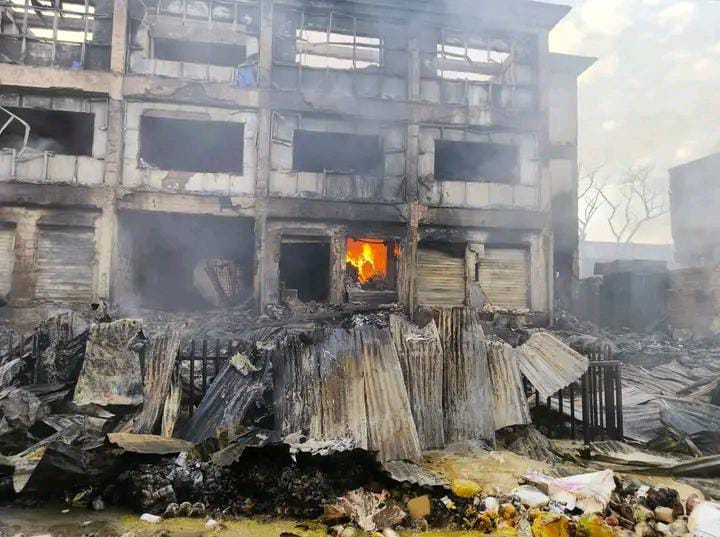
The Chairman of the Singer Market Development Association, Alhaji Junaid Zakari, has described the latest fire outbreak at Singer Market in Kano as a severe setback for traders, revealing that goods and property valued at over N5 billion were destroyed.
In an interview with the journalists on Sunday, Zakari said more than 1,500 shops, including containers and makeshift stalls operated by small-scale traders, were completely razed.
He explained that the affected section is among the busiest parts of the market, housing high-value goods acquired through substantial capital investment.
“The affected area contains a large concentration of goods. Based on our preliminary assessment, over 1,500 shops and small containers were burnt. We estimate that properties worth more than N5 billion have been lost,” he said.
Zakari expressed deep concern over the economic consequences of the incident, noting that many traders depend entirely on daily sales to support their families.
“This is a major blow to our members. Some traders operate with borrowed capital, while others rely on cooperative contributions.
“The impact of this loss is enormous,” he added, confirming that the main fire had been extinguished while firefighters continued efforts to put out remaining pockets of flames.
When The Daily Reality visited the market around 10:12 a.m. on Sunday, smoke was still rising from parts of the affected areas, including Gidan Gilas, Gidan Gashash, Gidan Mai and the Audu Yahaya Danbatta section.
Firefighters were seen battling lingering flames and carrying out cooling operations to prevent a fresh outbreak.
Some traders sifted through debris in search of salvageable items, while others stood in clusters discussing the scale of their losses.
Alhaji Isa Abubakar, a shop owner, said he lost goods worth over N200 million.
“From God we come, and to Him we shall return. It is heartbreaking to witness goods worth billions of naira destroyed by fire,” he stated.
He also commended Yusuf for visiting the scene to show solidarity with affected traders.
Another trader, Musa Ibrahim, said he lost goods valued at over N340 million, lamenting that the fire had consumed everything in his shop.
Similarly, Halifa Abubakar, who operates a Point of Sale (POS) business in the market, said he lost all the cash in his shop, much of which belonged to other people.
He, however, noted that his loss was minor compared to traders who lost goods worth billions of naira, adding that he could not immediately determine the exact amount involved.
The fire, which broke out on Saturday evening, raged into the early hours of Sunday, causing widespread destruction and anxiety among traders.
The incident occurred just weeks after another devastating fire at the market resulted in significant losses, compounding the hardship faced by business owners.
As of the time of filing this report, the cause of the fire had yet to be determined, and authorities were still investigating the circumstances surrounding the outbreak.

Bandits abduct wives, daughters of Bauchi imam, others
By Sabiu Abdullahi
Suspected bandits have abducted the wives and daughters of Imam Abubakar Muhammad Digare, the Chief Imam of Jama’atu Izalatil Bid’ah Wa Ikamatis Sunnah (JIBWIS), during an attack on Digare town in Alkaleri Local Government Area of Bauchi State.
The incident occurred on Saturday night. The assailants reportedly invaded the cleric’s residence under the cover of darkness and took several victims away to an undisclosed location. Authorities are yet to confirm the exact number of those kidnapped.
Residents said the attack has heightened fear across the community. Many people have remained indoors, while movement within the town has reduced sharply due to safety concerns. Witnesses added that women and children were among those abducted. Neighbours described the operation as chaotic, noting that the gunmen fled immediately after seizing their victims.
Security analyst Bakatsine spoke on the development, stressing the implications for security in the area.
He said, “The attack on the residence of Imam Abubakar Muhammad Digare is a clear indication of the growing audacity of criminal gangs in the region. Such acts are designed to instil fear and demonstrate the weakness of local security arrangements.”
He also warned about the broader social impact of targeting religious leaders.
According to him, “Abductions targeting prominent religious leaders are particularly alarming because they can destabilise communal trust and provoke tensions within the community.”
Bakatsine called for urgent government intervention to curb the trend.
He said, “Authorities need to respond swiftly and effectively to prevent further escalation. This incident underscores the urgent need for coordinated security strategies in Bauchi and surrounding states.”
The latest raid adds to a string of violent incidents recorded in parts of Bauchi State in recent times. Communities across the state have reported kidnappings, armed robberies, and other attacks, which continue to raise concerns about public safety.
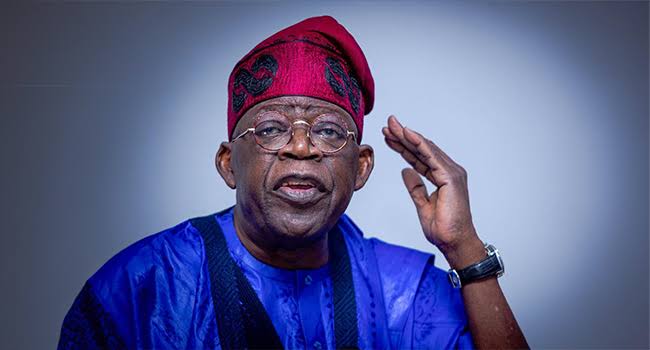
FG raises alarm over deceptive recruitment of Nigerians for foreign wars
By Uzair Adam
The Federal Government has cautioned Nigerians against falling victim to illegal recruitment schemes that lure citizens into participating in foreign armed conflicts.
In a statement released by the spokesperson of the Ministry of Foreign Affairs, Kimiebi Imomotimi Ebienfa, the government disclosed that investigations have uncovered a growing trend in which unsuspecting Nigerians are enticed with promises of well-paid jobs, security positions, academic opportunities, and migration benefits, only to be deployed to conflict zones under false pretences.
According to the Ministry, recruiters allegedly dangle attractive incentives such as high salaries, signing bonuses, and expedited citizenship processes.
Victims are sometimes persuaded to sign contracts written in foreign languages without proper legal advice.
In certain cases, their travel documents are confiscated upon arrival. Authorities also revealed that some agents arrange travel under tourist or other non-military visa categories to conceal the true purpose of the trip.
The government warned that engaging in foreign armed conflicts outside official and approved channels poses serious risks and could amount to violations of both Nigerian and international laws regulating mercenary activities and foreign enlistment.
It stressed that citizens who choose to participate in such activities without government authorization do so at their own peril.
To curb the trend, the Federal Government said it is collaborating with local and international partners to investigate the matter and intensify public awareness efforts.
Nigerian missions abroad have also been directed to heighten consular vigilance and issue timely advisories to citizens.
The Ministry further called on parents, guardians, community leaders, and educational institutions to sensitize young people about the dangers of deceptive overseas recruitment schemes.
Nigerians seeking employment or educational opportunities abroad were advised to verify offers through official government channels and promptly report suspicious approaches to the relevant authorities.
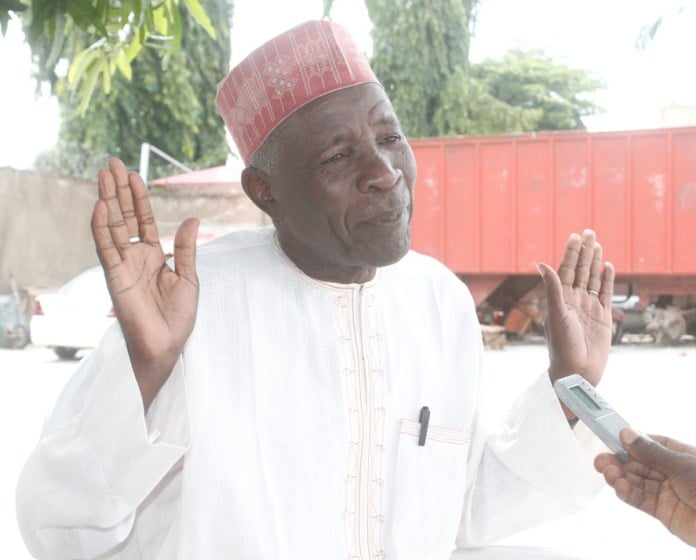
Governor Yusuf replaces Galadima as Kano Poly governing council chair
By Hadiza Abdulkadir
The Abba Kabir Yusuf has relieved Engr. Buba Galadima of his position as Chairman of the Governing Council of Kano State Polytechnic.
The decision was announced in a statement issued on Saturday by the Governor’s spokesperson, Sunusi Bature Dawakin Tofa.
In his place, the Governor approved the appointment of the Aliyu Ibrahim Abdulkadir, Emir of Gaya, as the new Chairman of the institution’s Governing Council.
According to the statement, the removal followed a restructuring process aimed at aligning the Polytechnic with the administration’s Kano First Agenda and ongoing reforms to enhance institutional performance. Although members of the Governing Council are expected to serve a three-year tenure, Galadima’s appointment was terminated before its expiration as part of the reform measures.
Governor Yusuf expressed appreciation to Galadima for his contributions during his tenure and urged the new Chairman to deploy his experience and leadership in repositioning the Polytechnic for improved academic and administrative excellence.
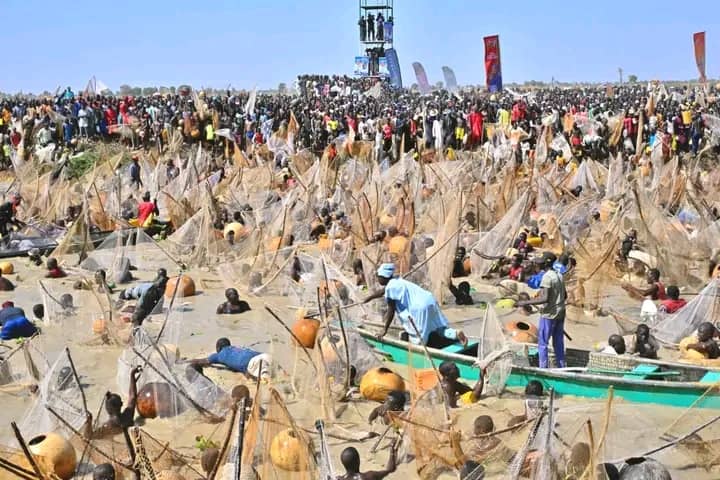
Argungu festival draws 50,000 fishermen as Tinubu hails ‘return of peace to northwest’
By Abdullahi Mukhtar Algasgaini
President Bola Tinubu has declared that the successful holding of the 61st Argungu International Fishing and Cultural Festival signals the return of stability to Kebbi State and the nation at large, as over 50,000 fishermen from Nigeria and neighbouring countries participated in the four-day cultural extravaganza.
Speaking at the grand finale in Argungu on Saturday, the President witnessed a local fisherman, Abubakar Usman from Maiyama Local Government Area, emerge as the overall winner after landing a 59kg catch. Usman went home with N1 million and two brand new cars.
The festival, which returned after a six-year hiatus, featured cultural displays, water competitions, traditional boxing, and dancing, drawing participants and spectators from across the region.
“This festival has endured for 83 years and stands as a powerful symbol of unity, resilience, and peaceful coexistence among our people,” Tinubu told the gathering. “The organisation, security arrangement, and internal outlook of the event demonstrate what is possible when leadership is purposeful and inclusive.”
The President used the occasion to reassure Nigerians that the fight against banditry and insurgency is being won, attributing the peaceful conduct of the festival to sustained investments in security and community engagement.
“I am pleased to note that significant progress has been made in combating insecurity across Kebbi and other parts of our nation,” he said. “The relative peace we are witnessing today in this region is not accidental. It is the result of sustained investment in security, intelligence gathering, and community engagement.”
Tinubu pledged stronger federal support for agriculture, tourism, and rural development, noting that events like Argungu can only thrive in a conducive security atmosphere. He commended Governor Nasir Idris for what he described as purposeful leadership in organising the historic event.
Before attending the festival, the President commissioned several infrastructure projects in Birnin Kebbi, including the Bola Ahmed Tinubu Secretariat Complex, a new modern motor park, a three-lane dual carriageway, and the Kauran Gwandu College of Nursing and Midwifery Sciences.
Governor Idris, in his remarks, outlined his administration’s achievements across infrastructure, health, education, and agriculture, including the recruitment of over 1,800 health workers, construction of thousands of classrooms, and free distribution of fertilisers and improved seedlings to farmers.
The Emir of Argungu, Sama’ila Muhammad Mera, described the President’s presence at the festival as “a profound identification with the core values of courage, reconciliation, peace, and friendship” that the 61-year-old festival represents.
In the keenly contested fishing competition, Abdullahi Garba from Argungu secured second place with a 40kg fish, winning N750,000, a brand new car, and a Hajj seat. The third position was jointly claimed by two contestants from Jigawa and Kogi states with a 33kg catch each, earning them N1 million and a motorcycle apiece.
All four winning fish were presented to President Tinubu as souvenirs at the conclusion of the event.
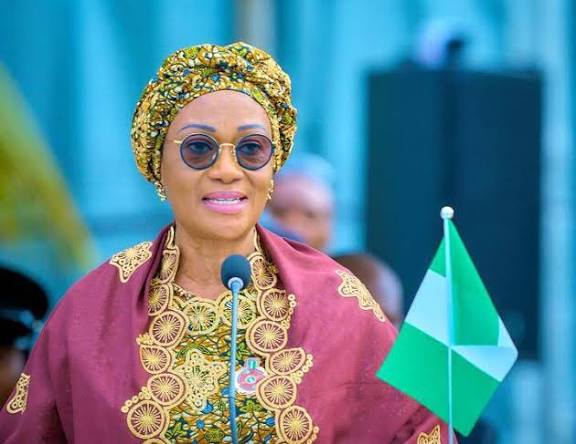
Remi Tinubu defends Muslim-Muslim ticket, says Muslims outnumber Christians in Nigeria
By Sabiu Abdullahi
First Lady Remi Tinubu has justified her husband, President Bola Tinubu’s Muslim-Muslim ticket, saying Muslims outnumber Christians in Nigeria. She made the remarks during her visit to the United States.
A pastor in the Redeemed Christian Church of God (RCCG), Mrs Tinubu told The Free Press that the decision for a Muslim-Muslim ticket in the 2023 election was political.
Explaining the choice, she said, “Let’s face it, the Muslims are more than us. If a southerner wants to run for president, politics is a game of numbers. You have to pick another Muslim. You can’t pick a Christian.”
The first lady also highlighted her role in the Presidential Villa, saying she attends to the interests of both Christians and Muslims. “I’m a Christian in the presidential villa. I take care of the interests of Christians, and I also take care of Muslims. That is what life should be. We have to respect everybody, irrespective of religion,” she said.
Mrs Tinubu, who attended the National Prayer Breakfast in the U.S., added that her trip was partly to address claims circulating on social media about alleged Christian genocide in Nigeria. She said the campaign followed her husband’s government navigating the country out of economic challenges marked by rising food prices and a declining naira.
In another interview with The Hill, Mrs Tinubu described global concerns over Christian persecution in Nigeria as “based on propaganda.”
She also urged the U.S. to intensify military strikes against terrorists and bandits in northern Nigeria, describing previous Christmas Day military actions ordered by former President Donald Trump as a “blessing” to the country.
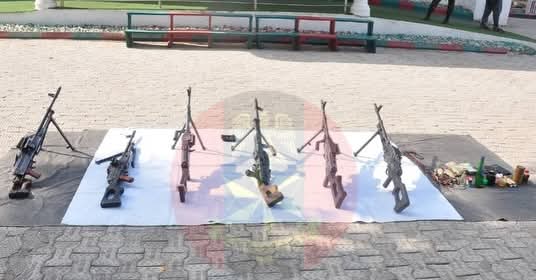
Nigerian soldiers recover weapons, arrest suspected gunrunner in Taraba
By Sabiu Abdullahi
Troops of 6 Brigade Nigerian Army, operating under Sector 3 of Operation Whirl Stroke, have arrested a suspected gunrunner during an intelligence-led operation in Ibi Local Government Area of Taraba State.
The operation took place on February 12, 2026, after security forces received credible intelligence. Troops stationed at the Forward Operating Base in Wukari acted promptly and apprehended the suspect, identified as 48-year-old Abubakar Ibrahim, who hails from Barkin Ladi Local Government Area of Plateau State.
Security personnel carried out a detailed search during the mission. The exercise led to the recovery of six PKT machine guns, two rounds of 7.62mm special ammunition, and a cash sum of ₦170,000. Officers also recovered a Peugeot 504 vehicle, a Q Seven mobile phone, seven bottles and wraps of perfume, as well as two small containers of Vaseline.
The suspect is currently in custody and undergoing further investigation.
Authorities said the interception prevented illegal weapons from getting into the hands of criminal elements. They added that the development supports ongoing efforts to address insecurity and strengthen public safety in the state.
The Commander of 6 Brigade Nigerian Army/Sector 3 OPWS, Chukwuemeka Micheal Akaliro, praised the troops for their vigilance and professionalism. He urged them to maintain the momentum in line with the mandate given by the Chief of Army Staff. He also commended residents for providing useful intelligence that aided the operation’s success.
“The Brigade remains resolute in its mandate to protect lives and property, and to restore lasting peace and stability across Taraba State,” he stated.
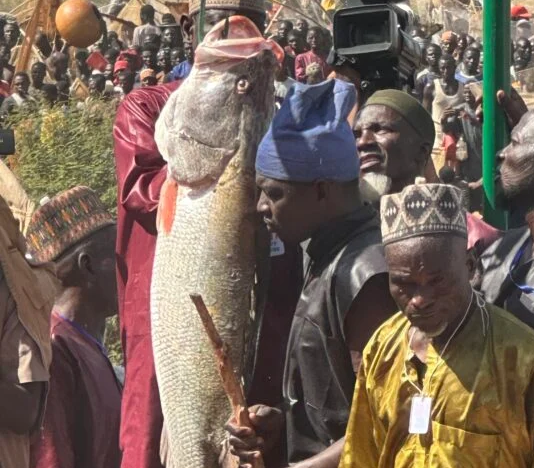
Argungu Fishing Festival records 59kg as biggest catch at 61st edition
By Sabiu Abdullahi
The 61st edition of the Argungu International Fishing Festival commenced on Saturday at Mata Fada in Argungu town, Kebbi State, with the heaviest fish weighing 59 kilograms.
The Special Adviser on Media and Public Communication, Sunday Dare, disclosed the development in a statement issued on Saturday afternoon, noting the remarkable size of the catch recorded at this year’s outing.
“61st Argungu fishing festival, biggest fish caught 59Kg,” Dare said.
The annual cultural event attracted thousands of fishermen, tourists, and culture enthusiasts from different parts of Nigeria and outside the country. Excitement heightened as a large crowd of the anticipated 40,000 participants rushed into the river shortly after noon. This happened before the formal opening ceremony and ahead of the arrival of President Bola Tinubu.
Reports from the venue indicated that in the fishing contest, “Abubakar Usman from Maiyama Local Government Area emerged overall winner with a 59kg catch.
“Abdullahi Garba from Argungu placed second with a 40kg fish, while third position was jointly claimed by Nasir Garba and another contestant, who each landed a 33kg catch.”
While announcing the winners, the Kebbi State Deputy Governor stated that the champion would receive “two Toyota vehicles donated by the Sokoto State Government, bags of WACOT rice and a cash prize of ₦1 million.
“The second-place winner received a car, a Hajj slot and ₦1 million, while the joint third-place winners were awarded two motorcycles each and ₦750,000.”
Earlier, President Tinubu arrived in Birnin Kebbi, the Kebbi State capital, where he inaugurated two major projects. The projects included the newly built State Secretariat and the renovated Central Motor Park. He later proceeded to Argungu to formally declare the festival open.
The Argungu Fishing Festival dates back to 1934. It was established to celebrate peace between the Sokoto Caliphate and the Kebbi Kingdom. Over time, the festival has grown into an internationally recognised cultural event that features fishing contests, traditional music, dance, wrestling, arts, crafts, and other cultural displays.
Court orders DIA to produce Kaduna cleric detained over alleged coup plot against Tinubu
By Sabiu Abdullahi
A Federal High Court in Abuja has directed the Defence Intelligence Agency (DIA) to produce a Kaduna-based Islamic cleric, Sani Zaria, before it on February 18 over allegations linking him to a coup plot against President Bola Tinubu.
The order followed proceedings on Friday before Justice Peter Lifu, who presided over a fundamental rights enforcement suit filed by the cleric. Zaria has remained in custody since December 2025.
Earlier in January, the Defence Headquarters confirmed the arrest of 16 military officers during the first week of the month in connection with an alleged attempt to overthrow the current administration.
Court documents showed that the cleric was first arrested by the Economic and Financial Crimes Commission before he was transferred to the custody of the Defence Intelligence Agency.
Respondents in the suit include the EFCC, DIA, the attorney-general of the federation, and Jaiz Bank Plc.
The applicant is asking the court to order his release. He argued that his continued detention has no lawful basis.
During the hearing, the federal government was unable to present a valid court order authorising his detention. The development drew criticism from the bench.
Justice Lifu had earlier instructed the DIA to produce any detention order or provide legal justification for holding the cleric under applicable laws, including provisions of the Administration of Criminal Justice Act.
The judge faulted the length of the detention. He subsequently ordered the intelligence agency to produce the cleric in court. The appearance, the court noted, will allow consideration of his bail application pending the continuation of the case.

Fubara dedicates award to Wike, says he chooses ‘weakness’ to preserve peace in Rivers
By Sabiu Abdullahi
Governor of Rivers State, Siminalayi Fubara, has said he deliberately chooses to appear “weak” in order to sustain peace and stability in the state.
The governor spoke on Friday in Lagos while receiving the 2025 Man of the Year Award presented by New Telegraph.
During his remarks, which focused on the burden of leadership, political disputes, and reconciliation, Fubara dedicated the honour to his predecessor and Minister of the Federal Capital Territory, Nyesom Wike.
“I do not care how you interpret it or misinterpret it. I also dedicate this award to somebody who discovered me, not minding the situation — the honourable minister of FCT, Nyesom Wike,” he said.
“He discovered me, and it is the discovery that gave me this loudness. Today is a very special day, and also special for everyone who has believed in me, and I know that for believing in me, you have a share of special pain.
“Some people have described these pains as weakness, while others say it is being strong. But I choose to be weak for a lot of reasons, weak because I want peace. Weak because we need to survive.
“Weak because I need to also protect those things that are dear, not just to me, but to our dear nation. Weakness is a virtue. It pays at the right time.”
Fubara thanked his family and residents of Rivers State for their patience and composure despite the prolonged political crisis in the state.
The development comes amid efforts to ease tensions between the executive arm and the Rivers State House of Assembly. Recently, President Bola Tinubu intervened and facilitated a truce between both sides after months of political strain, impeachment threats, and divisions within the legislature. Many lawmakers in the assembly are known allies of Wike.
The rift between the two political figures has played out publicly in recent months. Wike had opposed Fubara’s re-election ambition. He accused the governor of failing to honour an earlier peace agreement reached before the lifting of emergency rule in the state.
Earlier in the week, the FCT minister expressed optimism that the crisis between the executive and legislative arms would be resolved permanently following the president’s intervention.
Peace conditions linked to the dispute had earlier surfaced. One of the demands was the reinstatement of Sergeant Awuse, traditional ruler of Emohua kingdom, as chairman of the state’s council of traditional rulers. Fubara removed Awuse from the position in June 2024 and replaced him with Chike Worlu Wodo. Another demand involved the nomination of new commissioners.
In a fresh move, the governor dissolved the Rivers State Executive Council on Thursday. A day later, he forwarded a list of commissioner nominees to the state assembly for screening and confirmation.