

Kaduna State approves new salary structure for 3 tertiary institutions
By Abdullahi Mukhtar Algasgaini
Senator Uba Sani, the Governor of Kaduna State, has approved a new salary structure for three major tertiary institutions in the state.
The approval covers academic and non-academic staff of Nuhu Bamalli Polytechnic, the Shehu Idris College of Health Sciences and Technology, and the College of Education, Gidan Waya.
This decision brings to an end a 15-year-long struggle by the staff of these institutions, who have been demanding a review of their remuneration package.
The new salary structure is expected to align their pay with contemporary economic realities and improve morale.
While the specific details of the new salary scale were not immediately released, the approval is seen as a major victory for the educational sector in the state and a fulfillment of the government’s commitment to the welfare of its workforce.

Nigeria Customs Service warns public against fake appointment letters
By Sabiu Abdulahi
The Nigeria Customs Service (NCS) has cautioned the public against a fake appointment letter currently circulating on social media, describing it as a scam.
In a statement titled “SCAM ALERT!!!”, the Service clarified that it is “not issuing appointment letters at this stage of its recruitment exercise.” It further emphasized that the letters in circulation are “FAKE and should be disregarded.”
The NCS explained that the recruitment process is still ongoing and has not reached the stage of issuing appointment letters.
It stated that “the ongoing recruitment process is still at the examination stage; the Superintendent Cadre recently completed their CBT across the six geopolitical zones, while the Inspector and Customs Assistant Cadres also just concluded their online CBT.”
According to the Service, the fake letters are “another attempt by fraudsters to mislead unsuspecting applicants.”
The NCS urged applicants and the general public to remain calm, avoid sharing unverified information, and rely only on official updates from its verified communication channels.
It advised the public to follow the Nigeria Customs Service on its authentic social media platforms and website.

N-Power: Court sets date for suit against humanitarian affairs ministry
By Abdullahi Mukhtar Algasgaini
The National Industrial Court in Abuja has scheduled a hearing in a lawsuit filed against the Federal Ministry of Humanitarian Affairs and Poverty Alleviation.
According to a court notice, the case (NICN/ABJ/214/2025), brought by Maidu Shehu and nine others, will be mentioned before the court on Tuesday, November 4, 2025.
The notice, dated September 1, 2025, and addressed to the claimants’ counsel, A.A. Hikima, Esq., directs all parties to appear before the court sitting in Garki, Abuja, for the proceedings.
The suit names the Federal Ministry of Humanitarian Affairs and Poverty Alleviation and three other defendants, though the specific details of the claimants’ grievances were not disclosed in the notice.
The upcoming mention is typically a procedural hearing to address pre-trial matters and prepare the case for a full trial.

Presidential pardon list under final review, no inmates released yet—AGF
By Abdullahi Mukhtar Algasgaini
The Federal Government has clarified that no inmates have been released under the recent presidential pardon, as the process is still undergoing a final administrative review.
In a press statement on October 16, 2025, the Attorney-General of the Federation and Minister of Justice, Prince Lateef Fagbemi (SAN), stated that the exercise is at its last stage to ensure full compliance with legal and procedural requirements.
The clarification comes amid public speculation regarding the implementation of the clemency approved by the President following the Council of State’s endorsement.
Fagbemi explained that the final step involves issuing the formal instruments for the release of each beneficiary.
This stage, he noted, allows for a final verification of the list to correct any potential errors before the documents are sent to the Controller-General of Corrections for action.
“This verification process is part of the standard protocol and reflects the government’s commitment to transparency and due diligence,” the AGF stated.
He reiterated that the process is not delayed but is meticulously following the law to ensure only duly qualified individuals benefit.
“The rule of law does not rush; it ensures fairness,” Fagbemi said, adding that the public would be duly informed once all checks are concluded.
The Minister also appreciated the public’s vigilance, noting that such engagement strengthens institutional integrity and demonstrates a collective care for justice and good governance.

Senate confirms Prof. Amupitan as INEC chairman
By Uzair Adam
The Senate has confirmed Professor Joash Ojo Amupitan, SAN, as the new Chairman of the Independent National Electoral Commission (INEC).
The confirmation followed a three-hour screening session at the Senate Chamber on Thursday, during which lawmakers grilled the nominee of President Bola Tinubu on several issues regarding electoral integrity and independence.
After the session, Senate President Godswill Akpabio put the confirmation to a voice vote, and the “ayes” carried the day without any objection. Akpabio, thereafter, urged Amupitan to ensure that votes count under his leadership.
During the screening, Amupitan dismissed claims that he served as Legal Counsel to the All Progressives Congress (APC) during the 2023 Presidential Election Petition Tribunal or at the Supreme Court.
He noted that the law reports of those proceedings were publicly available for anyone to verify.
The new INEC Chairman pledged to ensure credible elections where losers would freely congratulate winners, stressing that such outcomes would strengthen democracy and national development.
He also vowed to prioritise logistics, safeguard election materials through technological innovations, and intensify voter education.
Amupitan entered the chamber at 12:50 p.m. after a motion by Senate Leader Opeyemi Bamidele (APC, Ekiti Central) was seconded by Minority Leader Abba Moro (PDP, Benue South) to suspend Order 12 and admit him into the chamber.
Before the questioning session began, Akpabio informed his colleagues that Amupitan had been cleared by the Office of the National Security Adviser (NSA), the Department of State Services (DSS), and the Inspector-General of Police, confirming he had no criminal record.
President Bola Tinubu had earlier written to the Senate seeking Amupitan’s screening and confirmation as INEC Chairman in accordance with Section 154 (1) of the 1999 Constitution (as amended).
In his letter, Tinubu urged the Senate to expedite action on the confirmation process, attaching Amupitan’s curriculum vitae for consideration.
Akpabio subsequently referred the President’s request to the Committee of the Whole, which concluded the legislative process with the confirmation on Thursday.
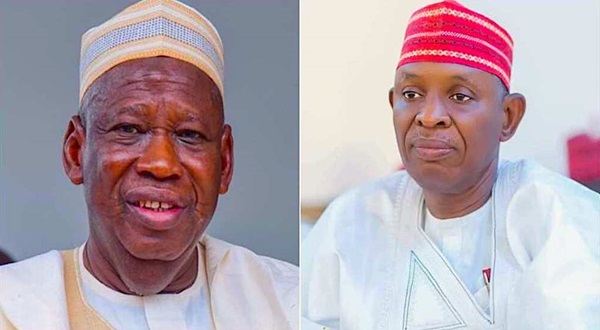
Kano govt sues Ganduje, sons over alleged N4.49bn fraud, moves to reclaim Dry Port shares
By Uzair Adam
The Kano State Government has instituted a high-profile suit before the State High Court, seeking to recover its 20 per cent equity stake in Dala Inland Dry Port Limited and reclaim funds allegedly misappropriated to the tune of N4,492,387,013.76.
According to court documents, the defendants in the charge include the former Governor of Kano State, Dr. Abdullahi Umar Ganduje; his sons, Umar Abdullahi Umar and Muhammad Abdullahi Umar; former Special Adviser to the Governor, Abubakar Sahabo Bawuro; former Executive Secretary of the Nigerian Shippers Council, Hassan Bello; a legal practitioner, Adamu Aliyu Sanda; and Dala Inland Dry Port Limited.
The Daily Reality reports that the defendants are facing a ten-count charge bordering on criminal conspiracy, misappropriation of public funds, breach of trust, and conflict of interest.
The court record indicates that the suit was filed on October 13, 2025.
According to the charge sheet, the defendants allegedly conspired to fraudulently transfer 80 per cent of the shares in Dala Inland Dry Port Limited, including the state government’s 20 per cent equity, to private entities under the fictitious name “City Green Enterprise” in an attempt to conceal the company’s actual ownership.
The prosecution further alleged that the defendants diverted over N4.49 billion of Kano State funds to execute infrastructure projects such as a double carriageway, electricity supply, and perimeter fencing at the dry port for their personal and family benefit.
In addition, the defendants were accused of abuse of office and conflict of interest, allegedly using their official positions to manipulate public resources for private gain, contrary to financial and constitutional provisions.
The prosecution listed several key witnesses, including the lead investigating officer who uncovered the alleged fraudulent transactions, and an early stakeholder in the project who was reportedly sidelined during the equity transfer process.
The summary of evidence alleges that the defendants used sham entities and proxies to conceal ownership of the Dala Inland Dry Port shares, diverted public funds to family-owned firms and personal businesses, coerced the original project founders into relinquishing control, created false documents to mislead regulators, and facilitated the diversion of N750 million through Safari Textile Ltd (STL Enterprise).
The prosecution will also present evidence showing that the 4th defendant conducted a review confirming the Kano State Government’s 20 per cent stake in the dry port, in line with a policy document initiated under former President Olusegun Obasanjo.
It further alleged that the purported transfer of shares was executed without the consent of other board members, and that the former governor, Abdullahi Ganduje, acted unilaterally to facilitate the move.
Although no date has been fixed for the hearing, the matter has been assigned to Kano State High Court 2, presided over by Justice Yusuf Ubale.

Time to revive house-to-house weekly sanitation: A call for cleaner communities
By Halima Abdulsalam Muhd
For decades, many Nigerian communities benefited from a rigorous weekly sanitation exercise led by duba gari or community health monitors who inspected homes and surroundings for hygiene compliance. These dedicated individuals went from house to house, checking toilets, kitchens, bedrooms, and waste disposal areas. Offenders were fined ₦50, a penalty that not only discouraged negligence but also ensured that communities maintained high sanitation standards.
Today, however, that once-vibrant practice has largely disappeared, leaving neighbourhoods grappling with mounting sanitation challenges, from blocked drainage to increased cases of cholera and malaria. Residents and experts alike are calling for the revival of this community-driven initiative.
Voices from the Community
Malama Hadiza Musa, a trader in Naibawa, recalled how effective the system used to be. “When the duba gari came every week, we had no choice but to clean up. Everywhere was tidy, even the backyards. Now, people dump refuse carelessly, and it is affecting all of us,” she lamented.
Mr Aliyu Garba, a retired civil servant, shared similar sentiments, “Back then, sanitation was part of our lives. Today, gutters are clogged, and mosquitoes breed everywhere. We need to bring back that system before things get worse.”
For Zainab Abdullahi, a mother of four, the absence of weekly inspections has created health concerns for families. Children now play around in dirty environments. If sanitation checks were still happening, parents would take cleaning more seriously.”
Community leader Malam Ibrahim Tukur believes the fines encouraged responsibility, “₦50 may look small today, but it carried weight at that time. It wasn’t about the money—it was about discipline. People feared being fined, so they kept their homes clean.”
Meanwhile, younger residents like Suleiman Adamu, a university student, argue that modern approaches should complement the old system, “We can bring it back, but alongside awareness campaigns and community waste management systems. Punishment alone may not be enough.”
Expert Perspectives
Environmental experts warn that abandoning structured sanitation monitoring has far-reaching effects.
Dr Fatima Yakubu, an environmental health specialist, emphasised the connection between sanitation and public health: “Poor sanitation directly contributes to outbreaks of cholera, typhoid, and malaria. Weekly inspections used to act as preventive measures. Reviving them could save lives and reduce health costs.”
Similarly, Prof. Emmanuel Okafor, an environmental scientist at Ahmadu Bello University, stressed the economic implications, “Communities spend more on healthcare when sanitation breaks down. By reinstating duba gari inspections, we are not just promoting cleanliness—we are reducing disease burden and increasing productivity.”
The Way Forward
Local governments, community associations, and traditional rulers are being urged to reintroduce house-to-house sanitation, perhaps updating the fines to reflect current realities while also integrating modern waste management solutions.
As Mrs Aisha Danladi, a public health advocate, put it, “We need a collective effort. The duba gari system worked before; it can work again. Our health and environment depend on it.”
Halima Abdulsalam wrote from Bayero University, Kano, via haleemahm42@gmail.com.

Dele Alake seeks closure of schools charging fees in foreign currencies
By Anas Abbas
The Minister of Solid Minerals Development, Dr. Dele Alake, has called for the closure of schools in Nigeria that charge tuition fees in foreign currencies, describing the practice as a major economic loophole undermining the value of the naira.
Alake made the call on Wednesday in Abuja during the Nigeria Gold Day Celebration, held on the sidelines of the 10th edition of the Nigeria Mining Week with the theme, “Nigeria Mining: From Progress to Global Relevance.”
The minister expressed concern over what he termed “economic contradictions” in the country, arguing that allowing local institutions to charge fees in foreign currencies puts unnecessary pressure on the naira.
“I am still going to make a proposal to the Federal Executive Council that all those schools in Nigeria that are charging in foreign currencies should be closed,” Alake said.
“These are some of the leakages and loopholes in our economy that people don’t take seriously. If your child attends a school in Abuja or Lagos and pays $10,000 or £10,000, you’ll have to exchange naira for dollars, pushing up the value of the foreign currency. You can’t go to the UK and establish a school charging in naira it’s only in this country such contradictions exist.”
Alake said the Federal Government was intensifying efforts to plug financial leakages across the minerals sector through digital mechanisms and stricter oversight, particularly within the gold value chain.
He noted that the government’s National Gold Purchase Programme (NGPP), implemented through the Solid Minerals Development Fund (SMDF), was designed to boost Nigeria’s foreign reserves and strengthen the naira by purchasing gold directly from artisanal miners in local currency.
The minister added that the initiative, a component of the Presidential Artisanal Gold Mining Initiative, would also reduce informal transactions and curb corruption in the sector.
In her remarks, the Executive Secretary of the SMDF, Fatima Shinkafi, said funding for gold exploration in Nigeria was on an upward trajectory, unlike global trends.She encouraged investors to take advantage of the country’s growing opportunities in gold mining.
“We implore everyone here to examine Nigeria’s gold resources and support the minister’s efforts to make Nigeria a premier destination for junior miners,” Shinkafi said.
“By next year’s Gold Day, we should be looking at Nigeria as a turning point in the global gold market.”
The Nigeria Mining Week, which runs from October 13 to 15, is organised by the Miners Association of Nigeria, in partnership with PricewaterhouseCoopers (PwC) and the VUKA Group.

Police arrest 11 suspected highway robbers on Katsina-Kano road
By Anas Abbas
The Katsina State Police Command has arrested an 11-member gang of suspected armed robbers notorious for terrorising travellers along the Sha’iskawa, Charanchi and Katsina-Kankia-Kano highways.
The Command’s Public Relations Officer, DSP Abubakar Aliyu, disclosed this while briefing newsmen on Wednesday in Katsina.
He said the suspects specialized in ambushing and robbing motorists on major roads within the state.
According to Aliyu, those arrested include Dikko Maaru, Dardau Kabir, Muntari Musa, Labaran Amadu, Usman Maaru, Lawal Zubairu, Nasiru Sanusi, Adamu Kabir, Abdullahi Zubairu, Muhammad Usman, and Sale Shehu — all aged between 21 and 35.
He explained that the arrest followed credible intelligence which led to the interception of one of the suspects on Sunday around 10 a.m. while attempting to sell stolen items.
The suspect’s arrest, he said, led to the apprehension of other members of the syndicate.Items recovered from the suspects include 80 wristwatches, nine mobile phones, and a knife used in their operations.
The Commissioner of Police, Mr. Bello Shehu, commended the operatives for their swift response and effective coordination.
He also appreciated the public for their continued cooperation and urged residents to keep providing timely information that could assist in combating crime across the state.
Aliyu added that the suspects would be charged to court upon the completion of investigations.

The Maryam Sanda pardon and Nigeria’s crisis of conscience
By Abdulhamid Abdullahi Aliyu
When President Bola Ahmed Tinubu announced a presidential pardon for 175 convicted persons across the country, Nigerians received the news with mixed emotions. But among the list, one name struck a raw national nerve: Maryam Sanda, the woman convicted of killing her husband, Bilyaminu Bello, in what remains one of the country’s most chilling domestic murder cases.
For many, it was not just another item in the roll call of mercy; it was a haunting reminder of how justice can sometimes be undone by power, privilege, and politics. The presidential prerogative of mercy, though constitutional, has now become a moral battlefield where the grief of the victim’s family collides with the influence of the powerful.
The late Bilyaminu Bello’s story is a tragic one. Murdered in cold blood by his wife in 2017, his death tore through the conscience of the nation. From the Federal Capital Territory High Court to the Court of Appeal, and finally to the Supreme Court in 2023, every judicial panel reaffirmed her guilt and upheld the death sentence. For many Nigerians, that long, painstaking journey through the courts was justice done and seen to be done.
But when the same Maryam Sanda walked free through the gates of presidential pardon barely two years later, the wounds of that tragedy reopened. In a country where thousands of convicts languish for years without the benefit of mercy, her release looked less like compassion and more like privilege dressed in forgiveness.
What deepened public unease was not just the pardon itself, but the drama that followed. As the late Bilyaminu’s family protested the decision, a man claiming to be his biological father suddenly appeared before journalists in Abuja beside Maryam’s own father to bless the President’s gesture. He pleaded that the woman should be allowed to raise his “grandchildren.”
Yet, investigative accounts reveal that this man, Alhaji Ahmed Bello Isa, had been absent from his son’s entire life. A retired storekeeper from the old Sokoto State, he reportedly disappeared shortly after the boy’s birth in 1981, never to return, not during his son’s childhood, not during his marriages, and not even during the long, high-profile murder trial that went all the way to the Supreme Court. His sudden reappearance, looking frail and poor, has been widely viewed as an orchestrated spectacle to give moral cover to an otherwise controversial pardon.
Meanwhile, Dr Bello Haliru Mohammed, OFR, the Ɗangaladiman Gwandu and uncle who raised Bilyaminu from childhood, issued a deeply moving statement titled “When Prerogative of Mercy Inflicts Inexorable Pain.” In it, he lamented that the pardon had reopened the family’s wounds, describing it as “the worst injustice any family could be made to go through.” He reminded the nation that the accused had shown “no remorse even for a fleeting moment” throughout her trial, and that her release mocked the memory of a life lost in cold blood.
Dr Bello’s words resonate beyond his family. They echo the silent frustration of many Nigerians who see the selective use of presidential mercy as a reflection of the country’s deeper moral decay. In this system, the powerful can always find their way out, while ordinary citizens drown in bureaucracy and neglect.
At this point, I must confess that I, too, find the whole episode unsettling. Mercy, in its truest form, should heal, not wound. It should reconcile, not re-traumatise. What purpose does clemency serve when it is perceived as a reward for influence rather than repentance? How do we explain to millions of Nigerians that justice can be reversed overnight, not because the convict was wrongly judged, but because connections spoke louder than conscience?
The case of Maryam Sanda is not just about a family’s pain; it is a mirror reflecting the cracks in our collective sense of fairness. When the law becomes a ladder, only the privileged can climb; justice loses its soul. When mercy is granted without genuine repentance, it ceases to be mercy; it becomes mockery.
Perhaps the President acted out of compassion, perhaps on counsel. But genuine compassion would have considered the pain of the victim’s family, the moral lessons for society, and the need to preserve faith in the justice system. Instead, what we have witnessed is a decision that reopens grief and reinforces the notion that justice in Nigeria bends easily for those with the right surname.
Now, as the nation debates and families mourn afresh, one cannot help but reflect on Dr Bello’s final words: that ultimate justice lies only with the Supreme Judge — Allah. That truth should haunt every conscience involved in this affair. Because when human mercy wounds justice, divine judgment will, in the end, heal what man has broken.
Abdulhamid Abdullahi Aliyu writes on disaster management and national development.