Religion

Late Sheikh Ja’afar’s daughter named Izala women leader

By Muhammad Sabiu

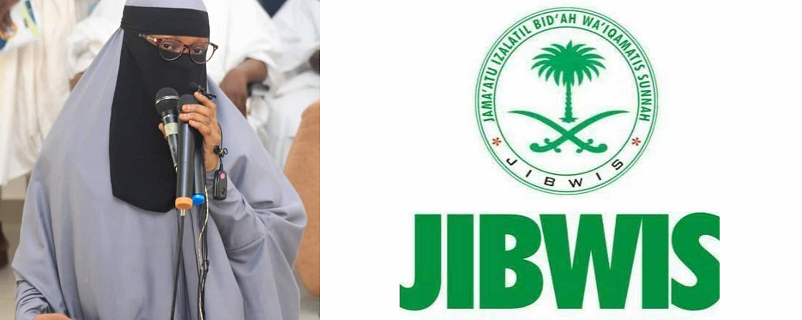
The daughter of the late Sheikh Ja’afar Mahmud Adam, Zainab, has been appointed as the new leader of a JIBWIS women body, also known as Nisa’us Sunna.

Delivering her acceptance speech after she was named the leader of Nisau Sunna, Malama Zainab expressed her gratitude to the Almighty Allah for making the event a reality.

She said, “I am grateful for being given this opportunity not because we are better than anybody, but for the simple reason that trust has been vested in us, with the thought that we will try our level best. And we hope the Almighty will spare us from disappointing (you), and may He grant us the opportunity to discharge the good expected of us.

“We, therefore, seek their [our leaders’] guidance in different aspects—in the aspect of praying for us as our parents, and on the part of commanding us.”

She also stressed the importance of the inclusion of women in areas that have to do with community development, adding that women are of great importance in any effort of bringing development.

The naming of Malama Zainab as a women’s leader went viral, thanks to the prominence and influence of her late father, Sheikh Ja’afar.

Recall that the late cleric was murdered in 2007. However, no culprit had been brought to justice even though a former leader of Boko Haram, Abubakar Shekau, claimed responsibility for his killing on several occasions.

Making Waqf a serious business in Nigeria

By Abdullahi Abubakar Lamido


Waqf, translated as Islamic endowment, simply means a perpetual charity. As a strategic Islamic socio-economic institution, it entails dedicating a benefit-creating or revenue-generating asset for the sustainable provision of free public services to the society – especially for the less privileged. It can be created by an individual, a group of individuals, a corporate body or even a governmental institution. Waqfable asset is that which is legally owned by the endower and is cable of perpetually creating benefit or generating revenues which would be channelled to defined religious or charitable purposes.

From the dawn of Islam passing through the periods of the companions, Umayyads, Abbasids, Ayyubis and the Ottomans, waqf was maximally utilized as a unique instrument for addressing virtually all aspects of societal religious, economic, educational, healthcare and environmental development needs. In fact, what “substantial historical evidence” suggests, as established by Islamic economic historians like Murat Cizakca and before him, Marshall G.S. Hodgson, is that, “waqf, not zakah was the most important institution for redistribution of wealth” in Muslim history.

Historically, waqf has sufficiently financed virtually all aspects of public welfare and developmental needs, especially education and healthcare. To wit, in the area of education, it was used for building schools, libraries, laboratories, student hostels and lodgings for teachers, scholars and researchers. It also funded scholarships, payment of teachers’ salaries and the provision of food, clothing, learning and instruction materials as well as creating conducive teaching-learning atmospheres. Great Muslim Universities were built as waqfs and have continued to be substantially financed from waqf proceeds. It grew so ubiquitous that “A person can be born in a house belonging to a waqf, sleep in a cradle provided by that waqf, be educated in the school of the waqf and read the books provided by it, become a teacher in the waqf school, earn a waqf-financed salary and at his death be placed in a waqf-provided coffin for burial in a waqf cemetery”.

Relating to health, waqf has been used to build hospitals, clinics and medical laboratories which provide a wide range of free medical services, including surgery. It is documented that it was due to the advancement in service provision through waqf that the need was not even felt for governmental ministries or departments for education and health, as these were fully financed by waqfs.

Education and health were not the only areas of waqf interventions. Waqfs sustainably financed all forms of social, economic and community development services including transportation, environmental protection and beautification among others. At some historical epochs, various Muslim nations relied on waqf sources for a substantial portion of their national income.  Waqfs were used to finance the building and maintenance of mosques, traveller’s lodgings, orphanages, bridges, water-wells, public conveniences, soup kitchens, roads, street lights and gardens.  In fact, in many Muslim communities, waqfs were created for the sustainable provision of all conceivable public welfare services. Until the colonization of Muslim societies, waqf remained a significant contributor to socio-economic development in many Muslim countries. It was colonialism that changed the subject of the formula.

Having realized how waqf provided social, cultural and economic independence to especially Muslim scholars and intellectuals, who incidentally were usually the most resilient class against selfish imperial policies; the colonial “monsters”, implemented well-orchestrated policies that saw to the hibernation of the waqf sector. They syphoned many waqf assets, weakened many, deliberately rendered many irrelevant, and calculatingly destroyed the functioning and autonomy of waqfs by subjecting them to government control. They created governmental ministries that coordinate waqfs, with all the negative consequences of that.

Worth stressing is the fact that western imperialists destroyed the waqf system in Muslim lands only after they had already copied the concept from the Muslim Middle East through the crusaders, and then developed it as an instrument for financing developmental services. In her celebrated 1988 study titled “The Influence of the Islamic Law of Waqf on the Development of the Trust in England: The Case of Merton College”, Monica Gaudiosi established that it was actually the waqf institution that gave birth to the concept of Trusts and Foundations in the West.  Modified and enhanced waqf was used to establish great western institutions such as the Merton College which still shares clear similarities with the waqf institution. And except for a few changes in the English law of Trust, most features of waqf have remained unchanged in the western practice of Trusts till date.

Interestingly, for more than two decades now there has been a growing global waqf reawakening. From the Middle East to Africa, and from the West to the East, waqf consciousness has continued to balloon. Despite the big blow that colonialism did to the waqf sector, making it reduced to merely an atomized institution concerned with financing some aspects of the spiritualties, the global Muslim communities have now rejuvenated their commitment to reposition waqf as a dynamic Islamic, third sector socio-economic institution. Waqf is seen and promoted as an engine of poverty reduction, wealth creation and distribution, employment generation and socio-economic development. In 2016, the World Bank noted that if properly harnessed “even if partly”, waqf, alongside zakah, can eradicate poverty in Africa, the Middle East and Southeast Asia. For a long time, combine global assets are estimated to be close to USD 1 trillion and growing.

Conversely, the story of waqf in Nigeria is largely different from other Muslim communities like Turkey, Morocco, Egypt, Saudi Arabia, and even others like Malaysia, Indonesia and Singapore. Yes, waqf knowledge and practice have existed in Nigeria for well over a millennium. But for several reasons, including historical, it was not comprehensively institutionalized in Nigeria’s pre-colonial history as a holistic, comprehensive socio-economic institution that provides a wide range of public welfare and developmental services. Its knowledge and practice have largely been reduced to the religious waqf, mostly mosques, cemeteries and religious schools. Even these waqfs, hardly had other revenue-generating waqfs for their sustainable funding as obtained in other climes.

But why should waqf be of great significance to Nigerian Muslims? It is of course factual that poverty is largely a Muslim phenomenon in Nigeria. All official statistics show that the states with the highest poverty rate are the Muslim dominated states. The majority of the Muslim population live in sorry conditions of socio-economic deprivations; poverty, hunger, squalor, illiteracy and poor healthcare. Muslims account for the highest number of out of formal schools and vulnerable children. These – combined with other factors – have resulted in rising insecurity and underdevelopment. For long, the solution to this has been largely viewed by many as the sole responsibility of the government. Only a few have realized that while governments have a great responsibility, Muslims can only alleviate their sufferings if they explore, among other things, Islamic socio-economic institutions in addition to agitating for good governance.

One important instrument that can significantly reduce the poverty and socio-economic backwardness of the Nigerian Muslims is no doubt the waqf institution. The flexibility and dynamism of the waqf institution provide for the mobilization of diverse resources in the forms of cash, landed properties, real estate, and other resources, which would be developed and invested, such that their revenues and fruits would be channelled to developmental services.

Nigerian Muslims already have the potentials for this. The long history of Islamic belief and practice, the enthusiasm of the population towards anything connected to Islam, the high spirit of giving that exist within the rich, middle class and even the masses, the availability of Islamic intuitions such as mosques, Islamic schools and media channels, the prevalence of governmental and non-governmental zakah and waqf institutions, among others, all provide a handy infrastructure that can be explored and utilized in the campaign for a new holistic waqf regime in Nigeria.

Particularly, the growing atmosphere of waqf consciousness among the elites and Islamic scholars, as exemplified in the increased awareness creation and establishment of Islamic charitable foundations in especially the last five to seven years, all point to existing opportunities for making waqf a veritable instrument for socio-economic empowerment. All this can also be added to the vast arable land an array of professionals and intellectuals that the Muslim community is blessed with.  It is our opinion that with these and several other potentials, if philanthropic waqf were to be well studied, promoted, institutionalized and maximally harnessed and utilized, poverty would be largely reduced and socio-economic empowerment would be greatly triggered in Nigeria.

In this regard, there is the need to utilize several platforms for waqf discourse such that its potentials would be unearthed, its dimensions analyzed, its impediments examined; goals defined, priorities set and methods of actualizing the dream well spelt out. These platforms should bring together the Islamic scholars, business persons, professionals, community leaders and all important stakeholders to common thinking tables. In the light of this, the AZAWON Newsletter presents itself as a primary platform for debating, dialoguing and analyzing waqf matters (alongside other Islamic social finance instruments).

Scholars, intellectuals, professionals and other concerned citizens are therefore invited to continue contributing articles, reports (written, pictorial or otherwise), opinions, comments and all valuable information that can enrich and smoothen the journey to making waqf a serious business in Nigeria.

Malam Abdullahi Lamido is the Chairman, Zakah and Waqf Foundation, Gombe, Nigeria. He can be reached via lamidomabudi@gmail.com.
CBN abandons non-interest loan facility for Nigerian Muslims

By Muhammad Abdurrahman

Despite millions of applications by Nigerian Muslims for the Central Bank of Nigeria’s interest-free interventions, the apex bank decides to discard this critical project.

A year ago, on July 24, 2020, the Central Bank of Nigeria (CBN) unveiled series of guidelines for the non-interest financial interventions under its Agri-Business, Small and Medium Enterprise Investment Scheme (AGSMEIS), Micro, Small and Medium Enterprises Development Fund (MSMEDF), the Accelerated Agricultural Development Scheme (AADS) and host of others. Millions of Nigerians, especially Muslims guided by the sermons of prominent clerics and the assistance of many Muslim IT specialists and academics, applied for these CBN’s interventions.

Nevertheless, more than a year later, there has not been any information or explanation from the CBN regarding these crucial programmes. As a result, Nigerians are now left only with speculations, which are gradually gaining ground.

Many people alleged that some interests within the bank and the country’s financial architecture sabotage the interventions, with all the consequences on the Federal Government’s acclaimed concern for integrated development.

In a statement signed by the National Secretary-General of the Da’awah Coordination Council of Nigeria (DCCN), Engr Ahmad M.Y. Jumba said, “It will be a great disservice for the Federal Government, which has been widely applauded for this milestone, to allow this intervention to end up in the dustbin of calculatingly sabotaged policies and programmes. If the CBN is serious, why then the delay in implementation even as it continues to implement other programmes?

“The Da’awah council calls on the authorities concerned to expedite action and make those interventions immediately available, accessible and affordable. At a time when many Nigerians are suffering from extreme poverty and hunger, when small businesses are crumbling due to lack of capital, when millions of youth are roaming the streets with no jobs and no access to start-ups; at this time of hyperinflation amidst dwindling incomes, we find it suicidal for the CBN to remain conspicuously silent about a programme that has all it takes to support Nigerians get out of poverty and put our dear nation on the path of inclusive growth and sustainable development,” Jumba lamented.

Some applicants contacted by The Daily Reality cried out that as is the norm for Muslim faithful, they had resorted to prayers and anticipation for God’s intervention. On this note, Jumba also added that:

“It is our hope that the Federal Government will fulfil its promise by directing the CBN to immediately release the modalities for accessing those interventions in the shortest possible time.

“We will call on all religious leaders, Imams, in particular, to use their pulpits and deliver QUNUT against any person who is deliberately engaged in sabotaging the interventions,” Jumba concluded.

Apex Muslim body, NSCIA, condemns butcher of Muslim travellers in Plateau, appeals for calm

By Muhammad Sabiu

The Nigerian Supreme Council for Islamic Affairs (NSCIA) on Sunday “unequivocally condemns” the attack and killing of over 22 Muslim travellers by a suspected Christian militia in Plateau State.

On Saturday, the Daily Reality newspaper reported the killing of the travellers who were returning from Bauchi to Ondo after attending a religious event.

In a statement, the NSCIA said, “The Nigerian Supreme Council for Islamic Affairs (NSCIA) under the leadership of its President-General Muhammad Sa’ad Abubakar, CFR, mni, unequivocally condemns the massacre of a group of innocent Muslims who were returning from Bauchi to Akure. Ondo State, on Saturday.”

The Muslim body appeals for calm and warns against reprisals, saying, “…the Council appeals to all Muslims to be calm and nobody should take laws into his or her hands. The Council re-emphasises that no human life deserves to be wasted on any ground, be it religious or ethnic.”

The Presidency also condemned the killing in a statement signed by the presidential spokesperson, Malam Garba Shehu.

Again, social media users took to their accounts to protest the killing by sharing photo and video content of the victims’ bodies and their funerals.

What Nigerian government should do about blasphemy

By Abdul-Hamid Abubakar Zubair

The ungovernability, which is crystal clear, toward the act of showing contempt and lack of reverence to sacred religious deity/deities is imminent and very alarming. If not seriously challenged and tackled by the constituted authorities, especially at the federal level, that may, unfortunately, aggravate severe tension even to the dogmatical secular democratic doctrine, believed to be a workable formula that has an answer to all national issues. 

It holds true, you like it or not, the fact that religion matters in Nigeria. Most people are firmly bound to one of the two major faiths, Islam or Christianity, and thus, it is a duty call for any person in power to uphold, respect, and support people’s various beliefs. The people have the right to practice their religion. Blasphemy is unacceptable and is punishable even according to national laws in the criminal codes as enshrined by both customary and Shariah laws. You can’t shift secularism to this place – at least, it is not yet the time.

Observing closely how cascades of blasphemous thoughtlessness and rashness have been unravelling in recent times, you can sense new dimensions and order of hidden treacherous agenda, purportedly insinuated by servile demonic elements. It is not by mere serendipity but a carefully thought out and planned memorandum.

In the North, there are more than four blasphemy suits filed in courts. The two trending cases include Yahaya Shariff Aminu, 22, a musician, and Umar Faruk, 16, both in Kano. The latter has been overturned and acquitted, and the former has been sent for a retrial by the Court of Appeal.

Another classic take-away example was the just concluded dialogue that features the controversial Shiite scholar, Abdul-Jabbar Nasiru Kabara, following his deliberate inciteful utterances and wrong interpretation and exegesis of Sunnatic traditions (Hadith), and after his request to the Kano State government to do justice and convene a physical dialogue with other Kano Islamic Clerics from the Salaf, Tijjaniya and Qadiriyya Sects. The aftermath of the conversation proved the bitter truth that was heavy and unfavourable to the eccentric Shiite cleric. 

I heard of a similar ordeal from Sokoto. A man allegedly made similar blasphemous utterances against the Prophet Muhammad (PBUH). However, we were supposed to be brainwashed by the excuse that he was suffering from temporal madness. Meanwhile, dementia was his alibi.

Taking a close look at these, one may ruminate over some questions and conclude that all these are not coincidental but planned.

Insecurity is a current social issue at hand. It has perturbed the entire nation. A lot of societal menaces are happening.  This trending problem of blasphemy coupled with insecurity will produce a severe stale. If it finds a place to stay, it will add salt to an injury, and the pain will be intolerably excruciating. 

There should be no room for apology for a deliberate blasphemous act. Anyone found guilty must be seriously punished and his actions thoroughly condemned. The same thing goes for all media outfits. Through that only, peace can prevail. 

Some personalities and deities are insurmountable, untouchable in major religions that should be demarcated by the power authorities and declared as a “no-go” zone. In strong terms, it should be stipulated that anything the Christians, Muslims, or any other religion recognised by the authority; within the Nigerian Province, which is considered alien or goes against the standard teachings – especially blasphemous utterances must be punishable. The government should get a grip on these with a strong and clenched fist.

The government should seize the day while it’s still dawn and make hay while the sun shines before things turned out of hand.

Abdul-Hamid Abubakar Zubair
Federal University Gashua, Nigeria.
E-mail: ibntaimiyya@fugashua.edu.ng
Phone no.: +2348138171001

Human rights in Islam

By Adamu Sani (Tj Chinade)

It appears that some people think of human rights was only theorised by the Western world and scholars. However, this perception proves inaccurate because Islam is the ultimate religion that left behind nothing in confusion. To understand this, Almighty Allah says, “…..We have neglected nothing in the Book (Glorious Qur’an).” (Qur’an 6:38). Given this verse, most of what the western people theorised has its roots in Islam. Meaning that if someone searches deeply into the topic, someone may easily trace its origin from the Glorious Qur’an and Hadith of the Prophet. Therefore, human rights have been discussed and recognised by some organisations as detailed in Islam, since Almighty Allah is the Creator of the universe.

What differentiates between human rights in Islam and the western perspectives is that Almighty Allah and all laws that give rights in Islam are derived from the primary sources. In contrast, in western perspectives, it is man-made laws, and the leaders provide the rights to their respective people of their States or Nations. It should be clear that human beings are all the same in the sight of Allah. The rights and privileges that Allah has granted to man as a human being will be enjoyed by all individuals, regardless of colour, religion, geographical location, nationality, among others. All the rights should be recognised and respected by every Muslim. The following are some of these rights.

1. Right to Life

The first and foremost fundamental right is the right to live and respect human life. The Glorious Qur’an states: “If anyone killed a person, not in retaliation of murder, or spread mischief in the land, it would be as if he killed all mankind…” (Qur’an 5:32). According to this verse, the punishment of taking life in retaliation for murder or spreading mischief on the earth can be decided only by a proper and competent court of law. In addition, if there is any war with any nation or country, it can be determined only by a properly established government. In whatever case, no human being has any right by itself to take human life in retaliation or for causing mischief on this Earth. In another place, Almighty Allah has condemned the killing of any soul without a reliable measure as He is saying;  “… and kill not anyone whom Allah has forbidden, except for a just cause (according to Islamic Law)…” (Qur’an 6:151).

2. Respect for the Chastity of Women.

In Islam, the chastity of women must be respected and protected under all circumstances, everywhere, regardless of her religion or even if she has no faith. A Muslim is forbidden to be in any illegal relationship with a woman. Almighty Allah emphasises this in the Glorious Qur’an, thus: “And come not near to the unlawful sexual intercourse. Verily it is Fahishah (i.e. anything that transgresses its limits)” (Qur’an 17:31).

3. Right to Basic Standard of Life.

The Glorious Qur’an enjoins upon the Muslims about the economic right. Allah says: “And in their properties, there was the right of the beggar and the Mahrum (the poor who does not ask the others)”. Qur’an 51:19.

4.Right to Freedom.

Islam has clearly and categorically forbidden the barbaric practice of enslaving a free man or selling him into slavery. Because of this, the unequivocal statement of the Prophet reads, “There are three categories of people against whom I shall by myself be a plaintiff on the Day of judgement. On this three, one who enslaves a free man, then sell him and eat this money”.

5. Right to Justice

It is also the most important and valuable right Islam has given to man as a human being. Almighty Allah calls upon humankind to respect justice in many places in the Glorious Qur’an. One of these places is where Allah says: “O you Who believed! Stand out firmly for Allah and be just witnesses and let not the enmity and hatred of others make you avoid justice. Be just: that is nearer to piety, and fear Allah. Verily Allah is Wel-Acquainted with what you do.” (Qur’an, 5:8).

The above verse clarifies that Muslims have to be just not only with ordinary human beings but even with their enemies. It is noteworthy that justice in Islam is not limited to Muslims but all people regardless of their race, colour, tribe, nation or religion – the entire humanity. This indicates the boundless mercies of Almighty Allah to his creators.

6. Equality of Human Being

It should be clear that Islam not only recognises and confers absolute equality between men irrespective of any colour, race, or nationality but makes it an essential and significant principle and a reality. To understand this, Almighty Allah says: “O mankind! We have created you from male and female and made you into nations and tribes that you may know one another. Verily the Honourable of you with Allah is that (believer) Who has Taqwa (Qur’an, 49:13).

The above verse suggests that the division of human beings into nations, races, tribes, and group is for the sake of distinction so that people of one tribe or group may easily recognise their partner once they meet. This further indicates that the superiority of one man over the other is only based on one’s faith, purity of character and high morals, not based on colour, nation, tribe and language.

7.Right to Freedom of Expression

Islam also gave human beings the right to freedom of speech, but with a limitation, this can be seen in one of the Hadith of the Prophet reads: “Say good, or be silent” This Hadith clearly shun away the spreading of fake news and hate speech.

By 

Adamu Sani (Tj Chinade)

07030045189

adamusani3828@gmail.com

Saudi Crown Prince MBS’ clampdown on clerics continues

The 35-year-old Saudi Crown Prince Mohammed Bin Salam, alias MBS, initiates more radical changes in the kingdom hitherto known for its conservatism and strict adherence to Sharia.

In addition to barring loudspeakers from amplifying prayers and sermons at mosques and turning down the volume during calls to prayer, the Saudi government announced that shops, restaurants and other enterprises do not have to close anymore during prayer times. A government was reported to have declared that “Those days of inconvenience are now over.”

The MBS initiated liberalisations continue to reverberate around the kingdom while dissents are silenced.

According to two Saudi human rights groups, “When a little-known religious leader penned an online article criticising the decision by the Ministry of Islamic Affairs, he was arrested, and his once-active Twitter account went silent.”

It is also reported that the government fired “many” Imams for not following an official directive to preach against the Muslim Brotherhood, which MBS-led Saudi Arabia has designated as a terrorist group.

A year ago, the government stripped the religious police of their powers to arrest people. Around the same time, women were granted the right to attend sporting events while removing gender segregation at restaurants, other events.

Sarah Dadouch of The Washington Post concludes thus, “Mohammed is rewriting the longtime power-sharing arrangement between the ruling family and the clerical establishment — a partnership that created the kingdom. Islam has remained a cornerstone of Saudi identity; the kingdom is the birthplace of the religion and hosts its two holiest sites in Mecca and Medina. The king’s official title is the custodian of the two holy mosques.

In some quarters, fears abound that the fabric of the kingdom is now 4unravelling. But those fears are rarely shared anymore, lest there be more arrests.”

Sheikh Zarbaan Al-Gamidi is dead

By Ibrahim Siraj

A renowned Islamic scholar and Chief Imam of the historic Qubaa Mosque in Medina, Sheikh Muhammad bin Abdallah Zarbaan Al-Gamidi has been reported dead. He died Friday, according to sources familiar with the development.

Sheikh Zarbaan was a teacher, mentor and father figure to all Nigerian graduates of the prestigious Islamic University of Medina. He was instrumental in the admission of hundreds of Nigerian students into the prestigious University through the Daura intensive training he coordinated for several years since the inception of the programme in Nigeria.

Prominent among Sheikh Zarbaan’s students are the late Sheikh Ja’afar Mahmud Adam, Drs Muhammad Rabi’u Umar, Bashir Aliyu Umar, Abubakar Muhammad Sani, Ibrahim Ilyas, Ibrahim Jalo Jalingo, Isa Suleiman, Muslim Ibrahim, Sheikh Abdulwahab Abdullah, Professors Mansur Sokoto and Abdallah Saleh Pakistan, to mention but a few.

He will be remembered for his special attachment to his Nigerian students, whom he mentored up to his final moment on earth. Every year, he would call some of them during the annual Ramadan Tafsir to pass a message of goodwill and encouragement.

He recently donated his entire book collection for the benefit of Nigerian scholars. The books were received through Dr Abubakar Muhammad Sani and will be kept in a library in Dutse for access by the public.

He was a friend to many prominent Nigerian scholars and philanthropists such as late Sheikh Aminuddeen Abubakar, late Halifa Sheikh Isyaku Rabiu and Alhaji Aminu Dantata. May Allah have mercy on him and make Aljanna his final abode, amin.

Arewa Today: Shari’ah for the masses, democracy for the elite

By Ibrahiym A. El-Caleel

Northern Nigeria, Arewa launched her Shari’a project on the eve of the third millennium, precisely in 1999. The project was cheered by Muslims, who are the larger share of the Arewa population. But, on the other hand, the project became a thorn in the flesh of liberal Muslims as well as Islamophobes. Therefore, this generated heated discussions within the Arewa intelligentsia, from the mosques’ pulpits to traditional media pages.

Immediately Shari’a was launched, additives were added to strengthen its influence over the years. The Shari’a courts appeared visibly effective and powerful in their jurisdictions. On the other hand, they were feared due to their initial charisma. Shari’a hudud (penalties) were unapologetically executed in states that subscribed to the project. In 2003, Kano State impressively established the Kano State Hisbah Corps to deepen Shari’a application further. All these were efforts that every conscious Muslim found impressive. Nigerian Muslims were able to leverage democracy to re-establish their lost treasure of Islamic Law. It was a sort of blessing in the eyes of conscious Muslims. Today, however, things are beginning to fall apart.

In recent years, we see rather poor management of the Shari’a project. Convicts in Shari’a courts now find a way to evade justice, leveraging the weak points in the project. More problematic is the visible selective application of Shari’a among Arewa Muslims. Concerning the Shari’a application, Arewa currently operates a caste system. Masses are prosecuted under Shari’a for the slightest offences, but the elites commit big offences and get away with impunity. The Shari’a practised by the earliest Muslim generations was egalitarianism, where everyone was equal before the Islamic Law. But in Arewa today, Shari’a is an elitism that only applies to the nobodies in the society, while the elites break the code and fingers are not raised at them.  

Kano Hisbah is famous for coming into the spotlight with all sorts of amazing arrests and “Shari’a law enforcements”. There are pictures of them randomly stopping youths and cutting their hair because they have kept bushy and unkempt hair. To me, this should be a minor thing that should bother Kano Hisbah, when every week, men and scantily dressed women converge at costly-rented event centres, dancing and freely mixing in the name of celebrating weddings. Kano Hisbah never shows up in such Shari’a noncompliant events because they might be meeting the last son of a commissioner, the wife of a minister or even the nation’s First Lady herself. Apologists of this caste system might say perhaps Kano Hisbah never comes across these numerous events that happen frequently and simultaneously. But the answer is, after concluding the events, these “untouchables” audaciously flaunt the immoral pictures and videos on social media to the public glare. And nothing still happens.

Shari’a in Arewa will continue to be feeble because Arewa leaders are not genuinely committed to executing it. Only Allah knows the hearts of men, but the body language we are seeing is that these leaders use Shari’a in the spirit of populism; to woo political fandom. If we have Shari’a, then everyone must come equal before it. In a sane society, everyone comes equal before the law. This is called “the rule of law”.

It was narrated that during the reign of Caliph Umar bnul Khattab, Amr bnul Aas was the governor of Egypt. This governor had a son who entered a horserace with an Egyptian man, and the Egyptian man won the race. This defeat angered the governor’s son, so he decided to flog the Egyptian man. The man left Egypt and travelled to Madinah to complain to Caliph Umar. Umar summoned Governor Amr bnul Aas and the son to appear before him. When they showed up, Umar asked the Egyptian man to flog the Governor’s son as he had flogged him. Then he said to the governor, “when did you start to enslave people when they were born free?”. This incident indicates that Caliph Umar, as one of the most influential leaders in history, never allowed impunity and elitism to prosper in the land.

Secondly, when a lady from Bani Makhzum committed theft, the people of Quraysh requested Usama bn Zayd to intercede for her with Prophet Muhammad (Peace be Upon Him). When Usama spoke about it to the Prophet (Peace be Upon Him), the Prophet said, “Do you try to intercede for somebody in a case connected with Allah’s Prescribed Punishments?” Then he got up and delivered a sermon saying, “What destroyed the nations preceding you, was that if a noble amongst them stole, they would forgive him, and if a poor person amongst them stole, they would inflict Allah’s Legal punishment on him. By Allah, if Fatimah, the daughter of Muhammad stole, I would cut off her hand.”

Prophet Muhammad (Peace be Upon Him) is the grand patron of all leaders executing the Shari’a. This is him (Peace be Upon Him) saying if his own most beloved daughter were found guilty, he would apply the laws on her with no regard to her exalted status. May Allah’s salutations be upon him. He indeed is our ultimate role model worthy of emulation.

Until Arewa leaders take the Prophet (Peace be Upon Him) as a role model in the Shari’a project, we will continue to be a laughingstock. It is quite shameful that daughters of Arewa governors and emirs dress immodestly at their weddings. We have seen the daughter of former Kano Emir Mallam Muhammadu Sanusi II taking a handshake from the Vice President, an ajnabi (strange man), in front of her father. The daughter of Kano State Governor Khadimul Islam, Dr Abdullahi Ganduje, dressed immodestly on her wedding day. She wore a sleeveless wide-necked gown that almost revealed her chest. As if that was not enough of breaking the Shari’a code, she danced in this outfit to the visuality of strange men. The daughter of former EFCC Czar Mallam Nuhu Ribadu also made a similar appearance some months back.

This week, the trending topic on Arewa Facebook centres around another Kano princess, Zahra Nasir Ado Bayero, who is getting married to the President’s son, Yusuf Muhammadu Buhari. In her bridal shower event in Abuja, the princess appeared in a tight wedding gown, exposing the upper part of her torso. Of course, her hair was styled and opened to the public like her fellow sisters in the Shari’a code-breaking. People are wondering how Kano Hisbah is not seeing all this and issuing a press release.

The amoralism is getting institutionalised by the children of Arewa leaders. It speaks volumes to why Shari’a is still a baby in Arewa despite spending more than 20 years in the system. People who could give us a formidable Sharia are issuing licenses to their children to abuse the code and go scot-free. This is why even convicted blasphemers these days do not end up suffering the penalties. Anyone with some copper coins in their pockets and a little political network can find a way out. Only the poor and the unconnected can be convicted and be eventually punished. This is the caste system we have awaken to in Arewa today. Unfortunately, leaders are not ready to walk the talk. We need a leveller to be able to have an effective Shari’a system. What is good for the goose has to be good for the gander. Else, we are all joking around.

Ibrahiym A. El-Caleel is a Civil Engineer by training with an interest in public and social commentary. He writes from Zaria and can be reached via caleel2009@gmail.com.

Prof Maqari vs Dr Abdallah: A diversion from Abduljabbar’s heretic teachings?

By Dr Muhammad Sulaiman Abdullahi

Tension grew as Prof. Ibrahim Maqari intends to sue Dr Abdalla Usman Gadon-Kaya based on what he (or his lawyers) called defamation of his character. It may be recalled that the main point of divergence between the two was their different religious affiliations, where Prof. Maqari subscribes to Tijjaniya Sufism, and Dr Abdalla is an Izala/Sunni scholar who preaches mostly against the teachings of Prof. Maqari and Tijjaniyya order in general.

Initially, the blasphemous and heretic teachings of Abduljabbar Kabara were the genesis of their misunderstanding, where Dr Abdallah erroneously cited a wrong reference when referring to an Abuja Imam. It was clear that the coalition of Kano Ulama, under the chairmanship of Dr Sa’idu Dukawa, lodged their complaint against what they found to be lies and concoctions against Bukhari, Muslim, some Sahabas, which in turn, ridicule and subject the sanctity of the Prophet’s household into questioning. These immoral teachings have negatively impacted some irate and ignorant youth, where they mockingly copy and paste anything from the sacred books and ridiculously call it a lie.

In response to this unprecedented religious turmoil, the scholars in Kano unanimously agreed to form a coalition to defend Islam’s sanctity. Abduljabbar directly targets Dr Abdalla and other prominent Sunni scholars in Kano as his reference point and as one of those at the forefront of exposing his evil antics. These altercations have taken a long time without Prof. Maqari featuring in the scene with either support or opposition to what Kano Ulamas have been doing.

After the debate session, the Muslims were happy as Abduljabbar failed to defend his heretical teachings. However, while everyone was happy and waiting for a verdict from the government, suddenly Prof. Maqari used his position from the Abuja Central Mosque and said that he perceived a form of propaganda in all that has been happening in Kano concerning Abduljabbar’s case. Thus, Prof. Maqari breathed life to all the supporters of Abdujabbar who died and buried their heads in shame.

Maqari’s submission made Dr Abdalla go berserk and even erroneously, out of emotions, mentioned many instances where an Imam in Abuja, which may be Prof. Maqari, used his position to delve into this – what no Imam in the history of Abuja Mosque ever delved into before. He cited instances where such an Imam said many things and even went to the extent of claiming to own classified audios of phone calls where that Imam, who may be Prof. Maqari, wanted to intervene in cases related to blasphemy.

In response, Prof. Maqari, in what shows his humility and humbleness, as usual, posted a video where he debunked all that Dr Abdalla said and called for peace. Later, Dr Abdalla also posted another video, clearly apologizing and calling for peace. Most poor innocent followers of these famous sheikhs were happy that the matter was settled amicably, only to wake up with another fresh video of Prof. Maqari saying he would go to court. I think this will be one of the first court cases that will generate high tension, cause a lot of damage, and divert people’s attention from the real cause of the trouble. It will indeed cause more harm than expected.

The decision may not ordinarily be  Prof Maqari’s. It may be that some people who are angry with Dr Abdallah may feel that this is the right time for them to score their cheap religious point by dragging Prof. Maqari and Dr Abdalla into the ring. How I wish it were done differently. How I wish it were not for Prof. Maqari and Dr Abdalla. Whoever knows Prof. Maqari knows a humble, soft-spoken, modest and religious personality. The way he doffs his Dara on his head can make everyone think of the kindest people of Magrib who devote their lives to the services of Islam.

On the one hand, Prof. Maqari is a Professor of the Arabic language, an Islamic scholar who triples as an Imam in the national mosque in Nigeria. He maintains a very cordial relationship with many people to whom he subscribes to their ways of religiosity and those he differs with. However, Prof. Maqari is tactically but unmistakably anti-Izali with a complete Tijjaniya Sufi disposition. These, he has never hidden and is found in many of his teachings. There are so many instances where he displayed anti-Izala inferences in his teachings, and this is not in any way bad as much as he is sure of his contrary opinions. Such disagreements and oppositions have been there among scholars since an immemorial time.

On the other hand, Dr Abdalla Gadon Qaya is a vocal, vibrant and versatile Islamic scholar who is also an Imam in an Izala mosque; he also triples as a lecturer of Islamic Studies at Bayero University, Kano. He has been known to talk during his Friday sermons fiercely against anybody who blasphemes, jokes, maligns or tries to tarnish the image of Islam. In addition, he has been known as a social media influencer, where he uses his position to viciously flatten his rude opponents, most of whom are not well-versed in Islamic studies, but trying to change the religious narratives, in the name of modernity or what they call modern Islam.

Looking at the delicate situation we are in now, I, therefore, call on these two gladiators in the ring to not allow their followers to use them to divide the Ummah further. We have many problems ahead of us, and that of Abduljabbar is not yet settled. Against whom are we to set our faces now? This may lead to another sectarian violence.

To me, both are good people. They are religious scholars; they are role models in their own rights. They are not infallible. Both have erred. Prof. Maqari emotionally chose the wrong time for his submission, while Dr Abdallah emotionally said something which Prof. Maqari didn’t say. All these are not supposed to come from Islamic scholars. Don’t allow those you call ‘YanBoko to play with your intelligence.

Your respected position will be trampled upon if you allow that. Both of you have lawyers who can give the last drop of their blood in protecting each of you; let these lawyers go and defend the sanctity of the Prophet. What will you gain if you see another person’s downfall just because you feel he wrongs you or he belongs to a different sect? What if the table turns? It isn’t socio-morally a welcome development for Islamic scholars to go to court. And who even initiated the idea of going to court? Who wants to use these reputable Malamai as his case study?

Finally, I am not in any way against going to court to look for justice. On the contrary, I support it. But, I won’t support scholars who are the mirrors to the Ummah to do that. What if one of your disciples learns from you that taking matters to court is the last good thing? Whether we like it or not, this will have sectarian colouration, and it will sow more rift than ever. Therefore, I kindly advise Malam Maqari to stop the court procession for good silently. I also kindly remind Malam Abdalla, Prof Maqari and all other Islamic scholars to guard and weigh their utterances and actions before uttering or doing anything.

Both clerics should silently sit, own the issue, discuss it and shame the detractors. Both Prof. Maqari and Malam Abdalla emotionally erred, and they apologised. That should have been enough reason to close the case. Why turning around and going to court? Otherwise, this will lead to digging more and more resolved issues by those rude supporters who don’t have much love for the religion, and it will lead to further disunity. Don’t we have other vital problems to deal with, please? And if both parties are doing it for the sake of Allah, then why court? Only the evil FOLLOWERS may propel their teachers to court cases just for them to laugh and continue to enjoy their ignorance.

Muhammad Sulaiman Abdullahi, PhD., is a lecturer at the Department of Nigerian Languages, Bayero University, Kano. He can be contacted via +234 80 65846225.