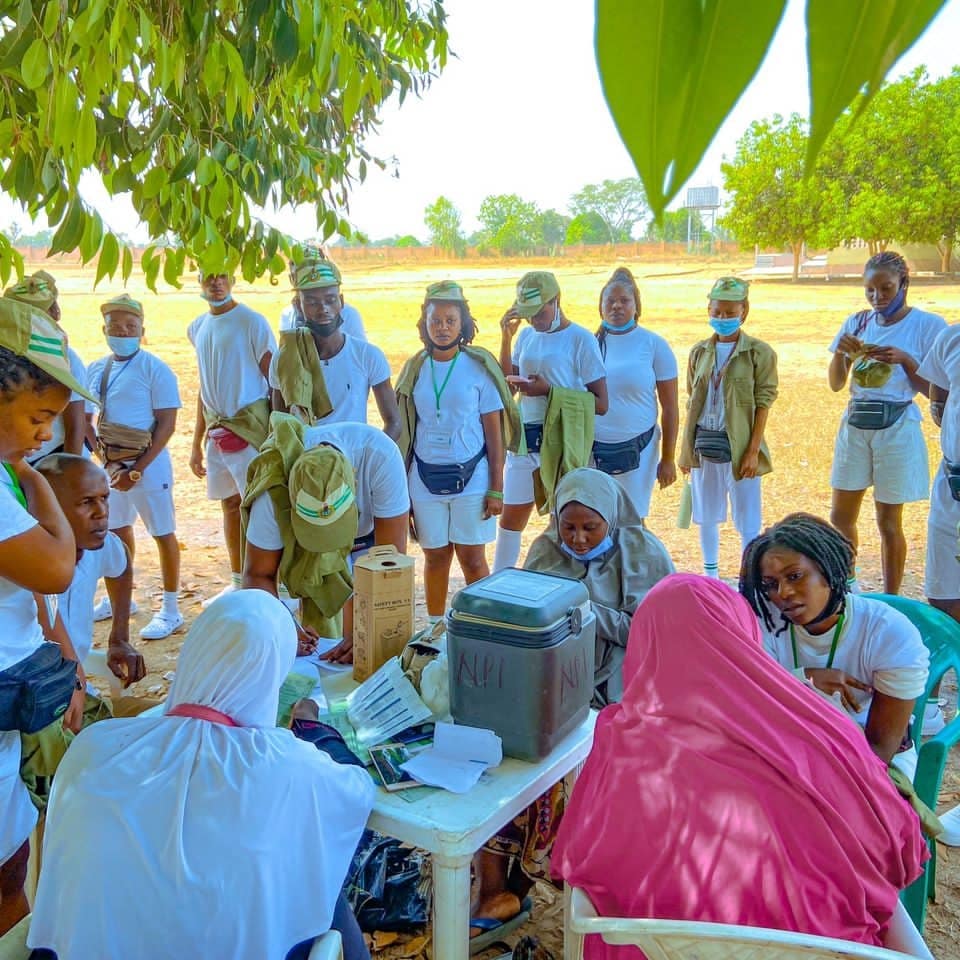
After accessing some social media posts about the 50th anniversary of the National Youth Service Corps (NYSC), I wish to share two of the numerous issues I had with the scheme.
Although I’ll try to avoid certain details, I must mention that an unpleasant encounter with a senior official of NYSC marked the third time I shed tears since reaching adulthood.
First issue
When I confirmed my mobilisation to serve under the National Youth Service Corps (NYSC) in 2018, I sought information about the registration process and requirements. I found that prospective Corps members could either get their call-up letters through their schools or pay about N3,000 to print the letters online. I went for the first option because I couldn’t afford the second one. Besides, I was about to go to Zaria for my statement of result, so I decided to pick up my call-up letter from Ahmadu Bello University (ABU), Zaria.
Everything went well, and I proceeded to the NYSC orientation camp in Fanisau, Jigawa State. However, the camp authorities insisted that I either pay the money and print the online version of the call-up letter or leave the camp and wait for the next stream (due in three months). They maintained their position despite acknowledging the authenticity of my call-up letter, which NYSC had sent to ABU. I had no option but to leave the camp for Kano (a short distance from the camp).
Fortunately, my arrival in Kano changed the story. I had no mobile phone, so I inserted my SIM card into someone’s phone. Within a few minutes, I received two different but connected calls, and I got the money I needed to print the call-up letter, hence my immediate return to the camp.
Second issue
My fellow Corps members received their allowance for December 2018 before the 25th of the month, but I didn’t get mine till after five months.
I started contacting relevant officials in the last week of December 2018, and by April 2019, I had submitted my bank statement of account, proof of clearance and about four letters. Surprisingly, I received a letter from my Local Government Inspector (LGI) titled “Query”, which demanded that I submit a handwritten reply to explain why I shouldn’t be punished for “refusing” to apply for my unpaid allowance. Well, I just replied as instructed, but I still didn’t receive the money (N19,800) until about a month later.
Two questions and answers
One, why did the camp officials force me to pay the N2,786.24? I believe they were keen on generating money for their organisation, and they felt letting me dodge the payment would lead to a fall in revenue in subsequent batches because I might communicate to other prospective Corps members whose closeness to their schools might make them opt for the free call-up letter.
Two, why did I receive a punishment threat for “refusing” to apply for my unpaid allowance? I feel it was the officials’ way of shifting the blame.
Conclusion
I had disliked NYSC long before my graduation from university, and my experiences during my service year only heightened the feeling.
However, I acknowledge the scheme’s contributions to national development. The interest of the majority supersedes that of an individual.
Ishaka Mohammed can be contacted via ishakamohammed39@gmail.com.
His name was Tijjani, and nicknamed Ma’aslam. He mainly lived in the Sabon Sara ward, Kano city, but was a common sight along the Mandawari junction to Kasuwar Kurmi corridor in the 1960s.
Everyone considered him nuts. Apparently, he built a single-storey building without stairs to access the upper floor. He did not think a door was necessary for any structure either, so the building had no doors. He simply jumped up to the upper floor at night and jumped down in the morning. It was enough for the ward head to report him to the Jakara magistrate for him to be locked up on insanity charges.
During the hearing, he was given a basket to fetch water. He simply laughed at the judge, informing him that only a madman would attempt to fetch water in a basket. The judge threw the case out, declaring him perfectly rational. He may be nuts – although eccentric was more apt to describe his behaviour. But then, it takes a certain amount of nuttiness to be an innovator. And he was an innovator.
As children – and I am talking 1960s inner city Kano – we simply referred to him as Ma’aslam. He, I would argue, planted the seeds of onomatopoeic intertextuality in Hausa popular culture, at least in Kano. This was the process of picking up an element of popular culture, say, a song, converting it side-by-side into a different language (intertextual), using ‘sound-alike’ of the original (which is onomatopoeia) into a new one. A quick example was the Bob Marley hook:
Get up, stand up,
Stand up for your rights
Sadi Sidi Sharifai, a Kano onomatopoeic superstar, converted this to:
Jallof, Jallof,
Jallop, sai da rice
Try singing both the original and Sadi’s interpretation, and you have become an onomatopoeic star yourself!
In 1967, the American super soul star James Brown & the Famous Flames recorded the stunning live double album of their concert at the Apollo Theatre in New York. It was, perhaps unimaginatively enough, titled, ‘Live at Apollo.’ A standout track on the album was ‘I Feel Alright’. Its choral hook was:
‘Hey, hey, I feel alright
One time, uh!’
The album of the concert was released on 16th August 1968. I was 12 years old then, and still now, totally wired in music, complete with a Ukulele guitar, given to me by David Hofstad (author of Tabarmar Kunya play). My Dad, an avid music lover, noting my attachment to the song which was played on the radio, simply bought the double album for me at Musa Zamani Record store in Fagge (are there any old codgers who remember this record store?). I played it to death on the old Grundig music player we had then.
Back to Tijjani Ma’aslam. With his eccentric behaviour categorising him as loony, Ma’aslam started reciting the ‘Dalailul Khairat’, a celebrated manual of salutations upon the Prophet Muhammad (SAW), written by Muhammad ibn Sulayman al-Jazuli in 15th century Morocco. What was unique about Ma’aslam’s open-air recitation, however, was that he adopted the James Brown meter in the song, ‘I Feel Alright’, as his chorus. His rendition of the hook for his recitation of the Dalai’lu was:
Mujibun, Mujabun,
Afiyan, Afuyan,
Rasulillahi
Ahlan wa Sahlan
Rasulillahi
This was accompanied by James Brown’s dance moves (shown on Television’s Soul Train, which was available in a few houses that he might have access to). Maybe he was not reciting the salutations in their structured order, but at least his verses were discernible, as the Dalai’lu itself was recited in a song form by many reciters in Kano. What he did, and did it differently, was using a foreign music meter to make it more accessible. This formula was to be adopted by the Ushaqu Indiya group of devotional singers in the city of Kano (actually along the same neighbourhood as Tijjani Ma’aslam). More of this in subsequent articles/posts.
Tijjani Ma’aslam’s delivery mode was intertextually onomatopoeic to ‘Hey, hey, I feel alright’. The chorus was ‘Rasulillahi’. Ma’aslam was usually followed by a gaggle of kids echoing the chorus while he merrily led the way, clapping his hands, dancing and reciting the names of the Prophet from the Dalai’lu. Elders were bemused at the spectacle and simply labelled Ma’aslam crazy. He might have been. He certainly was not following the sequencing of the Salawat from the book. But his performances opened a door.
Up the road from his haunt and covering the same zone was the Palace cinema. This was built and completed in 1951 and opened in 1952. Palace cinema became an instant hit with the youth, closeted in the city and without any visible means of night-time entertainment. Before its opening, and still a carryover from the World War II years (1939 to 1945), a curfew used to be imposed on city residents at 8.00 p.m. With the relaxation of the curfew, the few neighbourhood plazas (dandali) that offer games for youth (both boys and girls) were no match for the sheer spectacle of a massive screen accompanied by loud music. The predominant films shown in the cinema were cowboy or mainstream European films. However, after independence in October 1960, Indian films started to be shown from November 1960 in Kano cinemas. Early films screened included Cenghiz Khan, Jaal, Sangeeta, Raaste Ka Patthar, Waqt, Amar Deep, Rani Rupmati, Dharmatama, Dost, Nagin and thousands of others. The one that caught massive imagination in Kano’s inner city, however, was Rani Rupmati, originally released in India in 1957 but only found its way to Kano cinemas in the 1960s.
Like all Indian films, at least from what the industry refers to as Bollywood, Rani Rupmati had a lot of songs – in fact, its overall screenplay is based on two people united by their love of music. However, two songs from the film caught Kano’s inner city imagination, ‘Itihaas Agar Likhna Chaho’ and ‘Phool Bagiya Mein Bulbul Bole.’ Interestingly, there was no choreographic dancing in these two songs, unusual for general Bollywood films but typical of earlier, more historical and artistic ones.
The first, ‘Itihaas’, sung by Lata Mangeshkar, has a great hook that, thanks to Tijjani Ma’aslam, became domesticated by kids along his sphere of influence and Palace cinema zone. It goes something like this:
Itihaas agar likhana chaho /
Itihaas agar likhana chaho /
Azaadi ke mazmoon se /
…
To seencho apni dharti ko /
Veeroon tum upne khoon se /
Har har har Mahadev /
Allaho Akubar /
Har har har Mahadev /
Allaho Akubar /
Sung within the backdrop of a band of warriors getting ready to go into a battle, led by a woman (the titular Rani Rupmati), it certainly gave the picture of a woman more enlightening than what was both the Hausa and Indians are used to. The film itself endeared itself to Hausa through the modesty of the women – shy drooping kohl-enhanced eyes with long blinking lashes, fully clothed (even the swimming scene shows the singers fully clothed in the river), with sari that resembles Hausa wrapper (zani), lots of jewellery, and stunning beauty. A Hausa common saying of the period was, ‘Allah, kai ni Indiya ko a buhun barkono’/God, let me visit India even in a sack of pepper. That was how besotted Hausa youth were to the beautiful Indian women seen on the screen, giving a false impression that every single Indian woman is beautiful.
Hausa youth, inspired by Tijani Ma’aslam, quickly domesticated the chorus of the song as:
Ina su cibayyo ina sarki / where are the warriors, where the is king?
Ina su waziri abin banza / And the useless vizier?
Mun je yaƙi mun dawo / we have return from the war
Mun samo sandan girma / and we were victorious
Har har har Mahadi / hail, hail the reformer
Allahu Akbar / Allah is the Greatest
Har har har Mahadi / hail, hail the reformer
Allahu Akbar / Allah is the Greatest
In an interesting case of lyrical substitution, the Hausa intertextual transcription captured the scene of the song as shown in the film, if not the actual meaning of the words. Loosely translated, the original verse was urging warriors to defend their land with their lives and become part of history. The chorus translates as ‘Let each of us sacrifice ourselves to Mahadev’.
While Mahadev was a reference to the Indian deity, Shiva, this pantheistic line was followed by a monotheistic reference to Allah, the Supreme Being in Islam. Thus, two contrasting religious sentiments were expressed in the song. It was likely that S. N. Tripathi, who directed the film and composed the music, introduced the chorus to attract both Hindu and Muslim audiences. After all, while Rani was a Hindu, her love interest in the film, Baaz Bahadur, was a Muslim. The expression, however, has since then been used as a slogan of communal harmony between often warring Hindu and Muslim communities in India.
But more stunningly, the Hausa version substituted the word ‘Mahadev’ with ‘Mahadi’. The Hausa heard ‘Mahadi’ (guided one), not ‘’Mahadev’, which worked perfectly well. Substituting Mahadev for Mahadi Islamized the song, as it were. In Islamic eschatology, Mahdi is a messianic deliverer who will fill the earth with justice and equity, restore true religion, and usher in a short golden age lasting seven, eight, or nine years before the end of the world.
The second song from the film, ‘Phool Bagiya Mein Bulbul Bole’ (also sung by Lata Mangeshkar, with Mohammed Rafi), also inspired onomatopoeic intertextually but further afield from Kano and bizarrely entered into Hausa urban legend of the 1960s. Its first verse goes something like this:
Phul bagiya me bulbul bole /
Daal pe bole koyaliya
Pyaar karo /
Pyaar karo rut pyaar ki aayi re /
Bhanwaro se kahati hain kaliya /
Ho ji ho ho ji ho ho ji ho /
Ho ji ho /
What Hausa youth heard in the choral refrain was ‘Hotiho’, not ‘Hojiho’, and in the film Rani Rupmati, the lady (played by Nirupa Roy) came to be referred to as Hotiho. The Hausa griot, Mamman Shata (d. 1999) popularised the word (which has no particular meaning) in his song, Mallam Sidi, ‘Mijin Hotiho’/Mallam Sidi, Hotiho’s husband.
In the film, there was no marriage between Rani and Baaz Bahadur because she said she was ‘married to her music’, despite living with him after running away from home to avoid death from a chalice of poison given to her by her father to avoid the shame of her rejecting a chosen husband. In all their dialogues, Rupmati and Baaz Bahadur stress their shared love for music, not their love for each other. So, Shata did not accurately describe the relationship in the film. However, such deep film analysis is not important to the transnational interpretation of Shata of Baaz Bahadur as a signature tune for a hen-pecked husband. Shata’s interpretation of the actor who played Rani’s lover was certainly in order as he was effeminate and obsessed with music rather than empire building, despite being heir to a throne. It was even Rani who led their army into war. He was wounded in the battle and ran away.
Another Hausa griot, Ali Makaho (d. 1984), known famously for his anti-drug song, ‘Mandula’, briefly referenced Rani Rupmati in another of his songs.
Za ni Kano / I’m going to Kano
Za ni Kaduna / I’m going to Kaduna
Mu je Katsina lau za ni Ilori / Let’s go to Katsina and Ilorin
Na je Anacha / I will go Onitsha
Ni ban san kin zo ba / I didn’t know you had arrived
Da na san kin zo ne / If I had known you have arrived
Da na saya miki farfesu / I ‘d have bought you [pot of] pepper soup
Hitoho hotiho /
Hotiho hotiho /
With a comedy skit thrown in, Ali Makaho’s rendering uses Phoolbagiya’s meter to narrate a series of anticipated travels over northern Nigeria. As an intertextual comedy, it worked and remained of his most memorable skits.
A third Hausa griot to adapt a song from Rani Rupmati was Abdu Yaron Goge, who played the goge (a large fiddle played with a bow). Abdu picked ‘Raat Suhani’ from the film for his adaptation. Since, unlike the other griots who used the elements of the songs from the film, Abdul was a musician, he used two approaches – first was rendering the symphonic structure of the opening bars of the actual composition, Raat and playing it on his fiddle, then secondly, he onomatopoeically appropriated Mangeshkar’s lyrics as Hausa version. The original lyrics were as follows:
Raati Suhani /
djoome javani /
Dil hai deevana hai /
Tereliye /
Tereliye /
These lines were pure expressions of love the protagonist has for her lover, especially ‘in the beauty of the night’ [raati Suhani]. Abdu Yaron Goge’s rendition was as follows:
Mu gode Allah, Taro / We should thank Allah, people
Mu gode Allah, Taro / We should thank Allah, people
[These lines vocalized the opening bars of Raat]
Duniya da daɗi /This world is nice
Lahira da daɗi / The hereafter is nice
In da gaskiyar ka / If you are truthful
Lahira da daɗi / The hereafter remains nice
In babu gaskiyar ka / If you are untruthful
Lahira da zafi / The hereafter is blazing
Thus, in a single verse (which he kept repeating over and over till the end of the performance), Abdul Yaron Goge borrowed a popular musical motif from another culture and domesticated it to Hausa entertainment. At the same time, he delivered a message totally different from the original meaning.
There were, of course, many other onomatopoeic intertextual interpretations of Indian film songs, but the three songs from Rani Rupmati, predated by Tijjani Ma’aslam’s innovative use of foreign motifs, were the definitive pioneers in music. In Literature, look towards Abubakar Imam and Magana Jari Ce. The intertextual origins of Hausa arts, of course, started in the 1930s; but its migration to music was certainly in the 1960s. It spawned a Hausa Cinema industry which was labeled ‘Kanywood’ in 1999, a few years before the term ‘Nollywood’ to refer to the Nigerian English language cinema, was created.
On a final note, Nazeer Abdullahi Magoga, a Kano ‘Indian’ (who speaks the language fluently, to the shock of BBC Delhi, who sent a crew to interview him in Kano, in Hindi) composed a song for the Centre for Hausa Cultural Studies, Kano which I was heading, but which I had to pause due to lack of funding. He used the Raat Suhani meter and used both Hausa and Hindi lyrics in his wonderfully beautiful tribute to the Centre. A link to the song on YouTube is given below. To really appreciate Nazeeru’s performance, listen to the original Raat Suhani from the film Rani Rupmati, also provided in a link.
Cibiyar Nazarin Al’adun Hausa by Nazeer Magoga [Raat Suhani template]
I wake up with a demanding subject of debate – English Language as a measure of intelligence. Be that as it may, whether language, English or any other language, will be considered as a measure of intelligence is a non-binary proposition. As a linguist, I know it requires explicit and implicit discourse that will result in a logical conclusion. Hence the question:
Is language a measure of intelligence?
The 1950s is the year American linguists will see the improved acceptance of the Sapir-Whorf Hypothesis, popularly known as ‘Linguistic Relativism’. In the 1920s, Edward Sapir and a co-researcher, Benjamin Lee Whorf, made a sudden revelation to the American Society of Social Sciences that language shapes how one sees the world. Sapir-Whorf Hypothesis belongs to behavioural sciences.
This statement only explains that language is like a window, a spyglass through which speakers of that language build cognitive mechanisms to view, perceive, and explore the world and beyond, like Alice (in Wonderland), who studies the utopian world through the ‘Looking Glass’. It goes far as saying that to have a second language is to have a second soul – that is too important to say.
In sum, Linguistic Relativism allows one to see that fundamental differences between languages exist, and language actively influences the speaker’s worldview – concept formation, concept perception and concept interpretation. We kept rolling on this hypothesis till 1950, when the idea went out of favour. Cognitive Psychologist such as Chomsky sends this idea out of propulsion.
Around the 1960s and 1970s, Cognitive Psychologists studying mental processes such as creative thinking, problem-solving, and attention mapping rejected the idea. They found vulnerabilities in the Sapir-Whorf Hypothesis, such as conceptualisation which says if a given concept is unavailable in a given language, the speakers of that language won’t understand that concept is untrue. Also, language does not control our ability to reason. However, they argue that because speakers of different languages think differently doesn’t tell us whether it’s a language that shapes thought or vice versa.
Language as a measure of intelligence, influence or determinant?
We have seen the roles of language as a tool, what it’s and what it’s not. So now let’s return to the topic of the debate – the English Language as a measure of intelligence. But before we answer this question, let’s draw clear patterns. We may even breakdown the above question as follows:
Does language influence how we view and form reality (partial), or simply determine how we view and create reality (absolute)?
I believe the above questions will leave many strangled at the end of the tether. So let’s explore together how language works in real-life situations and see whether we can answer the questions appropriately.
Generally, linguists assert that language is a human invention – and it amounts to intelligence to invent a phenomenon as complex as language. It’s an essential tool to convey our mental processes to correspond to the physical and abstract world. It’s also considered one of the salient features of humans above other animals that are far more intelligent than human beings. Language makes our destiny clear and gives us a sense of humility, responsibility and belongingness.
Speaking of the English language, it is considered as the world language. It’s a first language to many people and a second language to many others. However, it has the largest stock in Literature. About 60% of contemporary knowledge is written in English, and a large share of ancient world knowledge is translated into it. This will give one confidence to say that your ability to navigate in English will determine the amount of knowledge one can acquire. The greater the amount, the higher the level of intelligence.
Law as a profession revolves around language proficiency. Characteristics of being a good lawyer include mastery of language(s). The ability to read, write, speak, and listen with unquestionable prowess. The greater the competence, the greater the performance and vice versa. The same applies to medical doctors.
For example, a lawyer with good command of English is likely to win cases. While a lawyer with bad command of English will not only fail but he’s also putting the life of his clients at risk. He will make the matter worse, complicate the process, and wrong justice will be served since the judge(s) depend on his presentation of reality.
Dear readers, for obvious reasons, don’t let anyone anywhere rob you of your conscience. Learning the English language is pragmatic and a must in the twenty-first century. However, while learning the language is necessary, being an expert is only advantageous. It will place you above yourself and many others and reward you in many ways: financial rewards and leadership roles. It can also earn you respect and integrity, among other things.
Wole Soyinka has been enjoying favours worldwide because he is considered intelligent, and his intelligence is tied to his mastery of the English language. As a Muslim, I believe if your mastery of (the English) language is utilised in good ways, it can earn you rewards hereafter. Translation of the Holy Qur’an from Arabic to English is an excellent example of the English language as a measure of intelligence.
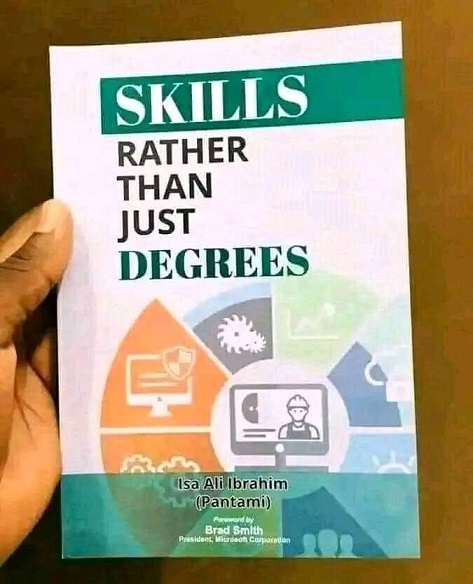
I don’t understand why someone like Farouq Abba, whose command of the English language is faulty, would waste his time kissing off Sheikh Ali Isa Ibrahim Pantami’s book titled, Skills Rather Than Just Degrees. I am pretty sure everyone who stumbles upon his criticism of the book would know that it’s such a ridiculous attempt to downplay the superbness of the book. To be honest, I find his criticism very tasteless and insulting. To insist that a comma must precede ‘Skills’ before ‘Rather’ is to insist that the English language isn’t a complex one. Unknown to the faultfinder-Abba, putting a comma before ‘Rather’ is quite unnecessary.
It’s up to the author to decide whether to insert a comma or not. And the absence of a comma in the book’s title doesn’t invalidate the effectiveness of the book. Well, it’s obvious that the critic is plainly being too naive to conceive that idea. That being said, his understanding of grammatical rules is limited. So, we may wish to dismiss his critique as a misguided priority or some sort of attention-seeking thing.
Surprisingly, Abba has admitted by himself that he hasn’t yet read the book. But he’s quick to point out some “gaffes” in the book’s title. I guess he’s simply being hypocritical like he has always been when it comes to matters of great importance.
I’m amused that he ended up exposing his ignorance while trying to alter what’s already inalterable. I understand that there are a number of people who wrongly assume that the use of ‘just’ in the book’s title is shocking. Contrary to their misapprehension of the adverb ‘just’, it can be understood in a series of ways. We all know that ‘just’ is synonymous with ‘only.’ Therefore, there’s nothing to worry about in that title. It’s as simple as it seems. I, however, do not wish to denigrate Abba. I only wish to disagree with him.
He also characterised the art on the book’s cover as being “too basic”. I don’t know what he clearly meant by that. But, to think that way is to think that the earth should revolve around him alone. That the book’s painting is “too basic” doesn’t mean the book won’t be impactful as it’s expected to be. You can only imagine what the book has in store if you haven’t read it. A good brother-cum-friend has shared the book with me via WhatsApp, and I have started reading it. It’ll be an interesting one.
In conclusion, the book is such a great masterpiece. It argues that having a degree doesn’t guarantee that a person possesses the necessary skills to succeed in a given position or industry. Moreover, it suggests that instead of sorely relying on academic achievements, employers should focus on an individual’s (applicant’s) experience, practical knowledge and work-related skills because that determines how they will perform the job effectively.
The truth is, having relevant skills is much more valuable than simply having academic qualifications. Isn’t it funny that this is the kind of book which Abba sought to dishonour?!
Usama Abdullahi is an Abuja-based writer. He can be reachedvia usamagayyi@gmail.com.
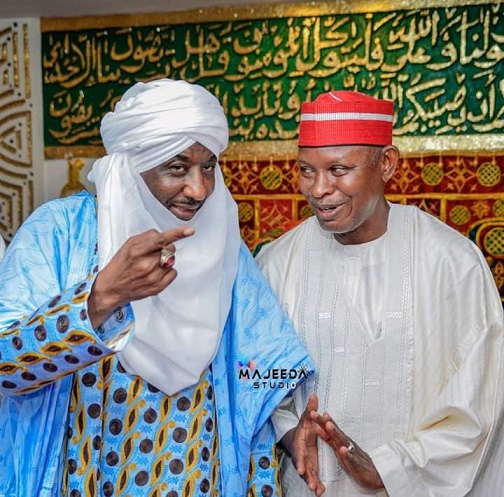
I am writing to express my firm belief in the need to consider re-installing Sarkin Kano Muhammad Sanusi II as Emir of Kano. As you are fully aware, Emir Sanusi II was illegally dethroned in 2019, allegedly for supporting your governorship ambitions, despite the absence of credible and substantiated evidence to support that claim. However, reinstating him will set your tune of kicking out all illegalities perpetuated by the Ganduje administration over the years. Additionally, I believe that his installation is one crucial point for you towards your effort to bring back Kano on the route of development previously set by the administration before Ganduje’s.
During his previous reign as Emir, he brought about innovative changes that standardised the ethics and customs of the institution. He organised massive seminars, workshops, and symposia for title holders to share ideas and strengthen the Kano traditional/sarauta institution. He also ensured that any member found violating standard ethics or even involved in immoral activity was thoroughly punished.
Additionally, he was reported to have improved the welfare package of junior workers of the emirates. He provided career opportunities for many of them, something that anyone could not have imagined many years ago. Therefore, it was safe to say Emir Sanusi II laid the foundation for the institution’s changes to strengthen its course as a principal legacy of the Kano people and “Kasar Kano’.
Considering the unity of the system, Emir Sanusi made sure that all other members of the ruling houses and other renowned houses of royals and clerics who felt neglected were brought back and given a sense of belonging. For example, he brought back the house of the late Emir of Kano Muhammad Inuwa Abbas (1963-1963) by turbaning his son Yahya Inuwa Abbas as Dokaji and later Dan Maje. In addition, he settled the dispute surrounding the Wazirin Kano title by giving the title back to the Waziri Gidado family. He also revived the houses of Sarkin Kano Alu (1894-1903), Danlawan Ayuba, Sarkin Shanu Hamza, Danburam Abubakar, Magajin Gari Inuwa Wada, Sarkin Fada Sule Gaya, Marafan Kano Sule, Danmasanin Kano Yusuf Maitama, Ma’ajin Kano Umaru, and many other aristocratic houses in Kano.
Furthermore, as part of his bicentenary celebration to mark 200 years of establishing the Dabo dynasty, preparations were in the final stages to bring back other houses, including your own house/family (descendants of Galadiman Kano Yusufu Maje Garko), Danburan Haruna, Galadima Khadir, Dan Isa Sanda, Sarkin Shanu Hassan, and surprisingly even the descendants of Sarkin Kano Tukur (1893-1894). The importance of bringing back these houses cannot be overemphasised, particularly in establishing unity and stability of the traditional institution in Kano.
According to many people, the neglect of many of these houses over the years has contributed to the continuous down-spiralling route the emirate had faced, something anarchists like Ganduje took full advantage of to bring destruction to family and the Kano traditional institution.
Emir Muhammad Sanusi is the only capable, noticeable figure within the “Bani Dabo” (apart from you) who has the resources, power, and connection to shoulder the burden and drive the institution to further development and greatness. He commands respect among government officials, fellow traditional leaders, clerics, and politicians from different backgrounds and sections of this country. In this aspect, your government can take full advantage of that. As an Emir, he can lead the Kano contingent on any assignment to boost Kano’s image and prestige. You have nothing to worry about with Emir Sanusi going anywhere because, as the famous Hausa praise saying goes, “Ranar fita kunya sai da Muhammadu.”
Emir Sanusi could also foster religious unity in Kano and, by extension, the country. With his position as the Khalifa of the Tijjaniya Sufi sect, he commands complete allegiance and fellowship of the sect. Additionally, his cordial relation with Izala scholars in the state and beyond, such as Dr Bashir Aliyu Umar, Sheikh Aminu Daurawa, Dr Nazifi Inuwa, Prof Mansur Sokoto, etc., as well as the Qadriyya, particularly its leader Sheikh Kariballah Kabara is vital to foster the religious unity and harmony thereby ensuring peace and stability in the state.
In terms of government policy development, Emir Sanusi is the perfect ally. You could wisely tap into his vast connection around the globe alone. He can lead an economic revolution in the state, provide advice on economic policies and be at the forefront of wooing investors. His connections to international firms like black rhino, African development bank, Islamic development bank etc., is the perfect avenue for you to exploit to bring about the much-needed changes Kano state needs. As I read, some of your campaign promises can be achieved swiftly with his insight and possibly heading.
For example, the policy of sending students (Kano indigene) abroad to postgraduate training. With his connection to educational centres and institutes worldwide, he can link with many universities and your government to achieve understanding and agreement. Knowing him, he may even convince some institutions to set up campuses and centres in Kano to facilitate educational growth further, as it is on your agenda for the state.
Like your proposed health policy, his connections with United Nations as a Sustainable Development Goals advocate, and health NGOs worldwide suit your government’s exploit. Through these bodies, grants and funding could be accessed by your government to improve health infrastructure, particularly in our rural areas suffering from difficulties in health care infrastructure.
Finally, it is important to note that bringing back Emir Sanusi II will benefit Kano State and the entire country. He is known to be a vocal advocate for good governance, accountability, and transparency, which are much needed in our country today. He has also participated actively in national discourse and contributed immensely to shaping public opinion on critical issues such as poverty, education, and healthcare. His return to the emirate will undoubtedly enhance his capacity to contribute to national development, a benefit that cannot be overstated.
In conclusion, I hope you will consider reinstating Emir Muhammad Sanusi II as the Emir of Kano. His reinstatement will bring stability and development to the Kano traditional institution and provide a platform for the state government to tap into his vast wealth of knowledge, experience, and connection for the overall state development. Thank you for taking the time to read this piece.
The ability to communicate effectively in the official language of one’s country is a hallmark of education and social mobility. Mastery of the official language is essential for communication and for accessing educational, economic, and social opportunities.
Language proficiency is a barometer of education and intelligence. One’s ability to articulate themselves with precision and clarity in the official language of their country is a reflection of their level of education, critical thinking, and cognitive abilities. Proficiency in the official language is integral to formal education, typically mandatory for accessing higher education and advanced employment opportunities.
Furthermore, proficiency in the official language is crucial for social mobility. Communicating effectively in the official language is paramount to accessing educational, economic, and social opportunities. Individuals who lack proficiency in the official language face barriers to accessing these opportunities, resulting in social exclusion.
Additionally, proficiency in the official language is pivotal for national integration and unity. A shared language promotes a sense of national identity and solidarity, fosters social cohesion, and enhances cultural exchange and understanding. The ability to communicate in the official language facilitates participation in democratic processes and civic engagement, promoting active citizenship and democratic values.
In conclusion, proficiency in the official language of one’s country is a crucial aspect of education, social mobility, national integration, and democratic participation. Therefore, it is imperative to prioritise language learning and provide equitable opportunities for all individuals to develop their language skills and reach their full potential. Doing so will foster inclusive and cohesive societies that value linguistic diversity and promote social and economic progress for all.
On 28th October 2015, a cool Tuesday morning, I headed to Jigawa State for the national call to offer my service to the nation. I wasn’t the type of person that went outside Kano often. I found it so amazing because it was my first trip for three weeks outside Kano. I felt a bit afraid. I didn’t know the nature of the people I would meet during my trip and the people in the orientation camp because all my schooling was in Kano State.
We were inside the car with my friends; as they were busy talking and laughing, my eyes and mind were on the road seeing long trees swinging and dancing to the tune of the winds, topographies, landscapes, undulating slopes, farms, markets, schools, and children among others. We reached the orientation camp around 10:00 am, along Dutse Road in Fanisau. I saw hundreds of people called Corps members at the gate being checked. We quickly followed the long queue to be checked too.
I remembered home, asking myself how I could cope among thousands of people as we were 4000+ during the exercise. We were in that queue till 4 pm, and still, we didn’t get accommodation and other things that would be used during the exercise at the camp. Finally, my friends and I sneaked to a line (short-cut), wrote our names and completed the registration for accommodation. We prayed, ate and returned for another registration and collection of kits (uniform, canvas and jungle boots). When I opened my gear, I saw that my boots were not my size, so I went outside around 2 am to change them.
It was hard to sleep because I wasn’t used to sleeping in a big room with many people as we were 64. So I cried as my friends had all slept. But I got used to the camp after 2 – 3 days; I became closer to many people from different schools, states, backgrounds, religions, and tribes.
The morning meditation was the first thing that scared me; we woke up by 3 am, took our baths, and, if there was time, ate something and headed to the mosque for prayers. Immediately after the Salaam was said, the soldiers would shout, “If you are finished, come out”; “If you are sleeping, you are wrong…come out”. I felt afraid for the first two days as soldiers used to scare me, but I was used to it the following days as the soldiers were friendly if and only if you followed their instructions. Each Platoon participates in different activities in the camp. Our group participated in the kitchen too.
I enjoyed the parade on the parade ground, especially when the drums were being beaten. I miss the friends I met. Going to Mami market with Fatima and eating noodles, that is when we don’t want to eat the food prepared by the kitchen, Platoon meetings, lectures (boring sometimes), Entrepreneurial skills which I was in a cosmetology group where I learned how to make air freshener, hair cream, liquid soaps etc. many my friends join different groups and learn other skills.
Activities that I miss at the camp include a parade, lectures, skill learning and friends. My Platoon parade commander (Danladi Mairiga and Aminu), Platoon leader and members, I missed you. The friends I miss include Fatima, Doris, Nene, ‘Yar Gaya, Hauwa, Patience, Your Excellency, Ayo (room leader), Aysha, Aysha (from Niger state), Makkiyya, Sabi’u Halliru, Rislan, Adamu, Aminu Funtua, Ahmad KD, a friend that I can’t recall his name in Kofar Waika of Kano. Many friends and roommates said the space would not be enough to write their names. My colleagues (Amina, Rabia and Walida) started together but later relocated. Some colleagues we started and finished together are all in my mind.
Government Secondary School Kanya Babba, Babura Jigawa State, was my first primary assignment, but I was transferred to Babura Divisional Library for some reasons. I served alongside Ann and Isma’il. That is where I completed my one-year national call.
In conclusion, National Youth Service is an activity that unites people of different tribes and religions, paving the way for many relationships, from marriage (my friends have married during the service year) to jobs and many opportunities. It strengthens the unity among Nigerians.
My service year was peaceful; it was perfect and successful. During my trip, I miss Bandirawa, Kwanar Dumawa, Minjibir, Danbatta, Koko, Tukui, Wailare and Makoda when taking off from Kano. When heading to Jigawa, I can’t forget Kazaure, ‘Yankwashi, Karkarna, Dandi, Burji, Walawa, Tasawa, Kwanar Sandamu, Koko, Kanawa, Babura, Rafin Canji, ‘Yar Kirya, Garun Gudunya, Babura Kudu, Babura Yamma, Gari Uku, Kanya Babba and many other places that I can’t recall their names. Indeed, the people in those areas showed great hospitality to us.
We all know and believe that marriages are associated with numerous cultures. These cultures come together to add flavour to the unforgettable memories that would be created in the minds of the brides and grooms during so many events of marriage celebrations.
The indelible joys and memories of marriage ceremonies usually transcend to even the minds of parents, friends, and relatives of both the brides and grooms. So, the importance of all the events associated with marriage ceremonies cannot be overemphasised in many cultures.
However, adopting the so-called Western civilisation has marred many events associated with marriage ceremonies, especially in the Northern-Muslim societies of Nigeria.
For instance, not more than a decade ago, the bride’s popular “Kamu” or “Sa lalle” usually took place in a sister’s house to the bride’s mother. And the people that would be in attendance at this event will comprise only the closest friends of the bride and some of her few female acquaintances.
Unfortunately, today, such events usually take place in outside rented event centres where the groom and his friends could be in attendance too. Not only that, it’s possible for a dance competition between the groom and bride, or between the groom’s friends and the bride’s friends during this historically decent event.
The most moving part is that it’s now a normal and unpreventable trend in so many events associated with marriage ceremonies that the brides must appear almost half-naked. So instead of the decent “riga da zani of Atamfa“, the bride will wear a Western wedding gown.
Even if the dresses are tailored locally, they will not only be diaphanous that one can see through, they are ensured to be tight enough to reveal all the contours and bumps in the bride’s body. And it’s in this kind of dress that the dancing will take place. So common. Are we really in our senses?
Remember, I insinuated earlier that parents usually attend these kinds of events. Can’t they stop it? Is it now normal for them too? I am sure our forefathers are not like this. And they didn’t train their children to be like this. Why only us?
As I sat in the conference hall at the Kano Social Influencer’s Summit (KANSIS) of 2021 and 2022, organised by the Centre of Information Technology and Development (CITAD), I couldn’t help but wonder about the immense power of social media. The conference brought together a diverse group of social media influencers, entrepreneurs, and enthusiasts who shared their experiences and perspectives on how social media can be leveraged to drive social and economic growth.
However, amidst all the exciting stories and success tales shared at the conference, one thing was clear: the effects of mismanaging social media can be disastrous. From cyberbullying to misinformation and hate speech, social media has the potential to be a double-edged sword. While it can be used to amplify positive messages and drive change, it can also be a breeding ground for negative and destructive forces.
One instance of the adverse effects of social media mismanagement is the infamous #EndSARS protest in Nigeria, which was initially launched on social media platforms. The protest started as a peaceful campaign to end police brutality but eventually turned violent due to the spread of fake news and misinformation on social media. The consequences were dire, with many lives lost and properties destroyed.
However, it’s not all doom and gloom. Social media platforms provide endless opportunities for individuals and businesses to connect, engage, and grow their brands. From advertising to influencer marketing, social media has become indispensable for businesses looking to reach new audiences and drive revenue.
Numerous success stories exist of individuals and businesses leveraging social media to achieve their goals. For instance, the fashion brand Fashion Nova has grown from a small online store to a multi-million-dollar brand by utilising social media platforms to drive brand awareness and engagement. Similarly, entrepreneurs like Jeffree Star and Kylie Jenner have built successful cosmetic brands by leveraging their massive social media followings.
Other examples of social media success stories include:
Salt Bae: The Turkish chef Nusret Gökçe went viral on social media after a video of him sprinkling salt on a steak went viral. Since then, he has built a global empire of restaurants and has over 20 million followers on Instagram.
Wendy’s, the fast-food chain, has become famous on social media for its witty and engaging responses to customers. Wendy’s Twitter account has amassed over 3 million followers and has been hailed as a masterclass in social media marketing.
Glossier, the skincare and beauty brand, has built a cult following on Instagram, with over 2 million followers. Glossier has used social media to build a strong community of loyal customers who engage with the brand and share their experiences online.
GoPro, the action camera company, has used social media to create a platform for user-generated content. By encouraging users to share their GoPro footage on social media, the company has created a vast library of high-quality content that promotes the brand and inspires others to purchase their products.
Old Spice, the men’s grooming brand, revitalised its image through viral videos that parodied traditional male grooming advertisements. The videos were hugely popular on social media and helped to reposition the brand as edgy and irreverent.
These success stories, however, demonstrate the power of social media in building brand awareness, engaging customers, and driving revenue. By leveraging the unique features of each social media platform, businesses can create targeted and effective marketing campaigns that resonate with their target audience. Social media also provides opportunities for individuals to build personal brands, connect with like-minded people, and share their passions with the world.
To sum it up, social media has the potential to be a powerful force for good or bad, depending on how it’s managed. By understanding the power of social media and leveraging its unique features, individuals and businesses can drive social and economic growth. However, it’s important to use social media responsibly and to be mindful of the potential adverse effects of mismanaging it.
As social media continues to evolve and shape our world, we must use it to build a better, more connected, and more inclusive society. So, whether you’re an entrepreneur, an influencer, or just a casual user, remember to use social media to spread positive messages, connect with others, and make a meaningful impact.
Mujahid Ibrahim, Program Officer, Centre for Information Technology and Development (CITAD), can be contacted via littlemujahid4@gmail.com.
Thinking of Nigeria’s future has left me swinging between apprehension at the prospect of some future doom and anxiety. However, I can see how the country can secure an imperium position in the comity of global superpowers considering its unique and extraordinary endowments that are rare for a country to possess. An idyllic realm where all Nigerians, regardless of their social background, have a smooth path to realise their dream world.
It is widely believed that the benefits of long-term planning last longer. And only beautiful destinations attract arduous treks of long distances full of hurdles and cruxes. But on the other hand, successful journeys are well-planned and adequately prepared for over a long period. Traditionally, farmers reap what they sow. Therefore, only those that planted beneficial seeds laugh at the harvesting period’s end.
It’s against this backdrop and considering other factors that drive national building in Africa, especially in Nigeria, always fail to see the lights of their desired destinations. As a result, Nigeria’s manifest destiny to inspire the global black race and lead Africa has remained in the doldrums despite its enormous human and material resources that could be judiciously utilised to translate such famed potentials into concrete aggregates for sustainable development.
Positive imaginations, futuristic political articulation and prescient abilities are imminent qualities and cardinal leadership principles. But, historically, the consistent absence of committed, transparent and future-oriented leadership has been a significant hindrance and unequivocal bane to Nigeria’s development.
Practical politicians are those whose political philosophy includes making the world a better place to live for their people and posterity. This is a core and thematic value of the politics of leaders who dedicate their lives canvassing for their country’s better future. This makes me recollect William Jennings Bryan’s food for thought that says, “Destiny is not a matter of chance, it is a matter of choice; it is not a thing to be waited for, it is a thing to be achieved.”
So, I ask you: have you ever bothered to ask yourself these questions, where is Nigeria heading to? What are we planning for the future? I asked again, have you ever thought of such critical questions? We must be curious enough about the country’s fate in the forthcoming decades, whether we are still alive or utterly forgotten. What would be the nation’s state then?
But the bigger question remains, do the country’s movers and shakers give a damn about its predestination and are busy strategising revolutionary, historical and ambitious deft policies geared towards defining Nigeria’s moment and securing the future? Unfortunately, the answer to this question is not in the affirmative.
In Nigeria’s contemporary context, where the gamut of formal and other traditional institutions has failed to generate vital mechanisms for efficient service delivery to Nigerians and the coming generations, coinciding with emerging trends of pervasive poverty and inequality amid burning acrimonious civic bond, political hooliganism and hollowed nationalism are particularly not a good look for the future.
I beg your pardon. I’m not a prophet of doom. But one is compelled to admit that the situation is entirely hopeless. From a cursory observation of the national scheme of things, there are explicit tales of troubles ahead. I don’t see fortune looming on the horizon from where I’m standing. And by all estimates, I don’t see a bright future for a nation whose kleptocracy deteriorated into kleptomania.
For all I know, there is no bright outlook for a country whose politicians are preoccupied with self-centred political hustles and busy making contacts to negotiate themselves for a place on the table of political spoils carrying along the baggage of selfish and vested interests, to wit, protection and advancement of these interests have become the defining nature of public office holding. On the contrary, I see a foggy future for a society whose bigwigs throw constitutional order and due process overboard under the suzerainty of selfish and vested interests, lest they consistently fall short of their public commitments.
In reality, we must come to terms with the fact that the destiny of a country can’t be secured while its bosses are absentminded about their public obligations and constantly engaged in party meetings, extravagant banquets and jetting over the country on chartered and private planes attending series of lavish occasions at its expense and detriment. A nation whose ‘spark plugs’ can’t put the nation’s interest above theirs, while its most favourable policies go awry when such interests are compromised.
Of course, this version of Nigeria we see today isn’t what its progenitors worked tirelessly for. This is reminiscent of the generational disconnection spawned by the egregiously rapacious leadership of their predecessors. However, people dogmatically believe history has an uncanny knack for repeating itself. I hope this unfortunate odyssey will not be repeated in the annals of Nigeria’s history.
So, now that we are here, I pray for a benevolent mother for all generations. A saviour to save us all.