National

You can add some category description here.

Pope Leo XIV calls for immediate release of abducted Niger students, staff

By Sabiu Abdullahi

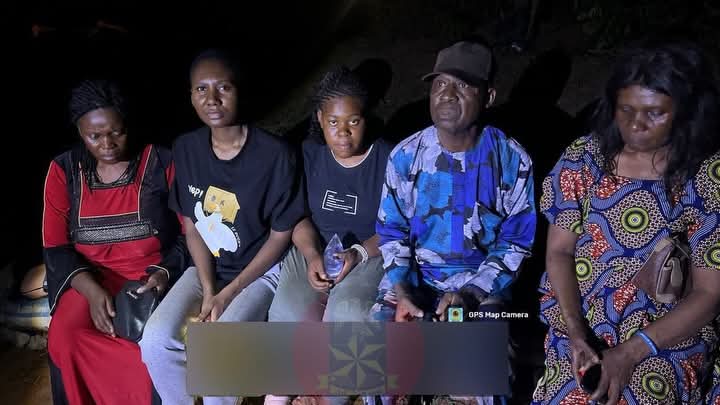
Pope Leo XIV has appealed for the prompt release of 315 students, teachers and other members of St. Mary’s Catholic Primary and Secondary Schools in Papiri, Agwarra Local Government Area of Niger State, who were recently abducted by armed men.

The Pontiff spoke on Sunday. He expressed deep concern over the incident, which involved students, teachers, priests and other members of the Catholic community.

In his words: “I received with profound sorrow the news of the abduction of priests, faithful, and schoolchildren. I make a heartfelt plea for the swift and unconditional release of all those being held.”

The attack reportedly took place in the early hours of Friday. Armed men invaded the private Catholic school during the operation.

Local sources said the attackers arrived in large numbers. They were said to be on more than 60 motorcycles and had a van with them. They forced their way into the school premises before carrying out the abduction.

During the assault, the school gatekeeper was shot. He was left in critical condition.A resident of Agwarra confirmed that the incident happened between 3 a.m. and 4 a.m.

He added that the exact number of abducted students had not yet been fully verified.

As he put it: “It happened between 3 a.m. and 4 a.m.. The number of students taken is still unclear.”

Another community source said several teachers were also taken during the raid. He said this has increased fears over the scale of the attack and the safety of those abducted.

Obi says Kanu’s conviction could deepen unrest, calls for political solution

By Hadiza Abdulkadir

Former Labour Party presidential candidate Peter Obi has warned that the conviction of IPOB leader Mazi Nnamdi Kanu could worsen insecurity in the country. Obi issued the warning in a statement posted on his social media accounts, saying the development comes at a time when Nigerians are already struggling with economic hardship and widespread violence.

Obi said Kanu’s arrest, detention, and now conviction represent “a failure of leadership,” arguing that the concerns raised by the IPOB leader could have been addressed through dialogue and inclusive governance rather than coercion.

He cautioned that the government’s approach risks aggravating tensions in the South-East and further stretching security agencies already battling multiple crises nationwide.

According to him, nations facing similar internal tensions often adopt political solutions and negotiated settlements when legal processes alone cannot guarantee stability.

Obi urged the Presidency, the Council of State, and respected national figures to intervene and pursue reconciliation, warning that only justice, fairness, and meaningful engagement can prevent the situation from escalating into a deeper security challenge.

Army nabs suspected arms dealer, rescues kidnapped victim as troops hit terror networks

By Uzair Adam 

The Nigerian Army has apprehended a suspected arms dealer, rescued a kidnapped victim, and disrupted terrorist logistics networks within the last 24 hours.

A credible source at the Army Headquarters reportedly disclosed that the troops of Operation FANSAN YAMMA, on Thursday, apprehended a suspected terrorist informant during an ambush at Ungwan Gombawa in Kontagora Local Government Area (LGA) of Niger State.

The source said troops of 1 Brigade also arrested an alleged major terrorist logistics supplier and arms dealer at Danjigba in Bukkuyum LGA.

According to him, preliminary investigations reportedly linked the suspect to two coordinators in Anka LGA, believed to be responsible for storing weapons sourced from the Niger Republic.

He said the troops recovered military uniforms, a helmet, boots, financial receipts amounting to about N4 million, and audio evidence linked to arms transactions.

The source added that troops responding to intelligence on the recent abduction of students of GGSS Maga in Kebbi State stormed a terrorist camp in the Gando–Sunke Forest, which belongs to a kingpin known as Bello Kaura.

He said the attackers fled the location, allowing troops to destroy the camp and its support facilities.

The source explained that another suspected informant travelling from Sokoto was arrested at Augie, where troops recovered five ATM cards, clothing, and N78,900.

In another development, he said troops survived an ambush along the Kaiga–Mara road in Katsina State, forcing the attackers to flee.

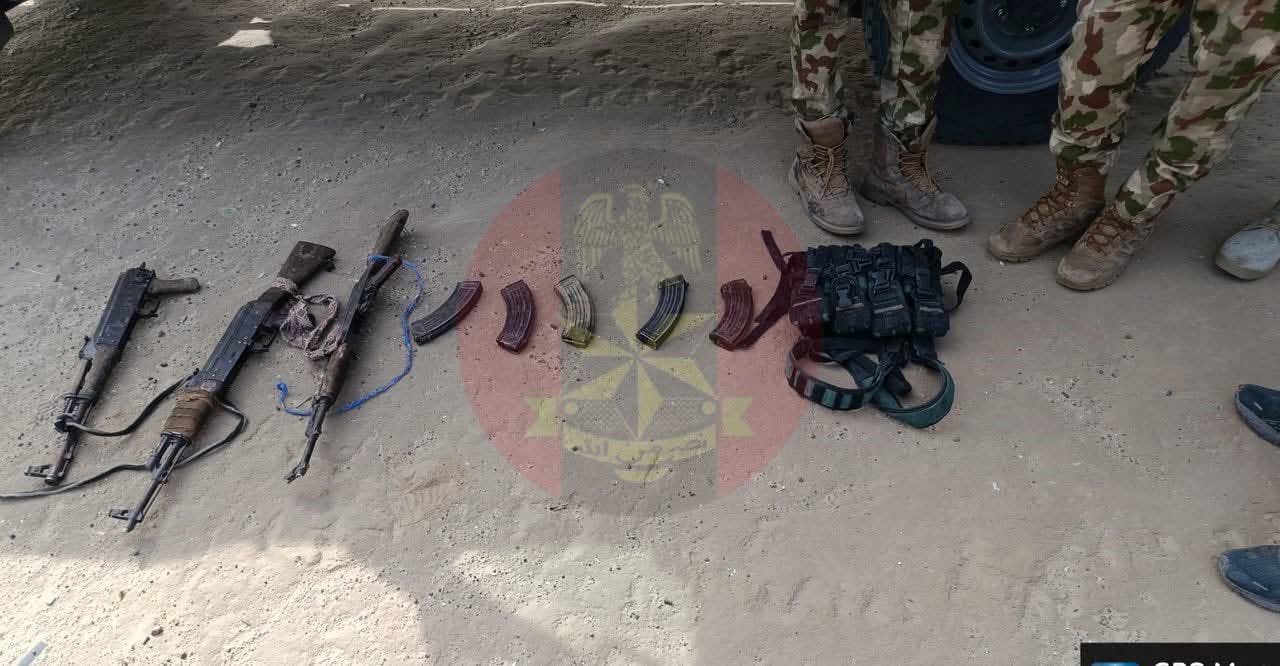
He added that an operation carried out in Shinkafi and Zurmi LGAs also resulted in a firefight during which troops captured two AK-47 rifles, ammunition and two motorcycles.

Under Operation Enduring Peace in Plateau State, troops foiled a kidnap attempt in Jos South, rescuing a victim who sustained gunshot wounds.

The source also confirmed that eight suspected criminal herders were arrested in a separate raid in the same LGA.

Similarly, troops of Operation Whirl Stroke responded to a road incident in Nasarawa State, where three passengers were reportedly kidnapped and a driver was injured. Efforts to rescue the victims are ongoing.

He added that troops arrested two herders accused of destroying crops in Guma LGA of Benue State.

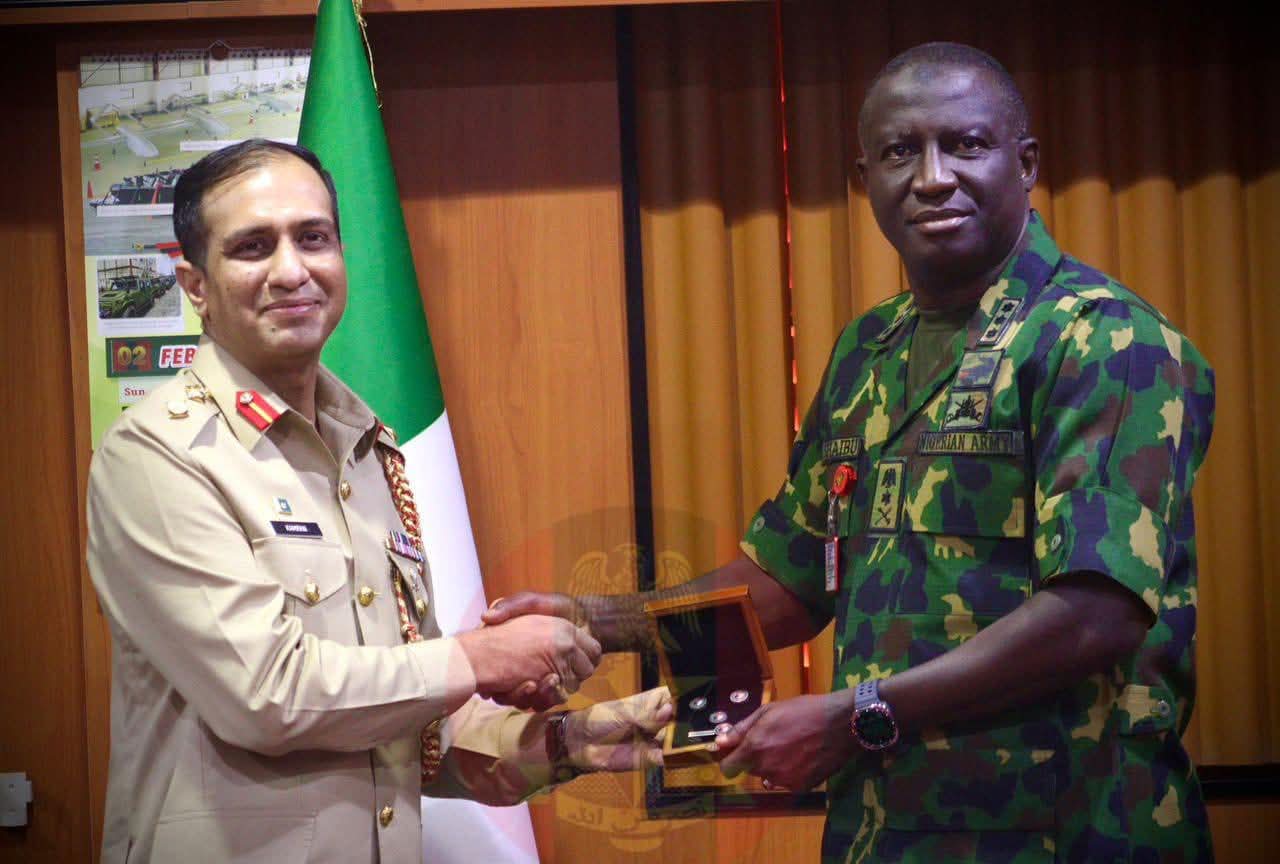
According to him, the Chief of Army Staff, Lt.-Gen. Waidi Shaibu recently undertook operational visits to Borno, Kaduna, and Zamfara, during which he assessed ongoing operations and urged troops to remain disciplined, alert, and committed to the fight against terrorism.

Nnamdi Kanu sentenced to life imprisonment

By Muhammad Abubakar

A federal court in Abuja has sentenced Nnamdi Kanu, leader of the banned Indigenous People of Biafra (IPOB), to life imprisonment for terrorism-related charges. The judge stated that Kanu’s calls for “sit-at-home” orders incited violence and constituted acts of terrorism.

The court ruled that for several of the charges, the law prescribes either life imprisonment or the death penalty. In delivering the verdict, the judge described Kanu as a “tyrant” capable of violence and said he should no longer remain a part of society.

The prosecution immediately called for the death penalty following the conviction. Kanu has previously been imprisoned, first in 2015 and again in 2021 after a controversial extradition from Kenya.

Supporters of Kanu have staged protests, and opposition politicians have criticised the government, alleging that the trial was politically motivated.

Nigeria’s border checkpoints plagued by extortion, not security — Witness

By Muhammad Sulaiman

Security experts have long warned that Nigeria’s porous borders are a major threat to national stability. This concern was echoed again when Dr Bulama Bukarti, a security researcher, lamented how almost anything can be smuggled into the country due to ineffective border control.

In reaction to Bukarti’s remarks, Dr Aliyu Yakubu Yusuf of Bayero University, Kano, shared a firsthand account that underscores the depth of the problem.

Dr Yusuf narrated that on a trip from Damagaran in the Niger Republic to Kano earlier this week, he sat in the front seat of a commercial bus and witnessed what he described as “a chain of extortion masquerading as security.”

According to him, as the bus approached the Babban Mutum border on the way to Ɓaɓura, he observed “so many annoying checkpoints,” sometimes only a few meters apart. Police officers, soldiers, immigration officials, road safety personnel, and customs operatives were all stationed along the route. Yet, none conducted any meaningful inspection.

“Each time we reached a checkpoint, the driver would simply pull out a one-thousand-naira note and hand it to an officer, then we would move on,” he said. Some officers even addressed the driver by name, apparently familiar with him as a regular traveller.

Dr Yusuf said the driver disclosed that there are 35 checkpoints between Damagaran and Kano, and at each one, he must part with between ₦500 and ₦2000, depending on the officials present. He estimated that drivers spend at least ₦30,000 during a single trip.

“Throughout the four-hour journey, not a single officer asked the driver to open his boot,” he added, expressing disbelief that such laxity exists despite Nigeria’s ongoing fight against insecurity.

His account reinforces concerns that many checkpoints serve as avenues for bribe collection rather than effective security screening—leaving the country vulnerable while motorists bear the financial burden.

“We are jokers, wallahi,” Dr. Yusuf concluded.

Brigadier general’s abduction, killing by ISWAP confirmed despite Army’s earlier denial

By Sabiu Abdullahi

Fresh details have confirmed that ISWAP terrorists assassinated Brigadier General Yu Uba during an attack in Borno State, even though the Nigerian Army initially rejected reports about his capture.

Uba was travelling in a convoy with troops and members of the Civilian Joint Task Force near Sabon Gari in Damboa Local Government Area on Friday when insurgents launched a heavy assault at about 5 pm.

Two soldiers and two CJTF operatives were killed in the ambush.

Shortly after the incident, the army dismissed early reports about the abduction. One of those reports was published by HumAngle.

On Saturday, Appolonis Anele, director of army public relations, issued a formal rebuttal.

His statement said in part, “The Army Headquarters also wishes to debunk the fake narrative going round some media platforms online alleging the abduction of the Brigade Commander. The general public is hereby advised to disregard the fake news regarding the incident while praying for the continuous success of our gallant service men and women.”

Following this statement, several online pages circulated claims that the senior officer had safely returned to base.

That narrative shifted on Monday when ISWAP released a photo of Uba in their custody and declared that they had killed him afterwards.

Sources within the military told FIJ that the image was genuine.

They explained that the denial issued on Saturday was premature.

One of the insiders said, “Uba had taken videos to show he was alive and on his way back from the ambush. However, he never made it. These videos were what we relied on originally, but nobody waited to see him first before going to discredit.”

Another source confirmed that insurgents captured the senior officer only minutes after the initial attack.

Uba is now the highest-ranking Nigerian military officer ever taken by ISWAP since the group’s emergence.

The messiah-villain binary: A trap in democracy

By Oladoja M.O

In the grand, often tumultuous, theatre of African politics, a deeply entrenched and insidious narrative persists: the Messiah-Villain Binary. This simplistic, yet devastating, framework casts political leaders not as fallible public servants, but as either divine saviours or malevolent destroyers. It’s a binary that suffocates nuance, stifles accountability, and, in a continent desperate for democratic maturity, acts as a corrosive cancer on the body politic. We must call this what it is: a dangerous delusion that has shackled Africa’s progress for far too long.

This orientation, a relic of post-colonial strongman politics, reduces the complex art of governance to a moral melodrama. Citizens, conditioned to see their leaders as larger-than-life figures, become spectators in a perpetual battle between good and evil. When a new leader emerges, they are instantly elevated to the status of a messiah, the one chosen to slay the dragons of poverty, corruption, and instability. Any opposition is, by default, cast as the villain, a saboteur working against the people’s will. This is not just a rhetorical device; it’s a profound psychological trap that prevents a healthy, critical relationship between the electorate and those they elect.

Look no further than the story of Robert Mugabe in Zimbabwe. In the euphoric dawn of independence in 1980, Mugabe was the indisputable messiah. He had led the liberation struggle, promised the people a new land, and was seen as the architect of a new, prosperous Zimbabwe. But as his rule solidified, dissent grew. His staunchest supporters did not see his brutal suppression of the Gukurahundi massacres and his increasingly authoritarian tendencies as the actions of a flawed leader, but rather as the necessary evils required to defeat the ‘villains’—the opposition, foreign agents, and internal critics. This narrative allowed him to dismantle democratic institutions and cling to power for nearly four decades, all while his country’s economy imploded. The messiah had morphed into a tyrant, but the binary, with its pre-assigned roles, kept many from seeing the reality until it was too late.

A similar pattern can be seen in Rwanda, albeit with a different trajectory. Following the 1994 genocide, Paul Kagame was hailed as the man who pulled his nation from the brink of total annihilation. He is undeniably a messiah figure for many Rwandans, credited with bringing stability, order, and remarkable economic growth. Yet, this messianic status has made it incredibly difficult for a genuine political opposition to emerge. Critics, journalists, and political rivals who question his iron grip on power are often swiftly silenced, accused of undermining national unity or of being sympathisers of the genocidal past. 

The messiah’s narrative, while perhaps initially justified, has become a tool to legitimize the suppression of democratic pluralism. The ‘villain’ is no longer the genocidal regime, but anyone who dares to challenge the man who defeated it. This is a profound danger: when a leader’s infallibility is tied to a nation’s salvation, dissent becomes tantamount to treason.

The messiah-villain binary is a disease that festers in the heart of African electoral politics. It’s visible in the fervent, almost religious, rallies where supporters see their candidate not as a political leader with a manifesto, but as an oracle. The 2017 Kenyan election and the subsequent crisis offered a stark illustration. Both Uhuru Kenyatta and Raila Odinga were cast as messianic figures by their respective supporters. For Odinga’s base, he was the long-awaited liberator, the man who would finally lead them to a promised land of social justice. For Kenyatta’s supporters, he represented stability and continuity, the man protecting the country from the ‘villainous’ forces of instability. This emotional fervour, fueled by tribal and regional loyalties, led to a deeply polarised society where compromise became impossible. The result was not just political gridlock, but a cycle of violence and deep-seated animosity that continues to haunt the nation. The election wasn’t a contest of ideas; it was a crusade.

This issue is not just a problem of the past; it remains alive and well today. In Nigeria, the perennial politics of ‘saviour’ and ‘enemy’ plague the electoral landscape. From the military regimes to the current democratic dispensation, every election is framed as a life-or-death struggle against forces of darkness. A new candidate emerges, promising to sweep away the corruption of the past, and is instantly elevated to a messianic pedestal. Yet, once in power, the same old patterns of patronage and unaccountability emerge. The people, having invested their faith in a person rather than in institutions and processes, are left disillusioned, only to repeat the cycle with the next messiah figure. This prevents the building of strong, independent institutions, a free press, an impartial judiciary, and a non-partisan civil service, because the entire political system revolves around the individual, not the rules.

The messiah-villain binary is a trap, a narrative cul-de-sac from which genuine democratic progress cannot escape. It’s a cancer because it preys on hope, exploiting the legitimate frustrations of the populace for political gain. It turns citizens into blind followers and opponents into sworn enemies. This dangerous orientation must be dismantled. We must stop looking for messiahs. There are no magical saviours.

There are only men and women who are fallible, flawed, and accountable to the people they serve. We must demand a politics of substance, not spectacle. We must judge our leaders not by the promises they make on the campaign trail, but by their respect for democratic institutions, their commitment to the rule of law, and their willingness to be held to account.

The true liberation of Africa as a continent and Nigeria as a nation will not come from a single hero, but from a critical and engaged citizenry that understands that the power to govern belongs to them and that no politician, no matter how charismatic, is a god. It is time to retire the messiah, to dismantle the villain, and to embrace the hard, unglamorous work of building a true and lasting democracy.

Oladoja M.O writes from Abuja and can be reached at: mayokunmark@gmail.com.

Nigerians react as Corps member threatens to sleep with female students

By Ishaka Mohammed

A man serving under the National Youth Service Corps (NYSC) has come under fire for publicly threatening to sleep with his female secondary school students, whom he considered voluptuous.

According to a Nigerian Army officer and Facebook user, Kolawole Oludare Stephen, the Corps member, Oyaje Daniel (KD/25A/0494), currently serves at Judeen International School, Mando, Igabi Local Government Area, Kaduna State. The officer tagged the NYSC in a Facebook post for urgent action.

Another Facebook user, Ọluchi Eze, who tagged the NYSC in a post, mentioned Oyaje Daniel as a Corps member in a secondary school in Kaduna State.

Reacting to Ọluchi Ezeʼs post, the Corps member, with the Facebook name Comr Oyaje Daniel, confirmed his local government of national service and tendered an apology, but expressed shock at people’s judgment of his character.  “I am shocked by the news surrounding my character, and I want to assure everyone that I am not a rapist or a perpetrator of any form of abuse,” part of the post reads.


While some Facebook users considered him remorseful and deserving of forgiveness, others called for penalties. 


The Daily Reality gathered that Comr Oyaje Daniel had earlier commented on a Facebook post in which he had threatened to sleep with any SSS 3 female students who failed to “coordinate” themselves, stressing how their bodies were more voluptuous than those of 400 level undergraduates.


At the time of filing this report, the National Youth Service Corps has yet to comment on the matter.

Group rejects US threats, urges national unity on security crisis

By Muhammad Sulaiman

A group of prominent Nigerian citizens has condemned recent threats by U.S. President Donald Trump to relist Nigeria as a “Country of Particular Concern (CPC)” and possibly take military action to protect Christians, describing the move as an affront to Nigeria’s sovereignty.

In a statement issued in Kaduna, the group — comprising Dr Bilkisu Oniyangi, Professor Usman Yusuf, Dr Ahmed Shehu, Dr Aliyu Tilde, Dr Hakeem Baba-Ahmed, and Barrister Kalli Ghazali — warned that such rhetoric from Washington could inflame religious tensions and “turn Nigeria into a pawn in global geopolitics.”

The signatories emphasised that while the concerns of friendly nations such as the U.S., China, the U.K., and Russia are welcome, threats and external pressure are counterproductive. “This is our problem as Nigerians, and it will be solved by us,” the statement read.

The group urged President Bola Tinubu to directly address Nigerians, prioritise national security, and suspend foreign travels until the crisis is resolved. They also called on the U.S. to withdraw its threats and instead assist Nigeria through strategic cooperation and capacity building against terrorism and banditry.

They further appealed for unity among Nigerians, noting that “every life taken, every kidnapping or assault anywhere in Nigeria matters equally.”

Reaffirming faith in Nigeria’s resilience, the statement concluded: “Our independence and unity have been tested many times, and this too shall pass — but only if we act together as one people.”

Wike: The deepening threat to Nigeria’s democratic landscape

By Abba Hikima

It is clear to even the most daft Nigerian that Nyesom Wike, a serving member of President Tinubu’s Federal Executive Council, is only in the PDP to sabotage it and clear the path for his benefactor, the President, come the 2027 elections. What may not, however, be clear is the extent to which Wike’s tactics and antics can undermine Nigeria’s democracy.

Whether you are APC, PDP, ADC or even politically indifferent, Wike’s actions should bother you, as long as you dream of a truly democratic Nigeria where institutions transcend whimsical meddling of the few.

From any angle, one sees a deliberate pattern that systematically seeks to dismantle the country’s main opposition party and tilts the political landscape dangerously toward one-party dominance.

The recent Federal High Court injunction, restraining the PDP from holding its planned November 15 National Convention, issued by Justice J. Omotosho, only reinforces this pattern. It aligns with a string of judicial outcomes and political manoeuvres that have consistently favoured Wike’s factional interests, all at the expense of Nigeria’s fragile democratic balance.

Between 2023 and 2025, Wike’s loyalists seized the PDP’s national secretariat at Wadata Plaza, installed their own acting chairman, and plunged the party into even deeper crisis. Earlier, he had been linked to moves to demolish the PDP headquarters in Port Harcourt and to lawsuits that derailed planned conventions.

These deliberate acts of sabotage are calculated to dismantle opposition structures and weaken the political alternatives that every democracy relies on. In Nigeria today, prominent political opposition actors are crosscarpeting from their political parties to the ruling APC, not because the APC is doing better, but to salvage their seats and realise their aspirations, which appear rather vivid with the APC.

In saner climes, inclusion of opposition figures within ruling governments is a laudable means of promoting national unity and bridging gaps. But in Nigeria’s case, Wike’s dual role, serving as a federal minister while wielding extraordinary control over an opposition party, is clearly a means of manipulation.

It blurs ethical boundaries and deprives citizens of genuine democratic alternatives.

Even more disturbing is Wike’s perceived closeness to certain segments of the judiciary- what Professor Chidi Anselm Odinkalu aptly described as a “pathological fixation.”

From 2019 to 2025, at least five major cases tied directly or indirectly to Wike’s interests have been heard before the same judge, fueling concerns of judicial clientelism —a scenario where powerful litigants can select their forums by proxy.

The danger goes far beyond politics.

If political elites can manipulate opposition parties while simultaneously bending judicial processes to their favour, then democracy becomes mere theatre. A performance that preserves power and erodes accountability.

Having said this, the National Judicial Council should randomise the assignment of politically sensitive cases and ensure that no single judge repeatedly handles matters involving the same litigants. A stronger ethical firewall must also be built between judicial officers and politically exposed persons.

Politically, Nigeria must introduce conflict-of-interest rules that bar sitting ministers or presidential appointees from exerting control over opposition parties. Democracy cannot thrive when the same hand both governs and manipulates its opposition.

Coming this far, we must accept that reform is not optional; it is existential.

Abba Hikima, Esq. wrote from Kano, Nigeria.