National

You can add some category description here.

January 15: The North will never forget

By Musa Kalim Gambo

January 15 marks 56 years since the gruesome murder of Prime Minister Sir Abubakar Tafawa Balewa and Sir Ahmadu Bello, the Sardauna of Sokoto and Premier of Northern Nigeria. To borrow a few words from Shakespeare, both were like Colossus under whose giant feet the North strode.

The description of that Saturday’s night events still haunts many of us here in the North. Though we sincerely believe that Allah must have predestined that these servants of His were not going to exceed that day on earth, and they would die from the bullets of Igbo-led soldiers. It is still a tragedy we will never forget.

On Tuesday, January 11, Daily Trust published an opinion piece written by my excellent friend Sa’adatu Aliyu titled “Igbos too deserve Nigeria’s presidency”. When I saw the title, at first, I thought it must have been written by an Igbo ethnic nationalist from South-Eastern Nigeria, for she is expressing an opinion that is utterly alien to Northern Nigeria’s political thought and discourse. One should expect this line of thinking to come from the Igbo because the Igbo elite has popularized this illusory notion of exclusion from Nigeria’s corridors of power, especially Aso Rock, as one of the major precursors for secessionist agitation in today’s Nigeria.

By the way, this is the ethnic group that produced Nigeria’s first civilian president, Nnamdi Azikiwe, in the 1960s. Then, again on the return of democracy in 1979, Chief Alex Ekwueme emerged as Nigeria’s Vice-President.

In 2019, Atiku Abubakar had Peter Obi, a former governor of an Igbo state, as a running-mate. Unfortunately, it was a wrong calculation, and we saw how it ended. One of Obi’s major sins that stained Atiku’s ticket is that as a governor in Anambra state, he reportedly came up with policies that frustrated Northern traders and artisans in his state. This sin is an expression of the general attitude towards the Northerner in the South-East region – where the Northerner is perceived with disdain and attacked in the event of any slight provocation.

Again we cannot forget Sardauna’s warning about the Igbo tendencies and quest for dominance in every little sphere of endeavour. This warning and the pain of Sardauna’s murder is still with many of us.

But it is important to understand that even without this fear of domination, the Igbo vote on its own is inconsequential in the making of a president in a democratic Nigeria. So even without January 15, which now resembles the Roman Ides of March, when power mongers assassinated Julius Caesar, the Igbo will not make it to the president.

However, suppose we have an Igbo man in the line of succession within the political equation. In that case, a natural tragedy as it happened to Umaru Musa Yar’adua may undeservedly promote an Igbo man to occupy the exalted seat of the president. And that will be a pure work of Providence that the North will pray for God to forbid.

Some people suspect that an average Northerner hates the Igbo man; that is a wrong assumption. No, the Northerner is comfortable doing business with the Igbo man, as can be seen by the presence of Igbo businesses in every village, town, and city in the North. However, in the political scene, the average Northerner is apprehensive about the Igbo man at the apex of political power. The Northerner does not want January 15 to repeat itself in terms of the elimination of our most revered political leaders.

In the end, I like to re-emphasize, as has been emphasized by many Northern political elites, we are in a democracy. An Igbo man is free to purchase a ticket on any political party’s platform to run for any political office, including the president. If he can generate the requisite number of votes to win the election, who will stand in his way?

Let it be known very well that the presidency of this country is not a baton in a relay race that would just be handed over to the next athlete standing. No, it is a tug of war with competing parties pulling against each other on opposing sides. So, no one should come here again with that sense of entitlement declaring that the Igbos deserve Nigeria’s presidency too. Instead, they should be advised to jump into the arena and fight for the seat with the full knowledge that the North’s deciding population will not clap for them. We study and honour history, its figures, and defining events in the North.

Now, on January 15, and every other day, let’s not forget to pray for Allah’s mercy and blessing upon the souls of Sirs Abubakar Tafawa Balewa and Ahmadu Bello, and all other departed heroes of ours who had the progress and development of our region and people at the centre of their hearts.

Gambo writes from Zaria, Kaduna State, via kalimatics@gmail.com

Towards achieving unity in Nigeria

By Lawi Auwal Yusuf

The amalgamation of the protectorates in 1914 predetermined a united state for multiple precolonial chiefdoms. Highly diverse Nigeria featured by a rainbow of cultures is deeply fractioned along ethnic and religious lines.

Imperial misrule left a bad legacy for national unity. Regional devolution caused intense tussles among regional forces over the powerful central authority, which was the basis for post-independence sectarian disputes.

Thus, six-year-old Nigeria witnessed a catastrophic separatist war that took the lives of many heroes. Since the aftermath of the bloodletting, the country has been bedevilled with lingering ethno-nationalisms coupled with regular fatal brawls between the tribes. This was due to extreme polarization and segregation of the heterogeneous groups with no sense of togetherness, community cohesion and dovishness. 

Deeply ingrained tensions have been the order of the day. Igbos accuse Northerners of their grief and impeding their chances of realising the apex power. The Northerners equally see the Igbos as power maniacs. Yorubas feel discontented with the status quo, while minorities have the impression of a roughshod ride over them.

Tribal and religious absolutism are awful threats as multiculturalism has failed, and communities have become ever more fragmented. Patriotism has eroded, and Nigerians are less tied by the bond of nationality. They are no longer one united people and do not regard themselves as national brothers with a sense of shared identity. Hence, there is an absence of the desired unity in diversity, tolerance and integration.

Politicians must develop the impulse and genuine commitment to national unity. They must believe that this is a dire task that transcends beyond cultural exhibitions, festivities or even wearing traditional attires of host communities during political rallies. Instead, it requires solid whims, sacrifice and effective policies.

Technocrats are required to accomplish this task efficiently. They must design policies that ensure equitable treatment of the ethnocultural groups alongside the creation of space for all the divergent voices to be heard. Everybody must have a say in society. Moreover, they must devise ways to live together harmoniously, without prejudice or malice.

Integration is so effective in ensuring peaceful coexistence between fractious groups. Therefore, increased contact across the nation should be emphasised, and Nigerians should increasingly intermingle with one another. This will allow people to live closer to one another, work amicably, and ensure that relations remain peaceful. Therefore, disputes will vanish obstinately.

This can only be realised if there is an honour for individual cultural preferences in public life. All institutions must make special provisions for all Nigerians’ choices and cultural needs. So, everybody will develop a worthy stake in the social order. Policies must be put in place to accommodate the values, diet, dressing, spiritual convictions, and practices respectably.

We need to facilitate multilingualism by encouraging people to learn several native languages. Speaking one another’s languages diminishes suspicion, tensions and conflict. This will also build trust, honour and understanding across all cultures.

Social exclusion creates deficient opportunities for disadvantaged/minority groups suggesting that they don’t have equal rights. As a result, they are treated as second class citizens, hindering cohesion and egalitarianism featured by social inclusion and pluralism. Moreover, it leads to distress to the abandoned groups, which poses a persistent threat of disharmony. However, institutions must make efforts to meet the needs of all communities and not tilt towards the needs of a particular section.

Regrettably, the tribes have distorted perceptions of each other. Malevolence aggravates because of misleading histories and myths falsifying the reality and typically portraying others as diabolic. They hold malicious convictions and stereotype each other based on their previously treated beliefs. Any trivial provocation warrants the impression and becomes a basis for vengeance. The exasperation of hostilities by IPOB, ESN, Afenifere and others are clear examples.

It is needful to enact a statute outlawing attitudes of these tribes calling one another with derogatory or slur names that denigrate or demonise others. Ethnicities hardly unite if they are abusing one another.

The present mass idleness must be evaded alongside the creation of decent jobs. Graduates happen to be jobless long after they have left school. Similarly, numerous unknowledgeable youths remain redundant. Ethnic and religious skirmishes intensify every day due to hardships encountered by youths in their efforts to have a lawful means of subsistence. Many of them have the requisite skills and qualifications but found them not helpful in securing employment. They have fallen victim to anxieties, delays, and disparagement and developed a strong feeling of despair, oppression, and unfairness. Hence, they engage in crimes or sectional clashes to counter the injustice and avoid the distress of poverty.

With such dissimilarities in all parts of society, tolerance is indispensable if Nigerians want to live in peace. The capacity to live in a plural society will secure a harmonious future for multiethnic Nigeria. However, Martin Luther King Jr. once said to Americans at the peak of racial segregation that “we must learn to live together as brothers or perish together as fools.”

Lawi Auwal Yusuf wrote from Kano, Nigeria. He can be reached via laymaikanawa@gmail.com.

EFCC rearraigns Mompha on fresh money laundering charges

By Ahmad Deedat Zakari

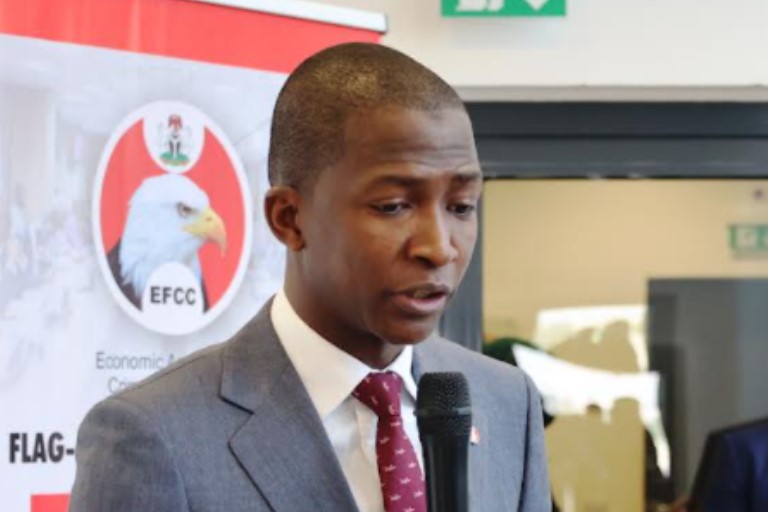
The Economic and Financial Crime Commission (EFCC) rearraigns Ismaila Mustapha, popularly known as Mompha on charges boardering on money laundering. He has been rearraigned in a Lagos Special Offences Court sitting at Ikeja, Lagos.

The commission made this known through a post on their verified Facebook account on Wednesday, 12-1-2022.

The post reads: “Operatives of the Lagos Command of the Economic and Financial Crime Commission, have re-arrested a suspected internet fraud star, Ismaila Mustapha for laundering funds obtained through unlawful activities of alleged proceeds of crime”

The statement also noted that Mompha was arrested on Monday, January, 10, 2022.

The Commission added that: “The suspect is currently standing trial alongside his company, Ismalob Global Investment Limited on an amended twenty two-count charge boardering on cyber fraud and money laundering to the tune of N32.9bn (Thirty-two Billion Nine Hundred Thousand Naira brought against him by the EFCC”

The Instagram celebrity was first arrested at the Nnamdi Azikiwe Airport, Abuja on October, 19, 2019. And since his first arrest has been in and out of the courtrooms.

Umahi meets Buhari, declares intention to run for president

By Ahmad Deedat Zakari

The Governor of Ebonyi State, Dave Umahi met President Muhammadu Buhari at the Presidential Villa, Abuja, Tuesday, where he indicates interest to contest for office of the President

Mr Umahi who defected to the ruling All Progressive Congress, APC, November, 2020, from the Peoples Democratic Party, PDP, made this Known while briefing newsmen shortly after the closed-door meeting.

In response to a question if he is not deterred by the interests of others seeking the party’s presidential ticket, he stated, “I am not in contest with anybody; I am in contest with myself.”

Mr Umahi’s declaration is coming a day after Tinubu’s declaration of interest also at the Presidential Villa on Monday.

Buhari mourns former Head of Interim Government, national flag flown at half-mast

The former head of Nigeria’s Interim National Government, Chief Ernest Shonekan passes on today. The president of Nigeria, Muhammadu Buhari mourns his death through a condolence message posted on his Facebook page. The post reads: “I received with profound sadness the news of the death of a great statesman and former Head of the Interim National Government, Chief Ernest Shonekan.

On behalf of the Federal Government, I extend my deepest condolences to Chief Shonekan’s wife, Margaret, his loved ones, and the government and people of Ogun State.

With courageous wisdom, Chief Shonekan left his flourishing business career to become the Head of Government, at a delicate time when the country needed someone of his calm mien and pedigree to save the ship of state from sinking.

He demonstrated to all that the love for country and commitment to her development, peace and unity transcend the trappings of office and the transient nature of political power.

Nigeria owes a great debt to Chief Shonekan, the peacemaker, who even at the twilight of his lifetime never stopped believing and working for a prosperous and democratic country.

I pray that his memory will remain a blessing to Nigeria even as he finds perfect peace with Almighty God.”

Troops neutralize bandits in Kaduna village

By Uzair Adam Imam

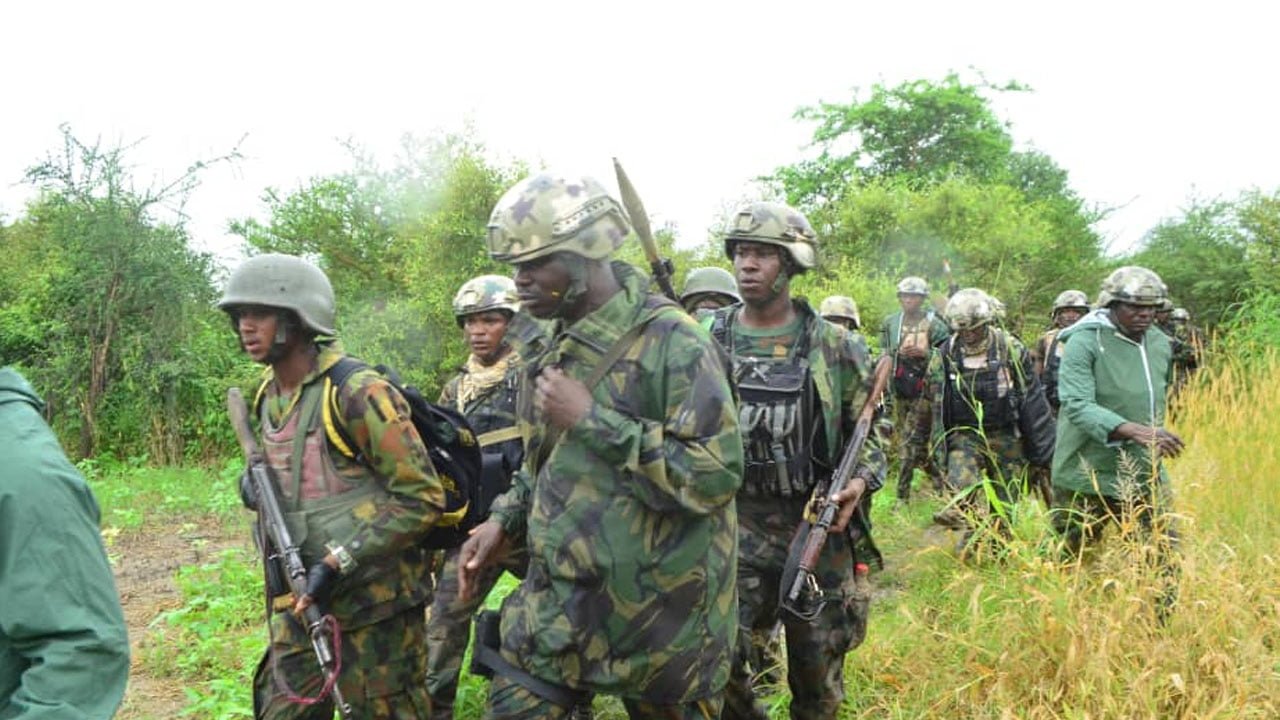
Troops in Kaduna State have reportedly neutralized bandits and foiled a planned attack on Fatika town of the state.

A release issued Monday, 10-1-2022 by the Commissioner for Internal Security and Home Affairs, Samuel Aruwan, disclosed that five members of the militant group were killed in the process.

Aruwan Said that the troops who conducted clearance patrols in Giwa local government area received credible intelligence of terrorists’ movement.

However, he added that, “the troops then mobilised to Marke and Ruheya in response.”

“The outlaws were sighted and attempted to escape the advancing forces. The troops however cut off their escape route at Kwanan Bataro, and engaged them in a firefight, during which five of the terrorists were neutralized. The troops returned to base after clearing the area,” he stated.

The statement stated that governor Nasir El-Rufai expressed satisfaction at the operational feedback.

El-Rufai has also commended the troops for their proactive and sharp response to the intelligence received, encouraging them to keep up the intensity in the ongoing offensives against terrorists in the area.

Reminiscences of Dr Ahmad Bamba BUK

Professor Salisu Shehu

حَدَّثَنَا إِسْمَاعِيلُ بْنُ أَبِي أُوَيْسٍ، قَالَ حَدَّثَنِي مَالِكٌ، عَنْ هِشَامِ بْنِ عُرْوَةَ، عَنْ أَبِيهِ، عَنْ عَبْدِ اللَّهِ بْنِ عَمْرِو بْنِ الْعَاصِ، قَالَ سَمِعْتُ رَسُولَ اللَّهِ صلى الله عليه وسلم يَقُولُ  ” إِنَّ اللَّهَ لاَ يَقْبِضُ الْعِلْمَ انْتِزَاعًا، يَنْتَزِعُهُ مِنَ الْعِبَادِ، وَلَكِنْ يَقْبِضُ الْعِلْمَ بِقَبْضِ الْعُلَمَاءِ، حَتَّى إِذَا لَمْ يُبْقِ عَالِمًا، اتَّخَذَ النَّاسُ رُءُوسًا جُهَّالاً فَسُئِلُوا، فَأَفْتَوْا بِغَيْرِ عِلْمٍ، فَضَلُّوا وَأَضَلُّوا “‏. قَالَ الْفِرَبْرِيُّ حَدَّثَنَا عَبَّاسٌ قَالَ حَدَّثَنَا قُتَيْبَةُ حَدَّثَنَا جَرِيرٌ عَنْ هِشَامٍ نَحْوَهُ.

Narrated `Abdullah bin `Amr bin Al-`As:

“I heard Allah’s Apostle saying, “Allah does not take away the knowledge, by taking it away from (the hearts of) the people, but takes it away by the death of the religious learned men till when none of the (religious learned men) remains, people will take as their leaders ignorant persons who when consulted will give their verdict without knowledge. So they will go astray and will lead the people astray.”

My first sight of Dr. Ahmad Bamba was 37 years ago in 1984 in the UMMAH MOSQUE at the Old Campus, Bayero University, Kano where I just got registered as a pre-degree student and had begun to familiarize and acclimatize with the people, routines, events and the environment in the University. Although the Central Mosque in Bayero University, Kano would always be the first sight of any visitor or newly arriving student to the University, having been strategically located near the Main Gate, the Ummah Mosque may be the first place of worship for the new resident (on-campus) student because, in its own case, it is sandwiched between the hostels and the two major and oldest Faculties of the University- The Faculty of Arts and Islamic Studies ( FAIS) and the Faculty of Education. Because of its lively nature and vibrancy-series of nasihas, ta’alims, Qur’anic study circles and Tajweed, Arabic classes and even sometimes, very hot intra-faith dialogues and debates that may sometimes prolong from Isha to Fajr Prayer time, the Ummah Mosque, therefore, would always easily capture every newly arriving young Muslim student who might have arrived the University full of curiosity as well as,  enthusiasm and zeal to learn. We, therefore, easily got hooked up to the Ummah Mosque. We would only be seen at the Central Mosque, most surely on Fridays for the Jumu’ah prayer.

It was quite rare to see non-students’ faces at the Ummah Mosque except during Zuhr and Asr prayers when some visitors and some lecturers might be around to join the congregation. There was, however, a non-student face that was very familiar in the Ummah Mosque most especially, during Zuhr prayer and seldom during Maghrib. That was Dr. Ahmad Muhammad Ibrahim Bamba. He would certainly be the first lecturer students that used to regularly attend congregational prayer in the Ummah Mosque would be familiar with because of his regular presence. Of course, another very regular face was Professor M. D.Sulaiman of the History Department. As it were, and as earlier stated, the Mosque was very close to the Faculty of Arts and Islamic Studies where Dr. Ahmad belonged. He would easily come down to join the students’ prayer congregation and there was never an instance that he made any attempt or overtures to lead the prayer or say a word. The nasihas, the ta’alims, and sometimes the debates would be taking place in his presence and to his hearing but he would not utter a word. The situation in the Mosque could actually sometimes be rancorous but it would never stop him from coming. He would, certainly, however, observe his nawafil, and would make his way out. I had a feeling but was unable to ask him, that perhaps his regularity in the Ummah Mosque was not just for the purpose of observing the regular prayer but also to keep close contact and relationship with the students for the purposes of Tarbiyyah h. It was later when I became an Imam in the mosque that I realized that he used to invite or approach imams/leaders in the Mosque to make corrections politely or offer some advice/suggestions, as the case may be.

My first countenance of Dr. Ahmad in the Ummah Mosque reminded me of my first IRK Teacher in the Teachers’ College -Sheikh Yahya Abdul’Azeez, a fully bearded Pakistani Sheikh who was to teach me again –Kitab al -Tauheed, Bulugh al-Maram and Al-Nahwu al-Wadhih in Gwallaga Mosque in Bauchi in 1984, after he transferred his services to Bauchi College of Arts and Science (BACAS). That was shortly before I got admission into Bayero University, Kano. The two were the two fully bearded Sheikhs I first met in life. On my first sight of Sheikh Dr. Ahmad in the Ummah Mosque, the memories of Sheikh Yahya Abdul’Azeez suddenly came back to my mind. At that time, Sheikh Dr. Ahmad was certainly in his late 40s while I was just beginning the third decade (early twenties) of my life as a young undergrad. More strikingly, however, the sights of the two gentlemen present to the heart a mien of piety that sometimes made you think of the countenances of the Sahaba, or so we used to think as young people that still had some elements of naivety in our thoughts.

Our admiration of Sheikh Dr. Ahmad was ceaseless whenever he came and prayed with us in the Ummah Mosque and left. But our interaction with him was no more than the Salam and typically, he would wave at you and made his way out or extend his hand for a shake when you happened to be very close to him. The first time I ever had a conversation with him or heard him spoke to me was when I was appointed as an Imam in the Mosque, which was later to become my class where I taught Tajweed for about three years up to graduation in 1988. I was certainly the youngest of the Imams, a second deputy after Sheikh Sani from Zaria. With the benefit of early background in Qur’anic learning from home, one’s mastery, so to say,  of reading the Qur’an could easily be discovered. So, right from my first year I got appointed as one of the deputy Imams. The substantive Imam then, was the late  Malam Usman Muhammad, the Chief Imam of Laranto, Jos, who was undergoing the Diploma in Arabic, Hausa and Islamic Studies.

Still, with the vestiges of adolescent exuberance and obsession for a fashionable and smart appearance, my wardrobe had more of the fashionable shirts and trousers of the time (TOBI shirts/jeans and HARA trousers) than kaftans. Invariably, therefore, the Imam in me would most of the time lead prayers in the said kinds of fashionable shirts and trousers in the Ummah Mosque. I led the Maghrib prayer one day. After the prayer, Sheikh Dr. Ahmad Bamba called me and held my hand to the outside of the Mosque. In his typical gentle manner and way he said, “Liman, yaya kokari”. I replied, “Alhamdulillah”, with a mix of exciting and nervous mien. He then said to me, “Toh liman ga karatu mai kyau, amma kuma kullum ana mana sallah kai babu hula?”. With a sigh of relief, I said , ” Na Gode Mallam, in sha Allah, za a gyara.”. It was both an awesome and joyful moment for me. But what was most instructive was the fact that that simple and gentle counsel not only made me appreciate that I was no longer just an ordinary student on campus but I was treading the path of spiritual leaders, it also changed my life in terms of personal dispositions and appearance on campus and beyond.

A second experience with Sheikh  Dr. Ahmad Bamba made me a witness to his magnanimity. It was in the case of attending his Hadith class for students offering  Islamic Studies as Special Honours. I was not one, so I could not register for that course. I offered Islamic Studies as a subsidiary course, but I was interested in attending his Special or rather advanced Hadith class. All my friends and classmates- Professor Salihu Lawal Malumfashi (present Dean of the School of Continuing Education and one of the Darul Hadith Imams), Alhaji Bashir Sheshe (now a Permanent Secretary, Ministry of the Federal Capital Territory, Abuja), Dr. Ahmad Maigari Dutisin -ma (Department of Islamic Studies, Usmanu Dan Fodiyo University, Sokoto), Professor Usman Sani Abbas (Department of Islamic Studies, BUK) to mention just a few were all encouraging me to just enter the class and that they were sure Malam would not send me out. On the second or third lecture day, I joined some of these mates while being very scary. I  sat in the class with some bit of nervousness. Sheikh entered the class, conducted his lesson and alhamdulillah, he did not send me out. He definitely saw me, and he definitely knew that I was not duly registered for that course because it was a small class of fewer than 15 students. Later, I want to believe that one of those classmates of mine approached him and spoke to him about me, and Malam graciously permitted. By virtue of my Imamship in Ummah Mosque, I was already a familiar face to him. With a deep sense of appreciation, I must say that that opportunity was my first experience with not only some of the basic and essential rudiments of Ilm al-Hadith but was also the greatest inspiration for deeper and more advanced study of the field.

After graduation in 1988 and having left for the national youth service scheme to far away Bendel State (now Edo and Delta) I did not only cease to benefit from the Special Hadith class of Sheikh Dr. Ahmad but also lost sight of him for about a couple of years. I got intellectually and personally reconnected with him when I returned to Bayero University, Kano in 1991. I came back to pursue Masters in Educational Psychology. Graciously, that presented yet another opportunity for, in a way, to continue to drink from the fountain of the knowledge of Hadith that Sheikh Dr. Ahmad Bamba personified. That was the year Sheikh Dr. Ahmad Bamba started his very awesome, weekly/weekend Hadith Ta’alim Sessions, beginning with Sahih al-Bukhari in the BUK Central Mosque and subsequently Darul Hadith Mosque, a teaching cum admonishment exercise that he continued to conduct uninterruptedly with a great sense of passion, vigour, consistency and rare faith and commitment for THIRTY (30) SOLID YEARS up to the end of his life. Although I was not chanced to be present at the first and second sessions, I would want to remember that I was there in the third session.

In the Hadith Ta’alim Sessions, we did not only learn the texts of the Hadiths and elements of Mastalahul Hadith but we also learnt to be much more committed to Sunnah in terms of faith and practice. Quite instructively also, we learnt lots and lots and lots of the Aqwal ( wise or sayings) of the salafs, many aspects of Usul al-Fiqh (Islamic Jurisprudence), Qaw’id al-Fiqh (Jurisprudential principles and maxims) and many Islamic religious and Jahiliyyah poetries (Qasa’id and Shu’ara’ al-Jahiliyyah). I would not, therefore, end this paragraph without recalling one stanza of a poem that Sheikh Dr. Bamba used to quote very frequently, in his constant admonishment on the obligation to hold and cling tenaciously to the Sunnah of the Prophet (صلي الله عليه وسلم). That is: “دعوا كل قول عند قول محمد فما ءامن في دينه كمغامر

It would be pertinent to mention here, perhaps also to inform those who might not know that Sheikh Dr. Ahmad Bamba did not only contribute to the knowledge of Hadith through the Ta’alim Sessions. He also  contributed to it through authorship. Within the first three years after the commencement  of the Sahih al Bukhari lessons one of his very scholarly Hadith works was released. That was his Takhreej and Tahqeeq work on Imam al-Bukhari’s “Juz al-Qira’ah Khalf al-Imam. It was a book that I unhesitatingly bought a personal copy and ‘voraciously’ read cover to cover within a couple of days.

For Sheikh Dr. Ahmad Bamba, it was a life well spent. Thirty solid years of uninterrupted teaching the Hadiths of the Prophet (s.a.w) was not just a monumental intellectual and scholarly contribution but was evidence of true love of and for our Beloved Prophet Muhammad صلي الله عليه وسلم. This reminds me of the saying of one of the Hadith scholars, quoted by the late Sheikh Muhammad Nasiruddeen alAlbani in his Sifat Salat al-Nabiyy that: اهل الحديث هم اهل الرسول وان: لم يصحبوا نفسه أنفاسه صحبوا.

The death of our most honourable Sheikh Dr. Ahmad Muhammad Ibrahim Bamba is certainly a tragic loss to the world of knowledge and Da’awah as rightly and as clearly alluded to in the Hadith above, with which we opened this tribute. Our closing words would only be fervent and sincere and hearty prayers for him.

إنا لله وإنا إليه راجعون

 إنَّ للهِ ما أخذ وله ما أعطى وكلُّ شيءٍ عنده بأجلٍ مسمًّى.

اللهم اغفر لدكتور احمد، وارفع درجتَه في المهديين، واخلفه في عقبه في الغابرين، واغفر لنا وله يا ربّ العالمين، وافسح له في قبره، ونوّر له فيه

وآخر دعوانا ان الحمد لله رب العالمين

All praise is due to Allah, Lord of the Worlds. May His Peace and Blessings be upon our Beloved Prophet Muhammad صلي الله عليه وسلم.

The biggest takeaway from Sheikh Ahmad’s death

Yesterday, Kano state, in particular, was rocked with the untimely passing away of the revered Sheikh Dr. Ahmad BUK aka “Ƙala Haddasana”. Social media was awash with condolences and prayers for Allah’s mercy on the deceased. In all my years on this space, I have never seen a single event that generated as much unanimous positive reactions from all quarters as this one. Experience has taught me that Northern Nigerian cyberspace is one of the most polarised places on the social media. Religious/doctrinal and political differences easily blind us to reason. Yes, Islam encourages us to speak good about the dead. However, seeing how the social media mourned the late Sheikh almost in unison makes me realise that indeed there is a big lesson to learn from this death.

The late Sheikh was one of the earliest Salafi scholars in Nigeria. In his many lectures, he confessed to have earlier been a follower of Tijjaniyya, which is arguably the biggest Sufi sect in the world. Despite his doctrinal leaning, the Sheikh commanded respects from all and sundry. The secret behind this is the fact that he never created bad blood with his rivals. In other words, the Sheikh was steadfast in his Salafi ideology while at the same time maintaining a cordial relationship with others. This is a rare character trait that we all need to embrace fully.

You can be a Salafi or a Sufi, an APC or a PDP fan, a Buharist or a Kwankwasite and so on. But learn to never burn bridges with others. You can hold different religious or political opinions. You can always disagree with others on different issues. But always try to disagree politely and learn to respect others’ opinions. Most of the animosities and tensions that characterise our existence are borne out of our seeming intolerance and in-your-face attitudes towards others.

I have come to the realisation that the outpouring prayers for Allah’s mercy and forgiveness on the Sheikh are not only the results of his teaching and mentorship but are also the consequences of his tolerance and thoughtfulness. When you live a useful life, your death would leave even your detractors with a void impossible to fill in. When you make tolerance your guiding principle, even your enemies would be left with no choice than to admire you, even if grudgingly. The take-home lesson is: be respectful of others regardless of existing differences.

May Allah SWT forgive the Sheikh and all others who have passed away before him.

Aliyu Yakubu Yusuf

Buhari appoints Ayo Gbaleyi as Chairman, Federal Mortgage Bank (FMBN)

By Ahmad Deedat Zakari


President Muhammadu Buhari, on Friday, January 7, 2022, appointed Mr Ayodeji Ariyo Gbaleyi as the Chairman of the Board of Directors of the Federal Mortgage Bank (FMBN).


A statement on the verified Facebook account of presidential spokesperson Mr Femi Adesina confirms the appointment.


In describing the appointee, the statement reads,” A Chartered Accountant and an Associate of the Chartered Institute of Taxation, Gbaleyi is a well-known financial expert who was once a Commissioner for Finance in Lagos as well as a player in the aviation sector.”


He added that Mr Gbaleyi replaced Chief Adesoji Adeeyo, who passed on recently.

Buhari hints on successor

By Ahmad Deedat Zakari.

President Muhammadu, on Wednesday, while granting an interview on Channels TV, reportedly said he had a favourite successor.

The President, whose tenure will be over in less than two years, dropped the bombshell during an exclusive interview on Channels TV on Wednesday, January 5, 2022.

However, the president refused to state who the favourite successor was on the ground of their safety.

The President, in his own words, ” I wouldn’t (mention the name of my favourite successor) because he may be eliminated if I do. I better keep that a secret.”

The interview has generated ripples and different reactions across the political spectrum in the country.