National

You can add some category description here.

Ruling APC loses 3 senators to PDP, NNPP

By Muhammadu Sabiu

Three All Progressives Congress (APC) senators have resigned from the ruling party.

Senators Ahmad Babba Kaita (Katsina North), Lawal Yahaya Gumau (Bauchi South), and Francis Alimikhena (Edo North) are the defecting lawmakers.

Gumau defected to the New Nigeria Peoples Party, while Babba Kaita and Alimikhena joined the opposition Peoples Democratic Party.

The Senate President, Ahmad Lawan, read three different letters in Tuesday’s plenary in which they announced their defections.

Senator Alimikhena’s decision to leave the APC was motivated by the “ongoing and complex crises that have plagued the APC,” particularly in his Senatorial District, “that has formed parallel executives that have weakened internal discipline, coherence, and commitment.”

Explaining the reason for his detection, Babba Kaita was quoted as saying, “As Senator representing Katsina North Senatorial District, I write to formally notify you of my resignation from the All Progressives Congress (APC), and registration declaration for the Peoples Democratic Party.

“My resignation from the APC was born out of the marginalisation of critical stakeholders by the State Government and Leadership of the Party in Katsina State, where small people like me do not have a chance.

“I have since been joyful and graciously accepted into the fold of the Peoples Democratic Party in Katsina State.”

ASUU Strike: Negotiations end, ASUU awaits FG’s position

By Uzair Adam Imam

Reports from different sources have indicated that negotiations between the federal government of Nigeria and the Academic Staff Union of Universities (ASUU) have been completed.

Meanwhile, ASUU awaits reports from the federal government to decide the fate of many promising students in the country.

However, demands of the union were made through a committee set up by the government to negotiate with it. The committee was reportedly headed by Prof. Nimi Briggs.

Speaking, the ASUU President, Prof. Emmanuel Osodeke, stated that the union had done its best in the circumstance.

He added, “we have made our presentations to the committee, and there is nothing more to add.”

Buhari appoints new ministers

By Ahmad Deedat Zakari

President Muhammadu Buhari has submitted names of seven ministers-designate to be screened and confirmed by the National Assembly.

The Senate President, Ahmad Lawan disclosed this during the plenary on Tuesday, June 21, 2022.

The names and states of the ministers – designate, read out at the floor of the Red Chamber include: Henry Ikechukwu – Abia State, Umana Umana -Akwa Ibom State, Ekuma Joseph – Ebonyi State and Goodluck Obia – Imo State.

Others are Umar Yakub – Kano state, Ademola Adegorioye – Ondo State and Odo Udi – Rivers State.

The nominees are to replace the ministers that left the administration to contest for different elective positions.

As at the time of fielding this report, the National Assembly is yet to schedule the date for the screening of the nominated ministers.

Presidency confirms ex-Head of State Abdulsalami Abubakar’s ailing condition 

By Muhammad Sabiu

Garba Shehu, President Muhammadu Buhari’s Senior Special Assistant on Media and Publicity, has issued a statement on General Abdulsalami Abubakar’s health.

Remember that Abdulsalami was reportedly transported out of Nigeria for medical treatment, according to some media sources.

The retired Army General was reported to have suffered a minor stroke before being airlifted to a hospital in the United Kingdom (UK).

Shehu verified Abubakar’s release from the hospital in a tweet on Monday, stating that there was no need to be concerned.

“Alhamdu Lillahi for Allah’s mercy.

“I just ended a visit to His Excellency Abdulsalami Abubakar, former Head of State.

“He is out of hospital in a London apartment and apparently in no serious condition.

“He was his jovial self, maintaining a keen interest in developments back at home in Nigeria. Please, no cause for alarm.”

Abdulsalami was the Head of State in 1999, during which he conducted an election that brought the democratically civilian government of Chief Olusegun Obasanjo to power.

Report that Kwankwaso will be Obi’s running mate is embarrassing – NNPP

By Ahmad Deedat Zakari

The New Nigeria People’s Party, NNPP, has made a clarification regarding reports that the party’s presidential candidate and former Governor of Kano State, Rabiu Musa Kwankwaso, would accept to be the running mate of the Labour Party’s presidential candidate and former Anambra State Governor, Peter Obi, in the 2023 presidential election.

This was made known on Sunday, June 19, 2022, in a statement by NNPP National Publicity Secretary, Agbo Major.

According to Major, there was no time such discussion or negotiation was held.

“NNPP has never at any time said its esteemed presidential candidate, His Excellency, Engr. Dr. Rabiu Musa Kwankwaso could accept to be Labour Party, Peter Obi’s deputy. The report is misleading and embarrassing to our great party, its Presidential Candidate, Kwankwaso and millions of supporters in Nigeria and in the diaspora, and urges journalists to crosscheck their reports before publishing them to avoid national disaffection ahead of the crucial 2023 general election.” He said

However, Major acknowledged the possibility of an alliance with the Labour Party in the interest of Nigeria and democracy.

“As a mass movement, NNPP acknowledged alliance talks with Labour Party that would consolidate and boost the nation’s frail democracy as we collectively strive for a new Nigeria which the party champions,” Major stated.

This is coming amidst the rumour of a merger of the NNPP and LP to unseat the ruling party, which was confirmed to be true by Kwankwaso in an interview with BBC Hausa on Saturday.

APC beats PDP, SDP, others to win Ekiti governorship election

B Muhammad Sabiu

In the early hours of today (Sunday), the All Progressives Congress in Ekiti State emerged triumphant after the results of Saturday’s governorship election indicated that the party’s candidate, Mr Biodun Oyebanji, defeated the 15 other contestants that took part in the race.

Oyebanji, the state’s immediate past Secretary to the Government, won in 15 of the state’s 16 Local Government Areas after receiving 187,057 votes in the election.

His nearest rival, Mr Segun Oni of the Social Democratic Party, polled 82,211 votes, while Bisi Kolawole of the Peoples Democratic Party received 67,457 votes.

Kolawole won his LGA, Efon, with a total of 6,303 votes, beating the APC’s 4,012 votes and the SDP’s 339 votes.

However, Chief Segun Oni, the Social Democratic Party’s candidate, who voted in his home town of Ifaki-Ward Ekiti’s 2, Unit 6, accused the other parties of vote-buying in Ado Ekiti and Oye Ekiti.

He was reported to have said, “I have been told that selling and buying of votes are going on in Ado and Oye. This is not allowed by the law. I want security agents to move in and stop those doing that.”

Vote buying isn’t an unusual practice in the Nigerian political space since the rebirth of democracy in 1999 when former President Olusegun Obasanjo took over power.

UN Resident Coordinator calls on Nigerians to forge a new contract with nature

By Muhammad Aminu

The United Nations Resident and Humanitarian Coordinator for Nigeria, Mr Matthias Schmale, has called on all Nigerians to forge a new contract with nature in the face of the danger of desertification and drought, and its growing threat to lives and livelihoods across Nigeria and Africa.

In statement after a virtual commemoration of World Day to Combat Desertification and Drought 2022 signed by UN Information Officer, Nigeria, Dr Oluseyi Soremekun, Mr Schmale appealed to Nigerians to help preserve the nature.

He said:“Together we can build a more inclusive and sustainable world that leaves no one behind. On this day, let’s begin to see ourselves as caretakers of the precious resource that is land.”

He explained that “we could forge a new contract with nature that would ensure a healthy and prosperous Nigeria for future generations,” and noted that restoring nature was the great test of our generation, a test that could not be failed.

The Resident Coordinator advocated for a more inclusive, balanced and sustainable world that leaves no one behind.

Schmale further called for actions to be taken at all levels, from citizens, businesses, governments and UN partners, “everyone can come on board and lend a helping hand to rise up from drought together.” He added.

In his welcome remarks, the WMO Representative, Mr Benard Gomez, who was represented by the National Professional Officer, Mr Roland Abah, emphasized that the State of the Global Climate 2021 report released in May 2022 by the UN Community through WMO, indicated that the past seven years had been the warmest seven years on record, and drought affected many parts of the world, including parts of Africa.

Abah disclosed that “UN Agencies support programmes and projects to combat drought, desertification and other extreme climate-related events in Nigeria. These programmes cover meteorological and hydrological observation, data infrastructure, monitoring and forecast products from satellite and data processing centres, information services, and early warning systems, emergency response and recovery.”

FAO Representative, Mr Fred Kafeero, represented by FAO Assistant Representative, Mr Abubakar Suleiman, disclosed that “FAO’s large-scale landscape restoration activities were carried out in 15 communities with a total of 2,240 Ha of drylands put under restoration through the planting of native woody and herbaceous fodder species including 2,757 Ha farmland areas that were naturally regenerated for biodiversity conservation and protection.”

Abubakar emphasised that FAO was promoting nature-based approach through sustainable land management practices and restoration of degraded dry lands in three states of Bauchi, Jigawa and Sokoto in Northern Nigeria.

He further emphasized the commitment of FAO to transformation of the food system and sustainable management of Nigeria’s natural resources.

In her presentation on “Fostering Sustainability and Resilience for Food Security in the Savannah Zones of Northern Nigeria”, the Project Manager, UNDP-GEF-IAP- FS Project Nigeria, Ms. Rhoda Dia, explained how UNDP have worked with small holder farmers to build resilience to climate risks (Desertification and Drought inclusive) and other shocks that drives food insecurities.

She cited the introduction of different erosion control measures such as use of cover crops, earth and stones bund and use of sandbags; and disclosed that “So far, 17.14 % (84.4 hectares) of eroded land was reclaimed in farmers plots. Planted /grew 180,747 seedlings/tree at farmer’s plots, school compounds, orchards and household gardens.”

Ms Dia further informed that the project provided linkages to research institution to access foundation for Seed multiplication; Established over 97 orchards with economic tree species in schools and communities; Trained over 38,000 beneficiaries on: Integrated pest & weed Management, and different erosion control techniques; among others.

Explaining the remedy for drought management, the Coordinator, Northern Zone, Natural Eco Capital, Mr Umar Saleh Anka, said that “Reliance on ground water and surface water are viable option for reducing the impact of drought.”

On the other hand, Irrigation as an option, according to him, will increase cost of production, but will definitely save farmer from drought induced total loss or crop failure.

The virtual observance of the World Day to Combat Desertification and Drought 2022 in Nigeria under the theme, “Rising up from drought together”, was organised by the UN Information Centre (UNIC), Food and Agriculture Organisation (FAO), UN Development Programme (UNDP) and the World Meteorological Organisation (WMO).

Supreme Court allows use of Hijab in Lagos schools

By Muhammad Sabiu

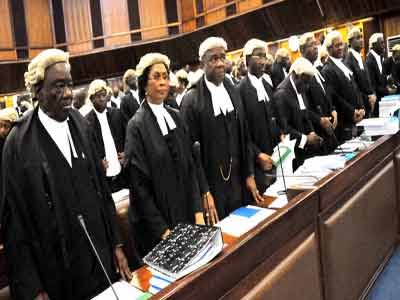
Lagos State’s ban on female Muslim pupils attending public schools in the state wearing the hijab was overturned by the Supreme Court on Friday.

In a 5–2 split ruling, the Supreme Court maintained the Court of Appeal, Lagos judgement from July 21, 2016, which overturned Justice Grace Onyeabo’s October 17, 2014 decision from the High Court of Lagos State.

The lead majority judge, Justice Kudirat Kekere-Ekun, dismissed the Lagos State appeal against the 2016 decision of the Court of Appeal, Lagos, because it lacked merit. 

Justice Tijani Abubakar read the lead majority judge’s decision on Friday.

Wearing the hijab in the Yoruba-dominated region, which is a mixture of Muslims and Christians, has been causing a lot of controversies.

Votes Count! Take note, Nigerian youths

Tordue Simon Targema

One of the most disturbing illusions in the Nigerian political space is the age-long notion that “votes don’t count”. This notion is mainly responsible for wide-scale political apathy among the citizens, especially the youths who constitute the majority of the voting population. A striking irony with the notion, however, is that those who peddle and promote it are active voters who always make sure they vote at each poll- from the ward to national elections! This irony, therefore, exposes the folly of those who accept the notion and, thus, disenfranchise themselves.

Of course, it is no longer news that the Nigerian electoral process is enmeshed in malpractices – from vote-buying to actual duplication of ballot figures. Yes, the enormity of malpractices in the Nigerian electoral system is weighty and serves to sustain this ugly notion that has become a great source of worry today.

Notwithstanding these malpractices, a fact that cannot be contested remains that votes are still essential and determine who wins the election. Yes, this is a reality, and even a casual observation of the Nigerian electoral process justifies it. For example, have you ever wondered why electoral evils such as vote-buying, underage voting, ballot snatching and massive thumbprinting of ballot papers by thugs all thrive during elections? The answer is simple: it is because politicians understand that the final vote-tally matters most and would stop at nothing to ensure that more individuals vote for them!

As a Presiding Officer in one of Nigeria’s most keenly contested national elections- the 2015 general elections, and as a voter at several elections, both local and national, I have sufficient grounds to attest to the fact that votes do not just count, but that politicians also realise this fact and stop at nothing to get their supporters to vote for them. The desperation they usually demonstrate during election seasons to woo voters justifies this. You can, therefore, refuse to vote at your sole expense!

I served as a Presiding Officer in one of the most strategic elections in Nigeria’s Fourth Republic. A popular candidate with a wide fan margin- Muhammadu Buhari, contested against the then-incumbent President Goodluck Jonathan. Buhari and his kingmakers had convinced the masses that they had all the solutions to Nigeria’s numerous problems- which were, at that time, overwhelming like always. This narrative was supported by the fact that realities proved Jonathan to be a clueless weakling who lacked the strategy and tact to successfully navigate the country out of its numerous woes- endemic insecurity, pervasive corruption and deteriorating living standards.

Despite his limitations, Jonathan had a pool of supporters who still believed in his leadership philosophy, sympathised with him based on his developmental strides, tribe, region and religion, and also had the potent privilege of incumbency! Never underestimate the power of incumbency in Nigerian elections. This made the election one of the most highly contested, as the margin between the two top contenders eventually indicated.

But most striking is the fact that technology was introduced for the first time in the conduct of elections – the almighty card reader! This made almost all the difference and took the political class aback during the polls. The political class, sensing that it would no longer be business as usual, embarked on massive mobilisation and canvassing for votes. Money flew in the air- as it has become the custom with elections in the country, gifts and inducements of all kinds – clothes, foodstuffs, livestock etc., exchanged between the political class and the masses to woo them to vote.

I had an experience as a Presiding Officer that made me believe that politicians believe in voting as the surest way to win elections! Stakeholders in my polling unit tried their best to get me to manipulate the outcome of the presidential election but to no avail. I would tactically tell them that I had a template, and any manipulation of the outcome would go against my template. Although I had no problem with that, the results would be rejected at the collation centre! This would quickly disarm them, and I had my way through without any rancour. That way, I finished the presidential election without a hitch from any angle.

By the second election- gubernatorial and state assembly, I had to contend with yet another challenge! The elite had studied the workings of the card reader and decided on how to manipulate the election, but that could only still be possible if they got people to vote- even if they were illegal voters. A particular stakeholder insisted he would convey me on his bike from the collation centre to the polling unit- some several kilometres away from the ward collation centre, which was equally an interior rural area, far removed from the local government headquarters. I obliged.

On our way, he intimated to me of his ambition: he had hundreds of unclaimed voters cards belonging to his polling unit, which he wanted to use. He observed during the presidential election that voters whose cards were successfully authenticated by the card reader and those that the machine could not authenticate their cards due to one reason or the other were eligible to vote.

The card reader operates at two levels: accreditation, which confirms whether a given card belongs to a polling unit or not, and authentication, which verifies that a voter’s biometric records match those of the card they are carrying. Authentication is usually successful once the card confirms a voter’s thumbprint. Where it fails to confirm, authentication is deemed unsuccessful, but the voter can still vote – provided that the card is successfully accredited. The Presiding Officer then fills an incident report form for such a voter. At the end of the voting process, the total number of successfully authenticated cards and the unsuccessful ones is expected to tally with- or at least, be more than the total votes cast, not the other way round.

The stakeholder pleaded with me to allow him to use the cards he was carrying since both those whose biometric records are successfully authenticated and those whose records fail are eligible voters. When I consulted with my team at the polling unit, I discovered that they had already mobilised and were ready to disrupt the election should we reject the bid. As a confirmation, we had early reports from the neighbouring polling unit that the electoral officers were booted out of the village! The Supervisory Officer had to call all of us and seek our tactical cooperation in the interest of peace.

Stakeholders at our unit then embarked on aggressive canvassing for voters- because I categorically told them that I would not allow one person to vote twice, whatever happened! So they had to pay willing young men with no cards to the turn of N500 per voting to use the unclaimed cards and vote for their political parties. Funny enough, all political parties cooperated and brought their supporters to use the unclaimed cards and vote. We had a peaceful voting process afterwards.  

During the 2019 general elections, I had an amusing but similar experience, this time around as a voter and not an electoral staff. The stakeholders of my polling unit had hundreds of unclaimed voters cards belonging to the unit. They undertook to pay each available voter N500 to vote for their parties. My friend was into the game and had to vote as many as four times! In the fourth round, the Presiding Officer warned him to respect himself and not return.

Now tell me: if votes don’t count as purported – or say they don’t matter, why would politicians go that far to get people to vote for their parties? Have you ever observed how desperate political stakeholders are during voter registration? For example, in the first and only voter registration exercise I participated in as ad-hoc staff, I was posted to the village of a one-time Member, the House of Representatives, a very interior village that is hardly accessible.

The ex-Member solely undertook to take care of our welfare; provided our accommodation, a generator for our comfort at night, ensured that we had the best meals and all of that. Why would a man do that if he had known that votes are needless and all he needs to do is manipulate election results during elections?

By my analysis, winning an election in Nigeria today is the responsibility of two sets of individuals within a political party: the individual voters and the elite class. As a voter, your duty to your party and the preferred candidate is to vote – and get as many of your friends as possible to vote for him as well. Once you do that, you have fulfilled your responsibility as a party loyalist and patriotic citizen. Leave the rest to the elite; it does not concern you. Even if your party did not win in the end, the conviction that you played your part- as a patriotic citizen would- is enough consolation.

The greatest disservice many young men do to their favourite political parties and the country at large is to make all the noise on social media while they do not know what a voters card looks like, have never voted and have no intention to vote, after all, wallowing in the illusion that “votes don’t count in Nigeria after all”. This crop of individuals is the major problem we have in Nigeria.

A clarion call to all Nigerian youths as the 2023 election approaches is to disabuse your mindset of this counterproductive notion, register, get your voters card and vote. Votes actually count! Don’t be deceived.

Tordue Simon Targema is a doctoral student at the Department of Communication Arts, University of Uyo, and teaches in the department of Mass Communication, Taraba State University Jalingo. Email: torduesimon@gmail.com.

Nigerian Army fixes June 28 to July 11 for recruitment screening

By MMuhammad Sabiu

The Nigerian Army has released the dates for the 83 Regular Intake 2022 screening process for non-tradesmen and women applicants.

“The state recruitment screening exercise is scheduled to commence from 28 June – 11 July 2022 in all the 36 states and Federal Capital Territory Abuja,” the Army says in a tweeted public statement on Tuesday.

“A high standard of discipline is expected from all candidates. Candidates who violate any instruction during the Recruitment Screening Exercise would be disqualified,” the tweet added.

Applicants have also been advised to visit the recruitment portal at https://recruitment.army.mil.ng for the online application form.