Opinion

Importance of understanding your partner’s love language

By Aisha M Auyo

Love, it is popularly said, makes the world go round. This implies that the presence of love engenders harmony, peace, and tranquillity in relationships.

As the nucleus of the family, which in turn is the pivot of human society, it is very important that true or genuine love exists between the two people who live together as a couple, as in husband and wife.

Do you know the concept of love language? Do you know your love language? Do you know your partner’s love language?

Knowing about these will solve most of the issues that usually rock marriages and our relationships with others.

Love language is defined as a person’s characteristic means of showing affection or care for another. It can also be portrayed as how a person prefers to express love to—and receive it from—a partner. 

If you doubt your partner still loves you, know you are not alone. The fact is, you might be speaking a different love language from that of your partner. 

Relationship expert Dr. Gary Chapman created the concept of love languages in his book The Five Love Languages: The Secret to Love That Lasts

The book explains that to ensure a healthy relationship, it is essential to identify and use your partner’s love language. This will help eliminate miscommunication and allow for a more understanding, harmonious couple. The following are some points to know about love languages to help you on the road to a healthier relationship.

There are five types of love languages: 

1. Words of affirmation.

When words of affirmation are your love language, words build you up. You thrive on spoken affection, praise, encouragement, and compliments. Harsh words and criticism irk and can bother you for a long time.

2. Acts of service.

As a woman, anything your partner does willingly to ease your workload is a sign of love to you. You feel cared for when, for instance, your partner vacuums (or sweeps) before you get to it or makes you breakfast as a surprise. On the other hand, broken promises or laziness can make you feel unimportant.

3. Receiving gifts.

When you speak this love language, a thoughtful (special) gift shows you that you are special. In contrast, generic gifts and forgotten special events have the opposite effect. This love language is not necessarily materialistic – it could be as simple as receiving your favourite snack after a bad day.

4. Quality time.

To you, nothing says you’re loved like undivided attention. When your partner is genuinely present (not looking at their phone, laptop or TV), it makes you feel important. Failure to actively listen or long periods without one-on-one time can make you feel unloved.

5. Physical touch.

Holding hands, kisses, hugs, and other tender touches are your preferred ways to show and receive love. Appropriate touches convey warmth and safety, while physical neglect can drive a wedge between you and your partner. 

Generally, men are people of action, while women thrive on words. If a woman disrespects a man, doesn’t obey his orders, or talks to him disparagingly, it is usually very difficult to convince that man that she loves him, even if she does.

 If you, as a man, spend time, resources, and efforts to make life easier for a woman and make no effort to tell her sweet nonsense, trust me, you may not win her heart. On the other hand, a playboy, with few spoken words like, ‘I love you’ or ‘you’re beautiful’, will win her heart in no time.

 Although some women may be materialistic and prefer gifts and money, some men, too, may prefer a voluptuous or sophisticated woman to a submissive, uneducated one. The examples are endless.

How love languages can improve your relationships

Most of us have one or two preferred love languages – often different than our significant other’s. If you express your love through your preferred love language, the chances are that it goes unnoticed by your partner.

For example, if your love language is gifts, and you often surprise your partner with thoughtful gifts, how does it make you feel when they just have a quick look at your thoughtful present? Meanwhile, your partner hardly values gifts but appreciates acts of service. It would mean the world to them if you did chores around the house instead of buying gifts. So you and your partner won’t feel loved, as there is a difference between what one gives and what the other wants to receive.

Many women complain that their men are not romantic: no hugs, pecks, or holding hands. Some frown at their women when they initiate any of these gestures. Some men find it hard to vocalise their feelings, such as “I love you”, “I miss you”, “you are beautiful”, and “You smell nice” appear to be very difficult for some men. “Allah Ya yi miki albarka” is difficult for some men. The issue here is a difference in love language between the couples. 

If these men go out of their way to provide for the family and make you comfortable, then to them, they’re communicating that they love you. If your man is interested in what you do, listen to your small and big talks, even if he doesn’t say a word, it means he cares about you.

My sister, if your man hardly comments on your clothes or outfits, it means he values your character and personality more than your looks. But if he’s so inclined to your physical appearance, it means you should pay much more attention to how you look than how you behave.

My brother, I know it’s a man’s nature not to vocalise what you feel, but your woman needs to know your love language to please you. Know your love language and communicate it accordingly. Also, try and get to know hers.

Some women love gifts, but this doesn’t mean they’re materialistic. Even if it’s something small, the thought matters to them. She will be happy and submissive. 

Some women love to hear sweet nonsense. These kinds of women do not care about your gift as much as they care about your attention and affection. If your woman is of this type, men, your wealth or gift will not mean much to her. Lack of attention makes her feel unloved.

In conclusion, speaking your partner’s preferred language can drastically strengthen your relationship. Relate with your partner in their love language, not yours, for a better and more fulfilling relationship. Let me stop here.

Aisha Musa Auyo is a Doctorate researcher in Educational Psychology, a wife, a mother of three, a homemaker, a chef, and a parenting/ relationship coach. She can be reached via aishamuauyo@live.co.uk.

BOOK REVIEW: India in the Persianate Age 1000-1765

Author: Richard Eaton

Number of Pages: 489

Date of Publication: 2019

Publisher: University of California Press

In case you’re too lazy to read the book, it is all about the time when Islam was the dominant ruling religion in the Indian subcontinent from the sociopolitical, economic and military perspectives.

This is a very interesting book that, according to the author, challenges some preconceived narratives and stereotypes on the complex interactions between India and the Persian-speaking world during the medieval period.

The book takes a long view of the political dynamics of the Persianate age, discussing the emergence of the Mughal empire, its spread and culmination, and its interplay with other contemporary gunpowder empires: the Ottoman and the Safavid.

Naturally, any discussion on the emergence of the Mughal Empire must include a historical look at Timur, a controversial figure whom I believe many Western authors, unfairly criticize. Of course, there was an entire chapter dedicated to Abu al-Muzaffar Muhi-ad-Din Muhammad Bahadur Alamgir Aurangzeb Badshah al-Ghazi, under whose 49-year reign the Mughal empire reached its peak in terms of glory and geographical extent.

The author builds the bulk of his arguments upon a very deep historical background, and he closely examines the role of Persianate age in shaping religious and intellectual developments in India.

He also discusses the impact of Sufism on Indian society and explores how Persian texts played a crucial role in the spread of Islamic mysticism across the subcontinent. This way, the book provides insights into the assimilation of Persianate cultural practices into Indian religious traditions, such as the development of Persian-influenced styles of devotional poetry in languages like Urdu.

The author, Richard Eaton is an American historian at the University of Arizona.

Shamsuddeen Sani wrote from Kano, Nigeria.

We don’t need change in Hadejia

By Garba Sidi 

Patriotism is something any good citizen of a particular society must practice. Anyone who has no interest in the development of where they were born knows nothing. If we all care more about where we came from and do whatever we can to benefit our society, our lives would be on a great path. That wouldn’t happen without loving society and its people.

As it has been said many times, Hadejia has witnessed the leadership of many politicians as local government chairmen. Still, no one has seen half of what the current chairman, Honourable Abdulkadir Bala Umar, has put on the ground for the development of the people and the town.

Sadly, since the beginning of His Excellency Muhammad Namadi (Dan Modi), the current Governor who won the primary election for the APC and beat his running mate after the secondary election from the PDP, Mustapha Sule Lamido, rumours have circulated that he’s going to step down all chairmen and replace them with his allies, even though the law has already been verified to allow three-year terms, unlike before. Before the end of the reign of former Governor Muhammad Badaru, a bill was signed for an additional year for chairmen’s terms, for which all processes were completed and assigned.

We, the people of Hadejia, don’t support that idea. That’s why I want to bring attention to His Excellency and think deeply before taking that action. If, as you have said many times, you came to get what’s needed for the state and the development of the state is what’s on your agenda, prove it by letting Honourable Abdulkadir Bala Umar rule for a second term because he’s the one Hadejians need to continue developing the town.

They gave you one hundred per cent support during the campaign. They spent their wealth, time, and effort just for you to secure the position. Who could do that to someone they see as a rival? Only those close to you are trying to lead you down the wrong path, which may not bring you anything good in the end. He’s ruling us, and we like his ways, and it is not against anything if you let him rule for a second term.

We don’t need change in Hadejia.

Garba Sidi wrote via sidihadejia@gmail.com.

Preserving our heritage: The dethronement saga in Kano State

By Fatihu Ibrahim

Sometimes, our directionless life in Nigeria amazes me. Although we were once ruled by British colonists, we adopted the American presidential system, which is not only costly but also ineffective for our country.

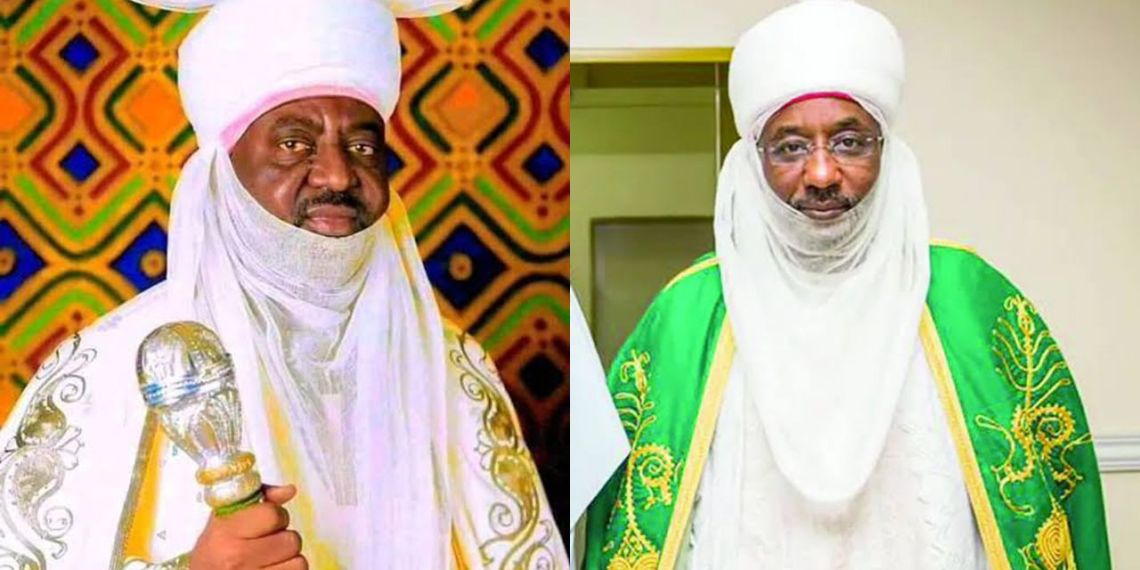
With a heavy heart, I reflect on the recent dethronement of the 15th Emir of Kano, His Royal Highness Alhaji Aminu Ado Bayero. This event marks yet another instance where the government of Kano State has seemingly exercised its power dictatorially. Aminu was dethroned for no reason other than his association with the Ganduje administration. There was no justification for this action other than political disagreements and personal enmity.

This is the second time this government has taken action that deeply affects me. The first was the demolition of business buildings at the Eid praying ground, which caused the loss of billions of Naira worth of properties. This act indiscriminately affected nearly everyone in the Kofar Wambai market, regardless of political affiliation.

Some might argue about Sanusi Lamido Sanusi’s dethronement, which I also believe was wrong. However, at least there were allegations against him, whether true or false. In Aminu’s case, there was no such basis. He has tried to stay out of the political drama, avoiding the turmoil.

One wrong cannot right another. The most troubling aspect of this saga is how quickly the House acted, from proposing the motion to passing the verdict, in stark contrast to the usual legislative process. I recall advocating for gender-based violence laws in Kano State, which took months, if not years, to pass. The double standard is glaring.

The House of Assembly should focus on pressing issues. Our children have performed poorly in the SSCE qualifying exams, and our education system is dire, especially in primary and secondary schools. While I commend the governor for declaring a state of emergency on education, more must be done. Our universities are burdened with a 600 million Naira debt. Yet, the administration is spending 2.7 billion Naira on exotic cars for assembly members, ignoring the plight of the masses who elected them.

Ironically, the member who proposed the dethronement motion has no significant achievements. Many people who share his political affiliation vote for him out of blind loyalty to the party. It’s time we recognise the importance of voting for suitable candidates, regardless of their political views.

Yesterday, it was Sanusi; today, it’s Aminu. Who knows what will happen tomorrow? This cycle of dethronement could continue, with each governor bringing in their emir. What will become of our traditional institutions? Kano is renowned as one of the best Emirates in West Africa, if not the world. If this continues, can we still boast of being the Kano we once were?

Conflicts between the government and the emirate are not new; they date back to the colonial era and span various regimes. The government should find a way to resolve differences with traditional institutions without resorting to dethronement, preserving our history.

Perhaps someday, a governor will return the emirship to the HABE, the original heirs to the throne. There are still descendants of Muhammadu Rumfa and Sarki Muhammad Alwali, the last Hausa king. This, however, is a story for another day. Before anyone questions my loyalty or faith, I am a proud descendant of one of Shehu Dan Fodio’s flag bearers, making me Fulani by genealogy from the Kuninkawa clan.

May Allah bless Kano and its people. May we continue to lead in the political sphere in the north and Nigeria at large.

God bless Nigeria.

Fatihu Ibrahim wrote via fisabbankudi123@gmail.com.

Skills or Degrees? You may need both to thrive

By Nusaiba Ibrahim

For over a year, I have been working alongside other creatives in my department after I assumed my role as a content writer and website manager with a higher education institution. The department in which we work is formally referred to as the Media and Communication Department, but somehow, maybe before I joined, it became known as the Creative Department.

Whenever we attend a meeting, we are termed the creatives. Only along my journey did I realise that two or three of the team members had undergone degrees in disciplines that had little or no bearing on the creative industry. The team—a social media manager, a content writer or website manager, a graphic designer, a motion designer, and a creative support staff member—has one thing in common: we possess skill sets that are within the creative industry. Yet, we all have degrees.

During our usual chitchats, I realised that the social media person I had met was a history graduate with a second degree in the same field. He’s doing wonderfully well today in Lagos because of his exquisite skills as a brand marketer and manager. The new staff member who assumed the role is a biology graduate; the motion designer studied industrial design; the graphic designer and I studied mass communication; and the creative support staff studied quantity survey and obtained a postgraduate diploma in the same field.

From the faculty to operational staff to even students, the creative department comprises geniuses skilled in producing exceptional creative pieces that would be admired by the university’s community and beyond. Hence, the department is admired by many. Simple casual discussions with students and staff, whether in or out of the office, never ended without passionate statements like “I will stop by to learn one or two things” or “I’ll come to learn a few things.”

When I was putting this piece together, a faculty member, a friend of the creative department, had come in to drop a request. While going out of our office, he was tempted to read the title of the article. He read it carefully and said, “I think I disagree with you. I am of the opinion that skills are better than degrees.” I turned and tried to explain that the topic didn’t mean degrees were superior to skills or vice versa. They could be used to complement each other when necessary.

This particular faculty member only left me with more thoughts about the debate. He’s a faculty member with a B.Sc. and Master’s degree in International Relations and is very much appreciated by the institution due to his expertise in teaching. He is yearning for a skill set. I understand he must not have realised he could do well as a public speaker, as that is what he’s most notable for. Hence, he didn’t value his proficiency in public speaking, which is now widely applauded. Later that day, he came into our office to further explain his passion for learning graphic design or motion design.

With these current debates, which have awakened people’s desire to invest more in skill sets, I think we are on the path to building the future we’d envisioned to be far. We are getting closer to a better Nigeria. Nonetheless, you might still need a solid foundation from degrees that will familiarise you with values and etiquette that will propel your career.

I’d say this regarding the book title by Prof. Pantami, ‘Skills rather than Just Degrees’, that stirred the Arewa atmosphere a week ago (which I haven’t read). I’m only saying this based on the evident experiences of the revered scholar and the book title. Sheikh Pantami possesses three degrees: a B.Sc., an M.Sc., a Ph.D., and other academic qualifications. He is also a distinguished Islamic scholar who has been lauded adequately due to his skills in teaching Islamic education through his exceptional preaching.

To showcase the relevance of having both, the Sheikh used his wealth of technology experience to serve as a minister and accepted a professorial award (which has generated so much back-and-forth). In the process of serving as one of the ministers under former President Buhari, he definitely acquired more administrative and political skills, making his career stronger.

So you see, the title wouldn’t have become a bone of contention if people had realised the Sheikh was writing to explain the benefits of obtaining both, but just a little bit of emphasising skills. But works of art unleashed on the world are open to criticism. This is something authors and artists cannot control; hence, the Sheikh faced reactions due to his publications.

One of the things I’ve learned amid other creatives is skills and academic upgrades. I tell you, we’ve learned so much from each other. We often see ideas from similar perspectives when it comes to designs, motion graphics or writing. Three out of four yeses is always a pass for any content. We have become part of one another’s journey and a great team. Despite our skill-based engagements, we’d encourage one another to further our degrees.

Whether you have skills or degrees or both, use what you have to get what you want in life. With degrees, you can pursue a particular area of interest and gain something extraordinary. Likewise, with skills, you can also realise your potential. So, the big idea is to use any of the two to gain something beneficial for yourself.

Nusaiba Ibrahim Na’Abba wrote from Kano. She can be contacted via nusaibaibrahim66@gmail.com.

The return of Sanusi

By Aliyu Nuhu

I have read the amended Kano Emirates law, which was brief, concise and straight to the point, to achieve certain ends. It is a promise fulfilled by the new NNPP government. Engr. Rabiu Musa Kwankwaso had said time without number that if elected, the government would repeal the Dr Abdullahi Umar Ganduje-led Emirates laws.

If Governor Abba Kabir Yusuf signs the amendment into law (which is a certainty), it will remove the present emirs from their offices and return all the Ganduje creation of first-class emirs back to district heads (hakimai). The affected emirs are those of Gaya, Rano, Karaye and Bichi.

The new law gives the governor the power to either re-appoint them hakimai or remove them and search for new ones.

Until the coming of this new law, I thought that Muhammadu Sanusi II’s return was impossible, as it had no precedence in the history of the Kano emirate. But after talking to officials and people who know the workings of the government, it appears certain that Sanusi will return to his throne, in fact, soon enough to preside over the coming Eid-Kabir prayer. 

Nothing is certain yet, but nothing is impossible, thanks to political intrigues and the need for the new government to reverse Ganduje’s legacies. There is no love lost between Kwankwaso, Abba, and Ganduje.

For my own views, I support the amendment of the Emirates laws and the return of a strong Kano emirate, but I don’t support Sanusi’s return as emir of Kano. The current Emir of Kano, Aminu Ado Bayero, is doing well and is loved by the people. 

I don’t support Sanusi’s return. I know he has not learned a lesson and will still come back and meddle with Kano politics, attack Abba and his government, and continue shooting his mouth as if he is an ordinary person. People who sit on the Kano throne don’t talk too much. He must also not try, like his grandfather did to Sardauna, to outshine the Kano state governor.

In history, there was an incident where the then-Emir Muhammadu Sanusi shamed Sardauna in the Kano race course parade ground by attracting a standing ovation with the Sardauna seated. The premier of Northern Nigeria considered it an affront to himself as the Emir stole the spotlight by arriving in full splendour and pageantry, and the whole assemblage had to stand up for the Emir in traditional homage and honour. It was a percussion to the dethronement of Emir Sanusi of Kano.

The grandson Sanusi Lamido Sanusi has inherited those tendencies from his grandfather, and I daresay when it comes to attacking and criticizing the government, Kwankwaso/Abba don’t have the patience, and if you like to call it table manners of Ganduje. They will throw out Sanusi in a blink of an eye.

They said a leopard never changes its colours. But time will tell.

Until then.

Nigerian leaders and the call to save our country

By Yusuf Yusuf 

Sometimes, even the starry-eyed optimist must give up on Nigeria. The way things go from bad to worse in the country today is appalling. The great novelist Chinua Achebe had diagnosed our problem as a nation where he said, “The trouble with Nigeria is simply and squarely a failure of leadership.” The leadership of this country is not doing enough to save us from what experts call a “failed” to a “collapsed” state. We fervently pray for God’s intervention. 

The recent revelation by an ace investigative journalist and maverick writer, Malam Jaafar Jaafar, is mindboggling! It highlights Nigerian leaders’ new joint venture in unrelenting efforts to run this country aground. It shows their insensitivity to the suffering of other Nigerians. How will a government that berates the payment subsidy of basic stuff for its citizenry and whose minimum wage is among the lowest approve such an unsubstantiated rise in the salary and allowances of only a “select group”?

I cannot unravel our leaders’ craze to undermine this nation’s progress. Sometimes, I feel like believing conspiracy theories about them being stooges of other groups with vested interests in our nation. Our leaders fail to grasp that when you cause your country to fail or collapse, you will spend the rest of your life a stranger, the life of a Black Hermit (apologies to the great Kenyan writer Ngugi wa Thiang’o).   

White-collar crimes are threatening the existence of Nigeria. Once upon a Giant of Africa is now a baby learning to crawl. Ironically, a country blessed with human and natural resources will become a poverty capital. The way these resources are mismanaged points an accusing finger to its leadership.

The level of suffering in Naija these days is monumental. The dream of having a meaningful life is becoming a mirage. The hopes of the young people are being shattered by daily reality in the country. Hunger and poverty have become our co-tenants—businesses, whatever the scale, are crumbling. Young graduates with both certificates and functional skills are roaming about our streets.  Sensible minds are afraid of what may happen next. You know, poverty always breeds crimes.

This trend needs to be reversed. More than anyone else, the Nigerian leader has a lot to do to reverse the rot and change the status quo. We can all borrow a leaf from other people’s books.  Nigerian leaders are very good at making allusions to attitudes which promote development in other climes. 

Charity, they say, begins at home. The best way the Nigerian leader can help his people catch up with progressive worlds is by renewing our hopes of the noble decision to cut the cost of governance, as leaders of these nations have done. 

Cutting undeserved official allowances and estacodes, unnecessary long laundry lists of aides and stopping duplicity, inflating figures and collecting kickbacks when issuing contracts could help save now the slim chance of the survival of the nation. 

The earlier the nation’s leadership makes the above noble decision, the better for our collective future. This has the potential to prevent the furtherance of the untold hardships that the majority of Nigerians are going through. These hardships, I am afraid, could make many citizens easy prey to international criminal syndicates, especially young and inexperienced minds, with mere food and money handouts. Nigerian leaders, individually and collectively, need to act swiftly to avert the arrival of our doomsday. 

May God save Nigeria from Nigerians.

Yusuf Yusuf can be contacted via yusufyusufgamji@gmail.com.

Familiarity breeds contempt

By Abdurrazak Muktar Makarfi

In our daily lives, those closest to us often find it most challenging to appreciate or value us fully. Familiarity can breed contempt, as the saying goes. The people we interact with regularly, whether family members, close friends, or colleagues, can sometimes take us for granted or overlook our unique qualities and contributions.

When someone sees us daily, they become accustomed to our presence and may fail to recognise the depth of our character or the significance of our actions. They might overlook our strengths, talents, and achievements because they’re too focused on the routine aspects of our relationship. This familiarity can lead to a lack of appreciation and understanding of our true worth.

On the other hand, people farther away from us, whether geographically or emotionally, may have a clearer perspective on who we are and what we bring to the table. They might see us through a different lens that isn’t clouded by everyday interactions and expectations. They may be more likely to appreciate our unique qualities, offer genuine recognition for our accomplishments, and provide valuable feedback because they’re not as intimately familiar with us.

It is important to recognise this dynamic and strive to balance closeness and distance in our relationships. While it’s natural for those closest to us sometimes to struggle to appreciate us entirely, we can take steps to foster understanding and gratitude within those relationships. 

Communication, expressing gratitude, and regularly reflecting on each other’s contributions can help bridge the gap between familiarity and appreciation. Additionally, seeking feedback and validation from various sources, including those farther away, can provide a more comprehensive perspective on our value and worth.

Abdurrazak Muktar Makarfi wrote from Kaduna via prof4true@gmail.com.

Governor Fintiri and market development 

By Zayyad I. Muhammad 

In systems thinking, infrastructure and social developments don’t occur in isolation; projects and programmes are built using a series of interconnected systems that complement each other’s purposes and functions. Governor Fintiri is applying this approach to his development programmes, projects, and policies.

A typical example is the modernization of the Jimeta Shopping Complex, which aims to connect its purpose and functions with those of the new flyover at the old Mubi Roundabout while also providing a befitting shopping complex at the centre of Jimeta City for economic and aesthetic development as part of the urban renewal programme.

The new flyover at the old Mubi Roundabout will connect travellers to Jimeta’s economic activities and natural beauty. At one end, it will lead to the Gerio Swamp and the historic Jimeta Bridge over the River Benue, offering a glimpse of the area’s natural charm. At the other end, it will provide access to the Jimeta Modern Shopping Complex and ease traffic within the city—economic and social development knit together.

The new Jimeta Shopping Complex will feature a world-class, 24-hour, one-stop shopping mall with high-rise buildings. The redevelopment plan of the complex includes a diverse range of shops, boutiques, arcades, food courts, cinemas, banks, smart parking facilities, Wi-Fi connectivity, interactive displays, and a customer service desk.

Adamawa’s three senatorial zones each boast important urban and rural markets. In the southern zone, spanning from the Ganye grain market to the historic Mayo Belwa market, there are connections to the central zone’s Ngurore cattle market, the Jimeta modern market, the new Jimeta shopping complex, the Jimeta old market, the Yola-town market, and the Hong agriculture market.

In the northern zone, notable markets include the Mubi International Cattle Market, Michika Market, and various weekly markets. Plans are underway to transform these markets into modern trading hubs catering to local, national, and international trade. The markets in the northern zone and the Fufore markets serve as crucial centres for traders from Cameroon, Chad, and several Central African countries.

The redevelopment of the Mubi International Market is already underway, with plans to rebuild and remodel the burned Yola Town Market. Additionally, other major markets across Adamawa State are slated for modernization. The markets will undergo systematic redevelopment following Governor Fintiri’s government’s series-system development process.

Governor Fintiri’s comprehensive plan for market development focuses on revitalising economic activities across the state by introducing modern markets and shopping centres. This initiative aims to create vibrant commercial hubs catering to diverse needs. 

Central to the plan is a robust market redevelopment policy, streamlining bureaucratic processes and attracting local and international investors. Job creation is prioritised, with the goal of stimulating employment opportunities through market revitalization and new commercial spaces.

The policy also emphasises sustainability, promoting private sector participation to diversify revenue streams and reduce dependence on the dollar. Overall, Governor Fintiri’s vision for market development encompasses economic transformation, community empowerment, and a prosperous future for the state.

Zayyad I. Muhammad writes from Abuja via zaymohd@yahoo.com.

The raise and the rays of Prof Adamu Abubakar Gwarzo

By Murtala Sani

The story of Professor Adamu Abubakar Gwarzo cannot be narrated without weaving greatness with success and mixing niceness with kindness, for he is a character of dignity and simplicity. His life is a hub of imagination and determination, creativity and possibility, humanism and activism because he is a master of generosity and hospitality. Gwarzo’s life style is full of optimism, strength, zeal, courage, tolerance with no iota of hopelessness and laziness as seen in his commitments and achievements.

Adamu Abubakar Gwarzo is an origin of Gwarzo Local Government, Kano State, pursuance of knowledge took him to France where he obtained all his degrees. He held Bachelors degree in French, Masters of Arts in French, PhD in French Linguistics, and then PhD in High Education. This gave him a room to become a Professor of Modern European Languages and also a Professor of Leadership. Obtaining dual Professorship is a feat that only a genius can attain.

Gwarzo became a Professor in his early fourties, coincidentally; he was the President of Protection Rights of Journalists of Africa (PRJA) in his early thirties when he was active in the field of Journalism. At the young age he fought for the rights and freedom of Journalists across Africa.

His passion for business and entrepreneurship opened doors for him to get opportunities in France where he made a huge success. He was the first person that founded bilingual University in Niger Republic, Maryam Abacha American University, Niger (MAAUN) in 2013. Seven years later, Gwarzo founded Maryam Abacha American University, Nigeria, (MAAUN) at Kano in 2021 after two years he founded two more Universities in Nigeria, Franco-British international University, Kaduna and Canadian University of Nigeria, Abuja the former is the first Franco-British University in Nigeria.

Therefore, within ten years, Adamu Gwarzo founded four universities making him the first and youngest man that founded four universities in Africa.

Gwarzo is the pioneer President of the Association of African Private Universities due to his dedication to the development of education in Africa. Considering his outstanding contributions to education sector, International Union of Universities in collaboration with Association of African Private Universities gave him an award which serves as commendation to his tireless effort in uplifting education within the African continent.

Again, noticing Gwarzo’s impact on the education sector, International Academic and Management Association (IAMA) inducted him as the Member of its Advisory Board. For the same reason, World Education and Ed Tech 2 awarded him as Innovative Leader in New Delhi, India. These are few out of the numerous awards and honors Gwarzo received from various governmental and non-governmental organizations, national and international associations institutions, schools, communities and students.

The generosity of Adamu Gwarzo led him to establish a foundation with which he can easily touch the lives of many people that are in need of assistance, therefore, Adamu Abubakar Gwarzo Foundation was initiated. The philanthropic activities of the foundation revolve around education health, entrepreneurship, empowerment and provision of infrastructural facilities to communities.

For instance, the foundation donated 66 seater bus to Aliko Dangote University of Science and Technology, Wudil (ADUSTECH), 60 seater bus to Bayero University Kano (BUK) , 66 seater bus to Al-Istiqama University Sumaila, 60 seater bus to Kaduna State Polytechnic and 60 seater bus to Niger University. The foundation also constructed more than one hundred boreholes in Gwarzo Local Government area and some areas within Kano State that were in dire need of water. Again, the foundation undertakes the tasks of giving skills and capital to orphans and masses in order to make them self – reliable considering the economic hardship and the rate of unemployment within the country.

Adamu Gwarzo is an enigma. If you see him dining with the elites today, you may see him feasting with the masses tomorrow. His down-to-earth joyous interactions with the masses make him the hero of the commoners. His capacity gives him the opportunity in rubbing shoulders and shaking hands with African, Arabian and European Presidents despite his young age. No wonder Chinua Achebe said a boy that washes his hand well dine with the elders.

His fluency in Hausa and Yoruba languages, plus his mastery of French and English languages speaks volumes of his intelligence. He is peaceful and tolerant because he is he is neither a racist, nor a tribalist, nor a religious jingoist. Muslims, Christians and Jews have no problem with him as seen in his constant navigation to almost every continent of the world. In his entourage, there is no separation between Sunni and Shi’ite believers, therefore, Qadiriyya, Tijjaniyya, Shi’ites and Izala followers work closely with him without segregation. He embraces the actors, musicians, footballers and all sorts of celebrities or legends that swarm around him without stigma.

Adamu Gwarzo is heterogeneous, as a Pan- African, he named MAAUN’s Senate Building after Nelson Mandela, the former South African President and activist that fought against the subjugation of the black people under Apartheid system of government. He named MAAUN’s President Building after Thomas Sankara, that revolutionist that served as the President of Burkina Faso. He named MAAUN’s Deanry Block after Kwame Nkrumah, the first President of Ghana and nationalist who fought for the independence of the country. He named MAAUN’s Library after Murtala Ramat Muhammad, the patriotic Nigerian General who was assasinated on power.

Furthermore, as an advocate of girl-child education, he named MAAUN’s Social Centre after Magajiya Danbatta, the legendary female singer who promoted girl-child education in her songs. As a Philanthropist, he named MAAUN’s School of Health Sciences after Aminu Alhassan Dantata, a legendary business man and iconic philanthropist. As a non-partisan, he named MAAUN’s school of Social and Management Science after Atiku Abubakar, the former Vice president of Nigeria and former Nigerian Presidential candidate under PDP. He named the Association of African Private Universities (AAPU) Secretariat Building after Senator Rabiu Musa Kwakwaso, the former Governor of Kano state and former Nigerian presidential candidate under NNPP. He named MAAUN’s School of Law Building after Remi Tinubu, the First lady of the Nigerian President, Bola Tinubu, who became President under Apc. Reciprocally, streets, buildings and schools were named after him by the communities, institutions and schools that benefitted from his philanthropic gestures.

In appreciation of Adamu Gwarzo’s friendly and kinship relationship with people he interacts with, Sarkin Hausawan Turai, a leader of Hausa community living in Europe turbaned him as Wazirin Sarkin Hausawan Turai. A Hausa community living in Agege, Lagos, turbaned him as the Sarkin Zumunchi of Agege. In Niger Republic, African Aminci Cultural Association Niger crowned him as the Sarkin Yaki da Jahilci na Afrika. This is in tune with his ambition where he stated that his ambition is to sponsor the education of one million people.

Currently, Maryam Abacha Amercan University Nigeria (MAAUN) is the 4TH best private University in Nigeria, 17th in Africa and 854 in the world, according to the AD Scientific Regulatory Ranking Body for global Academic Institutions. The ranking is based on capacity in Research Inputs /Outputs, Quality Teaching Aids (Faculties and Facilities), Conductive Atmosphere of Learning, Internalization and Collaborations, Students /Staff (Academic and Non – Academic), Positive Interpersonal Relationships, Community Services and Support, Human and Infrastructural Developments that fit with global standard.

Murtala Sani writes from Gwarzo Local Government of Kano State. He is also an academic staff of Kano State Polytechnic, Department of Basic and Remedial Studies.