Opinion

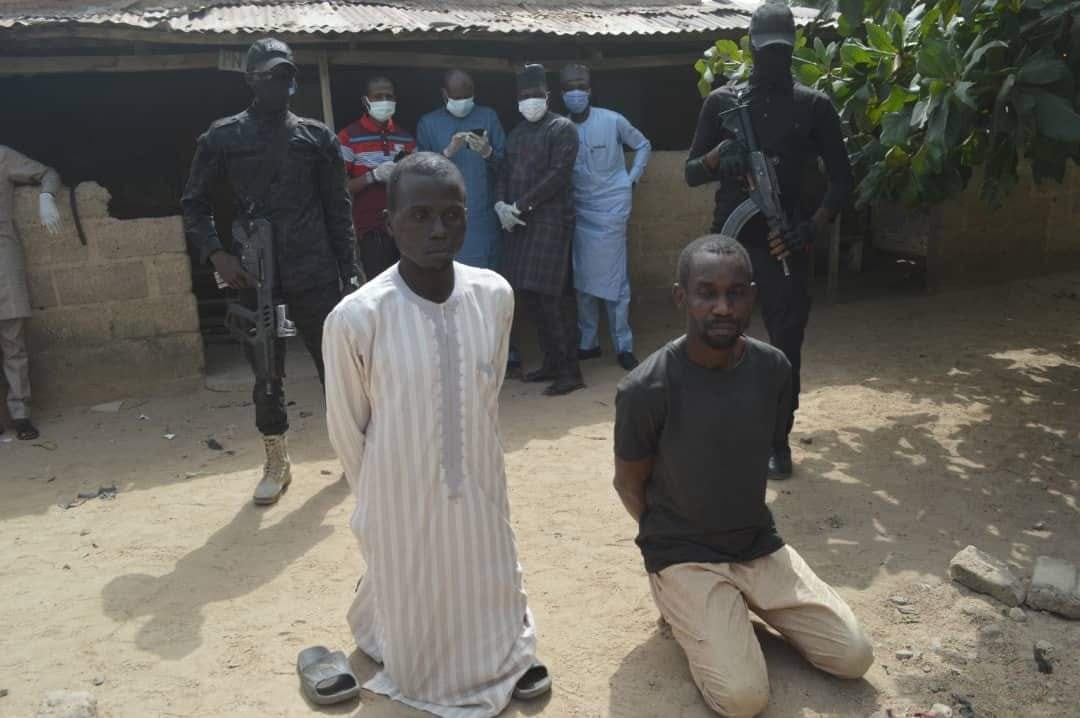
The dilemma of being a hostage in the kidnappers’ den (I)

By Alkasim Harisu Alkasim

If you are eating like a horse, learn to eat like a bird because once in the abductors’ den, you will never gain enough to eat. Your thighs, hips, and cheeks will slenderise. Recently, nothing devastates me like the story of three abductees. Still, I was wondering how in this world a person would choose to win his living either by robbing, kidnapping, etc. and feel okay notwithstanding. This huge misfortune leaves me wallowing in confusion. 

The story opens with a taxi driver, a mother, and her daughter chartered to convey them to some place in Kaduna. The woman was also in the company of a young man, her close relative. The woman is a do-gooder because her trip was bound for a place populating the poor. She was travelling there to distribute goods and other gifts to the needy. But, alas! The goody-goody gesture of this fortysomething mother suffered the sabotage and heartlessness of a cruelty-ridden lad who also doubles as a relative. He has made his bed and must lie in it because he must reap what he has sowed when the authority arrests him.

The incident communicates a misfortunate and the truth we are no longer safe even in the fellowship of friendly people, our blood included. Society abounds with criminals starving and drowning in the urge to make megabucks. We are just between Scylla and Charybdis. Our desire to live beyond our means transforms our societies into hell. And all hell breaks loose when people choose to not live within their means. We want to cut ties with poverty by living a prostitute life. This is the path many youths have picked and chosen for themselves. 

One of the kidnap kingpins, to whom money means nothing, told the kidnapped driver that should he get a house to buy in the G.R.A, he would buy it no matter how expensive, provided the government would let him walk alone. That an abductor had such an intention demonstrates what a menace kidnap is. The kidnapper obviously envies the life his kidnappees will continue to enjoy once he releases them. This afforded him the idea of thieving out of the kidnapping den at the slightest opportunity. To hell with such a life of people abductors.

The kidnappers are exceptionally talented at weaponsmithing. They manufacture local double barrels that can gun down five people at a time should they vertically line up. When asked about the number of the kidnappers at the den, the driver-cum-abductee said, after swearing, that they amounted to a thousand. I am still reeling from the zinger of hearing this harrowing story. 

Rest assured, the desire to make beaucoup bucks overnight is the Newton apple pushing these low-IQ people into kidnapping. The kidnappers’ den is not a home away from home. But instead, a Jahannam on earth. The lust for money triggers kidnapping to catch fire in the North. Bitten by poverty, many youths choose to become repeat-offending abductors.

If their prey misbehaves, the abductors eat him for breakfast. Nobody can dream of getting a breakfastcupful of tea or milk in the morning, never mind chips or fried yam. When their hostages are hungry, these wrongdoers give them a small mango to lick and a bottle of water to share among the five or even more. There is always not enough to eat. When everybody is silent, nobody should break the silence. Otherwise, the kidnappers will break his balls. 

Certainly, kidnapping makes a song and dance about our wobbling social structure. What a prettily dilemmatic situation that destroys our social fabric! This menace is never a job in which one can make a name. The government should make an example of them to the teeming public when it arrests them. The police should feel their collar and take them to court for proper sentencing. Frankly, from the perspective of readiness and sufficiency, we are still in dire need of security agents. But, of course, we need enough sense to pound sand into the rathole. 

According to a victim, a few security personnel would underwhelm the outpouring number of the kidnappers because they are enough to choke a horse. The situation is enough to make the angels weep. Thus, the government should provide its people with enough security to avoid throwing them to the wolves. The kidnappers are armed to the teeth while the hostages are naked as the day one entered the world. These baddies have got screaming guns fit to wake the dead. 

The driver said there was a time when the kidnapppers narrowly escaped soldiers’ arrest, which compelled them to change den by forcing their victims to walk to a distant place on foot. In the kidnappers’ den, no one can stand on their two feet because horror looms. The den presents a panorama of difficulties. The kidnappers deny the hostages water as if they were drought-tolerant trees. The faculty of these people must not be intact due to their bestiality and inhumanity. The driver, who shares no blood with the woman and her daughter, established a kindred spirit with them. The trio began to bear the undertreatment they were suffering. 

The kidnappers cannot eat, wear, or sleep where they want. They are only trousering, potting and sacking money they cannot enjoy. They do their utmost to herd the kidnapped by being all eyes and ears with them. They do not give ear to anything unless it is relevant to their job. The kidnappers’ lair is where the sexy ladies cannot hussy up, nor can they keep themself to themself. It is where everybody contemplates escaping, and one can quickly get gunned down if they fail to fall to command.

It is also where the hostage is to eat out of the palm of his master’s hand. A place where no one should drive the kidnappers up the wall. A place where downpouring of torture is a common occurrence. A place where everybody is constantly at a loss for words. Maltreatment and suffering are the only hood of this hell on earth. These abductors rape female hostages in a very unacceptable way, even to women selling sex.

The driver said that he had absolutely lost hope in living when they were relocated to another hideout as the security agents nearly ambushed them. More so, in the early days of their kidnapping, the kidnappers swore to kill him and the daughter of the Hajiya on account of I.D cards they saw them carrying. The abductors mistook the cards for police I.D cards. The driver and the girl insisted that they were not police officers and that his card was a driving licence card and the girl’s was a school’s. They did not leave them alone until they asked one abductee to clarify the situation for them. Still, they partially agreed with the cards. 

To be continued.

FACT-CHECK: How true is the claim that 90% of Northerners are not on social media? 

By Muhammed-Bello Buhari

Claim: Atiku, Nigeria’s former Vice President and the Peoples Democratic Party presidential candidate, Atiku Abubakar, claimed that 90 per cent of northerners are not on social media while responding to a question in an exclusive pre-recorded interview on Arise TV aired on Friday, July 22.

Atiku made the claim, suggesting that the Labour Party cannot make inroads in northern Nigeria. He played down the possibility of Labour Party’s presidential candidate, Peter Obi, causing an upset to his presidential ambition during the next year’s general elections.

His words:

“It is very difficult to expect a miracle to happen simply because Peter Obi is in the Labour Party. After all, they were saying through social media [that] they had more than one million votes in Osun state.

“But how many voters turned for the Labour Party? And then again, mark you; you’re talking about social media. In the north, 90 per cent of our people are not tuned to social media.”

With this claim, social media was awash with all sorts of counterclaims. Nigerians on Facebook and Twitter knocked the former vice president out for his comment, alleging that such a claim is untrue.

Verification:

According to the Digital Report 2021 by Datareportal—one of the world’s most trusted sources of social media data, insights and trends—the number of social media users in Nigeria was equivalent to 15.8% of the total population (208.8 million) in January 2021. This means there were 33.00 million social media users in Nigeria in January 2021.

This same report recorded the total population of the northern region to be 128.17 million. This is also in line with the National Bureau of Statistics figures on Nigeria’s demographics, using data from the National Population Commission.

So assuming that the divide of the social media users in Nigeria between the south and the north is 50-50. i.e. of the 33 million users, 16.5 million are northerners. This means that of the 128.17 northerners, only 12.9 per cent are on social media, representing 87.1 per cent are not on social media.

And given the apparent disparities in internet usage between the north and south due to market size, urbanization, economic development, income, telephone density and employment, which are the major contributory factors to the divide as reported in the research conducted on the digital divide in Nigeria, there’s at least a 60-40 percentage divide between the south and north in terms of internet and social media usage.

As such, 40 per cent of Nigeria’s 33 million social media users is 13.2 million. This means that of the 128.17 northerners, only 10 per cent are on social media, which also means that 90 per cent are not on social media.

Verdict: Atiku’s claim that 90 per cent of northerners are not on social media is backed up by data. Findings have shown that only 10 per cent of northerners are on social media. Therefore, the claim is valid.

Muhammed-Bello Buhari is a freelance fact-checker based in Kaduna and can be reached via embbuhari@gmail.com.

Inside Adamawa Politics: Binani, Fintiri’s greatest nightmare

By Abubakar M. Nyakos

Upon the emergence of Most Distinguished Senator (Engr.) Aishatu Dahiru Ahmad Binani as Adamawa State APC gubernatorial candidate, His Excellency Rt. Hon. Ahmadu Umaru Fintiri started acting like a wounded lion who runs after his prey not to satisfy his hunger but to gratify his anger. He started blocking some beautiful chances of Adamawa citizens reaping the dividend of democracy through the workaholic Senator. 

He has forgotten that giving back to society and coming to the rescue of people when necessary is a habit that becomes lifeblood to Binani, for it flows through her veins. She can’t fold her hands and see people suffering without doing the needful. It’s unlike her. She is an empathetic politician who always holds her people dearly and very close to her heart. No amount of pressure and effort from the opposition can change that. 

Fintiri’s deep-down sense of insecurity proved to every sensible Adamawa citizen and me that he is far behind Binani in politicking. I used to fancy his political tactics and antics but not anymore. He has reduced himself to an ordinary local champion who manoeuvred himself into the Government House just because of the then APC internal crises. He knows that’s what paved the way for him. 

We are all aware that Covid-19 has globally interrupted pilgrimage for two good years. As a governor with high regard for the welfare of his dependents, he is expected to inspect, renovate and make all the necessary things needed at the Hajj camp before this year’s Hajj activities. 

Unfortunately, he failed to do that. When journalists arrived there and began to ask the pilgrims some questions regarding welfare, etc., they bitterly expressed their grievances, which got to the ears of Senator Aishatu Dahiru Binani. She instantly responded to the situation and provided all required at the site: mattresses, mosquito nets, solar panels etc. She did all that within just four hours. Isn’t that gesture laudable? I believe it is. 

Instead of Governor Ahmadu Umaru Fintiri to accept his failure and laud the revered Senator without bickering, he opted to rent a hotel and order the pilgrims to vacate the place which Binani made conducive for them. What kind of politics is this?  Where was he? Why didn’t he do the needful on time? 

Consequently, Binani constituted a committee that could facilitate and ease some unseen hardships that  Adamawa pilgrims might encounter in Saudi Arabia. The committee was saddled with the responsibility of cash disbursement to pilgrims and the like. 

Through the Executive Secretary of Adamawa  State Muslim Welfare Pilgrims Board, the governor tried to halt and frustrate the process in several ways because of their selfish interest.

1. They refused to give Binani’s committee the list of Adamawa pilgrims

2. They ordered Adamawa Scheduling Officers not to partake in the process.

3. They threatened both scheduling officers and Adamawa pilgrims that there would be repercussions for not following their order. 

That habit alone must make anyone pause and rethink when addressing such a self-centered fellow as a politician. Talk more of giving him a mandate. Instead, he always thinks of himself alone. 

Instead of working on integrating himself, he is busy attracting more enemies through dictatorship! 

Nonetheless, Binani’s committee used I.D. cards to identify Adamawa pilgrims to distribute the money, and Adamawa pilgrims collected what was meant for them and shunned the directive given. 

They thanked Her Excellency, Aishatu Binani, for her untiring support and commitment to the welfare of Adamawa citizens. 

The pilgrims finally prayed for Binani’s victory in 2023 and pledged allegiance to support the Senator with their full chests.  May Binani succeed, amin.

Abubakar M. Nyakos wrote from Adamawa via mnyakos@gmail.com.

Should the Northern youth “Japa” too?

By Hassan Ahmad

The term “Japa” is slang used by Nigerians to refer to the continuous exodus of young Nigerians to the developed countries in search of greener pastures with the intent of not returning home. Japa is widely accepted in southern Nigeria, with many youths leaving Nigeria in the last decade. The justification for this mass departure is not farfetched. They include unemployment, insecurities, incessant strike actions by university teachers enabled by the government and other social problems cumulatively, among others. But on the other hand, the direct opposites of these push factors are the pull factors that also encourage it.  

The southern region of Nigeria housed the larger percentage of industries available in this country, with a better literacy rate and a better standard of living. 

However, in the North, the story is by far worse. Topping the list is insecurities from the Boko Haram ravaged northeast to the bandits’ taking over of northwestern villages and the ethno-religious conflicts in the north-central states. Don’t forget farmer-herders’ conflicts, too. 

Aside from insecurity, the poverty rate in the North is alarming – constituting 86 per cent as of 2021. In addition, illiteracy is prevalent, and there is high existence of unemployment as well as under-employment.  

From the above, we’ll understand that northern youths have more reasons to Japa and never look back, but that has not been the case. This can be understood to play out this way for obvious reasons: deep kinship relationship, lack of understanding of the evolving nature of the 21st century, fear of the unknown, ill contentment and others. 

The underlying issue is that it’ll no longer take long before the northern youths follow the footsteps of their southern counterparts and get fed up with Nigeria, and look beyond the seas and deserts to better their lives. Oh!  It has started already. Thousands of youths are already risking their lives through the Sahara desert with the hope of reaching Europe or the Middle East. Many others who were chanced to have acquired scholarships overseas ended up staying in those countries to pursue a living. This creates two scenarios.

While the educated northern youths get out of the country legally through scholarships and fellowship, the less educated and uneducated look for their ways illegally and, in most cases, lose their lives or ending as sex slaves. We lose our best brains to the developed world while losing our uneducated ones who can alternatively be a source of labour to the graves.  This means that the youths who are supposed to carry the northern and Nigerian dream (if there is any) are giving up already.

Where is the Northern Governors Forum? Have they provided a roadmap for the development of the North, how to tackle insecurity, unemployment, poverty or even improve education? 

Or the Forum is meant for negotiating power between the ruling elites? So why must it be far away Lagos that’ll have the foresight to partner with Kebbi in producing Lake-rice? Why not Kaduna, Kano or Nasarawa?  

Why is the same Forum quiet while their young people are out of school for an avoidable strike?  North is the most hit by the ASUU strike because 90% or more of her students depend on public universities for their education. Is this too hard for the governors to understand? Have they ever intervened? 

Northern leaders should rise to their responsibilities before it’s too late. The outside world is open to all but cannot afford to embrace us all. So it is either they make the North a home for the younger ones, or we look for another home. There is no sense in sticking to the parents that humiliate you all your life. 

As things are, if there is an opportunity, let’s Japa too, legally. 

Hassan Ahmad Usman writes from Lafia, Nasarawa State, Nigeria. He can be reached via basree177@gmail.com.

How much is your salary?

By Hamza Sulayman, PhD

One of the most difficult questions to answer among Nigerians is “How much is your salary?”. It does not matter who asked the question; the answer is always tricky. It might be a father asking his son or daughter after spending a fortune paying for their education, or a wife asking her beloved husband. The reason behind this varies from one person to another.

I came across a US-based content creator (IG: americanincome) who moves around the cities of the US asking strangers about their annual salary. To my surprise, they always answer right away and specifically to the last dollar. He asked some follow-up questions, like what did you study? And from which university, how many years of experience do you have? And what advice will you give someone who wants to follow in your footsteps?

To me, that type of content creation is amazing because it provides the young generation with factual data on how they can achieve their goals, which is much better than what the guidance and counselling departments of schools and universities can offer. That is, if the department exists.

My recent interaction with some youth led me to believe that they are after the money or, as they say, “secure the bag”. So, for example, if you are willing to get $150,000 per year, you should work as a Data Analyst, Model, or Software Engineer. If you are humble, you can be a high school teacher and earn about $42,000 a year. If you have a higher taste, you can be a doctor or dentist and rake about $200,000 to $300,000. There are other non-formal sectors with high income, like a professional barber earning $300,000 (I was surprised too) and a sneaker dealer earning $150,000. Top on the list was a luxury watch seller that makes $1,200,000 yearly.

Enough with the numbers, can you answer the question? How much is your salary? Many people cannot answer the question because they don’t even know. After all, what they received is not what is on their offer/pay slip, or the amount is laughable. Some people don’t answer the question because of what people might expect from them. I remember one of my colleagues. He told me that when the salary scale of academic staff was circulating on social media, it became a blessing for him because his family and extended family saw his salary as a Professor and decided to reduce the responsibilities placed on him.

Although in Nigeria, what you study is not entirely relevant to where you work, having a guidance and counselling advisor or a mentor is still advisable. Find someone you want to be like in the future and ask him to mentor you. Learn from their strengths and weaknesses and be a better version of yourself. Lastly, choose a career path that will make you happy, whether it is about the monetary aspect or otherwise.

Hamza Sulayman is a postdoctoral research fellow at Zhejiang University, China. He can be reached via hamza.sulayman@gmail.com.

ASUU’s undying struggle

By Auwal Mustapha Imam, PhD

Nigerian politics should copy ASUU politics. There’s no union, party, association, society or any group in Nigeria that has the structures as firm as that of ASUU. None has united, tolerant and harmonized structures as ASUU. ASUU is mindless of the religion, region, ethnicity or tribe of who becomes its leader, the only thing ASUU members are after is, someone that has the capacity to face and challenge any inappropriation, misconduct, injustice or insincerity from the powers that be.

The leadership has been like that since its inception. No one cares wether or not the leader is a Muslim/Christian or any tribe. If the leader is a Christian from the South, he challenges the powers and addresses the problems of every Muslim lecturer from the North, devoid of consideration of his faith. This goes vice versa.

When my teacher and mentor Dr. Nasir Isa Fagge, a Muslim from Bayero University, Kano was the President of ASUU, he faced and challenged the then President Goodluck Ebele Jonathan, a Christian from the South. None of either ASUU members or Nigerians complained that he was harsh because the President was a Southern Christian. All they were after was the result and the struggle.

Now that President Buhari, a Muslim from the North is the President, the two consecutive ASUU leaders Professor Biodun Ogunyemi (immediate past) and Professor Emmanuel Osodoke (the present) are fiercely challenging the Buhari’s government for the betterment of education in Nigeria, where both Muslims and Christians from all angles of the country can benefit. None of either ASUU members or Nigerians are complaining that the strike lingers because a Northerner is the President. All we are after is the result and the struggle.

Whereas, in Nigerian politics, one’s religion, region and ethnicity are scrutinized and looked at first before even his intellectual capacity. This has thrown us into a deep mess that led us to underdevelopment and public service abuses. Every organization recruits not based on merit, but connection, relationship and nepotism. This can never allow us to establish a structure that will ensure transparency and good governance.

ASUU’s structure, opinions and decisions are both descending and ascending. All deliberations from the local chapters ascend to the zone, then to the national. Likewise, all communications and decisions descend from the national to the zones and to the local chapters. Every member of ASUU is a stakeholder and all opinions are listened to and respected. This is why it is difficult for government to break the structure and penetrate with any inducement to corner the loyalty of some members to the agreement of government’s policies against ASUU.

ASUU’s structure enables unity and enforces loyalty to decisions. If your voice is heard and respected, you have no reason to go against the decision you took part in. This is why every member is loyal.

My master, Professor Mutari Hajara Ali of Physics Department BUK, once told me how he used his Vespa then for commercial “achaba” to survive the harsh policies of the then government of no-work-no-pay against them. I know many lecturers who are currently into commercial transportation services with their vehicles to survive the policy and endure the strike.

To all ASUU members, struggles and sacrifices are part of the job. Hence, nor starvation can force ASUU to retreat, unless its demands are met. Many of us are into hardships, but to us, the struggle needs to reach a logical conclusion rather than back down because of hunger.

Aluta Continua!

How philanthropists support the crusade against drug abuse in Kano

By Usman Ibrahim

For a long time, Kano State has battled the enormous increase in drug abuse and trafficking of illicit drugs. Most commonly, many people directly or indirectly abuse drugs. In the past, only male youths aged 18 years and above were the major players in the business. But these days, it is more heart-aching that underage boys and girls, including married women, are into drug abuse, and it is increasing by the day and assuming top spots on the statistics.

People often see drug abusers as jobless who consume the drugs to forget their problems of unemployment and poverty. The precarious situation makes them steal from their families, friends, and even their communities.

Drug addicts are particularly vulnerable to politicians who utilize them to cause havoc during elections and protect them from the wrath of the law after their arrest. When they don’t get the opportunity to become the “boys” of the politicians, they resort to their communities and continue to cement their legacies as the greatest criminals of their time.

In addition, they sometimes make it uncomfortable for people in their communities to commute to some streets. Unfortunately, though, others see drug abuse as something one chooses to do due to peer group influence. Unfortunately, even teens living in stable and affluent homes are also into this drug addiction – many rich teens are into drug abuse despite all the care their parents have shown them.

Badawa in Kano State is one of the communities notorious for drug abuse. It is an intensely multi-ethnic setting harbouring diverse ethnicities but deeply troubled by illicit drug sales and consumption for over a decade. In an interview with a teenager into selling these intoxicants, he admitted that he couldn’t stop selling illegal drugs because he earns a lot from it, and many people from distant places come and buy from him at expensive rates. I also asked him whether he was aware of the anti-drugs agency or the vigilante groups who would arrest him, and he said he was aware. Still, he cannot stop because it is the only way to source his income.

But a philanthropist defies all odds to change existing narratives in the community. Seeing the height of the problem has made the anonymous Good Samaritan solve the menace. With his own money, he purchased three cars, walkie-talkies and uniforms to help arrest hard drug dealers and employed some men in the community’s vigilante group to assist in the fight.

According to Badar, one of the vigilante members, “At least we have arrested more than ten drug dealers in which some of them are in prison”. However, he also states that their work involves too much risk because some drug dealers walk along with knives, sharp horns and machetes, among other dangerous local weapons. So they are always cautious in handling their operations. And they work hand in hand with NDLEA to give them more information about the community.

The National Drug Law Enforcement Agency’s (NDLEA) significant role is exterminating illicit drug trafficking and consumption in Nigeria. And also, it is for the sake of protecting the country from the dangers of hard drugs. Since the agency’s establishment in 1989, the war against hard drugs has been increasing yearly. The agency tries its best to tackle drug trafficking and importation of hard drugs such as cocaine, marijuana, cough syrups and other hard substances. However, the activities of philanthropists cannot be underscored because of the rapid increase in violence, especially during elections and among drug addicts in communities.

Therefore, combating drug abuse as well as securing the lives and properties of Nigerians needs collaborative efforts between security agencies, community leaders as well as philanthropists. If there is a time when these collaborations are desperately needed, it is now.

Usman Ibrahim is a level 200 student from the Department of Information and Media Studies, Bayero University, Kano. He can be reached via usmannibrahim66@gmail.com.

From false dignification to blasphemy: My take on Abduljabbar Nasiru Kabara (II)

By Alkasim Harisu Alkasim

I think Abduljabbar hires out for the Western world. AlhamdulilLahi! Our learned scholars bird-dogged his heinous acts and pulled him down. In his illusions, he aspired to transform Islam and thought he could play sports with the scholars of Kano. He did this to buy himself a public advantage and attention. In his book, Minhajus Sunnah, the erudite scholar Ibn Taimiyyatal Harrani quoted Nana A’isha thus: the Prophet says that he who seeks public attention by sinning against Allah, Allah will draw the attention of people to him and make them love him. But in the end, Allah will turn people against him … (My paraphrase).

Truth be told, Abduljabbar is not well-read. As of late, he was asked by a government lawyer about his studentship. He affirmed that since his father’s death in 1996, which is 26 years now, he has stopped learning before a teacher. He has only been revising for all that long. For your information, when his father died, Abduljabbar was in his mid-twenties. I can bet my last dollar that, at that very moment, he could not have completed the study of the six books of hadith. I also doubt if he has ever read a single many-volumes book from start to finish. A person who knows Abduljabbar very well and shares blood with the family of Sheikh Nasiru Kabiru once told me that the former had not completed the jurisprudence book titled Almukaddimatul Iziyya when he fled the majlis his father taught people. 

How Abduljabbar translates and misinterprets prophetic traditions that do not sit well with his faulty faculty shocks many people. This leads him to ascribe to the Prophet what even the likes of Abu Lahab, Abu Jahl, Walid bn Mugira had never done to the Prophet. His mistranslating of prophetic traditions illustrates how he lacks the nitty-gritty of translation. The fact that he has never taken his time to be adequately mentored destroys him. I have never seen as big a laughingstock as Abduljabbar. He thinks he is glorifying the Prophet despite all these horrible things. How can one magnify the Prophet by describing him with names even Satan will feel angry when one addresses him with?

I suspect this man is selling the secrets of his religion. I was wondering if a sensible person would ever do this. I can remember a tradition he once cited that reduced the Prophet’s charm. The first time I glanced at it, I got physically numb. As I checked the reliability of the reporters in Alhafizuz Zahabi’s book Mizanul I’itidal fi Naqdir Rijal, the hadith turned out to be counterfeit thanks to the weakness of the reporters. Sure enough, such traditions he falsified are mind-boggling and should not be attributed to the person of the best of Allah’s creatures. Therefore, I advocate his refusal of such traditions.

What is funny with Abduljabbar here is his ignorance of the fact that there are books whose singular themes are the history of reporters of hadith. There are also those books that did not necessitate only authentic or sound traditions. Thus, one can find all sorts of traditions ranging from the authentic, sound, and weak to even false ones. While giving the history of a reporter, the scholars mentioned some of the traditions they reported through him, directly or indirectly. If the reporter were weak, they would exemplify (a) weak (a)hadith he had reported. Such books comprise Tariku Baghdad by AlKadibul Baghdadi; Tariku Dimashqa by Ibn Asakir, to mention a few.

What motivated the above scholars and their likes to write down these ahadith was their thirst to show their absolute lack of authenticity. They brought forth the ahadith under the history of a particular reporter, as said earlier. For instance, any reporter of hadith, whether strong or weak, provided he had ever been to either Baghdad or Dimashqa, they wrote about him. 

Additionally, there are hadith texts whose authors preoccupied themselves with reporting ahadith a la classifying their teachers in alphabetical order. Such authors did not care to report even false ahadith they heard from their teachers. For instance, AlMuujamul Kabir, Ausad and Sagir by AdDabarani. Therefore, one can say it is a sin to report or mention a false hadith. Thus, it is noteworthy that such hadith scholars reported counterfeit traditions to show the world their falseness for people to avoid them.

There are books singled out to mention only false traditions, such as Abdullahi Bn Adiy’s book Alkamil fi Du’afa’ir Rijal, etc. Strangely, Abduljabbar cited ahadith from this book, not knowing that it was purposely written to give accounts of weak hadith reporters. This faux pas has illustratively emphasised the ignorance of Albduljabbari. Therefore, this and other shockers are enough to discredit his scholarship.

The Scholars’ Verdict on Blasphemy

Doubtless, the abominable utterances Abduljabbar has made against the Prophet demonstrate him as blasphemous. Like it or not, he is a blasphemer who has tried to tarnish the image of the Prophet, his companions and their righteous followers. His badmouthing of the religion of Islam cannot be reduced to writing. The extent to which his muddy utterances have reached in reducing people to tears is enough to tell you about the gravity of the situation. A young girl listened to one of such unprintable assertions of this fake scholar and immediately broke into tears.

Indeed, any Muslim that blasphemes against Allah or His Prophet deserves death. After citing many other scholars, Iyad bn Iyad bn Musa and Ibn Taimiyyah ruled that any Muslim that blasphemes against the Prophet will be condemned to death even if he repents. His repentance neither spares him nor assures him Allah’s forgiveness. Contrarily, if a nonbeliever blasphemes against Allah or His Prophet, he can be spared if he converts to Islam. Otherwise, he will go to the gallows. 

Last, the right action should be taken against any blasphemer regardless of their rank in society. This is to make people revere the Prophet all the more and watch their tongue. May Allah guide us, amin.

Alkasim Harisu Alkasim wrote from Kano via alkasabba10@gmail.com.

Antimicrobial resistance, the quiet pandemic

By Aminu Shehu Karaye

You wake up at midnight with a running stomach, all sweating and with a terrible headache. You surrendered that it was typhoid and, of course, opened the first aid shelf and brought out some drugs to take. It was amoxicillin for typhoid and tetracycline for the running stomach. But you remembered that every Nigerian has got some malaria, so you brought out the artemether and took it also. However, are you aware of antimicrobic resistance?

Even among the literate, only a few understand the effects and dangers posed by antibiotic resistance. Especially in Nigeria, where awareness is low, the magnitude of antibiotic resistance is expected to increase considerably over the coming years due to excessive use of antibiotics and other practices that are said to trigger antimicrobial resistance.

Antimicrobial resistance (AMR) is a general term used to describe the ability of microorganisms, including those that cause diseases (pathogens), to resist the effects of drugs that were once used to kill them or slow their activities. AMR is a worldwide concern and should be taken with all seriousness. The UN ad hoc interagency coordinating group on antimicrobial resistance warns that if action is not taken, drug-resistant diseases could cause 10 million deaths annually by 2050 and damage the economy, similar to the 2008-2009 global financial crisis.

Also, by 2030, AMR could force up to 24 million people into extreme poverty. The World Health Organization identified misuse and overuse of antimicrobials; lack of access to clean water, sanitation and hygiene (WASH) for both humans and animals; low-grade infection and disease prevention and control in healthcare facilities and farms; lack of access to quality, affordable medicines, vaccines, and diagnosis; lack of awareness and knowledge and lack of enforcement of legislation as the major drivers of AMR (WHO, 2021).

In Nigeria, people get antibiotics over the counter without a prescription from the appropriate specialist. An individual would take an antibiotic when he has a running stomach or even a mild headache. The misuse of antibiotics is one of the biggest causes of antibiotic resistance.

Antibiotic-resistant bacteria can also be transferred from animals to humans and vice-versa. Poultry is one of the leading industries that harbours these resistant bacteria. Due to our everyday association with poultry animals, we will likely get these bacteria into our bodies. Many other ways exist in which AMR can be established. However, it is our responsibility to curb this menace as we are the ones in danger!

Curbing the menace of AMR is everyone’s business. No matter how careful you are with antibiotics, you might buy and consume a chicken grown with antibiotics as a growth promoter, which will surely trigger resistance. Therefore, from farmers to healthcare workers to everyone else, we must all play our parts to control antimicrobial resistance.

In Nigeria, there is a need for appropriate bodies and the government to educate the masses and warn them about the dangers of antibiotic misuse. The government should also ban selling antibiotics over the counter, without doctors’ prescription, and see that previous restrictions on antibiotics are implemented.

No action today, no cure tomorrow!

Aminu Shehu Karaye wrote this article via aminushehukaraye@gmail.com.

From false dignification to blasphemy: My take on Abduljabbar Nasiru Kabara (I)

By Alkasim Harisu Alkasim

It took me a while to make up my to write on the embattled Abduljabbar Nasiru Kabara owing to the gruesome nature of what he has done. The misfortune still disturbs me. This controversial pseudointellectual prides himself on acquiring and accumulating an unmatched Islamic scholarship. He also boasts remarkable erudition and impressive oratory. But those who know him inside and out cannot be easily misled into believing this. In short, he fakes in-depth Islamic knowledge. Funnily enough, thanks to his persistent demand for a debate, the little braggart was granted his request. Abduljabbar has been blowing his own trumpet for as long as one can recall. He also despises the scholarship of the Kano ulema. He did not quit his prideful ways even when under house arrest.

In his wildest dreams, his scholarship surpasses that of everyone in the whole of Africa. He once boasted about knowing the Arabic language like the back of his hand and that nobody knows the language as he does in the African continent. He also claims super excelling in learnedness, hotshot scholar Nasiruddeenil Albani in the science of hadith – a field in which he had made a name for himself.

Abduljabbar also thinks he outclasses the Sheikhs Usaimin and his tutor, Bn Baz, in jurisprudence. Overall, he bests all the scholars that ever lived. As a wishful thinker, he wishes to renounce the traditions of the last Prophet. He means to cleanse prophetic traditions of impurities. But I don’t know the clearing up he is giving them. Because for a long, scholars have already worked on them. They have classified the authentic and the sound traditions and discriminated between the acceptable and the unacceptable traditions.

Abduljabbar is a charlatan aspiring to falsify ahadith. He considers any hadith his feeble mind fails to understand as a whopping lie against the Prophet. Shockingly, he judges Islamic rulings in line with his understanding – whichever he fails to comprehend, he, without much ado, invalidates. As a wish fulfiller, he describes Al-Bukhari as a concocter of traditions and a liar. He equates himself with Al-Bukhari and sometimes asserts that he is not even the match of this otherworldly scholar whose book has been prized as the second most authentic compendium after the Holy Qur’an (See Assuyudi’s Alfiyyatul Hadith and, AnNawawi’s Tadribur Rawi). This ill-intentioned fraud fakes profound knowledge. He is also a scatterbrain. Because he quickly forgets what he says, what transpires in court sessions, illustrates this. When given a chance to rack his brain, he can never remember what he had said in the past. I can remember listening to him contradicting himself and denying utterances he once made.

Abduljabbar’s denouncing some traditions in Sahih Al-Bukhari as false is hair-raising. He bragged about burning the midnight oil, reading and writing. This had become commonplace until the erudite hadith scientist Dr Sani Rijiyar Lemu revealed to the teeming public the sources from which he obtained his information. The hadith guru unveiled that Abduljabbar often copied the exact words of the scholars he plagiarised.

I could not help wondering how Abduljabbar keeps exaggerating his spending all night researching. The crooked pseudo-scholar did nothing but “copy and paste” in academic jargon. The deceitful Abduljabbar professionalises in plagiarism. Often, he ignorantly or knowingly plagiarises the works of occidentalism-inclined scholars and other orientalists. His concocted ideas and those of the Shiites are through and through worlds apart. A Shiite came out to deny ties with him not long ago. This had occurred a short while before that hot debate featured.

I was delighted at the news of the Mukabala. But my happiness prematurely died when the crude debater failed to prove himself and carry his points. The Mukabala demonstrated his utter incompetence all the more. On that day, he enormously flopped. He kept repeating himself and flip-flopping. He is used to switching to irrelevant topics whenever he runs out of ideas or feels slightly caught out. His Mukabala with the well-read and retentive Sheikh, Alkasim Umar Jibril Hotoro, exemplifies this. Fortunately, the one organised by the Kano State Government caused his empty boasts to run down. Surprisingly, he sweated all over in an air-conditioned room. “Mara gaskiya ko a A.C gumi yake” (loosely translates as the liar will sweat even in an air-conditioned room). This proverb is a remake of the familiar one, which reads, “Mara gaskiya ko a ruwa gumi yake” (the liar sweats even in water).

To defend his failure to speak for his views, Abduljabbar shamelessly said that the timeframe he was given to reply to questions was not enough. He said he could not clarify questions he took years discussing. He has forgotten, like the forgetful he has always been, that he often said he could answer any question when he awakens from a deep sleep. More so, as stated earlier, Abduljabbar bragged that even Albani, Bin Baaz and Ibn Taymiyyah could never catch him. Why the boast!

Look at the budding scholars that defeated him on that day. As a result, some of his fanatics parted company with him by calling it quits with his teachings. Finally, a person came out to declare his verdict in an audio clip. He bitterly regretted his keeping this Tartuffian scholar company. He announced that he had been with the fake scholar since his teaching one of his error-ridden books titled Asa Musa held at Gadon Kaya. When I read this book around 2015, as a budding student of hadith, I found unpardonable mistakes unexpected for a young student of hadith, let alone a guru. Even a toddler student of hadith could not make such enormously uncountable errors. Abduljabbar is not conversant with hadith jargon.

Alkasim Harisu Alkasim wrote from Kano via alkasabba10@gmail.com.