Opinion

What Edo Taught Me About Nigeria

By Rabi Ummi Umar

On the cool evening of Thursday, April 2nd, 2026, I returned home after an exhausting day of accomplishing my mission in Edo State, popularly known as the “Heartbeat of the Nation” for its rich cultural heritage. 

As I took a moment to unwind and pack my bags for my return journey to the Federal Capital Territory, Abuja, a thought struck me, echoing a conversation from earlier that would not easily be shaken off.

It circled back to a personal reflection titled “When We Focus on What Truly Matters.” After that heartfelt conversation with a friend, one can’t help but wonder whether we’ve truly been living out the “sermon,” especially in our own lives. 

Yet, those moments of self-doubt reveal something profound: the beauty of life lies in its openness. As long as we remain receptive, each day presents a renewed chance for self-examination and an invitation to learn and grow.

This friend, who is deeply involved in politics, spoke passionately about his thing. While I don’t typically report on government affairs, my discipline as a communicator gives me more than enough to follow along. 

Nonetheless, that specific dialogue shifted my perspective entirely. It made me realise how many others might change their minds if they were privy to the same insights. That realisation is exactly why putting those to paper became an inspiration.

The weeks in Edo allowed me to embrace a spirit of exploration, stepping outside my comfort zone to truly thrive even in spaces I never thought possible or even imagined visiting. It was the unpredictable beauty of life, perhaps why travelling is said to be a form of gaining from the vast body of knowledge.

During Ramadan, there was an event for the “City Boy Movement.” Initially, I assumed it was strictly “for the boys,” and, to be honest, the concept caught my fancy, but I kept an open mind. 

Surprisingly, it was organic and inclusive, spanning 36 states and involving men, women, the elderly, and, interestingly, the physically challenged. While “rice sharing” politics was never something to admire, I walked away that day with a much deeper understanding of the grassroots and its place in politics.

A few weeks later, a conference organised by the Senior Special Assistant (SSA) to the Governor on Student Welfare and Development, a dear friend, took place. Some attendees like myself were there simply “to see,” but the event was blown away. As someone who values authenticity and integrity over political optics, I found the turnout genuinely impressive. 

Despite being born and raised in Edo and being the daughter of a former SSA to the State Government (2023), I had never witnessed an event of this calibre in the state before. It stood out as a beacon of what is possible if everyone played their part, if and when youths are involved in the scheme of things. 

These encounters brought a realisation that while the state, like many in Nigeria, still faces significant lapses, the progress is undeniable. From new flyovers and school construction to massive infrastructural shifts, the developments in education and youth empowerment are particularly striking. 

This experience made me wonder, if so much is happening here beneath the surface, how many “small wins” are we overlooking in other states? Nigeria, as a whole, is currently weathering a storm that cannot be ignored. 

We are battling banditry, kidnapping, insecurity, and a staggering cost of living. To many, it feels as though things are only getting worse. Yet if you look more closely, there is incremental progress.

Take the education sector, for example. The era of constant Academic Staff Union of Nigeria (ASUU) strikes has finally lost its steam compared to years past. The Nigerian Education Loan Fund (NELFUND) is also there, providing loans and stipends to students; it is systematically reducing the number of students who would otherwise miss tertiary education across the country.

Of course, the heartbreak of insecurity remains. It is illogical and devastating when groups attack villages without demands, leaving only grief behind. In these moments of unrest, it is easy to point fingers solely at President Tinubu. But some of our issues start much closer to home, with us, the citizens.

I remember a friend whose father was assassinated at his doorstep; despite the proximity, every neighbour claimed they “saw nothing.” Another friend was robbed during our university days; when she screamed for help, neighbours simply locked their doors tighter. 

The bitter reality is that we rarely look out for one another. How can we expect a transformation at the top when we refuse to show humanity to those beside us?

We have become a nation of finger-pointers. Many have traded accountability for ignorance, blaming leadership for even the smallest personal failings. Too many youths today avoid research and critical thinking, choosing instead to sit back and complain, a habit that only digs our collective hole deeper.

Yes, there is a mountain of work left to do. But we must acknowledge the work already being done. Our government is trying. From my vantage point, the President is a solution-oriented leader doing his best under immense pressure.

Consider this: when inflation hits, marketers and drivers are the first to hike prices. We understand why. But when the economy stabilises, and costs drop, those prices stay sky-high under the guise of “old stock.” Is that the President’s fault, or are we our own worst enemies?

As Nigerians, we need to have these uncomfortable conversations. The popular saying “change begins with me” is not just a poetic catchphrase; it is a practical necessity. We must be the change we seek if we ever hope to experience the Nigeria we want.

As I head back to Abuja, I am carrying the lessons from Edo with me. We are making progress, but there is still a lot more to do. We all just need to pitch in to get to the utopia we deserve.

Rabi Ummi Umar is a corps member in Abuja. She can be reached via rabiumar058@gmail.com.
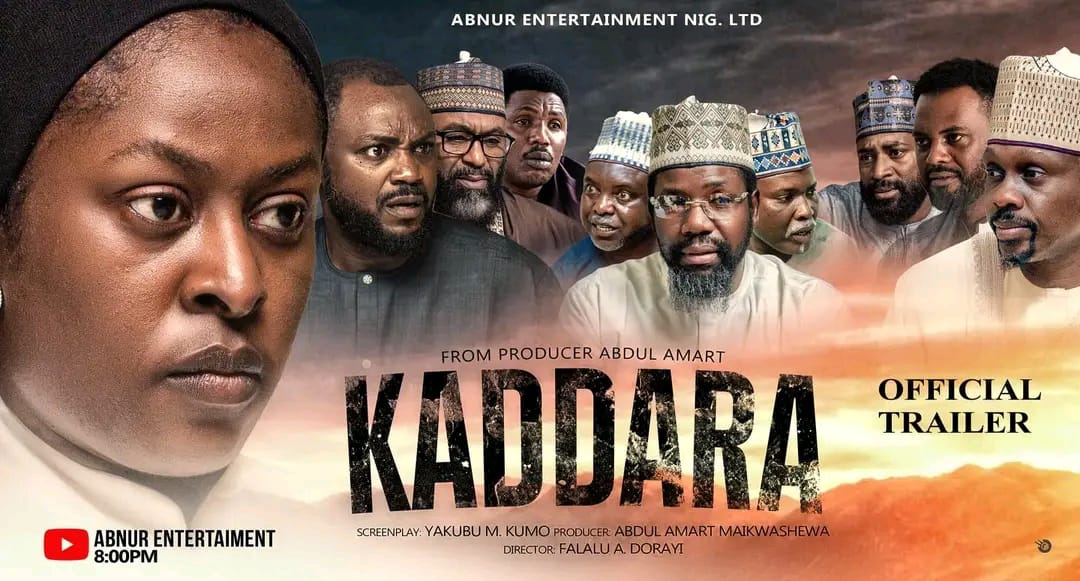
“Kaddara” the Series – A Preview

For the first time in a while, I have come across a Kannywood series trailer so compelling that it instantly made me crave its release. Such is the effect of the newly released trailer for the upcoming series Kaddara, unveiled yesterday.

It is worth recalling that the series was announced a few months ago by Abnur Entertainment. It has since generated considerable buzz due to the reputation of the producers and its stellar cast, including the veteran Nafisa Abdullahi, who is making a comeback after a prolonged hiatus from the Kannywood film industry.

The compelling has further amplified the anticipation. The editing is deliberate, showing only fragments of conflict without revealing the full shape of the narrative. In other words, the trailer teases just enough to excite without giving away the complexity of the plot.

This restraint is commendable, as it avoids the common pitfall of overexposure that plagues many Kannywood teasers.

Equally significant is the assembly of the cast. Alongside Nafisa Abdullahi are Ibrahim Maishunku and Zahradden Sani, whose reduced visibility in recent years has made their presence here particularly noteworthy. They are complemented by the constant faces of Ali Nuhu, Adam Zango, and Falalu Dorayi, among others. Naturally, this is a cast designed to deliver.

However, trailers are just promises, not guarantees. Kannywood has, on several occasions, produced compelling previews that ultimately led to uneven final products. The real test for Kaddara will therefore lie in its narrative discipline.

Kaddara is scheduled for release on Sunday, April 12, 2026. We wait to see whether it can sustain tension, avoid melodramatic excess, and translate its visual appeal into a coherent and engaging story.

Habibu Maaruf Abdu 

habibumaaruf11@gmail.com

Breaking Plateau’s Dangerous Cycle of Jungle Justice

By Usman Muhammad Salihu

I watched in horror as news spread of yet another attack on travellers in Plateau State. Young men from Jos, simply trying to earn a living, were killed on their way to Pankshin in a reprisal following earlier killings in Dorowa Babuje. Families are mourning. Communities are tense. Anger is rising.

This is not the first time. Years ago, youths travelling for a wedding near Barkin Ladi were ambushed and killed. Retaliatory attacks followed, claiming even more lives, many of them innocent passersby. That period left deep scars on families and entire communities. It taught a painful lesson: revenge rarely reaches the original perpetrators; it only multiplies suffering.

Recently, another tragedy unfolded along Nding Road. Young, hopeful traders were attacked. Even before the dust settled, calls for retaliation began echoing across the streets and social media. Roads were blocked. Vehicles were targeted. Innocent travellers were exposed to danger. We are dangerously close to repeating a cycle we already know too well.

Over the years, many travellers have been attacked along Plateau’s highways—routes that should symbolise commerce, connection, and coexistence. In too many cases, investigations fade quietly, and justice remains unseen. When there are no visible consequences, anger festers. When justice appears absent, reprisal begins to look like an option. That is how cycles of violence sustain themselves. Jungle justice thrives where trust in formal institutions weakens and where communities feel unheard, unprotected, or unfairly treated.

The perception, rightly or wrongly, that perpetrators are shielded by ethnic, political, or religious affiliations fuels suspicion and collective blame. But collective punishment is neither lawful nor moral. It transforms victims into aggressors and bystanders into casualties. It erodes the moral authority of communities that claim to seek justice and undermines the rule of law that binds a plural society together.

Social media has further complicated the crisis. Unverified reports, inflammatory language, and emotional commentary spread faster than facts. Within minutes, outrage can mobilise crowds before security agencies even understand what happened. In such an atmosphere, rumour becomes fuel and anger becomes action. What begins as grief quickly mutates into organised retaliation, with highways turning into battlegrounds and innocent travellers paying the price for crimes they did not commit.

Plateau has buried too many sons whose only crime was being on the road at the wrong time. Too many promising lives have been cut short by anger that could have been contained. Traders, students, farmers, and artisans now travel with anxiety, unsure whether they will return home safely. A state blessed with cultural diversity and economic potential should not be defined by recurring roadside violence.

Leadership at this moment must transcend emotion. Statements from influential figures—traditional rulers, political actors, youth leaders, clerics, and civil society voices—can either soothe or inflame the situation. Public calls for revenge put ordinary citizens in the crossfire, turning them into substitutes for unseen perpetrators.

Silence in the face of incitement is equally dangerous. Responsible leadership demands restraint, clarity, and an unwavering insistence on lawful redress.

Justice, not vengeance, is the only sustainable path forward. Security agencies must conduct thorough, impartial investigations into all recent attacks and ensure that those responsible are identified and prosecuted, regardless of ethnicity, religion, or social standing. Security presence must be strengthened along vulnerable highways and flashpoints, while rapid-response mechanisms should be improved to prevent escalation after incidents. Communication with the public must also be clear and consistent to rebuild trust and counter misinformation.

Government at both state and federal levels must demonstrate that accountability is neither selective nor symbolic. When arrests are made, the public should be informed. When prosecutions begin, they must be pursued diligently. When convictions occur, they should reflect the gravity of the offence. Justice must not only be done; it must be seen to be done. Beyond enforcement, preventive strategies such as community-based early warning systems, interfaith dialogue platforms, youth engagement programmes, and civic education campaigns are essential to reduce vulnerability to mobilisation for violence.

Retaliation does not restore dignity. It does not bring back the dead. It only creates new victims, new grief, and new reasons for the next cycle of violence. If anger becomes policy and revenge becomes justice, the funerals will continue. But if law, accountability, and responsible leadership prevail, the cycle can be broken.

Plateau deserves better. Travellers should not fear the roads. Traders should not fear earning a living. Communities should not live on the edge of retaliation. If we truly want this violence to end, then justice must speak louder than anger. Anything less will only prepare the ground for the next funeral.

Usman Muhammad Salihu is a PRNigeria Fellow and writes from Jos via: muhammadu5363@gmail.com.

Is it really Kano First or Politics First? 

By Dr Aminu Tukur Adam

The recent political drama in Kano State, which began as a rumour before metamorphosing into a full-blown political battle, is interesting: how loyalty is being reinterpreted, how personal interest is being transformed into the people’s mandate, and how politics gradually takes over governance. 

It’s now becoming crystal clear to everyone that the Kano State government is not only static but also backtracking. At a critical point of state emergency and national concern, our dear state is being placed on hold. 

To begin with, APC was initially viewed as a disaster by Engr. Rabiu Musa Kwankwaso, Kano State governor and all their supporters; many of the supporters sacrificed their lives to rescue the state from the APC, a party that was hated for its immense corruption, extortion and oppression. 

As big as Kano State is, with its about 20 million population and an over 1 trillion naira budget, it will surprise you to know that the state’s executive council members are currently redundant; the council held only one executive session in the span of 90 days! The previous buzzworthy council is now scheduled for the end of recess. 

That probably explains why the only visible function of this government, road construction, is also neglected; no one is there to approve new projects or supervise the ongoing ones. 

The most unfortunate event was the visit of the Turkish ambassador to Nigeria to the Kano State government house, with the aim of consolidating multimillion-dollar projects, but astonishingly, only the Chief of Staff and two commissioners received a figure like this! For anyone familiar with the Turkish Cooperation and Coordination Agency (TIKA), it must have been a nightmare. 

TIKA isn’t like the usual agencies you see; it’s an international technical assistance agency. This same agency renovated the Kano capital school without a penny from the state government. 

We’re also talking about the Turkish Trading Firm, Direkçi, which has invested over $22 million in Nigerian states, with Kano as a major beneficiary.

The visit was intended to create an opportunity to secure scholarships for Kano state indigenes, to bring the Turkish humanitarian foundation IDDEF to boost humanitarian services in the state, and to commence visa services at the Turkish consulate in the state.

Yet, when that esteemed Ambassador walked into the Government House, he was neither received by the Governor, nor his deputy, nor the SSG.

While the governor plays an absentee landlordism, some villages in the state were burning and many lives were also lost; the recent unfortunate incident in the Katai and Fauda communities in Wudil local government generated widespread reactions, a police officer lost his life and villages were set ablaze; however, no formal press release, no condemnation and no any form of assurance from the state government. 

Astoundingly, when the governor was too busy to hold a council meeting, overwhelmed to meet the Turkish ambassador to Nigeria and also overloaded with responsibilities to comment on the Wudil incident, we saw his face in the convoy of Yilwatda, the APC national chairman, courting the governor of Bauchi state, Bala Muhammad, into APC. 

To add more salt to the injury, when the governor was returning to Kano, the local government chairmen and some of the governor’s aides orchestrated a drama, where a rented crowd were paid to welcome the governor from his political excursion. You may be surprised as to why the welcoming? Was he not just coming back from Abuja? Was the journey not a political journey for the APC’s convention? Is there any significance to this journey in the life of the innocent Kano people? 

This is the Kano first agenda they’re selling. It’s not about you or the state; it’s simply an idea to sell Bola Tinubu and his party.

Indeed, Pantami — The North Must Tell Its Own Story

By Abubakar Musa Idris

During a recent Ramadhan Tafseer session in Abuja, former minister Isa Ali Pantami made a remark that ought to trouble every Nigerian who cares about media fairness. The North, he argued, needs a strong media presence capable of projecting its narratives to the world. This was not a regional call. It was a practical response to a structural imbalance that leaves Northern perspectives underrepresented both within Nigeria and beyond.

Two concepts explain what Pantami identified. The first is agenda-setting: when news platforms decide what to cover, they are effectively deciding for millions what matters. The second is the battle for narrative control: the competition to shape public conversation. He who wins this battle helps set the agenda. He who has no platform is spoken for by others. This battle plays out globally, where international outlets shape how the world sees Nigeria, and nationally, where the concentration of media houses influences which stories receive prominence.

Consider Nigeria’s media geography. Most major privately owned networks are headquartered in Lagos. This is not a conspiracy; it is a commercial reality. Lagos is the natural home of advertising revenue and media infrastructure. Consequently, perspectives from that region receive sustained national attention not out of malice, but simply because journalists live there. When newsrooms are concentrated in one area, other regions struggle for airtime. The North is reported on rather than reporting. This absence of strong Northern media with national reach is not favourable to accurate national discourse.

The international dimension is equally urgent. Global wire services—Reuters, AP, BBC, CNN, Al Jazeera function as gatekeepers of the world’s agenda. Their choices shape the understanding of billions. Research confirms that coverage of developing nations is almost entirely limited to stories of war and disaster. If a region cannot feed its perspectives into these channels, its stories will be told by others, whether incompletely or inaccurately, sometimes with hostile intent.

Consider what happened on February 19, 2026, when suspected Lakurawa terrorists attacked Kebbi State, killing thirty-four Muslims fasting for Ramadan. The next day, gunmen massacred thirty-eight more in Zamfara. Earlier that week, gunmen in Plateau abducted an imam and seven mosque committee members. Where was the sustained national coverage? Where were the front-page stories? Coverage existed, but it was minimal relative to the horror.

Not because these deaths mattered less. They received less attention because the institutions with the power to amplify them are far from affected communities, and because the North lacks platforms to project these tragedies into national consciousness.

Now contrast this with another narrative that dominated global discourse throughout 2025. Between January and October, a story alleging Christian genocide in Nigeria gained significant traction. Investigators traced this coordinated campaign to networks affiliated with IPOB. The narrative reached 2.83 billion impressions on X alone. It influenced the United States to designate Nigeria a Country of Particular Concern. It shaped discourse around the Sokoto airstrike. It is now cited in discussions about sanctions against Northern figures and proposals to label Fulani groups as terrorist organisations. 

One side had an army of storytellers. The other had none. Agenda-setting power shifted accordingly in Abuja and Washington. The absence of strong Northern media is not favourable in such a landscape.

The proposed sanctions and scrutiny of the Fulani illustrate where this leads. As analyst Yushau Shuaib observed, criminal elements exist across every line. But the Fulani are a diverse population numbering in the millions. Collective blame is profiling. 

Yet profiling becomes easier when only some perspectives dominate discourse. The Fulani have no platform to tell their own story, their history, their contributions, their humanity. They risk being defined solely by what others say. This is about ensuring all Nigerians can represent themselves accurately when the world is watching.

Pantami also pointed inward, critiquing Northern media that prioritize entertainment over substantive reporting. Insecurity, education, industrial revitalisation, issues that shape daily life receive far less attention than partisan conflicts. The stakes are higher for regions with limited platforms. When local media fails to set a serious agenda, it becomes distraction. 

But the problem is also reaching. Numerous Northern stations exist, but many broadcast locally in Hausa, limiting national influence. Reliance on NTA alone is insufficient. The absence of strong, English-language, professionally run Northern media with national ambition is simply not favourable.

Pantami also called for a world-class station broadcasting in English, French, and other global languages. Its purpose: to speak to Nigeria and the world. To feed alternative narratives into national and global ecosystems and claim power to help set the agenda. He pointed to Al Jazeera.

 Before Al Jazeera, the Arab world was narrated by Western outlets. After, Arab perspectives could not be ignored. The channel succeeded not as propaganda, it faced criticism from all sides but because it invested in professional journalism and built credibility. A Nigerian equivalent could do the same.

Consequences extend beyond the North. When any community cannot tell its story, the nation’s image is shaped by whoever has the loudest platforms. International sanctions and diplomatic decisions are increasingly influenced by narrative control. So too are national decisions: budget allocations, security responses. If Northern realities are not part of the national conversation, they will not be part of the national response. Without professional media projecting Nigerian perspectives, the country will be defined by whichever voices dominate existing platforms. This is not favourable to national cohesion.

Pantami spoke during a religious gathering, but his message was strategic. He identified a vulnerability and proposed a solution. The question is whether Northern elites will redirect resources toward building the media infrastructure the region desperately needs. The North must tell its own story. Not because its story matters more, but because every community deserves to represent itself. Nigeria needs multiple voices engaging with the nation and world.

Today, many platforms shaping perceptions of Northern Nigeria are headquartered elsewhere. This is not an accusation. It is media geography. And geography can be changed. The North can build. It can invest. It can tell its own story. Not through propaganda, but through professionalism. Not by silencing others, but by adding its voice.

Abubakar Idris wrote via abkidris99@gmail.com.

Why Religious Inclusion Matters in Plateau Governance

By Malam Aminu Wase

There is something quietly noble about Plateau State, its hills, its history, and above all, its diversity. It is a state woven together by the threads of ethnicity, language, and religion. And yet, that same diversity, which should be our strength, has too often been ignored in political leadership.

For too long, the highest office in Plateau State has been shaped by one-sided considerations. The repeated emergence of Christian Christian governorship tickets, while strategically convenient to some, continues to erode the principle of inclusive governance. It sends a subtle but loud message to a large portion of the population: you are seen, but not enough to be counted.

Muslims in Plateau have consistently shown political maturity. They have supported Christian-led tickets, participated in state-building efforts, and invested their trust in shared progress. From Wase to Kanam, Jos North to Shendam, Mangu, Quanfaan, and beyond, Muslim communities have not withheld their votes, their voices, or their commitment. But politics, like any meaningful relationship, cannot survive on one-sided loyalty. Reciprocity matters.

This is not just about religion; it is about equity. About the right of every community to see itself reflected in the leadership that governs it. Muslims make up a significant segment of Plateau’s population. Their persistent absence from the governorship, or even from serious consideration for the deputyship, is more than a political oversight; it is a moral failure.

What would it cost the political class to offer a Muslim-Christian ticket or vice versa? What would it say to the next generation if Plateau finally decides to lead by example, to choose unity over uniformity, and inclusion over imbalance?

My reflections are not theoretical. I grew up in a Plateau that taught me the value of coexistence. My closest friends in school, from Pilot Central Primary School, Wase, to Government Science College, Wase, through Federal College of Education (Technical), Bichi, in Kano State, and later Ahmadu Bello University, Zaria, were Christians. We laughed together, studied together, and dreamed together. That spirit never left me. It shaped my worldview, grounded in mutual respect and shared humanity. If we could sit side by side in class, why can’t we serve side by side in leadership?

In Wase Local Government, where Christians are a minority, they have not been pushed aside. They have held positions of responsibility, including Deputy Chairman, and benefited from federal appointments, many of which came under the leadership of Rt Hon Ahmed Idris Wase. This is not charity. It is simply fairness in practice.

That example should guide the rest of the state. Leadership is not a reward for numbers alone, but a test of vision. A government that sees only one side of its people cannot fully represent them. And a society that silences its own diversity risks becoming deaf to its own future.

Plateau State belongs to all of us. Let us end the quiet exclusion. Let us begin a new chapter, one in which faith is no longer a political disadvantage and unity is no longer a slogan but a living reality.

It is not too late to do the right thing. But it is urgent.

Malam Aminu Wase is a Political Analyst and Advocate for Good Governance and Youth Inclusion.

Beyond the Grand Finale: The Chronicles of the 61st Argungu Fishing Festival

By Dahiru Kasimu Adamu

The Argungu International Fishing and Cultural Festival is renowned as one of the most colourful spectacles on the global calendar. But beyond the crowning of the champion fisherman, the 61st edition, which concluded on February 14, 2026, was a profound chronicle of peace, cultural pride, economic promise, and even human drama.

Dating back to 1934  from the historic visit of Sultan Hassan Dan Ma’azu, which marked a handshake between the Sokoto Caliphate and the Kebbi Kingdom, the festival has evolved from a symbol of peace into a globally recognised cultural phenomenon. This year, after rigorous planning, the event delivered a programme richer than ever, blending tradition with advancement and culminating in a grand finale that drew thousands of fishermen and spectators to the ancient city of Argungu.

A Festival Forged in Culture and Commerce

The 61st edition was not merely a competition; it was a multifaceted event strategically designed to showcase Kebbi State. Activities kicked off in the state capital, Birnin Kebbi, with an Investor Forum that highlighted the region’s vast economic potential. This was complemented by an intellectual youth engagement, a Quiz and Debate competition at the Presidential Banquet Hall. 

Also, a colourful motor rally, flagged off in Abuja and involving over 30 vehicles, was part of the activities heralding the globally celebrated festival.

On Wednesday, February 11, the festival burst into life with a vibrant display of traditional sports. Archery, catapulting, camel and donkey racing, local wrestling, and a polo competition drew captivated audiences from within Nigeria and beyond. Participants displayed remarkable skill, with winners earning trophies, cash prizes, and gifts, setting an energetic tone for the days ahead.

Day two shifted gears with exciting cycling and boxing competitions unfolding at the festival venue.

The cycling race from Birnin Kebbi to Argungu saw Bello Muhammad clinch victory after one hour and 30 minutes of intense effort, taking home a trophy, a motorcycle, and N300,000. The boxing ring was equally electrifying, with Sha’aban from Kano State defeating Kebbi’s Yahayan Tarasa in a fiercely contested match that kept spectators on the edge of their seats.

The Heartbeat of Tradition: Kabanci and its Human Cost

Thursday was dedicated to celebrating the region’s lifeblood agriculture. An impressive Agricultural Show in Argungu featured giant rice pyramids, a powerful visual testament to the state’s rich endowments and achievements.

But the spiritual core of the festival, the legendary Kabanci water sports, unfolded on its third day.

 The Mala  River side became a theatre of ancestral skill as thousands thronged the banks. The scene was a breathtaking display of cultural heritage: men and boys fishing with bare hands, two-man canoe races slicing through the water, and the gruelling swimming contests with clay pots.

Participants demonstrated remarkable agility, passing down techniques across myriad generations. The Water Relay Race, a true test of endurance, was among the most cheered. However, the celebration was tinged with tragedy. Despite the presence of emergency services, reports emerged of the death of two participants in the water relay competition after Red Cross officials gave emergency assistance.

As dusk fell, the majestic Kabi Durbar transformed the atmosphere. A magnificent procession of decorated horses and riders, reflecting the Emirate’s martial history and equestrian excellence, offered a spectacle of regal splendour.

The Grand Finale: A 59kg Triumph

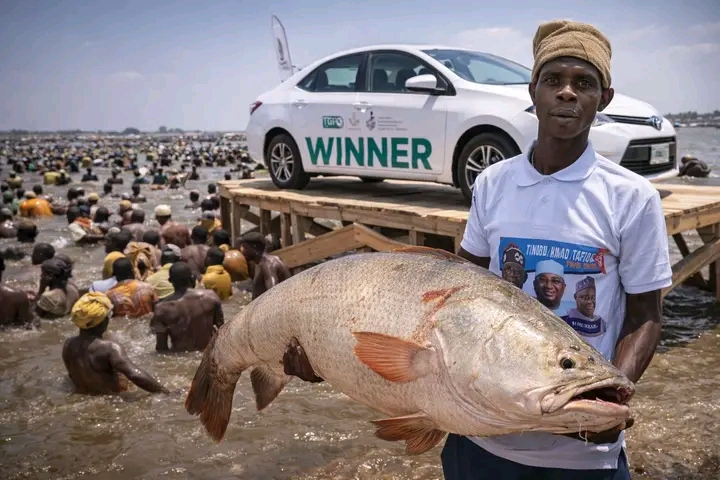
The week-long celebration culminated in the main event on Saturday, February 14. Over 40,000 fishermen entered the Matan Fada River, a river of humanity awaiting the starter’s signal. The formal commencement was timed with the arrival of the Special Guest of Honour, President Bola Ahmed Tinubu, who was joined by a host of dignitaries from within and outside the country.

The result was historic. Abubakar Usman from Maiyama Local Government Area of Kebbi State emerged as the champion, landing the festival’s biggest fish, weighing 59 kilogrammes. His feat earned him two brand-new Toyota vehicles, generously donated by the Sokoto State Government, along with a N1 million cash prize.

Abdullahi Garba from Argungu secured second place with a 40kg fish, receiving a Toyota saloon car from WACOTT Rice Miles Limited and N1 million. The third position was jointly claimed by Danlansu Dankani from Jega and another contestant, who each caught fish weighing 34kg, going home with N1 million and a motorcycle apiece.

President Tinubu, in his address, encapsulated the festival’s essence, describing it as “a historic event and a powerful symbol of unity and resilience and peaceful coexistence amongst Nigerians. It reflects the richness of our culture, the strength of our tradition and the opportunities that lie in harnessing our natural resources for national development.”

Echoes from Argungu: A Look to the Future

The festival’s impact resonated deeply with local residents. For Shamsu Usman and Ishaka Kabir,  among others, the event is more than a cultural showcase. They believe it is a vital economic driver, with income generated poised to be channelled into other productive activities, reinforcing the festival’s role in grassroots development.

The success of the 61st edition was also significantly amplified by the vital role of legacy media, news platforms, social media influencers, and content creators, whose coverage projected the images of Argungu to a global audience.

As the festival continues to attract tourists from every corner of the world, its position as a premier cultural tourism destination in Nigeria is firmly cemented. The collective vision now is for the Argungu Emirate Council, the Kebbi State Government, and the Federal Government to work in concert. By investing in modern strategies, infrastructure, and sustainable practices, they can further enhance the festival, ensuring it remains a powerful engine for socio-economic development in Argungu, Kebbi State, and the nation at large for generations to come.

Umar Ascon: A friend, A Brother, A Dreamer Gone Too Soon

By Shamwil Ibrahim (Justice)

The news of Umar Ascon’s death arrived with a weight that words can barely carry. For many who knew him, it felt unreal, like a story told in error, a rumour that would soon be corrected. But it was true. Umar Ascon was gone. For those of us who shared a classroom with him, the loss feels even more personal.

I first met Umar Ascon in 2015 at Kano State Polytechnic. We were both admitted to study English and Applied Linguistics. Like many students starting a new academic journey, we were strangers brought together by the same course and the same campus. Yet it did not take long for Umar to become someone impossible to overlook.

He was one of the funniest people in our class and, arguably, in the entire department. Wherever Umar was, laughter followed. His humour was natural and effortless. He had a way of turning ordinary conversations into moments of joy. In lecture halls, corridors, or casual gatherings around campus, Umar had the rare ability to make people forget their worries, even if only for a moment.

Although he was older than me, Umar never allowed age to create distance between us. He treated everyone with openness and warmth. Over time, what began as a simple acquaintance developed into friendship. Across Kano State Polytechnic, Umar was already known by many students. Whenever he walked across campus, people would often point him out and whisper a familiar word: celebrity.

The reason was simple. Even during his years as a student, Umar Ascon was already appearing in Kannywood films. He was gradually building his presence in the Hausa film industry while still pursuing his education. For many students, seeing someone from their own classroom on television screens was both surprising and inspiring.

Yet what made Umar remarkable was not just his growing recognition in the film industry. It was his humility.

Despite the attention he received, Umar remained approachable and friendly. He never carried himself with arrogance. Instead, he used his position to encourage and uplift others.

For me, Umar did something that would shape my life. He introduced me to the Kannywood film industry. Through him, I found my own path into filmmaking, a voyage that continues to define my creative life today. Opportunities like that often come through people who believe in you before the world does. Umar was that person.

Even in recent times, Umar continued to think about the future of the industry he loved. The last conversation I had with him was about a film project he was planning. Umar spoke passionately about creating a production that could reach global standards, a film capable of standing proudly alongside international productions on platforms such as Netflix. He believed strongly that the Hausa film industry had the talent and stories needed to reach the world.

His dream was not only to entertain audiences but to elevate the industry. That dream now remains unfinished.

When the news of his death reached me, disbelief overwhelmed me. I felt compelled to confirm it myself. I called his phone. His wife answered. My voice shook as I asked, almost hoping the answer would dismiss the rumour. “Where is Umar?”

There was silence for a moment. Then, through tears, she spoke words that will remain with me forever. “Umar is no more.” She explained that he had passed away following complications related to liver illness. In that moment, reality settled with painful clarity.

Inna lillahi wa inna ilaihi raji’un.

Umar Ascon’s death represents a profound loss not only to his family and friends but also to the Kannywood film community. He was talented, vibrant, and deeply passionate about his craft. His presence brought laughter to classrooms, energy to film sets, and encouragement to those around him.

Some people leave behind fame. Others leave behind fortune. Umar left behind something far more enduring: memories, laughter, and inspiration.

For those who knew him, the echoes of his humour and kindness will remain long after this moment of grief passes.

May Allah forgive his shortcomings, grant him Aljannatul Firdaus, and give strength to all those mourning his loss.

Umar Ascon may be gone, but the stories, laughter, and dreams he shared will continue to live on. History will be so kind to you, Umar Ascon (Chairman).

Shamwil Ibrahim (Justice) wrote via ibrahimshamawilu@gmail.com.

OPINION: Tinubu’s Policies Are Systematically Destroying Northern Agriculture While Boosting Southern Businesses

By Dr. Umar Musa Kallah

Nigeria’s food import bill has more than doubled under President Bola Ahmed Tinubu, rising from ₦3.83 trillion in 2023 to ₦7.65 trillion in 2025, according to the National Bureau of Statistics data.

This surge is not the result of global shocks or natural disasters alone. It stems directly from a deliberate policy of granting liberal import waivers on maize, rice, soybeans and other staples. Announced repeatedly as a measure to crash food prices, these waivers have instead achieved a far more targeted outcome: the collapse of Northern farms and agro-processing industries while delivering clear economic advantages to Southern importers, poultry conglomerates and port-based processors.

The contrast with the Buhari administration is striking. Between 2015 and 2023, agriculture was positioned as a cornerstone of national development. The Anchor Borrowers’ Programme channelled over ₦800 billion to more than four million smallholder farmers, enabling cultivation on more than five million hectares.

Rice production rose sharply from between 2.5 million and 3.7 million metric tonnes to peaks of 8.5 million to nine million metric tonnes, positioning Nigeria as Africa’s largest producer and, for a time, a net exporter in the region. The 2019 land border closure protected local value chains and revived rice milling, soybean crushing, groundnut and cotton-seed processing across the North.

More than 150 modern rice mills emerged nationwide, with over 100 located in Northern states. Oil mills in Kano, Kaduna, Gombe and Jigawa thrived on locally sourced raw materials, generating tens of thousands of direct and indirect jobs and triggering a strong post-harvest multiplier effect that spread prosperity through transport, packaging, marketing and local services.

That progress has been reversed under the current administration. Milled rice production has fallen to a projected 5.5 million metric tonnes in the 2025/26 season, down from Buhari-era peaks. According to the Rice Processors Association of Nigeria, nearly 90 of the country’s 150 rice mills have shut down since 2023, with many surviving mills operating at 30 per cent capacity.

Northern facilities have suffered the heaviest losses. Soybean, groundnut and cotton-seed crushing plants that once benefited from protected local supplies now run at below 20 per cent capacity or have been forced to liquidate assets. Fertiliser prices have escalated dramatically, with a bag of urea selling for  ₦58,000 and NPK for ₦120,000 in many markets.

Diesel and pms costs have tripled following the removal of fuel subsidies. At the same time, farm-gate prices for staples such as maize have collapsed to as low as ₦38,000 per 100kg bag, often falling below the cost of production, which exceeds ₦1 million per hectare in many areas. Farmers are abandoning their fields, selling at a loss or leaving the sector entirely.

These outcomes are not accidental. The import waiver regime, which offers zero-duty and VAT exemptions on key commodities and was first announced in 2024 before being effectively extended, has operated without any parallel measures to reduce input costs or protect local processors.

Maize waivers have primarily benefited major poultry conglomerates concentrated in the South, where the feed industry is dominated by Southern operators. Soybean imports allow Southern processors to bypass local crushing altogether. Rice milling is visibly shifting southward, with imported paddy now processed in expanded Southern facilities and the finished product shipped back to Northern markets.

Northern oil millers, who lack direct access to seaports, are placed at a severe disadvantage. They cannot import raw soybeans competitively and are instead forced to purchase already-crushed crude soybean oil from Southern refiners who enjoy the logistical advantages of Lagos and Port Harcourt ports. As a result, capital that once circulated within Northern communities now flows southward to port operators, importers, logistics firms and Southern feed mills.

The regional imbalance extends far beyond farming. Unemployment has risen sharply in the North, where agriculture remains the primary source of livelihood for the majority of the population. Each closed rice mill has eliminated hundreds of direct jobs and thousands of indirect positions in farming, transport and allied services.

With nearly 90 mills out of operation, tens of thousands of Northern livelihoods have disappeared. Rural underemployment has increased as the traditional post-harvest economic surge has vanished. Northern states, already facing challenges of insecurity and weak infrastructure, are experiencing accelerated rural-urban migration, higher youth joblessness and deepening poverty. In contrast, Southern urban centres have gained from expanded import-related activities, including more jobs in ports, poultry processing, logistics and distribution services tied to cheap foreign inputs.

Other factors compound the North’s disadvantage while strengthening the South. Billions of naira invested in Northern agro-industries during the Buhari years are now stranded or liquidated, while Southern processors with direct sea access and waiver-backed imports continue to attract fresh capital and expand operations.

The classic multiplier effect that once spread prosperity from Northern harvests across the national economy has been reversed, with money draining out of the North and concentrating in Southern hands. Food security has been undermined for the entire country.

A population exceeding 230 million now depends increasingly on volatile imports for basic staples, exposing Nigeria to global price shocks, foreign exchange crises and potential supply disruptions. The South, as the hub of processing and distribution, benefits from short-term consumer price relief and sustained industrial activity.

No policy under the Tinubu administration prioritises the strengthening of local farms and industries over importation. Instead, the waiver regime actively discourages domestic production by making imported raw materials artificially cheaper than locally grown equivalents, without corresponding support for Northern farmers or processors.

Government statements continue to celebrate minor drops in consumer prices while ignoring the collapse of local capacity. The pattern is consistent and unmistakable: repeated public commitments to crash farm-gate prices, unchecked waivers and complete neglect of Northern processing infrastructure.

Nigeria cannot achieve sustainable development by weakening its primary food-producing region. The deliberate marginalisation of the North’s agricultural economy risks mass unemployment, rural depopulation, social instability and long-term national food insecurity. Northern governors, traditional rulers, farmers’ associations, rice processors and business leaders must now break their silence. The evidence shows a clear agenda to render the North economically redundant so that Southern interests can dominate value chains and resource flows.

The mills cannot remain silent and the fields cannot be left fallow indefinitely. A nation of this size, increasingly dependent on foreign food while one of its most productive regions is systematically impoverished, faces grave danger. The people of the North must act to defend their economic future before it is lost forever. This is not development. It is calculated dispossession, and it must be confronted without delay.

Dr. Umar Musa Kallah wrote in from Kano, Nigeria.

A Wake-up Call to Our Youth

By K.H.M Haladu Muhammad 

As I wrote this article from my point of view on leadership, or what leadership is all about, we already know that leadership is a collective responsibility, not a one-person business. Some may think leadership is only one person’s business or responsibility, that’s the one people elected or chosen to be in the mantle of leadership.

A leader is a servant of the people, meaning that leaders serve the interests and affairs of the state, not their personal interests. Some people think that if a leader is done with some developmental projects or programmes, my fellow youth and citizens think that the government or the leader is privileged; they forget that anything the government has done is our right, not a privilege.

In these points, I would like to call our attention to what values and self-leadership are. Let us take a look at what values are: beliefs and principles that guide someone on how they think, how they act, how they treat others, and how they make decisions.

Values enable leaders to earn respect and trust, make the right decisions, stay consistent under pressure, and lead without fear.

My question is whether there are some core values that we all have, these are: Accountability, commitment, discipline, fearlessness, integrity, respect for others, tolerance, hardworking and timeless.

Please, are you accountable, committed, disciplined, hardworking, and respectful of others? I just selected five of the nine to see whether any of us are practising the core values.

Let us take a look at self-leadership, a process of intentional self-influence that fosters motivation, direction, and continuous personal growth. It’s taking ownership of your thoughts, actions, and development without waiting for external directions. Why I say self-leadership matters as a young person: it allows you to build confidence, enhances autonomy, increases adaptability, and sharpens decision-making.

Are we all practising self-leadership? Please, if we are not, let us start not tomorrow or later, the time is ticking, we should start now.

We should start taking care of our little problems, because leadership starts from our home, school, office, and even up to where you think the so-called leaders are based. Because change starts with you, not others, if we do not change ourselves, we can’t have the leaders we aspire to.

And lastly, who are those leaders? Their people, like me, you, and us, are from the society and community; they’re like you, so if we don’t change our values and practice self-leadership. We should start making nonsense all over social media or at gatherings because we’re the ones producing the leaders we have.

Please let us look at these core values and reflect on some of them. Thank you  

K.H.M Haladu Muhammad wrote from Maru LG, Zamfara State.