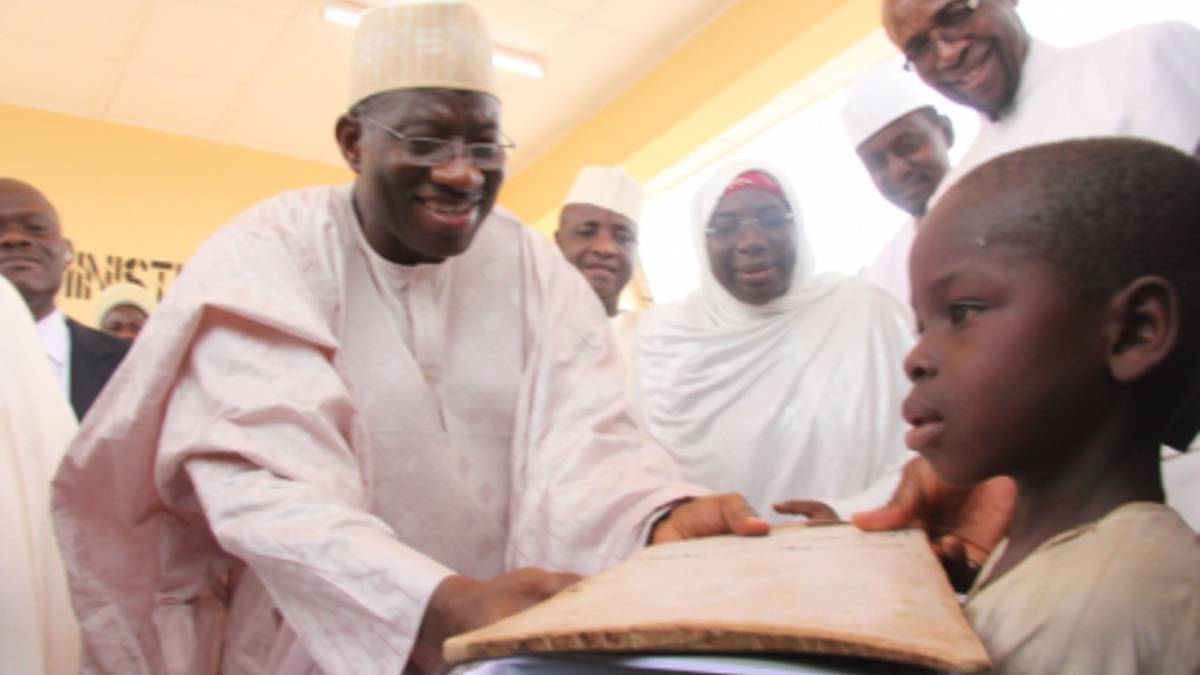
The innovative Almajiri School Initiative of President Goodluck Ebele Jonathan (GEJ), directly or indirectly, challenged northern Nigerian elites on the intense need for a proper plan and execution of any sustainable way of curtailing the menace of the Almajiri system of education. He did his best during his tenure. We expect the incumbent government and the next one to build on where that administration stopped to ensure continuity.
I don’t know how Northern Nigeria is becoming so loose that our communities find it difficult to maintain essential infrastructures like those installed during the GEJ government. Instead of optimising the system, we allowed the structures and the equipment to rot away. We abandoned the schools. Today no one cares to adopt the strategy even in our localities, neither our philanthropists nor any NGO.
Most of our elites are only good at criticism. You will never see them when it comes to action. They instead spend their energy on empty talks and promises. While in a situation like the one Arewa is subjected to, action is mostly needed, with less noise. Though we all agree that “facta non verba”, actions speak louder than words, we always end up talking the wrong walk instead of walking the right talks.
Alhamdu Lillah, we started a model of such a system within our jurisdiction, called ENGAUSAR ALMAJIRAI, under Engausa Global Tech. Hub, which has recently attracted an intervention from NITDA Nigeria and a solo philanthropist from JOS Plateau State, Alh. Yusuf Yahaya Kwande. I don’t want to say much about the outcomes at the moment until we achieve enough to discuss. I always prepare walking the talk instead of the opposite.
We had witnessed a similar effort to revamp the TSANGAYA SYSTEM in Kano State during Malam Ibrahim Shekarau’s tenure. Shekarau transformed the Tasanga (Almajiri School) system and provided Almajirai and their teachers (Malaman Tsangaya) with sustainable means of livelihood. But unfortunately, the innovative Tsangaya System, sphere-headed by Dr Bashir Galadanci, a man with a sincerity of purpose, was abolished by the successor of Shekarau. And all the achievements recorded from the innovative system were brought back to square one.
Moreover, this is how the monotonous lack of continuity in governance, lack of patriotism, and focus are consuming every program or policy designed to transform our socioeconomic and sociocultural activities. In the same way, Kano ICT Park and Jigawa Galaxy Back Borne and Informatics suffered from the unpatriotic people at the helm of the affairs of Nothern Nigeria. Both Jigawa and Kano would have been ahead of Lagos regarding the digital ecosystem and digital economy. As of 2005, Jigawa was rated as the best ICT State in Nigeria due to the achievements recorded from those iconic “digital wings”.
Our society needs a new set of purposeful leaders, the likes of Borno State Governor Prof. Babagana Umara Zulum. We require leaders who are ready to sacrifice their lives for any struggle necessary to save our society from obscurity to prominence. With such Zulum’s prominent achievements, the progress recorded under Shekarau in Kano, and that of Goodluck at the federal level, we now have a concrete reason to disagree with anyone who thinks Nigerians will never be taken to the proverbial promised land.
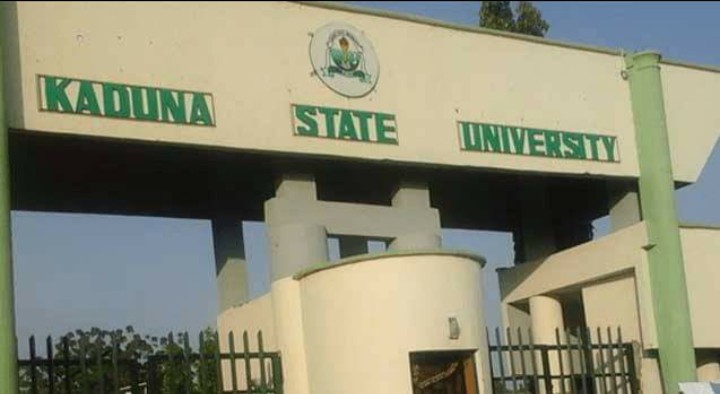
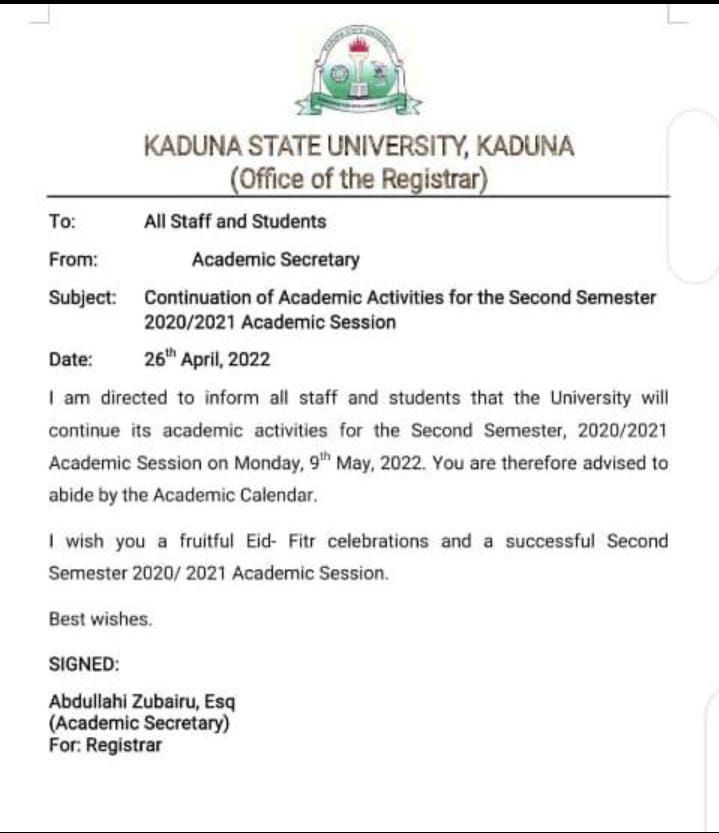
The management of Kaduna State University (KASU), Kaduna, has decided to back out of the ongoing strike embarked upon by the Association of Staff of Universities Union (ASUU) as the resumption date for academic activities is announced.
The resumption notice, which is contained in a statement by the institution’s Academic Secretary, Barrister Abdullahi Zubairu, said that “the University will continue its academic activities for the Second Semester, 2020/2021 Academic Session on Monday 9th May 2022”.
The Daily Reality learnt that the management has decided to resume in order to avoid stoppage of salary from the Kaduna State Government. The ASUU Chapter in KASU may likely clash with the management about the new development in the institution.
Recall that ASUU has condemned the Federal Government’s handling of the negotiation on its demands and nonchalant attitude towards the ongoing strike.
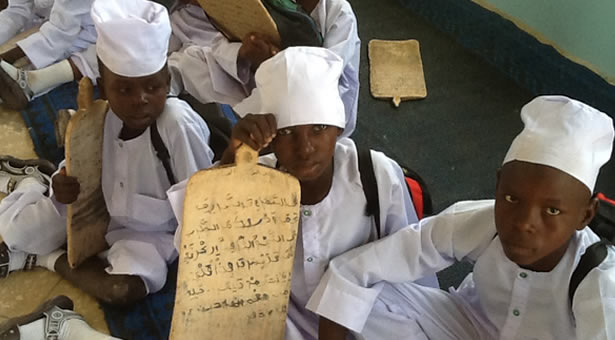
Islamiyya system has been proven to be an alternative to the Almajiri system. In the Islamiyya system, it is easier to commit the Qur’an to memory within the shortest period with decency. And it also allows the children to seek other knowledge that will aid them in confronting the present challenges. Almajiri system can only be insisted to be reformed when it is proven that that is the only way to learn the Qur’an. The system poses a lot of danger to the children, such as health challenges, inferiority and, of course, most of them become morally debased in the end.
Reforming this system alternatively means rewarding irresponsible parents for their irresponsibility, creating unsustainable programs which cannot see the light of the day. Instead, the government should ban and criminalise the system and absorb all the already enrolled Almajiri into formal schools. Then any other parent that wants his child to learn the Qur’an by traditional means must first provide shelter, food, and health facilities for the welfare of the child and must ensure that the child goes to school to at least get primary education.
No one is saying karatun allo should be banned. Karatun allo differs in content and operation from the Almajiri system. While the former entails learning Qur’an by the traditional design by all and sundry, the latter entails recruiting young persons to learn Qur’an by traditional means without provision for food, shelter and medical facility for children recruited. The said recruited army of children relies only on begging leftover food and tattered clothes for subsistence.
It requires no second thought to believe that this system of taking young children away from their parents at the ages they need their parents the most should be stopped and criminalised. No child under the age of 12 should be taken away from his parents’ house in whatever guise. There is nothing good in the Almajiri system as practised today. The system has served and outlived its usefulness. It became archaic and, to some extent, barbaric considering the conditions of the children involved in the system.
There are more decent systems which are alternatives to the already abused system. The system indirectly supports irresponsible parents to breed bundles of children they know they cannot cater for. The parents use the system to abdicate their parental responsibility of feeding, clothing, educating and sheltering their children.
Also, the half-baked Malllams use the system as a means of income. The activists are using it to get themselves employment from international NGOs. The nagging question is, can Qur’an be learned through a more decent system than this child molesting system? The answer is yes. Thousands of children have committed the entire Qur’an to memory through the modern Islamiyya system.
Let’s move on; the system is not viable in the present era. The era of dogma has passed. Let every child be supported by his father and take Quranic education before his parents while attending school. Any system that encourages parents to take their children to the street is barbaric and should not be encouraged.
Muhammad Dattijo Kabir. Muhammad is a lawyer, a human rights activist and a public affairs commentator. He lives in Kaduna and can be reached via jibrilmuhammad27@gmail.com.
I have observed the raging debate over the Almajiri debacle in the last few days, especially the antagonism against a Kannywood actress Nafisa Abdullahi. The actress voiced out against parents who send their children to urban centres to memorise the Quran under the guise of an Almajiri system.
This issue resonates with me because I was once an “Almajiri”, though in a modernised form of learning. I was a product of Arabic and Islamic education. I am still grateful to my late father for seeing the wisdom in sending me to the College of Islamic Studies Afikpo, a boarding secondary school in Southeastern Nigeria funded by a Saudi Arabia-based International Islamic organisation Rabita Alamul Islam (the Muslim World League). Unlike some of my schoolmates who later studied Islamic studies at Islamic University Madina and Azhar University Cairo, Egypt, I decided to study International Studies at the Ahmadu Bello University, Zaria, against my father’s wish, whose dream was for me to be an Islamic scholar.
I am still at a loss wondering why the actress is being pilloried for telling the truth. If you ask these intellectual lilliputians and Nafisa’s traducers whether they will be comfortable sending their children out to beg on the streets under the guise of Quranic education, they will never say yes.
Before you call me “Karen farautar yahudawa”, an agent of Jews, which our people are fond of calling those who seek societal change and are in tune with modern realities, let me clarify that I did not attend a conventional secondary school. I advocate an integrated education system involving the acquisition of both western and Islamic education.
I will never advocate against memorising the Quran or acquiring Islamic knowledge because I was a beneficiary of that. At the boarding secondary school in Afikpo, Ebonyi state, we were taught Hadith, Fiqh, Balaga, Tafsir, Tajwid, Saqafa, Sirat, Ulumul Falsaf, Sarf and Nahw, among other subjects, by some Islamic scholars mainly from Pakistan, Egypt and India. I was able to speak Arabic with confidence on completing my secondary education. I even took some Arabic courses as an elective throughout my studies in Zaria. Even here in Germany, I still communicate with my neighbours from the Middle East in Arabic.
I am not worried that this article will generate antagonism in some quarters or be pilloried for triggering anger in some folks. But the truth of the matter is that we cannot continue on this trajectory. This system can no longer continue the way it is; otherwise, we may be heading towards the precipice.
The word Almajiri is derived from the Arabic word “Almuhajirun”, meaning a person who migrates from his locality to other places in the quest for Islamic knowledge. During the colonial era and a few years after that, the schools were maintained by the state, communities, the parents, ‘Zakkah’, ‘Waqf’ and augmented by the teachers and students through farming. “Bara”, begging as it is known today, was completely unheard of.
Mallams and their pupils, in return, provide the community with Islamic education, reading and writing of the Qur’an, in addition, to the development of Ajami, i.e. writing and reading of the Hausa language using Arabic Alphabets. Based on this system, which is founded upon the teachings of the Qur’an and Hadith, the then Northern Nigeria was broadly educated with a whole way of life, governance, customs, traditional craft, trade and even the mode of dressing.
However, the system was corrupted in the past few decades, with teachers sending the children to beg for food on the streets. Similarly, many irresponsible parents were unwilling to cater to their children. Thus, they send them away to cities to purportedly acquire quranic education.
The current Almajiri system is not only archaic but atavistic. We must tell ourselves the truth that society is drifting. What we are facing today regarding security challenges in the North will be child’s play if our people refuse to change their ways. There is no gainsaying that the future is bleak if what we can boast of is an armada of malnourished and unkempt children who are roaming the streets under the guise of Islamic education. Eventually, the children may not acquire any meaningful skills to become useful members of society.
I am not a prophet of doom and derive no joy in pessimism. But, I do not see a bright future for a region struggling with a depleted human resource, coupled with millions of underage children clad in tattered clothes with bowls roaming the streets begging for food. I do not foresee any meaningful progress and development in such a society.
I still recall, in 2012, when former President Goodluck Jonathan visited Sokoto to inaugurate the Almajiri Integrated Model School in the Gagi area of the Sokoto metropolis. This boarding school was equipped with modern facilities. As a journalist working with THISDAY Newspaper then, I was there at the commissioning and even interviewed the school’s principal Malam Ubaidullah, a few months after the inauguration. I was excited that there would be a gradual process of taking Almajiris off the streets, as was promised by former Sokoto governor Senator Aliyu Magatakarda Wamakko. However, the euphoria was short-lived as governments in the region neglected the programme while the school buildings rotted away.
I wonder why our people antagonise those who want the system to be reformed or outrightly banned in the North. Are we comfortable seeing underage children roaming the streets under such dehumanising conditions? Have we pondered over the looming famine in the Sahel as forecasted by global development organisations, of which Northern Nigeria is part due to climate change worsened by overpopulation? Are we not witnessing the level of insecurity pervading the region because of societal neglect and marginalisation caused by a rapacious elite?. Do we sit down and pray and wait for a miracle to happen while expecting that our problems will go away?
Already we are battling with banditry in the Northwest due to societal neglect of a segment of the society that we use to mock because of their ignorance. And things will even get worse in future unless drastic action is taken to reform the system to enable children to memorise Quran in a friendly atmosphere devoid of hunger and deprivation. The current Almajiri system is a pathway to perdition.
Parents should stop sending children to cities if they are not ready to cater for them. These children should stay in their localities and learn under a school system presided by their Islamic teacher or Malam. The state governments must engage those Quranic teachers and pay them a stipend. I know this is doable because the government has the means to do that.
Unfortunately, much resource has been wasted on frivolities instead of channelling it towards revitalising the Almajiri system. We must wake up from our slumber and direct our energies toward finding a way to tackle problems in our society. Taking action is the key, and I believe that is the only way we can expect to have stability and peace in the polity.
Aminu Mohammed is at the school of Sustainability, Christian- Albrechts- Universität zu Kiel, Schleswig Holstein, Germany. He can be reached via gravity23n@gmail.com or stu219013@mail.uni-kiel.de.
Nigeria’s Minister of Labour and Employment, Chris Ngige, on Thursday, April 21, 2022, said the decision to halt the ongoing strike solely lies with the Academic Staff Union of Universities, ASUU.
Ngige said this on Channels TV while featuring as a guest in the televised program ‘Politics Today.’
According to Ngige, the time the strike will end is only for ASUU to decide and that it is expected of the Union to decide if they have the student’s best interest at heart.
On when the strike, which has crippled academic activities in Nigeria’s public universities, will end, the Labour Minister said, “It depends on ASUU. The ball is in their court. They should go and meet the Benimi Briggs Committee and look at what the committee is doing and make further inputs so that work can be accelerated, ” he said
Ngige added that ASUU’s attitude towards the labour crisis is not helping the situation.
“ASUU has to come down from their high horse. You cannot go and start intimidating people in NITDA and threatening the Minister of Digital Economy and Communication with revocation of his professorship that he is a fake professor. You go to ABU and say you are going to withdraw the certificate of the director of NITDA. That’s bullying. It is not allowed in Labour negotiations,” he stated.
In this second part of the special report, The Daily Reality reporter narrated how other business activities continue to suffer due to the strike in Nigeria’s public ivory towers. And it is now getting worse as other unions in the universities, such as SSANU, NASU, and NAAT, have since declared strikes following the government’s failure to honour agreements with the workers’ unions.
Okada, tri-cyclists and yellow bus
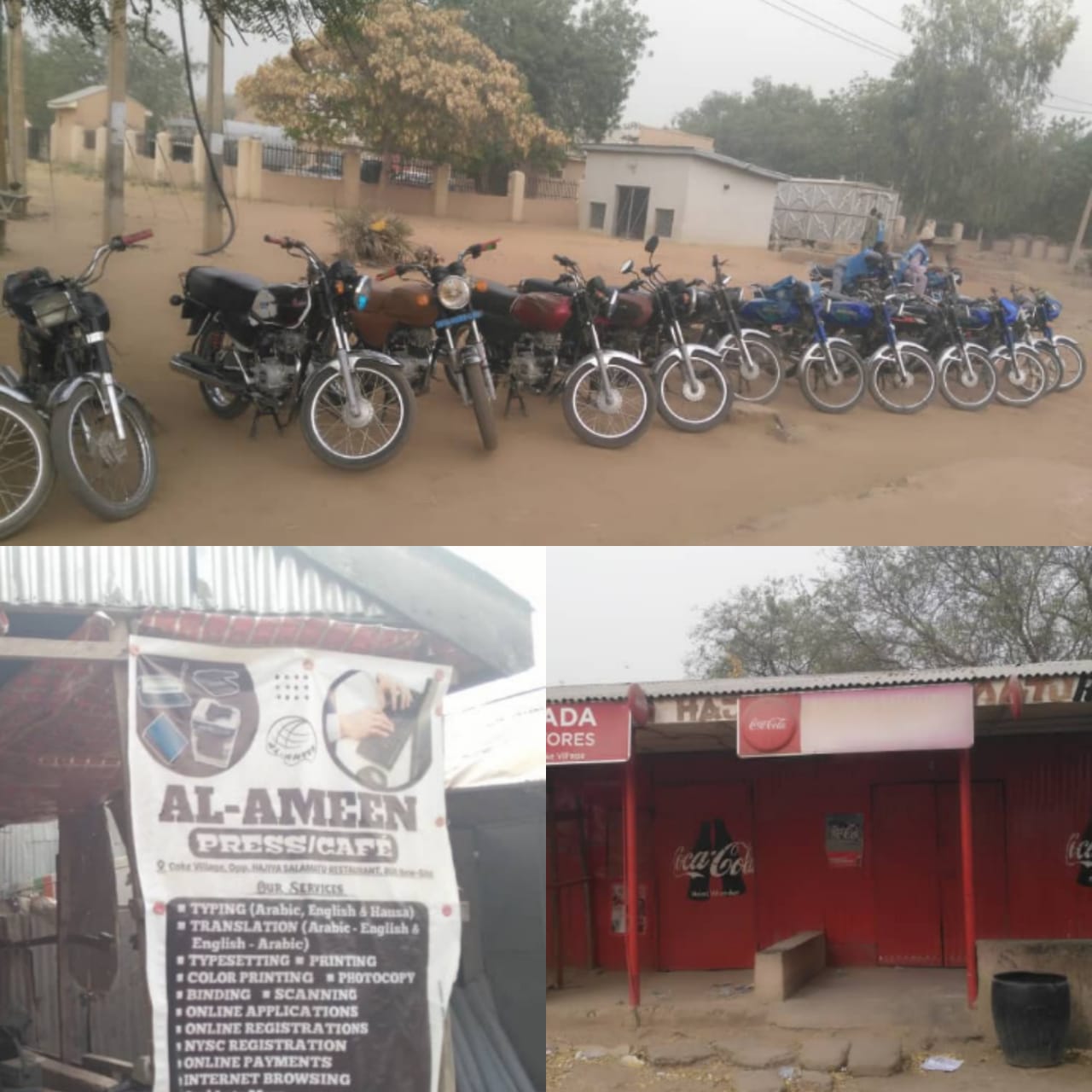
Commercial motorcycles, tricycles popularly known as Adai-daita and commercial shuttle buses, alias yellow buses (or taxis),are the major means of transportation in and around the universities for students’ daily movements.
With the suspension of academic activities in the universities, the commercial transporters discontinued their operations, rendering hundreds of them without their normal means of earning a living.
Although Okada/Acaɓa (commercial motorcycle ride) riders are still doing skeletal work with very few passengers, as they explained in their interaction with this reporter, tri-cycles and yellow buses have since moved elsewhere in search of respite.
Young Abdurrahman Usman, whose means of eking out a living is okada/acaɓa in BUK. He used to convey students to, in and outside of the university, cater for his family’s needs. He now faces challenges as a result of the strike. He said:
“It is quite saddening. The strike stifles our means of livelihood. There are no passengers now to carry. Students have vacated the campus, and the remaining ones have been served notice to leave since. We are pleading with the government to resolve the problem. Acaɓa riders, students and other business people suffer. Government should meet up with ASUU’s demands for activities to resume on campus.”
“It was unnerving when I first heard there will be a strike”, recalling when his friend told him about the strike as he had bitter experience in the past, adding that “before the strike, I used to make N1500 – N2000 a day but now hardly I make 200 -300 a day. I am in a very tense situation,” Usman concluded.
“Honestly, we can only say Inna lillahi wa inna ilaihi rajiun! Because this isn’t a new thing to us. Whenever there is rumour of embarking on a strike, we will be praying that the issue gets resolved before the strike commences. But if the strike is declared… it is really usually terrible for us”, said Ado Umar, who serves as the Secretary of the BUK Riders (Acaɓa) Association.
Ado said with the current economic realities of Nigeria, “Federal Government and ASUU, for God’s sake and the plight of the hungry people around and students, should resolve their differences”, adding that “I don’t think any of them can get what he or she desires completely…they should have sympathy for us… businesses in Kano, not just BUK, suffer the consequences of the strike.”
Photographers, barbers decry
Abdulmuiz Ibrahim, with his largest photo studio at BUK, said he had already lost most of his customers, primarily students, due to the industrial disharmony between the government and teachers.
While students vacated the environment, he noted that he had been surviving from a few people who come from outside the university and wedding bookings from outside campus, “we’ve been surviving from one or few people who are coming from outside. And as you know, weddings happen, we get wedding bookings from outside campus. That is what we’ve been using to maintain …the strike hasn’t been fair at all.”
Resilient photographer, Abdulmuiz, who described the strike as less devastating ditto Corona lockdown, said he is determined to survive the strike as he “brushed through previous strikes and Corona lockdown”, adding that “That is part of what I did then because there weren’t outdoor events. There was no event to cover, and school wasn’t in session. So you live on savings from savings to taking money from family and friends.”
He acknowledged that ASUU is fighting a worthy cause but advised them to engage in alternative means of resolving the problem, saying, “The victims are the students, the business owners, the workers, neighbouring communities that sell to students, the markets …this affects everybody.”
He further advised the Federal Government to resolve the problem amicably to avoid forcing youths to be on the streets. “We have seen what happened during the EndSARS protest. If schools weren’t closed, EndSARS wouldn’t have been that successful. If students were in school doing one thing or the other, EndSARS wouldn’t have had that solidarity. I hope they learn any lesson”, he cautioned.
“The Federal Government often talk about self-reliance and entrepreneurship, but they are now destroying our self-reliant businesses …there are over 200 business people in BUK New Site alone, and each has at least ten people under him. So thousands of people are in trouble with this strike. Government should help those who create jobs, not to destroy them” emotionally laden Abdulkadir Suleiman chronicled the chain of employment their businesses provide to people, including students on the campus.
Approaching his photography shop, Abdulkadir was already parking some items, ready to move out of the BUK to find some work to cater for the needs of his wife and six children.
Due to his business’ nature, he shuttles between town and campus, arguing, “With the current economic situation in the country, even the outside is very difficult. Campus remains the best but strike…” stressing further that “we are now thinking of alternative if not one day we will turn to beggars!”
He reminded the Federal Government that people brought them to power, and God will hold them accountable. “They should resolve this conundrum. God give them trust, and He will question them on it.”
A barber, Aliyu Badamasi, noted that the least he could work on before the strike were 15 – 20 people daily, while currently, the average is 2.
Aliyu noted, “It is very, very horrible, that is what I would say… Life hasn’t been easy. If the school is on break, it isn’t funny, not to talk of a strike. It is not easy.”
With his barber’s shop as the only means of making ends meet, Aliyu urged the Government and ASUU to remember that “So many people rely on students’ presence to survive”, appealing to the government “to put education first. They should make it a priority.”
Some businesses are moving off Campus
Abdurrahman Shafiu, who doubles as a student and a POS operator, concluded his plan to move to the town pending the resumption of academic activities at the university.
Abdurrahman said his only option now is to move out of the university to survive the strike, “The strike is really affecting my study and my business concurrently. When students were around, I realised like 6k a day, but now I hardly make 1k. So I’m just coping by the grace of God. I’m moving out of the campus because I’m a family man. I need to feed my family!”
For Khamisu Alhassan Abubakar, the only phone repairer currently available in BUK, said only one-fifth of his customers patronise him presently as most of them have travelled.
With nonteaching staff also embarking on strike, as their unions recently announced, he noted that it is no longer possible to remain on campus.
NASU, SSANU embark on strike
Meanwhile, as ASUU’s strike entered its third month and with no visibly committed resolution efforts from the Federal Government, other unions of nonteaching staff in universities have mobilised their members to embark on an extended two-week warning strike after they exhausted earlier two weeks of warning.
Joint Action Committee of Non-academic Staff Union (NASU) and Senior Staff Association of Nigerian Universities (SSANU) conveyed the message of the strike to their branches in a letter/memo signed by the SSANU President and NASU Secretary-General.
The letter, in part, reads: “In view of the nonchalant attitude of the Government to our demands, this is to direct our members in all Universities and Inter-University Centres throughout the country to commence a two-week warning strike by midnight of Sunday, 27th March, 2022 in the first instance as earlier conveyed in the Federal Government in our letter.”
The unions said the strike would be comprehensive with no concession.
With this latest strike pronouncement, the public universities in Nigeria will be completely grounded as teaching and administrative activities, as well as any other activities by the members of the trio of ASUU, NASU and SSANU, will be brought to a complete halt.
Incessant strikes may hamper the 2030 agenda
As one of the signatories that ratified and adopted Sustainable Development Goals (SDGs), Nigeria is committed to implementing the goals, especially in the current decade of action.
However, with incessant strikes in universities, attainment of the global set targets may elude Nigeria. This is in view of the fact that abrupt termination or suspension of academic activities in institutions is likely to have a direct and indirect negative impact on the attainment of the Sustainable Development Goals.
A non-governmental firm, Cynox IT Limited, has unveiled a 500 million US Dollar educational development intervention project aimed at reducing the number of out-of-school children in Kano.
The Daily Reality gathered that the project would focus more on basic and secondary education.
The project titled Education Strategic Investment and Development Initiative (ESIDI) is said to have also intervened in the areas of western, Islamiyyah and even Almajiri/Tsangaya schools.
It was reported that the project is in collaboration with the state’s ministry of education.
The Cynox Vice Chairman, Abdulrahman Abubakar Yabo, disclosed that the project came up as part of their attempt to address education challenges in entire northern Nigeria, starting with Kano.
He added that “Our ultimate goal is knowledge value revolution by increasing school enrolment in Kano and even training teachers.
“We are also working towards making students self-reliant after leaving school. The project will also focus more on Science, Technical, Engineering and Mathematics. We will collaborate with international tech giants such as Microsoft and Google in that aspect.
“Cynox is working in raising $500 million from local, national and international donor agencies, philanthropists and the host state (Kano) in raising the money.”
Yabo also explained that the Kano Government would provide 30 per cent of the amount.
Also speaking, Kano State Commissioner for Education, Muhammad Sanusi Sa’id Kiru, said the state had signed a memorandum of understanding with the firm.
He said, “this will go a long way in complementing the state’s free and compulsory education.”
During their compulsory National Youths Service Corps (NYSC) scheme, many people don’t usually ask themselves, “What next after the service year”? Many people know what they want and what to do, but they don’t have any concrete idea of what they want or even what they want to do.
But now, the service year is over. For many, the reality will face them right in the face, NO MORE ALLAWEE (33,000 stipends). As small as this money is, it will become gold to many who could not find a job after some months of completing service.
The scheme’s purpose is primarily to inculcate in Nigerian youths the spirit of selfless service to the community and emphasize the spirit of oneness and brotherhood of all Nigerians, irrespective of cultural or social background. This is because the history of our country since independence has indicated the need for unity amongst all our people and demonstrated the fact that no cultural or geographical entity can exist in isolation.
The Joy of every student is to see that they graduate and serve their father’s land without minding the stress they passed through while in the school, but then what next after the one year of NYSC? This is the question many people ask themselves while still on camp, but when you know the answer to it, you are good to go, and vice versa.
After the service year, you are faced with the next phase of life. Some very lucky ones will get a well-paying job or will further their education, while others may have to start all over again after the 33k allowance must have stopped coming.
Back in the day, when a person graduated from tertiary institutions, there was a high tendency that such a person would get a well-paying job without any stress of going to look for a job, but now the case is different. Many students are scared of even leaving the NYSC because they know that there’s no job.
Millions of graduates with outstanding results out there are looking for white-collar jobs, but the country doesn’t have jobs to give everybody. Thus, you should try as much as possible to acquire one or two skills that can be of help after your service year. Don’t wait to finish NYSC before you start thinking of what to do next. Before you even go into NYSC, ask yourself these questions:
What is life after NYSC?
What am I going to do after NYSC?
How am I going to start with life?
When you know the answers to these questions, you are 50% on the track. Today’s world requires us to do more than going to school or graduate with good grades.
Don’t be carried away by the title “graduate”; get yourself something doing. If you have a skill already, develop it; start from small. Yes, it’s pretty stressful, but you will reach that goal with determination and hard work.
Many people who are now successful today passed through a lot, but today they are doing fine. So if those people can do it, there’s no excuse for you.
Fatima Usman is a 300 level student of mass communication at IBB University, Lapai. She can be reached via usmanfatima499@gmail.com.
The Academic Staff Union of Universities (ASUU) has asked Nigerians to hold the Ministry of Communication and Nigerian Information Technology Development Agency (NITDA) responsible for the lingering impasse between ASUU and the Federal Government.
ASUU Zonal Coordinator, Buchi Zone, Professor Lawan Abubakar, briefed reporters on Monday, March 4, 2022, in Jos, where he alleged NITDA is misleading Nigerians on the credibility and acceptability of UTAS which he said has passed the integrity test.
“Ironically, NITDA, in conjunction with its parent Ministry (The Ministry of Communications where Pantami is minister), is seriously sabotaging the government at resolving the impasse. This is obviously capable of prolonging the current strike, thereby bringing untold hardship on Nigerian University students and the University System.” Prof. Abubakar stated
He further explained that NITDA, who scored UTAS high in the past, can not suddenly say UTAS failed integrity test.
“After scoring UTAS this high, NITDA went further to contradict itself by making a fallacious statement that UTAS has failed integrity tests. The union wonders how a score of 97.4% will amount to failure.
“The Union still agreed to another Test by NITDA on March 8, 2022, in the presence of observers front the Federal Ministry of Education/National Universities Commission (NUC), Federal Ministry of Finance/OAGF, Federal Ministry of Labour and Employment and the National Salaries, Income and Wages Commission.
“This most recent test still scored UTAS 99.3% in all the Tests metrics. ASUU is Therefore surprised that NITDA, having scored UTAS this high on two different occasions, unpatriotically went to the press to deliberately mislead the public into believing that UTAS has failed Integrity tests again.” Prof Abubakar clearly explained.
Therefore, he called on Nigerians and the Federal Government to call the Ministry of Communications and NITDA to order to resolve the labour crisis.
Campus-based businesses in and around Bayero University and Yusuf Maitama Sule University Kano have mostly closed following strike action by the Academic Staff Union of Universities (ASUU), leading to the loss of multiple jobs amid the harsh economic situation in the country.
The strike, apart from terminating academic activities across the campuses of the Universities, has left the institutions desolated as the absence of students grounded business activities to a halt.
A cross-section of petty traders, okada riders, restaurateurs, typesetters and other campus-based artisans have complained about how the strike is taking a toll on their businesses, scuttling their means of livelihood amid soaring inflation in Nigeria.
Nigerian public universities have been on industrial action since 14th February 2022 to pressure the government to fund the universities and settle some outstanding issues as contained in the 2009 Memorandum of Understanding (MoU) and 2020 Memorandum of Action (MoA) as negotiated by the Union of the University teachers and the Federal Government.
Why is ASUU on strike?
The university teachers signed an agreement with the Federal Government of Nigeria in 2009 for the revitalisation of public universities, which will enable the ivory towers to access 200bn annually for six consecutive years. The FG reneged as it only released once in 2013.
Government’s inability to implement other issues of 2009 MoU and 2020 MoA, such as salary upward review after three years relative to the strength of naira-dollar, payment of Earned Academic Allowance (EAA), etc.
The continued use of the controversial Integrated Payroll and Personnel Information System (IPPIS) did not capture university peculiarities and refusal to accept ASUU’s alternate payment system called University Transparency and Accountability Solution (UTAS).
Another point of concern by ASUU is the proliferation of universities by the federal government without adequate funding for the existing ones, which the union argues will further jeopardise the entire Nigerian public university system.
From warning strike to “extended” warning strike
The university dons have completed a 4-week long warning strike in an effort to press home their demands for the Government to honour the agreements. However, after a series of talks between government delegations and the leadership of ASUU, the union extended the warning strike by another eight weeks “to give the government enough time to implement the agreement”, according to ASUU President Prof. Osodeke.
Equally, meetings between the minister of education and the leadership of the National Association of Nigerian Students (NANS) did not yield the resolution of the bone of contentions.
Businesses disrupted, livelihood lost
As the industrial action continues, its effect is taking a toll on businesses and vocations on and around the campuses, with many business owners facing bankruptcy. Although most businesses, such as petty traders, cafés, restaurants, typesetting and photocopying centres, barbing shops etc., have closed down, the remaining few yet to close narrate their harrowing experiences at Bayero University Kano and Yusuf Maitama Sule University.
Ummi Abdulaziz, whose shop in BUK could not sell goods of N1000 a day due to the absence of students, described the ongoing ASUU strike as unfortunate, adding that “The strike affects us really seriously. There are no customers now. There are no people around. We open our shop, but there are no buyers. We are adversely affected. Sales have drastically reduced or even stopped. I can’t even make 1k a day now…”
Ummi, who called on the Federal Government to meet up with ASUU’s demands, said the plight of students and campus-based business people should not be allowed to suffer for long. She urged the two parties to have “A discussion and resolve this problem once and for all.”
Another business owner who identified himself as Sarkin Noma Maitireda BUK said the strike had brought misery and deprivation to their lives as his sole means of survival was being threatened. He was thinking of moving out of campus to find ways to feed his family.
Maitireda further lamented, “Honestly, we are not happy with the strike. We are pained because of our business. Everything on the campus isn’t functioning now. We only sit down by our stalls and shops sometimes to even nap. It badly affects our lives negatively.”
He recalled nostalgically how he survived past strikes partly by leaning onto his savings and ultimately on support from family and friends, saying, “We used to survive on our savings, then we borrowed from friends and family. When the strike ended, and businesses normalised once again we repay our debts”.
He decried that the current situation in the country makes it extremely difficult for him to obtain any support from friends and family, saying “everyone is battling with his challenge.”
“We call on the Federal Government to consider their demands so that they resume their activities and our university to reopen.” He appealed as he narrated how he naps by his stall due to no patronage.
Adamu Aliyu, who used to rake N30, 000 daily on average through his stationery stall but now less than N1000, argued that business people suffer the multiplier effects of the strike more than other members of the university community, including students.
Adamu called on the Federal Government to fulfil its promises to the academics and observed that “the situation in the country today is very terrible. So, I call on the FG to consider the situation of the country generally and consider the students and campus-based businesses specifically.”
Mohammed Kabir of Chiroma Business Centre in BUK, whose typesetting and stationery business vicinity remain desolate, said the strike alongside soaring inflation in the country makes his survival as a father and a husband very difficult.
Narrating his challenging sailing through the harsh reality of the economy compounded by the ongoing strike noted that “it has been difficult for me to survive because before now we were feeding from hand to mouth because of the economic situation. Most of the materials we were using have skyrocketed because of inflation…and now strike….”
Kabir lamented further that, unlike previous university strikes where few works were available, currently, “Probably due to the economic situation of the country, everything stopped. Nothing comes.”
Kabir pleaded that in the interests of students and the nation, even if business owners would not be considered, the two parties should resolve their differences to allow academic and business activities to return to universities as soon as possible.
”As a matter of urgency, the Federal Government and ASUU should come together and have a dialogue to resolve the issue. For the interests of the students’ even if they won’t recognise us, business owners… FG should fast track implementation of the issues so that at least the strike can be called off”, he further stressed.
It is no different at Yusuf Maitama Sule University (YMSU), as academic and business activities are grounded following the declaration of the strike. Unfortunately, like students, most businesses on the campus have closed due to poor patronage created by the vacuum left by students.
Abdussalam Adam was among a few business owners that come around to open their business for a few hours daily but now is considering total closure.
His business centre that provides Café services, typing, printing and photocopying to students has been badly hit by the ongoing strike. As a result, his average earning of N5000 has been depleted to around N500.
A stranded business centre
“Seriously isn’t easy for us that have business here on campus. The strike isn’t affecting students alone. It affects us. When the students were around, there was much work to do. I used to make 5k, 6k a day but now ….since morning I am just having 500 naira with me”, he complained.
He stated that “If I have the opportunity to talk to the federal government, I would advise them to consider ASUU’s demands and resolve the issue. They spend more than what ASUU is demanding on their personal issues. Why not on universities?”
“New World Cyber Café has already temporarily disengaged its staff because of the strike, but they will resume work when the university’s academic activities resume’’ said Bitrus Monday, who operates the biggest cyber café at BUK.
Bitrus Monday, who decried that strike is becoming habitual in Nigerian public universities, stated that there is an urgent need for the parties to have dialogue that will lead to settlement of the burning issues soonest.
“We are negatively affected. They should help us settle themselves. They should have a round table discussion and sort things out. It is obviously becoming a yearly habit in our universities.” He said.
Food and vegetable sellers worse hit
Food-related businesses that serve the universities and their communities are currently facing unique challenges that differ from their past experiences during varsity strikes in the past.
Alonelyvegetableseller
Shamsu Haruna, whose famous Gurasa Joint at BUK serves hundreds of students, staff and other university community members daily with this Kano delicacy, appeared visibly hapless due to the destructive effects of the strike on his business.
Shamsu soberly recalled how busy and deeply engaged his staff were when students were on campus. He noted that more than ten people were fully engaged in full-time jobs in his Gurasa Business but now are rendered jobless because of the strike.
He reminded the relevant authorities of the ephemerality of power and authority should they fail to discharge it for the public good, adding that “Other powerful, influential people have gone so also the current leaders will go. But what they do now is what they will be remembered for. They should try and leave a good legacy. They should consider the situation of the country and resolve the problem.”
He further noted that although members of non-teaching university staff are not on strike, his business has lost over 85% of its customers, expressing that “As we are in a very difficult situation because if you consider the market, we’ve already lost over 85% of our customers. This is not a small loss in business. We pray that God intervene in this situation… But Federal Government and ASUU should remember that life is transient.”
Restaurateur Fatima Ibrahim owns Al-Khairat Restaurant and has been in the campus-based food business for years, but the current strike is giving her a hard knock.
The strike is painfully touching for Fatima as her once-booming food business is struggling to recover after a near-death experience occasioned by the corona pandemic lockdown. “I used to go to the market to supply foodstuff on a daily basis, every blessed day, but now we go to market once a week. Unfortunately, after you prepared the food, there were no customers. Sometimes you sell, some other times you dispose of it.” she noted, adding that “FG and ASUU should please sympathise with the students and us to solve this conundrum so that they shouldn’t jeopardise the future of the students.”
Similarly, at Medinat Restaurant, the disturbance of the peace caused by the lingering university academics’ strike is making resilient Medinat Mohammed have sleepless nights. Her narration reverberated unpalatable experiences by other business community members of the university since the commencement of industrial action in public universities.
Adesertedrestaurant
”I used to cook 4-5 mudus of rice and prepare other varieties of meals, but now half mudu doesn’t finish a day. No students. No teachers”, she bemoaned
Determinedly tenacious, Medinat said of her over 20 years of experience in the business, this is the most devastating strike she experienced, alluding to the spillover effects of coronavirus pandemic lockdown “Sometimes we take a loan and after the cooking children will eat, and we (staff) too eat from it and pay transport…for over 20 years selling food, this strike is the worse because we did not recover fully from corona lockdown. It is only through the grace of God that we survive.”
She appealed to the Federal Government to settle critical issues it had earlier agreed on with ASUU so that normalcy return to the university campus.
Unlike other businesses, vegetables and fruit sellers are the most hit, languishing in their anguish due to the perishable nature of their supplies. Their harrowing experience cannot be understood entirely from the outside as they had already lost some quantity of their goods the very first week students deserted the university as explained by Alh Isah Gurgu Maikayan Miya, “With this strike, our business was completely put to a halt, completely grounded. Things have turned off. Our reliable customers, students, are no longer on campus. Academic staff no longer come. Some vegetables decomposed the week the student left because we brought them much and no buyers. So to get our daily meal now proves to be extremely difficult.”
He sadly revealed how he is now making an average of N1000 a day which is far below his average daily sale of N10000 before the strike, which according to him, “cannot cater for my family needs.”
He urged the Federal Government and ASUU to “please sympathise with students and we business owners”.