Admin

APC debunks social media reports on zoning of key National Assembly positions

By Muhammadu Sabiu 
 
The All Progressives Congress (APC) has described as false online reports that the party had zoned some important positions in the upcoming 10th National Assembly.
 
The National Publicity Secretary of the APC, Barr. Felix Morka, debunked the report in a statement released on Friday.
 
He said: “The attention of the All Progressives Congress (APC) has been drawn to a report circulating on social media on the purported zoning of key positions in the incoming 10th National Assembly.
 
“The report is false and misleading, and should be disregarded in its entirety. The party has not made any decision on zoning of positions or offices of the 10th Assembly.
 
“As soon as a decision is made on zoning, it will be made public through the party’s official communications channel.”
 
Recall that the President-elect, Bola Tinubu, disclosed that he has no favourite candidates for the leadership of both chambers who would make up the 10th National Assembly during the meeting with incoming National Assembly members-elect.
 
Senator Abdulahi Adamu, the party’s national chairman, also stated during the meeting that Tinubu and the party leadership would have the necessary consultations to come up with a plan for sharing the National Assembly’s offices.

If we were from Kano, Abba Gida Gida would be our choice – Group

By Ahmad Deedat Zakari

A group of persons from different states in Nigeria, under the auspices of Concerned Citizens for Human Rights and Democracy, have expressed their thoughts on the forthcoming gubernatorial election in Kano State.

In a now viral WhatsApp message, the group said they would vote for Abba Kabir Yusuf, the governorship candidate of the New Nigeria Peoples Party, over Nasir Yusuf Gawuna of the All Progressives Congress.

The group predicated their concerns on the failure of the administration of the incumbent governor, Abdullahi Umar Ganduje.

According to them, poverty, non-payment of gratuity and the illegal sales of government properties characterise Ganduje’s administration.

They further opine that Gawuna’s intention to continue with the policies of the incumbent governor is shameless and disastrous.

A paragraph in the article reads:

“Upon all the offences and atrocities committed to the people of Kano State by Mr. Ganduje and his cabinet, still the All Progressive Congress’ candidate in the next coming Saturday Governorship elections in Kano State, Dr. Nasiru Gawuna had without slightest feeling of shame pledges to continue with the unpopular policies and oppressive programmes of the present administration of the state if elected. But no wonder! since, the duo are accomplice in the destruction of the economy and society of Kano.”

The signatories to the article include:

  1. Dr. Bolaji Raheem, Sociologist (Lagos)
  2. Mr. Oluka Jekky, Medical Doctor (Port Harcourt)
  3. Mrs. Nneka Obi, Activist (Anambra)
    Hebert Kingsley, Historian (Akwaibom State)
  4. Ali Yabo, Trade Unionist ( Sokoto State)
  5. Mallam Babawo Ibrahim, Writer ( Katsina State)
  6. Dr. Mvandiga Tor Political Scientist, Benue State
  7. Ibrahim Zunkur, Pastor ( Plateau State)
  8. Muhammad Wunti, Teacher ( Bauchi State)
  9. Babagana Musa, Aid Worker ( Borno)
    Saleh Garba , Islamic Cleric/Imam ( Jigawa)

Yobe: The fall or success of Mai Mala Buni 

By Muhammad Suleiman Yobe

Yobe has been called a one-party state since the return of the fourth republic. Firstly, in 1999, after the return of democracy, the All People’s Party, APP, won the governorship election, where former Governor Bukar Abba Ibrahim won the election and was re-elected in 2003.

After ruling the state for eight years, the late Mamman B. Ali won the state governorship election held in 2007 also in the same party APP, after the party’s name was changed to All Nigeria People’s Party (ANPP).

After spending two years in power, God took over the life of Mamman B Ali and later, his deputy Ibrahim Geidam at that time, became the governor of Yobe state.

Ibrahim Geidam continued to lead the state for ten years in power. The ANNP continued ruling the state until 2014, when the coalition of opposition parties united and created a new party, the All Progressive Party (APC).

This means that since the return of democracy in 1999, only one party has been ruling the state up to 2019 when Mai Mala Buni emerged as the governor of the state under the banner of the APC party.

The most surprising thing in Yobe state is that there has never been a victory over the ruling party in the presidential election until this year’s elections. Even in 2011, when the ANPP nominated Malam Ibrahim Shekarau as a presidential candidate, the ANPP party won the state in the presidential election by a wide margin.

The question here is, what caused the ruling party’s failure in this year’s presidential election?

 How will the presidential election affect the success of Governor Mai Mala Buni?

Of course, the election held on February 25 scared the leaders of the APC in Yobe state, especially the way the opposition party PDP won by a considerable margin.

In the election held, Professor Umaru Pate, the returning officer of the state in the just concluded presidential and national assembly elections, declared the PDP party as the winner of the election as follows; APC 151,459, LP 2,406, NNPP 18,270 and PDP with 198,567.

This means that the PDP won by a margin of 47,108 votes, even though elections were cancelled in some polling units with large crowds in Fika, Bade, Fune and Jakusko local governments, which are expected to be won by the PDP.

What is more surprising and interesting is how the ruling party failed to win in the major local governments with the most registered voters as follows:

(1) Potiskum 181,091 registration voters

(2)Damatura 122,197 registered voters

(3) Fune 121,900 registered voters

(4) Bade. 113,716 registered voters

(5) Nguru. 101,044 registered voters

Total = 639,948 registered voters.

Surely! If the people of the towns mentioned above will vote massively for the PDP again, there is no doubt that governor Mai Mala Buni will fail because the total number of registered voters in the state is 1,485,146. As we saw in the presidential election, only less than 400,000 cast their votes.

The presidential election may not signify Mai Mala’s future, but there is a threat to the ruling party. Because many years ago in Yobe state, it was not possible to oppose the state government because of the threat of firing a person from a job or confiscating a person’s farm if he did not support the ruling party, but now because of the emergence of social media, there has been a change in society’s awareness and opposition.

Further, the change in the presidential election happened because Mai Mala Buni failed to meet the situation of the top politicians helping the state’s poor people.

Similarly, the emergence of Bola Tinubu in the APC presidential elections contributed to the downfall of the APC because the people of the state did not accept him. And the governor failed to help the rural residents, so the government lost the presidential election in his local government of origin (Gujba).

With this, I think if the state residents will be allowed to vote for their prepared candidates without buying votes, without compulsion on the people, both APC and PDP will all be able to win the gubernatorial election on March 18, 2023.

Muhammad Suleiman Yobe wrote via muhammadsuleiman190@gmail.com.

Protest Votes: Abban Kanawa and the sins of the Kano APC Government (II)

By Auwal Umar

Fifth, the Kano people versus the Kano Government Act of Butchery on Land: The writer of this piece is neither environmentalist nor a climate expert, but from the little I know, it is never good for the health and wellbeing of the environment when open spaces in schools, road pavements, school premises and graveyards are fully or partially commercialised. Does this mean our urban areas are as well-planned as other major cities in Nigeria?

Kano’s schools and higher institutions were butchered not to afforest some trees to save us all from the danger of climate change or to provide new classes to alleviate overcrowding in our jam-packed classes that make the teaching and learning environment unconducive. The glutinous act of butchery of the Kano land by the invisible knives of the state government has not spared school vicinities, mosque premises or even graveyards in some instances.

As an illustration, many plots of land were carved out from the School of Management Studies Kano, located near the Sheikh Ja’afar Road and inexplicably allotted to the highest bidders to construct houses. If shame were an animal or human, it would surely be skinned alive. Arguably in most of our primary schools, one class is forced to accommodate two or three hundred pupils. It is surprising that there’s still a government in existence whose target is to commercialise the available spaces that are yet inadequate.

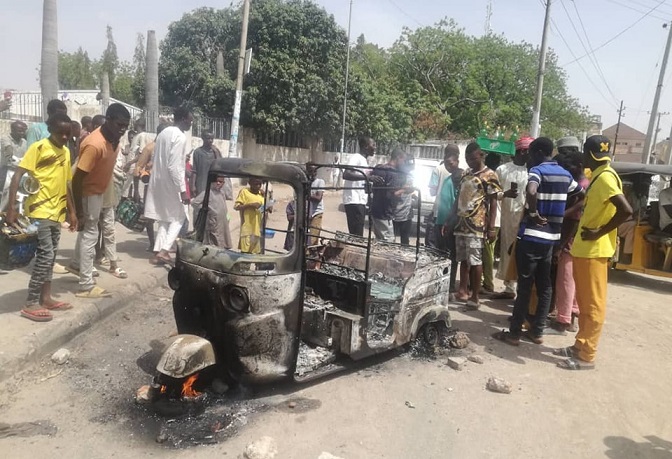
Sixth, Ƴan Adaidaita-Sahu (tricyclists) versus the Kano APC Government: No serious government attempts to base its decision solely on a profit-oriented venture instead of people based. The socioeconomic importance of this socially commercial venture to the state cannot be in any way overemphasised. It would be a minor miracle for business moguls like Dangote and BUA to be able to fully employ these youth when they are forced off the road to look for livelihoods elsewhere. Alarmingly, most of them might resort to illegal ways to sustain themselves.

Despite the huge amount of money the state government generates daily from these hundreds of thousands of youth, the tricyclists operate under constant threats from the KAROTA MD, who wants to ban the profession, notwithstanding the precarious consequences the so-called action may have on the whole state. For example, the Kano market experienced a drastic reduction in the number of customers because the state government has failed woefully to make necessary provisions to cater for the needs of the commuters due to its hasty decision to frustrate the people, perhaps owing to the perceived grudges they had with the governor. Many issues transpired as a result.

The tricyclists were forced to pay about ₦20,000 for a tracker. It is common knowledge that a ‘tracker’ is a technological device that provides much range of functions, including tracing the location of the vehicle, mileage report, stay report, overspeed report, fuel consumption report, travel report moving overview, driver’s behaviours and more importantly, it ensures the security of both the vehicle and the rider. This seemingly new development was welcomed by all and sundry. But to our chagrin, the supposed tracking device mysteriously transformed into a sticker.

The riders used their hard-earned money and tolerated the wonderful disappearance of their sweat for the love of peace. The maltreatment they were subjected to was best explained by both Barrister Abba Hikima and Malam Mubarak Ibrahim Lawan, who stood out and sacrificed their time to fight for them, with the former being their advocate in and outside the court.

Let everyone know that Adaidaita Sahu is not a venture that benefits only a few people. No, the entire Kano populace benefits from it directly or indirectly. For example, traders, students, guests, civil servants and the whole commuters are direct beneficiaries. The state government only suspends the ban for a while because of the looming election and the fear of the backlash from the teeming tryclists. But if they assume power again, nothing may stop them from going ahead with the ban. It is only God who knows how much billions several people invested in the Adaidaita Sahu business. What will be the fate of such a huge investment if this government reinstates the purported plan to ban this profession? The voters will answer these questions on 18th March 2023.

Seventh, the State Civil Servants versus the Kano APC Government: There is constant uncertainty about the actual amount of salary of civil servants in Kano and the time salary is paid in the state. I can vividly remember the biting economic conditions the generality of the Kano civil servants were subjected to during annual fasting periods and Sallah festivities. They were deliberately abandoned at the mercy of lenders and virtually inaccessible bank loans. In the spirit of mercy and compassion, they should have been paid on the 25th of the month of either Sallah or Ramadan fasting due to the increasing demand for money in such periods. This has been the story of Kano civil servants for so long.

In most cases, there is an urgent need for manpower in many ministries, with the education sector needing it the most. Our primary and secondary schools need more staff, but the government does not care to recruit new and competent hands, thereby leaving the current teachers with a heavy workload and a suffocating welfare package. The issue of promotion has become a serious headache for the poor teachers who deserve a promotion but cannot have it without a kickback, especially if you do not know who pulls the string in the top offices in the sector.

Eighth, the Kano Traders versus the APC-led Government: The highhandedness of the Kano state government towards marketers has made the business environment unfavourable. Gone are the days when a person could go freely to Kantin Kwari or Kofar Wambai markets without much apprehension about the parking lots. The lanes are not spacious enough due to the greediness that prompted the allocation of the space meant to be unquestionably public for commercial purposes. Many people can still recall how flood-ravaged many areas of the market recently. The unjust and greedy allocation of shops makes it difficult for the staff of the state’s fire service department to fight fire during some catastrophic infernos. Instead of the markets being decongested, the government created the very problem that made them jam-packed, thereby making it hard for business activities to run smoothly.

Ninth, commercialisation of public places: One can hardly explain what the Kano town plan looks like right now and how it used to be. Everything was thrown into confusion. Kofar Mata Eid prayer plot has been butchered and allocated to the highest-bidding traders. The famous Masallacin Waje was subjected to a similar fate. Many roadsides have experienced the same. Even schools. and graveyards are not spared from this unnecessary marketisation. Heck! Even some parts of the storied Sabon Gari stadium are commercialised.

In conclusion, the surge of anger in the minds of voters is an indication that the people are tired of this government’s style of administration. The issue of transparency and accountability are essential to any good governance. But many statistical data show that this government has performed so woefully in that areas. If we are serious and concerned about the state and overall development, we have cogent reasons to punish them with our PVCs on the D-Dsay.

Auwal Umar wrote from Kano. He can be contacted via auwaluumar9@gmail.com.

Kawu Sumaila, the Sabo Bakin Zuwo of our time

By Mukhtar Sani Yusuf 

I heard Senator-elect Honourable Kawu Sumaila describing himself and Senator Rabiu Musa Kwankwaso as Sabo Bakin Zuwo and Aminu Kano of our time in an interview he granted to local radio stations in Kano a few days after he was declared the winner of the just concluded election on Kano South Senatorial district under the platform of New Nigeria People’s Party (NNPP). Perhaps, Kawu Sumaila’s analogy has to do with the relationship that existed between Malam Aminu Kano and Aliyu Sabo Bakin Zuwo, the relationship between a leader and his disciple and those who fought and championed the course of emancipation of the poor people and the downtrodden. Kwankwaso and Kawu are now under the same umbrella, as a political leader and his loyalist following the same path of fighting for the common man’s rights.

Although Malam Aminu Kano and Alhaji Sabo Bakin Zuwo are household names in the political history of Nigeria and Kano state in particular, Kawu Sumaila’s recent statement aroused my attention as passionate of political history to take a deep dive into the political history of the two ace politicians of the blessed memory. And in this piece of writing, I laid my emphasis on where Bakin Zuwo and Kawu Sumaila shared some similarities and differences.

According to Wikipedia, “Sabo Bakin Zuwo had no background in formal education, he missed the opportunity to get formal education at an early age but was said to enrol himself at the age of sixteen at Shahuci primary school adult literacy class in 1950-1954, Igbo community school Sabon Gari and a course on local government administration in ABU Zaria. He also attended Malam Aminu Kano political school in Sudawa, Kano. An outspoken politician, Zuwo was said to have used radio more effectively than any other politician in Northern Nigeria. He was elected to the Senate in 1979 and sponsored more bills than any other senator at the time.”

Unlike Bakin Zuwo, Kawu Sumaila acquired formal education at an early age. He attended Sumaila  Gabas Primary School, Sumaila, and Government Secondary Sumaila, where he earned his First School Leaving Certificate and Secondary School Leaving Certificate in the years 1976 & 1988, respectively. He proceeded to Bayero University Kano and acquired a Diploma and an Advanced Diploma in Educational Management before he was elected to the House of Representatives in 2003 and spent 12 years representing Sumaila/Takai Federal constituency. Like Bakin Zuwo, Kawu utilises radio oftentimes to enlighten the local populace. An outspoken lawmaker, Kawu sponsored many important bills that reshaped the status of Nigerians during his days in the House of REPs.

In the 1983 gubernatorial election in Kano, Bakin Zuwo contested the election under the platform of PRP and defeated former governor Alhaji Abubakar Rimi. Even though he had the shortest reign as a governor of Kano state from October to December of 1983, he is remembered for his act of closing down the popular palace cinema in Kano, which was considered the haven of immorality at the time after listening to the yearnings of people. 

Like Bakin Zuwo, Kawu also contested the seat of Kano state governor in 2015 after he finished three tenures in the House of Representatives. He later withdrew the contest on the day of the APC primary election to support the candidacy of the current governor of Kano state, Dr Abdullahi Umar Ganduje. He was appointed SSA to the president on National Assembly matters shortly after president Buhari emerged as president of the Federal Republic of Nigeria in 2015.

In what appears similar to the act of Alhaji Sabo Bakin Zuwo in 2016, there was a public outcry in Kano on the federal government’s proposed film village to be cited in the state after listening to the peoples’ call who vehemently rejected the project, Kawu singlehandedly took the bull by the horns to approach the president on the matter. This single act led the federal government to rescind its position about the project.

One thing I learned about Alhaji Sabo Bakin Zuwo and Senator-elect Kawu Sumaila, which they shared in common, is vociferousness in voicing out their stance, especially when fighting for the interest of their people.

Hon. Kawu Sumaila is now elected Senator who will represent the people of Kano South in the Red Chamber, and before he was elected, he reached the pinnacle of formal education as he bagged PhD in political science.

Mukhtar Sani Yusuf wrote from Kano and can be reached via mukhtarsaniyusuf678@gmail.com.

Former Kano APC deputy governor endorses Abba Gida-Gida

By Uzair Adam Imam

A former deputy governor of the State, Professor Hafizu Abubakar supports Engineer Abba Kabir Yusuf ahead of Kano gubernatorial elections on Saturday, 18th March, 2023.

Prof. Hafiz, who’s still a member of All Progressives Congress (APC) stated this during an interview on Express Radio on Thursday.

Professor Hafizu also blamed the APC government for imposing numerous unnecessary hardships of cash and fuel scarcity on the citizens over the years.

He called on Kano citizens to vote for Abba Kabir Yusuf, popularly known as Abba Gida-Gida, for a better Kano on Saturday, March 18, 2023.

Professor Hafizu also urged the people Kano State to vote wisely in order to get rid of the APC government in the state.

The Former Deputy Governor also asked the citizens to ensure peaceful election while casting their votes and never allow anyone to rig or disrupt the election process.

He stated, “I ask the Kano state people to come out and vote for NNPP. And, they should not allow anyone to rig the election results because this people (APC) can do whatever to rig this election.”

Furthermore, the former deputy governor explained how he sponsored over 1000 youths into various trainings in order to solve some of their problems.

He said that the trainings were to reduce the number of jobless people and enabled them to be self-reliant due to the incessant job scarcity in the state.

The trainees comprised of 700 females and 300 males. Each of them received a start-up capital of N 5,000.

“We consider the situation people find themselves today of poverty. We therefore decided to come up with this idea of training 1,000 people on various skills acquisition.

We gave N5,000 to each of them. We also have the data of these people and many others and we will consider them if NNPP wins the Saturday’s election,” he said.

Senator Hanga: A beacon of hope for Kano Central

By Mubarak Umar

With the Supreme Court Judgment that affirmed Senator Rufai Sani Hanga of the New Nigeria Peoples Party (NNPP) as the Senator-Elect, Kano Central Senatorial District, the people of Kano Central have reason to rejoice.

Kano Central is truly abuzz with excitement following the judgment, which Senator Hanga challenged the Independent National Electoral Commission’s (INEC) declaration of Malam Ibrahim Shekarau as the winner of the February 25th, 2023 senatorial election in Kano Central.

This victory of Senator Hanga is a significant boost for the NNPP. It also demonstrates the importance of pursuing justice through the appropriate legal channels, rather than resorting to violence or other unlawful means. This is a win for democracy and the rule of law, and testament to his resilience and determination in fighting for his right.

I am delighted that Senator Hanga has been elected to represent Kano Central at the Upper Chamber. With his experience and dedication to public service, I believe he will be an effective advocate for his constituents and a valuable asset to the Nigerian government.

A graduate of Accountancy, one-time member of House of Representatives (1992-1993), senator who represented Kano Central from 2003-2007, chaired several committees including Chairman, Senate Committee on Drugs, Narcotics and Financial Crimes; Chairman Senate Sub-Committee on Housing and Urban Development; Chairman Sub-Committee on Finance; Vice Chairman, Senate Committee on Tourism and Culture; and Vice Chairman, Senate Committee on Special Duties.

These positions contributed to Senator Hanga’s deep understanding of the political and economic landscape of Nigeria. He has shown himself to be a skilled negotiator and collaborator, able to work effectively with others to achieve common goals. I believe that these qualities will serve him well as he navigates the complex issues facing Kano people, particularly his constituents.

Senator Hanga has demonstrated a strong commitment to the development of his community and the nation as a whole. His focus on issues such as education, healthcare, and infrastructure has been commendable, and I am confident that he will continue to work tirelessly to address these and other important challenges facing his constituents.

He is a politician with an impressive track record of public service, making him a valuable asset to any government. With years of experience working at various levels of government, Senator Hanga has developed a deep understanding of the political process, the needs of his constituents, and the challenges facing the country. His wealth of experience and expertise will undoubtedly prove invaluable in driving positive change and development initiatives in Kano Central.

Kano Central Senatorial District located in the northern part of Nigeria has fifteen local government areas, also known for its political and economic importance, it is the metropolitan commercial city of Kano, one of the largest cities in Nigeria.

One of the major reasons Kano Central needs good representations at Nigeria’s National Assembly is to ensure that the interests and needs of its people are adequately represented and addressed at the national level. This is important because the National Assembly is responsible for making laws that affect the entire country, and it is important that the laws made are fair and just for all Nigerians, including those in Kano Central. Now, the voices of Kano Central people will be heard and their needs will be addressed in the national discourse.

Senator Hanga’s representation at the National Assembly should ensure that Kano Central gets its fair share of the national resources. This includes funds for infrastructure development, education, healthcare, and other social amenities. With his effective representation, the district will not be left behind in terms of economic development, as policies that promote economic growth and development are made at the national level.

Furthermore, Kano Central is facing a number of challenges that require urgent attention from the National Assembly. These challenges include insecurity, unemployment, poverty, and lack of access to basic amenities like clean water and electricity. Effective representation at the National Assembly can help to address these challenges and improve the standard of living of the people of Kano Central.

The importance of good representation at Nigeria’s National Assembly cannot be overemphasized. The National Assembly is the highest legislative body in Nigeria, responsible for making laws that govern the country. As such, having good representation is crucial for the development of any district or constituency.

Kano Central is in dire need of infrastructure development. The district is home to several markets, industries, and transportation hubs, making it a hub of economic activity in the state. However, the lack of good roads, electricity, and other basic amenities is hindering economic growth. Good representation of Senator Hanga at the National Assembly should ensure that the district receives adequate funding for infrastructure development.

Kano Central is home to several tertiary institutions, including Bayero University, Kano State Polytechnic, and Yusuf Maitama Sule University. However, the education sector in the district needs significant improvement. His representation at the National Assembly should ensure that these institutions receive adequate funding to improve the quality of education and provide better facilities for students.

Kano Central is also in dire need of better healthcare facilities. The district is home to several hospitals and health centers, but most of them are understaffed and lack adequate medical equipment. Senator Hanga should ensure that the district receives adequate funding for healthcare facilities, as well as training and recruitment of medical personnel.

Kano Central has a high rate of unemployment, especially among the youth. Senator Hanga now has the opportunity to use all means of legislation that can attract foreign investors to the state and promote entrepreneurship, leading to job creation and economic growth.

Kano Central has experienced several security challenges in recent years, especially phone snatching, political thuggery, and burglary. Senator Hanga should ensure that the district receives adequate security funding to combat these challenges and maintain peace.

I am excited to see what Senator Hanga will accomplish during his time in office. With his dedication to public service, his commitment to his constituents, and his extensive knowledge of the Nigerian political landscape, I am confident that he will be a valuable and effective representative for Kano Central. I wish him all the best in his new role, and I look forward to seeing the positive impact he will have on the people of Kano and Nigeria as a whole.

Mubarak Umar writes from Kano State.

A Rejoinder to Binta Spikin’s article “Protest Votes.”

By Auwal Umar

One of the most onerous tasks before anyone though seems so easy is to see things as they are. That squarely sums up the essential job of criticism with the actual sense of the term. We are all subjects therefore, we are all predisposed to certain inclinations that tempt us to be subjective. Truth, no matter how opinionated one seems to be, can be separated from falsity. Against this background, I write this to the rejoinder written by one Binta Spikin titled: “Protest Votes” as a rejoinder to my article “Protest Votes: Abban Kanawa and the Sins of the Kano APC” published on 6th March 2023 by The Daily Reality.

Having had the conviction that even the points are raised cannot be easily refuted without wreaking havoc on the feeble reputation of the Kano APC led government. I really feel sense of pity seeing how Miss Spikin tried to defend her boss at all cost. I cannot reproach her for doing her job but when that shall deter the truth to prevail.

The meaning of criticism has nothing to do with condemnation but to simply point out both the strengths and weaknesses of the situation. The writer went ahead to rate Ganduje as one of the best performing governors especially on security which I equitably agree with no question. However, many questions still left unanswered on whether he is the best in handling the affairs of the state being comfortably positioned as statistically one of the worst performing in transparency which has nothing to do with the writer’s poor attempt as you described it to predict the possible scenarios that might unfold at the gubernatorial election as you called it, you really understood my piece but you skilfully evaded going squarely to disprove the points I raised but unfortunately you keep dangling between the facts and your newly self-appointed job of being a generous spokesperson instead of addressing them directly.

For the record, in the tail end of 2013 as reported by The Vanguard,  Nigerian Union of Journalists (NUJ) decorated Governor Musa Kwankwaso of Kano State as the best Nigerian Governor in the area of Fiscal Responsibility – a concept which refers to openness, discipline and accountability in governance unlike your self rating to please the power. On the other hand, Kano state under the stewardship of His Excellency Dr Abdullahi Umar Ganduje and Malam Nasiru Gawuna have performed woefully that is substantial enough to raise questions rather than answers. This means a lot to any one that is conversant with the art of governance, because lack of transparency signifies absence of financial accountability which culminated into unspeakable corruption allegations and embezzlement of public fund.

It is quite unfortunate to hear the writer chanting a sonorous songs that the governor has done his best with regard to education and health. This kind of “best” is enough to tell you that they have nothing to offer as one cannot give what he does not have. It was the best thing Ganduje could have done to education to close down schools established by his former boss as if they were meant for the children of Kwankwaso not for Kano citizens. He did his best by not constructing new one and recruit competent and qualified teachers in primary and secondary schools across the state. He did a commendable job to the health sector by his lackadaisical attitude to let the medical doctors of Kano extraction to get employed in Katsina and Jigawa with many of them securing juicy jobs abroad while the generous governor’s last attempt was to employ them as volunteers during Covid-19 pandemic.

It is very laughably shameful to describe protest of the frustrated and stranded scholars as indoctrination unlike Rimi’s era. For your information, Dr Abdullahi Umar Ganduje was the main brain behind it, if you even assumed it were. I heard Ganduje’s voice bashing them for even complaining. Those students were rendered like beggars close to importuning for alms to sustain them. Instead for their governor to treat them as his sons, he treated them as his archenemies. When did the heated political atmosphere should transferrable to the innocent people instead of being aimed at your opposite numbers? If you blame this to be indoctrination, you boss is the first culpable. No doubt, we don’t have much problem with Kwankwaso-Rimi political tussle as long as it did not affect the citizens, it was their interest. Had the incumbent governor adopted this style of opposition as that of Shekarau and Kwankwaso, he would not have been so much greeted with blows.

On the rerun, the zig-zag style detected in your writing is very funny. First you did not talk about the perpetrators and the implications of it. But I’m glad you admittedly come to terms with how it has come so much an issue and wonder this bespeaks how deeply it itched and still irking the Kano citizens. It is in order to have a rerun but it is not in tandem with the law of the land to be robbed of your mandate before the whole world by having a recourse to the thuggish force instead of votes. Put up with me! Kanawa will definitely give the right answer on 18th March seeing how the perpetrators are fielded as candidates. How I wish you had denied it but you didn’t.

On sponsoring the Kano state indigenes to attend the Law School the excuse is so frail and obvious. You first associated the failure with the dwindling oil revenue from 2015 to date, it is okay. Even though I cannot blame you for the upward and downward nature of the oil price curve in the world. Despite the dwindling oil revenue of Kano State has the guts to abandon education, health, science and technology, and many other critical sectors in favour of the bridges and underpasses. Wow! The governor is so concerned about these humanitarian projects that he even went further to see for billions of loans to go on with the projects yet the dwindling oil revenue impede the payment of Law school fees for the poor sons and daughters of Kano. One could praise the governor’s audacity to seek for ten billion Naira loan for the installation of CCTV cameras for the security of the state but not meagre amount can be sacrificed for our law graduates. It is very difficult to be one spokesperson but I cannot blame this honourable writer for her job.

In your last point, I respectfully take the different route which maintains that Ganduje is unmatched as he instituted continuity in governance partly true but not that true. Kwankwaso’s laid foundations for many projects  that are left in deplorable condition. Many schools are still close, not to talk of improving them and establishing new ones. Northwest University renamed as Maitama Sule University left in the mercy TETFUND. The training Institutes Kwankwaso established to bridge the wide gap in the rural areas are still part of the unanswered questions.

In conclusion, with much sense of respect, I admire your effort for doing your job as SA Research and Documentation but unfortunately you here got some of your records wrong and fail to do serious research about the points I expressed in my article.

Thank you.

Auwal Umar writes from Kano and can be reached via auwaluumar9@gmail.com

New CP pledges peaceful election in Kano

By Ahmad Deedat Zakari

The Commissioner of Police in charge of the forthcoming gubernatorial election in Kano State, Muhammed Usaini Gumel, has pledged to ensure a peaceful election in Nigeria’s Center of Commerce.

CP Gumel, in a press briefing on Thursday in Kano, disclosed the readiness of the Police to ensure that the guber and state parliamentary elections are conducted peacefully.

CP Gummel, in the press briefing, outlined the measures taken by the Police to avoid security breaches during the election.

According to him, the Police have undertaken security analysis and upscale the level of preparation across all the polling units in Kano State.

He said, “We have undertaken security threat analysis and upscale the level of preparation for the elections across all the polling units at the local government areas of the state, and we are fully prepared to emplace the requisite strategies towards managing the identified threats.”

Against the backdrop of Police preparedness, CP Gumel sought the trust and confidence of the people of Kano. He stated that criminals that wish to thwart the electoral process would be decisively dealt with.

“Ladies and Gentleman, please give us confidence so that nobody should be in doubt, I repeat, nobody should be in doubt as to the current capacity and renewed determination of the police to deal decisively with elements that attempt to test the will by engaging in political violence or other electoral manipulations including vote buying or use of threats; direct or indirect which are some of the elements threatening our democratic values.

“A similar warning also goes to any person that intends to offer himself to be used negatively by some ungodly political class in the state and urges him/her to take the advice that it will be better to have a rethink or else be ready to face the harsh consequences. Thank you for listening,” He said.

Re: An open letter to Barrister Abba Hikima

By Abba Kyari Mohammed

I read an article with the heading above written by one Yakubu Nasiru Khalid, which somewhat tries to demonise activists and freedom fighters venturing into politics. I got heartbroken and dumbfounded at our level of understanding of politics and its roles in our lives and nation-building.

The writer asked a pertinent question: Should a real social fighter be partisan? In this article, I will address just the question.

For clarity, by social fighter, I believe he meant someone who promotes and fights for socially progressive ideas and, where necessary, takes actions that benefit society. This is typical of Abba Hikima’s activism and benevolence in helping less privileged people access justice, voicing out the predicaments of people, the maladministration, and educating the populace about their civic rights and responsibilities. Also, by partisan, I believe he meant partisan politics, where one supports the candidates of one political party over others or decides to contest for office under a certain political party.

To start with, Abba Hikima has not been appointed as a ‘social fighter’ by anyone, nor did he, from my knowledge, ever arrogate to himself that title. It is a result of the work he does in promoting social justice, good governance and progressive ideals that people decided to refer to him as Freedom Fighter, Human Rights Activist, Social Fighter and many more nomenclatures to qualify the person that he is, which left to me are very deserving of him.

However, being a Social Fighter does not in any way exempt a person from participating in the democratic process of his country, which our Constitution generously guarantees and even demands explicitly. Therefore, I believe it is a gross injustice and discrimination to demonise or question anyone from exercising his rights because of his voluntary service to his community and nation, which you coined as ‘social fighting’.

It is also disheartening that we think politics and participation in the political process is an exclusive preserve of the elites or people who have no feelings for social justice and people´s emancipation or people with no impact on society. A serious society should rather have the Social Fighters, the Activists, the Freedom Fighters like Abba Hikima, who are adept at understanding societal problems and proffering people-tailored solutions, than some proletariat who live upstairs and have no touch with the masses to dictate to them whom to vote and even lead them.

For example, Barrack Obama of the United States was a lawyer and community organiser before he ventured into politics. Look how it turned out. Gani Fawehinmi is a Nigerian Human Rights Lawyer and Activist who campaigned for democracy, fought the brutish military regime, defended its victims for over 40 years, and later ventured into politics and contested the presidential election in 1994.

Nelson Mandela, a South African anti-apartheid activist, lawyer and former leader, fought and resisted apartheid in South Africa and was also a politician to become the first black Head of State, among many others. These tell you the place of politics in societal emancipation and social justice.

More so, what Abba Hikima does is more of civic enlightenment to the citizenry on what he firmly believes is right, especially in the face of what seemed like a gang-up to impose characters that have no business in leadership. According to Martin Luther King Jr., “The ultimate tragedy is not the oppression and cruelty by the bad people but the silence by the good people”.

The questions now are: Do you expect Abba Hikima to keep silent in the face of current political oppression in his state? Do you want him to disenfranchise himself because some people think he should not do so when no law or moral code is pointing towards that? Do you want Social fighters to steer clear of politics so thugs and the proletariat can take it over? These are questions worth pondering.

Abba Kyari can be reached via abbakyari2013@yahoo.com.