Month: April 2026

2018 Police Recruits Petition IGP Disu Over Promotion Delay, Salary Disparities

By Sabiu Abdullahi

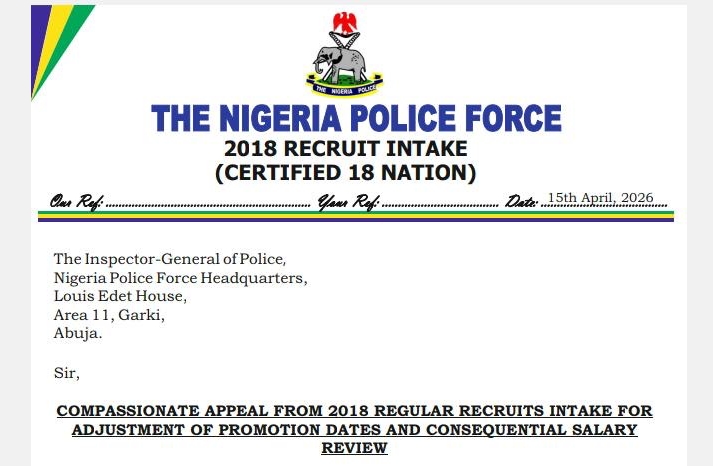
A group of officers recruited into the Nigeria Police Force in 2018 has written to the Inspector-General of Police, Tunji Disu, over a delay in their promotion, which they say has affected their earnings and career growth.

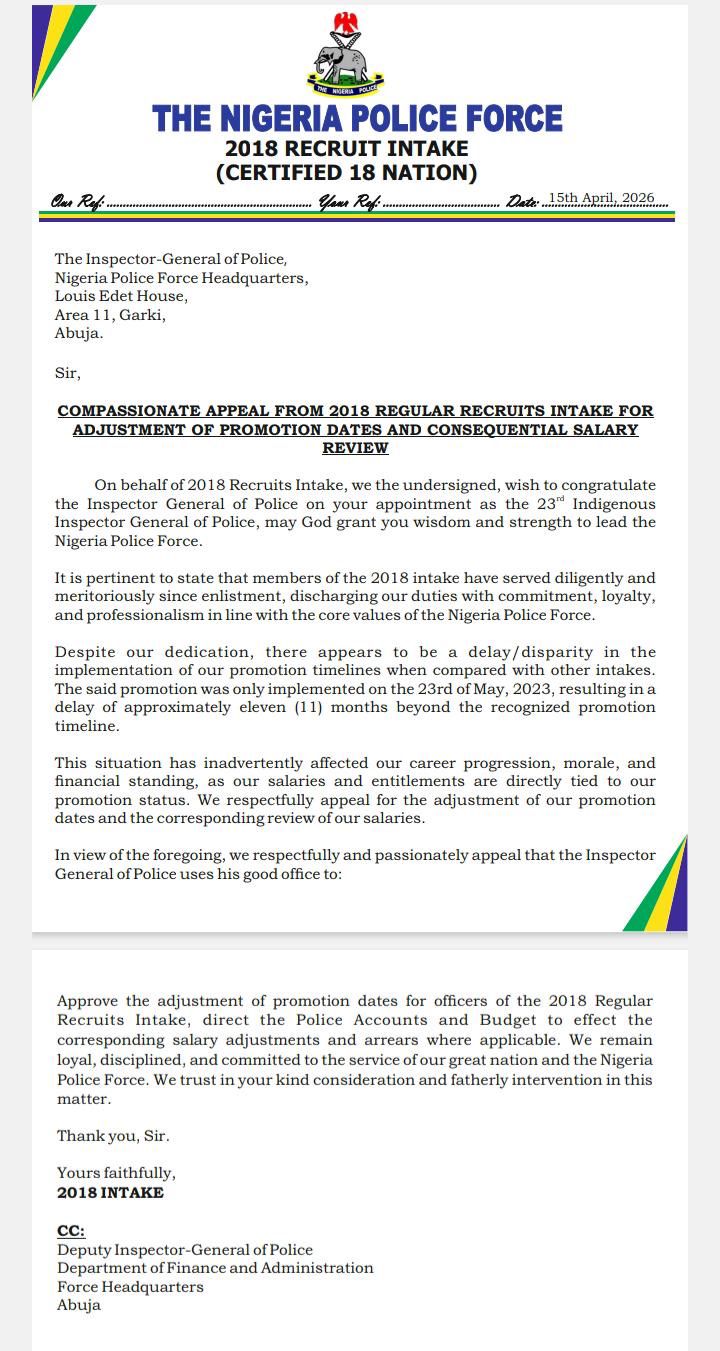
In a petition dated April 15, 2026, and addressed to the IGP at the Force Headquarters in Abuja, the officers requested a review of their promotion timeline and salary structure. They argued that their case differs from that of other intakes.

The officers opened their letter with a message of goodwill. They said, “On behalf of 2018 Recruits Intake, we the undersigned, wish to congratulate the Inspector General of Police on your appointment as the 23rd Indigenous Inspector General of Police… may God grant you wisdom and strength to lead the Nigeria Police Force.”

They stated that they have served with dedication since joining the force. According to them, their efforts have not been reflected in their advancement.

“It is pertinent to state that members of the 2018 intake have served diligently and meritoriously since enlistment, discharging our duties with commitment, loyalty, and professionalism in line with the core values of the Nigeria Police Force,” the letter read.

The officers pointed to a delay in their promotion, which they said came much later than expected. They explained that the exercise was carried out on May 23, 2023, almost a year behind schedule.

“Despite our dedication, there appears to be a delay/disparity in the implementation of our promotion timelines when compared with other intakes. The said promotion was only implemented on the 23rd of May, 2023, resulting in a delay of approximately eleven (11) months beyond the recognized promotion timeline,” the letter said.

They noted that the situation has affected their welfare and financial position. They linked their salaries and benefits directly to their promotion status.

“This situation has inadvertently affected our career progression, morale, and financial standing, as our salaries and entitlements are directly tied to our promotion status,” they said.

The officers appealed to the police leadership to correct what they described as an anomaly. They asked for an adjustment of their promotion dates and a review of their pay.

“We respectfully appeal for the adjustment of our promotion dates and the corresponding review of our salaries,” they stated.

They also outlined steps they expect the authorities to take. These include directives to the appropriate departments to implement changes and settle any outstanding arrears.

“Approve the adjustment of promotion dates for officers of the 2018 Regular Recruits Intake, direct the Police Accounts and Budget to effect the corresponding salary adjustments and arrears where applicable,” they said.

Copies of the petition were sent to the Deputy Inspector-General of Police in charge of Finance and Administration at the Force Headquarters.

The officers reaffirmed their commitment to the Nigeria Police Force and expressed hope that their concerns would receive prompt attention.

“We remain loyal, disciplined, and committed to the service of our great nation and the Nigeria Police Force. We trust in your kind consideration and fatherly intervention in this matter,” they added.

FG Says Jilli Airstrike Targeted Terrorist Hideouts

By Abdullahi Mukhtar Algasgaini

The Federal Government has provided further clarification on the airstrike carried out by the Nigerian Air Force (NAF) in the Jilli area of Gubio Local Government Area, Borno State, on April 11, 2026.

The government stated that the strike was not a random or careless attack; rather, it was deliberately aimed at terrorist hideouts.

In a statement issued by the Minister of Information and National Orientation, Mohammed Idris, he emphasized that the operation was part of Operation HADIN KAI and was conducted based on credible intelligence.

The Jilli area, commonly known as “Daulaye Market” (a terrorists’ market), has long been under the control of Boko Haram and ISWAP fighters. It is where they collect illegal taxes from residents, purchase supplies, and plan their attacks.

The statement further revealed that on April 12, 2026, troops arrested a 15-year-old boy named Tijjani in the Ngamdu area. Tijjani confessed to ferrying money and other supplies for ISWAP terrorists between Jilli and other locations, demonstrating how terrorist leaders exploit underage children to carry out harmful activities.

Similarly, Borno State Governor, Professor Babagana Umara Zulum, confirmed that the Jilli and Gazabure markets had been shut down five years ago due to terrorist occupation.

Although the government defended the military action, it extended condolences to the families of those affected. The Minister stated:
“The life of every Nigerian is important, and we deeply regret the loss of civilian lives that may have occurred.”

To ensure transparency and justice, the Federal Government has ordered an independent investigation into the planning and execution of the airstrike to identify any errors.

Currently, the government is collaborating with emergency management agencies—NEMA and SEMA—to provide relief to the families and injured persons in Borno and Yobe states.

The government also urged civilians to avoid restricted areas and continue to cooperate with security forces to bring an end to the insurgency.

Nigerian Medical Doctor Dies After Delivering Triplets

By Sabiu Abdullahi

A female medical doctor, Ere Siana Sintei Ogbachi, has passed away after developing complications shortly after she gave birth to triplets at the Niger Delta University Teaching Hospital (NDUTH) in Okolobiri, Yenagoa Local Government Area of Bayelsa State.

Sources within the family said she initially showed signs of recovery after the delivery. Her condition later worsened unexpectedly.

She was then transferred to the Intensive Care Unit (ICU) of the Federal Medical Centre (FMC) in Yenagoa for advanced treatment.

Despite efforts by medical personnel, she was confirmed dead in the early hours of April 14, 2026.

In a statement issued by Meshack N. Sintei, the family described the loss as devastating. They noted that all attempts to save her life did not succeed.

The statement added that doctors at FMC Yenagoa worked continuously to stabilise her condition as it declined, but she did not survive. It also explained that her vital signs kept dropping despite close monitoring.

The late doctor was described as a dedicated health professional, a wife, and a mother to her newborn triplets. She was a member of the Nigerian Medical Association and a graduate of the Niger Delta University.

Her death has drawn reactions from colleagues and members of the medical community, many of whom described the incident as deeply tragic.

The family also thanked friends, colleagues, and supporters for their sympathy and solidarity during the difficult period.

Nigerian Army Bids Farewell To Brig Gen Braimah, Other Soldiers Killed In Borno Attack

The Nigerian Army on Wednesday held a burial ceremony for Brigadier General Oseni Braimah, Captain Ismail, and other soldiers who lost their lives in a recent insurgent attack in Borno State.

The funeral took place at the Maimalari Cantonment Cemetery in Maiduguri, where the fallen personnel received full military honours in recognition of their service to the nation.

The officers were killed on April 9 after suspected Boko Haram and Islamic State West Africa Province fighters launched coordinated assaults on military positions in Benisheikh. The town lies in Kaga Local Government Area along the Maiduguri–Damaturu highway, a key route in the North-East.

The Army, in a statement on its official Facebook page, described the ceremony as one marked by deep emotion and national reflection.

The statement read:

“In a solemn and emotionally charged ceremony, the nation on Wednesday, April 15, 2026, laid to rest late Brigadier General Omo Braimah, Captain Ismail, and other gallant soldiers who paid the supreme price in the line of duty.

“The burial, held at the Maimalari Cantonment Cemetery in Maiduguri, Borno State, was marked by deep sorrow, honour, and reflection,” the statement read.

The military further explained that the ceremony reflected the respect given to personnel who died in active service. It noted that the honours accorded the deceased represented recognition of their commitment to national security.

The statement added:

“Their sacrifice serves as a poignant reminder of the heavy price paid daily by members of the Armed Forces to safeguard the peace, unity, and security of Nigeria,” it said.

Dignitaries present at the burial included Borno State Governor Babagana Zulum, the Chief of Defence Staff, General Christopher Musa, and several senior military officers. They described the deceased soldiers as patriots who showed courage in defence of the country.

Religious rites were observed for the repose of the souls of the fallen officers and soldiers. Military officials also read out citations highlighting their service records before their families and colleagues.

The Army stated that the grief expressed by families reflected the human toll of ongoing security operations in the North-East. It added that the bravery of the deceased would remain a source of honour within the Armed Forces.

Kano First? Then Deputy’s Choice Should Not Be Difficult

By Muhammad Sani Ilyasu

Over the past few days, Kano’s political atmosphere has been gripped by what should have been a routine decision — the selection of a Deputy Governor. Instead, it has dragged, stretched, and unsettled expectations. As the Hausa proverb reminds us, wankin hula yana neman kai. Sooner or later, the moment of decision arrives, and when it does, it reveals more than preference. It reveals judgment.

But truthfully, this is not a difficult decision.
Once the list of nominees from the old APC bloc surfaced, one name did not merely appear — it stood apart. Alhaji Rabiu Suleiman Bichi. Not because of sentiment, and certainly not because of noise, but because of something far more scarce in today’s politics: substance.

This is a man shaped by governance, not just politics. He has moved through the system at its highest levels — serving as Secretary to the State Government, managing policy at the governor’s office, and working across institutions where decisions are not announced for applause but executed for impact. That kind of experience does not shout. It shows. And in moments like this, it matters enormously.

Yet the weight of this decision extends well beyond qualifications. The governor did not simply make a political realignment — he justified it with a principle: putting Kano first. That declaration raised the stakes. It transformed every subsequent decision into a test of consistency. Because once Kano becomes the stated priority, convenience must give way to capacity, and politics must submit to judgment.

You cannot declare Kano first and then treat this appointment as negotiable. The office of Deputy Governor is not ceremonial. It is not a token for balancing interests or rewarding loyalty. It is a quiet but powerful engine of governance — where coordination happens, where pressure is absorbed, and where experience prevents the kind of costly mistakes that erode public trust. It is not a place for learning on the job. That is precisely why Rabiu Suleiman fits this moment.

Rabiu Sulaiman Bichi carries a rare combination that politics often separates: administrative competence and genuine political experience. As a founding figure of the Kwankwasiyya movement, a former PDP State Chairman, and later Director-General of the APC’s 2023 campaign in Kano, he has operated credibly across political lines without losing his footing. That is not inconsistency. It is relevance across eras — the mark of someone who understands how power works without being consumed by it.

More importantly, he brings reach. His network — spanning national and international circles — is not ornamental. It is functional. It is the kind of capital that attracts serious partnerships, aligns policy with opportunity, and positions Kano beyond its immediate boundaries. At a time when states compete not only internally but on a broader stage, that kind of exposure is not a luxury. It is a strategic asset.

And then there is the other side of the equation — the part many would rather avoid, but which cannot responsibly be ignored. Leadership is defined not only by what is built but by what is tolerated. To elevate a deputy whose public record is clouded by ongoing court cases involving serious allegations of corruption and financial misconduct is not merely a political risk. It is a statement — and a loud one.

Because once made, that choice will not remain local. It will travel. It will shape perception, invite institutional scrutiny, and define the governor’s seriousness in the eyes of allies, investors, and the wider Nigerian public. You cannot stand on reform and lean on controversy. That is not balance. It is contradiction. And Kano cannot afford contradiction at this level of governance.

This is not a moment for experimentation. It is a moment for clarity — a moment to demonstrate that governance here is still anchored on competence, credibility, and consequence. In Rabiu Suleiman Bichi, that clarity already exists. Which is why this decision, despite the delay, remains straightforward.

If Kano truly comes first, the answer is already known. Anything else is not a strategy. It is a misstep.

Muhammad Sani Ilyasu writes from Maryland, United States of America and can be reached via msaniiliyasu@gmail.com

Tribute to the Doyen of Accounting: A Man of Ethics and Impeccable Character

By Sunusi Abubakar, ACA

Had it not been for someone I deeply respect breaking the news of Professor K.I. Dandago’s passing to me might have left me harbouring resentment towards someone for a period of my life. I was utterly shocked by Prof’s death.

Professor K.I. Dandago, widely known in Nigeria and beyond, was a renowned academic whose character was exemplary among his peers.

Those who Prof K.I. Dandago taught will agree that one thing no one could take away from him was his ethics and sense of responsibility. The professor could stand in the rain or shine just to deliver a lecture. He could climb a 10-storey building merely to fulfil his duty. Despite being ill, Prof. often stood for nearly two hours to deliver a lecture to us when we were in level 400. He was always honest and sincere in his dealings.

My first encounter with Prof was in 2018 during a lecture on Ethical Issues in Accounting. I had the privilege of discussing with him the reason for my absence from a previous lecture. Even after I gave a genuine explanation, Prof insisted that I submit it formally so that he could verify its validity.

My second encounter was after a lecture at Northwest University (NWU)’s Main Campus. I asked him about the Big Four accounting firms in Nigeria. He shared extensive insights and even explained how he facilitated a business relationship between KPMG and a private university in Kano.

My relationship with Prof grew stronger and more personal during Level 400. During that time, I often visited his office for professional guidance. He graciously agreed to act as my professional referee when I began my journey with the Institute of Chartered Accountants of Nigeria. The professor was instrumental in my path to becoming a chartered accountant and entering professional practice. I vividly remember him contacting the Principal Partner at Namadi Umar & Co. (Chartered Accountants) to secure my acceptance as an Audit Trainee. 

The last time we communicated was about my job application to Ahmadu Bello University, Zaria. He assured me of his professional response and an academic recommendation. The last time I saw Prof was at a sensitisation lecture organised by the Faculty of SMS at NWU, Kano, where he served as a speaker and demonstrated his expertise in accounting and taxation, particularly regarding the new tax laws.

My relationship with Prof. was not merely that of a student and a lecturer, nor solely that of a mentor and a mentee; it was akin to that of a father and a son. The professor helped me in every possible way. I owe him a profound debt for living this life with honesty, accountability, and sincerity of purpose.

May He grant him Jannatul Firdaus and give us the fortitude to bear this irreplaceable loss.

Sunusi Abubakar, ACA, wrote from Birnin Kudu, Jigawa State.

Army Overruns Bandit Camps, Captures Families, Destroys Logistics in Bauchi Forest

By Abdullahi Mukhtar Algasgaini

The Nigerian Army has intensified its onslaught against banditry, recording major breakthroughs in clearance operations across Bauchi State, with troops overrunning key terrorist camps, capturing families of fleeing criminals, and destroying vital logistics in the Dajin Madam Forest.

In a statement issued today, the Army confirmed that troops of 33 Artillery Brigade, working in coordination with the Office of the National Security Adviser (ONSA), conducted a fierce clearance operation deep inside the forest. The operation led to the destruction of several bandit enclaves, including the notorious Azuge and Hari camps.

During the offensive, troops neutralized an unspecified number of bandits, while many others fled under heavy military pressure. In a significant development, security forces took into custody six women and thirteen children, family members of the bandits. Several motorcycles used by the criminals for mobility were destroyed, severely limiting their ability to launch further attacks.

A cache of items recovered from the camps includes one AK-47 magazine, packs of tramadol, a pair of police uniform, multiple military uniforms, and two horses, items the Army said were indicative of the group’s criminal enterprise and attempts at impersonation.

“Troops are currently maintaining a firm hold position within the Dajin Madam Forest to consolidate the gains achieved and prevent any re-infiltration by fleeing bandits,” the statement read.

In a related follow-up clearance operation to Mainamaji, conducted after recent air strikes on bandit hideouts, troops made no contact with the enemy—a further indication that sustained military pressure has significantly degraded bandit presence and movement in the area.

The Nigerian Army reaffirmed its commitment to sustaining the offensive until lasting peace and security are restored. Citizens are encouraged to continue supporting security agencies with timely and credible information.

Carlson Weighs In on Trump’s AI Jesus Image Row, Says Muslims Love Jesus

By Muhammad Abubakar

Renowned American commentator and podcaster Tucker Carlson has ignited debate after saying, “the people in charge don’t want you to know this, but Muslims love Jesus,” amid tensions involving Donald Trump and Pope Leo XIV.

The remark followed controversy over an AI-generated image shared by Trump on Truth Social, showing him in attire associated with Jesus Christ.

Carlson’s comment drew mixed reactions online, with some noting that Islam indeed reveres Jesus as a prophet, while others questioned the timing and context of his statement.

Recall that President Trump called Carlson low IQ, among other abuses, as the two former allies fall apart, especially because of the US-Israel war on Iran and US foreign policy towards Iran.

As of the time of this report, Trump has yet to respond to Carlson’s recent post on Jesus and Muslims.

Customs Launches AI Training To Boost Revenue, Transparency

By Sabiu Abdullahi

The Nigeria Customs Service (NCS) has begun a training programme focused on the use of Artificial Intelligence to improve revenue generation, remittances and reconciliation processes.

The exercise took place on Monday, April 13, 2026, at the Ladi Kwali Hall of the Abuja Continental Hotel. It attracted senior Customs officers, technology specialists and members of legislative oversight committees.

The presence of lawmakers alongside Customs officials highlights ongoing cooperation between the Service and the National Assembly. Both sides aim to improve accountability and introduce modern technology into public administration.

Speaking at the event, the Comptroller-General of Customs, Adewale Adeniyi, reaffirmed the agency’s commitment to transparency in financial management through innovation.

“We are united in our resolve to ensure transparency in public accounting. Technology continues to evolve and plays an important role in strengthening our operations. It has also helped us better understand patterns in international trade,” he said.

He expressed confidence in the benefits of Artificial Intelligence for Customs operations. He also noted that the Service operates within a wider global trade system.

“We want to reap the benefits of Artificial Intelligence collectively. I encourage participants to actively engage the facilitators, ask questions and take full advantage of the training,” he added.

In her remarks, the Deputy Comptroller-General in charge of Finance, Administration and Technical Services, Kikelomo Adeola, described the initiative as timely and strategic.

“This training reflects our commitment to national development. Artificial Intelligence is no longer a concept of the future; it is a technology we must embrace to strengthen our systems,” she said.

She explained that the programme aims to close gaps in revenue management and equip officers with the skills to use AI tools to protect public funds.

Adeola also acknowledged the attendance of lawmakers. She described it as a sign of shared responsibility in promoting transparency and accountability.

“This synergy is important. I encourage participants to ask relevant questions and exchange ideas that will enhance the effectiveness of this initiative,” she added.

The Chairman of the House of Representatives Public Accounts Committee, Bamidele Salam, praised the Customs Service for its reform efforts and focus on innovation.

“Customs is a global institution and plays a critical role in shaping Nigeria’s economic image. I commend the Comptroller-General for the progress made so far,” he said.

He described the training as necessary and noted that the use of Artificial Intelligence in Nigerian public institutions is still limited.

“We must continue to build capacity because the effectiveness of any system ultimately depends on the people who operate it,” he added.

Also speaking, the Chairman of the Senate Public Accounts Committee, Senator Ahmed Aliyu, called for stronger collaboration to build durable systems for the future.

“All hands must be on deck. We must build systems that will endure and continue to serve the nation for years to come,” he said.

The programme featured a presentation by technology expert Bamidele Oyedeji. He highlighted how Artificial Intelligence can improve trade processes and operational efficiency within Customs administrations.

The initiative reflects the determination of the Nigeria Customs Service to adopt emerging technologies to strengthen revenue management, improve transparency and enhance overall performance.

K-SAFE Seeks Strategic Collaboration to Boost Literacy in Kano

By Uzair Adam

The Kano State Accountability Forum on Education (K-SAFE) has intensified efforts to strengthen collaboration with key education stakeholders following an advocacy visit to Community Aid Connect.

The Daily Reality reports that the move, according to the group, is part of ongoing engagements aimed at improving access to inclusive and quality education across Kano State.

In a statement issued on Monday, and signed by its Public Relations Officer, Nasiru Yusuf Ibrahim, the organisation said the visit formed part of its broader strategy to partner with development actors.

It noted that such collaborations are essential to addressing challenges affecting education delivery, particularly among vulnerable and underserved populations.

The delegation, led by K-SAFE Co-Chair (CSOs), Auwalu Halilu, was received by the Kano State Team Lead of Community Aid Connect, Surajo Mahe Alkali.

The meeting, held on Monday, provided an opportunity for both organisations to explore areas of mutual interest and strengthen existing relationships.

During the engagement, Halilu commended Community Aid Connect for its role in promoting literacy and numeracy through innovative programmes.

He specifically referenced initiatives such as the DARASI programme and the Community Radio Literacy and Numeracy Programme, describing them as impactful interventions in the education sector.

The K-SAFE Co-Chair noted that the programmes provide flexible learning opportunities for learners with limited access to formal education.

According to him, such initiatives are particularly beneficial to vulnerable groups, helping to bridge gaps in access and improve foundational learning outcomes.

In his remarks, Alkali highlighted the impact of the DARASI Programme in supporting basic education, especially at the foundational level.

He also emphasised the effectiveness of radio-based learning in reaching remote and hard-to-access communities, noting that such approaches have expanded educational access in underserved areas.

Both parties stressed the importance of community participation, stakeholder coordination, and sustained advocacy in addressing learning gaps.

They noted that improving educational outcomes requires a collective effort involving government, development partners, and local communities.

They also identified key areas of collaboration, including joint advocacy campaigns to promote enrolment and retention in schools.

Other areas include partnerships on radio-based awareness initiatives, strengthening monitoring and accountability mechanisms, and capacity building for community-based education structures.

The organisations further agreed on the need to document programme outcomes to support policy dialogue and education sector planning in Kano State.

They said such evidence-based approaches would enhance decision-making and contribute to long-term improvements in the education system.

The Daily Reality also gathered that the engagement reaffirmed the shared commitment of both organisations to enhancing access, equity, and quality of education.

It also underscored their resolve to promote innovative solutions aimed at improving literacy and numeracy across the state.