Month: May 2023

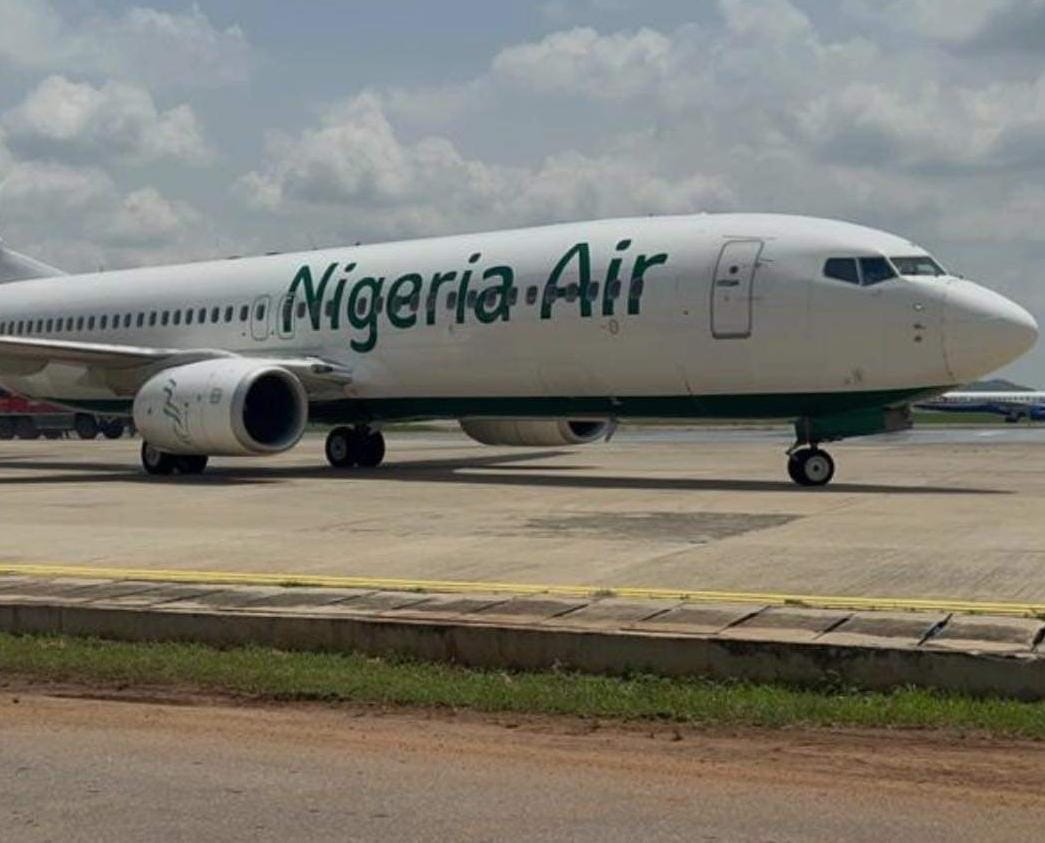
Nigeria Air: Omokri commends Buhari

By Muhammadu Sabiu
 
The Federal Government, led by President Muhammadu Buhari, has received praise from Reno Omokri, a former presidential spokesperson, for the starting up of Nigeria Air.
 
The sociopolitical pundit, who is also a fervent opponent of Buhari, made the statement while downplaying the accusations of the Nigerian administration over Nigeria Air.
 
Following the arrival of the Nigeria Air plane, Nigerians have been accusing the Federal Government of being involved in fraudulent activities.
 
Nigerians bemoaned it because it was said that Ethiopian Airlines was the owner of the aircraft.
 
 
“But Nigeria Air is a good idea. Even starting it with a wet-leased aircraft is an even better idea than starting it with a new one. If the government does badly, let us cane them with koboko. But if they perform well, we should be objective and praise them with the same ferocity, ” Omokri said.
 
 
However, responding to critics about the number of planes in the carrier, the former presidential spokesperson tweeted: “Emirate Airlines, that many Nigerians love to fly with, started off in 1985 with two airlines provided to them by Pakistan International Airlines.
 
“Today, they are thriving. If there is something to criticise, please sòrò sóké. But do not just criticise because your party is not in government. Ruga was a bad idea. Arresting Nnamdi Kanu was a wrong move. The Northernisation of our National Security Council was a horrible thing to do. And we criticised all of those.

ABU wins Huawei ICT Competition in China

By Ahmad Deedat Zakari

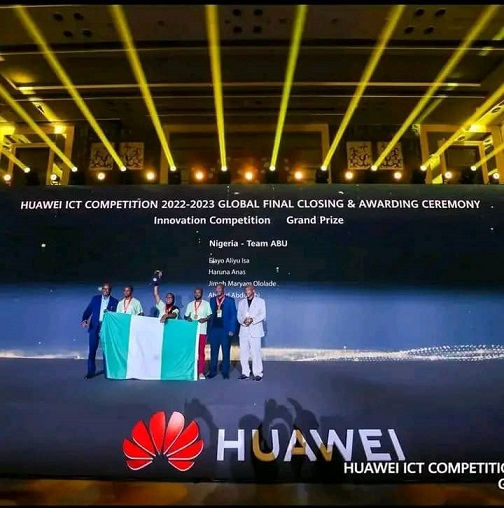
The Ahmadu Bello University (ABU), Zaria, has emerged winner at the Huawei ICT Competition for the 2022-2023 Global Final held in Shenzhen, China.  

The management of Huawei disclosed on their website that the competition was the first to be held physically since 2019, and about 80 universities worldwide participated.

“Today, the Huawei ICT Competition 2022-2023 Global Final concluded in Shenzhen, drawing to a close the seventh instalment of this competition. The first to be held in person since 2019, the event’s culmination was a competition between finalists in 146 teams from 36 countries. Before the Final, more than 120,000 students from more than 2000 universities in 74 countries and regions around the world took part in the ICT Competition,” the statement reads.

Maryam Jimoh Olalade, Haruna Anas, Ahmad Abdullahi and Elayo Aliyu Isah represented the institution that won the prize.

Abolishing Nigerian godfatherism mentality

By Usman Muhammad Salihu

Nigeria has long been known for its political culture of godfatherism, which refers to a system in which a powerful politician or group of politicians wield significant control over the political fortunes of others. The practice of godfatherism has been a defining feature of Nigerian politics for decades, and it has been blamed for perpetuating corruption, stifling democratic participation, and hindering economic growth and development.

Godfatherism in Nigeria is typically characterised by a system in which a powerful politician, usually an incumbent governor or party leader, sponsors and funds the candidacy of a less-established politician or aspirant for an elected office. In exchange, the godfather expects loyalty and a significant portion of the proceeds from the office once the candidate is elected.

This system has become deeply entrenched in Nigerian politics, and it has produced a political class that is more interested in personal gain and self-preservation than in serving the needs and interests of the people. The consequences of godfatherism are numerous and far-reaching, and they include:

Corruption: Godfatherism promotes corruption in the political system, as the godfather expects a significant return on their investment in the candidate. This often leads to a cycle of corruption, where the candidate engages in corrupt practices to satisfy the demands of the godfather.

Lack of accountability: The godfather system creates a culture of impunity in which elected officials feel less accountable to the people they represent. This lack of accountability undermines the credibility of the democratic process and perpetuates a culture of political apathy among citizens.

Stifling of democracy: Godfatherism stifles the growth of democracy by limiting the ability of independent-minded candidates to contest for political office. This limits the choices available to voters and undermines the democratic process.

Economic stagnation: The godfather system discourages economic growth and development by favouring candidates more interested in their gain than in implementing policies that will benefit the economy.

Social inequality: The godfather system reinforces social inequality by favouring candidates from privileged backgrounds or with access to financial resources. This leaves many citizens without a voice in the political process and perpetuates a system of elitism.

Given the many negative consequences of godfatherism, it is clear that this practice must be abolished if Nigeria is to realise its full potential as a democratic and prosperous nation. This will require a concerted effort from all stakeholders, including politicians, civil society organisations, the media, and the general public.

To achieve this goal, Nigeria must strengthen its democratic institutions, including the judiciary and the electoral system, to ensure they are more independent and less susceptible to external influence. Additionally, there must be greater awareness and mobilisation of the public to demand accountability and transparency from elected officials.

In conclusion, the mentality of godfatherism in Nigeria must be abolished if the country is to achieve its full potential. This will require a long-term commitment to strengthening democratic institutions, promoting accountability and transparency, and mobilising the public to demand change. With a concerted effort from all stakeholders, Nigeria can move beyond the politics of godfatherism and towards a more democratic and prosperous future.

Usman Muhammad Salihu wrote from the Mass Communication department, Abubakar Tatari Ali Polytechnic, Bauchi State. He can be contacted via muhammadu5363@gmail.com.

The North always supports Yoruba Presidency – OPF replies OPC

By Muhammad Abdurrahman

Moved by the recent threat to the North by the Oodu’a Peoples Congress (OPC) on the issue of contesting the National Assembly leadership sharing formula announced by the National Working Committee of the All Progressives Congress, the Oodu’a Peoples Frontiers (OPF) said, time immemorial, the North has always supported Yoruba Presidency.

In a statement issued to the media signed by the convener, OPF, Comrade Moses Oluwasegun Odewale said, the threat by the OPC, is in no way representative of the views of the decent Yoruba nation and should not be seen as such.

The statement said, “If anything, the threats, though empty and unsolicited, are embarrassing, shameful and only expose the inconsistencies of the OPC and other groups like the Afenifere that pose as representatives of the entire Yoruba nation.

“Whether OPC, Afenifere or any other group from any region wants to believe it or not, available facts and figures prove that the North is majorly responsible for the emergence of the Asiwaju as APC flag bearer and to his eventual victory at the polls.

“We cannot forget so quickly that eleven APC governors of Northern Nigerian states stood firmly against all odds and ensured that power moved to the South and to the Southwest in particular which paved the way for Tinubu’s emergence.

“And there is no disputing the fact that Tinubu’s final victory at the polls was secured by the northern votes which made up 60 percent of the total votes he got, far and above what he got in the Southwest.”

Odewale, reminded that, facts of history have shown how the North had been consistent with its support for a Yoruba presidency even at the expense of candidates from the North.

“During the 1993 elections, Bashorun Abiola contested on the platform of the Social Democratic Party, partly due to the influence of a northern force presented by the late General Shehu Yar’Adua.

“And at the polls, the Northern votes comprehensively went to Abiola to ensure his success over their own son, Alhaji Bashir Tofa, a prominent, respected personality.

“Record shows that of the 6.6 million votes that had been announced before the annulment, Tofa had received 2.3 million and Abiola  4.3 million of which more than half came from the North.

“Abiola won all the states of the south-west; three of the seven states in the south-east; five of the nine northern states including Kano, Tofa’s state; and four out of the seven states in the central middle belt.”

He further revealed that the gesture was replicated when Olusegun Obasanjo was released from prison by the northern establishment, made a candidate for the Peoples Democratic Party by the northern elite and voted for the presidency by the northern voters in 1999.

“On all these three occasions such self-professed Yoruba protection groups as the Afenifere and OPC were nowhere visible, in fact they only surfaced after the June 12 annulment to bask in the glory of what they did participate in.

“Also in 1999,  Afenifere and the OPC led the Yoruba nation to favour Olu Falae while the North worked for Obasanjo’s victory against their son.

“And this time around, Afenifere openly declared opposition to Tinubu, OPC was missing in the field while the North did all the work.”

From its viewpoint, the OPF believes that by making it look like the OPC are protecting their son, the President-elect, Asiwaju Bola Ahmed Tinubu, it has ended up exposing him in particular and the South-west several political vulnerabilities in the future.

“It is therefore the peak of insanity, shamelessness and ingratitude for the OPC or any Southwest group to reward the North with threats in the false presence of defending their son whom they rejected earlier.”

OPF, therefore, emphatically dissociates the decent Yoruba nation from these threats to the North in particular and to any other section of the country while condemning with all might the uncivilized action of OPC that threatens the long standing political friendship that exists between the North and the Southwest.

OPF further called on the President-elect not to fall for the dirty game of the OPC and Afenifere which only aims to pitch him against his most reliable traditional political allies.

“Asiwaju should as much as possible distance himself from agents of destabilisation operating in various guises and instead concentrate on governance and the task of nation-building with justice and equity to all.”
 

Kano Governor-elect declares assets ahead of inauguration

By Muhammad Abdurrahman

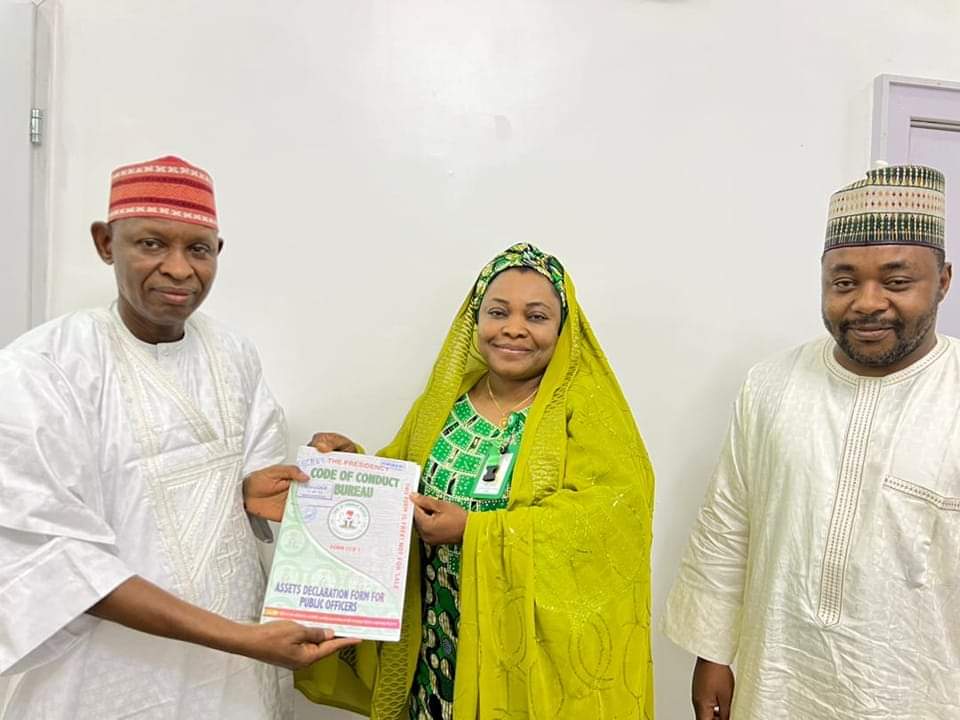
The declaration was made known on Friday 26, 2023, via a pess statement signed by Sunusi Bature Dawakin Tofa, the chief press secretary to the Kano State Governor-elect, H.E. Abba Kabir Yusuf.

The statement describes how the Governor-elect declared the assets and liabilities ahead of his inauguration on Monday 29, 2023. In accordance with the law, Engr. Yusuf submitted a completed form to the Code of Conduct Bureau, CCB, Kano office.

Engr. Abba, who was received by the CCB State Director, Hajia Hadiza Larai Ibrahim, said his earnest declaration of assets is a demonstration of transparency and accountability that will form the bedrock of the incoming administration in Kano State.

He said: ”Today, I have fulfilled the constitutional obligation of declaring my assets before assuming the office, May 29.”

The Governor-elect, told his host that public service is a calling; it is a service to humanity and I am always ready to serve having won the confidence of the good people of Kano State.

Further, Engr. Abba declared that the coast is now clear for the journey of restoration of sustainable development in all the sectors, where every Kobo of the public fund spent will not only be justifiable but accountable in Kano State under his watch.

He assured that all the public officials including political appointees that will serve in his administration will be mandated to follow suit of asset declaration as required by the Law.

Will Dangote Refinery be a monopoly?

By Zayyad I. Muhammad

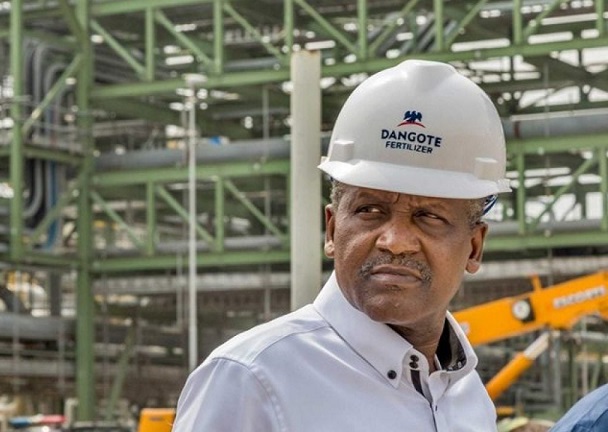
One entity that will benefit most from the Petroleum Industry Act (PIA ) is Aliko Dangote, with his 650,000 barrels per day integrated refinery, which is Africa’s biggest and the world’s biggest single-train facility. The refinery has 1,100 kilometres of pipeline to handle three billion Standard Cubic feet of gas per day. In addition, it has power plants with a combined capacity of about 400MW.

Section 317 (8) of the Senate version of the PIA noted that petrol importation license would be restricted “only to companies with active local refining licenses”. This clause and the unmatched prowess occasioned by the refinery is a formidable edge for Dangote. However, some report state that the federal government has reversed these exclusive petrol importation rights.

Dangote can have absolute control of the petroleum industry’s downstream and midstream sectors. How? Dangote can acquire the numerous idle fuel stations scattered nationwide or take over one of the established major retail marketers, though most idle stations are not strategically located. However, Dangote can revive and utilise them using the price advantage- by setting an unbeatable price, and a litre is a litre strategy, employing the best domestic workforce in the downstream sector and optimising modern technology for service delivery in these stations.

The petroleum retail industry is growing in Nigeria. The growing number of fuel stations across corners of the country is proof of this. But operational and logistical gaps remain in the blooming industry, like bad roads coupled with the use of old trucks, poor remuneration of drivers, and lack of modern technology. Thus the industry is losing billions of Naira due to shortages when truck discharge petroleum products at fuel stations and the rising disputes between drivers and station managers.

Furthermore, some marketers have poor welfare systems for staff and have not put in place some feasible plans for the realities that will accompany the arrival of the Dangote Refinery in the PIA regime. As a result, many of them may end up operating in the dark. For any marketer to survive the new regime, they must set up a strong think-tank or a special unit in their R&D departments to ‘look’ at the future, opportunities and threats and opportunities that Dangote Refinery will come with.

With his current economic capacity, Dangote can exploit oblivious lapses to implement backward integration in the petroleum industry. The $100 million Dangote-Sinotruck plant in Lagos will give Dangote an advantage in the logistics and operations sector. The plant assembles trucks and cars in Nigeria for local use and export; it is 65 per cent owned by Dangote and 35 per cent by Sinotruck. Therefore, having new petroleum distribution trucks and well-trained and well-paid drivers will not be difficult for Dangote.

The Dangote Refinery will give him the required volume of products and enough loading bay for trucks to load. The refinery covers 2,635 hectares of land, six times the size of Victoria Island, Lagos. Scarcity will not be challenging for Dangote if he ventures into retail. Dangote can tap the domestic workforce to employ the best hands in the downstream sector. With access to funding and resources, Dangote can deploy massive Liquefied Petroleum Gas (LPG) and Compressed Natural Gas (CNG) skids at once in as many stations as possible to also prepare for the future.

As mentioned, if Dangote acquires these thousands of idle fuel stations or any of the established major marketers, the brand can offer mouth-watering prices at these stations, making customers travel even 5km just to purchase petroleum products at a Dangote station. Furthermore, these prices can knock many competitors out of the market. However, some of them can still survive as third-party partners to Dangote. However, the NNPC can take advantage of its $2.76 billion stake in the Dangote Refinery and boast its retail business.

With this colossal refinery, Dangote has the advantage in the midstream and downstream of the oil and oil gas industry. Anyone coming in will need the next ten years to catch up. The bigger, the more advantageous, it seems!

Zayyad I. Muhammad writes from Abuja via zaymohd@yahoo.mom.

A scorecard for Buhari 

By Mukhtar Jarmajo 

As President Buhari prepares to leave office the following Monday, reflecting on his tenure and his impact on Nigeria is important. When he assumed office in 2015, he came with the promise of improving security, revamping the economy and tackling corruption. While much is still desired, it is clear that he has made significant strides in achieving these goals.

On security, President Buhari’s administration has made considerable progress in the fight against insurgency, particularly in the country’s northeast region. The Boko Haram terrorist group has been significantly weakened, and the government has also made gains in the fight against banditry and kidnapping in other parts of the country. Although much work still needs to be done, it is clear that the foundations for a more secure Nigeria have been laid.

In terms of the economy, President Buhari inherited a challenging economic situation, with falling oil prices and a depreciating currency. His administration implemented a series of economic policies, including a diversification drive, the implementation of the Treasury Single Account, and the launch of the Economic Recovery and Growth Plan. These policies have helped to stabilise the economy and put it on the path to growth. While there is still much work to be done, the next administration will have a more solid foundation to build upon.

President Buhari’s administration also significantly tackled corruption, a major challenge for Nigeria for many years. The government implemented various anti-corruption measures, including establishing the Presidential Advisory Committee Against Corruption, launching the Whistleblower Policy, and prosecuting high-profile corruption cases. While corruption remains a major issue, it is clear that the government’s efforts have had a positive impact and set the stage for further progress.

Many challenges have characterised President Buhari’s tenure, but also significant achievements. As he prepares to leave office, it is clear that he has laid the groundwork for a more secure, prosperous, and corruption-free Nigeria. The incoming president will undoubtedly find things easier, given that many of the difficult decisions needed to make Nigeria great have already been taken. President Buhari will go down in history as one of the most tolerated presidents in the annals of Nigeria, and his contributions to the country will be remembered for years.

Jarmajo wrote from Wuse Zone 2, Abuja. 

Corruption allegations: 107 groups protest in Lagos, urges Tinubu to cleanse EFCC

By Aisar Fagge
 
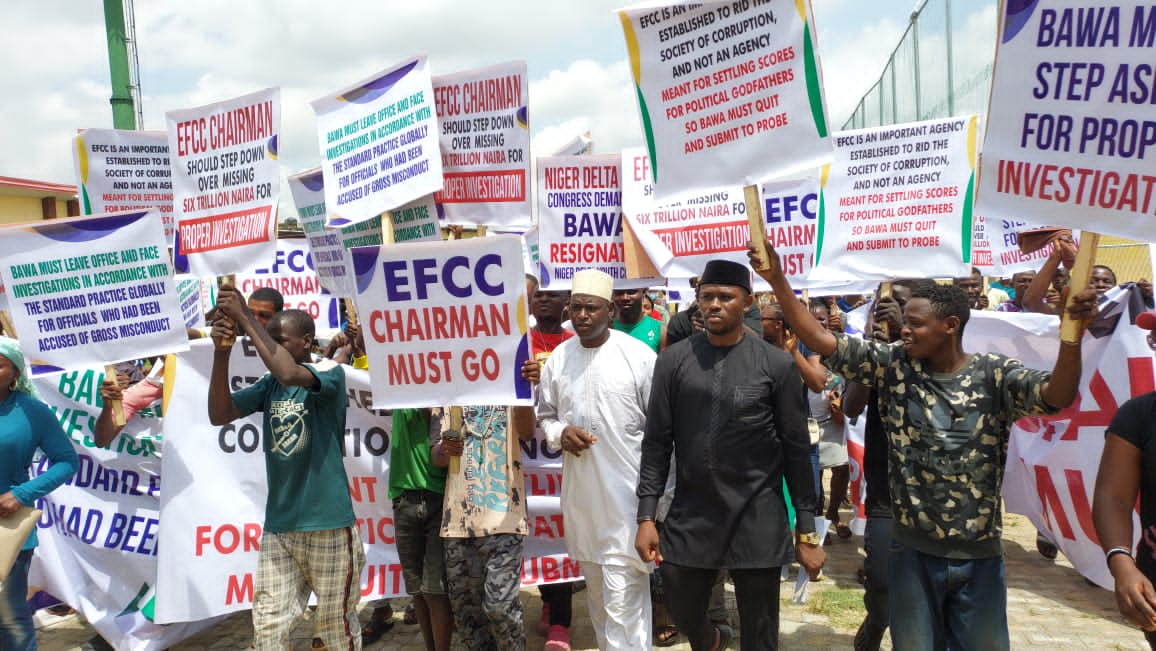
A conglomeration of about 107 Anti-Corruption crusade groups led by Crime and Corruption Monitors, has impressed on the incoming administration of President-elect, Bola Ahmed Tinubu to ensure the Economic and Financial Crimes Commission (EFCC) is cleaned of entrenched corrupt leadership symbolized by its current Chairman Abdulrasheed Bawa.

This follows a protest by the Anti-Corruption crusade Conglomerate, which was terminated at the Youths Sports Complex, Lagos.

The groups pointed out that EFCC is an important government agency in Nigeria, established primarily to rid the society of corruption and not conceived as an agency for settling scores for political godfathers.

The convener of the conglomerate, Idowu Bello who read the statement in Lagos warned that “If a government agency expected to fight crime is found going about its business in a manner that mimics witch-hunt and selective justice while also being unable to deal with the corruption going on within its own workforce, the nation is headed for real time crises, conflict of confidence.”

He noted that despite government’s claim of making the fight against corruption and related practices a top priority, EFCC, the agency charged with the execution of the war, is in questions over mounting allegations of monumental corrupt practices.


“Allegations that about 80 per cent of cases under EFCC investigation are not taken to court. EFCC offices now literally serve as courtrooms.

“Last week, Zamfara state governor, Bello Matawalle, alleged that Bawa demanded the sum of $2million from him as bribe to stop a purported probe against him.   

“Even before Abdulrasheed Bawa was presented as substantive EFCC Chairman, he has been arrested and detained by the anti-graft agency in 2019 for selling at least 244 trucks worth between N20-30 million each to his proxies at N100,000 per unit.

“He is also accused of recently expanding a large amount of money to the tune of $300,000 for hotels and other activities, which is far and beyond his income as civil servant, during a visit to Mecca with his family on a lesser Hajj.

“There are also allegations of connivance with the Attorney General of the Federation,  Abubakar Malami in auctioning of sea vessels holding crude oil seized by the Federal Government, violating Section 31(2) and (4) of the EFCC Act 2004.”

According to him, Malami and Bawa also allegedly authorized the sale of vessels by companies under EFCC prosecution for similar offence of illegal bunkering.

“Bawa and Malami were fingered in the discontinuation of a N25billion criminal charge against Senator Danjuma Goje without any justification after over seven years of diligent investigation and prosecution.

“Equally, the incident of Abel Isah, an EFCC cadet in Sokoto who was allegedly beaten to death by superior officers for refusing to sign off on incomplete exhibits is still fresh in the minds of Nigerians,” the statement read.

The Crusaders however, demanded the immediate sack of Bawa as EFCC Chairman and to be subjected to wholistic probe the way his predecessor Ibrahim Magu was treated.

“Like every other agency of government everywhere, there are global standards of practice  for officials who had been accused of gross misconduct to step aside while investigations were conducted to ascertain the veracity of the allegations.

“As pointed out earlier several eminent eminent Nigerians have claimed to possess evidence of corrupt practices, breach of public trust and abuse of office against the EFCC and its Chairman, Abdulrasheed Bawa.

“It is based on the above observations that the Crime and Corruption Monitors and 107 Anti Corruption Crusade Groups deem it necessary to demand that Abdulrasheed Bawa excuses himself from office and surrender for investigation.

“We demand that if Bawa remains adamant,  he be forced out and subjected to comprehensive probe  the way his predecessor Ibrahim Magu was made to do.

“Since it is obvious by now that the Buhari administration which brought Abdulrasheed Bawa is not disposed to initiating action, we call on the incoming President Bola Ahmed Tinubu to make it first priority to cleanse the EFCC of corrupt leaders.

“Corruption is one of the most serious social and security challenges facing Nigeria today which is the more reason why Tinubu should see it as an existential matter that needs to be addressed and tackled robustly and defeated once for all.

“No nation can aspire to greatness or seek to remain secure and safe when corruption and other corrupt practices are allowed to find their way into all its vital institutions including the agency saddled with the responsibility of fighting it.

They added that, for this reason, corruption must be confronted  with the entire will and resolve of the incoming administration beginning with thorough cleansing of the EFCC by first getting Bawa out and subjecting him to probe before extending action to cover other organs and tiers of government in Nigeria without exception.

“Failure to do so will indubitably mean that every effort made the anti-graft agency is headed by suspicious leaders will defeat all development endeavours of the incoming administration and render its task the more difficult and futile.

“We remind the President-elect that National challenges such as the corruption we are faced with should not be treated with levity and condescension. Neither should action be limited to targeted individuals or tiers of government. On the contrary, corruption is a cross-national issue that affect every one of us regardless of where we live or come from,” the statement read.
Near East University awards Kano academics for exceptional achievements

By Muhammad Abdurrahman

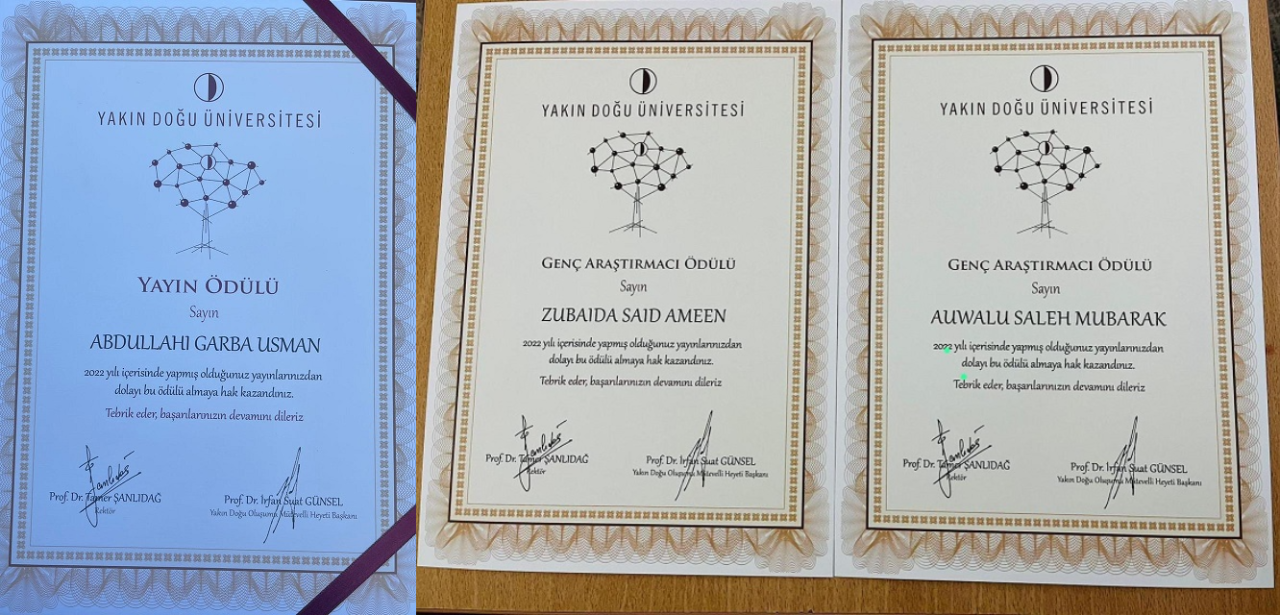
Near East University, Cyprus, honours three Kano state indigenes, Dr Mubarak Auwal, Dr Zubaida Said Ameen, and Asst Prof Abdullahi Garba Usman, for their outstanding achievement in the research world.

The above was made known in a Facebook post by Dr Sagiru Mati, another Kano indigene and staff of Yusuf Maitama Sule University (formerly North-West University, Kano) doing his postdoc at the same university.

Dr Mati added, “We are thrilled to announce that these brilliant individuals have been recognised as the best researchers by the prestigious Near East University. Their dedication, perseverance, and exceptional contributions to their respective fields have not gone unnoticed.

The award certificates

Mubarak and Zubaida, not only exceptional researchers but also a married couple, have shown us the power of collaboration, support, and shared passion in achieving extraordinary results.”

Asst Prof Abdullahi’s research focuses on analytical chemistry and operational research in healthcare. He has numerous publications in reputable journals and more than 600 citations.

The fantastic couple (Drs Mubarak and Zubaida) work in the same field of Biomedical Engineering and Artificial Intelligence. They also have several publications and hundreds of citations to their credits.

Dangote refinery and the leadership question in Nigeria

By Aisar Fagge

On Monday, 22nd May, 2023 President Muhammadu Buhari inaugurated the Dangote oil refinery in Ibeju-Lekki, Lagos State, Nigeria. Many African leaders, envoys and dignitaries from various parts of the world attended the event.

As the Vanguard newspaper reported, the essence of building the refinery is to “help Nigeria achieve self-sufficiency in refined products and even have surplus for export.” This is a huge win for Dangote as a businessman, Lagos State for its revenue and perhaps Africa for its image at international stage.

However, many Nigerians are asking, didn’t Nigerian leaders feel any shame to attend an event of an entrepreneur who built a refinery but a whole government of the leading economy in Africa cannot? 

Historically, Nigeria has four refineries: Old Port Harcourt refinery commissioned in 1965, Warri refinery established in1978, Kaduna Refinery commissioned in 1980 and New Port Harcourt refinery commissioned in 1989. However, for the past 20 years, these refineries had a poor record of operation before they ran out of steam.

Nowadays, none of the refineries works because we institutionalise corruption. Every new govt will come with the promise that Kaduna or Port-Harcourt, or Warri refinery will soon commence production, but no drop of oil will be refined. And yet, government continue paying these ghost workers who produce nothing.

The question Nigerians keep asking is, if one man can build a refinery from scratch, why does a government with all its resources fail to rehabilitate its four refineries, sack all those ghost workers, appoint new MDs, stabilise them, refine our crude oil, use the trillions of the so-called subsidy to develop education, health, agric, security, infrastructure, etc.?

Some people would argue that in today’s world, the government has no business in businesses; it should only provide an enabling environment for such private investors to thrive through competition. So, they say the government should only focus on governance, policies and regulation of private investment.

Those people will cite the US and other developed countries without public refineries. But what of the Saudi ARAMCO and other Gulf countries like UAE, Kuwait, Qatar, etc? They all own and control their refineries. Look at their development index and look at where we are languishing. Even this Dangote’s refinery is greeted with mixed reactions. Some people argue that his refinery will make little or no difference at all since it is not ours. But only time will tell about that.

Though I’m not an economist, I think transforming Nigeria into an entirely capital state will not produce the desired result, considering our current development and peculiarities. A country with weak institutions should first believe in strengthening those institutions before thinking of borrowing a Western economic model.

So, I believe the Nigerian government must provide and guarantee its citizens’ basic needs – education, security, electricity, and health before anything else. Citizens of an oil-rich country, such as Nigeria, don’t deserve this suffering we’re in. We deserve more.

We pray for the success of Alhaji Aliko Dangote. He achieved this feat against many odds. However, for Nigeria to attract more investors, more must be done at all levels.

Aisar Fagge wrote from Kano. He can be contacted via aisarsalihu86@gmail.com.