Month: April 2022

CBN fines 3 banks ₦800 million over cryptocurrency transactions

By Farid Suleiman

Bloomberg reports that the Central Bank of Nigeria (CBN) has penalized three banks over non-compliance with its cryptocurrency directive. The affected banks are Stanbic IBTC Bank, Access Bank Plc and United Bank for Africa.

In a circular dated January 5, 2021, the apex bank had issued a directive to Deposit Money Banks (DMBs), Non-Bank Financial Institutions (NBFIs), and other financial institutions (OFIs) to identify and suspend all accounts of individuals and entities used for cryptocurrency transaction on their system.

“Further to earlier regulatory directives on the subject, the bank hereby wishes to remind regulated institutions that dealing in cryptocurrencies or facilitating payments for cryptocurrency exchanges is prohibited,” the circular reads.

“Accordingly, all DMBs, NBFIs and OFIs are directed to identify persons and/or entities transacting in or operating cryptocurrency exchanges within their systems and ensure that such accounts are closed immediately.”

The affected banks were fined a combined sum of ₦800million. Stanbic IBTC Bank, United Bank of Africa and Access Bank were fined 200million, 100million, and N500million, respectively.

Lagos shuts down a hospital over Illegal operation, inadequate personnel

By Abdullahi Abdullateef

The Lagos State Government, through the Health Facility Monitoring and Accreditation Agency (HEFAMAA) has shut down Medville Global Health Centre located in Okota area of the state over its illegal operation and low numbers of personnel working in the hospital.

This is contained in a statement signed by the Head Public Affairs of HEFAMAA, Mr Muyideen Ayokunle Uthman on Tuesday, 5th April, 2022.

According to the statement, the Executive Secretary of the Agency, Dr Abiola Idowu, says that the Medville Global Health Centre which is located at 1, Bashiru street, off Lateef Adegboyega street, Ago Palace Way, Okota is sealed for not complying with the set standards.

Reacting to the demise of one Mr Triplem C. Mchaty’s wife, she said the agency carried out preliminary investigations which revealed that the hospital was not registered with HEFAMAA, noting that this contravened the 2006 health sector reform law.

She stated, “It means the facility was operating illegally.” She added that the hospital had inadequate personnel.

Reiterating the allegation on social media, in a tweet, one Mr Triplem C. Mchaty @scantee stressed the sad moments on his Twitter account @scantee. The tweet reads thus:

“Good morning family, I am really heartbroken now. My wife died at MEADVILLE GLOBAL HEALTH CENTRE (HOSPITAL) NO. 1 Bashiru street,off Lateef Adegboyega Street, Ago Palace Way, Okota.

“We just got married 10 months ago, she took in, she was undergoing Antenatal in Onitsha, Anambra [state].”

However, Dr Idowu disclosed that the Chairman Dr Solanke Kayo Esq. has ordered the agency to carry out a full investigation to uncover the facts of her death.

Relating with the closure of the hospital, she maintained that the agency has taken the crucial decision in furtherance of public protection awaiting the final outcome of the ongoing investigations.

She finally urged all administrators of health facilities in the state to adhere strictly to the set standards and cooperate with the leadership of Governor Sanwo-Olu.

Shehu Sani picks Governorship form, clarifies that he, not any group, buys it

By Ahmad Deedat Zakari.

Shehu Sani picks the Governorship Form. However, he said he would not lie that a group paid for the nomination form.

Senator Shehu Sani, who represented Kaduna Central Senatorial district in the 8th Assembly from 2015 to 2019, disclosed this on his confirmed Facebook account on Wednesday, April 6, 2022.

“I picked my Governorship form. I suppose to lie that “a group” bought the form for me, but I can’t start with such lies. We need your support and prayers,” Sani posted

Mr Shehu Sani has long indicated an interest in contesting the 2023 Kaduna State gubernatorial election, and picking the nomination form did not come as a surprise to many.

Many people have commented on Shehu Sani’s post, wishing him well in the gubernatorial race.

“Victory all the way, Sir.” Stephanie Sewuese Shakaa, a Facebook user, commented.

Another Facebook user, Al-Ameen Jumare, said, “Best wishes, sir, our solidarity and support are priceless.”

Pantami and the bitter taste of politics (I)

By Aminu Nuru

Isa Ali Ibrahim Pantami’s odyssey into public service, and mainstream politics in Nigeria by extension, is so far filled with notable controversies that muddy the stream of his public image despite being received and welcomed with a reservoir of goodwill and optimistic anticipations by many Nigerians.

Although some people may argue that, before Pantami’s appointment to public office, there were members of the Federal Executive Council (FEC) equally knowledgeable in the matters of Islam and could be regarded as scholars in their own rights. Still, the fact is that both Mallam Aminu Kano and Senator Bello Maitama Yusuf made a name for themselves in politics and public service before Islamic scholarship and preaching. Or, to say it better, the duos are more widely known for their political engagements than anything else. Thus, they were seen as full-time politicians in the public eye. While Pantami, on the other hand, got his fame strictly from Islamic teachings and discourses.

Therefore, Pantami is a trailblazer who pioneered a cause in Nigerian polity – a revolution of Islamic clerics from Northern Nigeria joining national politics and public service. This position naturally accords him the status of a role model for subsequent clerics from the North that are willing to join public service in the future.

Though preaching and propagation of Islam would have played a role in Pantami’s rise to prominence and subsequent appointment into Nigerian public service, the controversial minister, to be fair, has demonstrated some degree of competency and seems to be averagely prepared, to say the least,  to the job he has been offered as the Director-General of NITDA  and later Minister of Communication and Digital Economy. In the same vein, he has also recorded some achievements so far. Unfortunately, however, a series of controversies are beginning to overshadow these achievements, which are at the same time complicating his polity. Still, some of these complications may not be disconnected from his past. On the contrary, they could be best appreciated if one revisits and analyses the context and content of his previous preaching vis-à-vis the atmospheric politics of the time.

Efforts to corroborate the exact date Pantami made his debut into the realm of Islamic preaching in his first preaching base – Bauchi – proved abortive. But what is certain was the unique style he adopted in delivering lectures, Tafseer sessions and Friday sermons, which promptly endeared him in the hearts of the local audience.

In the early 2000s, most Western-styled educated Muslims were looking for a fresh voice in Islamic preaching and seemed to be tired of the “oldies” and their archaic modus. They wanted something different and were eager to access the new approach that analyses and interprets contemporary issues from Islam’s perspectives. They were looking for an Islamic preacher to address and speak to them in the manner and tongues they would align and reason with. A preacher that could, for example, scrutinize the EU’s foreign policies and the US invasion of the Middle East and validate his points with the verses of the Holy Qur’an.

In Pantami, they saw the exponent of those ideals. This was due to his ability to demonstrate basic knowledge of global politics, international relations, and science and technology through the lenses of the Quran and Hadith. In addition, he commanded a very good English Language (a rare talent among Islamic clerics at the time). He exhibited a charming oratory skill sauced with puritanical diction – a personal endowment and enchantment that he consciously or subconsciously deployed to arrest, startle, and move his audience. The eloquence with which Pantami delivered his sessions was what stood him out among his contemporaries. Consequently, Pantami became the darling of Muslim populations in Bauchi and beyond for this and other intellectual traits. The Western-styled educated populations saw a 21st-century Islamic cleric of their dream in his shape.

As an influential preacher with access to grass-root populations, his pulpit echoed a dissenting voice against the government of the day. He was explicitly critical of PDP’s government at both the state and national levels and openly promoted the presidential ambition of General Muhammadu Buhari (GMB). It is on record that Pantami was not the only cleric to uphold the candidature of GMB via his pulpit; other clerics had also promoted him with equal conviction. However, Pantami’s open romanticism and penchant for the General were so extreme that when his old “friend” – Governor Isa Yuguda – fell out with Buhari’s ANPP and decamped to PDP, Pantami was not reluctant to denounce this move. Therefore, he launched out series of attacks and criticisms of the Yuguda administration in his Friday sermons (despite being a back-door “friend” of the Yuguda administration).

In an article titled “Nigerian Politicians and Hypocrisy”, Pantami wrote: “I do not know a profession anywhere in the world that is full of professionals who fulfil all the characteristics and signs of hypocrites aptly described by our infallible Prophet like Nigerian politicians in the corridors of power, particularly the companions of the largest, and probably the most dangerous party in Africa (PDP)” (Premium Times, 2012).

Nobody felt Pantami was not doing the right thing among the population. He was even celebrated and eulogized for his vilification of the PDP’s government and support for GMB. His effort was appreciated as a selfless service to the poor masses. He was practically dancing to the bits of the society. Naturally, this created a public image for Pantami – an image of an honest Islamic cleric who told the truth to power (PDP’s government?). 

Considering this background, it is not entirely out of sight if some groups work to step back on Pantami’s toes now that he has been appointed a Minister of the Federal Republic of Nigeria. They would not also relent to feed him the same bitter pills of politics through (de)constructive criticism, malice and deliberately cooked scandals. Therefore, it is not a surprise if, for example, some pundits dug into his past utterances to make the polity difficult for him now. Or it is not least expected if some of his critics alleged that he used the garment of Islamic preaching to reach where he is now – an allegation echoed loudly by his fellow preacher and former neighbour in Bauchi. This particular preacher believes that Pantami is not worthy of being considered an Islamic cleric simply because he did not attend any Islamic school.

This allegation could be dismissed as sheer envy, especially as it comes from a fellow Salafi cleric who does not hide his aspersion of the minister. Reputable Islamic scholars have, time without number attested to Pantami’s intellectual prowess and competence in Islamic scholarship. Besides, altogether, he has tackled those accusations cleverly by not quitting the teaching of Islam even after being appointed a Minister.

The accusation that may have firmly stood is how Pantami’s pulpit swiftly changed from being a pro-people voice to one with less interest in the matters of governance and the governed. There’s no more dissent voice against the government. Even the choice of his texts for his ta’alims at Annur Mosque were deliberately strategic in the sense that their content analysis and commentary of moral truth and calls for proper conduct may not be extended explicitly to subjects within the present government. From their titles, both Kindness to Parents and Kindness to Relatives and Loved Ones would surely give a soft landing for anybody willing to avoid activism in his preaching.

His defenders may argue that Pantami now has unlimited access to the government. Therefore, he can channel his grievances privately, but the atrocities for which he vilified the previous government have also been committed, doubled and tripled by the present administration. Morality demands that he does more than voice his anger privately, considering his earlier vituperation.

One would think he will not hesitate to relinquish anything that has to do with this administration to demonstrate his unreserved solidarity for the masses. But, unfortunately, Pantami – an erstwhile vibrant advocate of good governance – is not the man to surrender power for posterity. Therefore, while it may not be the wisest decision to leave the government to demonstrate his pro-masses stand, Pantami should do better in making patriotic moves decisions no matter whose ox is gored. He could do that while avoiding avoidable controversies and political tussles that may tarnish his image and the institution he represents.

Aminu Nuru wrote from Bauchi. He can be contacted via aminuahmednuru@gmail.com.

Giwa, banditry and internally displaced persons

By Musa Kalim Gambo

Before this kidnapping, banditry, and terrorism got to this scary stage, I consider(ed) Giwa my favourite and adopted Local Government in Kaduna State. This is a place where I have the largest number of friends in Kaduna State; many of these friends have come to assume the status of brothers to me. Not long ago, I visited Giwa frequently, almost weekly.

Now all things have changed. Giwa has become an epicentre of kidnapping and terror attacks on innocent individuals. Criminals attack people at home and on their farms; kill and abduct for a huge ransom. In the past few weeks alone, the rate of this criminality has intensified geometrically. Due to this tragic development, some villagers have been forcefully displaced. They have had to migrate to the Giwa town, which is relatively safer than their communities. About 3,000 of these displaced persons now take refuge in camps in Giwa town, Marabar Yakawada, and Yakawada. While a large number of the displaced persons have also moved to stay with their relatives in neighbouring towns of Sabon Gari and Zaria in Kaduna State and Funtua in Katsina State.

The families who have been sadly uprooted from their homes have obviously been denied access to the arable rural farmlands. Beyond the refugee crisis, this will result in an attendant shortage of food in the towns, which may eventually spill over to the rest of the country. Therefore, it is evident that life will not be easy for them in their camps and the host communities.

These refugees now have to contend with the gory reality in town, that while they run for their lives, they also definitely need food, medical attention and clothes to survive in their new temporary settlement. It has been reliably reported that the Giwa Local Government Chairman, Dr Abubakar Shehu Lawal, has made provisions for feeding them at various refugee camps in Giwa and across the Local Government. Also, Senator Uba Sani is reported to have delivered some relief items to the camps. This is indeed commendable. The local politicians have indicated a high level of commitment to responding to the plight of their people in distress.

However, all these are not enough. What is needed is a total end to this incessant spate of killings and kidnappings in Giwa. Within the week, this was one of the major issues raised on the floor of the House of Representatives by Honorable Shehu Balarabe, a member representing Giwa and Birnin Gwari federal constituency, in a motion of urgent public importance. Honourable Balarabe, in a very emotional tone conveying the gravity of the situation, highlighted the depth and dimension of the troubles and crises that these banditry, kidnapping and senseless killings have plunged his constituency in both Giwa and Birnin-Gwari. He called on the Federal government to direct all the relevant agencies to swing into action in order to address the crisis.

It is sad to note that the two Local governments that Honorable Shehu Balarabe represents at the House of Representatives are the two most dangerous places in Kaduna State in terms of banditry and kidnapping today. So it is easy to understand the difficult situation in which the Honorable finds himself as one of the voices of these people in Abuja. Birnin Gwari suffers way too much from the atrocious attacks of these bandits, and it also has its refugee crisis as well. However, I write on Giwa because of my deeper connection and access to the situation there.

So to an appreciable extent, it may well be concluded that the political leaders from Giwa are playing their roles to bring an end to this madness that has continued for too long. However, what remains is the commitment on the part of the federal government, which obviously does not seem to render any positive outcome yet. There has been a military presence in Giwa and other bandit infested communities. However, it has remained a puzzle that the criminals could still carry out attacks almost every day without any hindrance.

The month of Ramadan has just begun. While we keep calling on the governments at all levels to aid these communities in crises, it is also important for us to use this holy month to pray to Allah to provide succour and restore peace and sanity in the land. It is now evident that we should no longer pray for Allah to guide these criminals aright, no! They have unleashed an unforgivable magnitude of terror on our land. The least we can do now is pray for an eternal condemnation upon them, starting from here on earth. It should also be our point of prayer that whoever supports these criminals, in whatever way or means, from their informants’ right to the supply chain of their arms and ammunition, should face eternal perdition and body crippling afflictions here on earth before they meet their worse punishment in hell.

Finally, may Allah grant our leaders the will and ability to put in place the right measures to end these killings and kidnappings. At the same time, we should assist these displaced persons with the little we have in terms of food items and clothes; I have also seen a group of youths on Facebook led by the immediate past president of the Giwa Students Association, Nuhu Haruna mobilizing funds on Facebook to assist these displaced persons. We should contribute as much as we can.

Musa Kalim Gambo writes from Zaria and can be reached via gmkalim@hotmail.com.

APC leader Bola Tinubu admits Nigeria is bleeding, calls for joint action

By Muhammadu Sabiu

Bola Tinubu, a former governor of Lagos State, warned on Tuesday that Nigeria is bleeding due to the recent wave of killings.

The All Progressives Congress’s National Leader asked everyone to join hands in the fight against banditry.

This comes as Governor Nasir el-Rufai stated that Nigeria is at a fork in the road and that the country must make a difficult decision by 2023 on who will lead the country out of its various problems.

Tinubu, who was in Kaduna for a condolence visit following the terrorist attack on a Kaduna-bound train from Abuja on March 28, donated N50 million to help the state government repair and care for the victims.

“We are facing the current challenges seriously, and we have to do more. Nigeria bleeds on behalf of everybody.

“We need to fight terrorism with all our energy and whatever we have. It’s not shameful for people to be poor, but it’s unacceptable to accept poverty as a norm.

“It’s shameful to be callous, wicked and be a bully or terror to instil fear in humanity, and it’s not acceptable,” Mr Tinubu was quoted as saying.

Worsening Insecurity: Our lives latter 

By Najeeb Maigatari 

The recent attack on travellers along the Abuja-Kaduna road is shocking. The fact that those ‘terrorists’ could now detonate explosives before killing and kidnapping innocent people is damming and quite alarming. It says a lot about our security system. 

It also sends a clear message to everyone that no one is safe. We are all in this mess together; the ordinary people and the ‘elites’ alike. No transportation system is secure in the country. One could now be attacked when travelling by road, railway or even by air. 

The unfortunate train attack is not the first of its kind- and will seemingly not be the last unless the needful is done. The only difference is that this time around, unlike other attacks before, the ‘terrorists’ appear well-armed, more audacious with the hunger to kill, which shows their daunting strength. 

Those terrorists have been attacking villages and killing people, especially in the northern part of the country, where such attacks have become the order of the day. They have established themselves as an authority with several villages under their control. Some of their brutal attacks and heinous crimes are underreported in the news media. 

According to the Nigeria Security Tracker (NST), in a report published from January to February, at least 1761 people lost their lives across the country in incidents related to insecurity and protracted armed violence. 

Under our noses, our beloved country, once a nation of peace and tranquillity, is gradually turning into the likes of Somalia, Libya, and Afghanistan or worse; today’s Nigeria has become a slaughterhouse, and its citizens turned into walking corpses. 

Even worse, most of those killed are people trying to make a living for themselves and their families. People are killed in their homes, offices, markets, on roads, and virtually everywhere. It’s practically killings everywhere at every turn under every circumstance. 

It suffices to conclude at the moment that there’s seemingly the creation of ‘a state within another’. On the one hand, there’s almighty sovereign Nigeria – that continually fails to protect its citizens – and on the other hand, the hypothetical terror nation ruled by such terrorists as Boko Haram, bandits, kidnappers and the likes. 

The government is evidently failing – woefully so – in its fundamental responsibility of securing the lives of citizens, as they swore to do before taking over from the previous administration. 

Therefore all hands must now be on deck to nip in the bud this issue that threatens our existence irrespective of gender, ethnicity, religious or political affiliations. 

To begin with, the government should be bold enough to fish out and address the ultimate cause of all these crises, such as answer the question as to the genesis of the terror groups, their sponsors, financial channels, sources of arms and weaponry, contacts in the community, etc. 

In addition, such factors that tend to inflame the situation as poverty, social injustice, illiteracy, etc., should also be proactively addressed by devising measures to assuage people’s suffering and displeasure. 

Furthermore, the security forces should be well equipped with state-of-the-art weapons to take the war to the terrorists’ camp. They should also engage the public as people. If people can get trained, they can be utilized for intelligence gathering, informant tracing, reporting suspicious activities, etcetera. 

In conclusion, the people should also cooperate and work hand-in-hand with security forces and other relevant government agencies in every way legally possible in order to curtail the worsening insecurity crisis ravaging the country once and for all. 

Our lives must matter as long as we continue to call this our homeland. We should not allow those ‘terrorists’ to take over our homes and rule our lives in perpetual fear. If those in authority cannot secure our lives, they should honourably step aside and let competent individuals take over the helm of affairs in the country. Enough is enough! 

Najeeb Maigatari writes from Jigawa State and could be reached via maigatari313@gmail.com.

Ramadan: Zulum distributes food, cloth, N5.7m to 285 Gov’t House cleaners

By Uzair Adam Imam

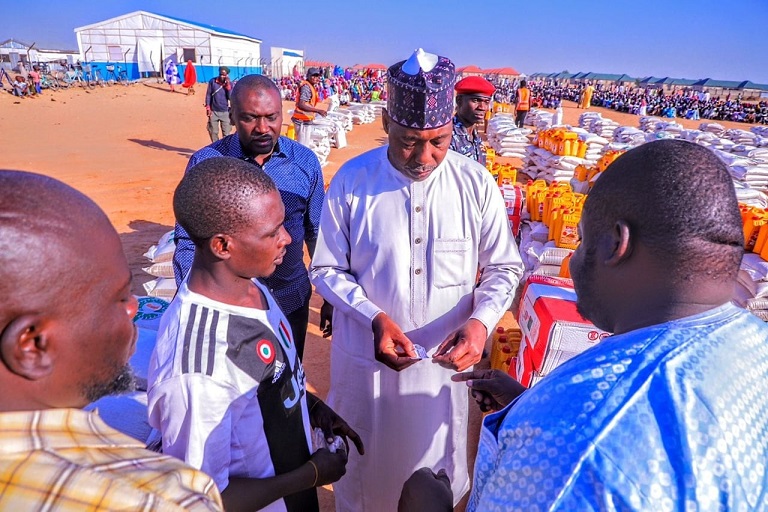
Governor Babagana Umara Zulum of Borno State has distributed food items, cloth and combined cash of five million seven hundred thousand to 285 cleaners, messengers and other lowest rank individuals working at the Borno State government house.

The Daily Reality gathered that each beneficiary received a bag of rice, sugar, cooking oil, textile and N20,000 as support for the Ramadan activities.

The development, which took place on Monday, has grabbed the attention of many people who commended the governor for the kind gesture, especially when people face hard times all over the country due to hikes in prices and insurgency.

The Governor showed appreciation to the workers for their services, saying they are critical to the operations of the Government House.

Zulum further swore to sustain welfare support to the workers.

He also promised to improve the condition of their services.

An unpopular view of the post-conflict dilemma in Sokoto and Zamfara

By Khairat Suleiman Jaruma

I sat down in the car, slightly annoyed that the Corolla 2003 didn’t have a Bluetooth connection. I love to listen to music when travelling and I was tired of using my AirPods. I was travelling from Kano to Kaduna, and the driver had stopped at Zaria to pray. We parked inside an obsolete filling station.

I was getting bored in the car, so I decided to get out and stretch my legs. So, I walked to the roadside; many people were standing. They seemed to be waiting for travelling cars, so I went closer and figured they were all going to Abuja. Considering the road condition, especially these days, I wondered why someone would be heading to Abuja from Zaria by 4 pm. Anyway, I walked back to the car and sat down, and the driver came, and we continued our journey.

We kept on seeing more people that would scream “Abuja” if the car slowed down. Finally, I could not hold it anymore, so I decided to ask the driver since he travels a lot. I asked him why there were so many people (mostly youths) desperately going to Abuja at this unsafe hour. He said they were all “yan cirani,” meaning unskilled “migrants”.

I kept quiet for a moment, then I went ahead to ask him where they were migrating from, and he said most of them were youths from Zamfara and Sokoto who had lost their families and means of livelihood. Some were even students who could no longer afford to pay tuition fees or even feed themselves. I felt a sharp pain in my heart.

But then, I was wondering why Abuja? We all know the cost of living in Abuja is high; why not Kaduna or Kano? Unfortunately, I have not been able to answer these questions. The main point here is that you will agree with me that there are no jobs for these people in Abuja. The number of people I saw was alarming, and I was told by the driver who plies the road every day that sometimes there are even more people than this number. These people are most likely to become a nuisance to society if they eventually arrive in Abuja and are forced to face the reality of unemployment.

Another sad part is that these are youths that are expected to push this country forward with their innovative ideas. These are the young people we want to see as part of governance. But these young people have been failed and abandoned by their government. So while trying to end insecurity, it is imperative that the government addresses unemployment and creates an effective post-conflict reconstruction for affected areas. Prevention, they say, is better than cure.

Khairat Suleiman Jaruma wrote from Kaduna via khairatsuleh@gmail.com.

Pantami’s ministry and NITDA responsible for prolonged strike, says ASUU

By Ahmad Deedat Zakari

The Academic Staff Union of Universities (ASUU) has asked Nigerians to hold the Ministry of Communication and Nigerian Information Technology Development Agency (NITDA) responsible for the lingering impasse between ASUU and the Federal Government.

ASUU Zonal Coordinator, Buchi Zone, Professor Lawan Abubakar, briefed reporters on Monday, March 4, 2022, in Jos, where he alleged NITDA is misleading Nigerians on the credibility and acceptability of UTAS which he said has passed the integrity test. 

“Ironically, NITDA, in conjunction with its parent Ministry (The Ministry of Communications where Pantami is minister), is seriously sabotaging the government at resolving the impasse. This is obviously capable of prolonging the current strike, thereby bringing untold hardship on Nigerian University students and the University System.” Prof. Abubakar stated

He further explained that NITDA, who scored UTAS high in the past, can not suddenly say UTAS failed integrity test. 

“After scoring UTAS this high, NITDA went further to contradict itself by making a fallacious statement that UTAS has failed integrity tests. The union wonders how a score of 97.4% will amount to failure.

“The Union still agreed to another Test by NITDA on March 8, 2022, in the presence of observers front the Federal Ministry of Education/National Universities Commission (NUC), Federal Ministry of Finance/OAGF, Federal Ministry of Labour and Employment and the National Salaries, Income and Wages Commission.

“This most recent test still scored UTAS 99.3% in all the Tests metrics. ASUU is Therefore surprised that NITDA, having scored UTAS this high on two different occasions, unpatriotically went to the press to deliberately mislead the public into believing that UTAS has failed Integrity tests again.” Prof Abubakar clearly explained.

Therefore, he called on Nigerians and the Federal Government to call the Ministry of Communications and NITDA to order to resolve the labour crisis.