Month: January 2022

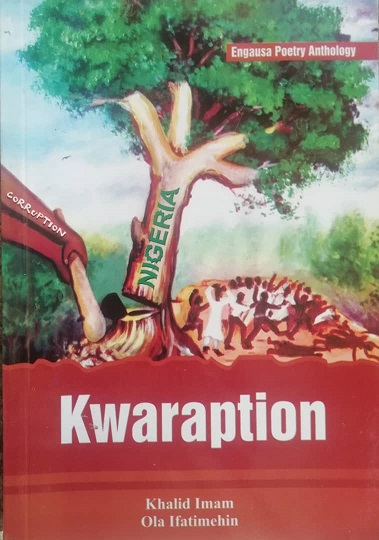
Book Review: “Kwaraption”

Book Title: Kwaraption

Editors: Khalid Imam and Ola Ifatimehin                                                                                   

Type: Anthology of poetry written in Engausa

Publisher: Whetstone Art and Information Service

Pages: 72

Year of publication: 2021

Introduction:

Although not simple to define, corruption is a major impediment and barrier to Nigeria’s progress. For many years the country suffers a lack of infrastructure and poor condition of living because of corruption, which not only stagnates the nation but also derails it from the path of progress. Although more endemic now than ever before, the story of corruption in Nigeria is at least very old.

A missionary teacher in Kano, Madam Ethel Daniel Miller (who came to Kano in 1917) in her book The change here in Kano complained of a prince from the emirate that gifted her a set of clothes for the simple reason that she is a sister to Dr Walter Miller, thinking that she could influence his choice as a successor to the throne.

Other examples can be found in fictional works such as Magana Jari Ce (1937), where Dan’iya bribed a police officer to deceive his friend, Daudu, in a story titled “An ƙi cin biri an ci dila.” The case of Obi Okonkwo in Achebe’s No longer at ease (1960) and that of The Incorruptible Judge (1962) by Olu Olagoke were just a few out of many similar cases. These are clear indications of how writers used their pen to expose and sometimes fight corruption since the beginning of Nigeria formation.

This anthology of poetry edited by indefatigable Khalid Imam and awesome Ola Ifatimehin contains 51 poems contributed by 45 poets. Nearly half of the contributors are female writers, which is a clear indication that females have come of age in terms of literature in northern Nigeria.

The title of the book “Kwaraption” is a Hausa and English attempt at pronouncing corruption. While the first, “kwara” part is just the Hausa sound of the first four letters, “corru” (in a word corruption), the second part was derived from the last for letters (ption) of the original word. In other words, kwaraption is a corrupt way of saying corruption. Instead of the editors using Hausa translation of the word corruption which is loosely translated as Cin-hanci or Rashawa, or just writing Hausa variant of corruption as kwarafshin, they decided to retain part of the original English words. This is to portray the uniqueness of the work as an anthology of poems written using Engausa which involves coding switch or mixing of languages (English and Hausa) with a view to achieving artistical beauty and increasing richness of literature.

An Appreciation of Some of the Poems in the Collection

Looking at the anthology, one can understand that the poems covered a wide range of issues of interest as far as corruption in Nigeria is concerned. Some of the issues covered are:

  1. Recognizing Nigeria as a rich country which is very blessed with both human and material resources, but whose citizens are poor because of corruption and other social vices.

ƙasa mai albarka da albarkatu,

mai attajirai, masu ilmi da yan siyasa Hafsa Ja’afar in a poem titled Rashawa (p. 30). 

  • The state of the country as far as corruption is concern. For example, Ameer Nasir in Cutar Zamani described the country as one having expertise in corruption to the extent that it is difficult to separate us from corruption “tamkar jini da hanta” (p.17). Basheer Adam Gobir assumes that ‘almost everyone’ in the country is corrupt (p.23). Similarly, Farida Mohammed Shehuin Abin Takaice (p.24)and Khalid Imam (p.37) see corruption as a hazard whose impact is everywhere; mosque, church and in all places, and Khalid particularly described corruption as ‘flood’ that destroys (Corruption Everywhere, p.39). Khadija Hanga in her poem titled Despicable Diseases sees corruption as marriageable girl, however dubious whose main goal is to deceive “a fool”. In fact, as captured by Ola in his allegory, “Kukan Kurciya”, corruption is now “new education”. Because we are so accustomed to corruption that we are given it good names and the corrupt person were assumed to be philanthropist as captured in a poem Philanthropist na gangan (p.26) “barazanar ɗan ta’adda ba ta mayar da shi gwarzo”. Also, YZ Ya’u corroborates this in his “Sai Mai Taimako”. Umma Aliyu educates us on different forms of corruption that we don’t see as such due to level of societal decay.
  • Looking at corruption as a cause to many problems this country witnesses.  For example, in a poem “Tick” byAbubakar Isah Baba, corruption is responsible for poverty and insecurity;

It causes abubuwa masu yawa,

Poverty mai kashe gwiwa,

Insecurity mai karkatse rayuwa,

Ga misalan scandals nan da yawa.

In “Lamentations for a Country,” Adesina Ajala blamed corruption for dividing the country along many social layers “Corruption is the common denominator that divides this land without fractions.” The division is along religious, ethnic, regional and even occupational strata. In “Gobarar Daji” Yahaya Abubakar sees corruption as “alpha and Omega”, hence, the chance of getting out of the current quagmire is very slim,

“ta yaya za mu yi rayuwa sustainable,

tattalin arziƙinmu disabled.”

Bashir Umar blames corruption for bankrolling the country such that it cannot meet its basic needs, he sees it as embarrassing that the country now relies on foreign aid for its development “wai yau ni ke neman aid from foreign organization”. The writers believed that Nigeria has taken a poisonous venom, whose effect transmitted to the children, making them engaged in killing one another “mun ɗauki kansakali, maimakon magani.” Ajuji in his “Bragging da Kayan Sata” captures an attribute of a corrupt person.

“there stand akimbo…

carrying pot belly,

like expected mother.”

  • Trying to understand the dynamism and causes of corruption is one other focus of the poets in the anthology. Amatullah Saulawa in her “We shall not be afraid” boldly says:

“yes, it is our faults,

if dictators shift gears,

we bring them back” (p.15).

This is a similar submission of Maryam Baffer in the poem “Har da ni”. However, the politicians are most blamed in the collection because they stand for it

“ko da tsiya ko da tsiya tsiya

sun kasa

sun tsare,

sun raka,

sun rabe”

as stated by Hafsa Ja’afar in Rashawa (p. 30). Lynda Mustapha in her two poems “Write it down” and “Buhu-buhun Iskanc”i blamed politicians for perpetrating corruption in the country. Moses Odozie writes on corrupt civil servants whom he nicknamed “Ɓarawo mai Biro”. Murtala Uba Mohammed, in his poem “Corrupt Nation”, believed that corruption is not limited to politicians, there is also the police, court and parents (p.51).  

  • The writers are tense of corruption and eagerly want it to end. Adesina Ajala said;

“Yaushe zamu warke daga wannan ciwon ne?

Wa zai haska fitilar gaskiya cikin wannan duhun baƙi?.

Corruption is here seen as a wound that needs to be cured and darkness of a night that should be put in the light. In “The Oak Tree”, Aliyu voices out; “yet we hope for betterment”

  • The authors not only lamented over the problem, they also recommended some solutions to the problem. Madinah Abdussalam in his “Yours and Mine” sees the solution as public, that every person should do it himself.  He says “who will end corruption in ba mu ba”.

In “Soyyayar Corruption” by Elizabeth Zephaniah, the public is seen as a solution, she metaphorically states “yaushe za mu ga eagle na fighting corruption”. Musa Adam was also having a similar view in his “My father’s 61st Rebirth”. Some of the poets expressed unity as an important factor in the fight against corruption, “dole we have to be united” as stated by Haneefa Musa Isah in her poem “Mu haɗa kai” (p 31). Also, Sani Abdullahi Salisu in his Kwarapshin (p.61).      

Engausa

It was not surprising when I saw this anthology. This is because of my prior knowledge of the debate that started on the page of APNETi when Dr Ola began to release his poems in a fashion of code switch, mixing English with the Hausa language which Khalid and some other members called ENGAUSA and opined that it is new and welcomed development. Some members of the group, most especially Professor Yusuf Adamu objected to that saying that language blend and code switch is not new in poetry particularly among Hausa poets citing a popular line of late Nai’ibi Sulaiman Wali in his poem Damina

“… su yi kasuwa su yi kantuna,

kowa busy sai su damina.

Yaran gari ko sai bal suke,

kowa ka duba very happy…”.

Khalid and his likes were not convinced arguing that the example given is INGAUSA, different from ENGAUSA. They said INGAUSA is a Hausa poem where words and phrases are used to complement the writer’s inability to come up with the right words based on context or meaning as opposed to ENGAUSA which is a poem written specifically with two languages blending and it is purely artistical. In the introduction of this book, the editors maintained this view indicating that they had not shifted their position, more so, in an interview conducted by Ola stated that this Engausa is almost his own daughter.

While this anthology may certainly be the first collection on the ENGAUSA poem, the view that the ‘new ENGAUSA’ is different from the ‘conventional INGAUSA’ is very weak. This is because language swap in Hausa poetry is not just triggered by weakness or inability to come up with the right phrase or word in a context, it is equally deliberate. Also, when we look at recent popular Hausa songs we can see Engausa. In particular hip-hop singers such as Billy’o in his song “Rainy Season” wherein he said:

Mosoyiya, farkon ganinki na yo confusing,

sai da zuciyata tai ta squeezing,

sai da temperature ta tai rising,

jiri nake sai ka ce na sha poising,

ni ko so nake a san ina da reason”

is a good example of Engausa. In recent, northern Nigeria’s film series such as “Son of the Caliphate” and “Gidan Danja” are also full of Engausa. In addition, Aliyu Idris aka Abdurabbihi is another example, whose poems are in a mix of Hausa, English and Arabic languages even before seeing Ola’s “Sarauniyata” which appeared first in APNETi platform. Agreed, Ola and to some extent. Khalid can take the accolades of popularizing the Engausa and APNETi for holding the first workshop to teach it. It is another issue as to whether the new Engausa has a rule or not. But it is important to state that Engausa is an attempt to mimic how we (particularly the educated elite among us) talk at home and other places.

Finally, I wish to congratulate the editors for the first Engausa anthology and the All Poet Network International (APNETi) and Centre for Information Technology and Development (CITAD) for sponsoring the publication of important literary work that can help in Nigeria’s corruption crusade. The text is truly a noble of a kind. While wishing to see more literary work of this format, I wish the editors will do more in editing the Hausa language in the subsequent publications. I noticed many orthographic errors with respect to the Hausa language, which our indefatigable Imam will share the larger blame for his expertise in the area. I also conclude with the following lines:

Mai biɗar gane corruption,

To ya ɗau wannan collection,

Hausa tare da Englishin,

Sandwich kuma conjugation,

An zubo concatenation,

Kar ku ce contamination,

An yi ne don education,

Tun da Ola ya yi motion,

Ka ga Khalid zai yi action,

An yi  don inganta nation,

Yau kwaraption mun rejection.

The reviewer, Dr Murtala Uba Mohammed, is with Geography Department, Bayero University Kano, and can be reached via murtalamuhammadu@gmail.com.

Why, as a man, I fight period poverty, menstruation stigma

By Bilyaminu Idris Ndasadulau

I believe in collective action, responsibility and collaboration. That’s why I joined as a man to fight against period stigmatisation and period poverty. It’s everyone responsibility, not only the females.

Menstruation matters to me. Thus, I consider any form of stigma associated with menstruation a social abuse and crime against women. Unfortunately, millions of women and girls continue to live in period poverty around the world without any support from the government to end the problem. We need to address the issue collectively. That’s why in 2019, I started online research studies on health matters, and I found out many women and girls need pads, but they cannot afford them, which can often lead to girls not attending school and also unhygienic practices. 

So in 2020, we initiated the “Rescue A Girl” project, which aims to end the stigma and discrimination and focus on enhancing, from the grassroots, adequate education, health and gender equality, which is a key to achieving the Sustainable Development Goals agenda. 

In the same year, during the COVID-19 pandemic, we launched the project on International Girl Day. We outreached to different schools and communities where we educated and impacted over 350 women and girls with free sanitary pads.

After our 2020 project report, we understand that sanitary pads are not the best solution to end period poverty and financial inequality worldwide. So we design a sustainable solution strategy to support these women and girls through reusable pads products. Which is very affordable and also help in economic empowerment to produce these materials and sell them. At the same time, our approach will be a sustainable solution to end period poverty and increase available good health hygiene aids for women and girls. 

In late 2021, we decided to push the sustainable solution to reality, where we visited and trained almost 1000 women and girls in different marginalised places. While we also raise awareness to improve knowledge and practices of menstrual hygiene management, especially for the local residents and school girls.

This effort was supported by Connected Development in collaboration with ShareYourself Organization from the USA. Through this project, we build transparency data of impact to ensure our partners and the public can see the sustainability of our work. So we can gain more support around the world. 

This project targets 2000 women and girls just for the 2021 goal. Still, it is a life continuation work to ensure we reduce the high rate of women and girls facing period poverty and lack of MHM knowledge. While we also empower them to become self economic independent and minimise environmental waste caused by sanitary pads. 

We will keep pushing the Rescue A Girl project as a movement to ensure policymakers, government, NGOs and individuals all play their role through taking it as a responsibility and commitment to change the policies and mindsets to support these vulnerable living survivors. 

The experience we gained throughout this health project was unique. We travelled to slums; we met a lot of young housewives and girls, and we built confidence brought hope and a smile on their faces.         

You can reach Idris Bilyaminu Ndasadu’Lau via bilyaminuidrisndasadulau@gmail.com.

Police helicopter crashes in Bauchi

By Ahmad Deedat Zakari

A Helicopter belonging to the Nigerian Police Force has crashed in Bauchi Airport. The Accident Investigation Bureau (AIB) made this known on Thursday, January 27.

According to AIB, no loss of life was recorded due to the crash, but there were injuries sustained.

Part of the statement reads, “On 26th January 2022, Accident Investigation Bureau, Nigeria was notified by Nigerian Airspace Management Agency (NAMA) about an accident involving a Bell 429 helicopter with Registration Marks 5N-MDA owned and operated by the Nigerian Police Force (NPF)”
The AIB further disclosed that the NPF helicopter departed Abuja at 16.54 UTC for Bauchi with six persons onboard maintaining 5,500ft.

AIB also urge individuals for assistance, “The Investigating agency, AIB-N needs and hereby solicits for your assistance. We want the public to know that we would be amenable to receiving any video clips, evidence, or information any member of the public may have of the accident that can assist us with this investigation.”

Unknown gunmen abduct ex-President Jonathan’s cousin

By Uzair Adam Imam

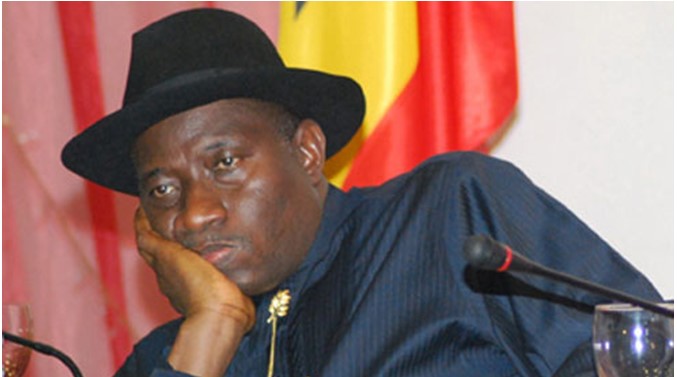
The cousin of the former president of Nigeria, Goodluck Jonathan, was reported to have been abducted by unknown gunmen at his residence in Yenagoa, Bayelsa State.

The cousin, identified as Jephthah Robert, was abducted on Monday, 24, January 2022.

The Daily Reality has learnt that the abductors have yet to contact the family long since his abduction

SP Asinim Butswat, the police spokesman in Bayelsa State, confirmed the development while addressing the journalist.

He added that this has resulted in intensifying efforts to save the victim and arrest the culprits.

Reports from the state have shown that the rate of kidnappings in Bayelsa State has increased recently.

Chinese-based company, Hikvision, certifies 14 Engausa apprentices

Hangzhou Hikvision Digital Technology Co., Ltd., often shortened to Hikvision, is a Chinese state-owned manufacturer and supplier of video surveillance equipment for civilian and military purposes, headquartered in Hangzhou, Zhejiang. The Chinese government owns its controlling shares. 

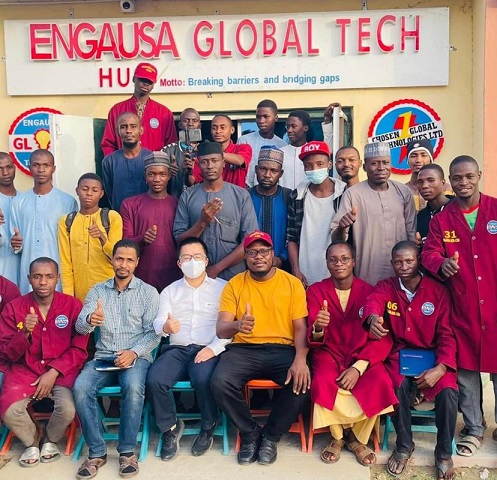
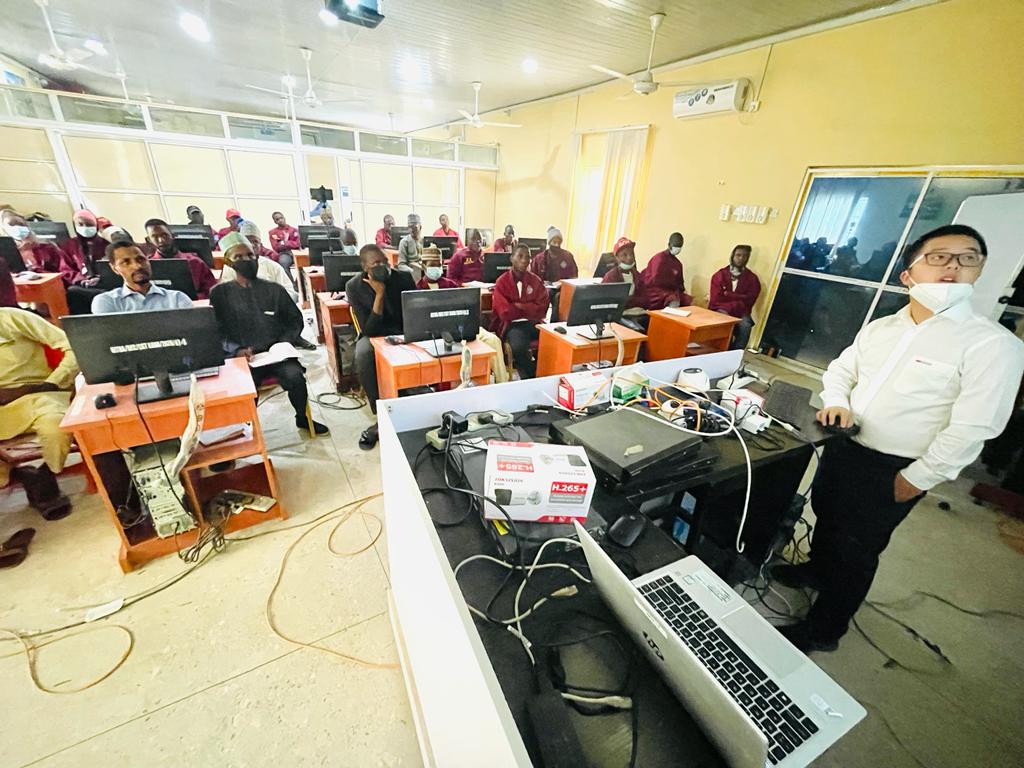
As part of the company’s mission to expand operations in northern Nigeria and Sub-Saharan Africa, Hikvision trained and rigorously assessed the theoretical and practical capabilities of 14 apprentices at the Engausa Global Tech Hub in Kano, Nigeria.

Impressed by the individual performance of the apprentice after the certification exams, the company has agreed to register Engausa Global Tech Hub as a Hikvision Training Academy, the very first training ever in northern Nigeria. 

We are joining the general public to congratulate these 14 Engausa apprentices that bagged Hikvision International Certification on CCTV tagged Hikvision Certificate Security Associate (HCSA-CCTV).

Recall that the founder/CEO of Engausa Global Tech Hub, Engr Mustapha Habu Ringim, has bagged a similar certification from Hikvision two years ago. And this makes a total number of 15 certified professionals in HCSA-CCTV. 

Let’s promote our culture

By Usama Abdullahi

It’s challenging that we are found wanting in our own culture. We don’t promote it simply because we don’t want to be looked down upon or mocked about it. Western culture has now substituted ours. We assimilate and worship anything western. Ironically, the West doesn’t force their culture on us; we rather westernise ourselves. 

Sometime in 2013, my uncle bought us pizzas. I used to see pizza as the best dish ever, but I was nauseous when I took my first bit. Being in the company of my cousins, I had to conceal my bitter feelings and fake some smiles to fit in. I was pretty low that day. 

For me, pizza is supremely overrated and not as delicious as I thought; it’s aromatic, though. Mind you, I’m not condemning the Italian dish in its entirety. But why do I bring this to light? I felt like sharing my experience, and I want my people to understand that not everything foreign is delectable.

As people with beautiful cultures, we have crazy good dishes that can excite and quench so many aliens’ appetites. Yet, we don’t promote that. We fault it instead. I have watched several western TV shows where the westerners expressed their liking for African culture, particularly their foods.

Arguably, most Nigerians tend to shun and dislike their culture because, to them, it’s worthless. The preference for western dishes leads to the decay of our cultural dishes. Sadly enough, most of the dishes are given western names, which has become difficult to catch on to. Those names don’t correspond and are mostly corrupt versions of the western ones.

Some of us, the so-called civilised ones, erroneously claim that most of our foods are detrimental to one’s health. Though I’m not medical personnel, the little I know tells me that foods like Tuwo provide the body with energy. Awara/Kosai, the most-avoided dishes by the corps d’elite, help build and repair tissues because they are “proteinaceous”. My claims are open to criticism because they are perhaps not well-grounded.

There are others too, which I guess could be harmless and good for consumption if thoroughly examined. It’s time we stopped self-hating or ridiculing ourselves merely because we want to look or sound different, say like the western. Until we promote our culture, our culture will go extinct someday.

Usama Abdullahi wrote from Abuja, Nigeria. Can be reached at usamagayyi@gmail.com.

387 persons killed in 2 years of Kaduna communal crisis – Gov. El-Rufai

By Muhammad Sabiu

Three hundred eighty-seven (387) people were murdered in the communal clashes in Kauru and Zangon Kataf, according to Kaduna State Governor Nasir El-Rufai.

On Wednesday, he stated this at Agwatyap’s palace in Atak Njei, Zangon Kataf.

The Commissioner of Internal Security and Home Affairs, Mr Samuel Aruwan, who represented El-Rufa’i at a meeting with traditional, religious and community leaders at the palace of Agwatyap, urged the communities in Kauru and Zangon Kataf to stick to the law and avoid generalizations that exacerbate the security situation in the areas.

He further called on the communities in Kauru and Zangon Kataf to keep recourse to the law.

During an emergency meeting with traditional rulers, Aruwan, who was escorted to the conference by security chiefs, also stated that the counter-killings were unacceptable.

The most dreadful experience of my life

By Yahuza Abdulkadir

Many a time, I listen to people expressing their feelings and emotions, telling their beautiful and ugly stories, talking about the experiences they encountered through their journeys.

But then, there’s this story I wanted to write, but I couldn’t. Whenever I tried to, fear overwhelmed me. So, I overcame my fears and summoned the courage to write this story today.

In April 2021, while travelling to Funtua in Katsina State, I had a dreadful experience that left a big scar on my heart.

On that day, I reached Kano at around 6:30 PM and boarded the ‘Adaidata Sahu’ tricycle to Rijiyar Zaki Park because I was told that it’s only there I could get a car that would take me to Funtua by that time.

We started the journey to Funtua at around 9:00 PM. It was late and a lovely friend who happened to know how the road used to be at night advised me to stay till morning. But I couldn’t heed her advice because I wanted to reach Funtua that night and complete my assignment the following day.

I started regretting why I embarked on the journey when our car spoiled at Malumfashi. The driver tried to get the car back to work for almost an hour but no progress. Finally, he decided to walk a few metres away to get a mechanic. And we were lucky that he came back with one. After several trials, the car engine started, and it got back to work.

I can still echo the voices of the two women seated at the back, pouring blessings upon the mechanic who helped fix the car’s problem. He really tried, but God’s miracle has taken place, I believe.

As we continued the journey – chatting and listening to other passengers telling their stories, I fixed my eyes on the road, and many thoughts knocked me on the head. When I noticed no car coming from the other side of the road, fear robbed my mind. My heart kept beating. I wanted to tell the driver that I was uncomfortable with this journey, but silence kissed my lips. I kept mute for some minutes. But deep inside of me, I wasn’t feeling okay.

A few kilometres to Bakori, we spotted torchlights reflecting from a close distance. And I heard the driver saying, “Inna-lillahi Waa Inna Ilaihir-rajiun,” meaning: “From Allah we are, and unto him is our return.” He tried turning the car to escape the trap in our front, but the sound of gunshots flying in the air made him stop the car.

I couldn’t remember what happened, but I saw people with guns and torchlights telling us to get out of the car. We went out, and I was terrified. Some voices began to whisper into my ears, “Had I known, I could have stayed in Kano till the following day like my friend said, but my stubbornness got me into this, it’s not my fault; this is my fate.”

That night we were robbed. “The Children of the Night” collected all our money and that of the driver. Then, they took away our cell phones and walked into the bush, shooting in the air.

When they left, I got into the car, shivering. Then, I realized that my smartphone was inside my small travelling bag, which I kept close to where I sat. I put the phone into the bag earlier because its battery was flat. So, I was lucky that my smartphone was still with me, though they took my small phone I used for calls. I know that we were lucky enough to be alive that night.

We stayed there till dawn because our car couldn’t get back to work again. We were thinking of what to do next when a car carrying bags of maize showed up. We waved hands for the driver to stop. And he did. He got out of the car and headed to where we stood. We told him about the incident, and he showed his concern, sympathizing with us. He told our driver that he was rushing to get to his destination. Then I saw him removing some money from his pocket and offering it to our driver. The driver thanked him and asked us to do the same. This man is very kind. Humanity lies in his heart, I whispered.

We kept waiting there till an empty commercial bus came. Then, after discussing with its driver, he asked us to get in. And we headed to Funtua. Our driver left his car with the intention to get a mechanic at Funtua who could repair it.

When we reached Funtua, I wished the other passengers well and prayed for their safety everywhere they would be. Then, I took my travelling bag and walked to my destination.

Although I have been travelling along the Damaturu-Maiduguri highway, I have never felt shocked and frightened like this before.

This was the most dreadful experience of my life. It’s a memory I can never forget.

Yahuza Abdulkadir wrote via yahuzaabdulkadir50@gmail.com.

A minute of silence for Hanifa Abubakar

By Maryam Muhammad Lawan

“Baby sis! I’m craving for something spicy,” I said in a cosseted voice. 

“Don’t worry, please. Your lazy sis will take care of you today. Guess what! No, I’m not even telling you anymore. Just wait for it,” sis said. 

I jabbed at her amusingly while saying, “Go and prepare whatsoever it’s please”.

“So, you’re poking fun at me. I’ll surprise you today”, My sister said while cackling.

“Yeah, don’t surprise me with rubbish, please, “I teased while she guffawed and moved on. “What a sis? Bless her ya Allah, “I said silently.  

I was left alone in the room when I logged into my Facebook account and started scrolling. Why do I see Haneefah’s pictures on almost every post? Did those other sets of humans release her? So I decided to read, to discover what it is. 

SubhanAllah! AstagfiruLah! I read as many updates as possible, for I couldn’t believe what I read from the first update. But eventually, I realized even the first update was as right as a trivet. 

“Don’t tell me you couldn’t wait for me to finish. I want to cook delicious food, so be more patient, please,” My sister said as she heard my footsteps towards the kitchen. I stood there, and she quickly looked at me. “Okay. Cry, cry, baby, what’s wrong again? Let me turn off this cooker before this mood of yours spoil my hot spicy meal,” sis said aggressively.

I couldn’t spell out even a word, maybe because I was emotional. So all I could do was to extend the phone to her. 

She used her hands and closed her mouth. Tears had no option rather than to roll out of her eyes.

Innaa lillaahi wa innaa ilaihi raaji’uun! AstagfirulLah wa atubu ilaik! Ya Allah, have mercy on us. The girl I so much like? Though I don’t know her, the girl I always pray for Allah to protect her wherever she’s, and from the evil of those men?” she said with a sorrowful voice. She continued reciting, “HasbunalLahu wa ni’imal wakeel”.

“Her school teacher did this, then, if learning places are not safe, where on earth then? What a wicked world, Ya Rahman, have mercy on us. Ya Razzaq, grant her parents the fortitude to bear this loss,” My sister prayed

I replied, “Ameen ya Rabb,” while giving her a shoulder to cry on.

Maryam Muhammad Lawal wrote from Kaduna via mmafamam@gmail.com.

Let there be Rice!

By Tahir Ibrahim Tahir Talban Bauchi. 

As intelligent, hardworking and technologically advanced as we brag about being, it is ironic that at the end of the day, we fail to show up for patriotism and country — and choose to dwell on the divides that do not crystallise into the positive building blocks of our national development. Instead, we tow the lines that harp on our differences and rhetorics based on political party apathy.

We often embrace the gulfs of ethno-religious segmentations of our society and deliberately fail to show up for our country. We are absent when it comes to celebrating the country’s achievements and progress. We instead converge to mock her, even when she has birthed something fruitful and prosperous. However, anytime we find ourselves stuck or in need of a dear country, our voices are gravelly with echoes of her name and her might.

When D’Tigers made waves whacking USA’s Dream Team, it was called Igbo or IPOB teams. When it wobbled, it was Nigerian again. When the Super Eagles didn’t score, the striker is labelled gateman because he is of a particular demographic. Still, when he does, the Super Eagles are flying again and are the only team in AFCON 2021 to make the group stages on a stainless slate. 

The CBN and RIFAN (Rice Farmers Association of Nigeria) unveiled the pyramids in Abuja as seeds of the long and aggressive Anchor Borrowers Programme. Many rose to blindly and sheepishly discredit the programme. An old image from a certain state, which showed the assembling of rafters, as if constructing a roof, with rice bags placed as tiles, to simulate a huge pyramid, was shared to disillusion gullible ones, that the CBN/ RIFAN event was dubious and unreal. Some said the bags were filled with sand, while some dissected the event as a waste of resources and energy. Some didn’t want to credit the administration due to party affiliations, and others didn’t want to have any of it because of their own biases. Most couldn’t put Nigeria first and all other differences aside and be happy that the motherland has achieved this milestone, despite the overwhelming and depressing global environment for business and governance. 

In our importation bills, it is more than evident that the importation for food, especially rice, has stepped down many notches. This is because government intervention in rice importation has also dropped astronomically. One million bags which is just a percentage of what RIFAN has produced, were unveiled at the event, being an aggregation of the 2020 dry season and the 2021 wet season. They are the commitment from farmers in the repayment of their loans from the Anchor-borrowers programme.

No fewer than 230 small, medium and large scale rice mills have emerged all over the country from 2015 to 2021. A Kano-based lady has a 160 ton per day capacity rice mill, while another, one of the biggest, has a 32 metric tonnes per hour capacity built-in Lagos. From averaging less than 3 million metric tonnes per year, in 2015, an outstanding 7 to 9 million metric tonnes per annum was achieved in 2021. The rice revolution is unbelievable but far away from being a hoax. 

Ado Hassan, the Secretary of the Kano chapter of RIFAN, had said that their move was towards engendering the twin benefits of food security and economic diversification. Agriculture contributed over 21% of our GDP. This is incontrovertible evidence that a lot has actually been achieved in this sector. Nigeria has become the largest rice grower in Africa, and neighbouring countries are coming in to educate themselves on how Nigeria is dominating Africa, as the giant of any continent should rightly do. 

Nigeria is gradually achieving food security, which we should be proud of and glad to attain. Unfortunately, the vociferousness of global inflation is biting the most developed countries too, and not just developing nations like dear country. A Briton was lamenting that the cost of parking, which was just £.10 a few months ago, had risen to £.50! Perhaps if Nigeria were not hindered by insecurity and a pandemic for the last three years, we could have been celebrating a lot of such pyramids across the country.

The Nigerian military does a show of force, so does the NAF with jets in formations over our skies. Lecturers have conferences, and the NBA has annual conferences as well. Every sector of our economy has players coming together under one roof to showcase their achievements and discuss prospects. So why can’t our dear farmers, under the auspices of RIFAN, do their own show of rice? Isn’t it an important part of accountability?

We pray that their efforts will directly affect the market price of rice in the coming weeks, as the mills get busy husking the rice that was showcased. We also pray that unscrupulous marketers will not deny the everyday person the fruit of this labour. Those ones are a whole chapter of those unpatriotic ones we so have to live with. 

Tahir is Talban Bauchi.