What would be our take home as we celebrated the World Environment Day (WED)?
By Murtala Uba Mohammed (PhD)
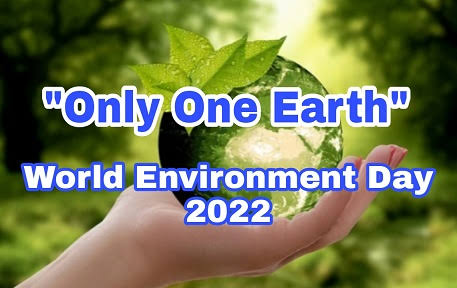
In recognition of the importance of environment to human life, the United Nation Environmental Programme (UNEP) sets aside 5th day of every June as the World Environment Day (WED). This year, the world celebrated 50th WED with a theme “Only One Earth”. If everything, this theme was the first theme of the WED and also it signified the importance of protecting the planet earth. Since man has no any other place to call his home other than the earth, it is binding on him to safeguard its sanctity and ensure its sustenance, as well as to do everything possible to maintain its health status.
The planet earth which came into existence some billions of years back, was in a harmonious state with respect to its chemical and biological elements. Although, volcanic eruption and other natural occurrences such as falling of asteroids that occurred in the past, might have induced some modifications to it as the state is always being checked through planet’s self-regulating mechanism, recycling, replenishing and adaptation.
Man’s dominance of the planet which began with his emergence some 200,000 years ago through the current epoch of Anthropocene has made the most significant footprint on the earth. At the early stage, human beings started living in a small number; lived a simple life (without access to any tool) through hunting and gathering things, before man later multiplied (reaching billions) and acquired new technologies to exploit nature to suit his purposes. Through waves of revolutions in agriculture, urbanization, industrialization and information, environment received so much impact from human who introduces, transforms, modifies, hastens many processes and terminates many.
Consequently, with the recent development, environment started to react as earth begins to witness unusual, unfamiliar and difficult to predict events. Issues such as rise in temperature, air pollution, ice melt, flood, tropical storms, drought, desertification, soil desiccation, groundwater depletion and more intensified earth tremors and quakes become regular visitors to the planet. Also noticed is the extinction and disappearance of many species and habitats as well as emergence and re-emergence of new diseases. The main drivers of this change as explained by Intergovernmental Panel for Biodiversity and Ecosystem Services (IPBES) are changes in land and sea use, direct exploitation of organisms, climate change, pollution and invasion of alien species. All these are linked to human activities in the field of agriculture, mining, building of settlements and industries.
Although the drivers may not be sporadic as far as their nature and magnitude, their consequences are ubiquitous. The most vulnerable to the impact are the weaker members of human society and species such as the developing countries due to their poverty and underdevelopment status; the children and women because of their powerlessness and dependency; the disabled and people with special needs; and above all, the none human part of the environment (plants, animals and abiotic components) who may not have the human intellect and know-how (for example) to run for their safety.
At global level, efforts are made through changing and adapting more cleaner energy sources such as solar and hydro, as against the use of fossil fuel based energy which is harmful to the ecosystem and equally contributing to carbon accumulation into the atmosphere; switching to green technology through recycling of resource and producing environmentally friendly technologies and product; better and less environmentally damaging agriculture such as zero tillage, less to zero acreage farming, control grazing, integrated organic farming; as well as changing to green engineering, climate smart engineering among many other things. Rehabilitation, reclamation and restoring the damaged ecosystems are also receiving priorities through such projects such as Great Green Wall.
In spite of this effort at global level, we need to look inward and see what we are doing/can do at local level to help in solving the global problems while at the same time addressing our local issues. The population, particularly those in rural areas should be empowered through knowledge and economy to embrace changes in the areas of sustainable climate, smart agricultural practice, afford better technologies and change to clean energy. With current economic shock, low income, and high cost of accessing cleaner energy sources such as solar, we are indirectly encouraging Nigerias’ poor to continue using wood fuel and inflict more damages to our fragile ecosystem. When farmers are left at the mercy of nature, doing little to nothing to subsidize them or improve market price of their goods, the agricultural output will remain low and the demand for more land will continue leading to destruction of forest and reserves. Only when farmers are getting sufficient income, they will save enough and be able to send their children to school. This will address the current rural-urban drift which is making it difficult for city administration.
Environmental planning is one area we need to do a lot in Nigeria. Respect for nature and natural world is very fundamental. City folks should have access to open spaces, recreational areas and parks. Our built brown ecosystem should be sandwiched with grassy greenish and watery bluish ones to achieve harmony. Presence of all living things is fundamental to the environment. Cities soundscape should be a blended one, with presence of both manmade and natural (such as birds, insects and reptiles) sounds. Workability should be encouraged for both health improvement of resident and for carbon off-scaling in our urban area. We also need to revive and improve our local technologies and architectural designs to make it environmentally friendly.
Health and safety of residents should be given a priority. While, sharing the moment of grief in Kano State, as over 200 residents inhaled unknown gas and ended up in hospital, we hope such things will not happen again. The state recently faces problem of water scarcity particularly in the metropolis where a 25 litre water container cost between 60 to 100 Naira. This has implication on health and sanitation of the populace who are now taking water whose quality is highly questionable. The state should do more on water provisioning and supply. Water policy should also be implemented in order to check the current rampant proliferation of boreholes whose future implication is likely a doom.
In a nutshell, WED is a good time to reflect and ponder. It is time to think more about environment, make it healthy and support its sustainability. It is a moment for all hands to be on deck to achieve sustainable development where a balance will be achieved between built and natural ecosystem. All stakeholders including the policy makers, the professionals and media have roles to play in this endeavour. It is right to advocate for a healthy and sustainable environment.
Murtala teaches Geography at Bayero University and can be reached via his email, murtalamuhammadu@gmail.com