University Education

Return to Forever: African Studies in Europe

By Prof. Abdalla Uba Adamu

Frankfurt, Germany. 3rd July 2013

The German immigration officer looked at me and gave the usual clenched-mouth smile. I did the same. I am used to it. He flipped through my passport and then looked up.

“How many days are you staying THIS time.” Emphasis on THIS.

“Two days in Cologne”, I replied. “Today, tomorrow, and the day after that, I am off.”

He stamped the passport without asking for the usual – return ticket, invitation, hotel booking – all of which I had. He wished me a pleasant say and waved to the next person behind me.

I was then in Cologne to attend the valedictory retirement conference held in honour of the woman who mentored me and virtually adopted me as her son – Heike Behrend, who was retiring from the Institute of African Studies, University of Cologne, Germany, where she was the Director. She created the research category of “Media and Cultural Communication”, and I was the first African to be invited to deliver a lecture at the cluster. The Immigration Officer’s reference to the length of my stay was in response to the numerous times I had been to Germany – and never stayed beyond the time necessary for whatever it was that brought me.

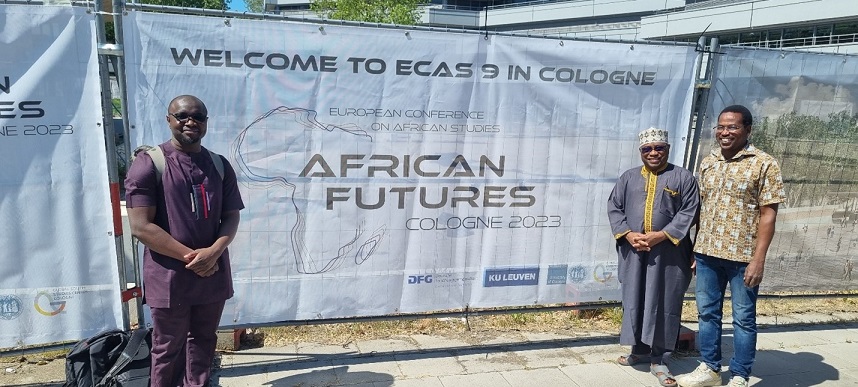
The week from Tuesday, 30th May to Sunday, 4th June 2023, I returned after ten years. This time, the occasion was to attend ECAS2023: 9th European Conference on African Studies, with the theme of “African Futures.” It was hosted by the University of Cologne. “African Futures” explores the continent’s critical engagements with the past, present, and future of Africa’s global entanglements. ECAS is the largest and most visible single event under the AEGIS umbrella. AEGIS is an expression of a much wider and dynamic set of African Studies connections, collaborations, activities and opportunities within and beyond Europe. The conference, lasting four days, had over 70 panels involving hundreds of papers and speakers. All were efficiently coordinated through the various classes at the University of Cologne.

Earlier in the year, I and colleagues from Germany and US had submitted a panel, “Digital/social media and Afrophone literature”, for consideration at ECAS 9. It was accepted.  The conveners were me (BUK), Uta Reuster-Jahn, Umma Aliyu (Hamburg) and Stephanie Bosch Santana (UCLA). Before submitting our panel to ECAS, we first held an online symposium which was preceded by a call for papers. Despite sending the CfP to various universities and the Nigerian Academy of Letters (NAL), the response was pretty poor. The symposium was titled Social Media as New Canvas, Space and Channel for Afrophone Literatures. It was eventually held online at the University of Hamburg, Germany, on 22-23 February 2023. The participants then were from Germany (Uta Reuster-Jahn, Umma Aliyu Musa), Nigeria (Abdalla Uba Adamu, Zaynab Ango, Ado Ahmad Gidan Dabino, Nura Ibrahim, Asabe Kabir Usman, Isyaku Bala Ibrahim), Tanzania (Hussein Issa Tuwa, Zamda Geuza), Ghana (Nikitta Dede Adjirakor), Stephen Ney (Canada), US (Stephanie Bosch Santana).

After the symposium, we submitted a panel for the ECAS 9th edition. Our panel was accepted, and all the participants of the online seminar were issued official letters of invitation to process their funding for the conference in Cologne in June 2023. As a panelist, I was fully funded to attend by Deutsche Forschungsgemeinschaft (German Research Foundation, DFG). Umma and Uta were able to sponsor themselves from Hamburg. Unfortunately, only Nikita from Ghana was able to come from the others who could not get any funding. As a result, our panel, held on Wednesday, 31st May 2023, had only four speakers. It was déjà vu all over again – after almost 24 hours of flying and waiting at airports (Kano, Abuja, Doha), I was given only 20 minutes for the presentation.

My paper was “From Kano Market Literature to Kano Social Media Literature: The Reincarnation of an Afrophone Literary Genre.” The paper traces the trajectory of the genre from print media to its liberation in online media, with a specific focus on Facebook, Wattpad and APK files on Google Play. The paper uses netnographic methodology to harvest the dominance of and reaction to the newly reincarnated genre, which, far from being dead and buried, is more than ever before, alive and kicking in other spaces – beyond censorship or any form of criticism. In the process, the paper explores the freedom gained by the authors in unrestricted storylines that cross boundaries of identity, gender and alternative sexualities.  The Journal of African Literature Association (curated by Taylor and Francis Group) has agreed to publish the papers of the Symposium in 2024. We will have to ask for more contributors.

Another dividend for me was that I was approached by a representative of Lexington Books in the US for the possibility of publishing my paper as part of a book on Hausa media cultures if I have something like that. As it happened, I have almost completed such a project titled “Hausa Cinema” (to complement Jonathan Haynes’s book, “Nollywood”) which was to be published by the Ohio University Press in 2010, but things went southwards! Now Lexington Books is providing an opportunity, and I am excited about it.  

Our panel was lively, though, and I even met a fan! He was Jos Damen, Head of the Library and ICT Department of the African Studies Centre at the University of Leiden. While I was making my presentation, he took my picture with his phone and uploaded it to my Wikipedia page (itself created by another fan)! Later he told me I needed to have a picture there, and he took that responsibility. So it was kind of him!

The conference attendance was a fantastic homecoming for me because although Heike Behrend had retired back to Berlin, where she came from (and where I visited her in 2015 had a wonderful dinner when I was a guest of the Haus der Kulturen der Welt, Berlin), Muhsin Ibrahim is now in the same institute. Both Muhsin and I were from Bayero University Kano. Muhsin was teaching Hausa at the Institute.

I first came to Cologne in 2004 – at the invitation of Heike Behrend when I met her in Kenya. At that time, I had an invitation to participate in an African Literatures project at Johannes Gutenberg University, Mainz. Heike asked me to reroute my itinerary to stop at Cologne, teach a Postgraduate class and give a public lecture. I did both on Monday 15th November 2004. Since then, I have almost lost count of the times I visited Germany – Berlin, Freiburg, Hamburg, Leipzig, and the wonderful Cologne with its incredible, massive and stupendous cathedral – the largest Gothic church in Northern Europe. It was in Cologne in 2004 that the foundation of my ethnographic foray into critical media studies was laid. Unlike in Nigeria, where many saw me as an ‘interloper’ (as they murmur, ‘After all, he is a Biologist, isn’t he?’), here it is not what you study but what you can contribute to any discipline. I have been to Colone four times and other cities several times – all on the same mission of promoting Hausa media studies.

ECAS 2023 started wonderfully with Muhsin meeting me at the Koln Hauptbahnhof and helping me drag my luggage through various concourses to the trains that would take us to his flat: a very lovely well-furnished, and very spacious space. Upon arriving and freshening up, a massive mountain of uncharacteristically fat masa was waiting for me. Even the masa looks like a ‘Bajamushiya’! The soup alone could feed a family for a week! It was a truly delicious welcome. Once I got rid of the hunger, he took me to my hotel, IBIS Centrum.

Breakfast in the morning at the hotel saw a meeting of Who-is-Who in African studies – both diasporic Africans, home-based Africans and European and American researchers. It was indeed a wonderful gathering. In addition, I had a chance to reconnect with one of the most promising diasporic Hausa African Studies experts – Musa Ibrahim.

Musa is based in Ghana. He travelled there through South Africa and Japan, ending up in Bayreuth, Germany, where he obtained his doctorate. We met at Leipzig in 2018, and I collected his CV with the hope of getting him employed in our Information and Media Studies department, Bayero University Kano. However, the university was not interested. Before you knew it, he was grabbed by the University of Florida, Gainesville, where he spent about three years before getting another appointment at the University of Ghana. Such rich and varied experience would have been valuable to us in Kano, but the parochialism of our university system did not factor in multidisciplinarity.

The following day saw dinner at Muhsin’s house, and this time, Umma Aliyu, originally from Bauchi, joined us. Umma now lives and teaches in Germany at the University of Hamburg (after her studies at Leipzig). Like Muhsin, she also teaches Hausa at Hamburg, where she took over from Joe McIntyre (Malam Gambo), who retired some time ago. During dinner, we brainstormed the idea of two book projects – which, for me, was one of the significant takeaways from ECAS9.

Muhsin, Abdalla and Musa at ECAS9, Cologne

The first book project would be tentatively titled “Hausa Studies in European Diaspora: Experiences and Perspectives.” This will be a collection of chapters written by Hausawa living and working permanently in various European universities, either teaching Hausa or other disciplines.  The objective is to demonstrate how internationalised Hausa scholarship is. We started with about five in Germany alone.

The second book project would be a post-Boko Haram narrative. So far, the Boko Haram literature has focused on the human disaster of the insurgency – virtually all books written were from the governance, security and disaster perspectives. Yet, much success has been and is being recorded in the war against terror in the form of surrenders, deradicalisation and reintegration. Yet, no one is looking at this. Using ethnographic field data, the book project will provide another side of the war on terror in Nigeria. We were excited and promised to work on various draft proposals before embarking on the works, which we hope will be completed by 2025.

The Conference’s overwhelming focus on the multidisciplinarity of African Studies was an eye-opener—no room or time for a narrow perspective on scholarship. No one cares about what your degrees are in – what matters is what you are bringing to the table NOW and how it impacts the knowledge economy of African societies and contribute to the decolonisation narrative.

For me, Cologne is a Return to Forever – the beginning of an endless loop of research and investigation.

My deepest thanks to Muhsin for being such an excellent, graceful host.

Academic dream: My research, my citations, my h-index, and the “true impact”

By Prof. Abdelghaffar Amoka

Colleagues have been sharing their experiences as academics in Nigerian universities with several reactions. The essence is not to discourage people from going into academia but to know what lies ahead of you if you want to go into academia. Like most colleagues, I had no idea of the challenges in Nigeria’s academia when I was so eager to join. For example, I never knew the job is for 24 hours, and that promotion is based on research output you will fund from your pocket.

After graduating in 1999, I looked forward to being part of the academia. During my youth service in Kano, I visited the HoD of Physics, ABU Zaria, Prof I. B. Osazuwa, to discuss my “academic dream”. He directed me to the late Prof. N. I. Hariharan. I met him, and he advised that I should enrol for MSc. So, in 2001 on my way from Kano, I stopped over in Zaria, purchased the PG form, and left for Lagos.

As we were job-hunting in Lagos, I remember my friend and Brother, Yusuf Osafore, saying it appears I was not taking the job hunting seriously but was more concerned with pursuing a Master’s degree. My looking forward to becoming an academic was so apparent to people around me. Then, I eventually got hired in March 2005. It was a dream come true. I have finally joined the group of intellectuals. The “most revered” group in the society. A group of knowledge generators. A group of reservoirs of knowledge.

After a few months in the university, they revealed the reality of Nigerian academia. The fact that I had no prior knowledge of. There are, of course, viable ideas, but they die within the university walls because the political class isn’t interested in them. The ideas are published, but it is just for promotion’s sake. I paid N7,000 or so to publish my first paper in a Nigerian university-based academic journal in preparation for the next promotion to Lecturer II. These made me begin to meditate on “my academic dream”.

In 2007, I had the opportunity to visit ICTP for a two weeks workshop, and my interaction there revived my academic dream. Then, in 2009, I got lucky and left the country for my PhD, strengthening my revived “academic dream”. My joy knew no bounds when I published my first research paper in an Elsevier-indexed Q1 journal in 2011. From then on, the papers kept coming.

There are two publication options. You either publish in close access journals where publishers are paid for access to your research work, or you pay between $1,500 to $3,500 to publish as open access for everyone to have access. I remember spending some dollars in 2014 to publish the last paper from my PhD work in Elsevier’s Sustainable Materials and Products journal as open access. That money came from my salary in Norway.

We were told that research impact is based on the number of citations one has. Something they called h-index was brought to classify our research impact. I began to monitor my citations and h-index on Scopus, ResearchGate, and Google Scholar. I usually wear a smile on my face whenever I receive citation alerts. As the promotion period approached, I counted my number of publications and was excited as my number of citations grew. We began to use Scopus h-index to rate academics. Unfortunately, we get carried away so much that if you talk too much, we ask, “What is your Scopus h-index?”

The irony is that you look for money (either grant or personal fund) to do research and get it published in a reputable journal after rigorous reviews (reviewers work for free) and are excited for an additional paper to your credit. Brag that you have so many articles in indexed journals and get promoted for a peanut added to your salary. In Nigeria, you become a Professor to earn about 440 USD (N325,000) per month. You proudly go around with the title (Prof). Meanwhile, a multi-billion dollars cooperation makes money from your sweat and the knowledge you have laboured to create. And all that we are happy with are citation alerts, a growing h-index, and promotions that come with peanuts.

The best publication time is during our young age. As we grow older, our students take over the writing. Then, the university will ask why you are the paper’s first, second, or last author. They have got no idea how it was funded. The academic dream can truly be defined as spending our entire youth creating knowledge and paying a billion-dollar corporation to take it from us in exchange for career capital that you can then use to buy meaningless promotions from other exploited individuals.

Sometime back, I logged into the university network, and the research output of a senior colleague on Google Scholar was highlighted on the university webpage with thousands of citations and a high h-index. So I decided to follow the link to check mine. Mine was very much below his, but it wasn’t that bad. So then, I sat down and began to question the true impact of my research work beyond what Google Scholar has evaluated.

Do a mere citation of our publications truly translate into research impact? Research is global, but you should see your work impact your immediate environment. We have Professors with thousands of citations that can’t present an inaugural lecture, faculty colloquium, or even a departmental seminar; so, what is the impact of our research on our immediate community?

I tried to reflect on our impact, especially as Professors and Farooq Kperogi came to mind. I remember checking on him on Scopus when he became a Professor in the US. However, when I later reflected on his writeups on Nigeria’s sociopolitical scene and the healthy discussions he had generated towards repositioning the country, I began to realise that Farooq has made much more impact on Nigeria than many of us with a better presence on Google Scholar, Researchgate, and Scopus.

Let me introduce myself properly—a Professor of Physics specialising in dielectrics and high-voltage electrical insulation. I have 33 research documents indexed in Scopus and an h-index of 11, 13, and 14 in Scopus, Reseachgate, and Google Scholar, respectively. In addition, I have about 585 citations on Google Scholar. My published research articles are on high-voltage insulation. Still, the articles and the citations, put together, have not impacted our electricity network in Nigeria, which is on a breakdown spree. So, what, then, is my impact?

Universities are identified as keys to innovation, from developing new ideas to providing state-of-the-art facilities. Industrialists and managers of the countries engage them in keeping the workflow full of new ideas. But in Nigeria, our university system has been made the most insignificant institution that has been reduced to lecture rooms. We only publish to avoid perishing.

Everywhere in the world, academics are respected and heard when they talk. But in Nigeria, especially during the Buhari government, they are tagged as enemies to crush. Our universities were once places where policies evolved. Academics generated ideas that shaped the country. Discussions in academia are used to shape the policy development of our nation. The golden time of Bala Usman can never be forgotten. What happened to those intellectual discussions? Who killed it? We now chase appointments within and outside the universities, especially after we become ‘Professors’.

Nigeria has been messy for the last eight years, and universities are in the worst state ever. But the government of Buhari used eight years to run away from education stakeholders’ engagement. The political class are educated people with no value for the education of the people. The best gift that Buhari gave to the people that so loved him was to strangulate the public universities for the people. Rather than having a public engagement on how to salvage the situation he was well aware of before his appointment, the outgoing Education Minister, Adamu Adamu, described the backwardness that they have imposed on us as “self-imposed backwardness” and their idea of the solution is by approving the establishment of more substandard private universities in the North.

The incoming government of Bola Ahmed Tinubu needs to come in with a clean and open mind to engage the academia with sincerity. They should look at ASUU as partners in progress rather than enemies to crush. The solutions to our problems are right in our hands if we are willing to engage each other. On the other hand, academia needs to start looking beyond publishing, not to perish. We need to start thinking beyond journal publication impact that has no impact on our immediate constituency, Nigeria. We need to wake up and revive the golden days of Bala Usman on our university campuses.

©Amoka

FUBK gets new DVC, directors

News Desk

The Governing Council of Federal University Birnin Kebbi (FUBK) has appointed Professor Aliyu Abdullahi Turaki as the new Deputy Vice Chancellor of the University.

The appointment was sequel to the recommendation of the Senate and subsequent approval of the Governing Council at its 26th meeting held from 10th to 11th May 2023.

The appointment is for a term of two years at the first instance and takes effect from Thursday, 11th May, 2023.

Prof. Aliyu A. Turaki attended Sabon Garin Rikoto Primary School from 1978 to 1983, where he obtained his Primary School Leaving Certificate. He then proceeded to Government Science College, Birnin Kebbi, where he obtained his Secondary School Certificate in 1990. He obtained B.Sc. and M.Sc. Biochemistry from Usmanu Danfodiyo University, Sokoto, in 1996 and 2006, respectively.

Prof. A.A. Turaki obtained his PhD in Molecular Biology at the University of Greenwich, United Kingdom in 2014. Between 2007 and 2008, he also obtained Postgraduate Certificate in Food Safety and Certificate in Applied Hazard Analysis and Critical Control Points (HACCP) from University of Greenwhich and Royal Institute of Public Health, UK.

The new Deputy Vice-Chancellor comes with over 2 decades of professional experience. He started his teaching career as a Lecturer at the College of Agriculture, Zuru, in 1998. He joined the services of Federal University Birnin Kebbi on 26th May, 2015 as Lecturer I at the Department of Biochemistry and Molecular Biology, where he rose through ranks to become Professor in 2022.

Prof. Turaki served in various capacities in the University setting. He had been the Director of Academic Planning from 2021 to date; Deputy Dean, Postgraduate School from 2021 to date and Senate Representative on Council from 2021 to date. He also served as Deputy Director, Academic Planning from 2015 to 2021 as well as Head of the Department of Biochemistry and Molecular Biology from 2018 to 2023.

Prof. Turaki published papers in both local and international journals. He is a member of several professional organizations. He was born on the 5th of October, 1970, in Zuru, Kebbi State. He is married with children.

In another development, the Vice Chancellor, Federal University Birnin Kebbi, Prof. Muhammad Zaiyan Umar, has approved the reappointments of the immediate past Deputy Vice-Chancellor, Prof. Kasimu Shehu, as Director, Research and Innovation; Prof. Isa Garba Abor of the Department of Mathematics as Director, Consultancy and Entrepreneurship as well as Prof. Kabiru Jega Umar of the Department of Chemistry as Director, School of Basic Studies.

The appointments take effect from April 27, 2023.

Similarly, the Vice Chancellor approved the appointments of Prof. M.D.A. Bunza (Biological Sciences), as Director, General Studies; Dr. Sirajo M. Bakura (Computer Science) as Deputy Director Students Industrial Work Experience Scheme (SIWES); Dr. Abubakar Musa Shinkafi (Computer Science) as Deputy Director, Entrepreneurship; Dr. Ahmad Saidu (Nursing Sciences) as Deputy Director, School of Basic Studies and Mal. Yazid Salihu (ICT Directorate) as Deputy Director, Information and Communication Technology (ICT).

Their appointments take effect from 27th April 2023.

The new appointees are charged to bring to bear their wealth of experience in the discharge of their duties and responsibilities.

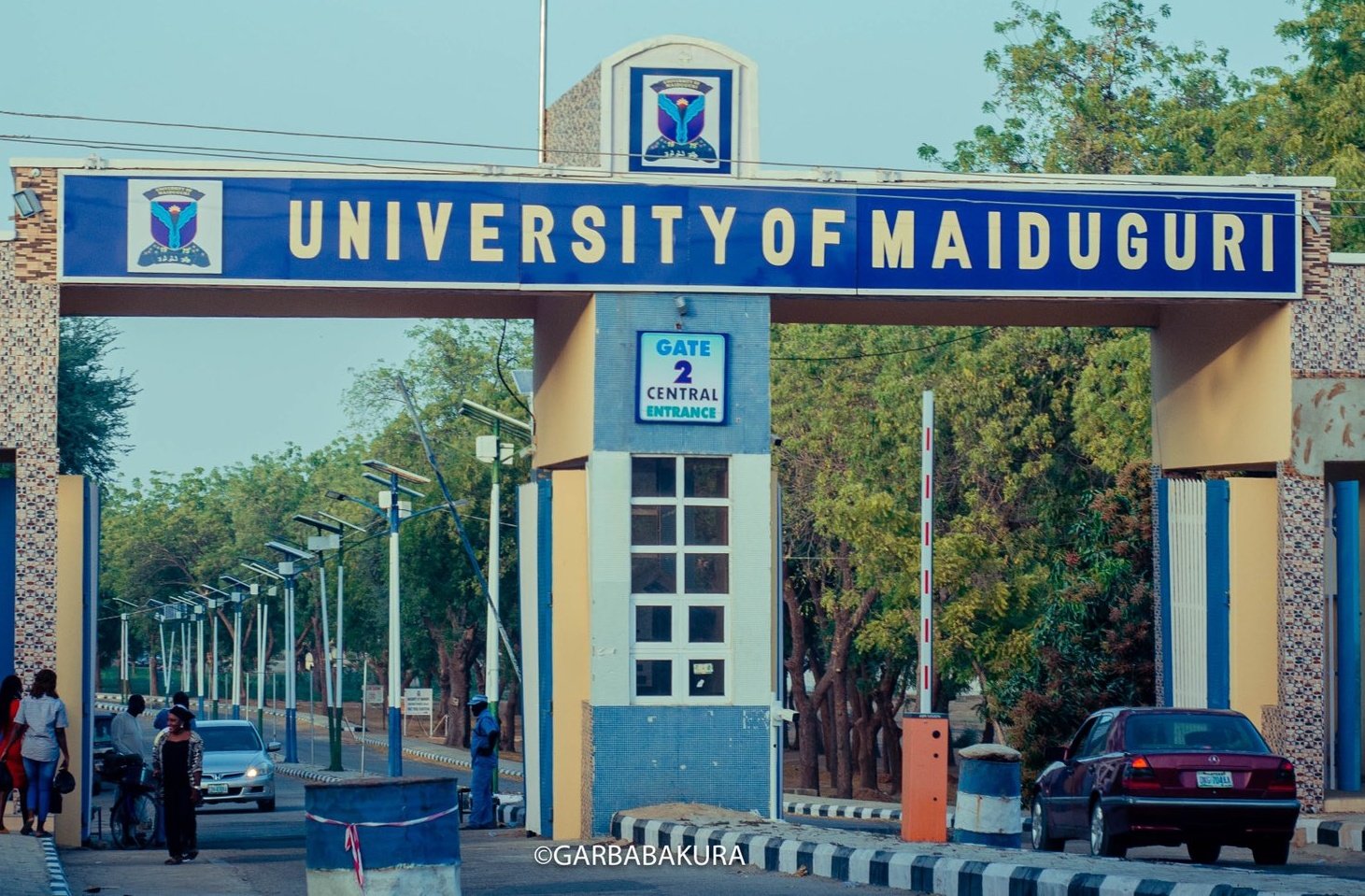
Is the University of Maiduguri witnessing one of its worst administrations?

By Salim Toro

A mistake repeated more than once is not a mistake anymore. It is a decision. – Paulo Coelho

I am not sure if this write-up will reach the appropriate authorities. But, anyway, if it reaches them, they should please consider and solve all the problems facing students of this great learning environment.

This question keeps coming to my mind. I can say that most of the University of Maiduguri students recall that the school commenced its 2022/2023 academic session on 3rd January 2023 for its new students and 16th January 2023 for returning students. However, I can see that no one is talking about it, although it’s already getting to two months, and no proper academic activities have commenced yet. 

Firstly, I’m not sure if this happens at a few universities. Still, it’s not proper to commence an academic session without placing your students’ results/academic statuses. But the case is different at the University of Maiduguri, and no effort is put into changing it. This same mistake happened last year, resulting in massive failure the following semester for those carrying over previous level courses, especially first-semester courses, because tests had already been conducted before the placement of the academic status. 

It’s tragic to know that the University of Maiduguri, a university created in 1985, doesn’t have any active student portal for registration, hostel registration, etc. They always come up with a new portal at the beginning of each session, with many difficulties for students when registering. Many students could not apply for hostel last year due to such challenges, and the management is still not ready to sort out this problem. 

Moreover, the university management doesn’t listen to students’ pleas on issues such as electricity, hostel maintenance and water supply. Sadly, students stayed in total blackout for weeks during the last examination session, which might result in massive failure in the semester examinations. Unfortunately, neither the school management nor the Student Union Government (SUG) takes serious action to solve the problem.

It’s sad to say that when the student representative met with the Vice Chancellor of the university, he boldly told them that the students should focus on their primary assignment and should not bother about anything other than that, which is impertinent. 

Although the SUG is supposed to be a channel between us and the management and a representative when any matter arises, I think they were appointed without minding to know the exact duty of the student union, and at last, they failed woefully. Aliyu Fannami’s administration is the worst SUG administration the university has ever had. 

Lastly, I’m calling on the JAGABAN of this administration to please put things into order. There’s still time to leave good legacies that will write your name with a golden pen in the university’s history, sir, because going down like this will only write your name as one of the worst JAGABAN the university ever had. 

Best wishes, Sir!

Salim Toro writes from Toro and is a 400l student from the Faculty of Agriculture, University of Maiduguri. He can be contacted via salimabdulhamid0909@gmail.com.

KASU gets new Registrar

By Sumayyah Auwal Ishaq

The Governing Council of Kaduna State University has approved the appointment of Barrister Samira Balarabe as the new Registrar of the institution.

In a statement by the university’s management on Tuesday afternoon, the new Registrar will be the 4th of the institution. She succeeds Mr Samuel Manshop, whose tenure expires this month.

Barr. Samira joined the services of Kaduna State University in 2006 as an Administrative Officer I in the Registry Department (Legal Unit). She rose through the ranks to the position of Deputy Registrar. 

She holds Multidisciplinary Academic Qualifications, which include: LL B. Hons (2002) and LL M (2022) with a specialization in property law, both from ABU, Zaria. She also has a Master’s degree in Conflict Peace and Strategic Studies (MCPSS) (2016), specialising in Conflict Resolution from KASU, Kaduna. 

Barr. Samira also obtained her B.L. from the Nigerian Law School, Bwari, Abuja (2004).

FG upgrades Sa’adatu Rimi COE to university

By Ahmad Deedat Zakari

The National Universities Commission ( NUC), has approved a new university for Kano State.

Consequent of the approval, Sa’adatu Rimi College of Education, Kumbotso is now a university of education.

On Tuesday in Abuja, the Executive Secretary of NUC, Prof. Abubakar A. Rasheed, presented the letter of recognition of the institution to Kano State Governor, Abdullahi Umar Ganduje .

Ganduje said, the new university was part of his administration’s efforts to meet the growing demand for education in the state.

According to him, the university, which is the third under Kano State, has 116 lecturers with PhDs.

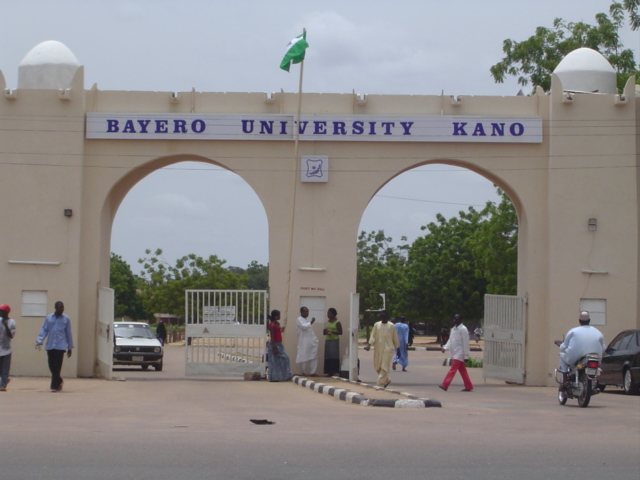
Bayero University debunks school fees increment rumours

By Sumayyah Auwal Ishaq

The Bayero University Kano (BUK) has debunked rumours that the institution has increased registration fees.

A statement published in the official bulletin of the university and signed by Lamara Garba, the Deputy Registrar, Public Affairs, says, “The attention of the Management of Bayero University, Kano, has been drawn to a purported fake letter in circulation on social media announcing an increase in registration fees.”

The statement further adds, “In the light of the above, students, parents, and other stakeholders should note that Bayero University has not yet decided o ln any school fees increase as against the social media post being circulated by some unscrupulous elements”.

The Management cautioned members of the public to disregard the information as fake and malicious.

Abubakar emerges Chief Justice as ABU inaugurates students’ judiciary

By Ahmad Deedat Zakari

The Faculty of Law, Ahmadu Bello University (ABU) Zaria, has inaugurated its students’ judiciary.

The inauguration ceremony was held at the Faculty of Law, ABU Moot Court, Kongo Campus, on Monday. 

The event was attended by teachers and students of the faculty and other faculties across the country. 

Mustapha Abubakar, an award-winning final-year student, emerged as the Chief Justice of ABU. 

Mr Abubakar, who, until his appointment, was Justice of the ABU Court of Appeal. He is a recipient of several awards.

In 2019, Abubakar emerged as the best Advocate of Ahmadu Bello University, Zaria. 

The same year, advocacy took him to the national level as he emerged as the best and winner of the 2019 National LAWSAN moot competition.

He was also announced best and winner of the NAMLAS Moot and Mock competition in 2019.

In 2019, he also won Best Brief Writer and Best Oralist Of The Clinical Legal Education (CLE) Annual Mock and Moot Championship.

Mr Abubakar left the student Bar to the student Bench in 2020 as a Justice of the Court of Appeal, where he received a Medal of Honour as a distinguished justice of the court 2020.

The ABU Faculty of Law is where the country’s most distinguished jurists and legal practitioners were thoroughly bred. This explains why there is something particularly unique and different about the ABU student judiciary. It is the microcosm of the Nigerian Judiciary. The Courts are arranged from the Supreme Court down to the Sharia Court of Appeal.  

The Supreme Court is headed by the ABU Chief Justice, who must be a final-year Law student and must be knowledgeable in procedural and substantive law. Other final-year students are appointed as justices of the Supreme Court. 

Then we have the Court of Appeal headed by the President Court of Appeal, who must be a final-year Law student. Other justices of the Court of Appeal are appointed from the 400 level. 

The High Court is headed by a Chief Judge of the High Court, and a Grand Khadi heads the Sharia Court of Appeal. Other judges and Kadis are appointed to aid the efficient learning of the law. 

The arrangement of the court helps students in the procedural and practical aspects of the law. This is because procedures might be similar but are different in all courts.

Cost of university education in Nigeria: Facing the reality

By Salim Ibrahim Isa

Since late last year, many public universities have released revised fees, primarily reviewed upwards in unprecedented percentages (mostly more than a 100%). Students, parents and other stakeholders have expressed shock, with many blaming the Academic Staff Union of Universities (ASUU) for being behind the increase as a response to the Union’s fallout with the Federal Government last year and members of the Union laying responsibility to the executive councils of respective universities.

Whatever the reason for the increase and whoever is behind it, the rising cost of education is a reality students and other stakeholders have to face, for it is doubtful to be reversed.

It will be useful to consider the following discussion, especially by students who would be directly affected by the fee hike.

Choice of courses

Choosing a course to study has been a longstanding issue. Many students go to university to study courses for years only to realise later that they could have made better choices regarding their aspirations. With education being more expensive, prospective students will save themselves much disappointment later in their studies or after graduating by researching courses before applying for them and making informed decisions. Nobody wants to pay massive amounts of money to study a course only to find out later that it has no job prospects or something like that.

Alternatives to degrees

It is not a divine revelation that everybody must have a degree. Colleges of education, polytechnics and other higher institutions offer various types of training and award multiple certificates, which can be as useful as a degree, depending on how the holder uses acquired knowledge. A student who cannot afford the higher costs of a university education shouldn’t lose all hope. It is still OK to seek other affordable alternatives and acquire training and certification.

Many non-degree holders have had spectacular achievements the world over. The most important thing is the training and how and to what use it is put.

Distance learning

Thanks to the internet, a significant number of universities all over the world now offer many courses online. This eliminates the burden of physical presence and its attendant financial implications, making the courses a lot cheaper while maintaining the quality of the courses. Many of these courses have flexible payment schedules, so students can pay in instalments and flexible classes, allowing students to work while studying. One may explore the availability of courses of choice both within and outside Nigeria and enrol in a good course at a good university. In addition, students may apply for discounts and fee waivers to make their studies even more affordable.

Scholarships and sponsorships

Governments, universities, foundations, companies and even individuals within Nigeria and abroad offer scholarships and financial aid to students under various schemes to subsidise education. Some scholarships involve moving to the supporting country/institution, while others support candidates locally. Sponsorships may also be complete or partial. A good way to be up-to-date on scholarship information is to subscribe to scholarship advertising websites and make a good network, especially in academia. Students need to remember, however, that all scholarships have criteria, and many of these criteria revolve around sound academic performance. Nobody wants to waste money on candidates who are not serious about studying, so all need to buckle up.

Salim Ibrahim Isa wrote via saalimibraheem@gmail.com.

University Degrees vs Skills debate: A consequence of our purposeless education system?

By Prof. Abdelghaffar Amoka Abdelmalik

A recently published book by Dr Ali Isa Pantami has rekindled the debate between degrees and skills. Even though the book focused on digital skills, “educated” Nigerians are trying hard to separate skills from university degrees (education). That someone graduated in computer science without being able to write a computer code does not mean that all graduates in computer science cannot write computer code.

Public primary and secondary schools have collapsed, and there is no debate on a possible mission to rescue them. The public universities are on the path to the state of the public primary and secondary schools, and all we want is to keep the kids in the class to MILT (manage it like that).

Some of the questions that came to my mind as I watched the debate were: What is skill? Can you truly separate skills from university degrees? What qualified you to receive a degree from a university? What skills do you need to survive in Nigeria? What skills do we need to propel Nigeria to a particular height? Just digital skills? What are the available jobs in high demand in Nigeria? Over the last 20 years, tell me about a job that was advertised, and after all the screening, they could not get a qualified graduate in Nigeria with the appropriate skills for the job.

The debate on degrees and certificates is getting more interesting. It is more interesting to me this time around as the Northern elites champion it. We are growing up.

I did my National Youth Service in a secondary school in Bagwai, Kano state, between 2000 and 2001. One weekend, I went to the market to get some stuff and met the Senior Teacher. I jokingly asked why he was in the market and didn’t let the wife do the shopping. That led to a lengthy discussion where I mentioned the General Hospital, Bichi. As of then, there were 3 Doctors, all male, at the hospital. Two were Yoruba and one Igbo. They were all Christians. There was no female doctor. I told him that they need to encourage their daughters to go to school so that we can have their daughters as Doctors in those hospitals. I guess I was wrong. Degrees are useless.

We are fond of mentioning our iconic automotive designer, Jelani Aliyu, as an example of skills rather than degrees. This is a very interesting example with a missing background. Jelani was a very good student and truly left the university for the polytechnic because he wanted a more practically oriented program. That is what polytechnics are originally meant for. So, after finishing his HND from the polytechnic as the Best All-Round Student, he got a scholarship from the Sokoto state scholarship board to study automotive design at the College for Creative Studies in Detroit, US. They got certificates every step to show that he has acquired the requisite skills. The rest is history.

You see, anyone can write a book on degrees vs skills, especially people at high places whose entire success is based on their degree certificates. But can the book change our reality? Not likely. Only a few Nigerians actually read books. A long post on Facebook is even difficult to read. We prefer to use the time to argue over who is the football G.O.A.T. How do we change that? There are several challenges to deal with to save our system.

But then, by the virtue of your degree certificate, you got a job as a Graduate Assistant at a public university. You built on that to have your Master’s degree in the university. And being a lecturer in a public university, you got a scholarship for PhD in the UK. With a PhD degree from the UK, you got a job offer as an Assistant Professor at a university abroad. Then, a few years later, you got an appointment outside academia. I guess a skill was identified that took you to all these places. There was no record of industry experience. So, all the skills were acquired at the university. So, what is your problem with the university? If you have got all these skills in the university and the necessary skills that your students in your department need to have are missing, then we should blame you for it.

All that you are was built on your degrees, and the same degrees are suddenly no more important but skills? We are supposed to be the light of our society. So, what is skill? What do we do in the universities? Are university environments unskilled environment? Where do you get the skills? Meanwhile, their kids are in university acquiring degrees. My guess is that you need skills, while their kids need degrees to manage your skill.

One of my senior colleagues once told us during an undergraduate lecture in the ’90s that physics makes you think. That’s a skill. He said, whatever you decide to do after graduation, physics will help your thinking. Sometimes back, I had a discussion with one of our graduates who switched from physics to IT after graduation, and he said IT is a piece of cake compared to Physics. He said he finds it easy having studied physics. Of course, let’s preach skills and not degrees while our best graduates are been harvested by the US, Canada, France, Norway, England, Germany, etc.

Recently, there were some trending Master’s graduation lists from UK universities where the graduates were 99% Nigerians. The tuition fee for the master’s program can start a business in Nigeria, but they decided to give the money to the UK university to acquire a certificate that will qualify them to work in the UK. Their first degree from Nigeria got them admission to a Master’s program in the UK. That qualifies them for the two years post-study visa to get a job. They don’t intend to come back, and they will get a job there with a university degree.

Shaquille O’Neal found it offensive when he walked into business meetings, and people would only talk to his representatives. He felt he was lacking something and found it necessary to enrol in a Master’s degree program at the University of Phoenix. He told them that he wanted somebody to teach him in class but was informed that the course he enrolled for was only taught online and that he can’t be taught alone. He asked for the requirements to have a physical class, and he was told that they needed a minimum of 15 students. Shaq paid for 15 of his friends to join him in the Master’s program. There was a gap, and he got a degree to fill it. It is up to you if degrees are skillless.

Barrister Jimoh Ibrahim recently got a Doctor of Business degree from Cambridge Judge Business School, University of Cambridge. He is a billionaire with an MSc in Major Programme Management from Oxford, an MBA from Cambridge, a Certificate in International Tax Law from Harvard, an MPA from Ife, and a Bachelor of Law from Ife. He has been a billionaire. What does he need another degree for?

Our universities are not in the best form, nor are our polytechnics the way they were during Jelani’s days. We watched public educational institutions degrade over the years without any resistance except ASUU. That we have lost some vital components of what made a university a university is not a global case. It’s a peculiarity that we have to deal with to save our system. Our efforts should be towards reviving the lost skills that ought to be acquired at each level of our education, from primary schools to polytechnics and universities. 

Sadly, instead of making efforts to save the education system of the country and direct it toward the developmental needs of the nation, we are arguing over degrees and skills while they are taking the extra steps for the further destruction of public universities. The people telling you to go for skills instead of degrees have got their kids in schools abroad or private universities. What are they acquiring there? Unskilled knowledge? They have systematically destroyed what made the university a university but complained of a lack of skills. Double standard.

Since our brothers are championing the commercialization of public universities and skills rather than degrees, I hope our general hospitals in the North have got enough doctors so that we can close down our degree programs for medical sciences. What about law, finance, etc.? Optic fibre, which has revolutionized medicine and telecommunication, was a product of research from the university. A simple physics concept (total internal reflection in a material) that was engineered. Endoscopy and broadband transmission are not products of questionnaires but skilled thinking.

The World Bank recently said it will take northern states 40 years to catch up with their southern counterparts considering the current growth rates. Meanwhile, northern leaders don’t seem to bother about that but doing politics with the education of the people. I was informed today that grasses have taken over some of the primary schools in a state in the North-central. If we are to stop going to school, we need to start telling them to lead the way on the skills we need to survive in the North and make Nigeria work. Is it farming, as the president advised?

In a recent World Bank report, the Bank stated that “despite its vast natural resources and a young, entrepreneurial population, development in Nigeria has stagnated over the last decade, and the country is failing to keep up with the GDP growth of its peers. Declining private investment and demographic pressure push young Nigerians to pursue opportunities overseas”. Lack of skilled leadership and not a skilled workforce is possibly responsible for this.

It wasn’t a lack of skilled workforce that caused the massive unemployment in the country. There won’t be unemployment if there are jobs. There can’t be jobs if there is no job creation or an enabling environment for job creation. We are quick to forget that every certificate, degree or not, comes with the requisite knowledge and skills. The certificate is to show that you have acquired the prescribed skills. Of course, some find a way to get it without getting the requisite skill. This is Nigeria, where everything is possible. That is a systematic problem. That is why there is an interview.

Are you dealing with incompetent graduates? Blame your hiring process or yourself for not conducting the required interview. That you can’t find a job in Nigeria does not mean you don’t have the skill to get a job. The jobs ain’t just there. Go and study in the UK. If you stay back, you will get a job without any need to know someone that knows somebody. But if you dare return to Nigeria out of that thing called “patriotism” to contribute, you may need to buy a job or know somebody at a high place to get that dream job.

The problem is that we don’t even know what we want. No strategic plans. Everyone is just looking out for his pocket. After seven years, there is no clear education policy for the country. They said there are not enough resources to properly fund education, but they can’t produce a sustainable funding model for education. We are still living and surviving in lamentation mode.

They said a country cannot grow beyond the level of education of the people. Meanwhile, the education system of the country is in a deep mess, and no one is calling for a discussion on the sort of education that we need to aid our development as a developing nation. Every opportunist sits in the comfort of his office to push a policy through our throat, policies that will naturally die after they are out of the office. 

It was entrepreneurship yesterday and that made them introduce entrepreneurship as a compulsory subject in secondary schools and as a general studies course in the universities. But which entrepreneur will go and sit as a secondary teacher in a class to receive slave wages of N40,000 per month? The course is taught at the university by colleagues struggling to get home with their take-home pay.

The subject is taught by people struggling with monthly salaries and doesn’t know what entrepreneurship looks like aside from what they read in the book. The government that introduced the policy, as usual, did not make adequate provisions for it to be taught. But they are happy to have introduced the subject. Not sure of how many entrepreneurs we have produced from the teaching of the courses. Today, it is skill acquisition. Are we confused?

Just like the “entrepreneurship” package of yesterday, “Skills rather than Degrees” seems to be the new gold mine among those in government with different packages for funding from the government. At least we have started spending billions on skill acquisition across states. A report from Vanguard on April 6, 2022, says over N6.2 billion was spent to train and equip 16,820 Bauchi youths in the art of smartphone repairs. That’s about N368,609 per person.

You can write books on skills and get Bill Gates to write the foreword, but that won’t change our situation until we are willing to change it. We are not getting it right with our education system, and we have refused to ask honest questions and find answers to them. Some of the skills needed to be acquired at the university are missing due to system failure, and we pretend that all is well. All that our leaders want is to hear that students are in class and manage it like that. The quality of the teaching is not important to them. After all, their kids ain’t there. Unfortunately, we don’t see anything wrong with the MILT syndrome, and some of the victims even consider questioning/challenging the leaders as insubordination.

A member of this government is championing the “Skills and NOT Degrees” campaign, and he has written a book on it. I did not know that ministers have the luxury of time to write books while in office, despite their tight schedules. Well done, sir. I hope the idea will not die in May 2023 after leaving office.

There is no doubt that all is not well in our universities, from the hiring process to the interference of professional bodies to funding to the strangulation of the system by government agents to the killing of motivation to the localization of the universities to the internal politics to the quest for positions to the loss of a scholarship, etc. But condemning the university system that made us because of our mindset against ASUU won’t solve our problem unless we ask the right questions and find answers to them.

Why did the public primary schools collapse? What is the basic skill requirement at the primary school level? Why are those skills missing? What are the deliverables at the secondary schools? How did we lose it? We had the Government Technical Colleges. What happened to them? Can we restore them? What are the expectations from the polytechnics and the university for national development? What are the obstacles to making the expectations a reality? How do we get rid of the obstacles? The University education system is a universal purposeful system that has not changed. Ours is what we made it to be. We must revive the purposeful educational system towards our developmental needs as a developing nation.

Restoring our universities and other educational institutions to the state they are meant to be needs an honest approach. But window dressing our challenges won’t solve the problems if we don’t tackle them from the root. If we don’t sit to deliberate on the sort of education system we need to aid our development as a developing nation, we’ll keep moving around the clock while our situation keeps deteriorating.

Abdelghaffar Amoka Abdelmalik, PhD, wrote from Ahmadu Bello University, Zaria. He can be reached via aaabdelmalik@gmail.com.