The Tertiary Education Trust Fund (TETFund) has unveiled ten textbooks authored by Nigerian scholars.
The books, which were TETFund-sponsored, were aimed at reducing over dominance of foreign publications in the nation’s higher education institutions.
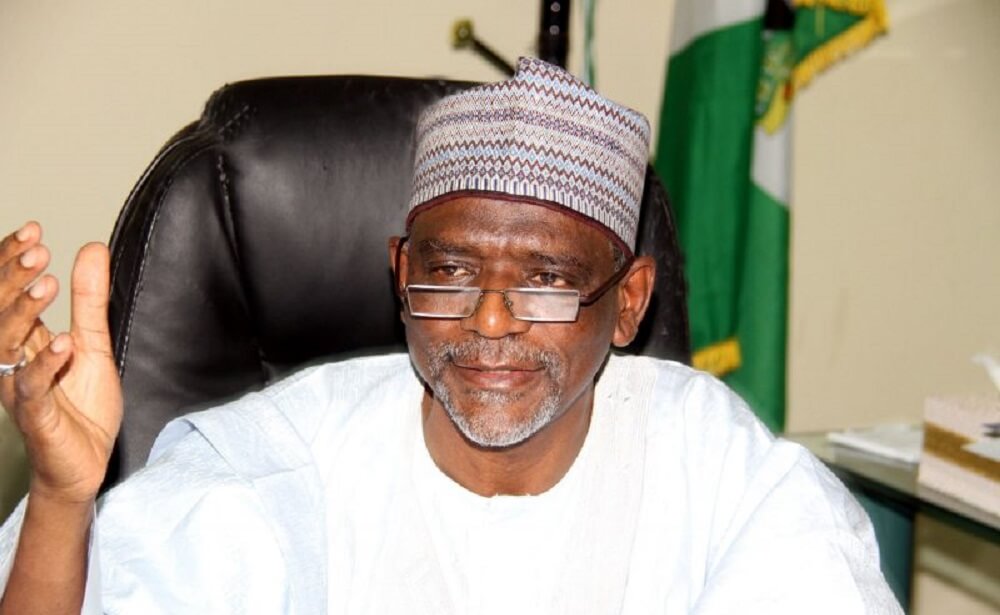
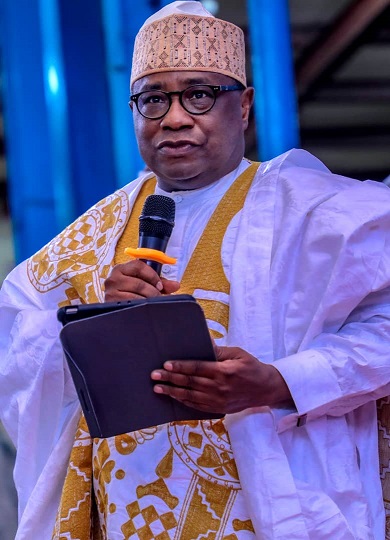
Speaking at the event in Abuja, Minister of Education Adamu Adamu said the dependence on foreign academic publications portends great danger to the nation’s education sector, adding that boosting indigenous authorship would address the problem.
The minister, who was represented by the State minister of education, Goodluck Nana Opiah, said: “The paucity of indigenously authored and produced tertiary level textbooks and related academic publications in the nation’s tertiary education institutions is a known fact over time. Nigeria’s tertiary education institutions became dependent on books published outside the country with the attendant consequences of the pressure on the demand for foreign exchange.
“It is equally worrisome that the quality of most academic publications in our country leaves much to be desired. It is therefore expected that nurturing the culture of quality authorship and the production of indigenous books will not only ensure the availability of relevant books in the diverse subject areas that take cognisance of our local environment and sensitivities but will also safeguard national pride and reduce the demand for foreign exchange,” he said.
He commended TETFund for establishing the Higher Education Book Development project to tackle the scarcity of tertiary level textbooks which has before now reached a crisis proportion.
Adamu hailed the Fund for putting in place the Technical Advisory Group (TAG), whose mandate includes collaboratively working with the agency to ensure Nigerian authors churn out quality books.
“TETFund Book Development Fund intervenes in the three key areas of publication of academic books and the conversion of high-quality theses into books, support for Professional Association Journals, and the establishment and sustainability of Academic Publishing Centres (APCs).
“It is worthy of note that so far, seventy-seven manuscripts have passed through rigorous review processes by distinguished scholars and are ready for publication as books. I want to assure this gathering that an additional thirty books will be presented before the end of this year under the TETFund sponsorship programme.
“It will be of interest to note that over 60 per cent of these books are to be published by the Academic Publishing Centres (APCs) established by TETFund,” the minister said.
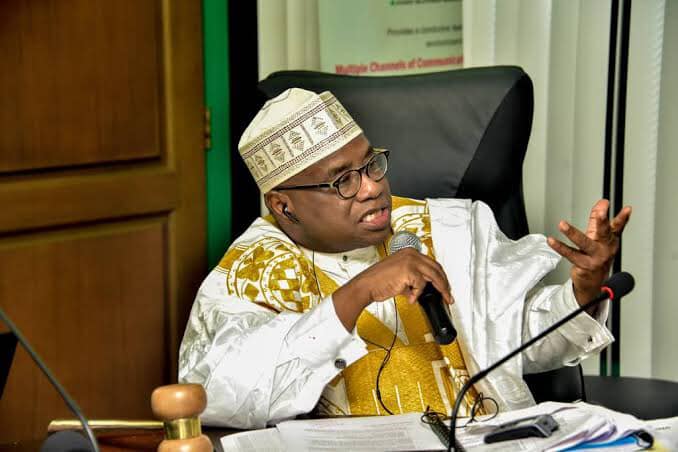
Executive Secretary of TETFund, Arc. Sonny Echono, who expressed delight over the quality of the ten books, said additional 30 books sponsored by the Fund would be unveiled before the end of the year.
He noted that the agency would sponsor the production of 50 textbooks in 2023.
“We have over 66 manuscripts; what we are unveiling today were published by only one publisher (one printing press) ….., by the time we unveil the remaining 30 in December, you are going to see all the authors cut across the three layers of our tertiary education institutions,” Echono said.
The TETFund boss also revealed that the Fund had provided support to ensure all the Academic Publishing Centres in the country become fully operational.
“There are seven of them across the country. When we came in March, only the University of Lagos academic publishing centre was fully functional and running, a few of them had little issues, some equipment, and other contractual issues, we have resolved all of them now.
“Four have been completed since the last few months, and the remaining we hope to finish by the end of September. The issue of operationalising them, making them self-sustaining is the debate we are having currently because we want them to run as a business enterprise and trying to create balance by focusing on academic publishing and being able to sustain themselves,” he said.
On his part, Chairman of TETFund TAG, Professor Charles Aworh, said 20 TETFund-sponsored textbooks were published in 2014 on different fields with wide acceptance from within and outside the country, adding that three of the ten new books unveiled today were from PhD theses.
He, however, called for more empowerment of the nation’s publishing centres.
“We are on course to publish 40 books before the end of the year, but the only challenge is the capacity of our universities to publish. Authors are ready to publish, manuscripts are ready,” Aworh said.
The high point of the event, which also attracted authors, academic staff unions and heads of education agencies, among others, was the public presentation of the TETFund-sponsored books, which include;1.Principles of Veterinary Surgery: A Concise Text for Veterinary Students 2. Fundamental of Chemistry 3. Fundamental of Public Finance 4.Java for Beginners and Web Design and 5. Programming for Beginners.
Others are 6. The Comparative Method and Civil-Military Relations 7. Fluid Mechanics and Hydraulics for Engineers 8. A Guide to Teacher Competence Evaluation 9. Financial Deepening and Economic Growth in Nigeria and 10. Motivational Factors and Teachers Efficiency in Secondary Schools.
The Minister of Education, Malam Adamu Adamu, said the Federal Government has sorted out issues with the Academic Staff Union of Universities (ASUU), adding that the ‘no-work-no-pay’ policy is the only condition delaying the truce.
The minister said this Thursday at the 47th session of the State House Briefing organised by the Presidential Communications Team in Abuja.
According to him, four of five unions in the tertiary institutions across the country had agreed to call off strike within the next week.
Regarding compensating students for time wasted from the six-month strike, the minister said ASUU should be held responsible for that.
The minister stated, “the affected students should ‘take ASUU to court’ to get compensated for the time wasted.”
The Federal Government and the Academic Staff Union of Universities (ASUU) meeting on Tuesday came to an end once more without a resolution.This indicates that the six-month-old lecturers’ strike at public universities will continue.
The Professor Nimi Briggs Committee and the striking academics met on Tuesday at the National University Commission in Abuja in the hope of breaking the deadlock.
Members of the Briggs renegotiation committee did not present any new offers to the table, according to a top member of ASUU who requested anonymity.
Instead, the committee begged the professors to cease their strike, the ASUU source claimed, assuring them that their issues would be addressed in the 2023 budget.
The discussion, which began at noon, reportedly lasted for about three hours without producing a resolution.
The acting Vice-Chancellor of Kaduna State University (KASU), Kaduna, Professor Abdullahi Musa Ashafa, has advised students of the university to be focused, hardworking and law-abiding in order to graduate in record time and with good grades and character.
Prof. Ashafa gave the advice yesterday while addressing the beneficiaries of the Need-Based and Merit Scholarship Award of Kaduna State Government. He said that though the university had quality academic and non-academic workforce to train them, they must play their part by studying hard, be disciplined and law abiding.
While thanking the Kaduna State Scholarship and Loan Board and the Government of Kaduna State for their consistent support to KASU students, he said students must not only read widely to learn, grow, understand and apply what they have learnt, but must also be prepared to take full advantage of opportunities that might come their way to succeed in every aspect of life.
Recently, the Kaduna State Government under Governor Nasir Ahmad El-Rufa’i awarded the sum of one hundred and fifty eight million five hundred and thirty thousand naira scholarship to best performing students of the university.
I read the justifiable frustration of many people affected by ASUU strikes, most of them undergraduates with a few months to graduate but were stalled by the strike. Some have already missed the chance to attend law school this year. This is quite unfortunate. It is a waste that saddens every sensible person.
However, there are other victims of the strike who are mainly forgotten. Many people talk as if the strike does not harm ASUU members. They say that ASUU members will get their withheld salaries back at the end of the strike. That’s largely true. But there are other implications for many of these members.
First, the younger ones in the profession — Graduate Assistants and Assistant Lecturers, their progress is truncated by strikes. These are people enrolled in our universities for their master’s and PhDs, respectively. A few of them get the chance to study abroad. Majority study at home. Every strike means an indefinite pause to their studies, careers, promotions etc.
Before you say that the strike is their choice, please understand how ASUU goes to strike: each chapter (or university) will hold a meeting to decide whether to embark on strike or not. Every member present has one vote, whether a Professor or Graduate Assistant. A simple majority carries the day. That means a Graduate Assistant may vote against the strike, but those in favour could win by a single vote. At the national level, the results from the chapters are collated and studied. If there are 100 chapters, the decision of a simple majority will be the final verdict. So if 51 universities vote for the strike against 49, that’s the end.
These strikes inevitably affect the professional development of every academic staff. Some couldn’t start and/or finish masters and PhDs on time. That delay will manifest up to their retirement. Strike halts promotion exercises of many universities. People who aspire to be professors in their forties might be delayed into their fifties despite their conferences, publications, etc.
Thus, the strike is not as viable an action as many people seem to think. The lecturer you insult for being an ASUU member might have voted against the strike from the beginning. They might have been equally affected by the strike in terms of studies or promotion.
And these are people who don’t even talk about their predicament. Instead, they simply suffer in silence.
Dikko Muhammad wrote from Umaru Musa Yar’adua University, Katsina. He can be reached via dikko.muhammad@umyu.edu.ng.
It is well known that members of the Academic Union of Universities (ASUU), the umbrella body of academic staff in Nigerian public universities, have been on strike for six months. Specifically, the strike began on February 14, 2022. Typical of the union of academics, it ensured that all means of avoiding the strike were exhausted before declaring the industrial action. Other university unions followed suit to avoid being left out in case ASUU emerged triumphant.
The issues are many, and not all of them have to do with money. And in fact, not all the funds mentioned in the dispute between ASUU and Federal Government will go to the pockets of ASUU members. No money goes to the union except the monthly dues it collects from members. It is not the duty of a trade union like ASUU to collect and disburse funds. That is the duty of university administrations.
Let me explain in plain language. But before I do, specific facts are vital.
Although the Federal Government has given licenses for the establishment of many private universities in Nigeria, only about six per cent of Nigerian university students are currently in private universities. More than 90 per cent of university students are in public universities owned by state and federal governments.
Another important note is that there are currently more supporting staff in public universities than operational (academic) staff. Consequently, there are three other unions in public universities apart from ASUU. People usually do not differentiate between ASUU and others, primarily due to Government propaganda. All of these unions are now on strike.
Nigerians may also wish to note that undergraduate students in federal universities do not pay a Kobo as tuition fees as long as they are Nigerians. The very little they pay as registration fees are for services like ID cards, games, hostel, etc.
The issues for which ASUU members are on strike are the same for which the immediate past government of President Jonathan Goodluck commended the union for being patriotic and selfless. One of them is the proliferation of public universities. Does it make sense that the same government that persistently complains of not having enough funds to run its existing universities is continuously establishing new universities in every nook and cranny of the country?
Revitalization of public universities for which an agreement was reached with Jonathan’s government to release N1.3trn in six instalments is what the FG has been using to misinform the public that ASUU is looking for too much money. Thus, any time the FG releases some paltry sum of N30bn, for example, it tells the world that it has given additional funds to ASUU. I think that is why some patriotic Nigerians once agreed to “donate the sum of N18b to ASUU” to call off its strike. This money does not go to ASUU. It is used to carry out projects by contractors appointed by FG or its appointee governing councils.
The only other thing that involves cash is the renegotiation of the 2009 agreement. In case you do not understand this, it is about the condition of service (SALARY AND ALLOWANCES) of academic staff, which the government promised to review every four years. But unfortunately, the promise has not been fulfilled for 13 years.
In 2020 after an ASUU strike, the Federal Government set up a committee to renegotiate with ASUU and other unions. The committee finished its work and submitted its report in May 2021. Regrettably, the report was dumped and, despite ASUU’s constant reminders and follow-ups, was only dusted when ASUU began its strike in March this year. That is when this government realized that it could not pay what was recommended by the committee. The same government set up another committee on the report it is unwilling to disclose.
As a student or parent, you are aware of all of the above if you have been following the engagement of ASUU with the Federal Government. I am only reminding you if you have forgotten.
I am particularly shocked to hear the Minister of State Labour, Festus Keyamo, calling on parents to appeal to ASUU to end the strike. The reason is that they cannot afford N1.2tr ASUU is asking for. When did ASUU ask for this amount? Is it the revitalization fund Keyamo is talking about which ASUU never requested the FG to pay in bulk? If that is the case, why does it have to take FG six months of ASUU strike to state it? Or is it the result of renegotiation for which the FG never called ASUU and said what it could pay? It just doesn’t make any sense.
What about other issues like the UTAS for which the FG has been meeting with ASUU and claiming to have conducted tests with xy results? Is Keyamo also appealing to parents to beg ASUU on it?
And who are these parents? Please let all the government officials involved in this ASUU/FG negotiation mention the number of children they have in public universities and the programmes they are following. Of course, I know the children of Mr President study in the UK. I wrote to advise him against it when his family celebrated the graduation of one of his daughters in December 2019. Whether or not the advice of nonentities like me matters is a different issue. It is the ordinary us that cast the votes to elect him anyway.
Finally, let me remind Mr President that he has only less than a year to leave office. Unfortunately, nearly all his diehard supporters I know have been disappointed. This is mainly due to the people he entrusts with fundamental issues like Security and Education.
On the particular issue of ASUU and sister unions, Mr President seems to be overconfident in the Labour Minister, a southeast politician who was expecting you to anoint him to take over from you next year. When you refused to do it, one of them, who is also in your cabinet, stood before you in the last convention and accused you and your party of injustice. With that, can you rule out sabotage?
Mr President, please use the little time left to correct your mistakes and avoid making another regrettable blunder. Nigerians did not elect Ngige, Keyamo, Zainab or any of those. If not for you, these names would have long disappeared into obscurity. Please remember that most APC politicians who won the 2015 and 2019 elections, especially in the North, won because of you. So, the expectation is high, and the performance is dismal.
I hope Mr President reads this.
Professor Abdussamad Umar Jibia wrote from Bayero University, Kano. He can be reached via aujibia@gmail.com.
Looking at the reality and how uncertain the future of education is in this country, you, as a Nigerian, should get a solution for yourself. But unfortunately, even though education is a right, not a privilege, the biggest stakeholders (read: government) are not ready to facilitate smooth learning for the sons and daughters of the “common people.”
In Nigeria, public university teachers, otherwise known as ASUU members, have been on strike for over half a year, thanks to the government’s failure to listen to their demands. Don’t you think this could make some students forget the names of their respective departments after someday the industrial action is suspended?
In light of these, I honestly feel the urge to share the Indian Government online scholarship with every serious-minded Nigerian who studies—or wishes to study—at any of our strike-ravaged public universities here. The last date for the application for the scholarship is August 15.
Here are five quick reasons why you should apply for the scholarship as follows:
1. Unlike other scholarship schemes, this scholarship—which you can apply for via https://www.ilearn.gov.in/—is fully-funded. This means you do not have to pay even a dime as tuition or a part of it. In addition, you don’t have to know anyone to apply or get it.
2. You only need a good mobile device (preferably a computer) with a good Internet connection to study. This indicates that you do not have to undergo the stress of boarding a flight from Nigeria to India, although it would be a pleasure to go overseas for your study.
3. The word “strike” might not exist in the dictionary of Indian universities. Therefore, one will have hitch-free academic sessions and most likely graduate on time. Moreover, the duration of some bachelor’s degree programs, as indicated on the application portal, is three years.
4. If you are one of the successful applicants, you will get the opportunity to study at some of the best universities in India, like Lovely Professional University, the Indira Gandhi National Open University and so on. The certificates to be obtained will be widely recognised. So, don’t panic over the recognisability of your results after graduation.
5. Unlike here in Nigeria, where you cannot apply for two or more different courses in one university when registering for the Unified Tertiary Matriculation Examination (UTME), there are universities on the list of eligible institutions for the scholarship that okay an applicant to apply for more than one course. An example of such a university is the Indira Gandhi National Open University.
Please hurry up and apply before the deadline, as this is an opportunity that should never escape your notice.
Muhammad Sabiu is a reporter for The Daily Reality and lives in Bauchi State. He can be reached via sabiucnd@gmail.com.
On my return in April 2012, I reported to my Vice-Chancellor, Prof. Abubakar Adamu Rasheed. In a moment of radical inspiration, he asked me to submit every publication and activity in communication to the HoD of Mass Communication, the late Dr Balarabe Maikaba, for possible recommendation as a professor of Media and Cultural communication. In the meantime, a position for a professor was created in the Department of Mass Communication to accommodate my presence.
I was surprised at this as I thought once you are a professor, you stay that way without any addition! The then Dean of the Faculty of Social and Management Sciences, Prof. Adamu Idris Tanko, also welcomed the idea. Dr Balarabe Maikaba wrote a supporting letter. I put in the application and submitted all the papers I had in the new area for external assessment.
In January 2013, I received a phone call from my Vice-Chancellor informing me that assessments of my publications sent out months earlier had returned positive. Therefore, I have been appointed Information and Media Studies professor with effect from October 2012. There was only one wonderful caveat: I was to relocate to the Department of Mass Communication from the Department of Science and Technology Education, where I was then the Head of the Department. This relocation was the most significant move in my academic career. The day I received that letter counted as one of the happiest of my entire life.
I suddenly realized that my earlier desire to be in the Faculty of Science was to become a research scientist. Now, 32 years later, I have become a research social scientist while retaining my scientific focus. Allah truly blessed me. The journey to the first professorship took 17 years (1980-1997), while the second took 15 years (1997 to 2012).
I handed over the Department of Science and Technology Education on April 25 2013, symbolic of my birthday. My new Department and the Faculty overwhelmingly welcomed me when I formally reported on April 26 2013. Even more remarkable, the Communication Studies fraternity also welcomed me – apparently, they have been keenly following my what one calls ‘revolutionary forays’ in media studies.
It was thus an honour to be made a member of the Governing Council of the Association of Media and Communication Researchers of Nigeria (AMCRON) and a member of the Association of Communication Scholars & Professionals of Nigeria (ACSPN). It was humbling to be in the company of communication giants such as Idowu Akanbi Sobowale, Ralph Akinfeleye, Lai Oso, Umaru Pate, Nosa Owens-Ibie, Hyginus Ekwuazi, Victor Ayedun-Aluma, Eserinune McCarty Mojaye, Abiodun Adeniyi and many wonderful others. It was always a pleasure to meet at various conferences and workshops and appreciate each other.
I was given a huge sparkling brand-new office with all the frills! I have already been teaching Management Information Systems (MIS) in the Department of Business Administration of the Faculty for almost ten years. Additionally, I had been a ‘part-time’ staff of the Mass Communication Department for seven years, teaching and supervising students. So, I was not new to the faculty. For me, being in the Department of Mass Communication was the absolute way to chill out my career to retirement in 2026, in shaa Allah.
So, am I the only ‘double’ professor in Nigeria? It depends on the context. If you are referring to two professorships in two different disciplines (which is the actual context of a double professor), then yes, according to the NUC’s Directory of Full Professors in the Nigerian University System (2017), I am. However, being a professor at two different universities does not count. The second professorship has to be qualified through an external assessment of scientific works in the discipline, a process my Vice-Chancellor at the time and Chairman of the Appointment and Promotions Committee of the University rigorously followed.
Is this the same as Emeritus Professor (some have referred to me as such)? No. An Emeritus Professor is an honorary title given to a professor to show respect for a distinguished career and who has retired (critical qualifier) from the university successfully and honourably. It is neither a right nor automatic. It is a privilege (just like the professorship itself), given at the discretion of the university to an outstanding professor (mostly the university one is retiring from, although an appointment to such position could also be made to the retiring professor in a different university).
One cannot be appointed an Emeritus until they have retired (whether before or at the age of retirement). It is usually conferred (at a ceremony) to those the university feel that despite retiring, they can still add value to the academic programs of the university, either through teaching, research, supervision or other leadership functions. It often attracts a token stipend (not salary), and the office the professor retired from. It is also for life – meaning he stops being an Emeritus when he shifts to the other side of the universe the James Webb Space Telescope would not be able to locate! Here is a list of Emeritus Professors in Nigeria (updating).
How common is double professorship generally? Rare. A limited discussion was held on Quora, where a few examples from some American universities were cited. For instance, Andrew Gelman is a professor of statistics and political science at Columbia and a professor of statistics at Harvard. He has no political science degree at all. His first degree was in physics, and his graduate work was in statistics. He has received the Outstanding Statistical Application award three times from the American Statistical Association, the award for the best article published in the American Political Science Review, the Mitchell and DeGroot prizes from the International Society of Bayesian Analysis, and the Council of Presidents of Statistical Societies award. Have a look at this blog to know how he came to be occupying those two chairs.
This answers the question of whether I should be a professor in Mass Communication without a degree in Mass Communication. At the professorial level, it is your output that matters. My own site might satisfy one’s curiosity about what the fuss is all about. As my Vice-Chancellor at the time, Prof. Abubakar Adamu Rasheed, pointed out when my case was presented in 2012, if anyone is a professor of History and made enough contributions to the field of Physics, they can also apply and be assessed as a professor of Physics.
Oh, I almost forgot. Two professorships? Yes. Two salaries? Unfortunately, no! You get only one salary.
Prof. Abdalla Uba Adamu wrote from the Department of Information and Media Studies, Bayero University Kano, Nigeria. He is, among many other things, the former Vice-Chancellor of the National Open University of Nigeria (NOUN). He can be reached via auadamu@yahoo.com.
Like a bolt of lightning, a key to open the freedom door dropped literally on my lap through the radio. In 1996 the government of Kano (Nigeria), where I live, was battling with Hausa creative fiction and public morals. One after the other, Islamic sheikhs came on the radio and condemned newly emerging Hausa creative fiction writers as being responsible for poor attention span in schools (and subsequent poor grades) and immorality. They did not indicate how many of the novels they had read, though. Their condemnations caught my attention, for it seems there was a reading culture among Hausa youth – something public culture kept lamenting as lacking among youth.
Reading culture is, of course, an environment where reading is championed, valued, respected, and encouraged. BUT it seems that the reading culture in Kano meant reading school textbooks (if available) and passing examinations. Reading culture? James Hadley Chase, Harold Robbins, Irvin Wallace, Agatha Christie, Denise Robbins, Nick Carter, Joan Collins, Wilbur Smith, et al., anyone? So why not Ado Ahmad, Balaraba Ramat, Ɗan Azumi Baba, Bilkisu Salisu Ahmed Funtuwa? All the objections against Hausa literature were based on the baseless Media Effects Theory, which believes that mass media influences the attitudes and perceptions of audiences.
I, therefore, decided to delve into this ‘problem’ further. It was to be a bridge between cultural studies (popular culture) and education (reading culture).
I eventually traced the production of Hausa novels to the City Business Center in the city of Kano under the proprietorship of Alhaji Abba Lawan Maiunguwa, a childhood friend. This led to Ado Ahmed Gidan Dabino, unarguably the most successful of Hausa novelists, and the forging of a life-long friendship based on respect. I spent about two years in the field, talking, recording, and unarchiving writers, critics and fans of the Hausa creative fiction.
The writers included Ahmad Mahmood Zaharadden Yakasai, Yusuf Muhammad Adamu, Ibrahim Saleh Gumel, Ɗan Azimi Babba Cheɗiyar Ƴan Gurasa, Aminu Abdu Na’inna, Badamasi Shu’aibu Burji, Hamisu Bature, Aminu Hassan Yakasai, Abdullahi Yahaya Mai Zare, Bala Muhammad Makosa, Bashir Sanda Gusau, Bala Anas Babinlata. Female authors of the period included Hauwa Aminu, Talatu Wada, Zuwaira Isa, Safiya A. Tijjani, Binta Bello Ɗanbatta, Binta Maiwada, Jummai Mohammed Argungu Karima Abdu D/Tofa, Bilkisu S. Ahmed, and the most outstanding of them all, Balaraba Ramat Yakubu.
Along the line, I developed the Hausa hooked glottal sound characters (Ƙ, ƙ, Ɗ, ɗ, Ɓ, ɓ) to help in proper Hausa writing on computer word processing programs using Fontographer software. But that is a story for another day. Next, I went to my dad, Muhammadu Uba Adamu (Kantoma), discussed with him my new-found direction and sought his blessings. He readily approved. Not surprising, considering he had always been a radical on his right. Further, my early contact with literature was from his library, as he studied Political History with English Literature as a minor. His approval, and even later, endorsement, gave me courage.
Finally, I summoned enough nerve (remember, it was not my field, and I was aware those ‘in the field’ jealously guard their turf) to write an article and send it to Ibrahim Sheme of the New Nigerian Weekly newspaper. It was titled “Hausa Literature in the 1990s”. It was published in their April 24 and May 1, 1999 issues. It created a tsunami of a reaction.
Unbeknownst to me, the debate about the merits (or lack of) of Hausa creative fiction had run its course in various Hausa language newspapers and magazines. Hawwa Ibrahim Sherif fired the first salvo in an interview with Ibrahim Sheme, published in Nasiha, on September 6 1991 (some eight years before my own article).
Following on from her views (and she was a writer herself), two camps emerged – those who did not see any merit in the novels, and those who believed in them, the latter, perhaps understandably, was made up of mainly authors themselves, such as Ado Ahmad Gidan Dabino, Yusuf Adamu, Kabiru Assada, etc. In 1998, Novian Whitsitt, an American student, even submitted a PhD thesis on Hausa creative fiction with a focus on Hajiya Balaraba Ramat Yakubu. His thesis was titled The Literature of Balaraba Ramat Yakubu and the Emerging Genre of Littattafai na Soyayya: A Prognostic of Change for Women in Hausa Society.” It was submitted to the African Studies Program University of Wisconsin-Madison.
You could therefore imagine the fire I came under; An Educationist was venturing into Hausa literary studies. Some accused me of being an ignoramus who knows nothing about Hausa literature (true), and others accused me of encouraging immorality (not true).
To get rid of my accused ignorance, I adopted two methods – both facilitated by my being a true believer in science and its methods. The first was rooted in the ethnology of Hausa cultural production. This approach was based on Victor Turner’s exposition of the ‘anthropology of experience’, itself based on Wilhelm Dilthey’s conception of ‘what has been lived through’. The approach enables the exploration of how people actually experience their culture and how those experiences are expressed in forms as varied as narrative, literary work, theatre, carnival, ritual, reminiscence, and life review. To get a closer look at the cultural production, it was necessary to be embedded in the process.
I started by identifying what was more or less a Bohemian cluster of Hausa fiction writers hanging out at City Business Center, Daneji, Kano city, along Sabon Titi. Then, I embedded myself into their cluster and observed what they were doing – inspiration for their stories, discussing plots for stories, typing, artwork, printing, marketing, etc. This went on for almost five years from 1998. As a result, I gained deep insights into their creativity and concerns. I also read quite a few of the fiction they produced to gain a more immersive experience.
In this process, I did not rely on secondary data but became a primary data gatherer myself. This came in good stead much later when I submitted a paper to a journal based in France. The editor wanted me to provide references for some of the narrative encounters. I pointed out that I was the reference and used Turner’s field study framework as a basis because I was there. The editor accepted, and eventually, the paper was published.
For the second method, I launched myself into a self-study of Critical Theory from the roots: to reflect on and critique society through literature. There were four varieties of such theory: new criticism, poststructuralism, psychoanalytic criticism, and Marxist theory. I delved into the first two, deeming that the other two do not apply to my data. I became a student of Jürgen Habermas and his “Structural Transformation of Public Sphere”, in which I see Islamicateness in expounding the boundaries of the public sphere. Stuart Hall and his critical works in cultural studies provided another roadmap to understanding the reception of media texts. Marshall Hodgson’s essay on the idea of “Islamicate” societies seemed to mesh perfectly well with my own sites of contestation of media production, distribution and consumption. Anthony Giddens and his Structuration provided an excellent introduction to Agency.
I thus refused to cage myself within Nigerian Hausaist (for which I am not one) delineation of Hausa studies into apparently mutually incompatible divisions of Literature (Adabi), Language (Harshe) and Culture (Al’ada). I said ‘apparently mutually incompatible’ because if you are versed or specialized in one, you are not expected to know much about the other. In other words, you should ‘stay behind the yellow line’!
And so, the battlelines were drawn, and for almost five years to 2004, New Nigerian Weekly and Weekly Trust pages were awash with what Ibrahim Sheme referred to as The Great Soyayya Debate. I was in the thick of it. But, since the debates were on pages of newspapers and therefore meant for the general readership, I focused on simply defending the right to write rather than the morals of the contents (for which, in my opinion, show cleanliness) or the grammatical sophistication of the writers. They have a right to write and thus write the rites to right the wrongs they perceive in society – after all, the genre is referred to as ‘adabi’ (reflection).
Only four people at Bayero University believed in what I was doing. Isma’ila Abubakar Tsiga, Sa’idu Ahmad Babura, Abubakar Adamu Rasheed and Ibrahim Bello-Kano – all from the Department of English and European Languages. Ibrahim Bello-Kano, or IBK as he is popularly referred to, was the Seminar coordinator in the Department of English and European Languages in 2001. He invited me to present a paper at their Departmental Seminar, which I agreed to and presented in January 2001. It was the first academic presentation of my research. I was understandably nervous because I was presenting something on new terrain to people fully trained and versed in it. However, the paper’s title, Tarbiyar Bahaushe, Mutumin Kirki and Hausa Prose Fiction: Towards an Analytical Framework, introduced something to the polemics besides just moral indignation.
However, soon enough, the massive success of Hausa fiction authors (despite scathing criticism from academic and public culture) emboldened them enough to migrate to the emergent Hausa video film industry. If there is one person to be credited with creating the Hausa film industry, it was a writer, the late Aminu Hassan Yakasai. He was both a novelist, a scriptwriter and a Hausa soap opera star. He and his collaborators, such as Bashir Mudi Yakasai and Salisu Galadanci, launched the first Hausa video film, Turmin Danya, in March 1990. This predated Nollywood’s Living in Bondage in 1992. Sunusi Burhan Shehu, a novelist, established a Hausa film magazine, Tauraruwa, and in a regular column in August 1999, created the term “Kanywood” to refer to the Hausa film industry. It is the first reference to a film industry in Africa and predated “Nollywood”, which was coined in 2002 by Norimitsu Onishi in a New York Times report.
In 1999 Sarauniya Films Kano released the catalytic video film that literally shaped the direction of the industry. It was Sangaya. It was, like most Hausa youth literature, mainly a love story. It was not the story that was significant about the film, however, but its soundtrack with catchy song and dance routines backed by synthesized sound samples of traditional Hausa instruments such as kalangu (talking drum), bandiri (frame drum) and sarewa (flute). The effect was electric on a youth audience seeking alternative and globalized—essentially modern—means of being entertained than the traditional music genre, which seemed aimed at either rural audiences or older urbanites. It became an instant hit. Indeed, the success of Sangaya was as momentous in the history of the Hausa video film industry as Living in Bondage was for the southern Nigerian video films. The Hausa video films that subsequently emerged were predominantly based on cloning Bollywood films and production characteristics – love triangles, gender rivalry, and choreographic song and dance routines. At least until 2007, when the system crashed after the leakage of a private steamy sex video of a popular actress. The entire entry was labelled bad, just like the literature industry. A new censorship regime was instituted that made film production difficult.
Internet became widely available late 1990s, and by 2000 it had become affordable. Before that, we had to rely on the National Universities Commission (NUC) switchbacks to access it. So when Nitel started offering it, we jumped on. Yahoo! Groups was launched in early 2001. A series of discussion boards formed the earliest reiteration of social networks, predating Facebook, which was created in 2004 but became available only in 2009 to us. Seizing the opportunity to create lively discussions, I formed three groups on the Yahoo! Groups platform: Finafinan Hausa, Littattafan Hausa, and Mawaƙan Hausa, from August 31 to November 15 2001. Finafinan Hausa was by far the liveliest.
By 2009 when the discussions whittled away, there were almost 25,000 postings on the board. Other boards did not fare too well. Further, between 2000 to 2009, I chaired thirteen Hausa video film award ceremonies, four of which were organized by Yahoo! Groups. The discussion board really popularized many of the Hausa video film stars. The University of Frankfurt in Germany even dedicated a Library Officer to join the groups and harvest all the comments as examples of public discourse on Hausa popular culture.
All these did not prevent me from participating in educational alphabet soup agency activities, so I was still rooted in Education. Criss-crossing the north, training education officials, writing reports no one read, and working out the next activity. Along the process, I became Head of the Department of Education – rather reluctantly, for I was enjoying fieldwork in cultural production and educational alphabet soup interventions (the latter helped to put additional plates on the table!).
In 1993 the late Prof. Mike Egbon of the Department of Mass Communication, Bayero University Kano, visited my office and asked me to help supervise his PhD student who was working on the transfer of communication education curriculum from the US to Nigeria. Between 1991 to 1992, I was a Fulbright Senior Research Scholar at the Center for Studies in Higher Education, University of California, Berkely. My work focused on the transnational transfer of education from the US to Nigeria, resulting in a book published in 1994 in New York. It was titled Living on a Credit Line: Reform and Adaptation in Nigerian University Curricula. It was my work in the US which I had been discussing at various places within the campus that attracted Mike Egbon, and he appointed me as co-supervisor and internal examiner to his student. Mike Egbon, then, was the one who opened the door for me to enter the Mass Communication department.
While all this was happening, a conference on Hausa video films was held in one of the northern Universities. The conference condemned the films, just as earlier on, the writers of Hausa fiction were also condemned. Many of these writers, using the cheap availability of video cameras, had transitioned from Hausa fiction to Hausa films and, in the process, attracted a lot of mainly non-indigenous Hausa into the industry. But because these elements use the Hausa language in their films and rely virtually exclusively on cloning Hindi cinema, all Hausa films were tarred with the same paintbrush. So the focus of the conference held somewhere in the north was to confirm how bad the films were from cultural perspectives.
However, in August 2002, a group of academicians and members of the Hausa entertainment industry in Kano got together to discuss the state of research on Hausa popular culture and media technologies, with particular reference to the Hausa films. It was meant to be a brainstorming session with various inputs from members overshadowed by the then-current crisis in the non-marketability of Hausa films due to condemnations from the public culture. Further, it was noted that there had been no systematic study of the phenomena from academic perspectives, at least by the practitioners themselves. A strong observation at this meeting was the increasing role of media technologies in popular culture and how Hausa urban communities are refining the concept of entertainment among the Hausa.
The group noted, with concern, a lack of local input into the systematized pieces of research showing the relationship between Hausa culture and popular media as a vehicle of cultural preservation and transmission. In this regard, it was noted some of the most significant advances in this area were made by our foreign Hausaist colleagues. All these researchers have published extensively on Hausa culture and language, and their works are heralded as authoritative accounts of Hausa popular media.
Thus, while the group acknowledged the immense contributions made by these foreign researchers, it saw these researches as challenges to stimulating local scholars into exploring other terrains of popular culture among the Hausa. As a result of these observations, the group suggested a series of activities aimed at creating collaborative opportunities for research between local researchers, practitioners of popular culture (literature, music, film, indigenous knowledge etc.) and international partners. A committee was formed to articulate all these into a conference, and I was made the Chairman of the Committee.
Eventually, on 3rd to 5th August 2003, we held the first-ever international conference on Hausa films in Kano, with the theme of Hausa Home Videos: Technology, Economy and Society. It was hugely successful, attracting presentations from US and Germany in addition to both local film practitioners and academicians. I, Yusuf Adamu and Umar Faruk Jibril edited the papers and a book with the same title as the conference was published in Kano in 2004. The resolution of the conference was to establish a Center for Hausa Cultural Studies. This was meant to be a think tank that would hold monthly events to promote Hausa cultural production in the internet age.
Later, tired of the constant criticisms against me from the film industry despite all my efforts (they believed that by focusing on culture, I was disparaging their art), I shifted my ethnographic focus to music, with a particular focus on the Rap genre which was trending at the time. This community of cultural producers – K-Boyz, Kano Riders, Lil’ TeAxy, BMERI, ClassiQ, Dr Pure, G-Fresh, Haddy, K-Arrowz, the late Lil’ Amir, etc. – proved more welcoming than filmmakers.
By 2004 I had attracted the attention of some colleagues overseas, particularly Brian Larkin in the US, Graham Furniss in the UK and Heike Behrend in Germany. I even wrote a visa approval letter for Heike Behrend, then Director, Institute of African Studies, University of Cologne, Germany, to come to Nigeria and conduct fieldwork on Hausa films. Heike Behrend was to later “adopt” me as her son. She is a brilliant ethnologist with a field experience in Kenya and Uganda, as detailed in her excellent book, Incarnation of an Ape. An autobiography of ethnographic research (2020), which itself is a textbook on the anthropology of experience. As she stated in a YouTube introduction to the book, “it was about reversing the perspective and showing how those I meant to ethnograph ethnographed me.”
Thus, when Graham Furniss was asked to nominate participants for a “Seminar on Media in Africa” in Nairobi, Kenya, organized by the International African Institute in August 2004, he nominated my name, and I was accepted. Again, in the same year, he was invited to Johannes Gutenberg University, Mainz, Germany (plainly referred to as the University of Mainz) to participate in the 8th International Janheinz Jahn Symposium “Creative Writing in African Languages: Production, Mediation, Reception”. It was to be held at the Centre for Research on African Literatures, Johannes Gutenberg University Mainz, 17-20 November 2004. Graham had too many engagements for the period and suggested to the organizers that I should be invited – something they accepted. I received an invitation to participate in the conference.
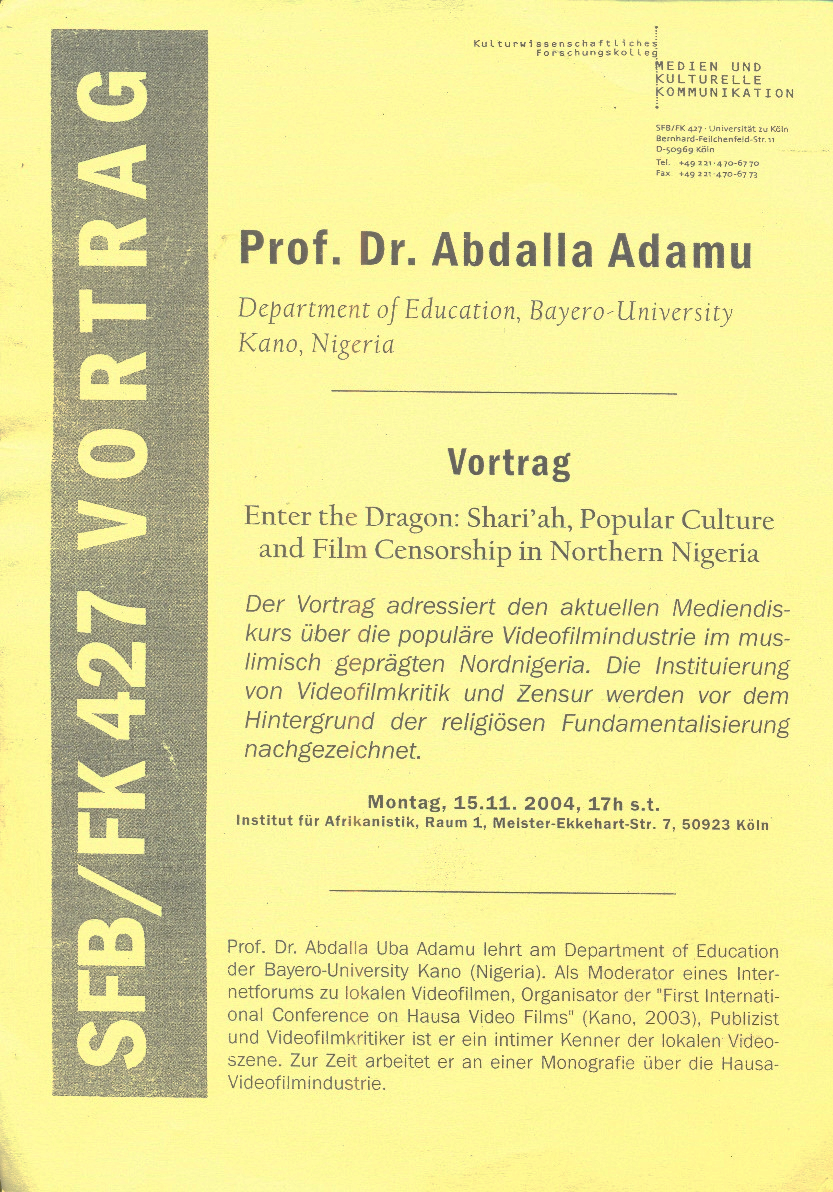
At the first event in Nairobi, I met Heike Behrend, who was also invited, and during an off-conference interaction over a cup of expresso (her favourite rendering of coffee!!) I informed her of my coming trip to Mainz for a conference. She immediately extended an invitation for me to come to the University of Cologne on my way to Mainz and present a seminar to doctoral students on any topic I like. This I did on November 15 2004 and presented a paper to the students. It was titled “Enter the Dragon: Sharī’ah, Popular Culture and Film Censorship in northern Nigeria.”
Vortrag
Note, from the poster, that I was still in the Department of Education. When I returned to Nigeria, I met Dr Gausu Ahmad, then Head of the Department of Mass Communication BUK, who insisted on the paper being presented at their own Departmental Seminar. Before that, I was already teaching Advanced Research Methods to postgraduate students and Online Journalism at all levels. Further, I was already working with a doctoral student in the Department. Unknown to me, Dr Gausu had already recommended my employment as a Part-Time lecturer in the Department of Mass Communication. A letter to that effect was eventually sent to me in November 2005. Earlier, the Department had requested my transfer from Education, but the Vice-Chancellor at the time refused.
The visit to Germany in 2004 was the beginning of a series of travels to various universities as a visiting lecturer/professor/guest speaker etc., in media and cultural production. These included the US (University of Florida, Gainesville; Rutgers State University of New Jersey; Barnard College, Columbia University), UK (School of African and Oriental Studies), Switzerland (University of Basel), Germany (Freie University, Berlin; University of Mainz; University of Freiburg; University of Cologne, University of Hamburg; Humboldt University), South Africa (University the Witwatersrand), and Cameroon (University of Yaoundé).
In November 2008, I was once more invited to Germany for an event. After my event at the University of Hamburg, one of the participants, Nina Pawlak from the Department of African Languages and Cultures, University of Warsaw, Poland, approached me and asked if I would like to visit Poland for three months as a Visiting Professor. I delightfully accepted. The funding was to come from the European Union under the program of The Modern University – a comprehensive support program for doctoral students and teaching staff of the University of Warsaw as part of Sub-measure 4.1.1 “Enhancing the educational capacity of a higher education institution” of the Human Capital Operational Programme, of the EU. After all the paperwork was done, I was eventually offered the Visiting Professor position at the Department of African Languages and Cultures, University of Warsaw, Poland, from March 1 to May 31 2012. I taught two courses: Transnationalism and Identity in African Popular Culture and Oral Traditions in Local and Global Contexts.
Prof. Abdalla Uba Adamu wrote from the Department of Information and Media Studies, Bayero University Kano, Nigeria. He is, among many other things, the former Vice-Chancellor of the National Open University of Nigeria (NOUN). He can be reached via auadamu@yahoo.com.
Right, it is time to address this issue. I am blessed and honoured to have variously been acknowledged and hailed as a ‘double professor’, ‘dual professor’, the only one from northern Nigeria, etc. How’s that even possible?
The first professorship was in 1997 (Science Education and Comparative Higher Education, to give it its full title), and the second one was in 2012 (Media and Cultural Communication). Two totally different disciplines. I delivered an inaugural lecture for each in 2004 and 2014, respectively. Further, I am both a Member of the Nigerian Academy of Education (MNAE) and a Member of the Nigerian Academy of Letters (MNAL) – a cross-over that is quite rare in Nigeria. A close friend says I am nuts to have two professorships. It’s okay; we used to call him nuts, too, when we were kids. I admit, though, it does take a bit of nuttiness. However, the whole ‘double professor’ thing came about by happenstance, thanks to the innovative, courageous Prof. Abubakar Adamu Rasheed, Vice-Chancellor, Bayero University Kano from 2010 to 2015, now Executive Secretary, National Universities Commission from 2016. Here is the whole backstory to the opera in one season of three episodes!
S01EP01: Liftoff
As a senior high school student, I had a target: to become a professor by 40. Given that I was born in 1956, that gave me up to 1996 to do my gig, exit stage left and hopefully seek new directions. Right from elementary school, I had wanted to work in a university after a visit to the house of then Malam Sani Zahradeen in 1966 on the old campus of Bayero University. Awed by the splendour of the house (and quite frankly, the wonderful breakfast I was offered), I decided right there and then the University will be my abode. I was ten at the time.
After going through the grind of schooling and finishing at Ahmadu Bello University, a degree in Science Education (Biology/Physiology) saw me getting employed as a Graduate Assistant in July 1980 at Bayero University Kano. The clock had started ticking – I had seventeen years to contact. I felt like I was in a cryogenic sleep capsule bound for a planet in the Betelgeuse star system, a mere 500 light-years from Earth. A confession, though. Education was not my preferred choice of Faculty at employment. It was the Faculty of Science. Made attractive by a blind ambition to become a research scientist – not a teacher. Plus, many top-notch teachers from the Department of Biological Sciences, ABU, my alma mater, had migrated to BUK during the period. I wanted to continue being their students because of their brilliance (fondly remembered, included Dr Shotter). But as fate would have it, I was employed in the Department of Education.
I did everything necessary to progress through the system, getting a DPhil at Sussex (courtesy of the Commonwealth Scholarship Commission) and a Fulbright Senior Scholar residency at the University of California, Berkely, US. I also became a Resident Fellow at the Rockefeller Foundation’s Bellagio Center near Lake Como in Italy. Beautiful view, wonderful neighbourhood, made only grisly by the fact that the Italian dictator Benito Mussolini (1925 to 1945) and his wife (or was it mistress?) Claretta Petacci were executed at Dongo, near the Lake, in 1945. A gruesome tourist attraction whose grimness does not take away the timeless beauty of the area.
Finally, after submitting all the necessary papers for assessment, I was conferred first Associate Professor of Science Education and Comparative Higher Education in 1994, and with more publications, full tenured Professor of Science Education in 1997. I was 41. Missed the mark by a year. Due to the weird BUK politics at the time, the professorship was only announced in 2001 but suitably backdated to its proper date, October 1997. I immediately wanted to give my inaugural lecture, but I was asked ‘join the line’ of others who were to present – all six of them. Eventually, I was asked to come and give mine after three years. I did so on April 24, 2004. It was the seventh in the university. I had wanted it on my birthday, but considering that April 25, 2004, was a Sunday, I settled for Saturday.
When I reached the point of being promoted and awaiting results back in 1996, I found myself interrogating the rest of my life. At that time, university lecturers retire at the age of 65. So that meant I had about 25 years to retire in 2021 – a futuristic date then. I had also crossed all the t’s and dotted all the i’s in Education, at least as far as I could see. I found myself deeply involved in alphabet soup agencies – you know, USAID, DFID, UNICEF, NPEC, UBEC, WB, etc., mostly talking loudly and saying nothing. I simply can’t see myself day in and day out enmeshed in this process of eventually recommending things to the government through reports nobody bothered to read. If I didn’t find something to do, there was every chance of me becoming truly nuts.
Prof. Abdalla Uba Adamu wrote from the Department of Information and Media Studies, Bayero University Kano, Nigeria. He is, among many other things, the former Vice-Chancellor of the National Open University of Nigeria (NOUN). He can be reached via auadamu@yahoo.com.