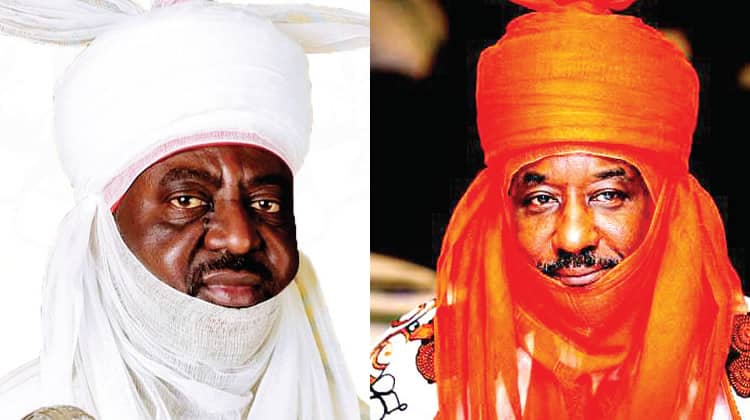
SLS

Battle of words: SLS, IBK, Kperogi and our collective suffering

By Bin Isah

it has been a long week of debates, discussions, rejoinders and exchanges between and among the fans of three important personalities from Northern Nigeria: Emir Muhammadu Sunusi (popularly known as SLS), Prof Farooq Kperogi and Prof Ibrahim Bello Kano (IBK).

The truth is that, the wordplay of the writers provokes the fancy of readers, and entices the sense of the intellectual minds. However, the real deal rests upon the substance of the game and the appeal of the persuasions. IBK has truly got it right in the wrong way, while Kperogi still holds the ball in his court.

In fact, Kperogi didn’t simply wake up to set a fire upon the super-luminous star of the nation, SLS. He was called to the pen. SLS made a reel of remarks that smelt of all personal proclivities to self-importance, interest and power. Kperogi read the remark in its pompous tones, which cumulatively ran down the bad road of nonchalance to national concern.

Kperogi was on fire because SLS seemed to have put the national concern lower than his personal interest. Not only that, the remark also showed that SLS had forgotten that the precarious dance of the national economy which he found uninteresting was the product of his biblical belief in neo-liberal economic theory that he has preached to the government for a while. Remove subsidies, privatize, and add more tax!

Actually, the battle of words would not make SLS safe from the wildfire, because the matter is beyond words and vocabularies and lexicons of English frenzy. It’s deeper to be reduced into a rejoinder that boils down to rhetorical bigotry, jokes and indifference to real issues. The matter reveals what SLS represents as a national treasure, a facade. This is man who considers himself to be a gift to Nigeria, who has a magic wand to solve its problems, yet a self-centred saint.

To be fair to Kperogi, he is not worse than SLS in deployment of abusive arsenals when engaging a person. SLS is expert at dropping bombs on the personality of his worthy critics, ripping them apart, with words so vile of his royal roots. But, this is what a pen power induced into a person with a sense of superior opinions. Remember his unprintable phrases on Sheikh Jafar Mahmud Adam in his “Engagement with Jafar Mahmud Adam”. In this line, Kperogi can even be holier than SLS.

The case that awaits SLS is that of his undiluted support for policies that proved difficult to yield any results to the nation. I don’t know to what school of economics theorists he belongs, but they are not the best. At least, when a solution is given, and the solution put people into the mud of another worse problem, you propose for another solution not to insist on the first solution which had failed to work.

Because, any economic solution that would lead to economic depression, losing jobs, closing of businesses, high cost of living, poor standard of life, and plunging millions of people into abject poverty, that solution has become a terrible problem. A problem which requires a revision, a change in thoughts, in ideas, and in actions. However, SLS as a lover of IMF recommendations and brutal capitalism, he sees no problem with that line of trial, and no any other solution can be given but an embrace of patience and hardship.

I’m not an economics expert but we have been taught that economics is for the creation and management of wealth and resources in a way that a nation and its people get better, do better and produce better. It’s about the betterment of people, not deprivation and exploitation for the benefit of the few. We know SLS is an economist, at the same time, a business man, and thus, a profiteering hustler around the national wealth. What do you expect?

A support to Tinubu’s economic policies over which the nation is weeping is a sin. It’s more of a moral abuse than an intellectual view. In fact, SLS as an intellectual, is a betrayal to public intellectualism. The basic work of a public intellectual is to help the poor people against the powerful, not the powerful against the poor. Only that we know SLS has been a friend to the people in power, which may actually be a reason why he cannot but help them to succeed in their poor management of the nation. A friend in need is a friend indeed.

It’s not a hidden fact that he has no regrets for his romance with Tinubu’s iconoclastic antics of economic problematics. That’s not a problem! The remorse of SLS is that after all the sweetest sugars he added to their policies the government is still not taking him as a friend, is not treating him like a political-economic superman with paranormal powers to make things happen in a hush of the blink. This is the economic problem that disturbs the soul of SLS, not the national one. The government has used and dumped him like a homeless prostitute. Of course, it’s not fair. But, who cares? It’s a dinner with the devil.

It’s not about Kperogi, IBK, or the fans that worship the wonderful words around their altars. It’s about SLS and his public show of unpatriotism to the nation after he placed his back for the government to implement its illest ideas that inspire a brazen, merciless management of the country. Now, that the people he had provided a theoretical justification to their economic malevolence have abandoned him in his battle over the throne, and he now wants to throw them away along with the entire nation into a deep blue sea. What made Tinubu and his government better than the nation?

The man is for himself.

Bin Isah is a blogger who writes from Kano State.

Kano must have one emir—Falana

By Abdullahi Mukhtar Algasgaini

Prominent human rights lawyer, Femi Falana, SAN, has stated that Kano State must have only one king, following the Court of Appeal’s affirmation of this stance.

He noted that despite opposition from some quarters, the 16th Emir of Kano remains firmly in his position.

Falana made the statement during the 21st memorial of Chief Gani Fawehinmi, held in Lagos.

He was quoted as saying, “However, as lawyers, when we gather, we must speak the truth. Your Majesty, we congratulate you on your victory in the Court of Appeal.

“Opponents of your rule have claimed they will take the matter to the Supreme Court, but as a lawyer, I am confident that the law has already clarified that traditional matters are not within the realm of human rights. Therefore, one cannot claim human rights as the reason for challenging a traditional title.

“Additionally, the court has clarified that the federal courts do not have jurisdiction over traditional matters. Thus, if some of our colleagues are deceiving their clients and causing confusion in the country, the Nigerian Bar Association (NBA) has the right to intervene and caution them.

“Your Majesty, wherever they may go – to the Supreme Court or elsewhere – remain steadfast in your position. We must have only one king in Kano. We cannot have two Emirs in Kano, nor two monarchs in Rivers State. This confusion must end.”

JUST IN: Emir Sanusi holds Sallah Durbar in Kano despite police ban

By Uzair Adam Imam

The Emir of Kano, Malam Muhammadu Sanusi II, has held a Sallah durbar in Kano, defying a police ban on the event.

The durbar was held after the Emir led Eid prayers and a sermon at the Kofar Mata Jumu’at mosque.

Governor Abba Kabir Yusuf and other officials attended the prayers and durbar, which was held despite heavy rain flooding the usual Eid grounds.

The police ban had been criticized by the Governor, who argued that he had not been consulted as the Chief Security Officer of the State.

Meanwhile, the 15th Fulani Emir of Kano, Aminu Ado Bayero, observed his Eid prayer at the Nasarawa mini palace, as earlier announced.

The event was marked by the traditional durbar procession, which was held despite the police ban.

The durbar was a significant event in Kano, with many residents attending to celebrate the Eid festival.

NLC strike stalls court hearing on Kano emirate tussle

By Uzair Adam Imam

The ongoing strike by the Nigeria Labour Congress (NLC) and Trade Union Congress (TUC) has stalled the hearing on the Kano emirate tussle at the Federal High Court in Kano.

The court had previously granted an order restraining the implementation of the Kano State Emirate Council (Repeal) Law, which dissolved the five Kano Emirates and reinstated Muhammadu Sanusi II as Emir of Kano.

According to the court order, “parties are hereby ordered to maintain status quo ante the passage and assent of the bill pending the hearing of the Fundamental Rights application.”

The hearing was scheduled for June 3, 2024, but due to the strike, the matter has been postponed until further notice.

The suit involves the Kano State Government, Kano State House of Assembly, the Speaker of Kano State, Attorney General of Kano State, Commissioner of Police of Kano State, Inspector General of Police, Nigeria Security and Civil Defence Corps, and Department of State Security (DSS).

As a result of the strike, the court was unable to hold the hearing as expected, and a new date has not been announced.

Gunfire erupts at deposed emir’s palace in Kano, residents flee in fear

By Sabiu Abdullahi

A sudden outbreak of gunfire at the mini palace of the deposed Emir of Kano, Aminu Ado Bayero, in Nasarawa GRA, sent residents fleeing in fear on Monday night. 

The palace, located just 300 meters from the Kano Government House, has been under surveillance by a combined security team due to heightened tensions in the area. 

Eyewitnesses reported hearing heavy gunfire coming from the direction of the palace, sparking concerns about an attack. Some commuters diverted their routes, fearing for their safety. 

While the source of the gunfire remains unclear, it is believed to be related to a court order issued earlier on Monday, directing the deposed Emir to vacate the palace. 

The Kano State High Court also ordered Mr. Ado-Bayero and four other deposed emirs to stop parading themselves as emirs, pending the hearing and determination of a motion filed by the Kano State Attorney General and Commissioner for Justice, the Speaker of the Kano State House of Assembly, and the Kano State House of Assembly. 

The incident has raised tensions in the already volatile region, with residents calling for calm and restraint.

The Kano State Police Commissioner, Muhammad Gumel, and the command’s spokesperson, Haruna Kiyawa, could not be reached for comment.

Political dynamics in Kano State: A reflection on the emirate controversy

By Dr. Mansur Hassan

In recent years, Kano State has been a focal point of political intrigue and traditional authority upheaval. This period of tension can be traced back to the administration of Governor Abdullahi Umar Ganduje, who, in 2019, made the contentious decision to create five new emirates: Kano, Gaya, Karaye, Bichi, and Rano. This move significantly altered the traditional power structure within the state.

The catalyst for this decision was an alleged accusation that the then Emir of Kano, His Royal Highness Muhammad Sanusi II, was supporting the opposition party and not endorsing Ganduje’s re-election bid in 2019. In an effort to diminish the influence of Emir Sanusi, Ganduje went as far as removing him from his position. Subsequently, HRH Alhaji Aminu Ado Bayero was appointed as the new Emir of Kano.

This drastic change sparked debates and criticisms, particularly because it was executed despite a court order against it. However, the opposition, notably the Kwankwasiyya movement, chose not to incite unrest, highlighting their commitment to peace despite the significant political provocation.

The creation of the new emirates was perceived by many as a strategy to dilute the power and influence of the traditional emirate system. This move arguably undermined the dignity and historical significance of the Kano Emirate, not just within Nigeria but across the continent.

In a turn of events, the Kano State House of Assembly in 2024 decided to review and reverse the law that led to the creation of the five emirates. The Kano State Emirate Council (Repeal) Bill 2024 (1445 A.H) was enacted, aiming to restore the traditional structure to its former status:

Title and Commencement: This bill, officially cited as the Kano State Emirates Councils (Repeal) Bill, 2024 (1445 A.H), outlines the legislative intent and its commencement.

Repeal of Previous Laws: It repeals the Kano State Emirates Council Law, 2019 (1441 A.H), and all amendments made thereafter.

Abrogation of New Emirates: All offices created under the repealed law are abolished, and appointments made under the law are set aside.

Restoration of Traditional Titles: Traditional office holders and title holders elevated under the repealed law will revert to their previous positions based on recognized customs and traditions.

Governor’s Authority: The Governor is empowered to take necessary measures to restore the status of the Kano Emirate System as it was before the enactment of the repealed law.

Commissioner’s Role: The Commissioner responsible for Local Government will oversee transitional arrangements concerning assets and liabilities of the abolished emirates.

Key Questions and Concerns:

Legislative Reversal: Can the state House of Assembly reverse a law passed and assented to by the executive governor? Legally, a state assembly has the authority to repeal or amend existing laws, provided due legislative process is followed and the bill receives the governor’s assent.

Federal Intervention: Concerns arise about external influences, particularly from Abuja, creating unnecessary tension by attempting to reinstate the deposed emir through federal power and security agencies.

A Call for Unity:

To the people of Kano State, it is imperative not to allow external forces or individuals, who have lost the people’s trust, to manipulate the situation for political gains. The matter of the emirate is deeply rooted in tradition and should remain an internal affair. Both the reappointed Emir Muhammad Sunusi II and the deposed Emir Aminu Ado Bayero are brothers, and resolving this issue amicably is crucial for maintaining peace and dignity within Kano.

In conclusion, the political and traditional landscape of Kano State is at a crossroads. It is a time for reflection and careful consideration of actions that uphold the integrity and historical heritage of the Kano Emirate. The recent legislative changes signify a potential return to stability and respect for traditional structures, but it requires collective effort and respect for due process.

Mansur Hassan, PhD wrote the article and can be reached via mhassan@yumsuk.edu.ng

Controversy erupts in Kano as emirate councils law repealed, Sunusi reinstated

By Uzair Adam Imam

The Kano State House of Assembly has repealed the Kano State Emirate Councils Law, which had established five new emirates in Kano, Gaya, Karaye, Rano, and Bichi during the administration of former Governor Abdullahi Umar Ganduje.

The law’s repeal, following its third reading on Thursday, has elicited mixed reactions among Kano residents.

The abrogated law will require district heads who were elevated or appointed under it to revert to their previous positions.

When the law was initially established in 2019, there were fears that it might politicize the traditional emirate system.

Kano residents expressed their opinions on social media, with some viewing the repeal as a politically motivated move, while others saw it as a step towards restoring the integrity of the emirate council.

Critics of Ganduje’s administration argue that the creation of new emirates undermined the traditional system.

Every new government to bring with it new emir

Dr. Ibrahim Siraj, a political analyst and lecturer at Bayero University, Kano, criticized the development, warning that it could lead to every new government appointing a new emir, thereby politicizing the emirate system.

“An interesting precedent has been set here in Kano: every change of government will bring with it a new emir and an entirely different emirate system,” he said.

He lamented that this could lead to numerous living but non-serving emirs, breaking the tradition of lifelong service.

Abdulyassar Abdulhamid expressed a broader concern, stating, “My concern is not about the emir’s removal or the installation of a new one. But a theory I have been nourishing for some time is giving way to reality.

“The struggle, the loudmouth(ness), the so talked-about intellectualism is about an excessive desire to be on a throne. Nothing more,” he added.

Ado Garba noted that those who supported the previous government’s decision to create new emirates were now seeing the repercussions.

“But because the majority of us are not sincere, they refused to see reasons. Now, here we are. Ganduje will never be forgiven by the good people of Kano,” he said.

Atiku Mu’amun Bello highlighted the anomaly of having one person potentially serving as both the 14th and 16th Emir of Kano.

“So we will just call him ‘former emir’ when he eventually leaves or is dethroned,” he added.

History repeats itselfUman Garba, reflecting on the historical context, stated, “There is nothing new on earth. Just history repeats itself. Let us simply accept the fate and move on.”

Abdulmalik Shu’aibu emphasized the importance of the emirate councils and questioned the motives behind the repeal by Governor Yusuf and Rabi’u Musa Kwankwaso.

“If truly Governor Abba and Kwankwaso love Kano, they shouldn’t have underestimated the tremendous contribution by the emirate councils in the state,” he asserted.

Yusuf Umar Yaro described the repeal as political retaliation, arguing that it was not aimed at the development of the state or its people.

The repeal of the Kano State Emirate Councils Law has sparked significant debate, reflecting deep divisions over the role and politicization of traditional institutions in Kano.

Sanusi Lamido reinstated as Emir of Kano, dothroned emirs ordered to vacate palaces

By Uzair Adam Imam

Governor Abba Kabir Yusuf of Kano State has reappointed Malam Muhammadu Sanusi II as the Emir of Kano, a position he was removed from in 2020.

The governor announced the appointment on Thursday at the Government House, shortly after signing the Kano Emirate Law as amended.

The signing ceremony was attended by the Deputy Governor, Speaker of the State Assembly, and other principal officers of the government.

With this development, Sanusi II has been officially reinstated as the Emir of Kano.

In a related development, Governor Yusuf has directed the five former emirs of Kano, Bichi, Rano, Gaya, and Karaye to vacate their palaces within 48 hours, starting from 5:00 pm on the day of the announcement.

They have also been ordered to hand over all properties in their possession to the Commissioner for Local Government/Deputy Governor.

This move is seen as a reversal of the decision made by former Governor Abdullahi Ganduje, who had dethroned Sanusi II in 2020 following a personal rift.

More details to follow…