Sheikh Usman Dan Fodio

On the use of the words “mutuwa”, “rasuwa”, or “wafati” for the Prophet of Mercy

By Ibraheem A. Waziri

In the Hausa Islamic civilisation, or what one might call the moral order and cultural refinement that grew from Islam’s deep roots in Hausaland, the word mutuwa (death) is a curious thing. It is harmless, ordinary, and adaptable. One can say mutum ya mutu – “the man has died” – regardless of who the man is. The same word can apply to an animal, a tree, or even an inanimate thing whose usefulness has come to an end. It can carry tones of mockery, pity, or finality. We say ya mutu mushe when some living thing has worthlessly ended, ya mutu murus when silence or defeat takes over.

Yet, our language is not without tenderness. When someone beloved passes away, whether out of affection or courtesy, we soften the word. We say ya rasu. Rasuwa is a form of loss tinged with grief and respect. It refuses the bluntness of mutuwa. It gives the heart its due.

When it comes to the Prophet Muhammad (SAW), the most noble of all creation whose departure shook the heavens and all generations after, our forebears chose words such as wafati (a peaceful return to Allah), fakuwa (withdrawal or disappearance), and rasuwa (loss imbued with yearning). These were not accidental choices; they were marks of reverence. The Prophet’s message, after all, did not die with him. His presence lingers, like fragrance after rain. Thus, Hausa Muslims avoided the word mutuwa not because it was wrong, but because it was too plain for such a sacred absence. Language itself became a form of prayer and praise, salati towards the Prophet of Islam, as the Qur’an commands the faithful to always offer.

This sensibility reflects a civilisation shaped by Islam yet polished by Hausa thought. It has endured for over a millennium, blending revelation and reason, piety and poetry, into a coherent moral fabric. Scholars such as Professor Mahdi Adamu have rightly argued that Islam is now part of the defining essence of being Hausa. Indeed, no serious student of culture can separate the two.

When Professor Samuel Huntington, in his 1993 popular thesis The Clash of Civilisations, classified the great Islamic civilisations as Arab, Turkic, and Malay, I once protested, mildly but firmly, in my column of 22 July 2013 in LEADERSHIP Newspaper, “Egypt: Western World, Egypt, Political Islam and Lessons.” For he omitted the fourth: the African, which includes the Hausa Muslim civilisation. Perhaps he did so because we in West Africa have not been diligent in documenting our own intellectual heritage. Our scholars mostly built souls rather than libraries. Their wisdom lived largely in hearts, not in manuscripts. Yet civilisation is not measured by ink alone.

By the eleventh century, Islam had already entered Hausaland through kings, scholars, and merchants. It mingled with the social elite, who naturally became custodians of what was right and proper. Over centuries, Islamic principles and Hausa customs intermarried. Law, governance, poetry, and etiquette became fused with faith. The result was not confusion but coherence. Nothing central to Hausa civilisation contradicted Islam at its core, unless one judged too quickly or too superficially.

That is why scholars such as Murray Last, in his work The Book in the Sokoto Caliphate, observed that even the nineteenth-century jihad led by Shehu Usman Ɗanfodio did not reinvent Hausa Islamic learning; it merely revived and restructured it. The civilisation was already mature, only in need of renewal and discipline.

After colonial rule and the birth of Nigeria, this historical balance was tested. Contact with global Islamic thought from Egypt, Saudi Arabia, Iran, and beyond brought new currents of theology and reform. Many who studied abroad returned believing they had discovered a purer Islam, one untainted by “local innovation.” Movements such as Jama’atu Izalatul Bid’ah Wa Iqamatissunnah (founded in 1978) sought to purify faith and democratise knowledge. Their zeal achieved much good, spreading Islamic learning to wider circles.

The unintended cost, however, was subtle: a growing suspicion towards the inherited Hausa sense of decorum, the gentle courtesies and expressions through which Islam had long been lived here. Many young preachers, both from Izala and other traditions, began to attack words, proverbs, and customs without studying their origins or meanings. They mistook refinement for deviation. They forgot that ladabi—good manners—is itself part of faith.

In the curricula of the Arab world, where some of them studied, there was no course on “Islam and Hausa civilisation.” Thus, they returned unaware that many Hausa forms of reverence, formal linguistic expressions, and proverbs had already been filtered through the sieve of Islamic thought over centuries. They saw impurity where there was actually depth. And when a people are cut off from the noble patterns that dignify their past, they begin to doubt themselves. This self-doubt, or inferiority complex, becomes more dangerous than ignorance itself.

Still, there is light in the dusk. From the 1990s onwards, a new generation of researchers began delving into precolonial manuscripts and oral traditions, recovering the intellectual dignity of old Hausaland. They showed how Islamic education, Sufi scholarship, and Hausa ethical thought intertwined long before the arrival of Europeans or the rise of the Sokoto Caliphate. Yet this work has mostly been carried out by Western-trained scholars, the so-called yan boko. Our purely religious scholars have been slower to engage, preferring imported frameworks to indigenous memory.

The road ahead, however, must bring both together. The Hausa Muslim future—steady, confident, and intelligent—will depend on producing scholars grounded in both the Islamic sciences and the lived wisdom of Hausa culture. Not a nostalgic culture, but one aware of its thousand-year conversation with faith.

If the Turks, Arabs, and Malays take pride in their civilisational imprint upon Islam, why should the Hausa not do the same? Our civilisation too has carried the Prophet’s light for centuries, shaping it into our language, our etiquette, and even our choice of words.

So, when we say Rasuwar Manzon Tsira or Wafatin Manzon Tsira, it is not mere politeness. It is theology—lived, spoken, and refined in our own tongue. To call it otherwise is to forget who we are.

Ibraheem A. Waziri wrote from Zaria, Kaduna State, Nigeria.
Celebrating World Speech Day 2024

By Bello Sagir

Today is World Speech Day (WSD), 2024! This year’s theme is “Speech for a Better World.” WSD is a day of celebration for all Nigerians and people around the world.

In 2015, Simon Gibson founded WSD at the Athens Democracy Forum to celebrate free speech, public speaking, and public speakers. In 2016, WSD was inaugurated and first celebrated in Athens and Singapore. By 2020, over one hundred countries celebrated WSD. As a result of this milestone, Facebookers and YouTubers began live-streaming the event.

World Speech Day is a celebration day for all Nigerians because, prior to 1960, when we officially became an independent nation from Britain, there were a series of speeches by Sir Abubakar Tafawa Balewa, Herbert Macaulay, Nnamdi Azikiwe, etc., in Britain, some African countries, and, above all, in Nigerian media and during processions and campaigns, all in a bid to free Nigeria from the shackles of the colonial masters.

Sheikh Uthman Danfodio reformed Islam in northern Nigeria, not because he was the most pious or educated person nor because he was the most fearless warrior, but largely, if not solely, because he was a very persuasive speaker.

The same is true of Malam Aminu Kano, who won the Kano East constituency in the federal legislature during the Second Republic. Similarly, in 1979, his party, the PRP, won the Kano and Kaduna gubernatorial seats in a landslide victory.

As we are Black and African, so is Barack Obama, whose father went to the United States from Kenya. Therefore, his political victory affects us. According to analysts, Obama became the first Black African American President because he could speak persuasively to the audience.

Teaching is a form of speech that falls under informative public speaking. That is to say, all educated people are educated because teachers have taught them. Imagine the world without teachers! Would there be medical doctors who take care of our health, engineers who design and make cars for us, pilots who fly us, military and other security personnel who secure us, bankers who keep and manage our money, or even journalists who hunt for news professionally and inform us? Would there be all these personalities and many more?

Regardless of the religion you follow, it reached you through public speakers who are God’s agents. They used largely informative and persuasive public speaking to extend the religion to people. Also, you learn how to worship God through public speakers who teach you at schools the performance of the religion, as prescribed by God and his messenger.

See how public speaking has been instrumental in Nigeria’s independence, the reformation of Islam in Northern Nigeria, educating Northerners (of that time), resisting bad governance, and a person of African descent becoming president of the powerful United States of America.

Additionally, considering how public speaking is responsible for the creature comforts and peace we enjoy, among other things, it is not amiss to conclude that World Speech Day is worth celebrating every year by all of us in our various capacities because, in a way, celebrating the day is celebrating all the public speakers responsible for the civilized world we are all proud of today.

Bello Sagir Imam

Public Speaking Coach

Unlocking West Africa’s Intellectual Legacy: The book unborrowed from Yale Library for 120 years

By Muhammad Jameel Yusha’u, PhD

On Friday, March 3rd, 2023, I attended two events at the Divinity School. The first was a lecture convened by Professor Ousmane Kane, and the second was a joint symposium called the Zaytuna-Harvard Symposium. These two events shared similarities in that they both aimed to highlight the intellectual heritage of sub-Saharan Africa in various fields of knowledge and the importance of traditional means of knowledge acquisition.

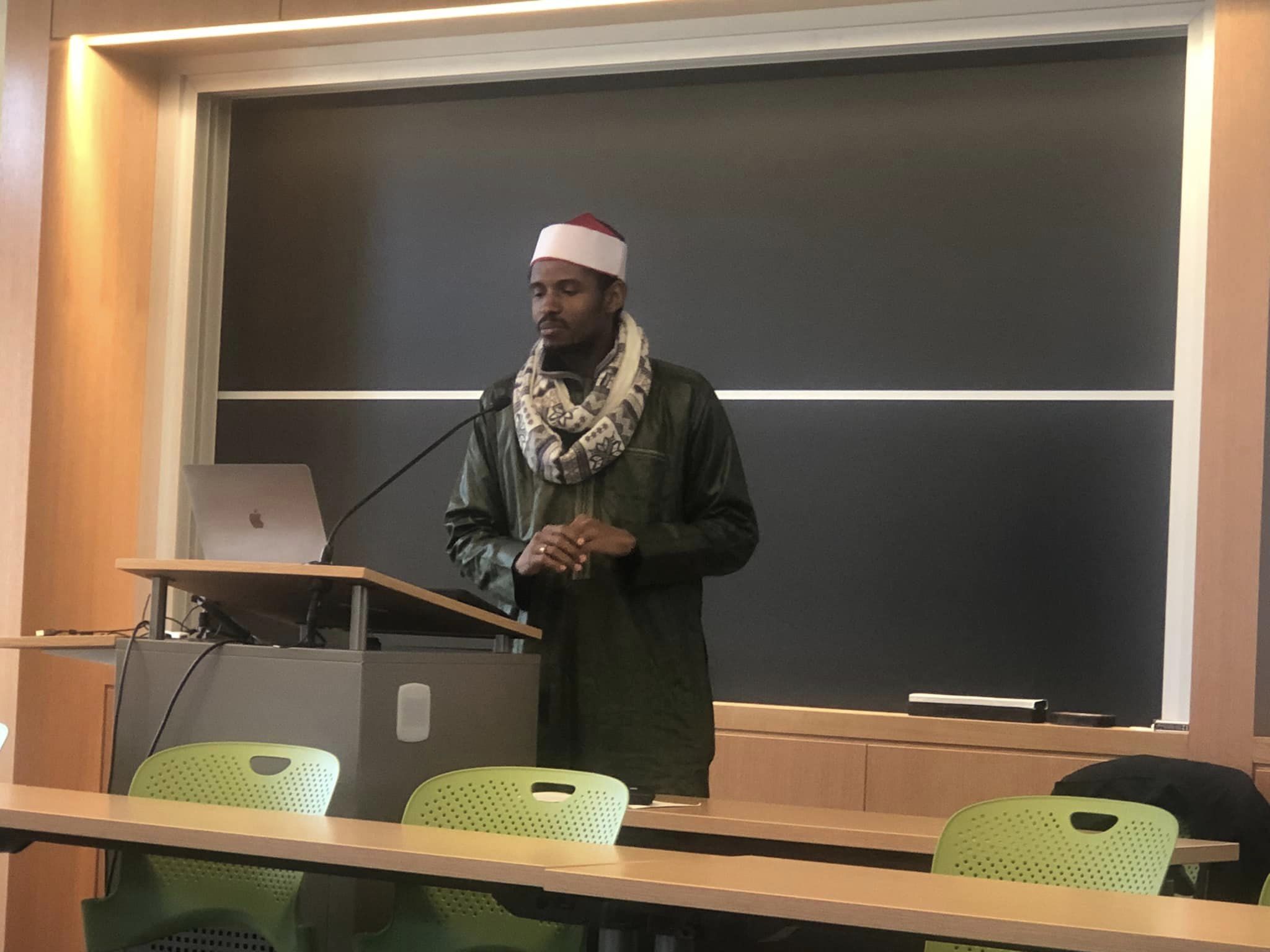
The former was a presentation by Ustadh Umar Sheikh Tahir, the son of a prominent Nigerian scholar Sheikh Tahir Bauchi and a current PhD candidate at Columbia University. His presentation was titled “Rediscovering 18th Century Knowledge Tradition: Alkashinawi’s (d.1742) Intellectual Networks in Bilad Al-Sudan and Hijaz.” The latter was a presentation by Sheikh Hamza Yusuf, President of Zaytuna College, who spoke on “The Arts of Understanding Prerequisites for Unlocking the Islamic Tradition.” Sheikh Hamza Yusuf studied traditionally with scholars in Mauritania, West Africa.

Ustadh Umar presented the story of Muhammad Alkashinawi, a West African scholar from today’s Katsina province in Northern Nigeria. Alkashinawi developed proficiency in Arabic language, logic, mathematics, and jurisprudence in West Africa. When he moved to Hijaz, his scholarship was acknowledged, and he became a respected scholar from whom society was learning. When he died in Egypt, he was buried in the cemetery of scholars. Alkashinawi’s story highlights the journey of a scholar whose intellectual depth was developed in West Africa and whose scholarship transcended geographical boundaries.

The uniqueness of Alkashinawi’s work was not as prominent as it should have been, and Ustadh Umar’s work is more relevant in that he is translating Alkashinawi’s book into English. Interestingly, some of Alkashinawi’s work is only available at Yale University, and his book was not borrowed from the library at Yale for 120 years until Ustadh Umar asked for it.

The unborrowed book from Yale Library for 120 years

Sheikh Hamza Yusuf’s presentation highlighted the importance of traditional means of knowledge acquisition and how it translates into scholarship that transcends geographical boundaries. Both presentations mesmerised the audience, providing evidence that knowledge is a human heritage that belongs to those who work to acquire it. It is neither the monopoly of a region, ethnicity, nor race but a heritage that beautifies a society that values it.

During the symposium, I sat among the students of Zaytuna College. One of the students asked me where I was from, and I responded Nigeria. He then introduced me to one of his schoolmates from Texas, who was a descendant of Sheikh Uthman ibn Fodio. I found it interesting how the family of Uthman Dan Fodio crossed the Atlantic and still keeps the story of their genealogy intact.

Takeaway: Knowledge is a human heritage. It belongs to those who work to acquire it.

Muhammad Jameel Yusha’u, PhD, is a candidate for a Mid-Career Master’s in Public Administration at Harvard University, John F Kennedy School of Government. He can be reached via mjyushau@yahoo.com.