Ramadan

Ramadan: ABU Professor distributes 40 bags of rice to students

By Ahmed Deedate Zakaria

Madinan-educated Professor of Islamic Law, Prof. Arsalan Muhammad, has distributed 40 bags of foreign rice to his students. 

On Tuesday, Professor Arsalan, who is reputed for his generosity, donated 40 bags of rice to the 400-level students of the Faculty of Law, Ahmadu Bello University, Zaria. 

The beneficiaries organised themselves into groups to receive the professor’s rare act of kindness. 

The Daily Reality gathered that all interested students got the rice irrespective of their faith.

Professor Arsalan is known for his generosity and always reaches out to outstanding students with textbooks, handouts and even money.

Below is a brief biography of Professor Arsalan Muhammad:

Professor Muhammad Arsalan was born in 1968. He attended several local Quranic schools between 1973 to 1983. Arsalan started his formal education in 1983, got admission into Jama’atu College of Arabic Studies Zaria and graduated in 1987. He then proceeded to Bayero University Kano, where he obtained his Diploma between 1987-1990.

Muhammad Arsalan travelled to the Kingdom of Saudi Arabia and got admission into the Faculty of Sharia, Islamic University Madina and graduated in 1995 and returned to Nigeria immediately and served his NYSC in 1996. 

Muhammad Arsalan got admission for his LL.M. and appointment as a Graduate Assistant in the Faculty of Law, Ahmadu Bello University Zaria, in 1996 and graduated in 2000 and proceeded to his PhD in 2001 and graduated in 2009. 

Arsalan was promoted to the rank of Lecturer 2 upon his successful completion of his LL.M in 2000 and promoted to the rank of Lecturer 1 in 2005, and to the rank of Senior Lecturer in 2009, he was also promoted to the rank of Reader/Associate Professor in 2012 and finally promoted to the rank of Professor in 2015.

2023 Ramadan: Qatar reduces prices of 900 consumer goods

By Ahmad Deedat Zakari

As Muslims all over the world prepare for fasting in the holy month of Ramadan, Qatar has announced a reduction of prices of 900 consumer goods for citizens of the country.

On Monday, the Qatar Ministry of Commerce and Industry (MoCI) made the announcement of the reduction of prices for hundreds of goods during Ramadan.

“Prices of more than 800 commodities have been reduced in coordination with major outlets in Qatar, starting from Wednesday, March 23, until the holy month of Ramadan,” MoCI said.

The Ministry added that the types of discounted goods include the most important food and consumer goods required by a family during Ramadan like:

Honey, flour and its products, cereals and corn flakes, yoghurt and dairy products, powdered and condensed milk, cheeses, juices, sugar, coffee and its products, dates, mineral and bottled water, tin foil (aluminium), paper napkins, washing powder, trash bags, pastries and pasta, legumes, rice, frozen vegetables, poultry and its products, eggs, meat products, tomato paste, tea, ghee, yeast, salt, personal hygiene items and household cleaning detergents and edible and cooking oils.

Does Sheikh Dahiru Bauchi contradict the Sultan?

By Malam Hassan Mohammed

You see, I have a lot of issues with Mallam Dahiru Bauchi when it comes to the sighting of the moon for the commencement and ending of Ramadan. The man has been, in the past, a deliberate source of unnecessary controversy and in the process dividing the Muslim Ummah. But we have to be fair to him this time. He did not ask anyone to break his fast, eat today and also observe Eid-el-Fitr. He did not contradict the Sultan or anyone in the position of authority to make the pronouncement of the termination of Ramadan whether locally or internationally.

In fact, listening to the conversation (the audio is almost everywhere) you’ll hear that even after serious pressure from some unscrupulous dudes who were discussing with him, the man was careful to refer to the Sultan. He was clear. He initially said that though it can be accepted that the moon may have been sighted in Doma (Nasarawa) and Abuja if as they claimed there are witnesses. But he could not tell people not to end Ramadan or that they could not if they chose to. Or call them people who knowingly violate injunctions.

However, he (1) specifically asked them if the Sultan is aware or had announced, which took the dubious guys aback because they didn’t expect that push back from him. And (2) when he got tired of their pressure he pushed back by saying just wait till next tomorrow, regardless of the claims that the moon has been sighted in Doma, Abuja and Niger Republic. If you can’t listen to the all 3:42 minutes, you may fast-forward to minute 1:33 where and when he asked if the Sultan has been informed and instructed that he must be informed so he will announce. And also 3:38 where he said he will not lead Eid, so they should wait.

The man simply ceded the right to announce the ending of the fasting to the constituted authority by saying, “If you are in Nigeria, you have no justification for breaking your fast unless you have not heard (the instruction of the Sultan). For that, we will not observe Eid. We are going to wait till next tomorrow. They should wait”.

These guys that were with the revered Sheikh and many others are used to the usual rebellion that they thought the Sheikh will simply agree and announce that the fasting should end and Eid to be observed today. To be fair to him, especially this time around, he didn’t. This is because one of our major problems with respect to moon sighting is that there are people who consider not accepting to commence the Ramadan fasting or ending it with the rest of Ummah/everyone, this is an act of rebellion. It is to them, a continuation of the denominational war. So, irrespective of the religious injunction and obligations, and also irrespective of their own beliefs as at the time of moon sighting, they must reject whatever the authorities say.

That this year’s Ramadan, the commencement and ending of the fasting, is not controversial as it usually is, is a serious letdown for them. If you pay serious mind to the nearly 4 minutes discussion, you’ll hear that Sheikh Bauchi was probing as he was also careful not to reject the idea that those who said they have sighted the moon completely have done so, but to also tell them that while he is not saying they lied, he emphasized that he desperately tried to avoid that, but he will not end his own Ramadan. That’s the wisdom of elders and of the learned, not the exuberance of young people who rebel in unnecessary and unhelpful controversy.

This shows that Sheikh is always at loggerheads with authorities over when to commence the Ramadan fasting because of his philosophical conviction and not because of ideological differences. So, if you end your Ramadan fasting just chest it. Don’t lie against the old man. Don’t use him. Just say that you just feel like it. It’s just about you and you, and nothing else. Try using another excuse for why you endured 29 days of fasting but cannot take just one more day. It is you, and you. Not Sheikh Dahiru!

Hassan Mohammed is a social analyst. He writes from Kaduna, Nigeria.

Moon not sighted: Eid Al Fitr is Monday – Saudi Arabia

By Ahmad Deedat Zakari

Haramain Sharifain reports on Saturday, April 30, that the crescent, which marks the end of the Holy Month of Ramadhan, was not sighted in Saudi Arabia and, consequently, the Eid Al Fitri celebration in the Kingdom of Saudi Arabia is Monday, May 2, 2022.

“The Crescent of Shawwal 1443 was NOT SEEN today. Subsequently, the month of Ramadhan will complete 30 days tomorrow and Monday, 2nd May 2022 will be the day of Eid Al Fitri”. They reported.

The astronomers of the Kingdom have reportedly been on the search for the crescent since the early hours of today before concluding.

Transition of Tashe

By Sumayya I. Ja’eh

Chorus/children: ‘Ka yi rawa kai mallam ka yi rawa.’

You’ve danced, oh! Mallam, you’ve danced

Mallam: ‘Ban yi ba’,

I didn’t

Chorus: ‘tsoho mai gemun banza.’

Old man with a useless beard

The call-and-response dialogue, accompanied by the beating of a drum, propped open my six-year-old eyes in my grandfather’s compound in a village in Katsina. It was one of those fuzzy moments when you wake up and don’t know where you are for a minute. I had slept off in the car, only to find myself in a dim room lit by a kerosene lamp. There was no electricity, and the young moon illuminated the compound. The young boys that woke me were beating a locally made drum from tins, nylon, and sticks. They looked like characters from the famous tale by moonlight series produced and aired by the national television station NTA, which I was obsessed with then. The main character, Mallam, had a costume: a babban riga, an old cap placed haphazardly, a white beard, attained by putting white cotton on a boy’s face, and his mimicry of an old Mallam thrilled me. It made me and their audience laugh. That was my first conscious experience of Tashe and one of the reasons I look forward to spending my fasting period with my grandparents in Katsina or Kaduna.

Tashe is an old-age traditional mimetic performance performed by children between 6 to 14. It is an annual cultural performance that takes place in the 9th month of the Islamic calendar and is performed in the early hours of the morning or the evening before the pre-dawn meal or after the break of the fast. Tashe is a short play that challenges a social issue, accompanied by songs, dance, and mimicry.

Tashe can be traced as far back as the contact of the Hausawa with Islam. The word is derived from ‘tashi’, a Hausa word for wake up. Muslims are expected during the month of Ramadan (9th) of the Islamic calendar to fast, and they are highly recommended to take the pre-dawn meal. So, some people feel the need to wake others up for Sahur, to replenish their empty stomachs and energy to see them through the rigours of the day’s work without much difficulty. So, a few community members took it upon themselves to wake people, to prepare and eat just before dawn. To lighten the frustration of struggling to keep awake with no alarms, these volunteers enact the games named wasannin Tashe. While the adults prepare the meals, children with nothing to do occupy themselves with games to help while away time. Another factor is the essence of Tashe, which is aimed at luring people away from un-Islamic leisure pastimes since the beginning of Ramadan.

Tashe is performed mainly by young children, who imitate adults. It is often satirical and full of humour but laden with moral lessons and socio-religious ethics of the Hausa community. Tashe is usually passed down orally from generation to generation. The characters fill the roles with costumes, makeup, and dialogues in call-and-response songs. It is social criticism and a mirror/lens to view the socio-religious ways of life in most Hausa communities.

The Almajirai also are volunteers that perform Tashe. The Almajiri’s source for their food, move from house to house, seeking food or alms. During Ramadan, the Almajiri sing a dirge in the late night hours, songs calling out to anyone with an extra plate to give them. Some musicians and drummers, along with young children, also began to imitate the activities engaged in by the adults. In time, these plays shifted to the early hours of the night. They sing, dance, dialogue, improvise and wear costumes. It is a comedy, but like all comedy, it is the presentation of serious matters in unserious ways.

One striking characteristic of Tashe is its didacticism; it doesn’t only entertain but emphasizes the Hausa cultural belief and tradition—Tashe projects social ethics. Therefore, many performances aim to ridicule those who deviate from correct social norms merrily.

One well-known Tashe passed down from generation to generation is that of naci na kasa tashi, meaning‘I’m so full, I can’t stand.” One of the young boys dressed as an older man puts cotton on his chin that looks like a beard and puts on some clothes to show his protruding stomach. When they are ready, they go from house to house. The lead character sings, and the other children chorus/reply.

Baba: na ci na kasa tashi!

Children: Baba zare gareka!

Baba: Tuwon da dadi yake!

Children: Baba zare gare ka!

Baba: kuma har da nama!

The above can be roughly translated as ‘I’m so full, I can’t stand’, and the children reply with ‘Baba, you’re greedy,’ while the Baba tries to justify his gluttony by saying the tuwo is sweet and there is meat.

For instance, Ga Mariama Ga Daudu, another Tashe, gives us a socio-historic glimpse of the Hausa laden with humour. It is a mimetic performance of the communal responsibilities/expectation of husband and wife, the type of staple food eaten by Hausas. Although a comic, the play is social criticism of the institute of marriage, which several people from both genders are desecrating. Girls stage the play. One of the girls puts on a costume, a long kaftan and a beard and tries to deepen her voice to sound like a man. It is a telltale that enlightens young women about what society expects from a married woman.

Due to the Hausa tradition that does not allow the two genders to mix freely, the girls and boys don’t mix to perform Tashe. Instead, each gender play switches roles with its unique performance type.

A very well-known Tashe is of Gwauro. It is a mime that consists of 5/6 boys. One of them is dressed in nothing but bante (a short nicker) Hausa traditional pants, a rope tied to his waist, a bundle of clothes with kitchen utensils like used tins, old, discarded radio, an old dirty kettle can be found in the bundle carried by the main character. The others hold on to the rope while the lead character tries to run and is being pulled by the rope, while they sing ‘gwauro gwaurogwauro nuna mana yadda kake tsanawa’? Gwauro can be translated to as Divorcee or an old bachelor. ‘Show us how you cook?’ He goes on to put a tin can, wedged it between two stones, and mimics blowing air into the woods.

This is aimed at ridiculing the bachelor, and lessons deducted from this drama border on the irresponsible nature of the bachelor for trying to play the role of a woman, who in most Hausa communities is the one who cooks. Tying the rope around the waist of the lead actor is symbolic. The rope restraining the bachelor also portrays the image of someone in bondage. This shows that in Hausa society, marriage is given such importance that the bachelor/divorcee is considered a lesser being than the other community members.

One Tashe that has gone viral and is available on YouTube is the 2021 Ramadan Tashe ridiculing the state governor of Kano, who asked for 15 billion naira to tackle the issue of Covid 19, as well as a scandal video of him collecting kickback. The short clip shows a boy lying on the floor with a babban riga (an overflowing gown), a red cap, and a white beard. His friends, the crew call out, ‘Ganduje tashi,’ ‘Ganduje stand up,’ to which he replies, ‘sai an ba ni dollar Corona’ ‘not until I am giving dollars to fight Corona.’ The clip is a short comedy skit that not only cracks people up but also has an undertone that challenges corruption by government officials.

Though Tashe is basically performed to provide merriment, the reverse may occur. Sometimes, Tashe meant to ridicule certain personalities, which may not be acceptable to the person concerned. Here the object of ridicule will not find the performance funny, and it is pretty common to see the performers running helter-skelter, being chased by the target of the performance. At other times, the performance itself may be acceptable, but the attitude of the performers may be irritating to the target audience. To cap it up, these performers would taunt any house owner who refused to donate anything. Upon exiting, the actor would often sing, “mun taka tutu, maigidan nan ya yi shi.” “We have stepped on a heap of shit; the owner of this house must have excreted it”.  

Tashe emphasizes communal performance. My grandparents or parents always give out some loose change to the performers. This is the norm that the adults expected to give alms to the performers. These donations can be money or food items, primarily grains like millet and sorghum, the staple foods in any Hausa community. There is no fixed amount for alms, but donation largely depends on the social and financial status of the audience, as well as the extent of enjoyment of a performance.

The audience, primarily adults, also participates by correcting any misrepresentation in the texts, disguise, or dramatization. With globalization and urbanization happening worldwide, Tashe, as I used to know it, is fast becoming a relic of the past. The face of Tashe has evolved in urban cities. Few children or Almajirai go from house to house, entertaining people while seeking alms.

This long-old tradition of performance entertains and highlights the life of the Hausa folks and brings the fore societal expectation of a man/woman in Hausa society. Although it is a series of plays that comes only once a year as entertainment, it is full of dramatic content that reflects contemporary events. This mimetic performance encompasses most characteristics of a drama; costume, dialogue, improvisation, storyline, and purpose. These earliest Tashe performances are the precursor of modern Hausa drama.

Tashe tries to divert the community’s attention from the economic and political predicament. Tashe, like Macukule, which explores the Hausa stereotype of the Gwari man, is still dominant in contemporary Hausa movies. A renowned character Dan Gwari is not new to anyone familiar with Hausa movies.

Today, if you google Tashe on YouTube, a few children and young adults pop up on your white screen. The TV channel, Arewa24, created a short series of Tashe that they stream. While this is another means of preserving this long tradition, the thrill and euphoria experienced by the audience are reduced by the limited screen. Unfortunately, my children would most likely never experience this long communal tradition of Tashe as I did.

Sumayya I. Ja’eh wrote from Abuja via sumyjaeh@gmail.com.

Kaduna: Young man reportedly dies in sujuud while leading Tahajjud

By Ahmad Deedat Zakari

A young ustadh identified as Muhammad Sani Lawal passed away on the night of Saturday, April 23, 2022.

Abdull-azeez Ahmed Kadir, a Nigerian journalist and the General Manager of Liberty TV and Radio, reported the incident on his Facebook timeline. 

Kadir described the young man’s death as how many Muslims would want their end to be like, calling it the “Best Death”.

Kadir posted thus:

Muhammad Sani Lawal, a young Islamic scholar, died last night in Samaru Zaria in a manner many Muslims beseech Allah to take their lives. He died not just in the Holy Month of Ramadhan, not just in the last ten days that hosts the Night of Majesty, not just in prayers, but Ta’ajud, in sujud while also leading the prayer at night.”

Kadir prayed to Allah to rest the soul of the deceased. The post has garnered many positive reactions while the story goes viral on mostly northern Nigerian social media space.

Tips on reciting the whole Qur’ān in Ramadan

By Ibrahim A. El-Caleel

Muslims across the world love to complete the recitation of the Qur’an in Ramadan due to different reasons.

Firstly, it was within the blessed month that the Qur’ān was sent down all at one time from Al-Lauhul Mahfūz (the Preserved tablet) to Al-Baitul Izzah (House of Might) in the heaven of this world.

Secondly, actions in this month are rewarded in manifolds. Good deeds and bad deeds alike. Ramadan has a single night whose eminence is better than a thousand months- 83 years+. Imagine submitting an act of good deed in this night and getting it accepted. The reward will be awesome.

Reciting the Qur’an is an easy way of accumulating good rewards. It is rewarded per alphabet. Prophet Muhammad (Peace Be Upon Him) said it is a 10-fold reward per alphabet each recited. An Uthmāni script of the Qur’an contains 604 pages, with each page having 15 lines. The estimated number of characters/alphabets in the Qur’ān is 330,000. Therefore, if you calculate the anticipated number of rewards for reciting the whole Qur’ān, you’ll see that it is massive. The reward becomes exponentially colossal if you factor in the multiplier effect of Ramadan.

This is why scholars of Islam from all walks of disciplines retire to the Qur’ān once it is Ramadan. They momentarily suspend studies in Hadīth, Fiqh, I’tiqād, History to settle for the Qur’ān so as to maximize the benefits in Ramadan. Mujāhid bn Jabr, a tabi’i expert in Tafseer used to complete the Qur’ān in every night in Ramadan. Imamul Shafi’i would complete the Qur’an 60 times in Ramadan!

Every conscious Muslim is looking forward to completing the recitation of the Qur’ān in Ramadan. It is a “bonanza period” for you to double your good deeds and earn some handsome rewards in your Book of Record. This is why everyone works on a plan to complete the Qur’ān. I have seen different plans that divide the Qur’an into number of pages, or rubu’, hizb or juz which should be covered on daily basis to complete the Noble Book before Ramadan elapses. Some go as detailed as breaking it down to recitals after each of the five obligatory prayers on daily basis.

AlhamdulilLahi. All these are implementable plans if one has the discipline to sustain them.

However, I have never tried following them because I do not have the organized sustenance culture in reading. And in the near past, either in 2016 or 17, there was a Ramadan where I was unable to complete the Qur’ān. Though there was nothing sinful about that, I wasn’t happy. I could make only around 45hizbs, falling short of 15. And since then I settled for my own personal plan.

My personal plan afterwards was a resolution not to join Taraweeh prayers in congregation unless I have completed the Qur’ān. Therefore, in the early days of Ramadan, typically before 10th, I do my taraweeh alone at home. I would silence-mode my phone to avoid any distraction. I would then pray my taraweeh typically covering 6 hizbs daily, in either two or four raka’ahs depending on my selection. It typically lasts two hours, or with an additional 30 minutes. Of course, the standing isnt easy but nothing rewarding has ever been easy. So, I bear it. Immediately after completing this taraweeh, I fall asleep. Saving me from the addition of late night punching of my phone.

This plan has been working for me, AlhamdulilLah. I am not sharing it for a holier-than-thou extravaganza, subhanallah. May Allah protect our deeds from show-off, Amin. But I am sharing it because it might be a method someone would want to adopt, especially for workers who run an 8am to 5pm work. They might not have chance to read the Qur’an during work hours in the day. And they may be thinking of what other plan can they adopt since they want to complete this Noble Book.

You don’t have to be a Qur’an memorizer to adopt this method. All you need is this copy of the Mushaf that is usually divided by hizbs selections numbering 1-10 (6 hizbs each) or numbering 1-6 (10 hizbs each). They are portable for use in prayers. And if you want to use the Qur’an app in your phone, no problem. You might just consider putting your phone in ‘Airplane Mode’ to ward off distractions.

It is halāl (permissible) to pray while holding the Qur’ān according to the most correct scholarly opinion. This applies to everyone- whether they are Qur’ān memorizers or not. In fact, Imamul Nawawiy considers it wajib if one hasn’t memorized Suratul Fātiha, then he must hold a Qur’ān and pray because not having Suratul Fatiha in your human brain isn’t an excuse for you not to pray. Therefore, whether you have the Qur’an at heart or not, you can still recite from the mushaf while in prayers.

If Islamic scholars are suspending other fields of knowledge to complete the Qur’ān in Ramadan, you can suspend social media to do same. If you want to use your annual leave, casual leave or compassionate leave from work, then so be it. It worths doing all these.

May Allah grant us the ability to maximize our time in Ramadan, Amin.

El-Caleel writes from Zaria, Kaduna State

Ramadan: Zulum distributes food, cloth, N5.7m to 285 Gov’t House cleaners

By Uzair Adam Imam

Governor Babagana Umara Zulum of Borno State has distributed food items, cloth and combined cash of five million seven hundred thousand to 285 cleaners, messengers and other lowest rank individuals working at the Borno State government house.

The Daily Reality gathered that each beneficiary received a bag of rice, sugar, cooking oil, textile and N20,000 as support for the Ramadan activities.

The development, which took place on Monday, has grabbed the attention of many people who commended the governor for the kind gesture, especially when people face hard times all over the country due to hikes in prices and insurgency.

The Governor showed appreciation to the workers for their services, saying they are critical to the operations of the Government House.

Zulum further swore to sustain welfare support to the workers.

He also promised to improve the condition of their services.

Sacred Sound Emission: Untangling human corruption from divine injunction

By Binyamin Lawal

Researchers often point to the dominance of virtual culture and modes of visual perception that organise everyday life. However, in a place like Nigeria, “public sound is a far greater presence and comes to constitute the ambient environment” (Larkin 2014: 992). Out of these multiple sounds, those disbursed with a glaring presence are those emanating from the sacred spaces. As a focal space for the generation of piety, one wonders whether such disbursement of sounds ‘piety’ is indeed achieved. This is one of the questions we should reflect on as we step into the month of Ramadan.   

Ramadan is the ninth month of the Islamic calendar in which fasting (Arabic: saum) is prescribed for Muslims so as to attain the status of Al-Muttaqūn (the pious: those who fear Allah and abstain from sins and evil deeds) (see Q 2: 183). Due to the special position of the month, Muslims live a substantial part of the year attached to it. They either pray to witness the month or pray that Allah accepts their acts of worship during the month. 

Now, as the month of Ramadan begins, we need not only to reflect on improving our piety but cultivating attitudes of not inflicting harm to people as well. In other words, while we encourage people to come closer to Allah through good conduct, we should refrain from other actions capable of eating up our good deeds. 

While Ramadan is the season where Muslims come closer to Allah and increase their piety – as stated above, activities that cause inconvenience to others must be avoided since avoiding the infliction of harm to humans is in itself an act of worship (Ibadah). Against this backdrop, the usage of loudspeakers, especially at night, needs to be regulated during the month and particularly the last ten days. In this regard, I would like to recount – from my memory – what I heard from a Kano-based Islamic scholar who responded to a question on the emission of sounds far beyond the sacred space.

In his response, he pointed out that doing that causes a lot of inconvenience to people around. As such, it is ‘unlawful’. He explained that some might want to pray in their houses, and the sound of the recitation dominating the public space will not allow them to have the needed silent atmosphere. Others may just want to sleep. Both are denied the silence and decorum they genuinely deserve.

In this regard, we should also be mindful of those willing to engage in prayers the whole night but cannot due to the kind of work/business they do during the day. After all, in their case, doing the work during the day to keep up their responsibilities is wajib (compulsory), while the prayers are recommended.

The night, as we know, is a special time to seek closeness to Allah, at the same time, a period of rest; “And We have made your sleep as a thing for rest, and We have made the night as a covering (through its darkness)” (Q 78: 9-10). Sleep, which is meant to be a rest, as stated in verse 9, is complemented by the covering provided by the darkness of the night to give us respite from the exertions of the day. That must be respected as we engage in our Qiyāmul-lail.

Furthermore, the Sheikh emphasised that our public spaces are shared between Muslims and Christians who don’t partake in Ramadan activities, so why incommodes them? In addition, one could also think of the sick persons whose sleep may be interrupted. Observing the act closely, one fears the salient intent of presence-making or show-off, an act that is seriously frowned at. “Say: “Will you inform Allah of your religion while Allah knows all that is in the heavens and all that is in the earth, and Allah is All-Knowing of everything” (Q 49:16).

Binyamin Lawan is a PhD student in Islamic Studies and wrote via abinyaminlawal@gmail.com.

Breaking: Ramadan crescent sighted in Saudi Arabia

By Muhammadu Sabiu

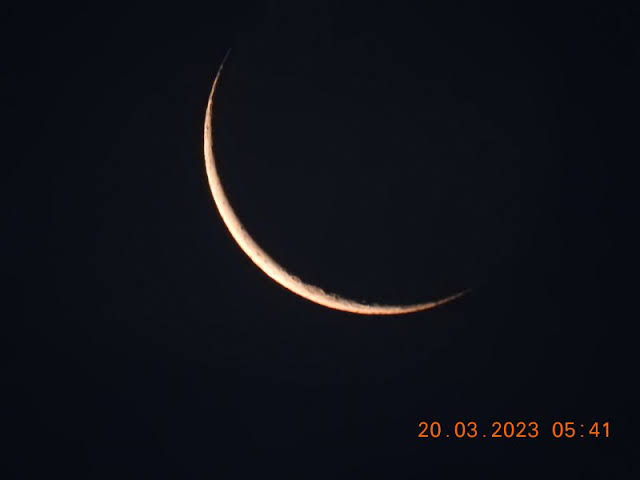
The crescent, which signifies the beginning of the month of Ramadan, has been sighted in Saudi Arabia, Haramain Sharifain confirmed in a statement on its verified Facebook page today.

“Crescent was SEEN in Saudi Arabia today. Subsequently, the month of Sha’ban completes 29 days today and tomorrow, i.e. Saturday, 2nd April 2022, will be the first day of Ramadan 1443,” the statement read.

This marks the beginning of the Muslims’ act of fasting for 29 or 30 days, not only in Saudi Arabia but across the world.

It can be recalled that even in Nigeria, the Sultan of Sokoto, Alhaji Abubakar Sa’ad III, has urged the Muslim faithful to come out today in search of the Ramadan crescent.