Ramadan

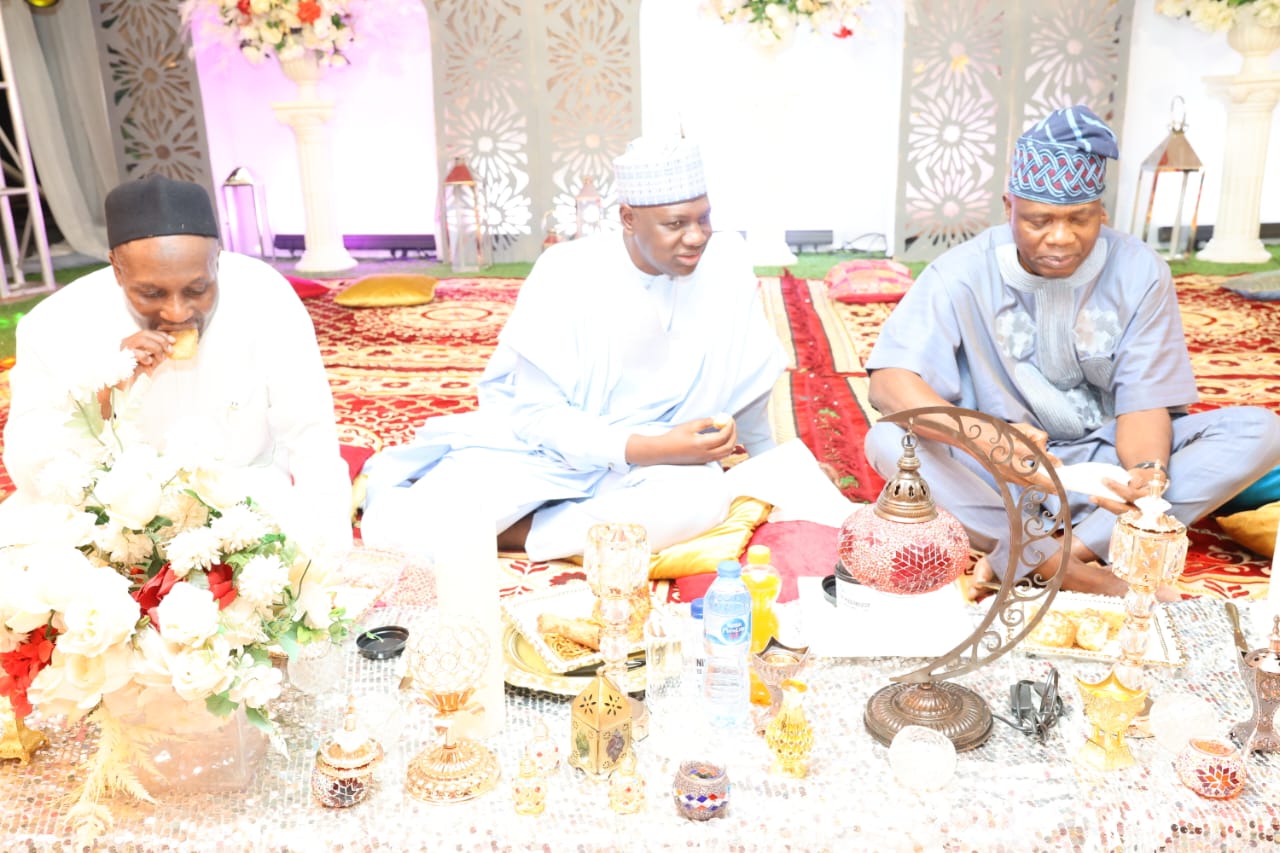
CGC Adeniyi hosts Ramadan Iftar with dignitaries, calls for national unity

By Sabiu Abdullahi

The Comptroller-General of Customs, Bashir Adewale Adeniyi, MFR, called for unity and harmony among Nigerians during the holy month of Ramadan. 

He stated this in an iftar gathering he hosted on Tuesday, April 2, 2024. 

The event, attended by dignitaries including Saleh Ahmadu, Chairman of the Trade Modernization Project, took place at the Nigeria Customs Management Estate in Abuja. 

In his address, CGC Adeniyi urged Nigerians to embrace the teachings of Ramadan, stating, “Only through eschewing bitterness, accommodating one another, and living with one another in peace and harmony can people achieve a prosperous country.”

He expressed the significance of Ramadan’s teachings. 

Reflecting on the recent celebrations of Easter and the ongoing observance of Ramadan, CGC Adeniyi stated the common values shared by Nigerians, stating, “What unites us is far more than what divides us.”

He called for collective action to address food insecurity in the country, noting that many Nigerians struggle to find adequate meals, especially during Ramadan. 

CGC Adeniyi reaffirmed the Nigeria Customs Service’s commitment to supporting Nigerians in need, pledging to implement measures to ensure food security.

He called on all Nigerians to embrace the spirit of Ramadan in their daily lives, urging them to “eschew bitterness and accommodate one another in peace and harmony.” 

Wale Edun, representing the Minister of Finance and Coordinating Economy, commended CGC Adeniyi for organizing the Iftar.

Ramadan: King Salman distributes foodstuffs in Kano

By Uzair Adam Imam  

Saudi Arabia’s King Salman Humanitarian Aid and Relief Centre has distributed food items to over 2,000 households in eight local government areas of Kano State, mostly for people with disabilities (PWDs). 

Abdulrahman ibn Abdul Aziz Al-Zaben, the team leader of the foundation, said the program aims to support families and those in need during the holy month of Ramadan every year to alleviate hardship and suffering. 

The National Emergency Management Agency (NEMA) and the State Emergency Management Agency (SEMA) implemented the program in Nigeria.  

Food items distributed included 25kg bags of beans, 25kg bags of rice, and 4kg of Masavita, among others. At the event, Kano State Deputy Governor Aminu Abdussalam Gwarzo expressed gratitude to the centre for remembering the people of Kano during Ramadan. 

The Director of Special Duties at NEMA, Fatima Kashim, who represented NEMA Director General Zubaida Umar, also thanked the centre for reaching out to those in need. 

The deputy governor, DG NEMA, and the representative of the King Salman Humanitarian Relief Center called on the beneficiaries to make good use of the items to improve the lives of their families.

Tips for women on balancing kitchen duties and worship during Ramadan

By Aisha Musa Auyo

I know this is coming in late, but better late than never, huh? Ramadan is a sacred month that is supposed to be dedicated to fasting, Quranic recitation, prayers, sadaqah, etc. But part of that ibadah comes with a lot of cooking and eating.

Ramadan is synonymous with a delicious variety of dishes—a paradox, right? That’s why many media stations and content creators dedicate time, energy, and resources to Ramadan dishes and treats.

Women are more often on the receiving end of this cooking duty during Ramadan. This has been the tradition since time immemorial, so we cannot change it, but we can create ways that will help us adapt, manage, and not be overwhelmed by it. We can make it beneficial and more rewarding.

First and foremost, cook with the intention of getting rewarded, not to impress your man, the family, or his friends. That gender may not even say thank you, sannu da aiki, abincin yayi dadi, or even Allah Ya miki albarka. But if your intention is to get rewarded by Allah, you are sure to have that reward. Innamal a’amaalu binniyati.

Know that whoever feeds a fasting person receives an immense reward. The Prophet (PBUH) said, “He who feeds a fasting person will have a reward like that of the fasting person, without any reduction in his reward.” (Tirmidhi) This applies to the one who buys the food as well as the one who cooks the food.

When it comes to tafsir, Ramadan lectures, and the like, technology has made things easier for us. You can listen to live or recorded programs on your phone, wherever you are in the world, while you’re cooking or cleaning. You can listen to Quranic recitation too; you can do lots of dhikr and istighfar while doing most chores. Try not to miss out on this.

If you have the means, give out sadaqah in cash and in kind, especially food and water. That will fetch you an immense reward. In the end, it’s the reward we are aiming for, so the end justifies the means.

If you are fortunate enough to have electricity, you can devote your weekends to making pepper soups, stews, and juices. Then, freeze them, which will make cooking easier for the rest of the week. Also, make use of food processors and other appliances that will simplify your work.

Make use of processed foods as much as you can afford. For example, if you want to make tiger nut drink, buy tiger nut powder from Auyo’s Cuisines. This will make your work faster and easier, and you will have the energy for Tarawih. Other processed foods that are much needed for Ramadan are ground peppers, ground kuli, masa premix, and garin kunu, all of which are available and affordable at Auyo’s Cuisines.

Making a weekly food timetable ahead of time helps a lot. Thinking about what to cook is very draining; knowing what to cook is like finishing half the work.

Seek help; don’t try to do everything yourself. Engage the kids and hire someone to help you, even if it’s just for the month. Going to the market will drain you and waste your time; find someone to help you with that from time to time.

You see that Zirkr our Prophet gave his daughter when she asked for servants, Subhanallah, walhamdulillah, and wallWallahar, don’t joke with it before you sleep, you need it now, more than ever.

Try to hydrate a lot during the non-fasting hours. Don’t be too exhausted to eat; you need health and energy more than anyone.

As much as you can, avoid social media, movies, useless chit-chats, and worldly distractions. You will have ample time for that after Ramadan. This month is sacred and only comes once a year. The Prophet said, “Verily, Gabriel came to me and he said: Whoever reaches the month of Ramadan and he is not forgiven, then he will enter Hellfire and Allah will cast him far away,”.

The Prophet peace be upon him also said, that a loser is the one who witnessed Ramadan and didn’t earn Allah’s pardon. A loser is one who’s despaired of Allah’s mercy. A loser lets time pass by procrastinating good deeds. A loser is the one who loses the reward of his fasting to mere hunger and thirst.

My fellow women, try to be on your best behavior this month. Try not to be a loser. As a woman, know that you will sleep less than anyone else in the house, but it’s okay; that’s your part of the sacrifice. Men go out to work too; some men work under the scorching sun. Some men’s work involves hard labor, harder than what you do at home. Some men, even though they work under AC, have pressures and issues they need to solve, which is also very difficult and draining.

Over to you, my brother. If you can afford it, please get some domestic help for your wife. She needs it, especially this month. If not someone who will help in the kitchen, find someone who will help with the shopping and outdoor activities.

If you want to bring people for iftar, do so in moderation. She is only human with two hands.

If you want to feed many people, employ ‘Mai kosai da kunu’ for that project. Many people need the job and the extra money that comes with it. Allow your wife to handle the family’s iftar. Allah Ya biya ka da aljanna.

Bro, I know you’re working hard to provide, but a kind word, a prayer, a gift (in cash or in kind) will make your woman feel appreciated and loved. It won’t kill you.

My fellow women, know that all this work you are doing might not be possible if your man were not providing the food and resources. Appreciate him, encourage him, and respect him. You are not the only one working hard.

But if you are the woman of the house and also the one providing for the household, know that only Allah SWT can help and reward you. I cannot explain or tell you how to manage your time, but I know you are incredible, and in sha Allah, you will enjoy the fruits of your labor, here and in the hereafter.

If you are a son or daughter still living with your parents, know that you also have roles to play. These roles can range from helping with meal preparation and cleaning to running errands and greeting your parents when they return home from work. Praying for your parents is also an important act of worship.

If you are earning money, buy fruits, vegetables, or gifts for your parents and siblings.

Guy, before you shamelessly take a Ramadan basket or kayan sallah to your girlfriend, who may not even marry you, do so for your parents first. It will be more rewarding for you.

Girl, before you shamelessly invite that stingy boyfriend of yours for iftar with your parents’ cefane, make sure you are always helping out with the cooking and cleaning; it will be more rewarding for you. Don’t be a lazy girl and then an active one when your guy is coming for iftar.

Dear couples, as much as I know you are tired, don’t ignore za oza room ibada during this month. It is very rewarding, it enhances mood and offers benefits for physical and psychological health including lowering stress, improving sleep, and boosting immune function.

Experts say the hour before suhoor is the best during Ramadan. By then, couples are well-rested, and they will be waking up for suhoor anyway.

Let me stop here. May Allah accept our ibadah. May He give us the health and wealth to perform this ibadah to the best of our abilities. May Allah make us among the servants who will be freed at the end of this month. May He forgive our shortcomings, and may all our prayers and wishes be granted. May we witness many more Ramadans in good health and wealth.

Aisha Musa Auyo is a Doctoral researcher in Educational Psychology, a wife, and a mother of three. She is a homemaker, caterer, and parenting/relationship coach.


Fasting Ramadān in the university: A treasure for campus students

By Dr Zakariyya Shu’aib Adam

Last week, I had a pre-Ramadan lecture session with Muslim Health Students at Usmanu Danfodiyo University Teaching Hospital, Sokoto. I reiterated the merits of the four most important acts of ibadah in Ramadān: fasting, recitation of Qur’ān, night prayers, and feeding the needy. I also emphasized how, as students, we can make judicious use of our stay in the university during Ramadān.

Contrary to the mainstream notion, observing fasting in the university is scrupulously enchanting and divinely pleasing. In this piece, I want to write some of the points I mentioned in that session for the benefit of a larger audience. It is worth noting that I drew most of what I said from my experience as a former university student who stayed on campus.

Although fasting is physically exhausting, particularly for a university student who, in most cases, lacks sufficient foodstuff for suhoor (pre-dawn meal) and iftār, it can quietly serve as a pathway that provides students with immense opportunities to connect heartily with their Lord.

During Ramadān, affluent students often use to invite the indigents for suhoor and iftār. You mustn’t cook food before you eat. Moreover, the Muslim Students’ Society of Nigeria [MSSN] sometimes obtains funds from the Sokoto State Government and Muslim lecturers to purchase all that is needed for Iftār. In such circumstances, students usually gather in a hall and break their fasts in what was popularly known as “Tarāsoo” (the word was gotten from the state of closely and neatly joining legs in a congregational prayer).

I haven’t observed a more composed Tarāweeh that is full of tranquillity and serenity like the one we used to observe in school. Specifically, in Tora Bora Masjid, we used to read one page in each raka’ah of Tarāweeh and spend an average of an hour. The congregation was very large. Retrospectively, the Imāms there recited with melodious voices that would touch hearts. There were brief admonishments between every four raka’ah. We were always happy observing this prayer.

When it was the last ten days of Ramadān, many students would be in the mosque for Iʿtikāf (seclusion in the mosque for the purpose of worship, especially the last ten days of Ramadān). Those performing Iʿtikāf receive food from Tarāsoo and from their friends who aren’t staying in the mosque. They constantly recite the noble Qur’ān during that period. In a nutshell, they devote themselves to all kinds of ibadah for a period of ten days.

During Tahajjud (night prayers), we had more than enough Imāms because there were many memorizers of the Qur’ān among us. The ruku’uh and sujood were almost as lengthy as the qiyām (standing). We were given a chance to make prayers to Allāh in sujood because it’s the closest moment a servant is to his Lord. Most university dignitaries attended such ibadāt with us. They relate with us with humility and demureness. This played a role in reducing the imaginary hiatus between students and lecturers.

Females, too, were given special consideration. A portion of the mosque was dedicated to them to observe I’tikāf. Everything they needed was provided to make their stay delightful. When it was time for Tahajjud, they made rows in the mosque and observed prayers with males. There was a question-and-answer session every night, usually organized by experts in Islamic jurisprudence among the I’tikāf members.

I am neither trying to portray my stay in the university during Ramadān as Shangri-la nor am I being utopian. Notwithstanding the aforementioned, some students do not participate in these ibaadāts. They instead go to the female hostels and spend time with their inamoratas. It seems as though they prefer worldly pleasure to the everlasting one. In some instances, they often present what they call Ramadān baskets to these inamoratas, thereby engaging in prodigality.

Others spend much time in social gatherings. You mostly see them chitchatting about politics and entertainment. They burn calories in debating about football. Champions League matches used to be on the night at the exact time of Tarāweeh. Therefore, big boys won’t attend the night prayers. Females, too, weren’t left out. They commit themselves to watching Korean TV series and Indian love movies. Their role models used to be Lee Min-Ho, Lee Min-Jung and Aishwarya Rai.

I entreat you not to be like these students. Be steadfast in your ibādah. Remember that Ramadān is made up of either 29 or 30 days. If the month elapses, you may not necessarily live to witness another Ramadān. Stay in the circle of pious friends. Never befriend anyone that doesn’t help you in your studies or doesn’t add to your religiosity. Devoted servants in Ramadān are rewarded in multiple, so also the transgressors – their punishment is multiplied.

Lastly, I narrate this to settle the nerves of students who are unhappy with their stay in the university during Ramadān. I, admittedly, was unhappy in school in my first year. Subsequently, it became apparent to me that I could turn that cheerless moment to my advantage. I doubt if, in the nearest future, I can have enough time I dedicated to myself for ibadāh in Ramadān as I had in the school. So, make good use of your stay in school during Ramadān while you are still a student. You may not have much time if you graduate.

Dr Zakariyya Shu’aib Adam is a serving corp member with Area Veterinary Clinic, Argungu, Kebbi State. He graduated from Usmanu Danfodiyo University, Sokoto. He can be reached via: zakariyyashuaib2020@gmail.com.

Time to return to the masjid

By Bello Hussein Adoto

When COVID-19 came, we switched from receiving exegeses of the Qur’an and Hadith from masājid and physical gatherings of knowledge to virtual ones. We attended Facebook Live and Zoom sessions to listen to our favourite scholars. We followed their tafsirs on Mixlr, Google Meet, and Telegram.

These were supposed to be temporary solutions to the social-distancing mandates that COVID-19 imposed, but they have become the norm. It is about time we returned to the masājid to restore their beauty and secure the blessings of learning physically from scholars.

This Ramadan is a great time to start.

Allāh says in the glorious Qur’an, “I did not create mankind and the jinn except to worship Me.” The masjid is central to this worship. We observe the congregational ṣalāt at the masjid, perform iʿtikāf there, distribute the zakāh, and listen to explanations from our scholars.

Beyond worship, the masjid unites us as a community by bringing us together with our Muslim brothers and sisters as members of a shared community, united by faith. In preserving this faith and community, we must find a way to restore the essence of our masajid, even in the age of online communities.

Why should we return to the masjid?

Islam is not against technological innovations that would benefit Muslims. Indeed, we use microphones to project the adhan, telescopes to observe the moon, and smartphones and other devices to spread the message of Islam beyond the masajid. Therefore, we are free to seek and adopt goodness from any source.

However, attending virtual lectures or learning at online madrasahs or Islamic institutes should complement, not substitute, listening to lectures in the masjid or learning physically at the feet of scholars.

The masjid creates a veritable platform for teachers, scholars, and students to connect physically and leverage the elements of the surroundings—the sound, the sights, the mannerisms, and the divine blessings—to achieve maximum benefit from the engagement. Besides, it is the most common place to connect as brothers and sisters and focus solely on learning and worship without distractions.

So, how can we return to the masjid?

Start small

Returning to lectures at the mosque or taking in-person classes would be challenging in the first few days. You are changing a routine and need time to adjust.

So, start small. Instead of joining Twitter Spaces for morning reminders, stay back for three to five minutes to listen to short tafsirs of the Quran and Hadith. If that is unavailable at your masjid, introduce the idea to the masjid committee. Then, you can listen to your virtual sessions on your way home.

Commit to optimizing Jum’ah sessions

The Jum’ah prayer is our weekly chance to gather in our numbers to worship Allah. Thankfully, Imams deliver khutbahs on salient issues that can provide us with much to ponder for the week. We can optimize our schedules to prioritize the Jum’ah sessions.

Set out early to secure convenient spots. Those of us who sleep through the khutbah can nap before going for Jum’ah. That way, we are more likely to stay sharp until the end of the service and earn the full reward.

Leverage your local masjid

The scholars at the mosque you pray at may not compare with the exotic collection of scholars you can listen to online, but they offer a great platform to keep you grounded in your community’s realities.

They speak your language, use local examples to explain Islamic concepts, and are easier to reach than those you listen to online. Physical sessions with these scholars and teachers also provide a social presence unmatched by virtual ones.

The mere fact that they are live before you strengthens your connection and primes you to appreciate better the content and context of the lecture or discussion. So, start with your local masjid and see how a virtual platform can help you improve.

Remember, the masjid offers more than learning

Think back to the last time you were at the masjid. Perhaps you met a brother you hadn’t seen in a while or made a new acquaintance. Whatever the case, you must have said tasleem, shaken a hand or two, or even felt the warm embrace of your brother in the Deen. Such is the richness that comes with the masjid, the one that strengthens our brotherliness and fetches Allah’s mercies.

We can listen to podcasts for hours and join Mixlr, Zoom, Google Meet, Facebook, or YouTube live sessions to follow our favourite scholars. Still, they cannot and should not replace our intimate experience of physical sessions.

If anything, their many limitations—the distractions, the weaker connection between scholars and students, speakers and listeners, the transient sense of community that virtual platforms foster, and even the difficulties that come with setting up virtual sessions and following them—show that we need our masājid and our ḥalaqah now more than ever.

Ramadan is here. It’s time to return to the masjid.

Ramadan: Kano governor urges reopening of borders to ease food crisis

By Uzair Adam Imam

Kano State Governor, Abba Kabir Yusuf, has appealed to President Bola Ahmed Tinubu to consider reopening the country’s borders for the importation of foodstuff in order to address the current food crisis.

Governor Yusuf stressed that the closure of the borders has had a significant impact on the people of Kano State, leading to increased food prices and suffering.

In a statement issued by the governor’s spokesperson, Sunusi Bature Dawakin Tofa, Kano Governor Abba Kabir Yusuf called for the reopening of the country’s borders to address the current food crisis.

The statement was released following a meeting between the governor and the Controller General of the Nigerian Customs Service, Alhaji Bashir Adewale Adeniyi, at the Government House in Kano.

Governor Yusuf noted the critical condition of hunger and starvation in the country, which has been exacerbated by the sharp increase in commodity prices.

The statement read in part; “We wish appreciate the President’s intervention on the ongoing national food initiative which he considers Kano as the host for the initiative to be launched believing that the programme will cushion the effects of food scarcity if implemented”

Governor Yusuf stressed the urgent need for intervention, including the reopening of the borders to allow for the importation of commodities.

In his meeting with the Controller General of Customs, Bashir Adewale Adeniyi, Governor Yusuf highlighted the hardships faced by the people, particularly during Ramadan.

He stressed that the opening of the borders would be a crucial step in alleviating the distress of the people.

In addition to advocating for the reopening of the borders, Governor Yusuf commended the Customs Service’s initiative to distribute food items to the people of Kano, who have been facing hardship and hunger.

He urged the Customs Service to ensure that the food reaches those who are most affected. The governor also pledged his support to the Customs Service in its efforts to benefit the people of Kano and Nigeria as a whole.

In his response, Adeniyi emphasized the importance of building strong ties between the Nigerian Customs Service and the Kano community.

He emphasized the Service’s commitment to collaboration and constructive dialogue, and pledged to implement policies that would improve business processes and strengthen engagement with all stakeholders.

In addition to his interaction with stakeholders, the Controller General Adeniyi revealed that the Customs Service had made extensive plans to address the challenges of food scarcity and hardship in Kano. This includes the distribution of food items to the people of Kano.

Time Flies: The things Ramadan taught us

By Dansaleh Aliyu Yahya

The way time skyrockets must frighten the humanity of every human. It was like yesterday we started to fast the holy month of Ramadan, but today, it has gone like a blink of an eye. And, later, it will come back like a sudden show of lightning—those that will live to the time will see it.

For the reason above, I would like to advise us all by saying; that time isn’t something we’ll play with—one has to milk every opportunity that comes to them. And, don’t dare to lose any worthwhile thing that may come to you in your life—when you do so, it’s challenging to have the ability later.

Secondly,  we all remember the good deeds we did during Ramadan, give, read the Quran, perform Tahajjud, and learn numberless things and teachings by listening to our scholars that did Tafseer during the month. So let us continue doing all the profitable workouts, by doing so, our societies will change into a splendour that must attract all people around the globe.

Ultimately, I’ll use this medium to admire each Muslim from every part of the world — precisely, those from Africa who fasted under the taxing situation of sunshiny days and many obstacles. Although, they could eat in their closed rooms and drink when performing ablution, in toilets, offices, and others. However, they didn’t,  due to their beliefs that their creator is with them everywhere and in every situation. Therefore, we must be praised, indeed!

May Allah SWT accept our deeds, amin.

Dansaleh Aliyu Yahya wrote via dansalealiyu@gmail.com.

BREAKING NEWS: New Shawwal moon sighted, Eid al-Fitr will be on Friday in Saudi Arabia

By Muhammadu Sabiu

The Shawwal crescent of the Hijra year 1444 has been seen as confirmed by authorities.

This was stated in a short statement through the verified Facebook page of the Haramain Sharifain.

The statement reads, “The Crescent for the month of Shawwal 1444 was SEEN today in Tumair and Sudair subsequently tomorrow i.e Friday, 21st April 2023 is the day of Eid Al Fitr.”

The sighting of the crescent indicates the end of the Ramadan fast.

Time Waits for Nobody: A Ramadan reminder

By Salim Samaila Marafa

It was like yesterday, The crescent of Ramadan was sighted, and we started fasting. But here we are today, with a few days to Eid-el-Fitr. Indeed, the speed at which time flies is amazingly alarming.

Among God’s creatures, time is an independent creature that exists without hinging on anything. It flies without waiting. It comes and goes without notification, so you either learn how to manage it or fall victim to “lack of time.”

Time is an undefeated warrior. It saw the rising and falling of great heroes and significant events and memorable moments. But, It put all of them in the bin of history. That’s all. The only warriors who can defeat time are those who know how to use it well. Therefore, we should learn how to use and manage our time to our advantage before it shows its habit of slipping away without notice. Since our time is limited and our days are numbered.

Ramadan is the month’s name in the Islamic calendar, while the month is a small portion of the time. Therefore, we should use this time, Ramadan, wisely, positively and to our advantage.

Ramadan is Islamically considered a holy month of blessings and Allah’s abundance of mercy. Our beloved prophet (pbuh) even narrated that during Ramadan, Satan is chained, doors of hell fire are closed, and those of paradise are widely opened.

Also, Ramadan is Islamically considered a glorious period during which Allah spreads the mat of his forgiveness to his servant. So, as we are observing the fasting of day 18 today, skip reading this reminder and ask yourself this question “From day one of this month up to date, what did I do that can earn me Allah’s  forgiveness and blessing.” 

If the answer to the above question is ” I did this and that”, it is okay, but not enough. Redouble your effort within these few remaining eleven or twelve days. To have more blessings in your possession.

 However, if the answer to the above question is ” I did not do anything good,” then this is where your problem started. But don’t panic; you are not that too late. You still have 11 days ahead of you; you can turn over a new leaf before it’s over and be forgiven by Allah the almighty.

What should I do to be forgiven and blessed by Allah? 

This is a good question we should all ask ourselves. There are uncountable positive things one can do to earn Allah’s forgiveness in this holy month of Ramadan. 

First, take your Qur’an, open it with good intentions and read as many verses and chapters as possible. Remember, every alphabet (harafi) of the holy Qur’an attracts ten rewards when you read it in the sacred month of Ramadan due to the holiness and glory of the month. So, if you. You can read two chapters daily, meaning you can read the Qur’an before the month slip away.

Secondly, help those needy people around you. Give out voluntary charity (sadaqah) to those who deserve it. Allah will surely reward you and forgive you for it long as you did it for His sake.

Thirdly, do you have parents alive?

If yes, be obedient to them, and show a kind gesture towards them. Allah loves those who love and take care of their parents. If your parents are no more, Don’t worry, do what you should have done to them, to their friends and to old people in your neighbourhood.

And to your dead parents, ask Allah’s forgiveness and mercy for them whenever you observe a prayer or any act of ibadat. This is another way you can get Allah’s mercy and forgiveness.

When night spreads darkness over the world, don’t just sleep from A to Z. Wake up when night ages, perform ablution, observe at least two rakat Voluntary prayer ( salat) and ask Allah whatever you wish. The night is a special period during which Allah accepts the prayers of his servants.

Remember, you can do many other things to get Allah’s forgiveness and blessings, which I did not mention here. Just Do them. This is a Ramadan reminder from your brother in Islam. Have a good Reading.

May Allah accept our fasting, prayers and every act of ibadat. And may He count us among those He forgives in this holy month of Ramadan.

Salim Samaila Marafa wrote via salimsamailamarafa82@gmail.com.

Ramadan: Dr Bichi distributes foodstuff worth millions

By Lamara Garba Azare

A chieftain of New Nigeria People’s Party (NNPP) in Kano State and former Executive Secretary of the Tertiary Education Trust Fund (Tetfund), Dr Abdullahi Baffa Bichi has distributed essential commodities worth millions of Naira to the needy as part of a humanitarian gesture to ease the suffering of the populace.

The items, which include rice, cooking oil, noodles and other commodities estimated at several hundreds of millions of Naira.

Interestingly, the commodity was given across the board irrespective of the party affiliations of the beneficiaries.

Those who benefitted from the gesture prayed to Allah to reward him abundantly.

A widow with 7 children who said she travelled from a far distance to come and collect the gesture burst into tears of joy when she was given 25kg of rice, noodle and cooking oil, saying the last time she saw rice was about a year ago.

“We have no words to thank Dr Bichi. If he had known how happy we are now, certainly, he would further understand the suffering of many of us. To be frank with you, the last time I cooked rice in my house was a year ago when I was passing by the Kabuga area, and I saw a large crowd of women going inside BUK quarters to collect food items. I joined them, and luckily I was given too.”

The coordinator of the distribution exercise, Honourable Ghali Mu’azu, said several thousands of people male and female from across the state have benefited from the gesture.

According to him, this gesture had been instituted by Dr Bichi for a long period of time, spanning over two decades, and priority was given to the elderly and those with physical challenge cutting across all strata of people.

“We gave out to every lucky person irrespective of his political leaning. Ours is to touch humanity by giving it to the needy among the populace,” he said.

Mr Ghali commended the compassionate attitude and benevolence of Dr Bichi, who he described as kind-hearted and a man with a big heart.