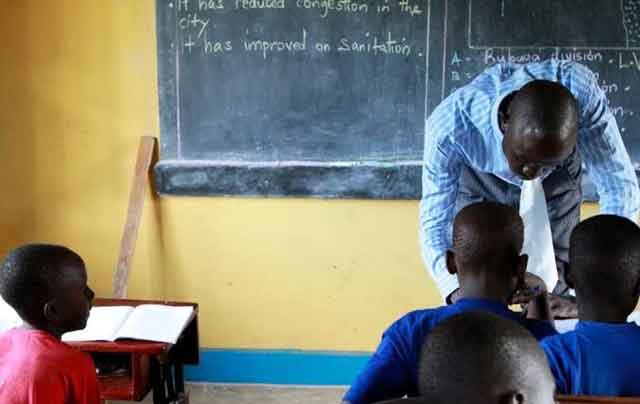
Private School

How I found my ideal students

By Ishaka Mohammed

My employers often commended my efforts, increased my salary and gave me bonuses even when I didn’t see any significant impact of my tutelage as a private school teacher. I was worried about my studentsʼ poor comprehension, negative attitude towards learning, and low morals. I couldn’t even stop them from cheating in tests and exams.

Although it was safe to link my failure to a lack of formal teaching qualifications, I expected the impact of the workshops I attended. And to cap it all, most of the teachers I knew (with the required qualifications) weren’t getting any better results. I was frustrated; I blamed parents, society and inadequate facilities—in that order.

However, I was joyous to get a job with an international school in 2024. The school offered excellent educational facilities, teacher training, a six-figure salary, pension, heavily subsidised lunch, and transport and accommodation allowances, among other things. Everything about the school was promising.

Nonetheless, my first meeting with the students ended my excitement. I worked harder than ever before, but as each new week brought tougher challenges, I conceded that I could neither minimise nor tolerate the disruptive behaviour and utter disrespect of the children of politicians, diplomats, business tycoons, etc. They came to the school for two reasons: to have fun and build rapport with their future business partners or political allies.

I quit the job after a term. While I was leaving, some senior colleagues commended my courage to do what they had been unable to do for years despite facing the same challenges that prompted my resignation.

I became jobless but happier, and I didn’t wish to teach again. But a call from a school proprietor in a distant state changed my mind. The head of the department I resigned from recommended that I attend a school he believed would suit me.

This happened when I was already preparing to start a new position in a different industry. My prospective employer is notorious for delaying salary payments.

After weighing the salary factor and the state of education in Yorubaland, I chose to return to teaching, and bingo! My new students meet all my criteria, particularly regarding their morals. Even though they come from privileged backgrounds, they are humble, respectful, and eager for knowledge. 

There was a day when we didn’t have enough teachers to invigilate the tests, and I was the only one who seemed concerned. Two halls were left without invigilators, yet everything went smoothly. I was impressed by the students’ maturity and honesty.

My meeting with these students has reminded me of many things, one of which is the importance of being oneself. While I recognise the significance of adaptability, I still believe that some principles should not be compromised. I appreciate the gentleman who referred me to my new employer. I commend the parents and guardians of these learners, the school management, and all the staff for nurturing such remarkable members of society. Once again, I am optimisticthat Nigeria will be better in the future.

Ishaka Mohammed wrote via ishakamohammed39@gmail.com.

Private school teachers and poverty: An insider’s view

By Ishaka Mohammed

I discussed in my last article why I don’t generally consider private school teachers victims of proprietors’ inhumanity. Many factors could be responsible for the seeming wickedness of some school owners. However, these teachers are mostly underpaid.

I understand that some private school teachers earn good salaries, but such usually come at the expense of their dignity and peace of mind. This is due to the presence of unruly students who are highly protected against reasonable corrective measures. A teacher must either tolerate their misbehaviour or be ready to quit.

In addition, schools that pay competitive salaries and have standard facilities often overlook other factors that might hinder learning aside from the teachers’ incompetence. Teachers’ efforts are hardly appreciated, as parents and proprietors judge everything based on the students’ scores in internal and external exams. As a result, teachers are usually under pressure to deliver near-perfect performance, hence sacrificing extra time and energy. 

Teachers in the above category are very few compared to those with meagre salaries. Based on my personal experience and interactions with colleagues and other stakeholders, a privileged private school teacher in Nigeria is one whose annual salary is enough to cover feeding, accommodation, clothing, toiletries, and transport expenses without attracting debts. I am talking about a person with perfect health conditions and no dependents.

I have seen instances where a teacher has to rely heavily on contributions (susu or adashi) for several months to be able to buy a new Android phone. 

Some people have questioned why anyone would choose to depend on such a job instead of finding additional sources of income.

Well, I don’t think anyone would decide to subject themselves to the life of penury that the job promises. 

Most private school teachers wish to have “side hustles,” but certain factors, such as time, location, information, capital, etc., block them.

We might think they should be able to access relevant information since they’re adults and educators, but life isn’t always like that. So, I believe that every individual, including you, the reader, can assist one or two teachers by occasionally sharing valuable information concerning alternative sources of income.

And if you own a school or are positioned to influence teachers’ well-being, I urge you to do your best to improve their economic status.

First, I appeal that you frequently review salaries based on economic realities and teachers’ efforts. Although salary increases largely depend on the organisation’s revenues, you must remember that a teacher’s failure to meet basic needs would adversely affect your organisation and education in general. 

Second, as much as possible, reveal dates on which your employees should expect salaries. This would allow them to plan how to use their money correctly. 

Lastly, strive to grant them access to interest-free business loans with flexible repayment terms. You can also organise workshops (for them) on managing multiple income streams.

I believe the implementation of the above suggestions would lead to win-win situations.

On wickedness of school proprietors

By Ishaka Mohammed

In a recently published article in The Daily Reality, one Muhammad Isyaku discussed the harsh reality of being a private school teacher in Nigeria. Despite arguing the inhumane attitudes of many school proprietors towards their employees (teachers), the writer admitted that there are still good school owners.

I have seen and heard about bosses being cruel to their subordinates in many private organisations, including schools. However, much as I wouldn’t want to completely rationalise the ill-treatment of any human being, I have to mention that some cases of maltreatment are simple reactions. Some workers break agreements without expecting any consequences. So, any attempt by a boss to implement a penalty could easily be considered as cruelty.

Nonetheless, I understand that some bosses take advantage of their subordinates by presenting them with seemingly unrealistic terms of contract. It’s unfortunate that desperation or economic realities force many people to sign some ridiculous conditions of service without a thorough examination.

For instance, as a secondary school teacher with over 24 lesson periods in a week and an average class size of 40 students, it would be unrealistic for one to prepare lesson plans and notes, deliver lessons effectively, give students a task after every contact and mark their books before proceeding to the next topic.

It would also be ridiculous for one to be expected at work by 7 a.m. and be prohibited from eating until the close of work (usually after 2 p.m.). Some people would sign but violate such seemingly impractical conditions and then demonise their employers for applying penalties.

A colleague of mine once lamented a deduction (for lateness) from his salary and threatened to resign. I found his outrage irrational because, despite the fact that we signed 7.30 a.m. in our conditions of service, our principal gave us a ten-minute grace. In addition, the first three violations in a month are pardoned. So, I wondered what that colleague really wanted.

Aside from the above, there are workers who hide their violations from their employers. Some go as far as telling lies to avoid penalties. I once went to work late and signed in after 7.40 a.m., but I was shocked when I later noticed that an older colleague, who arrived after me, falsified the time and signed in as if both of us had arrived before 7.40 a.m. Where is our integrity? Imagine what this colleague would have said about the organisation if the violation had been reported and penalised!

Things aren’t always what they appear on the surface. Just as many tenants are fond of demonising their landlords, many private school teachers vilify school proprietors by telling incomplete stories.

My views on this topic have made some people mistake me for a school owner. No, I’m not. In fact, I’m still a private school teacher.

I’ll share my thoughts on private school teachers’ salaries in another article soon, God willing.

Ishaka Mohammed can be reached via ishakamohammed39@gmail.com.

Debating the legality of institutional marketing in private schools

By Isma’il Hashim Abubakar

Schools established, owned and run by non-state actors and private institutions have, no one doubts, been providing a veritable substitute to the dilapidated public schools which have been suffering from wanton neglect by governments at various levels in Nigeria. Private schools have successfully, though not completely, reduced the burdens on governments to supply basic education for children in their public schools, which have been perpetually operating under the shadows of existential threat.

Although people of all social strata now have more faith in private schools and parents with even the meanest incomes and most fledgling source of earning, who always struggle to make ends meet, prefer to take their children to commercial schools at the behest of other life comforts, public schools, which serve as the last option for the extremely downtrodden, still seem to get congested due to the high number of enrollments of children from low-income families. If this indicates anything at all, it shows that people have now fully embraced modern education, and they can sacrifice the expensive things they have just to secure a quality formal education for their wards and children. 

While, as everyone knows, public schools tend not to have too many demands apart from the meagre or more affordable tuition fees, their private counterparts, in most cases, operate in such a way that many parents inwardly feel that the system is tilting more toward a business direction in an obvious capitalist fashion, despite that the dominant pretension of both parents and school managers is that of purely imparting knowledge and building sound character to the young and upcoming generation.

Many schools are extraordinarily excellent in both transmitting sound knowledge and instilling good morals in pupils, and as such, no material gratification can remunerate their work or compensate the teachers for their hard work, dedication and commitment toward discharging their duties and keeping good custody of what has been entrusted to them. In fact, some well-to-do parents often give gifts to teachers as an expression of gratitude for feeding their children with sound knowledge, which is primarily the responsibility of the parents but perfectly undertaken by the teachers on their behalf. As such, many parents may not bother with and will gently turn blind eyes to some straitjacketed and arbitrary financial demands that most commercial schools are now introducing day in and day out.

Some schools go beyond decorum and do not, in the least, pretend to be shy to depict their operation as a purely extortionate venture, deemphasizing the moral and instructional dimensions which their institutions are set upon. Parents now no longer feel at ease after having settled school fees which are the most basic financial burden that comes to everyone’s minds once private schools are mentioned. Not only do textbooks and instruction materials represent the source of anxiety that parents grapple with, but virtually everything which a school stipulates, largely with a marketing mindset. While most schools impose decrees that make it binding upon parents to buy textbooks, stationeries and all other instructional materials from the schools, some schools turn it into a rule that pupils and students must never be allowed into schools wearing uniforms supplied to them by their parents through all other channels apart from the tailoring unit of the schools.

Schools do complain that external tailors often violate dress codes and principles earmarked by the schools, including non-compliance with size, width and length but above all, the lack of authority to manufacture and issue official badges that are glued to uniforms. Hiding behind this pretext, schools have seized the free will of parents to transact with tailors of their choice, and because they aspire for their children to acquire quality education, they relinquish their right and bow down to the pressure of the schools. 

There is, however, no guarantee that the tailoring units of schools themselves are perfect for designing the most fitting and immaculate school attire for pupils. Having taught at both primary and secondary schools (as well as university), I have personally seen pupils wearing school-supplied uniforms that never matched or fully fitted the bodily structures of the pupils. If this is the case, this particular rule might have been informed more by a business instinct and less by a concern to preserve institutional dress codes. Parents of final year students who could only afford to pay for either WAEC or NECO exams for their children, which by the way, is better than missing both of them at once, are coerced by some schools to move heavens and earth to pay for the two exams or risk having their children removed from the list of graduating students. When they could not settle for the fees of the two exams and require the refunds of their money, they hardly recuperate more than half of what they have paid. 

Perhaps the most brazen example of such pecuniary impositions manifests in the demands of some schools on parents to pay internet charges, which would have been understandable and justified if pupils or students were engaged in regular computer lessons that are punctuated at close intervals by visits to websites. Alas! There are schools which extort this surcharge even from parents of nursery pupils, and the only justification for it is the data consumed by Whatsapp groups of parents initiated by the schools on which an administrator often sends announcements.

Many parents relate with schools while they are inwardly burnt due to how things have become in private schools, but because they envisage a better future for their children, they prefer to remain mute and only murmur their complaints on the rarest occasions or when they meet with fellow parents by the roadsides. The best opportunity for them to communicate or even express their squawks loudly to the schools is during periodic parents-teachers meetings, but the schools have been, paradoxically, hijacking and making platforms to further advocate their fiendish and self-aggrandizing policies. Their covert strategy is to appoint a loyal, docile and exceedingly compliant head of Parent-Teachers’ Association (PTA), and to gag his mouth for fear of being influenced by nonconformist parents, the schools bribe him with some free scholarship slots for his children. As a result, he weakens and sabotages any attempts by the parents to rise and challenge arbitrary extortions they suffer from these schools. 

Other schools have different, perhaps more treacherous strategies of navigating intricacies and tackling eventualities that may come up owing to this venture, such as giving undertaking papers for parents to sign before the children are accepted at the stage of enrollment, and many parents are carried away by the desire for the admission of their children and often don’t pay commensurate attention to these documents or mull over their future implications. The question that, however, is seldom asked, what is the legality of these modes of institutional marketing practices that have become norms in not only purely western-style schools but also model Islamic schools? To what extent do these operations comply with Islamic teachings and principles, and what are the business dimensions of these dealings which should then ideally be done and looked at from the viewpoint of Islamic commercial and financial regulations?

First of all, everyone knows what schools are primarily meant for, which is imparting knowledge and this should be the apex among all the operations that are expected to exist in the schools. Hence, from this prism, school fees are the most obligatory financial demands that parents are, by default, owed to schools and upon which any compromise will be a favour that the schools could grant or deny at will. Any other charge or tax is secondary and gains its legitimacy according to how it complements the primary function of schools, but, above all, it should be done in a transparent atmosphere defined by mutual agreement and understanding. In other words, selling textbooks, stationery and instructional materials at schools should be governed by Islamic commercial laws, without discrimination or thinking that schools could do as they will without referring to Islamic stipulations. If this is the case, then these materials sold to parents must be on the basis of freewill and agreement and not impositions that may result in penalties. 

Of course, many schools publish exercises and textbooks with their names and logos finely inscribed, which then makes it compulsory for parents to obtain the materials in no other places but the schools. Many other schools, meanwhile, retail the materials from markets and sell them to parents at exorbitant prices that at times double or triple the normal market prices. All these are normal and should be considered lawful businesses if only it is done with a mutual agreement such that parents have the liberty to buy either from the schools or at markets, or in the former case, if the materials are not sold arbitrarily at unimaginable prices just because of the inscriptions of logos and names. 

The general Islamic principle that confers legitimacy or otherwise to any business venture is free will and mutual agreement, and interestingly, this is explicitly postulated by the Qur’anic verse and Hadith, the two most fundamental sources of Islamic law. Allah says:

“Yā ayyuha alladhīna āmanū lā ta’kulū amwālakum bainakum bi al-bāṭil illā an takūna tijāratan ‘an tarāḍin minkum. Wa lā taqtulū anfusakum. Inna Allaha kāna bikum Raḥīma”.

“O you who believe! Eat not up your wealth among yourselves unjustly except it be a trade by mutual good-will: Nor kill (or destroy) yourselves: for verily Allah has been to you Most Merciful!” [Sūrat al-Nisā’: 29].

In his groundbreaking exegetical work al-Taḥrīr wa al-Tanwīr, the prolific commentator of the Qur’an, Muḥammad Ṭāhir Ibn ‘Āshūr posits that the prohibition to eat up people’s wealth without mutual agreement is paired with the crime of murder in the verse to draw Muslims’ attention on the gravity and heinousness of such a practice. He argues that it is emphasized because people do not largely consider it something significant and the victim is usually powerless and could hardly resist (as it occurs in private schools).

Moreover, in an authentic Ḥadith narrated by Anas bin Mālik, the Prophet (SAW) says, “lā yaḥillu mālu imri’in Muslimin illā ‘an ṭībi nafsin”. (It is unlawful to take a Muslim’s wealth except with his goodwill). [Dāru Qutnī, 3/26].

As asserted earlier, a lot of transactions in private schools are imposed upon parents, and school authorities often warn parents and even threaten to apply penalties when these marketing ventures are observed in the breach, leaving no room for a bargain and mutual consent that would ordinarily prevail in open transactions. Since this is the case, only a few people will contest the illegality of this practice. Needless to say, some officials and authorities, including ironically, of schools paraded as Islamic models, are, to some extent, oblivious of the legal status of their policies, although this is not a valid, genuine and acceptable reason. A Muslim is, after all, and before anything else, principally required to be fully conversant with the pros and cons of any action he undertakes.

One of the easiest ways to make amends and rectify this wrong tradition, irrespective of how well consolidated it is, how difficult it may be to refrain from or how odd our argument may sound to some, is to be so transparent and open to parents and gear the deal to be dictated by consent and mutual agreement. Freewill and mutual agreement are pivotal in any financial dealing and they determine whether it is done lawfully or unlawfully. 

And since schools, especially the religious ones, enjoy respect from parents, it will hardly be burdensome to mutually arrive at some understanding, and this, as beautifully ratiocinated by Ibn ‘Āshūr, could lead to the implementation of the divine principle that “if they give up willingly to you anything of it, then take it in satisfaction and ease” (fa in ṭibna lakum an shai’in minhu nafsan fakulūhu hanī’an marī’a) [Sūrat al-Nisā’, 4].

Indeed there is a need for governments to intervene and reintroduce guidelines that will neither oppress the schools nor allow them to do as they like, pertaining to their financial dealings with parents. Parents in Kano, for instance, will certainly look back with nostalgia at the era of Governor Rabiu Musa Kwankwaso, who laid down modalities that checkmated arbitrary extortions of parents by commercial schools. He formed a formidable committee that regularly went around schools and observed their operations to ensure they complied with state regulations, most of which were meant to shield masses from further extortions.

Unfortunately, Kwankwaso’s successors did not maintain the tempo, and now things are, to say the least, almost getting out of control. School authorities would increase school fees at will and would rush to mention inflation as a cause and the need to better the condition of their staff, while in essence, it is the proprietor and a few notable among his cliques that would end up enjoying while flowing pittance to and leaving the majority of staff to keep on wallowing in despondency.

Ismail writes from Rabat, the Kingdom of Morocco and can be reached via ismailiiit18@gmail.com.

The harsh reality of being a private school teacher in Nigeria 

By Muhammad Isyaku

The challenges faced by private school teachers in Nigeria are weighty. Many feel undervalued and disrespected by school proprietors, who often fail to treat them as equals. Despite their qualifications, teachers find themselves in dehumanising situations where their salaries are insufficient to meet their basic needs.

In Nigeria, private school teachers, particularly those working at the crèche, nursery, primary, and secondary levels of education, are akin to pumpkins in deserted homesteads because most school proprietors don’t treat them as fellow humans.

Imagine someone who has never paid your school fees; they just met you as a graduate with your qualifications, but because you are working under them, it would be dehumanising to you as if what they pay you could cater to your life demands.

Private school teachers are going through tough situations, and some of them contribute to their misfortunes because they are stuck in monster schools where they are not respected and dignified. If not for weaklings and silly-minded teachers, how could you choose to continue working with a proprietor who doesn’t respect your persona?

Some proprietors would shout at teachers in front of the students or their parents, giving students much higher priority than teachers in some schools. Some proprietors would prefer losing a teacher to losing a student, and the only excuse they have is that they might use the money to employ another teacher to replace the one they lost but could not use the funds to bring in students to their school, which is a terrible idea to me.

Furthermore, private school students are often disrespectful. Most of them don’t exhibit good manners in school, and their reason for misbehaving toward teachers or other school personnel is that their parents pay for their school fees, so they should be exempted from discipline. In contrast, students in public schools behave better because the government pays for them and provides everything for them for free.

In my experience, the most annoying place for a graduate to work is a private school. Though not all private school students are hellish or mannerless, some respect us as our younger siblings do at home. I won’t fail to admit that but the majority are not well-mannered. 

Most of the management in those schools doesn’t respect the welfare of their staff, but they want teachers to do a donkey job for them in the school. Some even have the manner of owing salaries; some would pay but not complete; some would pay, but teachers have to buy all the textbooks needed for their subjects.

I don’t want to be on record saying all proprietors are bad. Some are good and nice to work with, but others are pharaohs in human skins. My only candid advice for young graduates of either NCE or degree programs to work for private schools is for experience’s sake, nothing more or less.

Suppose one works in a private school before getting employment by the government or any private sector. In that case, he will learn much more, especially by being contemptuous and modest, because the salary can never be enough. Though nothing can be reached in this life, patience is the key.

However, in a private school, if one is to calculate what he is earning, even a pure water hawker could be earning more than he does in a month if all the daily earnings are to be calculated at the end of the month. 

I advise graduates to look for alternatives to teaching in private schools because those proprietors would exploit them and get richer through their sweat while they are getting poorer. The annoying part is that they don’t appreciate your effort. If they did, they should have found a token or incentive to offer you or pay while on vacation, but they won’t. All they do is let the month end before they pay you the salary.

People, especially young graduates, should go and learn skills or other business because teaching in private schools is not for them and can never contain their needs, especially in this hard-hit Nigeria. I am saying this from experience and as a private school teacher presently.

Moreover, for those who might be stricken or hurt by my words, I want to categorically state that I owe nobody an apology whatsoever. If you are unhappy with my submission, you can write a rejoinder and counter-argue.

Muhammad Isyaku wrote via muhammadisyakumalumfashi@gmail.com.

Academic slavery in school: A must-halt journey

By Sulaiman Mohammed

Education is often regarded as the foundation of every society, the key to unlocking prosperity and success for nations and individuals alike. Yet, despite its importance, the individuals responsible (teachers) often find themselves not only underpaid but also underdeveloped.

The most common complaint among teachers in private schools is the poor payment as monthly income they receive for their hard work and dedication. As a profession (teaching), it requires significant time, effort, and skill. Many hours are spent planning lessons, grading assignments, and providing individual student support. Teachers play a crucial role in shaping the future of society, yet many are struggling to make ends meet.

The low salary that many teachers receive fails to reflect the importance of their work and makes it difficult for them to support themselves and their families. This affects their well-being and their ability to teach and inspire their students effectively. 

In my community (Rigasa, Kaduna state), I know of many qualified and experienced teachers who left school for another or even a different profession outside of teaching, all courtesy of underpayment and undervaluation to the detriment of the students. 

Finally, to ensure that students receive a quality education, teachers need to be adequately compensated in terms of fair salary, access to benefits, and other professional opportunities for staff sustainable development. Only then can we ensure that our schools are staffed with dedicated and passionate educators who can provide the best education. 

This is in dedication to Mallam Salihu, Bn Masood, Yunusa Bala, Mallam Umar, Haruna Bala, and several other teachers in this profession. Keep on keeping on; the students and society are our concern.

Sulaiman Mohammed wrote via muhammedsuleiman213@gmail.com.