Plateau killings

The normalisation of atrocities on our roads: A call for accountability

By Kabiru Danladi Lawanti, PhD 

I cannot recall any incident where a vehicle or travellers were targeted simply because they were from Plateau State, in retaliation for the atrocities being committed by these savages.

Please, I challenge anyone to provide a single example—since 1914—where innocent travellers were attacked in Kebbi, Sokoto, Zamfara, Katsina, Niger, Kano, Jigawa, Bauchi, Gombe, Yobe, Adamawa, or Borno simply because they were seen as the “other.” 

Yet, we have countless documented cases from Tinno, Mambilla, Takum, etc., in Taraba; Riyom, Barikin Ladi, Jos, Mangu, etc., in Plateau; Agatu, Makurdi, etc., in Benue; and Gonin Gora, Koi, etc., in Kaduna, where innocent travellers were blocked, maimed, and killed—dismembered and buried or even burned alive—solely because of their identity as “others.”

These are normalised atrocities. The perpetrators are getting away with it because there have been no consequences. Only God knows how many lives have been lost in this manner between 2002 and 2025. 

Many of these crimes are well documented—some even recorded and posted by the criminals themselves, proudly sharing selfies while committing barbaric acts. Remember the Eid day massacre in Jos? Or the genocide in Mambilla? These incidents are documented by security agencies.

Tragically, these criminal gangs enjoy the backing of some politicians and community leaders. Take, for instance, the disturbing justification offered by the Chairman of Mangu Local Government Area regarding the killing of wedding-bound travellers from Zaria. Is that how a leader is supposed to speak?

Even more worrying is how these barbaric acts are celebrated on social media. Look at the screenshot of Kefas Gyang Pam that went viral yesterday, or the posts from a Facebook group in Bokkos openly celebrating the gruesome attack on the innocent Zaria travellers.

These individuals are not ghosts. They are known. And they can be easily traced.

Kabiru Danladi Lawanti, PhD, wrote from Ahmadu Bello University, Zaria.

The killing of Zaria travellers: A wake-up call to our failing conscience

By Muhammad Umar Shehu 

I read with deep shock and sorrow about the gruesome murder of innocent travellers from Basawa in Zaria LGA of Kaduna State. It is heartbreaking and disturbing. 

What is happening to our society? When did we become so heartless that taking a human life no longer moves us? When did we start watching these tragedies unfold without reacting, without speaking, without demanding justice? This is not normal. We are clearly losing our sense of humanity and conscience.

The killing of these travellers is wicked, and it must be condemned in the strongest terms. No matter the excuse, mob action is mob action. Whether it happens in Plateau, Uromi, Kaduna, or anywhere else, it is lawlessness. It is cruel. And it has no place in any society that wants to grow, that wants peace, that wants justice. The moment we begin to justify the unjustifiable, we open the door to more bloodshed and deeper division.

The Federal Government, Plateau and Kaduna State Governments, security agencies, traditional rulers, religious leaders, and all other concerned stakeholders must rise to the occasion. This crime must not go unpunished. It is not enough to issue statements. Action must follow. Those behind this evil must be arrested, investigated properly, and brought to justice. That is the only way this act can serve as a warning to others. We cannot continue to act as if all is well when innocent lives are being wasted with no consequences.

It is painful to admit, but we have become a society where people record killings with their phones instead of stepping in to stop the madness. Where is our sense of community? Where is our compassion? The silence and indifference from many quarters are just as dangerous as the violence itself. We must speak up, we must act, and we must demand better from those who claim to lead and protect us.

The media, civil society, and the public must not let this incident be buried under the weight of the next trending story. These lives mattered, and these families deserve answers. We must keep the pressure on until justice is served. A society that fails to protect the innocent will one day be a danger to everyone, including those who look away.

May the Almighty Allah forgive the victims, grant them eternal peace, and give their families the strength to bear this painful loss. And may we, as a people, wake up before it is too late.

Muhammad Umar Shehu is a writer and social commentator from Gombe and can be reached via umarmuhammadshehu2@gmail.com.

Wave of carnage in Plateau leaves 41 dead, many homes destroyed

By Muhammad Abubakar

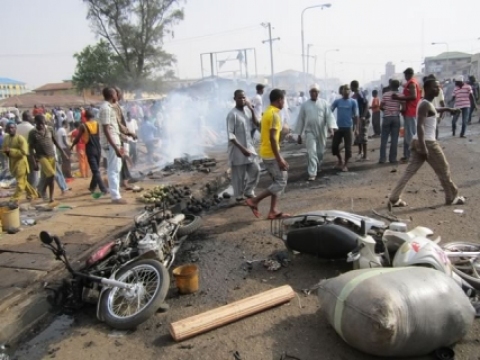
A wave of violent attacks across Plateau State over the past week has claimed the lives of at least 41 people, with dozens more reportedly wounded, local sources and security officials have confirmed.

In what residents describe as a series of coordinated assaults, a total of 96 homes were set ablaze in several communities, displacing scores of families and raising fresh concerns over the escalating insecurity in the region.

The attacks, which spanned multiple local government areas, are believed to be part of ongoing communal clashes and reprisal violence that have plagued the state for years. Eyewitnesses recount harrowing scenes of gunfire, arson, and panic as armed assailants descended on their villages under the cover of darkness.

Authorities say security operatives have been deployed to the affected areas, but locals continue to express frustration over what they perceive as a slow or inadequate response to the violence.

While the Plateau State Government has condemned the attacks and promised to bring the perpetrators to justice, humanitarian agencies are calling for urgent relief efforts to support the growing number of displaced persons.

As of the time of this report, no group has officially claimed responsibility for the attacks. Investigations are ongoing.

When Plateau dies and FG watches

By Abdulhamid Abdullahi Aliyu

In the early hours of Friday, April 12, 2025, Zike village in Bassa Local Government Area of Plateau State was reduced to a theatre of blood. At least 40 people, including women and children, were brutally killed by armed assailants who invaded the community under the cover of darkness.

Homes were set ablaze, farmlands destroyed, and hundreds displaced — once again. This is not an isolated tragedy. In less than four months, Plateau State has lost over 400 lives to mindless violence across Mangu, Bokkos, Riyom, Barkin Ladi, and Bassa LGAs.

According to data from local community leaders and humanitarian groups, more than 150 villages have been attacked since January 2024, with thousands displaced and properties worth billions destroyed.

Yet, the response from government authorities has been chillingly muted. Standard condolence statements have followed each carnage, but little in the way of justice or proactive security. For many in Plateau, it feels like being condemned to die in silence.

The question is painfully simple: for how long will this continue? The victims of these attacks are not armed militias or combatants. They are primarily farmers, traders, women, and children — people asleep in their homes, utterly unprepared for war but caught in its crosshairs.

The attackers, on the other hand, are described as well-coordinated, heavily armed, and operating with an eerie sense of impunity. The carnage in Plateau should not be seen as just a “communal crisis.” It is terrorism — plain and simple.

Any act that involves the targeted killing of innocent civilians on such a consistent and organised scale deserves to be treated as a national security emergency. The lack of urgency from both the federal and Plateau State governments is not just disappointing — it is dangerous.

The time has come for both levels of government to stop playing to the gallery and act. President Bola Ahmed Tinubu and Governor Caleb Mutfwang must rise above politics and confront this crisis with the seriousness it demands.

Enough of the empty press statements. The people of Plateau need protection, justice, and healing, not promises. There must be an immediate and thorough investigation into the Zike killings and all previous attacks across Plateau State.

The security agencies must identify and arrest the perpetrators. Communities cannot continue to bury their dead while those responsible roam free. Beyond this, a special joint military-police operation should be launched in Plateau — not as a temporary show of force, but as a sustained mission to flush out criminal elements and restore peace across all hotspots.

Such an operation should be intelligence-led, with active engagement from community leaders, local vigilantes, and civil society actors. Security operatives must also be adequately funded, equipped, and monitored to ensure professionalism and accountability in the course of duty.

Furthermore, there should be a comprehensive resettlement plan for displaced persons. The IDP camps in Plateau are filled with women and children who have been forgotten by a country that swore to protect them.

The government must support rebuilding destroyed homes, schools, and clinics in the affected communities. Most importantly, the culture of impunity must end. When killers are not punished, others are emboldened.

When justice is denied, peace remains a fantasy. Nigeria cannot claim to be fighting insecurity on one hand and tolerating unaddressed massacres on the other. This country must no longer treat the deaths of rural Nigerians as a footnote in national discourse.

The tears in Plateau are real. The graves are real. The trauma is real. And so must be our response. Plateau State is bleeding. Its people are tired. And the time to act is now — not with words, but with swift, firm, and visible action.

Abdulhamid Abdullahi Aliyu writes from the Centre for Crisis Communication (CCC) in Abuja.

Plateau Attacks: What is salient from the silent

By Musa Kalim Gambo

ND Shehu Kanam, a political scientist and son of the soil, offered a searing insight into Governor Caleb Mutfwang’s recent statewide broadcast in a Facebook post following the blood-soaked tragedy that befell some communities in Plateau. In dissecting the speech, he made a remark that has lingered in my conscience like smoke from an unquenched fire:

The governor made reference to previous attacks including Dogo Nahauwa and completely ignored the attack in Garga District of Kanam LGA in 2022 where over 100 lives were killed. At all times, Kanam LGA is being treated as third-class citizens in Plateau State.

And how true that is—how bitter, how brazen. One would expect that in the arithmetic of grief, every loss would count, that memory would not play favourites. But alas, even in mourning, there is politics. Even in death, there are those deemed more worthy of remembrance than others.

Let’s be clear: every act of violence against any group of people is an abomination. It should be met with absolute condemnation. Those who carry out such horrors—burning homes, hacking down the old and the young, silencing lives with the crack of a rifle—are not just criminals. They are monsters in human form, agents of chaos and cruelty, and they must be made to face the full wrath of justice, if justice still has a name.

But then we turn to the governor’s address. Perhaps the speechwriter, weary and burdened, meant no harm. Maybe it was all too much—the urgency, the pressure, the tears behind closed doors. Perhaps grief blurred the pen, and memory failed. But selective memory tells a deeper story, whether by accident or design. It speaks of a hierarchy of pain where some cries echo louder in the chambers of power while others are muffled into silence.

The omission of the Kanam massacre, where bullets and blades buried over a hundred souls in 2022, is not just an editorial oversight. It is a symbolic erasure. It is a painful reminder that suffering is not always seen in some communities in Plateau. The state does not always mourn their dead. Their pain is not always acknowledged. In the cold theatre of political memory, Kanam seems to occupy the balcony—watching, grieving, unheard.

But why? Why must Kanam and others like it constantly beg to be seen?

Maybe the intention of the governor’s speech wasn’t to compile a historical record of tragedies. Perhaps it was just a passing mention meant to stir the ghosts and frame the urgency. But even a passing mention must carry the weight of justice. When invoking past massacres, we must strive for balance, breadth, and truth. We cannot cherry-pick grief.

This is not mere sentimentality—it’s about shaping policy from a place of inclusion. When the memory of a people is consistently erased or ignored, how can they believe in the solutions presented to them?

Interestingly, embedded in the governor’s speech was a subtle but telling reference to the nature of the attacks. The subsequent ban on open grazing and cattle movement at night across the state implies that the perpetrators may be connected to patterns of pastoral violence. Whether these connections are definitive or speculative is for the intelligence community to clarify. Yet, in that policy, one senses that the governor has a working theory of the violence–it is, therefore, expected that this act of violence will be brought to a definite end very soon.

Still, even the most astute policies will fall flat if people feel excluded from the conversation—if they feel like third-class citizens in their own land.

A state cannot heal when its government speaks selectively, and a people cannot move forward when some of their dead are left behind in the narrative. To move forward, we must gather all the names, all the villages, all the cries, and lay them bare—without hierarchy or hesitation.

Governor Mutfwang must do better. Plateau deserves better. Kanam demands no pity—only remembrance, and justice.

Let this not be another footnote in the long, bitter history of the Middle Belt. Let this be a turning point—where silence gives way to truth, and truth gives rise to healing.

Musa Kalim Gambo writes from Barkinladi, Plateau State.

Bassa Killings: Obi calls for urgent federal action

By Muhammad Abubakar

A devastating attack has claimed the lives of over 50 people in Bassa, Plateau State, triggering national outrage and renewed calls for decisive government intervention. The latest wave of violence occurred just a day after a visit to the region by Peter Obi, the Labour Party’s presidential candidate in Nigeria’s 2023 general election.

Obi, who had praised the resilience of Plateau’s people during his visit, expressed deep sorrow over the killings, calling them “heartbreaking” and “unacceptable.” In a strongly worded statement, he condemned what he described as a “deliberate, systematic pattern of coordinated attacks,” echoing similar concerns raised by Governor Caleb Muftwang.

“This is not the time for press statements,” Obi said. “It is time for concrete, strategic action. The people of Plateau need more than sympathy—they need security.”

He urged the federal government to immediately deploy reinforced security operations and actionable intelligence to identify and dismantle the criminal networks behind the atrocities.

Obi also called for swift justice for the victims, emphasizing that peace and dignity are the rights of every Nigerian citizen.

The incident marks another grim chapter in the ongoing violence plaguing Plateau State and raises urgent questions about the effectiveness of current security measures. Obi extended his condolences to the grieving families and prayed for strength for the people of Plateau and eternal rest for the departed.

Police nab gunrunning trio linked to Plateau killings

By Uzair Adam Imam

In a recent development, the police have apprehended three suspected members of a gunrunning syndicate believed to be connected to the December 24 attack on Plateau communities.

The announcement was made by ACP Olumuyiwa Adejobi, the Force Public Relations Officer, during a media briefing in Abuja.

Following an order from the Inspector-General of Police, Mr. Kayode Egbetokun, strategic measures were put in place to bring the attackers to justice.

The arrested suspects were found with significant weaponry, including an ash-coloured Golf car, an AK-47 rifle, an AK-49 rifle, 1,000 rounds of live ammunition, and five magazines.

Efforts are underway to capture additional individuals involved in the attacks, and the public will be kept informed as events unfold.

In a related incident, police operatives on December 13, 2023, arrested nine suspects over the attack and murder of three Fulanis in the Gaube area of Kuje Area Council in the FCT.

The suspects, identified as six members of the hunters and forest guard in Kuje, confessed to the crime. The victims, three Fulanis in transit from Keffi, Nassarawa State, to Niger/Kwara states, were attacked and killed.

The suspects abandoned the bodies in Kabi forest, taking their Bajaj motorcycle to an unknown location in Takuba village, Kuje.

The recovered corpses were examined and confirmed dead by a medical practitioner before being released to their families for burial.

The deceased Bajaj motorcycle was also recovered, with investigations still ongoing. Additionally, police operatives arrested a suspected armed robbery and kidnap kingpin in Nasarawa State, found in possession of an AK-49 rifle and ammunition.

The suspect admitted to using the rifle and ammunition for criminal activities. During the investigation, the suspect revealed that another accomplice, currently at large, possesses an AK-47 rifle used by the gang to terrorize Nasarawa State.

Intensive efforts, including technical intelligence, are being employed to apprehend the fleeing suspect and recover the firearm.