Northern Nigeria

“I Will Sell My Cows For You To Become a Pilot”: The Incidence of Babar Mai Fura, Hausa Women and International Women’s Day

By Prof. Abdalla Uba Adamu

His name was Sadik. Perhaps about 11 years old. He walked into my newly allocated office in the old Mass Communications building of Bayero University Kano (Nigeria) in 2013. I was startled. He was a tiny boy with deep dark skin, a beautiful face with intense eyes and a dolphin smile. He asked if I wanted to buy Fura (steamed millet balls blended in cow milk, often used as dessert, although it could stand on its own as a nutritious meal). He did not look like any of the usual urchins who thronged the corridors of the building look for odd jobs – run errands, empty trash, sweep office when those officially charged – and paid – to do so did not. Intrigued, I ordered one. He disappeared and returned some twenty minutes later with the Fura in a transparent plastic bag. I paid him, and that was that.

He returned the following day. When I declined to buy it because I didn’t feel like drinking the Fura, he insisted I buy it for others. When I asked why, he simply retorted that I appeared richer than other staff because, first, I was a professor, and second my office was larger. I was amused by his evaluation of my finances based on my position. And true, my office was the largest for staff, but I was a new bride in the Department – having been wedded to Mass Communication after an amicable transfer from the Department of Science and Technology (thus the ‘double’ professor tag), and all stops were pulled to make me welcome. Based on his logic of having a larger office, if not a deeper pocket, I bought about ten and asked him to distribute them to colleagues.

Sadik was to become a regular fixture in the corridor. Always after 2.00 p.m. One day he came with a blue checkered school uniform. Mentally, I thanked the boy who gave him the ‘hand me down’. The uniform was from Musa Iliyasu College, located along Gwarzo Road, a few kilometres from the New Campus of Bayero University Kano. This was a private and prestigious high school in Kano, attended by the children of the well-to-do.

I was told, however, that the uniform was his own and that he was indeed a student at the famous prestigious college. Curious about the human aspect of this development, I decided to delve further. What I found was what I want to share with you regarding the world of Hausa women.

Sadik did not come from an elite home. He was from a large Fulani family living in a ruga (a Fulani cattle encampment) near Janguza Army Barracks in Kano – itself a few kilometres from Bayero University Kano, New Campus, along Gwarzo freeway. The unit was a father, three wives and eighteen children. Sadik was the eldest in his mother’s room. They were herders. Indeed, Sadik was born near Tamburawa along Zaria Road in Kano when the family was on the move in 2002. They camped near Janguza Barracks, where they located their ‘hometree’.

The mother was the one selling the Fura at Bayero University Kano New Campus that Sadiq marketed. She had a ‘stand’ near the Faculty of Engineering. She had a lot of customers in all categories of the university community. After all, even professors love Fura. Her interaction with the university community enabled her to develop an interest in education, and she wanted to get Sadiq to attend a school and eventually a university. She did not want Sadik to follow the family herd. His father, however, wanted the child to join the family herding tradition. The mother then engaged one of her customers, a professor, to drive to the ruga and convince the father to allow the child to attend school, to which he reluctantly agreed. The mother then took over the process of educating the child.

She enrolled him in a local private primary school inside the Janguza Barracks. After he finished, she inquired which was the best high school around, and Musa Iliyasu came highly recommended. She enrolled him there. An exclusive private school. Paid for from the proceeds of her Fura business. She bought a bike for Sadik to make it easy for him to attend the school, some five kilometres from their tent. His legs could barely reach the pedals, but he was enthusiastic about learning. After school, he would go to her Fura stand, park the bike and then trample all over the BUK mega building advertising his mother’s Fura (even boldly entering the Vice-Chancellor’s office to market the Fura), all the way till 6.00 p.m. when they close ‘office’.

I interacted with Sadik for three years. He was so curious, bold, confident and always lifting books on my desk, trying to read them, asking endless questions, his eyes always darting and roving all other office. He was truly an inquisitive and intelligent child.

In 2016 I temporarily relocated my place of work to Abuja, and that was the last I saw of Sadiq. I did not fully return to Bayero University till 2022. In the intervening period, I had wistfully thought of Sadik and finally decided to find out what had happened to him when I returned. It was a massive success story of doggedness by a traditional woman.

When Sadik finished Musa Iliyasu College, he told his mother he wanted to be a pilot. She asked him to find out how much it would cost. Off he went to the Nigerian College of Aviation Technology (NCAT), Zaria, where he learned the fees could be as much as ₦7.5 million. He informed his mother, who immediately asked him to continue the process of getting admitted. She would pay the entire sum – after all, she was already a millionaire with the large herd she had. She earmarked the number of cows to sell to raise the pilot school fees. Sadik did the entrance exams but did not scale the final test. So, he was not admitted.

He then applied to BUK with his JAMB score of 201 for Computer Science but did not meet the Post-UTME requirements for the program. Again, he faced rejection. His mother initiated the process of getting him alternative university admission and was advised to take him to Al-Qalam University, a non-profit Islamic university in Katsina. He went there and inquired about the admission process and the fees. With his results, he was admitted. His mother sold two of her cows for ₦450,000 and gave him the money to pay for the school fees in Computer Science and his accommodation in Katsina. He enrolled and started his program.

When he relocated to Katsina, she sent him money every day. She eventually gave him ₦200,000, with which he started a Fura packaging business, employing his co-tenants in the house he was renting. Soon, he established a small business employing other students. Eventually, he vied for and succeeded in becoming the Vice-President of the Computer Science Students Association of the Al-Qalam branch.

Sadik became a dedicated student with a consistently high CGPA, which could eventually lead to either a good second upper or a first in Computer Science. He was eventually elected the President of the Computer Science Students of his university chapter. One day, the officers of the Association came to Kano for a function during a school break and decided to see his house, especially after he told them he lived in a ruga. They were astonished to discover he was telling the truth – their respect for his modesty raised higher.

In January 2023, I was in my office at the Faculty of Communication BUK when someone walked in. I was bent on my laptop but did notice the guest removing his shoes and coming and standing in front of my desk, waiting for a pause in my typing.

I looked up at a tall well-built young man. I immediately knew it was Sadik. At 21 years, everything about him has changed, of course, but not his dolphin smile. He told me he learnt I was asking of him and decided to come and greet me. I was so happy to see him, and it was he who related to me what I had written so far. I immediately connected him to Sunusi Ahmad Baffa Dawakin Tofa, Chairman of the Kano State chapter of the Fulfulde Development Association of Nigeria (FULDAN), of which I was a patron. They promised to come together and see how Sadik could be part of community mobilisation awareness and a role model, especially for youth. Sadiq owes his success so far to his mother.

Professor Abdalla Uba Adamu and Sadik

***

Sadik’s mother, Hajiya Hauwa Suleiman Dikko, was not an educated, entitled, privileged woman. She did not go to school. Her class was the hard knock of life. As a young girl, she missed going to school with lunchboxes and rucksacks festooned with stickers from the Marvel Cinematic Universe – Spiderman, Hulk, X-Men, and Fantastic Four. She did not attend a privileged landscaped school with paintings of Micky Mouse and Donald Duck on their walls. She had no driver to chauffer her to school in an airconditioned SUV. No TV to return to after school hours in a nice airconditioned living room. No iPads to play with. No Netflix to relax her hard stressful day. No extra lesson teacher (Uncle John or Auntie Funmi) to ensure she passed those horrible subjects such as Mathematics.

Her contemporaries who lived such life finished successfully from their expensive private schools (of course, no private school would allow mass failure, especially from children of the privileged) and had gatekeepers to ensure they got admission into the juiciest disciplines in the university of their choice. If at all in Nigeria – otherwise, it would be off to Ukraine (before it became too hot), some obscure countries in Eastern Europe, India, Cyprus, the UK or preferably, Malaysia.

When such contemporaries returned, they had cushy jobs waiting for them and a relatively easy path to the top. Eventually, they are celebrated as women of substance – given awards (which they don’t need) and celebrated in academic papers and opinion pieces as role models of female achievement and doggedness in a patriarchal society. I don’t mind their high-profile visibility. I just believe the accolades are wrongly placed, or at the very least, the Point of View (POV) should sweep around.

My female heroes? Those I will be celebrating today, the 2023 International Women’s Day? Let’s start with Sadik’s mother. And hundreds of others like her. I am sure you know one or two in your locality. They are women, often widowed, left alone, with little or no inheritance, and who, with the little they have, were able to provide much-appreciated services in their communities and keep a tight hold on their families. They don’t engage in endless and fruitless debates about gender identity or reproductive rights nor women’s representation in political representation and their share of hegemony. Rhetoric. Talking loud and saying nothing. As my main Man sang, “Like a dull knife / Just ain’t cutting / Just talking loud / Then saying nothing”. (James Brown, 1970).

Mainly, restauranteurs, these local women build people and impact their communities. With their business – restaurant (ƙosai, koko, tuwo, ɗanwake, wake da shinkafa, alkubus, gurasa, ƙashin rago, etc.), public transport (Keke NAPEP, buses, Acaba/Okada, Ƙurƙura), estate (properties, rental apartments, plots of land) – they are the role models who should be celebrated. They don’t feel entitled and are privileged in the peace of mind they have and the mentoring they do in their communities. They have no PAs, SAs, fierce dogs at the gates of their solar-powered villas and mansions, no frowning ‘maigad’ to intimidate and scare away panhandlers.

They have no SUVs as the cost of one could serve as capital for a whole year for their business. They don’t even have cars, despite some owning a transport business or so. They do not take their holidays in London or Dubai – they have no time for holidays as they are busy serving their communities. They marry off their daughters, not in grand style, with furniture imported from IKEA in China but from local makers – thus contributing to local economies.

So, what should be the concerns of women on International Women’s Day? For me, with a focus on Muslim Hausa women living in traditional communities, how about integrating them into the modern sector digital economy? Instead of empty rhetoric about gender representation, why don’t we focus on enabling them to acquire skills such as mobile phone repairs and POS services – in the comfort and safety of their homes? Many women are now engaged with mobile phones and online trading and payments. Muslim Hausa women feel unsafe in approaching service centres where clusters of men provide these services. Empowering them to be skilled in digital knowledge in the lungu and saƙo (alleyways) of our communities works better than hot-air rhetoric and genuinely can make a difference.

On this day, I, therefore, award accolades to Sadik’s mother, Hajiya Mai Ƙashin Rago Fagge (with a whole street named after her), and countless others whom I am sure Jaafar Jaafar knows more. They are truly women of substance.

Today, being International Women’s Day, please locate any in your community, go right up to her and appreciate her. Celebrate her achievements and her silent but visible impact in the community as the REAL woman of substance.

PS: Some have asked about Sadik’s whereabouts. He is in his final year at Al-Qalam, Katsina, Computer Science, and from his results so far, he is heading towards either a First Class or a very good Second Upper.

Professor Abdalla Uba Adamu can be contacted via auadamu@yahoo.com.

President-elect and the citizens’ expectations

By Usman Muhammad Salihu.

Nigeria as a country is bedevilled with so many challenges and problems ranging from insecurity to inflation which causes a high cost of living, and the recent introduction of a cashless policy aimed at boosting the economy of the country but somehow causing life more difficult, especially to the masses, among other contributing factors.

Insecurity, especially the issue of Boko Haram militants (in the North East and some parts of north-west and north Central), where almost on daily basis bomb blasts occurred, hundreds of people killed and taken thousands into captivity, among others, were the major factors that force many Nigerians to preach the gospel of change in the year 2015 which after the then general election produces the incumbent president Muhammadu Buhari.

As time went on, Muhammadu Buhari’s administration did quite an impressive performance in curtailing the menace of Boko Haram, but yet, the rising of another phenomenon which is banditry.

Bandit came as a result of the farmers-herders crisis, which later escalated to another phenomenon currently causing serious and harmful effects on our economic, political and social development.

These bandits were known to be riding into villages on motorcycles in order to loot, rape and kidnap the inhabitants of such villages as well as kill anyone who resisted.

 Kidnapping nowadays has become a very lucrative venture, especially in north-western Nigeria. Between 2011 when the problem started to 2022, Nigerians paid millions of naira to free family members, friends, and relatives and in most cases, village inhabitants have to forcefully made by these bandits to pay a certain amount to them in order for the inhabitants to stay in their villages and carry out their day-to-day activities.

Moreso, the issue of the educational sector revamping, the ASUU’s eight months strike is still afresh in the minds of fellow Nigerians, especially students. Without revamping this sector, the future of our youths is at stake. As the saying goes, to kill a nation is to deny it education.

On the economy of the state, is there any nation that exists without an economy? The administration to come must have to do the needful to avoid the policies that may cripple the country’s economic sector, and this can only be done through forming a committee of economic experts who will be advising the government and leading the economic development aspect of the country.

The judicial system has to be allowed to carry out its full function without hindrance or interference from the government. This will pave the way for the sector to maintain its full function and possibly speedy arraignments and passing judgements effectively, and aside from that, it helps the government in the fight against corruption.

To whom much is given, much is also expected.

The 2023 general election is one of a kind, where the issue of vote buying was drastically reduced to a minimal level. This is saying that Nigerians voted for the President-elect based on their expectations of him hence being ready to face the numerous problems of the citizens and find out their solutions.

We pray that the president-elect’s campaign slogan ‘RENEWED HOPE’ will indeed renew the already lost hope of Nigerians.

Usman Muhammad Salihu writes from Mass Communication Department, Abubakar Tatari Ali Polytechnic, Bauchi, Bauchi state. He can be reached via muhammadu5363@gmail.com.

Conversations we must have with the President-elect

By Abubakar Suleiman

The period preceding the presidential elections was greeted with intense and unrestrained emotions, outright bigotries and zingers from political opponents and supporters alike, so much that discussing issues that really matter was out of the table.

Public pundits who tend to raise their voices or pen down their thoughts on the challenges ahead got their ideas or pressing questions drowned amidst fierce online arguments. Discussing the manifestoes of the parties of the major contenders took the back seat while bickering on variables like the contestants’ age, health, religion, region, and ethnicity became the front burner across many platforms.

As the wave of the electioneering is beginning to disappear and the elections have been won and lost, I think we can start to ask the president-elect, where do we go from here? His job has been well cut out for him. And it will definitely not be an easy ride, and we need to be realistic.

Contextually, should subsidy finally go or stay? Should education at tertiary institutions be subsidised or commercialised? How do we push the country towards a knowledge-based economy? How will the poor access quality basic and tertiary education? How do we fund deficits in the power sector to make industries wake up? Can we change the security architecture? Should state police be created? Should we continue to maintain two chambers in the National Assembly? And how do we source the fund to run the government? To what extent should we play politics with governance? Can all these and many more be done in 8 years? The questions are many.

The election and its aftermath exposed the fragile unity between the regions and religions that made up this geographical space called Nigeria. Therefore, as a matter of urgency, the President-elect should hit the ground running by reaching out to aggrieved regions and their leaders by assuaging their real or imagined fears and grievances.

The problems of the country are too enormous to be dragged back by agitations and the feelings of being left out. Therefore, an inclusive government and approach to governance have never been this necessary.

Security

Just when President Muhammadu Buhari was about to claim victory over Boko Haram and insecurity in the North East, unprecedented spates of killings, kidnappings and banditry reared their ugly heads in Northwestern Nigeria.

A huge swathe of land became inaccessible, many major roads were deserted, farming nosedived, and a humanitarian crisis ensued. With these problems, many people found themselves in the yolk of poverty. Others became homeless, and fangs of hunger rendered many others dead.

The security structure is in dire need of an overhaul. Community policing, intelligence gathering, using a non-kinetic approach and the continued procuring of more weapons cannot be over-emphasised. The procuring process of these weapons should be monitored to evade financial abuse by unpatriotic elements in security management.

Personnel on the front line serving the country should also be motivated. A situation where underperforming service chiefs are rewarded with tenure extensions or a slap on the wrist should end with President Buhari.

Furthermore, I think decentralising the Police Force is necessary to curb the spread of insecurity across the country. State police is an idea that could be floated and established while strong laws preventing sub-national governments from abusing it should accompany such establishment.

Successive governments have failed to face and address the epileptic power supply problem headlong. A humongous amount of public funds have been infused into the power sector only to purchase more darkness for Nigerians. We had intermittent national grid failure with President Buhari. Many Small and Medium Enterprises (SMEs) depend on the power supply to fester as many others have yet to recover from the COVID-19 pandemic and cashless policy shocks and effects.

The state of the economy is scary. Unemployment has increasingly become high; inflation rates are biting hard; economic growth is sluggish; the country’s debt burden upsurged; the gap between the poor and rich has widened; and the conservatism of the Central Bank was thrown to the dogs by Governor Emefiele thereby making monetary and fiscal policies blurred.

These indices have been detrimental to the security and well-being of the citizens and their businesses. Therefore, the President-elect has a considerable responsibility to close the gap between the rich and poor through job creation, effective wealth distribution, social protection programs with measured outcomes and strengthened fiscal policies.

Subsidy

Only a few among the unlettered in Nigeria don’t know this word. Even those who cannot speak English have a name for it in their language. It is obviously no longer sustainable, as we even borrow to close budget deficits. However, oil is the most critical ‘social safety net’ for the poor in Nigeria; a tweak in its price is greeted with snag, suspicion and impoverishment.

The distrust between the leaders and the led has reached a crescendo, and the oil sector is marred with irregularities so much that we are not even sure of the amount of our domestic oil consumption. Therefore, critical infrastructure needs the money channelled into the subsidy to enhance economic diversification and gradual departure from over-reliance on oil.

And an excellent way to allay the masses’ fears that the money derived from the lack of subsidy might be squandered is through involving vital stakeholders like the Nigeria Labour Congress, Trade Union Congress, civil societies, sub-national governments, community leaders, and other relevant bodies. A comprehensive Key Performance Indicator or milestone should be developed and tracked by these stakeholders, and a project implementation and result delivery unit on the side of the Federal Government.

ASUU-FG Debacle

Another problem the President-elect will carry forward from President Buhari and even presidents before him is the ASUU-FG debacle that has refused to succumb to any pragmatic solution. Fake promises and insincerity on the side of the Federal Government and dogmatic or unbending approach on the side of the Academic Staff Union of Universities have made it impossible for the two to reach a sincere, realistic and practicable solution on the way forward.

Corruption

Plus, we are still battling corruption. Padding in the budget, red tape in the civil service, inflation of contracts and other forms of abuse of public office for personal gain are still with us. Corruption has basically been cancer eating up the already meagre and dwindling resources meant for economic growth, nation building and stability.

Corruption will not disappear overnight, but with the help of technology, building strong institutions and strengthening existing ones like the Judiciary will go a long way in minimising it.

The issues mentioned above and many more are parts of the conversations we should naggingly keep having with the President-elect, who will be sworn in as the President come May 29, 2023.

We should be less tendentious in doing so, but we should never relent in holding our leaders — presidents, governors and other elected or appointed public officers —accountable as humanly possible. The era of lack of communication and the body language that being our President is like doing us a favour should end with President Buhari.

I wish the President-elect, Asiwaju Bola Ahmed Tinubu, successful days in office. May Allah grant him firm political will and a competent team to drive good policies and push the country towards greatness. Let the conversations continue.

Abubakar Suleiman writes from Kaduna and can be reached via abusuleiman06@yahoo.com

INEC officials escaped lynching in Gamarya, Gaya LGA

By Ibrahim Mukhtar

According to an eyewitness who was on the scene of the election, hundreds of thugs entered the Gaya town polling unit and attacked everyone who was around.

A victim of the attack narrated that “the thugs attacked us in the process of collating results in Gamarya Ward, Gaya. I had to escape through the window into the wild bush to save my life.

Thanks to Allah, I am now safely in Gaya town. It was really a terrible experience.”

Reports indicate that the Gamarya ward’s counsellor led the thugs together with some prominent politicians of the ward to disrupt the peaceful process of the collation.

The Daily Reality learnt that some people were reported to be severely injured and maimed while many others scampered and lost their valuables.

Nigeria’s security, humanitarian challenges and the role of journalism in tackling them

By Uzair Adam Imam

Nigeria as a nation has been battling with security challenges over the years. The issue has disrupted many activities in the country and, sadly, as the 2023 general elections approaches, there is no safe corridor in the country.

Nigeria, it is a bitter truth the citizens have to swallow, has relinquished its sovereignty in many parts of the country to terrorists.In the North East, there is the 12-year-old Boko Haram war that has displaced thousands, claimed hundreds of thousands lives and destroyed property worth billions of naira.

In the North West and some parts of North Central the activities of bandits is the new normal. Zamfara, Sokoto, Katsina, Kaduna and Niger states are the epicenters of this new wave of terrorism. In some parts of the above mentioned states bandits slum huge taxes on locals before they allow them to farm.

In the South West cultists and kidnappers have a field day. They machete people to death on a daily basis. The media are awash with the news of people being burnt alive.

In the South East the Indigenous Peoples of Biafra (IPOB) terrorists maimed their victims in broad daylight; and have extended this carnage to security formations in the region. One of the attributes of a failed state is insecurity, when the government is not in charge.

This drives away many foreign investors. This is the reality of Nigeria today.Humanitarian crisis in Nigeria comes in many hues. While some are caused by natural disasters, insecurity has worsened the situation.

Many states in various political zones in the country, internally displaced persons camps have opened up. Drug abuse, abortion, sexual exploitation, extortion, among other social vices, are rampant now.

In different parts of the country locals have no access to potable drinking water. Many of them drink from the same stream their cows drink, and they wash their clothes there, too. This has exposed them to different kinds of diseases like cholera and other life-threatening diseases.

The condition of our hospitals, especially in rural areas, is bad. Many of these facilities are understaffed and lack working materials. There are not enough beds and sometimes patients have to lay down on the floor for treatment.

As a student-journalist I believe journalism has an important role to play in tackling these lingering issues bedeviling Nigeria over the time. This includes but is not limited to public enlightenment, responsible reporting, countering fake news and balanced reporting (social responsibility of journalists involved here).

For example experts and analysts believe that many bandits are into banditry because of their ignorance. Balanced and factual reporting can help end terrorism in some ways.

This can only be achieved with adequate training of journalists on terrorism reporting.Recent documentaries by BBC and Daily Trust have laid credence to the argument above of how ignorance, unbalanced reportage and fake news contribute to insurgency or terrorism in Nigeria.

In conclusion, while insecurity is weighing down Nigeria as it worsens to humanitarian crises, journalists can tackle it by fighting fake news, balancing their report and enlightening the public of the danger ahead.

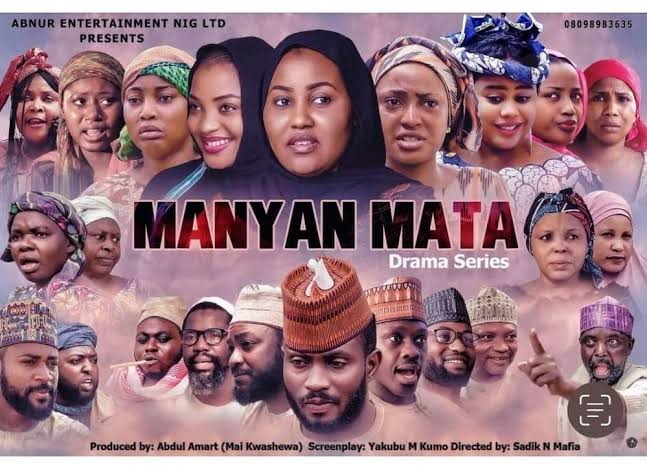
Manyan Mata: A new, worth-watching Hausa series

By Salim Toro

Yesterday, after meeting with Usman Toro, I returned home immediately to have dinner before retiring to bed. My siblings were watching a Hausa web series, Manyan Mata. So, while having dinner, I caught half of the episode they were watching. I found it captivating and worth watching.

I later learned it’s a new Hausa web series that premieres on YouTube and airs on Arewa24 every Saturday at 9 pm. The series is produced and directed by Ahmad Amart and Sadiq N Mafia, respectively. It brings all the leading Kannywood actors and actresses, such as Ali Nuhu, Adam A Zango, Sadiq Sani Sadiq, Hadiza Gabon, Fati Washa, Saratu Gidado, Momee Gombe and much more.

The storyline of the series is fascinating, entertaining, and educational as well. It highlights and depicts most of the trendy issues in our society (Arewa), such as marital and parental responsibility, girl child education and Almajiranci.

While I find the series riveting and worth watching, I recommend it to everyone here. Rest assured that you will benefit from it in one way or another. Happy watching!

Salim Toro sent this via salimabdulhamid0909@gmail.com.

Ƙoƙi and ethnographic slice of Hausa history

By Prof. Abdalla Uba Adamu

I was rummaging through my travel pictures when I came across a picture that I am sure has not been published anywhere. I saw it in a glass case at a ‘corridor museum’ at Universität Hamburg, Germany, on 2nd December 2008. I was excited because of its rarity. It was the picture that I am sure has not seen the light of day almost anywhere. I had vaguely heard about the man from my father, a writer, but did not pay attention then. Now he was there, smiling in all glory and right before me. I decided I would take the picture to show it to my father.

Edit: The man was Muhammad Ƙoƙi, the son of Alhaji Mahmud Ƙoƙi, the Kano Malam. His picture triggered my excitement about his father, Malam Mahmudu Ƙoƙi.

Malam Mahmudu was perhaps one of the most unsung and unknown critical literary figures in Hausa history. You can Google all you can. You won’t find him or his picture. Instead, you will be taken to Neil Skinner’s book, “Alhaji Mahmudu Ƙoƙi: Kano Malam” (ABU Press, 1977). I very much doubt if ABU Press itself has a copy. My copy is in excellent condition (except for a slightly scratched cover) since it was printed on shiny bond paper – and can therefore scan very well. I hesitate to do this for fear of copyright violation. I do wish ABU Press would consider retrieving a copy somewhere and reprinting it.

On return from Hamburg, I started looking for the book – and I was lucky to grab a copy at then ₦550 in January 2009. Now, some 14 years later, you can get a second-hand copy from the online store Abe Books for just $99 (cheap at ₦74,000 in 2023). At the moment, I don’t have any ‘kebura’ around me (since the ASUU strike was suspended!). Otherwise, I would offer mine for ₦50,000 for my copy!

Quite simply, it is a brilliant slice of Hausa history. Most significantly, it detailed the fieldwork done in the collection of data for Bargery’s Hausa Dictionary, whose full title is “A Hausa-English dictionary and English-Hausa vocabulary”.

Although mainly attributed to Rev. George Percy Bargery (1876-1966), an English missionary and linguist, the dictionary had significant input from Diedrich Hermann Westermann (1875-1956), a German missionary, Africanist, and linguist. The dictionary was published in 1934. The printed copy used to be available at ABU Bookshop, where a colleague of mine gifted me one he bought at the huge sum of ₦2,000 in ancient days, almost breaking his bank account!

The book was written/edited by Neil Skinner (1921-2015) at the request of Bargery’s son, Kenneth, to collect recollections of the elder Bargery while in northern Nigeria. Alhaji Mahmudu Ƙoƙi (1894–1976) was Bargery’s Chief Assistant in the preparation of the Dictionary and was the first choice to ask in 1967. As Skinner recollected, “I began recording some of his memories of Bargery. Listening to his vivid accounts of Kano in the first of the century, I formed the idea of putting together from Mahmudu’s lips some account of his own life.”

And what a fascinating life it was. Skinner continued, “As a son of the largest city of northern Nigeria, who had been born into the civil war of Aliyu and Tukur, M. Mahmudu saw the coming of the British, knew Waziri Giɗaɗo and Resident Temple, lived to see the end of the British rule and the Nigerian Civil War and, above all, had close contact with rulers and innovators, both Nigerian and British. He, therefore, seemed likely to have a tale worth recording for younger generation of Nigerians and those with an interest in Nigeria as it was and is. Mahmudu was a spectator of many great events and participant in not a few.”

And what a whirlwind tour of northern Nigeria it was in the early 20th century. Reading the book is like going back in a time machine. Everything was covered: economy, society, governance, culture, everything. As Neil Skinner stated, the book was told by Mahmudu himself – Skinner just edited it. It contained both fascinating and often disturbing details of days gone by. For me, for instance, I was traumatized by his account of the slave trade in Kano. As Mahmudu recalled,

“I used to see slaves being sold – with my own eyes! At Ƴan Bai, on the west of the [Kurmi] market. That was where they used to line them up and sit them down, with their feet sticking out, like this. Then it would be, ‘You there! Get up!’ And he would get up, and we would look him over well from top to bottom and say, ‘Walk a little!’ then he would do so until we told him to come back. He would do so, and we would say, ‘Right, go and sit down’ and put hand to pocket and take out a little money, perhaps a score of cowries or fifteen and give them to him. You would do this, whether you bought him or not. Then, if he saw someone selling groundnuts, he would call her over to get some saying he had been given the price for getting up to be inspected. That is how we have a proverb which says, ‘Tashi in gan ka ma na da ladanta’.”

Based on this disturbing account – in the heart of Africa – I wonder how many of our other proverbs have such creepy and dark origins? If you go to Ƴan Bai in Kurmi market in Kano, now you will only see mats, books and assorted goods.

Alhaji Mahmudu Ƙoƙi provides a rich tapestry of ethnographic details about how the Dictionary was compiled and the fact that the team of Bargery and his assistants insisted on seeing actual objects and their names before recording them. One wished they had an artist with them to sketch out many of the cultural artefacts that have all but disappeared now. It is good that the Bargery dictionary has been digitized and is available free online, thanks to the efforts of Hirokazu Nakamura of the Faculty of Human Science, Department of Human Sciences, Bunkyo University, Japan.

“Alhaji Mahmudu Ƙoƙi: Kano Malam” is comparable to “Baba of Karo” by Mary F Smith (wife of M.G. Smith, author of “Government in Kano, 1350 to 1950” amongst others, and which is available FREE online!). Published in 1954, “Baba of Kano” is an anthropological record of the Hausa people, partly compiled from an oral account given by Baba (1877-1951), the daughter of a Hausa farmer and a Koranic teacher. Baba’s reports were translated by Smith.

Books like these encourage us to seek out our own cultural history – visit those places mentioned, savour their historical aroma and note them as centres of excellence in discovering our past. By the way, Ƙoƙi is a ward in the city of Kano and right on the edge of the Kurmi market. If you are from the area, perhaps you may have heard of Alhaji Mahmudu from his grandchildren.

Don’t forget; this is not a review of the book but a memory jog on the old man, Alhaji Mahmudu Ƙoƙi, whose picture was honoured at a foreign university.

There is a composite collage of the picture I snapped in the Hamburg university museum of the son, the book and the father! as the latter appeared in the book.

Prof. Abdalla Uba Adamu can be reached via auadamu@yahoo.com.

Quick takeaways from the premiere of Manyan Mata!

By Mahmud A. Zukogi

This much-awaited, much-talked-about and star-studded film series, which incidentally will hit your screens today, Saturday, February 11, 2023, at nine o’clock this evening on Arewa 24, was premiered on February 4 at the Film House, Ado Bayero Mall, Kano.

The event, which was graced by the invited guests and Kannywood’s veteran, reigning and emerging stars, was full of the usual fanfare, excitement and expectations associated with the premiere of any new film. The red carpet was lit with beautiful lighting and stars, and guests took turns to pose to the beauty and demand of the evening.

The industry is gradually exploiting the opportunities that film serialisation provides, no thanks to the exciting marketing platform made available by the leading entertainment television, Arewa 24. It is to the eternal credit of the television that such films as Dadin Kowa, Gidan Badamasi, Labarina, Kwana Casa’in, Gidan Danger, etc., have become popular and a must-watch by the teeming audience of the industry. It is obvious, therefore, that the art of film serialisation has gained currency in the industry, and Manyan Mata is coming to compete for space and attention. How it is able to do this will depend largely on the techniques and the staying power of the crew, especially the producer and the director.

Manyan Mata is produced and directed by two of the industry’s iconic duo, Abdul Amart (Maikwashewa) and Sadiq Mafia. What the film brings to the table can be summarised into three: innovation, diversity and topicality of motif. Abnur Entertainment is known in the industry for innovations that have opened a window of opportunities to the core stakeholders, from the producer down to the end of the ladder in the entertainment chain.

The film is highly diverse because of the array of stars it could gather under one roof. As far as the Kannywood industry is concerned, it takes great power, confidence and directing abilities to handle these stars, each with his/her ideals and idiosyncrasies. Thus, if any outstanding star is left out of the film, it could be a result of unavoidable oversight or a logistical glitch. But getting Ali Nuhu and Adam Zango, the northern and the southern poles of the industry, in one set is no doubt speaks of the commendable effort of the producers. Talk of the leading female stars of the industry; name them, and they are all there.

What, then, are the central motifs of the film and which has made it outstanding and a must-watch? The Almajirci question, the girl-child abuse/prostitution and the male overload of the women under the guise of marriage have been juxtaposed to educate, entertain and, most of all, draw public empathy to the raging social issues putting us down as a people.

The premiere opens with electrifying scenes of these social motifs, and this drew great excitement from the audience, who expressed individual understanding and appreciation of the representations in the film and its many expectations.

Veterans of the industry were well represented, ranging from Kabiru Maikaba, Shehu Hassan Kano, Hajiya Saratu Gidado Daso and the like. No less represented were the leading directors in the industry who came to support one of their own. There were expressions of appreciation and critique of the film, which was well received by the directing crew.

Overall, the premiere evening was full of life, excitement, and encomiums for the head of Abnur Entertainment, Abdul Amart, for his creativity and vision.

The greatest oversight is the industry’s inability to tap into the opportunities provided by the university which is next door. As far as the industry is concerned, there has not been a concerted effort to establish the needed relationship between and gown, a beneficial relationship that would help to grow the industry and take it to a whole new level of growth and worldwide visibility.

Strong institutional linkage is desperately needed to grow the art and economy of this under-tapped multibillion-dollar industry. I’m aware that scholars such as the respected Professor have invested so much energy in intellectual research that would have propelled the industry to the worldwide heights it ought to be. Same for Professor Yusuf Adamu, Ibrahim Malumfashi and, lately, Dr Muhsin Ibrahim, who has published widely and recently completed his PhD on a topic related to the industry at the University of Cologne.

Yours sincerely and his colleagues were only there in their individual capacity and not on institutional representation, which shouldn’t be the case.

It is thus necessary and about time that this costly oversight is remedied. The industry needs to open up and embrace change, and the best way to do this is to key into the opportunities they stand to gain by establishing a solid relationship with the university to improve its art and human capacity. I also believe this should be a two-way process, so the university should take the industry into confidence and dispel its image of unapproachability.

Mahmud Zukogi can be reached via mabuzukogi78@gmail.com.

Lessons from Adam A. Zango’s life

Muhammad Ubale Kiru

Adam A. Zango, for those of you who don’t know him, is a Kannywood Film actor who is popularly known as Adamu Usher for his spectacular dance steps. He appeared in more than 100 Hausa films over the years.

While lamenting why his marriage is in chaos, Adam identified that his wife committed a number of mistakes that may probably lead to their divorce. One of the mistakes mentioned was that she posted a video of herself taken at a beauty parlour while having henna (kunshi) done on her and at the same time dancing.

He indicated that such action was something he prohibited all his wives from doing, and he was devastated by the action. Hence, he stated it as one of the things she did. Now, the irony is this – these people have no shame in picking young girls to act in their movies. They have no shame in displaying these young girls on TV dancing and sometimes even touching them. However, they know quite well that it is wrong, yet they lure young girls into it.

Adam felt so bad that he is thinking about divorcing her because of what he himself is doing with other women and yet posting on the internet.

Dear ladies: You see, most of you are not smart. Men can do things and run away with it, but can you? Adam can spend 50-60 years of his life acting, but for you, the maximum is 40-45. This means what you are doing is not really a good business because, in the end, they will use you and then dump you. They know so well that it is not right, yet, they get you involved because they don’t care about your life or future.

In an interview with Hadiza Gabon, she was asked about when she would be getting married or if she had a fiancee. In her response, she said, “yes, I have a fiancee. As for when I will marry, that I don’t know because I can’t marry off myself”. They have plenty of suitors, but will they be ready to commit to marriage? The answer is NO. because Film is a bad business for women. It doesn’t matter whether it is Kannywood or Hollywood. The majority of them spend their lives pursuing lusty men and, in the end, commit suicide or die in nursing homes helplessly and full of regrets.

2023: Presidential elections and the battle between two categories of Northern elders

By Ibraheem A.Waziri

Every election season in Nigeria comes with its provoking premises and issues! This time around, apart from the usual North and South, Muslim and Christian divides that are often most prominent than party affiliations; a new dynamic which has not yet caught public attention has been added up to the mix. The struggle to maintain relevance between two different categories of Northern eldership or leadership. These two categories, in the realm, are separated primarily by order of generational cohort (GC) in age!

Falling back to the scholars in anthropology, we learn that a GC is usually pegged at 15-20 years. All persons born within such intervals are regarded to, more or less, belong to the same groupings defined by the same circumstances; social, economic, and cultural events and would likely share some core elements in perspectives, tastes and life preferences.

Since the completion of the taking over of Northern Nigeria by the British in 1903, a generation who will eventually become Nigerians from the territory began to be given birth to that same year. Therefore the first generational cohorts (GC) of Northern Nigerians can be said to be those born between 1903 and 1919. That is if the mode at which boys usually reach puberty is considered as the norm to be 16 years!

The second GC came between 1919-35. The third was between 1936-51. This GC is the one that did the 1967 military counter-coup and prosecuted the then Nigerian civil war from the Northern Nigerian side led by 2nd GC member, General Yakubu Gowon, as Head of the Nigerian state.

One can be right to say that the 3rd GC of Northern Nigerians has been influencing politics and government policy not only in the North but in Nigeria from that time until now! The politicians among them, intellectuals and business owners, have been holding the region at its nape!

After the 2019 elections, some pundits among us have been harping about the fate of the North come 2023, as it was obvious that the 3rd GC are threatened by senesces and, therefore, very weak. The assumption is that they will reach a consensus among themselves to identify an able group of successors to hand over the affairs of the North and fade themselves into retirement, having put in their best for about 57 years now! The longest any GC have been there and probably will ever be.

None of us thought that the successor cohort, the 4th GC, born between 1952-67, would need to necessarily put up a fight to dislodge the 3rd GC from the power circle and forcefully take over like what is happening now in the ruling party.

However, since the statement made in Abeokuta on the 25th of January, 2023, in a campaign rally, by Asiwàju Bola Ahmed Tinubu, the All Progressive Congress (APC) party presidential candidate; to the effect that there are saboteurs in the Presidency – which ironically is occupied by his party – who are against his emergence as winner of the 2023 presidential Elections slated to hold 25th of February, 2023.

Bola Ahmed Tinubu, though a Southerner, enjoys the support of 14 of the 19 Northern Governors, who are from the ruling party. 11 of them also belong to the 4th GC. 1 belongs (Borno State) to the 5th GC. 

Kaduna State Governor, an outspoken element among them, has granted a series of interviews on the 1st and 2nd of February 2023. To a number of media Houses, including BBC and TVC, in both Hausa and English, implying that some 3rd GC Northern influencers around President Muhammadu Buhari (who is himself a member of the same cohort) are plotting to work against their candidate! By following other means, they do that to ensure a member of the 3rd GC, Atiku Abubakar of the opposition People Democratic Party (PDP), and a Northerner emerge as the winner of the 2023 presidential Elections!

The ultimate question now, apparently, is whether the people in the North will agree to prolong the tenure of leadership and eldership of the 3rd GC Northerners, adding another eight years to their 57 years, making it 65 long years. Or, in the alternative, they want to hand over the realms of their leadership and eldership to the 4th GC Northerners; to bring their own uniqueness to the table early enough.

It is obvious that the 4th GC Northerners, born during the years building up to the civil war to its end, have different perspectives and arguments about how Northerners should see themselves and live with their neighbours in Nigeria. They don’t view Southerners with the kind of suspicion the 3rd GC Northerners think of them. It is why in the first place, they would resolve to fulfil the unwritten agreement of power shift to the South in 2023.

Some members of the 5th GC of Northerners, either those born between 1968-83, would appreciate seeing a new perspective taking control of the space and atmosphere of Northern Nigeria come 25th February 2023. It will guarantee an experiment with fresher perspectives that are sure catalysts to positive change and comprehensive progress, not the same old perspective that has dominated the space for 57 years. 

Also, it is only when the 4th GC Northerners move a little higher on the ladder that the 5th GC Northerners, the post-civil war generation, will enjoy a certain degree of influence at some social plane. The same thing with the 6th GC Northerners, born between 1984-1998, the military rule generation. Also, the 7th GC Northerners, born between 1999 – 2015, Fourth Republic, Peoples Democratic Party (PDP) rule generation. Each movement on the ladder creates opportunities for growth and stability for others to play their role and display their God-given talent for the benefit of all.

These can be among the reasons why most Northern Nigerians would consider lending their support to the 4th GC Northern leaders in their bid to take control now. Politicians and bureaucrats like Nasir El-Rufai, intellectuals and opinion leaders like Dr Aliyu Tilde, Mahmud Jega; Abdulaziz Abdulaziz of the 5th GC and a host of other businessmen and religious leaders deserve this chance to move us to another level of life-changing perspective with Asiwàju Bola Ahmed Tinubu Nigerian leadership come 25th February 2023!

Ibraheem A. Waziri wrote from Zaria, Kaduna State. He can be reached via iawaziri@gmail.com.