Northern Nigeria

Kebbi, Zamfara and the burden of a country failing its rural citizens

By Abdulhamid Abdullahi Aliyu

Nigeria has fallen into a bitter cycle of violence, with communities caught in a war they neither invited nor comprehend. In four days, at least 145 Nigerians were abducted in Kebbi, Zamfara, and Niger. This included 25 schoolgirls kidnapped in Kebbi, three villagers killed, 64 seized in Zamfara, 16 vigilantes murdered, and 42 abducted in Niger. The headlines are shocking, but the stories are more troubling: rural areas are dissolving under fear, abandonment, and rising criminal violence.

For many Nigerians, these incidents are not isolated tragedies; they are part of a vicious pattern stretching back years. In 2023, during the tense pre-election months, at least 792 Nigerians were abducted in only the first quarter, according to verified data. Today, as political parties warm up again for the 2027 contest, the shadows are lengthening once more. Insecurity rises, rhetoric rises, promises rise, but communities continue to fall.

The Kebbi school attack is particularly symbolic. Once again, the targets were schoolgirls. Once again, a perimeter fence proved more ceremonial than protective. Once again, armed men walked into a public school as though strolling through an unguarded market. According to the police, the bandits arrived at about 4:00 a.m., firing into the air and overpowering the school’s security before escaping with 25 children. A staff member, Hassan Makuku, was killed. A guard was shot. And the students vanished into the vast, unregulated forests that now function as safe havens for armed groups.

The Federal Government has condemned the attack as governments always do, calling it “reprehensible,” promising swift rescue, and directing security agencies to “locate, rescue and ensure justice.” The Minister of Defence described the incident as “totally unacceptable.” These statements are necessary, but they do little for the parents who now spend their days staring at empty bunks and silent uniforms.

Zamfara’s case is no less alarming. Entire families were carted away from Tsafe and Maru LGAs, with reports confirming three deaths and at least 64 abducted in one attack alone. Communities such as Zurmi, Shinkafi, Maradun, Maru and Bungudu have lived under this shadow for years. They pay levies. They negotiate to farm. They bury loved ones. They flee at night. Banditry in Zamfara has evolved into a parallel economy, one that thrives because the state’s presence has weakened, and criminal syndicates now operate with cold confidence.

Niger State’s tragedy further complicates the picture. Sixteen vigilantes were killed, and dozens were kidnapped. These vigilantes are ordinary residents who step in where the state has failed with torches, dane guns and courage as their only armour. They are outmatched, outgunned and overstretched. Yet they stand in the gap because the alternative is abandonment.

What links Kebbi, Zamfara and Niger is not geography but the silence that follows after promises fade and attention shifts elsewhere. Rural Nigeria has become the theatre of a slow, grinding war of attrition. Schools, farms, highways and markets have become targets. Parents now enrol children in schools not by distance or quality, but by safety. Communities now make security decisions based on rumours, not signals from the government.

Reactions from political figures capture a growing national frustration. Former Vice President Atiku Abubakar condemned the attacks as “a reminder of worsening insecurity,” pointing also to killings in Plateau, Benue and Kano. The PDP accused the Federal Government of “preferring politicisation to protection.” Security experts have raised deeper worries. Former CP Emmanuel Ojukwu warned that abductions often spike ahead of elections, becoming tools of disruption and intimidation. Another retired CP, Ladodo Rabiu, countered that insecurity has now become permanent, not seasonal, and politicians merely exploit it when convenient.

Both views reveal a brutal truth: Nigeria’s insecurity is no longer episodic; it is structural. It feeds on weak governance, fragile policing, porous borders, fragmented jurisdictions, and an overstretched military deployed incessantly for internal duties it was never designed to handle.

But beyond statistics and politics lies the real crisis, a moral one. Rural Nigerians are bearing the brunt of the state’s slow decay. They pay for security with money they don’t have. They live in fear; they didn’t create. They bury victims they cannot protect. Nigeria is failing them not because officials do not speak loudly, but because institutions do not act deeply.

So where does the problem lie, and what must be done?

First, the country’s security response remains reactive. Troops are deployed after attacks, not before them. Intelligence is gathered after kidnappings, not to prevent them. This cycle guarantees repetition. Nigeria must invest in village-level intelligence networks, not just forest-level firepower.

Second, the state is fragmented. Federal, state and local security efforts exist in parallel but rarely intersect meaningfully. Community policing remains a slogan instead of a functional architecture. Insecurity requires a coordinated chain; currently, Nigeria operates with scattered links.

Third, governance in the North-West has become inconsistent. Some states negotiate with bandits; others fight them; others allow communities to fend for themselves. Criminals easily read these patterns and exploit them.

Fourth, poverty and governance failure feed bandit armies. Unemployed youths become foot soldiers. Unprotected forests become camps. Unregulated mining corridors become revenue lines. No amount of military operations can defeat a criminal economy unless the incentives are dismantled.

Finally, transparency is missing. Nigerians rarely know what works or fails. Operations are announced, but outcomes are not documented. Without accountability, improvement is impossible.

The solutions are not mysterious. Deploy intelligence-driven operations; rebuild local policing; integrate vigilantes into formal security structures with training; secure forests with drone surveillance; regulate mining corridors; strengthen border patrols; ensure swift prosecution of captured bandits; and most importantly, ensure that victims are rescued quickly and consistently.

But no solution will matter unless Nigeria is honest with itself: the country has abandoned its rural citizens, leaving millions to bargain daily with terror. Kebbi, Zamfara and Niger are not just news items; they are warning lights for a nation whose peripheries are collapsing inward.

The question now is not whether the government will condemn the attacks it already has. The question is whether Nigerians will see meaningful change, or whether new tragedies will replace these before this week ends.

Until the state reclaims every inch of its territory physically, administratively and morally, rural Nigerians will continue to live on borrowed certainty, waiting for the next sound of gunshots in the night.

Abdulhamid Abdullahi Aliyu is a journalist and syndicated commentator based in Abuja.

BREAKING: Trump claims US military strike on ISIS targets in Northwest Nigeria

U.S. President Donald J. Trump has claimed that the United States carried out a “powerful and deadly” military strike against ISIS targets in northwest Nigeria.

In a statement released on Thursday night, Trump said the operation was conducted under his direction as commander in chief and targeted ISIS fighters accused of killing civilians, particularly Christians. He described the strikes as highly successful and warned that further military action would follow if the violence continues.

There has been no independent confirmation of the operation from U.S. defense officials, and no details have been provided regarding the exact locations, casualties, or scope of the strikes.

As of the time of this report, the Nigerian government has not issued any official statement responding to or confirming the claims.

Saving Nigeria starts with honest self-reflection

By Suleiman Usman Yusuf 


Right now, I am deeply pained and genuinely confused, perhaps like many other well-meaning Nigerians who still believe this country can rise above its failures. If all I have to offer is my voice and my pen, then I will continue writing about Nigeria’s lingering security crisis until my last strength fades. Silence is no longer an option when the nation is bleeding this profusely.

This country is bruised. Every week, the news reminds us that Nigeria is fighting for its own life, not in theory but in blood and dust. Yet we move on too quickly, as if these tragedies belong to someone else.

The death of Brigadier General M. Uba should stop us in our tracks.

Not just because he was a senior officer. Not because his story is more important than the stories of countless others who fell before him. But because his final hours reveal both the extraordinary courage of the men defending this country and the painful weaknesses of the institutions meant to protect them.

Two days ago, Nigerians were told he was alive and safe. Today, the truth arrived from insurgent propaganda channels rather than from the State he served. That alone should trouble every citizen who still believes this country can be redeemed.

But beyond the misinformation, beyond the chaos of battle and the failures of communication, there was a man. A man who fought through one ambush, shielded his men, and kept talking on the radio even as danger closed in from every direction. A man who understood the terrain, the risks, and the meaning of service in a way many of us never will.

His killers did not find him by magic. They found him because insurgent groups in the North-East have evolved into highly adaptive, intelligence-driven networks. They have spotters, informants, trackers, and a familiarity with the terrain that gives them dangerous advantages. Our troops face that reality every day with limited resources and uneven institutional support. Yet they still go out, still patrol, still hold their ground.

Brigadier General Uba died in uniform, under a harsh Borno sky, in the service of a country that has not yet learned how to protect its defenders fully. His death is not just a battlefield loss. It is a national failure.

But this is where our story must change.

Nigeria cannot survive if we continue pretending that insecurity is a Northern problem, or a Christian problem, or a Muslim problem, or a regional competition in suffering. Nigeria is bleeding in too many places for that false comfort.

This is a Nigerian problem. All of us are inside this fire.

If we want to save this country, we must begin by admitting the truth.

We have an overburdened military fighting a war that politicians treat like background noise. We have intelligence agencies that do not always speak to each other. We have a society more invested in ethnic debates than national survival. We have families quietly burying soldiers while the rest of us argue online. We have institutions that hide failures rather than learn from them.

But we also have something else. We have citizens who still believe in Nigeria. We have communities ready to cooperate when trust is restored. We have young officers and men who refuse to give up on this country, even when this country sometimes gives up on them. We have people like Brigadier General Uba, whose courage reminds us of the Nigeria that is still possible.

If his death is to mean anything, it must push us toward a national rebuilding rooted in truth, accountability, and collective responsibility. It must force us to demand better communication protocols, better extraction procedures, better intelligence coordination, and better welfare for every man and woman who carries a rifle for this country.

Saving Nigeria is not a slogan. It is a long, disciplined, painful process that requires leadership, honesty, citizen cooperation, and institutional courage.

Brigadier General Uba has paid his share in full. The account is now with us.

Suleiman Usman Yusuf, a Governance, Security, and Development Consultant, AI Policy and Governance Advocate, and a Shaper of Africa’s Tech Future, wrote via suleimanusmanbac@gmail.com.

Bandits and Betrayal: Why negotiation is not the answer

By Muhammad Isyaku Malumfashi

There are people within this government who support negotiations with bandits, and this piece aims to address them. I wrote against former Governor Masari’s governance when he had negotiated with bandits in an article published by The Daily Reality newspaper, titled “How Governor Masari is Wrongly Governing Katsina State.” I’m doing the same to refute any move to negotiate with bandits at the expense of the government’s power.

Meanwhile, apart from the government’s “data boys,” the problem we now have is the “negotiation lawyers” who protect the government from criticism of negotiating with terrorists. As I have been saying, it is a failure of the government to negotiate with terrorists.

Not only I, but many security experts have opined that negotiating with bandits is futile. In fact, the governor himselfDr Dikko Umaru Radda, admitted during a call-in interview with Channels Television that he wouldn’t negotiate with bandits at their weakest point. We all applauded, as they have no justifiable reason for their actions and hence no grievances to present to the government for it to listen to. They should either surrender and cease fire, or the government should use force to wipe them out.

We’ve seen many such negotiations with bandits in both the previous administration and the present that have not borne fruit. Perhaps the Fulani terrorists breached the truce by breaking the agreement, thereby continuing to commit crimes against innocent citizens. 

The biggest problem is that they will come into town with weapons, as we’ve seen in the Kankara Local Government area, until people become accustomed to seeing them. Then, some will start to befriend them, so they, too, can get the opportunity to handle weapons. Thus, the country might become like Libya – God forbid – where arms became available to citizens as a result of government carelessness in the name of self-defence, and subsequently turns into a lawless state.

Because in Libya today, one with more sophisticated arms is the most feared and powerful being, just like a government. They can do and undo as they want. Nigeria, particularly Arewa, might face a similar fate, but I believe God will embarrass them. The worst thing about this negotiation is that even if there is negotiation, these Fulani bandits won’t take up any job that will earn them money. Instead, they’ll move to another town where there’s no security problem and continue their terrorist activities. If there’s another negotiation, they’ll move forward.

They wanted to pursue an agenda of conquest with great force, as in the 1804 Jihad. I know historians among us will relate better, though I’m not one; I’m a history enthusiast and studied it in secondary school. Thus, we’re not ignorant of the past. If we don’t forget, those Fulani bandits camped at the Kankara forest under the notorious bandit leader Babaru, aka, had to negotiate with the people of Yar Goje town, before they could target some villages.

Then, they got the opportunity to attack the Mantau village in Malumfashi, where they killed many worshippers during dawn prayers in the mosque and thereafter kidnapped many residents and took them to their camps. Although they later released them, the government claimed the release was due to a firefight with troops, but Zuma Times reported the opposite. We believe the latter, as the government didn’t present any evidence of casualties.

The Mantau village has been a headache for the bandits for years. They’re well-prepared and gallant, and on many occasions, they’ve hidden at routes where bandits pass by to attack and kill them. The village was a no-nonsense and fearful place for bandits. Even the day they attacked them, it was a raid, not face-to-face, which shows an act of cowardice. Therefore, the Fulani won’t stop terrorising; they’ll move forward until they’ve conquered the Hausa land entirely, as captured and masterminded by their ancestors for centuries.

Negotiation with bandits, even though it has never happened at the state level but at the local governments’ level, as seen in Jibia, Batsari, Kurfi, Kankara, and others, makes us suspect that even those that happened at the local governments’ level were with the governor’s consent. He doesn’t want to admit his failure or is afraid of reversing his stance on non-negotiation with bandits.

The idea is totally archaic and reckless because not everybody will sit down and watch people who killed their loved ones or bankrupted them through ransom payments be forgiven and allowed to roam freely, while the people they killed are no more. The properties destroyed or collected for ransom are not compensated.

Even the government’s careless move to empower repented bandits is not welcoming because they have enough money collected from ransom payments. Why should the government empower them with our money? I think the best approach is to empower the victims, not the repentant bandits. The government should also reintensify its security approach, especially given the recent surge in banditry attacks in eastern and southern Malumfashi over the past two days. May Allah restore absolute peace and stability in our towns, states, and the country at large.

Kwara’s false sense of security: How complacency risks a regional catastrophe

By Iranloye Sofiu Taiye

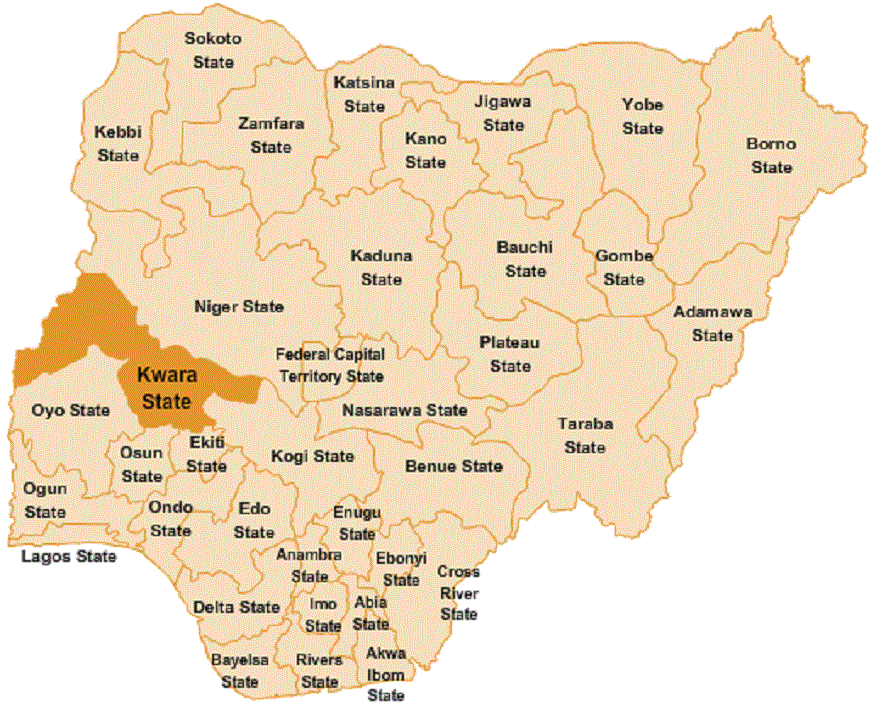
The crackle of gunfire shattered the night’s calm in Patigi Local Government Area last August. For hours, residents hid in terror as militants believed to be linked to the Mahmuda terrorist faction ransacked homes and farms, leaving behind a trail of displacement and despair. This wasn’t in conflict-ridden Zamfara or Borno. This was Kwara State, Nigeria’s so-called “State of Harmony”, now facing the brutal reality of spillover violence from neighbouring conflicts.

For years, Kwara has been regarded as an oasis of peace. While northern states battled insurgencies and northwestern states negotiated with bandits, Kwara’s security strategy primarily relied on these measures. This complacency is now our greatest vulnerability. As armed groups face increasing pressure in Nigeria’s northwest and the Sahel, they are seeking new territories and routes, and Kwara’s under-protected border communities present the perfect opportunity.

The data reveals an alarming trend: while Kwara recorded 70 violent incidents in 2024, representing a sharp increase from previous years, with ACLED data showing 21 fatalities signalling emerging threats. Meanwhile, neighbouring Niger State suffered 179 incidents with 514 deaths, over 2.5 times Kwara’s rate. This disparity highlights both Kwara’s relative peace and its growing exposure. Nigeria’s overall security situation has deteriorated dramatically, with the country dropping to 148th on the 2025 Global Peace Index and suffering over 2,266 deaths from banditry and insurgency in just the first half of 2025, exceeding the entire 2024 total.

The False Comfort of “Relative Peace”

Kwara’s peaceful reputation has created a dangerous paradox: the state appears secure compared to Nigeria’s raging conflicts, yet this very perception has led to critical underinvestment in security preparedness. With a meagre ₦350 million (approximately $230,000) security vote in its 2025 budget, Kwara has insufficient resources for basic border surveillance, let alone comprehensive counterinsurgency measures. This budgetary neglect reflects a fundamental misreading of the evolving threat landscape.

The nature of modern conflict doesn’t respect artificial boundaries. Militant groups operate across porous borders, exploiting governance vacuums and ethnic kinship. The emergence of groups like Mahmuda around the Kainji Lake area demonstrates how terrorist organisations establish footholds in perceived “safe havens” before expanding their operations. As security reports have noted, there have been at least 13 ISIS-Sahel-linked attacks in central Nigeria in 2025 alone, indicating a strategic southward expansion.

The situation mirrors concerning patterns elsewhere in West Africa, where jihadist insurgency has spread from the Sahel toward coastal states. The southward spillover alarmingly threatens countries like Benin, Togo, Ghana, and Côte d’Ivoire, which until recently had been mostly spared jihadist violence. Kwara now faces precisely this dynamic, compounded by the added vulnerability of having dismissed the threat until it arrived at its doorstep.

Recommendation: A Community-Based Solution

Some advocate for a traditional security response: deploying additional military forces along border areas, establishing checkpoints, and implementing drone surveillance. While these measures have short-term deterrent effects, they come with significant tradeoffs: escalating tensions with communities, straining federal-state relations, and diverting scarce resources from development needs.

A more effective approach combines strategic security presence with community empowerment. I recommend that Kwara State immediately establish a Community-Led Early Warning and Resilience Program (CLEWRP) to train and equip more than 5,000 local volunteers in conflict mediation, digital reporting, and response coordination. This approach recognises that security is not merely about repelling attacks but about building resilient communities capable of preventing, withstanding, and recovering from violence.

The evidence supporting community-based security is compelling. When local populations are empowered as first responders, they provide hyperlocal intelligence that external forces cannot access. They understand the terrain, recognise outsiders, and can distinguish between legitimate herders and criminal elements. As the tragic incidents in Kwara’s south communities have shown, top-down security responses often arrive too late after attacks have occurred and perpetrators have vanished into the forest corridors connecting Kwara, Niger, and Kogi states.

The proposed CLEWRP program would unfold in three phases: planning and stakeholder consultations across Kwara’s 16 LGAs; pilot implementation in high-risk areas; and statewide scaling, with continuous evaluation. The Kwara State Ministry of Homeland Security and Vigilante Affairs would lead implementation, partnering with the National Emergency Management Agency for federal coordination, local governments for ground implementation, and international organisations for training expertise.

Financing the $3-5 million USD program would require a blended approach: 60% from the state budget and 40% from federal security grants and humanitarian NGO partnerships.

A National Security Imperative

Kwara’s security crisis represents a microcosm of Nigeria’s broader challenges. The federal government’s 2025 budget allocated ₦4.91 trillion to defence and security, about 8.9% of total expenditure, recognising that without security, economic development is impossible.

The national security strategy must therefore prioritise preventing the southward spread of violence in states such as Kwara. This requires both regional cooperation and smarter resource allocation. The Accra Initiative, which promotes intelligence-sharing among coastal West African states, offers a promising model that should be expanded to include central Nigerian states facing spillover threats.

Furthermore, security funding should incentivise preventive approaches rather than merely funding reactive measures. The federal government could establish a matching-grant program for states that develop community-based security initiatives, thereby encouraging locally adapted solutions rather than one-size-fits-all approaches.

The Time for Action Is Now

Kwara stands at a precipice. The state can continue its complacent approach, hoping that violence will spare its territories, or it can acknowledge the changing threat environment and build resilient systems before the crisis becomes a catastrophe. The choice is stark: invest modestly in prevention now, or pay enormously for response later.

The CLEWRP program offers a practical, cost-effective solution that aligns with Kwara’s cultural traditions of community cooperation while incorporating modern technology and coordination methods. It acknowledges that security is not solely the government’s responsibility but a shared undertaking between authorities and citizens.

History shows that complacency amid spreading instability is a recipe for disaster. West Africa’s security landscape has deteriorated dramatically in recent years, with jihadist groups expanding their operations. Kwara cannot assume it will remain immune.

The phrase “State of Harmony” should not be a relic of Kwara’s past but a promise for its future. Preserving this harmony requires honest acknowledgement of emerging threats, courageous investment in preventive measures, and collaborative implementation across government and communities. The time for action is now, before the next attack becomes a full-blown crisis.

Iranloye Sofiu Taiye is a Policy Analyst specialising in Peace Building and Conflict Resolution, Digital Governance, and Service Delivery, and can be contacted via iranloye100@gmail.com.

Rector Cares Foundation wins Top Climate Award at AFFIF 2025

By Hadiza Abdulkadir

Rector Cares Foundation’s documentary “Dying for Water” has won the Award of Excellence for Best Film on Climate Change at the Africa Film for Impact Festival (AFFIF) 2025, earning widespread recognition for its powerful portrayal of water poverty in rural Nigeria. 

Screened at the festival’s 4th edition, held from October 29–31 at Silverbird Cinemas, Yar’Adua Centre in Abuja, the film tells the story of Fatsuma, a mother grieving the loss of her child who drowned in an unsafe community well, and highlights the daily struggles faced by women and children relying on hazardous water sources. 

Founder and executive producer Onyedikachi Erete described the honour as a validation of the Foundation’s mission. “This victory validates our mission to ignite conversations about water poverty and the crucial role of WASH in fostering sustainable development,” he said. 

Directed by Omoregie Osakpolor and co-produced by Stephanie Ohumu, the documentary forms part of Rector Cares Foundation’s ongoing efforts to raise awareness of climate-driven water crises and strengthen collaborations with organisations working in water provision and technology. 

MPAC accuses US delegation of sectarian bias during Nigeria visit

By Muhammad Abubakar

The Muslim Public Affairs Centre (MPAC) has condemned what it describes as the “sectarian and deeply troubling” conduct of a recent United States congressional delegation to Nigeria.

In a statement issued by its Executive Chairman, Disu Kamor, MPAC faulted the visit of Congressman Riley Moore, who publicly emphasised meetings with Christian and traditional leaders during the trip, including bishops in Benue State and a Tiv traditional ruler. Moore, a vocal proponent of the claim of a “Christian genocide” in Nigeria, said on his X account that he came “in the name of the Lord” and held discussions on alleged Fulani-led attacks.

MPAC argued that the delegation’s failure to engage the leadership of the Nigerian Muslim community—particularly the Nigerian Supreme Council for Islamic Affairs (NSCIA)—was a deliberate snub rather than a scheduling issue. It accused the U.S. team of avoiding Muslim victims and communities affected by violence and warned that such selective engagement risked reinforcing “extreme voices and anti-Muslim narratives” within U.S. policy circles.

The organisation said the pattern of “selective listening, selective engagement, and selective outrage” threatens Nigeria’s delicate interfaith balance. It called on international partners, especially the United States, to demonstrate neutrality and ensure that foreign policy on Nigeria is not shaped by religious lobbies or sectarian biases.

MPAC reaffirmed its commitment to justice and peaceful coexistence, urging Nigerians to question why key Muslim institutions and victims were excluded from the delegation’s itinerary.

Nigeria secures release of 100 kidnapped schoolchildren

By Hadiza Abdulkadir

The Nigerian government has secured the release of 100 schoolchildren abducted last month from St. Mary’s School, a Catholic boarding institution in the Papiri community of Niger State.

The attack, which occurred on November 21, saw armed men take 303 students and 12 teachers hostage. In the days following the abduction, 50 pupils managed to escape and were reunited with their families.

According to officials, the rescued children are expected to be handed over to Niger State authorities for medical and psychological evaluation. Government sources confirmed the release but did not disclose whether it resulted from negotiations, military operations, or other interventions.

Despite the successful rescue, concerns remain high. More than 160 students and staff members are still unaccounted for, leaving many families anxiously awaiting news of their loved ones.

Child-protection advocates and community leaders have renewed calls for stronger security measures around schools, stressing that the safety of students must be a national priority as mass abductions continue to plague parts of the country.

Tax reform, content creators and the rest of us

By Isyaka Laminu Badamasi

It is becoming glaring that the Federal Government is taking Nigerians for granted. A few months back, we were all here condemning the new tax reform introduced by the APC administration led by President Bola Ahmed Tinubu, a reform whose implications will be deeply felt by Nigerians, especially the downtrodden.

Though some analysts and experts argue that the new tax reform is the right step, particularly for an economy whose revenue depends almost 70% on crude oil, my little contribution to the debate is not to analyse the reform or weigh its positive and negative impacts on our well-being. Rather, it is to raise a few critical questions arising from my thoughts on the matter at hand.

My concern is specifically about content creators who were engaged to sensitise Nigerians on the new bill—a development that sparked another debate, one that again exposed our disunity as a people and our lack of seriousness about matters of national importance and those inimical to our well-being. Nigerians, especially Northerners, instead of examining the bill and preparing for constructive criticism, began complaining that none of the selected content creators was from the core North. As if having a core Northern content creator in the sensitisation team would somehow change or reduce the taxes that will eventually be imposed on core Northerners.

With or without any sensitisation or awareness campaign, the new tax reform has come to stay. Regardless of how people accept or reject it, it will be implemented as planned. The content creators engaged by the government may not even understand the policy themselves, let alone be able to sensitise the public properly.

For me, therefore, this entire conversation about the “selection of content creators” is unnecessary. To my understanding, it was technically designed to divert Nigerians’ attention. Instead of focusing on constructive criticism of this inhumane policy, we have been pushed into arguing over who should be involved, when, and how—a distraction that does not help an already fragmented country.

Let us not forget that we are in 2025, in the 21st century—111 years as an amalgamated entity and 65 years as an independent nation, with more than two and a half decades of an uninterrupted democratic dispensation. It is high time we appreciate our togetherness despite the odds and chart a path toward unity. This is especially crucial at this moment, when we are facing serious and multidimensional security challenges, particularly here in the North, ravaged by bandits, insurgents, and kidnappers, with pockets of ethnic and religious conflicts here and there. Do we so easily forget that Nigeria was once declared a “country of particular concern” by the US President, Donald Trump?

It is important for policymakers and implementers to avoid introducing issues that, instead of fostering peaceful coexistence, end up dividing us. Meanwhile, those in positions of authority continue siphoning our meagre resources—resources that have failed to address our critical challenges in health, education, security, and other essential sectors.

On the issue of not engaging or selecting content creators from the core North for this “all-important” sensitisation campaign, the situation is both baffling and questionable. It is strange that the PR unit of the FIRS/FGN did not consider the three major languages—Hausa, Igbo, and Yoruba—alongside English, our official language, as part of their information-dissemination strategy. However, it is still not too late to make corrections.

Whatever the reasons may be, Nigerians—regardless of region or religion—should prepare themselves, as the policy will take effect come January 2026.

Isyaka Laminu Badamasi wrote via makwalla82@gmail.com.

Arewa Community Germany disowns Berlin “Hausa International Protest,” warns against divisive messaging

By Muhammad Sulaiman

The Arewa Community Germany has formally disassociated itself from a video circulating online about a so-called “Hausa International Protest” organised by Hausa Tsantsa Development Association, staged in Berlin.

In a letter addressed to Nigeria’s Consul General in Frankfurt, Ambassador Yakubu A. Dadu, the group said it had no role in organising or endorsing the demonstration and warned that the protest’s message conflicts with its core values.

The association, represented by Alhaji Tijani Garba, Dr. Ummah Aliyu Musa and Buhari Abubakar, stressed that it was founded on the principle of unity among all northern Nigerian peoples. It noted that Hausa, Fulani, Kanuri, Tiv, Nupe and other groups share a common heritage, adding that the organisation “does not draw lines” between northerners and will not support any activity that promotes ethnic profiling or elevates one group above another.

According to the statement, the Berlin protest risks fueling division and misunderstanding among Arewa communities in the diaspora, where the group says cohesion is especially important. The association reaffirmed its focus on cooperation, peaceful engagement and presenting a positive image of Northerners living in Germany.

The Arewa Community Germany also cautioned the public against linking its name to the protest, emphasising that any event involving the association will be announced through its official channels.

The group concluded by reaffirming its stance on harmony, mutual respect and a united Arewa identity.