Muslims

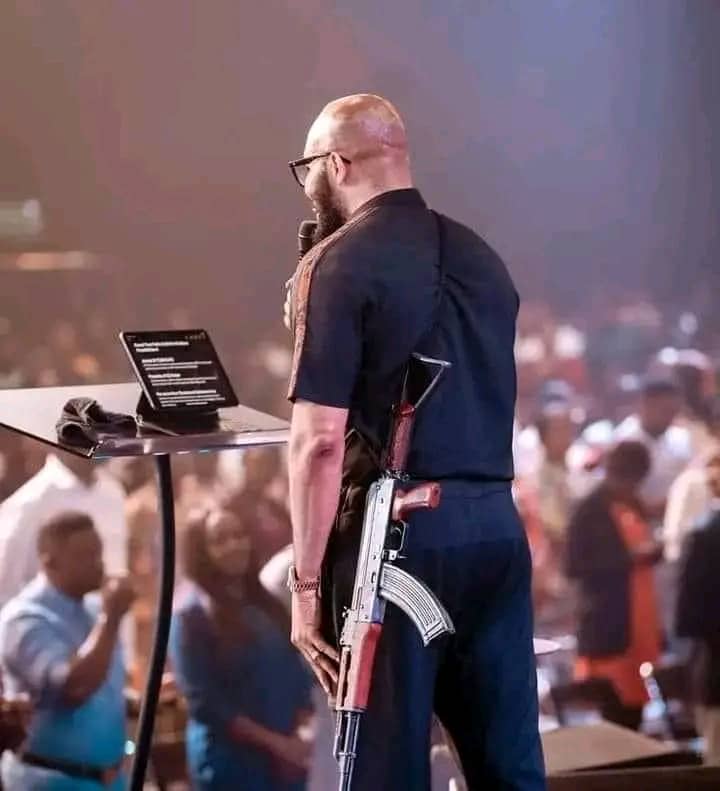
Pastor faces backlash for bringing AK-47 to church

By Ahmad Deedat Zakari

The presiding pastor of an Abuja church, Pastor Uche Ugbe, has brought himself to great disrepute and backlash after he took gun to the church on Sunday.

Pastor Ugbe, while on the altar addressing christian faithfuls, had an AK-47 dangling from his shoulder.

He was reported to have said he came to church prepared because some people are looking for his trouble

However, his action do not sit well with many Nigerians and they have taken to different social media platforms to lambast him.

Abdullahi O. Haruna, a journalist and public affairs analyst, described his action as insensitive.

Haruna said, “Yes, he is not a security guy,
He is a pastor wielding unabashedly this weapon of death, to a congregation that had children, exuberant youths, not minding the sensitivity. He reigns with such impunity. Don’t worry, this is Nigeria. Anything goes…”

Another Facebook user, Nasir Muhammad Salis, said, “I can’t fathom the high level of panic or tension some people will ignite in the country if this was Sheikh Gumi or Sheikh Pantami. But now, they are ignoring it. I don’t see, in my view, any justification for this childish dramatic action!”

Other persons have described him as silly, childish and attention-seeking.

As at the time of writing this report, the Christian Association of Nigeria (CAN), is yet to comment on the illegal possession of firearm by the pastor.

Interestingly, the Nigerian Police Force has also been conspicuously silent on the issue.

How Harvard University sponsored students for Umrah

By Muhammad Jameel Yusha’u, PhD

On Friday, I spent the early morning hours participating in a boot camp on negotiation. It was part of the effort of Professor Rand Wentworth to build the capacity of his students in negotiation. The boot camp was facilitated by Monica Giannone.

Immediately after the boot camp ended at 12 pm, my friend Alibek Nurbekov and I proceeded to the Friday prayer. As I was about to enter the prayer hall, Dr Khalil Abdur-Rashid was also arriving. Dr Khalil is the Muslim Chaplain at Harvard University and teaches courses at Harvard Kennedy School and Harvard Divinity School.

“Sheikh Khalil, welcome back from Umrah,” I said as he made his way into the prayer hall.

“Good to see you, Jameel. I need to talk to you after the prayer,” he said, and I nodded in agreement.

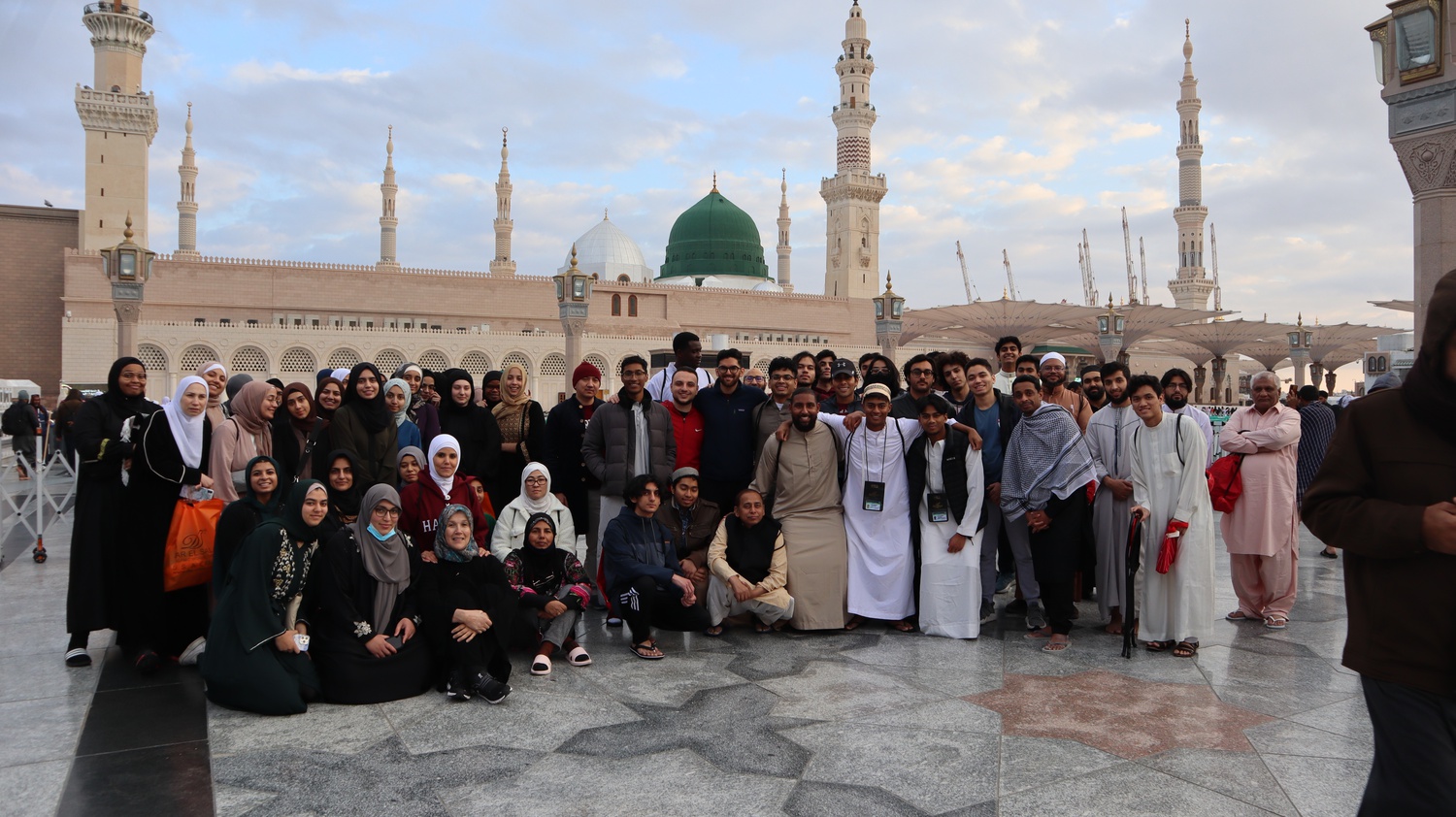
Dr Khalil led a group of students and other members of the Harvard Community to participate in Umrah, the lesser Muslim pilgrimage, where Muslims visit Makkah and perform the Umrah rites. They also visit Prophet Muhammad’s (PBUH) mosque in Madina and other historical places in the Kingdom of Saudi Arabia.

I came to know about the Harvard Umrah trip during the welcome orientation for students led by Dr Khalil last year at the beginning of the fall semester. He announced that some donors had provided scholarships for Muslim students to attend the pilgrimage, and he played a video for us on the experience in 2019 when they went on a similar voyage. Many students pledged to join the group for the trip in January.

Organising trips to different countries is a common tradition at Harvard University during the January break. Many trips were organised to Brazil, Singapore, Mexico, Saudi Arabia and more. The Harvard chaplaincy also utilised the break to organise the Umrah from 4th-14th January 2023.

Quoting Dr Khalil, The Harvard Crimson reported that “a generous donation from a graduate of Harvard Business School and a parent of two current Harvard undergraduates allowed the University to offer the trip at no cost to first-generation, low-income Muslim students. The donation for this year’s trip reportedly totalled approximately $100,000.”

As the Friday prayer finished, I waited patiently for Dr Khalil. As he came out, he asked me to walk towards his car. He brought a gift from the car and handed it to me. “This is a gift from the Umrah.” His wife Samia, who is also the female Muslim Chaplain, said, “it is a little gift for your girls.”

I thanked them in appreciation and headed home to enjoy the rest of the evening with my family. You can find the full story on the Harvard Umrah trip entitled “Spiritually Stimulating: Harvard Students Embarked on First Umrah Trip in Four Years.” (https://lnkd.in/et_dEBer).

Takeaway: Spiritual well-being is important in helping students to have a balanced educational experience.

Muhammad Jameel Yusha’u, PhD, is a candidate for a Mid-Career Master’s in Public Administration at Harvard University, John F Kennedy School of Government. He can be reached via mjyushau@yahoo.com.

Be your parents Sadaqatul Jariya

By Tijjani Muhammad Musa

I left the house without taking breakfast or even a bath in order to meet an 8:00 am appointment with the rest of our SWS.Comms production crew. A client has brought in an advert for emergency production and airing on the radio against an event scheduled to take place the next day, Saturday morning, by 10:00 am after the monthly Sanitation exercise.

The heavy traffic of Adaidaita Sahu, private vehicles, motorcycles, and so on State Road was highly discouraging as I turned into it from Maiduguri Road. Quickly calculating my other options, I thought of taking alternative routes to steer me away from the delay most likely to occur if I should get trapped in the traffic mess.

However, thinking positively and hoping for the best, I still drove into the snailing jam of vehicles. Soon, however, I saw an opening on the side of the road accommodating a trickle of cars and the ever-daring tricycle riders. Now being in a bit of a hurry, I instinctively branched into that flow. 

This gave me and many others the opportunity to cut off almost three-quarters of the “go-slow” that was caused due to road repairs, maintenance and renovation work going on on the roads as a result of adverse effects of heavy rainfall witnessed in the city in recent time. 

So many of the roads in the metropolis have turned into shallow graves and potholes, forcing many drivers to demonstrate their driving skills and dexterity, with pedestrians expressing their anger and annoyance once in a while from getting splashed with dirty potholed rainwater.

As I slowly snake through the engaging challenge, turning my head side to side to check the distance between me and the line up of tricycles to my left, I suddenly saw her in one of the Adaidaita and couldn’t help but stare. While briefly looking at it, I at that same time sensed myself being stared at. So I checked to see who was poring his or her eyes over me.

It was a much younger woman sitting next to the person who had caught my rapt attention. Clearly, she was wondering why my face lightened up and suddenly saddened again upon seeing the old woman sitting calmly by her side. 

To douse her fears, I lowered my car window, pointed at the old woman and loudly said, “She reminds me of my mother, who is now late. May her soul be blessed and rest in peace.” I whispered the supplication to my hearing only.

The younger woman, now relaxed and with a slight smile, said, “Allaah Sarki. Allaah Ya jik’anta da rahama” and I said, “Amin thumma amin” as tears wheeled up my eyes. I quickly got hold of myself as I averted the gaze of both the woman as well as the okada rider, whose attention had now turned to me.

I looked at the old woman intently once again and realized that she didn’t actually look like my Hajia in any way except for her height and the frail, wrinkled body characteristic of old women in their octagenarian stage of life. She was looking absent-mindedly into a future that none could tell what it was her mind’s eye was seeing or thinking.

Once again, tears overwhelmed me, for I could remember clearly the same kind of look on the face of my mother. She didn’t want to die due to the uncertainties that lay ahead. But then, none can avert its coming to pass, as it is a promise that must be fulfilled.

This is because Allaah AWJ Says in the Qur’an, “Kullu nafsin za ikatul maut” – Every soul must taste of death (Q3:185). So we all must eventually bow out. When, where, why, by what or how none of us knows. Thus by the 1001 ways and more to die, we all must become deceased.

I felt for her as I did feel for Hajia then whenever I saw that worrisome look registered on her face. I would immediately want to do something to distract her attention so as to change her mood for the lighter from such disturbing thoughts. 

Suddenly without thinking, I reached into the pigeon hole in front of my dashboard and fetched out some money I usually keep there in case of an emergency and asked the Adaidaita rider how much was the cost of the ride. He told me, and I handed much more than the amount to him, telling him to give her the change.

The old woman looked at me and smiled. She was pleased with what I did and waved her two palms at me in thanks, and all of a brief flash, I saw my mother in her. It was a beautiful sight. The younger woman with her was also happy and prayed fervently for me as I drove off.

Then by Allaah SWT, the dam broke, and I started crying, in the wonder of what my mother might be going through, wherever she might be at that moment. There and then, I started praying to Allaah AWJ to please forgive her, whatever wrong she might have done while alive and bail her from anybody’s haqqi if she has done them wrong. 

That my Lord and Maker should please compensate whoever she owes, whatever it might be and set her soul free in Barzakh, pending when she will be admitted into Jannah and His AWJ’s much sought after Grace. Fortunately, I’ve dreamt of her 3 times already. She’s doing alright, bi iznilLaahi.

In one of such dream, we were at an occasion with Prof. Yusuf Adamu, and she came to the place. So I excitedly introduced her to him. As he respectfully greeted her and started thanking her for me, she said to him, smiling, “A’a haba ai mu ne da godiya”. More tears tore into my composure like a small child.

I had to stop myself as passersby were beginning to stare at me, wondering and whispering to each other what they thought was wrong with me. Though I never liked the idea of tinting off my car windows since I have nothing to hide, for a change, I wished I had done so, so I could indulge and enjoy my emotional outburst in full privacy. 

It’s not every day that such grace from Allaah happens to me. Anyway, I pray that all our parents who have died be in better existing conditions, wherever they may be right now than when they were here living on earth. 

May all other mothers and fathers be similarly forgiven for their wrongs, mistakes and shortcomings. Allaahumma amin thumma amin.

A look at the Kano Hisbah Board law vis-à-vis Nigerian Constitution

By Rabi’u Muhammad Gama

Introduction

The Kano State Hisbah Board (hereinafter referred to as “the Board”) has been an object of controversy, particularly on social media, for quite some years – probably right from the inception of the Board. The controversy usually surrounds the way and manner by which the Board, or more properly, the foot soldiers of the Board (the Hisbah Corps), carry out its, supposedly, statutory responsibilities (functions), ranging from matchmaking, reconciling civil disputes between persons and/or organisations, seizing and destroying bottles of alcohol, imposing a certain mode of dressing on people to waylaying young people, especially males, when they seem to have a certain objectionable hairstyle considered to violate Islamic morals.

Even though some historical accounts of the philosophical underpinnings behind the evolution of Hisbah will be very rewarding for a better appreciation of the topic, this article restricts its scope to the constitutional status and the functions of Hisbah as provided for in the Kano State Hisbah Board Law No. 4 of 2003.

The Constitution of the Federal Republic of Nigeria

The Constitution of the Federal Republic of Nigeria, 1999, (hereinafter referred to as “the Constitution”) is the Supreme Law of the Land. It is the Law over and above which there is no other law. As such, if any other law, either deliberately or by necessary implication, happens to be inconsistent with the provision of the Constitution, the Constitution shall always prevail, and that other law shall, to the extent of its inconsistency, be void and of no effect whatsoever. See Section 1(1)(2)(3) of the Constitution.

The Constitution is not only the Biggest Law of the Land, but it is also the  Fountain Law of the Land from which all other laws flow. It (the Constitution) distributes legislative powers between the federal and state legislatures. Section 4(1) confers on the National Assembly(which comprises the Senate and the House of Representatives) the power to make laws for the whole country or any part thereof. Section 4(6) likewise empowers the State House of Assembly to make laws for the state or any part thereof. However, these powers are to be exercised within some certain constitutional limits: the National Assembly cannot legislate outside the Exclusive Legislative List and the Concurrent Legislative List, while the State House of Assembly cannot, and shall not, trespass upon the Exclusive List. This clear distribution of powers forms the foundation of the debate as to the legality of the Hisbah Board Law, but that should be a topic for another day.

In response to the then prevailing circumstances and mounting agitation for the reintroduction of Shari’ah in the State, which was sparked by the reintroduction of Shari’ah in Zamfara State, the Kano State House of Assembly exercised the powers given to it by Section 4(6) of the Constitution by enacting a law known and cited as “The Kano State Hisbah Board Law No.4 of 2003, which brought the Hisbah Board into existence.

The Hisbah Board Law

The Kano State Hisbah Board Law, 2003 (hereinafter referred to as “the Law”) came into force precisely on the 7th  day of November 2003. The law is relatively short: it has 17 Sections only. Section 3(1) of the Law establishes for the State “…a Board to be known as the Kano State Hisbah Board”. “This Board”, says Section 5 of the Law, “shall be responsible for general policy-making as well as coordination of activities between State and…Local Government Hisbah Committees”.

Section 7(1) of the Law empowers the Board to establish the State “Hisbah Corps”, who, according to the Section, may be eligible for appointment as Justices of Peace. By virtue of Section 7(2), the Corps so established shall be under a Commander who shall be appointed by the State Governor. And the duty of the Commander of the Corps, by virtue of Section 7(3), shall be the general administration of the Corps.

According to Section 11(1) of the Law, the Board shall have a Secretary who shall be appointed by the State Governor. The Secretary to be appointed shall be a legal practitioner with not less than 6 years of post-call experience. That Secretary shall be both the legal adviser and the head of the legal department of the Board.

It is important to assert, at this juncture, that the Kano State Hisbah Board, in spite of the raging debate going on in the legal cycle, is a legal and lawful organisation/institution which is duly and validly created by the Kano State House of Assembly pursuant to Kano State Hisbah Board Law No.4 of 2003. See also the case of Yahaya Farouq Cheɗi v. A.G Federation (2006) 13 NWLR (Pt.997) 308  (CA).

Duties of the Hisbah Corps

The Hisbah Corps, created by Section 7(1) of the Law, is the most active arm/department of the organisation. The Corps is the foot soldiers and the chief executor of the responsibilities of the organisation. For the sake of clarity and precision, below are the functions, or rather, responsibilities of the Hisbah Corps, as provided for under Section 7(4) of the Law. According to the said Section, the Hisbah Corps shall have responsibilities to:

Render necessary assistance to the Police and other Security agencies; encourage Muslims to unite in their pursuit of justice; encourage kindness to one another; advise against acquiring of interest, usury, hoarding and speculation; encourage charitable deeds, particularly the payment of Zakkah; give advice on moral counselling; encourage orderliness at religious gatherings; encourage general cleanliness and environmental sanitation; reconciling of civil disputes between persons and/or organisations where parties are willing; assisting in traffic control; emergency relief operations; assisting in any other situations that will require the involvement of Hisbah.

Anything other than the above is beyond the statutory functions of the Hisbah Corps. This begs the question: can the Hisbah Corps give itself powers or functions that are not given to it by its enabling law? The answer is “No”! And one fundamental thing that can be deduced from the above functions is that the Corps seems not to have any “actual power” to execute anything. The Law seems only to empower the Corps to “advise”, “encourage,” and “assist”, nothing concrete and definite! The Hisbah Corps clearly has no power to arrest, detain, waylay or force anybody to do anything against his or her will. The Law could not be clearer, and it is there for all to see.

Conclusion

The Constitution of the Federal Republic of Nigeria, 1999, is the first and the ultimate law of the country, the Grundnorm of the Land, so to speak. It creates and empowers the Kano State House of Assembly to make law for the peace, order and good government of the State or any part thereof. It is in the exercise of these powers that the Kano State House of Assembly made the Kano State Hisbah Board Law No. 4 of 2003, which brought into existence the Kano State Hisbah Board. The Kano State Hisbah Board Law, 2003, also creates the Hisbah Corps and empowers it with some specific functions and/or responsibilities.

It is the view of this writer that any act, no matter how noble or well-intentioned, done by the Board or the Corps must be in accordance with the provisions of the Kano State Hisbah Board Law, 2003; otherwise, the act is illegal, unlawful and ultra vires. And where an act of the Hisbah Board, or the Hisbah Corps,  happens to be in conformity with the Kano State Hisbah Board Law, 2003, but not in conformity with the Constitution of the Federal Republic of Nigeria,1999, or any other law validly made by the National Assembly, then the Constitution, or the law of the National Assembly, shall prevail and that act stands unlawful and illegal, no matter how religiously rewarding or well-intentioned the act is. See the case of Musa v. INEC (2002) LPELR-11119 (CA).

Rabi’u Muhammad Gama is a Law student; he writes from the Faculty of Law, Bayero University, Kano, BUK. He can be reached via rabiuminuwa327@gmail.com.
Chinese woman converts to Islam in Nigeria 

By Ibrahim Mukhtar 

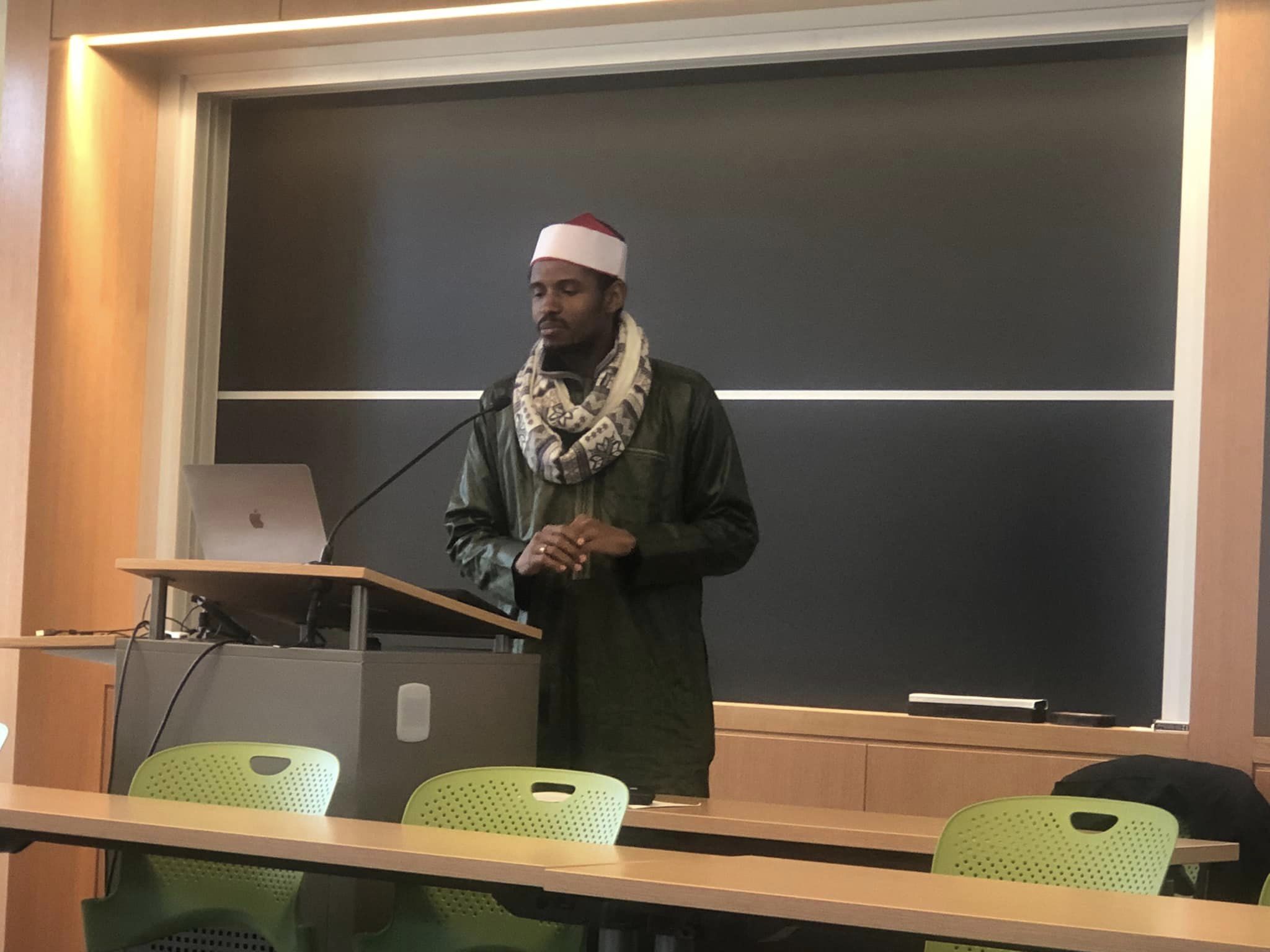
A Nigeria-based Chinese woman accepted the religion of Islam at the palace of the Emir of Machina in Yobe State. 

The woman who was at the palace with her fiancé explained that no one forced her to accept the religion—she wanted Islam on her own conviction. 

After she took the Kalimatu al-Shahada from His Highness, the Emir of Machina, she was asked to choose the name she wanted.

The Daily Reality learned that she chose “Fatima” based on the advice given to her by her fiancé. 

Fatima was observed to have been happy and relaxed alongside all those with her in the Emir’s palace.

Waqf Foundation upgrades lives of Nigerians

By Abdulhamid Muhammad

Sunday, 25th December 2022, was a day of revelations and feedback from the Waqf Ambassadors of the Zakah and Waqf Foundation, Gombe, Nigeria. It happened during the Uncovering Potentials Workshop (UPW) organized by the Foundation for the 1st and 2nd sets of its Waqf Ambassadors, which was facilitated by Dr Najeeb A.A. Gambo, a researcher with the Microsoft Company and Nigeria’s 2nd Google Certified Trainer.

It was conducted a day after a 2-day intensive induction training for the 2022/23 Waqf Ambassadors at the Foundation’s Training Room. As usual, of all the year-long life-changing training that the Foundation organizes monthly for its 80 enrolled Waqf Ambassadors annually, the UPW was highly impactful, thought-provoking and action-triggering.

In the closing session of the workshop, scores of youth voluntarily gave their testimonies on how the sessions of the workshops they have gone through in the last 12 months have completely revolutionized the way they look at the world financially and intellectually.

One of the ambassadors narrated how excited she was after starting a business and discovering that she could now do a lot of things with her earned income without asking or waiting for someone to give her. It was a great discovery because she grew up in a society that programmed her to think that she could not make money for herself.

Another person said that it was a workshop in ZAWFOG on reading culture that ignited in him the habit of reading books, and that has completely transformed his life, making him more creative and more confident, and hopeful about life.

Another Ambassador, whose parents hitherto paid all his bills, revealed how as a result of the motivation he got from these series of lectures is now able to earn more than the national minimum wage every month despite being still a student. And many of the participants went on and on.

These are a few of the testimonies, and I wished the Chairman of the Foundation, Ameer Abdullahi Abubakar, was there at the closing session to hear how the Foundation is making an impact and transforming lives. It is clear that his model is working; the Waqf Ambassadors are fast moving from poverty (p) to prosperity (p) and soon to philanthropy (p) in sha Allah. As envisioned by the founders of the Foundation, we will soon have a generation of youth who are rich enough and committed seriously to building our society through Waqf.

May Allah accept this from all the people who have contributed in one way or the other in moulding the next generation to be a productive one, amin. May He continue to bless the Foundation and take it to greater heights.

Abdulhamid Muhammad is a 2021 Waqf Ambassador and wrote from Gombe State, Nigeria.

SAS Kano promoted Shari’ah after Jihad – Prof. Naniya

By Ibrahim Mukhtar

The main aim behind the establishment of the famous School for Arabic Studies (SAS) Kano was solely to promote Shari’ah after the conquest of Northern Nigeria by the colonialists.

This was disclosed by Professor TIjjani Naniya of the History Department, Bayero University, Kano, during the SAS day celebrations, which marks the 82nd anniversary of the school.

The History professor went down the history lane and narrated how the school was established and how the then-colonial government wanted to undermine Shariah by promoting their own legal system.

According to the professor, “Sarki Alhaji, who was the first emir of Kano to have performed Hajj, was the one who applied and sought the approval of the colonial masters to establish a school which would cater for the peculiar legal needs of the Northern Muslims.

The colonial masters thought it would be another way to distort and dominate the Islamic legal system, but unknown to them, the School for Arabic Studies would outshine them and their mischief.”

Prof. Naniya narrated how the school admitted only brilliant students based on merit and how a son of a late business tycoon in Kano was expelled as a result of his bad attitude then.

He further talked at length about how the story of the school went high and how the model was copied and established in other states in Nigeria and beyond. Finally, he urged all the attendees to pray for those emirs and leaders who worked very hard to promote Islam and Shariah for all the country to benefit.

The 82nd anniversary took place Monday, December 26, 2022, on the school premises. The event was well-attended by the alumni of the school and other dignitaries.

The 2022 Qatar FIFA World Cup: Triumph of cultural tolerance and setback to clash of civilisations

By Babayo Sule, PhD

The 2022 Qatar FIFA World Cup is no doubt a beginning of a fresh era in intercultural relationships globally because of the indelible marks of perception, dynamism, fresh vigours, advancement of a new model and, most importantly, the introduction of a new style of reception, fanfare and farewell from the host to the world. Hosting a gargantuan event like FIFA World Cup is certainly a herculean task that financial muscles and political influence alone cannot earn. It takes beyond the lobby, indefatigable consultations, display of economic prowess, commitment, smart strategies that will outsmart competitors and, above that, a clandestine promise of delivery and reliability. Of course, Qatar surmounted all these obstacles and won the hosting. Beyond that, the World Cup was successfully organised, hosted, done and dusted most sublimely and fashionably way to some groups, perhaps.

Not long ago, some Western scholars, including Fukuyama (1996), Huntington (1996) and Lewis (1992), struggled hard to convince the world that the Western ideology, civilisation and system are forever the best and can never be competed with or matched in any circumstances. But for the critical counterattacks of the likes of Sa’id (2005), Harun Yahaya, Nefeily (2002) and some others, the Fukuyama-led cultural clash nearly succeeded in defeating the world to surrender to the almighty West and despair from any form of competition. Fortunately, the Sa’id-led counterattacks made us believe that cultural clash or advancing it is an act of ignorance that can be suppressed with dialogue and better understanding built on tolerance and respect. The approach of Qatar to the 2022 FIFA World Cup practically convinced us to discard the former school and hold firm on the latter.

When I learnt that the small country of Qatar, with just a population of 3 million, spent a breath-taking $200 billion, I cautioned myself to wait patiently and see what the country is after because my inner ego told me that the country is definitely up to something otherwise it will be crazy enough to believe this embezzlement amidst the myriads of squalor, deprivation, abject penury, natural disasters and other sufferings emanating from armed conflicts in the Muslim-dominated states. Qatar should have diverted this huge amount of money for humanitarian intervention in the most affected states, but my curiosity continues to deter me from concluding without seeing the actual intention. At last, it is revealed glowingly most passionately and soothingly to the global Ummah that Qatar invested in a modern and strategic Jihad.

Football is arguably the most unifying festival or even phenomenon globally, more than anything. Even religion today is not hypnotising like football, especially among youth. Take Nigeria, for example. Divisions are sharp and threatening to national unity in virtually all matters, even that of critical national importance like security, except for football. In an employment to strategic parastatals or apportion of a political position, no section of the country will tolerate the composition and the outlook of the national team, the darling Super Eagles. But in football, Ahmed Musa can score against Argentina in the World Cup, celebrate by prostrating before Allah (SWT), one of the major pillars of five congregational daily prayers and a major point of bringing one closer to his Creator, the Hausa/Fulani, Igbos, Yorubas, all the more than 400 ethnic groups, the Muslims, Christians, ritualists, animists and the North and South will unanimously celebrate the goal without minding exactly the mode and pattern of the celebration of the player. The same thing is applicable if a Christian player scores and celebrates using his religious signals and symbols. But for football, what can be tolerated that way in our mother country? Should a Minister prostrate in front of a national broadcast to celebrate the country and the achievement of his Ministry, trending impending insults among divided Nigerians will take weeks actively?

For Qatar, the small country lured the globe to its culture and way of using football as a tool. The country satisfactorily met all the requirements and fulfilled all the datelines, resources, infrastructures, provisions and all that is needed to host a successful World Cup. On several visits, the FIFA team always expressed its satisfaction with the level of preparations and provisions made by Qatar. However, some days before the commencement, Qatar boldly rose its head before the world and declared that it is a country of faith, culture, values and a system that must be respected without any compromise. Alcoholism in the stadiums, gay and other amoral attitudes are banned throughout the event, and any violation will surely attract a sanction according to the laws of Qatar governed by the Shari’ah system. Instantly, the belief that the West has in cultural clashes and the arrogant display of the ethnocentric chauvinism of superiority surfaced.

The Western media pounced on Qatar, and some even threatened to either boycott the event or Qatar must be forced to rescind its decision and guidelines for attending the event. Qatar stood firm and pledged never to compromise its stand on the ground that Qatar respects all cultures, and anywhere the citizens of the country visit, they respect and adhere to the guidelines, principles and laws of the land; then, why should her own be different? In what ways is any culture superior or advanced or super enough to bulldoze and overshadow the host culture? Fortunately, the FIFA President, being honest, frank and fair, supported Qatar fully and chided the West for, according to him, ‘its hypocrisy, intolerance, arrogance and immorality. Instead of the West apologising to the world for its more than 300 years of plunder and arrogance, it is parading tits trademark again’. The Western media, unrelenting, resorted to blackmail that the FIFA officials were bribed to grant Qatar the hosting, and the FIFA is bribed to approve the preparations and accept the conditions of Qatar without any protest.

The West, which mesmerised and dazzled the world with its modern scientific and technological advancement, effervescent skyscrapers, efficient system, and continuous innovation, failed the simple test of tolerance, respect and morality. The moral bankruptcy appears disappointing. Sayyid Qutb earlier berated the West for its handicap in a moral view. He expressed his wonders in seeing the miraculous feat achieved by the West in technology and development but rebuked them for moral emptiness, cultural intolerance, intellectual fallacies of distorting Islamic culture and values to him and bestiality exhibited by humankind in their societies. The FIFA President himself chastised the West for its sheepish behaviour and the display of immorality to the level of bestial nuptiality. The West arrogantly believed that it had the monopoly of setting the agenda for even cultural perception. The long-term monopoly in the political and economic control of the world intoxicated the West to believe that it must always determine the standard for anything, and it must have its way. But Qatar, a small but mighty country, challenged this view and put a sudden stop to it in style.

Qatar designed a Jihad model and unveiled it where all the attentions are. They say, ‘hit them where it hurts’, and Qatar hit where it hurts, but it soothes many. The opening ceremony sent waves of meticulous fantasy and a display of a fabulous enigma of people that aspired to differ in all ramifications from the acclaimed normal norm. Instead of the noisy fanfare, thunderous jamboree and a competition to display nudity and craziness of masquerades, the environment of the opening ceremony was ensconced in a serene clime with the melodious recitations of the Glorious Quran and a lullaby of the romantic Arab scents and marvellous dressing. The spectators silently listened and were hypnotised by the beauty and eloquence of the Qur’anic recitation.  

Instantly, the campaign of calumny, blackmail and propaganda swung into action in the West. The BBC declined to air the opening ceremony. The major Western media embarked on futile and baseless negative reporting. For instance, the Independent of November 21st 2022, wrote a piece mocking Qatar, the host, titled ‘Qatar World Cup defeat proves there are some things in sport you can’t pay for’. Another article in the Independent in the date titled ‘Qatar’s opening World Cup impression slips into disaster on and off the pitch’.

In another propaganda, CNN reports in an article on 20th November 2022, ‘Qatar makes World Cup in a debut controversial tournament of firsts’. The 24th November 2022 article by the Independent titled ‘What on earth is Morgan Freeman doing in Qatar? Queried why Morgan Freeman should be in Qatar. In the assumption of the Western media, Qatar spent lavishly to win. When and where World Cup opening match is won by the host? Morgan Freeman is seen either as too civilised to be in Qatar to attend a Qur’anic opening ceremony or irrelevant. The motive of Qatar is entirely a different ball game. Qatar has won the World Cup in the eyes of the fair-minded, culturally-tolerant but specifically, the Muslim world. The Jihad exhibited a moderate contemporary approach, and the resistance against the imposition of alien cultures to then host succeeded in opening the eyes of the imperialised and the international relations and international system will, of course, never be the same again.

Other resistance to neo-colonialism and new imperialism are unfolding courtesy of what Qatar did. Peacefully but assertively, Qatar altered the shape of the global political economy for keen observers. Even Huntington must revisit his clash of civilisations and rethink the remaking of world order beyond his only perceived clash.

The damages that the West self-inflicted in the effort to spoil the World Cup show in Qatar can take many decades or centuries to restore. For example, they are enlightening the world to resist any culture that it is not comfortable with, starting with their forceful imposition. They may continue to lure and influence the world using economic leverage and threats, but countries that are self-conscious, like Qatar, which internally recycled its economic buoyancy, will resist and counter. African states may take a lesson or continue to be humiliated by the world at will. The West, in its intolerance, informed the world that the crusade for human rights, democratisation and other dangerous exports (Blum, 2013) might be resisted, and it is a setback to its agenda of ruling the world using institutions and agreements.

Another lesson the world learnt from the weird attitude exhibited by the West in Qatar is to draw back and resist any attempt to denigrate or demean any culture, value, faith or nation. It is a scientific gateway for many global policymakers and key players to justify when pushing an agenda or tackling it. The worse of the scenarios is the moral emptiness and sheepish attitude of some countries and their football teams. The sport, as if it were a living organism, showed them an early exit to save the world from their embarrassment and allowed the serious-minded ones to battle it out.

One fascinating scenario in Qatar that will outlive the tournament and qualify the event to be extraordinary is that the vulgarity of Qatar is not leaving any stone unturned in its newly discovered Jihadism. The likes of Dr Zakir Naik were offered the opportunity to display their prowess in Da’awah, and the accommodation was designed to introduce the Islamic process of cleansing from impurity, a discovery that leaves many visitors dazzled and interested in Islamic teaching. The calls to prayer, display of Qur’anic verses from all angles of the city and Prophetic golden words all revealed exactly what Qatar spent its money for and not what the Independent article misperceived or tried to push deliberately. The final or closing ceremony after Argentina won the Cup was exotic. African musicians, including the Nigerian Davido, were invited but were confined to the World Cup tune prepared by a Qatari singer. The best player, Lionel Messi, was decorated in the regalia of the most valuable Arabian dress instead of the obscured juju and the usual spray of liquor and other madness that have no place in most civilisations but are being pushed down the throats of the communities by the imperial powers.

The World Cup has come and gone, but its memory will forever relish our minds and in what Qatar did, ‘Verily, in this is a Sign: but most of them do not believe’ (Q26:8). Qatar has opened a gateway for other world countries to liberate themselves from the encumbrances of new imperialism and neo-colonialism that is used to push the imperialism (Nkrumah, 1965). The small country has presented a fashionable and peaceful model of Da’awah that will strategically counter propaganda and a model of Jihad devoid of terrorism. It is a kind of Jihad that is difficult to provide a vacuum for conspiracy or damaging insults. Qatar may face stereotyping and a campaign of blackmail, and other Arabs and Islamic states may not smell the opportunity of hosting the World Cup for the next century or more, provided the West continues to control the world, but world countries can now develop the effrontery to counter abuse and disrespect of their faiths and cultures and may advance to ward off imperialism. African continent may restore its umbilical cord with Latin America and the Caribbean to re-establish a strong, surviving and successful Pan-Africanism. Qatar, in our eyes, is a blessed land of the righteous that present a model of liberation. God bless the country and the tournament!

Babayo Sule (PhD) wrote from the Department of Political Science, Faculty of Humanities Management and Social Sciences, Federal University Kashere Gombe, Nigeria. He can be reached via babayosule@gmail.com.

Hisbah thwarts same-sex marriage in Kano

By Uzair Adam Imam

The Kano State Hisbah Board Monday said it apprehended 19 youths for same-sex marriage in the state.

The Commander General, Sheikh Harun Muhammad Sani Ibn Sina, confirmed the development to journalists.

Ibn Sina said the youths gathered to witness the wedding of two suspected homosexuals, Abba and Mujahid, at one event centre in the city.

However, he said their personnel arrived at the scene before the commencement of the wedding rites and 15 females, and four males were arrested during the operation.

He added that some of the ladies arrested said they were invited to the wedding from the neighbouring states.

He noted that the duo, tagged as bride and groom, Abba and Mujahid, escaped immediately after the arrival of the Hisbah personnel at the wedding venue.

A 21-year-old lady, Salma Usman, who is now in Hisbah custody, was said to be the event organiser.

Meanwhile, while reiterating that the Hisbah will intensify efforts to ensure the arrest of Abba and Mujahid, Ibn Sina said they would hand over those in their custody to the police for further action.

Some of those arrested who spoke to Radio Nigeria, Salma Usman, Sadiya, Aisha Adam, Maryam Ibrahim and Bilkisu Lukman, claimed to have been invited to a birthday party.

The ladies pleaded for leniency and promised not to engage in such acts.

MURIC condemns INEC for scheduling meeting inside church

By Uzair Adam Imam

The Muslim Rights Concern (MURIC) has condemned a decision by the Lagos State Office of the Independent National Electoral Commission (INEC) to hold its meeting inside a church in Ikeja, Lagos State.

Prof. Ishaq Akintola, the MURIC Director, made the condemnation in a statement released and issued to journalists on Thursday.

It was gathered that the Lagos headquarters of INEC scheduled a meeting for Thursday and picked Archbishop Vining Memorial Church Cathedral, Ikeja, as the venue of the meeting.

Akintola advised INEC Lagos headquarters not to hold any of its activities in any church except those meant for church members alone and that same goes for mosques and shrines.

He added that INEC has no business using places of worship for their activities, adding that the development is ‘very disappointing’.

The statement read, “This is very disappointing. How can an electoral body of INEC status pick a religious house of worship as venue for its meeting? Is the meeting for the Christian wing of INEC or what? Is INEC meeting members of the church? It is unacceptable.

“The choice of a church as venue for a meeting of INEC is very insensitive particularly given the very volatile situation, we are in Nigeria today. It is an open secret that Christian pastors are deeply involved in political campaigns.

“Many of them have turned 2023 election into a straight fight between them and the Muslims.

“INEC Lagos Headquarters has taken a false step. Holding an electoral body’s meeting inside a church is like holding it inside the secretariat of one of the political parties.

“It erodes confidence. It is totally wrong particularly in a situation whereby the church has publicly revealed that it is an interested party in the ongoing electioneering exercises.

“Why pick a church when there are hundreds of neutral places all over Lagos? Is INEC promoting the church’s vested interest in the 2023 election? Is some kind of connivance in the offing?

“INEC Lagos headquarters must prove to Lagosians that their votes will count. We call on Lagosians to watch the activities of INEC from now on because we are not convinced that it is going to be neutral,” Akintola said.