Military coup

Nigeria condemns military coup in Guinea-Bissau, demands return to civil rule

By Abdullahi Mukhtar Algasgaini

The Federal Government of Nigeria has strongly condemned the recent military coup in the Republic of Guinea-Bissau, labeling it a blatant violation of regional democratic principles and a threat to West African stability.

In a press release issued on Thursday, the Nigerian government expressed “profound dismay” over the military insurrection that led to an unconstitutional change of government.

It described the coup as an action that undermines democratic progress and constitutional order in Guinea-Bissau and the wider sub-region.

The statement called for the “immediate and unconditional restoration of constitutional order,” and demanded the safety and security of all detained persons.

It also urged respect for the country’s democratic institutions.

Nigeria specifically called on the new authorities in Guinea-Bissau to guarantee the safety of all election observers still in the country.

It advised all actors to exercise restraint, prioritize peaceful dialogue, and respect the will of the people as expressed through their votes and the official election results.

The warning was clear: those responsible for the coup “will be held accountable for their actions, which threaten to plunge the nation into chaos.”

As a key member of the Economic Community of West African States (ECOWAS) and the African Union, Nigeria pledged to work with regional and international partners to “take all necessary measures” to ensure a swift return to constitutional governance in Guinea-Bissau.

Defence Headquarters dismisses coup report as “false and malicious”

By Abdullahi Mukhtar Algasgaini

The Defence Headquarters (DHQ) has strongly denied an online report linking the cancellation of Nigeria’s 65th Independence Anniversary parade to an alleged coup attempt.

In a press release signed by Brigadier General Tukur Gusau, the DHQ described the publication as “false, malicious, and intended to cause unnecessary tension.” 

The military high command stated that the parade was cancelled to allow President Bola Ahmed Tinubu to attend a strategic bilateral meeting abroad and to enable the Armed Forces to sustain their operations against terrorism, insurgency, and banditry.

The statement also addressed the recent arrest of sixteen officers, clarifying that they are part of a routine investigation for professional misconduct. The DHQ assured that an investigative panel has been constituted and its findings will be made public.

Reaffirming its loyalty, the Armed Forces declared its unwavering commitment to the Constitution and the Federal Government, urging the public to disregard the falsehood being circulated by “purveyors of misinformation and enemies of our nation.” 

The statement concluded with the firm declaration, “Democracy is forever.”

Brice Oligui Nguema poised to win Gabon election after coup

By Hadiza Abdulkadir

Gabonese voters head to the polls Saturday in a pivotal election expected to cement army officer Brice Clotaire Oligui Nguema’s grip on power. Nguema, who led a coup last year ousting long-time ruler Ali Bongo, is widely popular for ending the Bongo family’s decades-long rule.

Unlike many juntas across Africa, Nguema has allowed relatively free elections and avoided harsh crackdowns. However, concerns remain about his democratic intentions.

A new constitution passed in November boosts presidential powers, and Nguema—though promising to step down from the military—has yet to do so formally.

International observers are watching closely, hoping Gabon can buck the trend of prolonged military rule seen in parts of West and Central Africa.

The outcome of this election may shape the country’s democratic future and signal whether Nguema intends to truly hand power back to civilians.

The military juntas in Africa

By Bilyaminu Abdulmumin

In the year 2021, when the gale of coup d’etat appeared to be fast resurfacing, it triggered revered columnist Mahmud Jega to title one of the columns “Fast Forward to the Past” to take us back to the period of the coup harvest, when the coup occurred as a competition in Africa. 

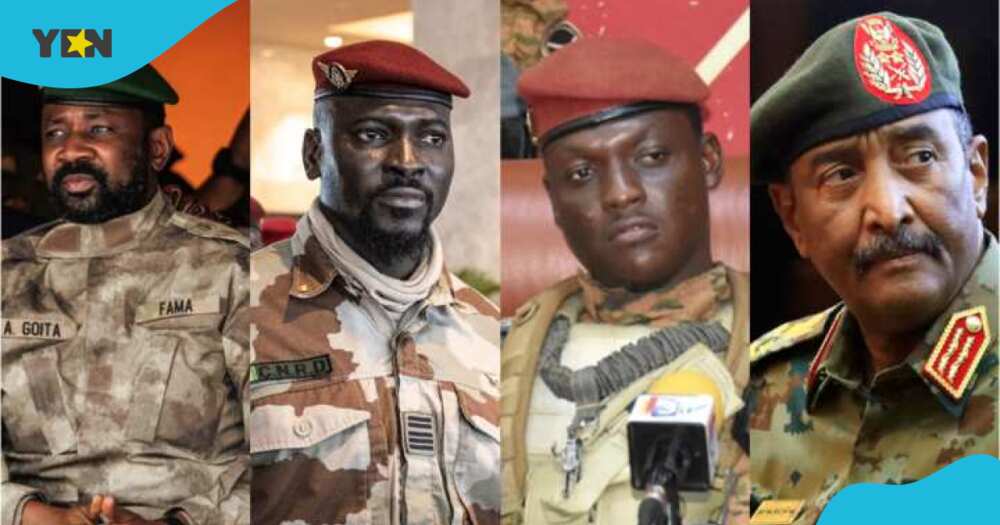
Within the 2021 year, three coups were carried out in Mali, Sudan, and Guinea Conakry. Conakry’s ousting of President Alpha Condé garnered a lot of media sensation. One reason that made it so was how the president was captured in the viral video in a state of disbelief, dressed casually, and the coup orchestrated by the commander of his supposed forces, a hitherto submissive commander, Mamady Doumbouya.

In the following year, 2022, there were two coups in Burkina Faso within eight months. The first one took place in January, with Lieutenant-Colonel Paul-Henri Sandaogo Damiba taking over as interim; after eight months, Damiba was, in turn, ousted by another military (installing Captain Ibrahim Traoré as transitional president).

It was even 2023 that has taken us ever faster than in the past. The news of coup d’etat or rumours about it broke almost daily. First, it was Niger, where the military guarding President Bozoum ousted him as simply as going to the park.  Similar to Conakry’s, the Niger coup drew a lot of attention, and the Nigeriens threw their weight behind the junta. Both the public and the junta kept the anti-French kite flying, paving the way for the shift in allegiance to socialist Russia- an alternative superpower block to which all the aggrieved countries with West meddling turn. In addition, the row that ensued between the Junta and ECOWAS has also added twists to the matter. 

Months after Niger, the Gabon military struck to oust Ali Bongo, which brought to an end the Bango dynasty of 53 years. Drama ensued when Ali Bango, who was declared winner of the Gabonese presidential election barely an hour before, appeared on recorded video, appealing for help from the international community: “I, Ali Bongo, president of Gabon, aim to send a message to all my friends all over the world to tell them to make noise, people here have arrested me, my family and son are somewhere right now I don’t know what is happening… I’m calling on you to make noise, to make noise really, I am thanking you” This reminds me of Colonel Muhammed Gaddafi in 2011, when the NATO-enforced rebels came ever closer, toppling him as they approached Tripoli, the capital of Libya, then the self-described “king of the kings” buckled down crying for help.

 The Niger and Gabon coup shook the African continent. It appeared the coup was sweeping the whole continent, and the writing was all over the horizon as the next coup seemed to be a matter of when, not if. This development has triggered several sit-tight leaders to do something. Both President Paul Kagame of Rwanda and Paul Biya Cameroon reshuffled military positions. President Umaro Sissoco Embaló of Guinea Bissau dissolved the country’s legislature and appointed a new prime minister weeks later. Hausa says Mai kaza aljihu baya jimirin ass (he who has a skeleton in his closet gets frightened at the slightest provocation)

One thing that has been a tradition for the coup plotters is to elongate their stay or convert to democracy and orchestrate their indefinite stay, for instance, the failed Sani Abacha attempt or the successful attempt by Yahya Jammeh of Gambia, Yoweri Museveni of Uganda, Mathiew Kerekou of Benin or the late Chad president Idriss Deby. 

Some of these sit-tight African leaders even taken their stay to another level: dynasty form, where children or family members take turns to preside over their respective countries like Mahamat Deby Idris taking after his father Idriss Deby, Joseph Kabila from his father Laurent-Désiré Kabila, Museveni’s son is currently heating up, the Robert Mugabe wanted to impose his wife. No one embodied this sentiment like The Nguema family of Equatorial Guinea. They didn’t surpass 53 years of the Bango family alone but showed no sign of relinquishing the power.

You see, it is not that there were not good reasons on the ground for the junta to intervene. For instance, the corruption was said to be unprecedented when Muhammadu Buhari intervened, the economic hardship was also on the equal scale when Ibrahim Babangida intervened, insecurities currently bedevil the Sahelian countries of Mali, Burkina Faso, the excuse for the toppling of the government in those countries. In addition, it is not that the Junta didn’t have good intentions to make things better for their respective countries, but somehow along the line after taking power, the situation became ‘Jiya iya yau’, (the more things change, the more they remain the same) sometimes even worse. Africa, where does the problem lie?

Breaking News: Military coup in Sudan

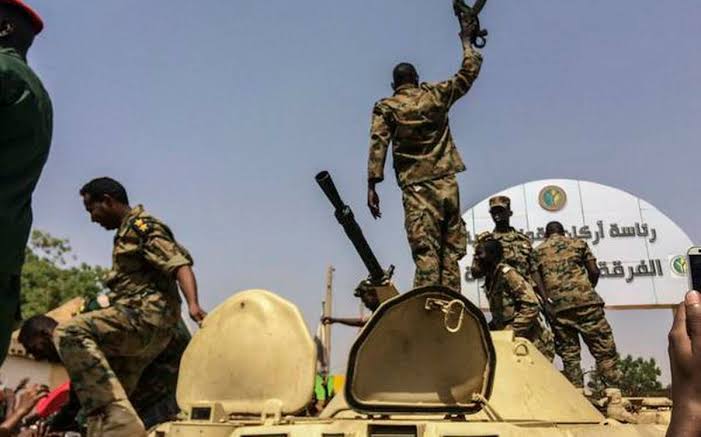
Through out last week, there were rising fears among the Sudanese as the military were about to intrude into the civilian spaces. Tension was so high, a situation that led to the closure of businesses, offices and many people remained indoors in the Capital city of Khartoum. However, earlier in the morning, there was a reported military coup.

According to CAIRO (AP) — Military forces arrested Sudan’s acting prime minister and senior government officials Monday, disrupted internet access and blocked bridges in the capital Khartoum, the country’s information ministry said, describing the actions as a coup.

In response, thousands flooded the streets of Khartoum and its twin city of Omdurman to protest the apparent military takeover. Footage shared online appeared to show protesters blocking streets and setting fire to tires as security forces used tear gas to disperse them.

Protesters could be heard chanting, “The people are stronger, stronger” and “Retreat is not an option!” as plumes of smoke from burning tires filled the air.

A takeover by the military would be a major setback for Sudan, which has grappled with a stop-and-go transition to democracy since long-time ruler Omar al-Bashir was toppled by mass protests two years ago.

The United States and the European Union expressed concern over Monday’s developments.

Jeffrey Feltman, the U.S. special envoy to the Horn of Africa, said Washington was “deeply alarmed” by reports. Feltman had met with Sudanese officials over the weekend in an effort to resolve a growing dispute between the country’s civilian and military leaders. EU foreign affairs chief Joseph Borrell tweeted that he’s following events with the “utmost concern.”

The first reports about a possible military takeover began trickling out of Sudan before dawn Monday. By mid-morning, the information ministry confirmed that the prime minister, Abdalla Hamdok, had been arrested and taken to an undisclosed location. Several senior government figures were also detained, the ministry said in a Facebook post. It said their whereabouts were unknown.

In other hallmarks of a takeover, internet access was widely disrupted and the country’s state news channel played patriotic traditional music. At one point, military forces stormed the offices of Sudan’s state-run television in Omdurman and detained a number of workers, the information ministry said.

Monday’s apparent takeover came after weeks of rising tensions between Sudan’s civilian and military leaders. A failed coup attempt in September fractured the country along old lines, pitting more-conservative Islamists who want a military government against those who toppled al-Bashir in protests. In recent days, both camps have taken to the street in demonstrations.

Under Hamdok and the transitional council, Sudan had slowly emerged from years of international pariah status in which it existed under al-Bashir. The country was removed from the United States’ state supporter of terror list in 2020, opening the door for badly needed international loans and investment. But the country’s economy has struggled with the shock of a number economic reforms called for by international lending institutions.

There have been previous military coups in Sudan since it gained its independence from Britain and Egypt in 1956. Al-Bashir came to power in a 1989 military coup that removed the country’s last elected government.

Among those detained Monday, in addition to Hamdok, were five senior government figures, according to two officials who spoke on condition of anonymity because they were not authorized to share information with the media.

Those detained included Industry Minister Ibrahim al-Sheikh, Information Minister Hamza Baloul, and Mohammed al-Fiky Suliman, member of the country’s ruling transitional body, known as the Sovereign Council, as well as Faisal Mohammed Saleh, a media adviser to Hamdok. Ayman Khalid, governor of the state containing the capital, Khartoum, was also arrested, according to the official Facebook page of his office.

After news of the arrests spread, the country’s main pro-democracy group and the Sudanese Communist Party issued separate appeals for Sudanese to take to the streets.

Separately, the Communist Party called on workers to go on strike in an act of mass civil disobedience after what it described as a “full military coup” orchestrated by the Sovereign Council’s head Gen. Abdel-Fattah Burhan.