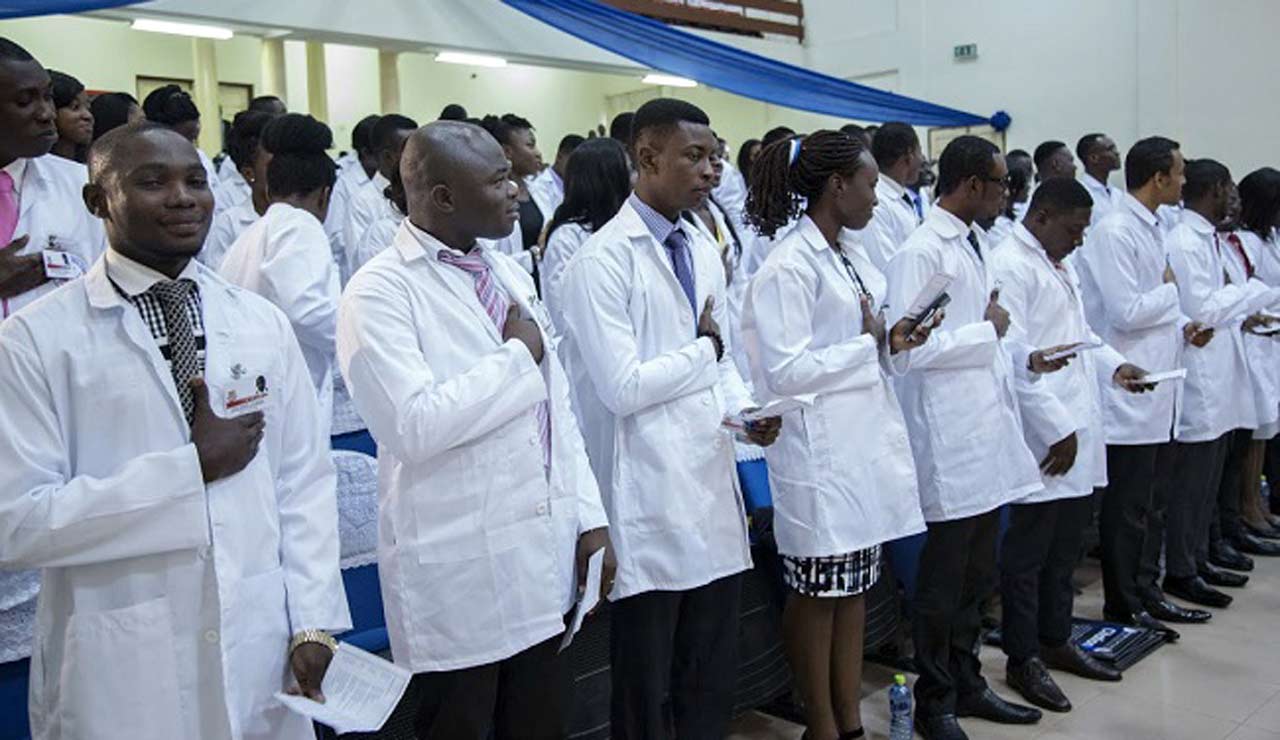
Medican Doctors

Doctors’ anti-migration bill and nurturing greener pasture

By Lawal Dahiru Mamman

Brain drain in Nigeria has lingered for some time now. In the medical profession, it is the most dominant issue occupying the mind of physicians and other health personnel. This may not be unconnected to the fact that human life is sacrosanct.

It goes without saying that the incessant brain drain of medical personnel in Nigeria will slow the attainment of Universal Health Coverage (UHC), that all people have access to the full range of quality health services, they need, when and where they need them, without financial hardship, in this part of the world.

Mainly, the mass exodus of doctors out of the country is caused by poor welfare of medical practitioners, lack of or insufficient working equipment, and poor working environment leading to the need for seeking a more sumptuous alternative – greener pasture as it is called.

This is purely a reflection of the theory which argued that “…… if wages rose above subsistence, the number of workers would increase ….” By implication, wherever our medical brains are sprinting to have a more luscious wage or salary for the profession. This would increase the country’s workforce while wearing out our dear nation.

Discussions have sprung over time on how to salvage the situation. Experts have suggested an increment in the welfare of doctors. In contrast, others have voted for ending medical tourism, especially public officeholders, to enable them to pay more attention to funding health facilities at home.

The most recent attempt to curb the mortal exodus of medical practitioners is to shackle them with the power of the law. This is through a bill sponsored by Ganiyu Johnson, a lawmaker from Lagos. The bill seeks to amend the Medical and Dental Practitioners Act 2004 to address the brain drain in the health sector. According to the lawmaker, it is only fair for medical doctors who enjoy taxpayer subsidies on their training to give back to society.

The legislation is titled, ‘A Bill for an Act to Amend the Medical and Dental Practitioners Act, Cap. M379, Laws of the Federation of Nigeria, 2004 to Mandate Any Nigeria Trained Medical or Dental Practitioner to Practice in Nigeria for a Minimum of Five Years Before being Granted a Full License by the Council to Make Quality Health Services Available to Nigeria; and for Related Matters.’

While the above is more restricted to medical and dental practitioners, the same lawmaker said on Friday, April 14, 2023, that he would be presenting a similar bill on nurses and pharmacists; when he intends to do that, time will tell.

With different medical associations reacting in negation by stating that the bill has the propensity to trample on the rights of doctors, the Minister of Health, Dr Osagie Ehanire, said the bill is in order especially looking at the fees paid by the government to subsidise their training at universities, and the service which they render before travelling overseas. However, the minister said the service does not make up for the cost of training.

The Nigerian Medical Association (NMA) has said the bill will not see the light of the day because it impedes the constitutional right to freedom of movement of doctors and violates international labour law, chiefly since the government has subsidised students from all other professions.

The Nigerian Medical Students Association (NiMSA) and the World Medical Association (WMA) have vehemently disapproved of it, too, because the bill, according to the latter, is “not only outlandish but totally retrogressive, unresearched and very ill-informed.”

The bill that intends to give health workers full license only after five years of working in Nigeria has passed the second reading in the House of Representatives. While this may have come out of benevolence, it may not be the piece we search for to solve the puzzle of brain drain in the health sector.

If the bill sees the light of day, after five years, doctors will still have the freedom to travel out, in my opinion even more experienced. So, could this be the solution we yawn for? Instead, a more lasting solution should involve doctors and government officials meeting halfway to save Nigeria’s crumbling health sector.

I want to firmly believe that Nigeria has what it takes to cultivate the soil for growing ‘greener pasture’ our medical professionals continue to voyage foreign lands for. But only leaders fuelled with altruism can summon the political will to do the needful.

Lawal Dahiru Mamman writes from Abuja and can be reached via dahirulawal90@gmail.com.

Doctor arraigned for sedating, raping patient in Ilorin

By Uzair Adam Imam

A patient in Ilorin has met with a sad fate when one Ayodele Joseph, the Chief Medical Director of Ayodele Hospital, sedated and raped her iside the hopital.

A police report revealed that Dr. Ayodele sedated the patient and eventually raped her without her consent.

It added that the doctor sedated the patient and raped her when she went to the hospital for medical treatment.

Ayodele was arraigned on a two-count charge of act of gross indecency and rape, contrary to sections 285 and 283 of the penal code.

The Daily Reality, through the police report, learned that the victim, who fell under the doctor’s trap, is also a professional nurse.

“Investigation into the matter however led to the recovery of the video recording containing sexual action of the defendant on the victim while medical text also confirmed that the said nurse was assaulted and raped”, the charge sheet disclosed.

Gbenga Ayeni, the prosecutor, informed the court of the gravity of the offence and the motion attached to the police report, which sought to remand the suspect.

The court granted Ayeni’s prayer for remand while the matter was adjourned to May 18th, 2023.

Brain Drain: Who is to blame for the mortal exodus of Nigerian doctors? 

By Dahiru Mamman 

Undoubtedly, one cannot overemphasize the importance of health. Doctors ensure that we stay healthy and when we are knocked down by diseases, no matter how severe, they perform their magic to lift us. According to Mahatma Gandhi, “the best way to find yourself is to lose yourself in the service of others.” This is what doctors across the globe do: service to humanity.

Although we get graduates annually, doctors are still insufficient not only in Nigeria but across the globe. These numbers are supposed to increase with the number of universities that offer medicine and other related courses, colleges of health and schools of nursing and midwifery. Still, unfortunately, it is not the case as our health sector is threatened by a ‘mortal exodus’ of health workers, which is termed “brain drain” in the health sector. 

Recent reports from different media outlets show that no less than 727 Nigerian-trained medical doctors have relocated to the United Kingdom between December 2021 and May 2022. Between March 2021 and March 2022, at least 7,256 Nigerian nurses have left for the United Kingdom. This statistics is only on the migration to the United Kingdom. What about those that moved to other parts of the world? Most doctors were reported to have moved during the period the federal government failed to pay their hazard allowance.

With a winsome smile, I was pleased that we have home-trained medical personnel that are fit to work abroad, especially in places as advanced as the United kingdom. But on the flip side, my winsome face turns gloomy because our beloved nation is losing the scarce service of the medical personnel to countries that are supposedly ahead of us. So who should we hold responsible for the ongoing migration, the leaders or doctors? 

The question is, should the physicians and other medics move in search of greener pasture because they are not paid hazard allowance or because the health sector is crumbling? One could answer in the affirmative because scholars like Adams Smith, when propounding price (for goods and services) theory, said the higher the risk involved in a job, the greater the rewards or pay if you wish.

So, doctors are exposed to severe danger because they fight a battle against soldiers they can’t see: microorganisms (viruses, bacteria, fungi etc.). Hence, they deserve a decent salary. But should the pay be the criteria for doctors to work? What about the oath they swore during their various inductions to “….treat human beings because it affects family members and economic stability….” 

Should those in charge of the doctors’ welfare (government and other stakeholders) relent because their job is supposed to make them selfless? In negation, as they work round the clock to ensure that citizens are healthy for self and economic development, somebody has to look after their welfare since they also have a family to cater for. Aside from catering for their welfare, who should be responsible for providing infrastructure, medical equipment and instruments for treating the sick? We can say those that swore the oath to protect the lives of citizens are. 

My call to the doctors is that they wear the white coat and scrubs with dignity and pride and strive to make the profession worth practising in the country. Even though the practice still saves lives away from home, they should know that they owe the service more to the country.

To those in charge, efforts should be made to do well by the medics to avoid further migration. Leaders, they say, make choices that keep them awake at night, and if they sleep well, it means they are not getting the job done. Hence, the situation should be tackled in a way that favours the masses.

If the issue remains unchecked, the wealthy will continue to relish in the comfort of seeking medical attention abroad while the masses or less privileged live in despair.

Mamman, a corps member, writes from Abuja and can be reached via dahirulawal90@gmail.com.

Nigerian doctors in diaspora: Brain drain or money drain?

By Khadijah Tijani

I have read many reactions to the recent trend of young and vibrant Nigerian doctors leaving the country for greener pastures. I also saw the interview with the minister who said the doctors are free to go because “we already have too many of them”. Some people even blamed these “selfish” doctors for refusing to stay after benefitting from “ridiculously cheap” medical education, blah, blah.

Oh well… Maybe I missed it, but I don’t know if anyone has talked about what these doctors are paying in exchange for their right to leave. Where these funds are going is another question begging for clear answers. 

For you to get a new passport or renew an old one, you need to pay something between 35k and 70k depending on the number of pages and the validity period. But you also need to tip some officers so that your passport can be issued on time.

Some universities do not issue your final certificate until years after graduation. Transcripts are not available online. You need to travel down from wherever you are and go to your university to make a request. If you are lucky, you will get it after several weeks. And yes, they will also charge you a not-so-little administrative fee for that.

Suppose you are asked to send a source-verified copy of your credentials to a regulatory body, for example, Saudi Council for Health Specialties. In that case, you need to pay up to 30k for each document to be verified and additional fees for courier services. Moreover, since many universities still don’t have functional emails or reachable phone numbers, you still have to travel down to get it done or pay someone to do it for you.

Talking of regulatory bodies, they also want to be sure that you are a good doctor and have never been in trouble while practising in Nigeria. So, they will ask you to submit a certificate of good standing, which goes for 66k. Some will also ask for detailed medical checks and police clearance certificates – more expenses. You have to pay for the medicals even if it’s where you currently work. 

When you are done with all that, and you finally move out of the country, you will still get yearly reminders to pay your dues to remain a licenced doctor in Nigeria. Of course, some people stop paying, but I know many doctors who still send their 10 to 20k annually. They even mandated us to pay 40k contributions towards the new NMA building last year.

Every university and medical college have their respective association of alumni in the diaspora. They contribute millions of naira to their alma mater each year. In addition, they send expensive machines to help in-patient care and loads of materials to aid in medical teaching. Unfortunately, some of these supplies might become sabotaged by the killjoys within the institutions if there is no direct supervision and maintenance. 

I have not even mentioned the off-record funds you have to send to family and friends back home every month. Or the huge amount of money that doctors have invested in small to large businesses in the country. Or the free medical and surgical services many have provided to the people whenever they come home on vacations. Or the big hospitals many have established to create employment for the people, among other things.

I am worried about the brain drain, but I am also concerned about the people who do not understand the pain of an average doctor who wants to leave. They think it is easy to wake up one morning and jump on the next flight. And oh! Flight ticket and all the hurdles you need to pass through before you cross the border… Phew! 

Since they think we are too many and can be exported like cash crops, we also need to ask them where the money from the foreign exchange is going. Are they building more hospitals or renovating the old ones? Are they providing enough medical supplies to work with? Are they paying the salaries of the few or “just enough” doctors left behind? 

We need answers, please.

Khadijah Tijani is a medical doctor, she writes from Ibadan, and she can be reached be through Askodoctorkt@gmail.com or @AskDoctorKT.