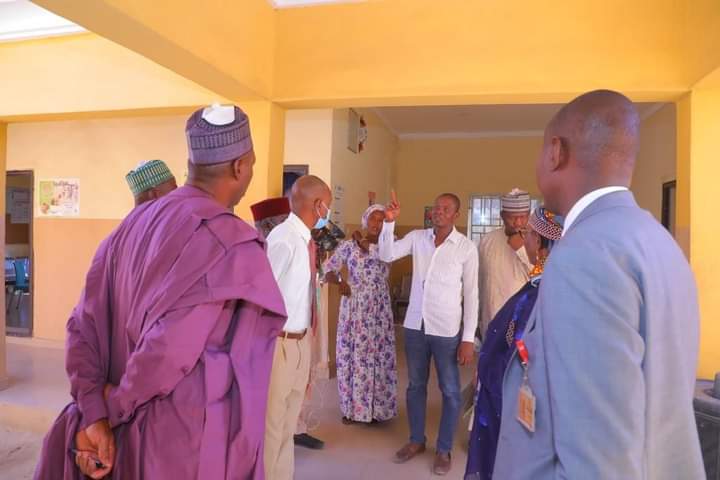
Borno Governor, Professor Babagana Umara Zulum on Thursday disguised his convoy and visited some Government healthcare centres unannounced, during which he found some officials collecting between N8,000 to N10,000 from patients, whereas the services are meant to be provided free of charge.
Zulum summoned the State’s Commissioner of Health, Mrs. Juliana Bitrus, and asked her to join him in a 10-seater bus that is usually used for airport services. The Governor left the Government house around 1:30pm without any convoy and without siren, leaving everyone surprised and wondering. Not even the Health Commissioner knew the Governor’s plan.
Zulum headed straight to the newly established and fully equipped primary healthcare centre at Gwange II ward in Maiduguri and found that some workers were collecting between N8,000 to N10,000 before diagnosing and treating patients of common ailments like Malaria.
“The staff we met here (at Gwange II, PHC) confirmed that they use to collect between N8,000 to N10,000 from patients to treat malaria. In fact they have turned this Government health centre to a private hospital, and this is why the centre has been deserted by people who mostly do not have the money to access services here. The workers just collect money and put it in their pockets”, unhappy Zulum said.
The Governor directed the Borno State Primary Healthcare Agency to thoroughly investigate, identify all the culprits and take appropriate disciplinary actions.
Zulum was also sad that the same primary healthcare centre had only one medical staff on ground to attend to patients, despite having 29 health workers on Government pay roll.
“You can imagine that at 2:00pm, this primary healthcare centre we built and fully equipped is empty (because of extortion and without medical staff). This level of impunity cannot be tolerated. The earlier we address it, the better for all of us” Zulum queried.
The Governor proceeded to a similar primary healthcare centre at Gwange I, but that was a pleasant experience.
Zulum found medical workers on ground attending to patients without extorting them.
The Governor was happy and he commended the staff for being good people.
The Governor has since formed the habit of showing up at odd hours including midnights at hospitals and early mornings at schools, for on the spot assessment of essential public services.
There are times Zulum extends his unannounced visits to schools, public offices and healthcare centres in Local Government Areas, some of them requiring him to drive hours from Maiduguri, the Borno capital.
The Zulum administration has constructed over 75 primary healthcare centers, built and renovated dozens of general hospitals and employed close to 600 medical workers of different categories, and is also building houses for doctors and nurses to inspire good medical services to citizens.