India

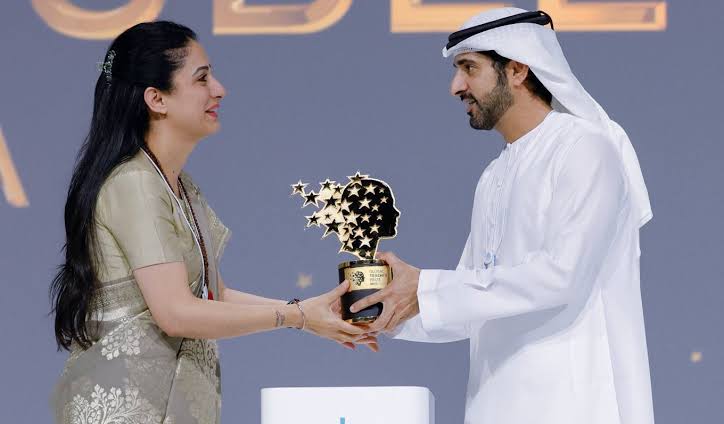
Indian teacher wins $1 million Global Teacher Prize for transforming education in slums

By Sabiu Abdullahi

An Indian teacher and activist, Rouble Nagi, has won the $1 million Global Teacher Prize for her groundbreaking work in bringing education to marginalized communities across India. The award was presented on Thursday at the World Governments Summit in Dubai, an event that attracts leaders from around the world.

Nagi, founder of the Rouble Nagi Art Foundation, has established over 800 learning centers in India. These centers provide structured education for children who have never attended school and supplement learning for those already enrolled. She also paints educational murals across slum walls, teaching literacy, science, mathematics, and history.

Accepting the award, Nagi said the recognition was not just for her but for India. She recalled starting 24 years ago with 30 children in a small workshop, and now reaching over a million children.

> “I think every step has just motivated me, inspired me to take every child in India to school,” Nagi said. “You know when I was a child it was my dream to see every child at school and as you grow up fulfilling that for as many as we can reach, I think it’s a very humbling experience.”


Sunny Varkey, founder of the Varkey Foundation, which awards the prize, praised Nagi’s dedication.

> “Rouble Nagi represents the very best of what teaching can be – courage, creativity, compassion, and an unwavering belief in every child’s potential,” Varkey said. “By bringing education to the most marginalized communities, she has not only changed individual lives, but strengthened families and communities.”


Nagi plans to use the $1 million prize to establish an institute that will offer free vocational training. UNESCO Assistant Director-General for Education, Stefania Giannini, added that Nagi’s recognition highlights the crucial role teachers play in shaping lives.

> “Teachers matter,” Giannini said. “We are honoured to join the Global Teacher Prize in celebrating teachers like you, who, through patience, determination, and belief in every learner, help children into school — an act that can change the course of a life.”


Nagi is the tenth recipient of the Global Teacher Prize since it was established in 2015. Past winners include educators from Kenya, Palestine, Canada, and Saudi Arabia, all recognized for their efforts to improve access to education in challenging environments.

Her work continues to inspire and redefine what is possible in education for underserved communities worldwide.

Row erupts after Indian minister pulls down doctor’s niqab at public event

By Hadiza Abdulkadir

A political controversy erupted on Tuesday after Bihar Chief Minister Nitish Kumar was seen pulling down a woman doctor’s hijab during a public event, triggering sharp reactions from opposition parties and civil society groups.

The incident, captured on video and widely circulated on social media, occurred at an official function where the chief minister was interacting with health workers. In the footage, Kumar appears to reach out and adjust the doctor’s headscarf, an action many have described as inappropriate and disrespectful.

Opposition leaders condemned the act, questioning the chief minister’s judgment and mental state, and demanding a public apology. “This is not only an insult to a professional woman but also an affront to personal dignity and religious freedom,” a senior opposition spokesperson said.

The ruling Janata Dal (United) has sought to downplay the incident, with party members suggesting there was no malicious intent. However, the controversy has continued to spark debate nationwide about consent, gender sensitivity, and respect for religious symbols in public life.

As of press time, the chief minister had not issued a formal statement addressing the incident.

Indian family’s one-way journey to London ends in tragedy

By Muhammad Abubakar

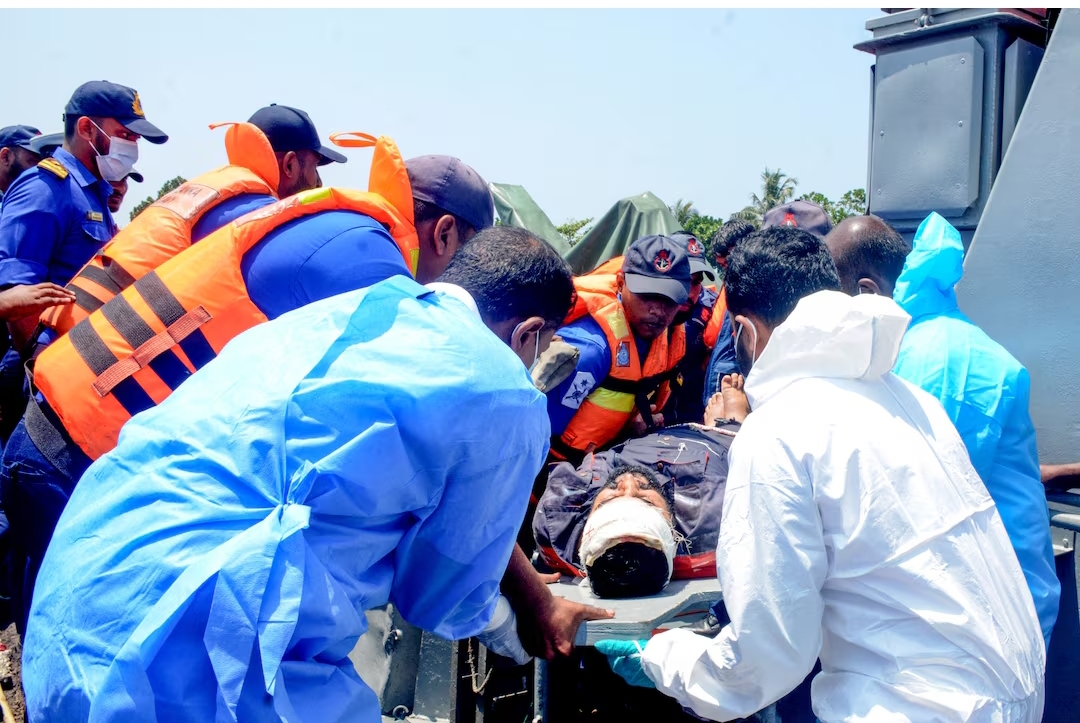
A young Indian family’s new life abroad ended in tragedy when Air India flight 171 from Ahmedabad to London crashed this morning, killing 241 people on board, with one miraculous survivor.

Among the victims were Dr Pratik Joshi and Dr Komi Vyas, both accomplished medical professionals, and their three children: aged 9, 6, and just 18 months. Their story, tragically, has come to embody the human cost of an unthinkable disaster.

Dr. Joshi, 38, had been living and working in London for the past six years, laying the foundation for a new life in the UK. Tirelessly working through the red tape of immigration and professional certification, he had long dreamed of reuniting his family abroad and offering them a brighter, safer future.

That dream was finally within reach. Just two days ago, Dr. Komi Vyas resigned from her job at a government hospital in Gujarat. The couple had packed up their lives, said their goodbyes, and looked forward to turning the page. Friends and relatives recall their excitement and plans to settle in South London, enrol their children in school, and continue their medical careers.

Before boarding the flight, the family took a photo after boarding and sent it to relatives with the caption: “One way to a new beginning.” Minutes later, the aircraft lost contact with air traffic control moments after taking off.

The Indian diaspora in the UK, especially among the medical fraternity, is mourning the loss. “Pratik was more than a colleague; he was a friend and a father trying to do right by his family,” said Dr. Meena Chauhan, who worked alongside him at St. George’s Hospital in London. “He was so excited they were finally joining him. It’s just incomprehensible.”

Back home in Vadodara, grief has swept through the neighbourhood. Friends and family gathered at the now shuttered family home, still echoing with recent packing sounds. A neighbour, clutching the last family photograph, said, “They were finally going to be together. They had waited so long.”

In a world fixated on the future, this family’s tale serves as a profound reminder to value the present—to embrace life, to express love, and to never delay happiness.

Plane crash near Ahmedabad leaves no survivors, officials say

By Hadiza Abdulkadir

A devastating tragedy unfolded near Ahmedabad early Thursday morning as AI171, a commercial flight carrying 242 passengers and crew, crashed shortly after taking off. Authorities have confirmed that there appear to be no survivors.

Ahmedabad’s city police commissioner told The Associated Press that rescue teams at the scene found no signs of life amid the wreckage. “It is with deep regret that we believe all 242 people on board have perished,” he said.

Emergency responders and investigators are working to secure the site and begin efforts to identify the victims. The cause of the crash remains under investigation, with aviation officials and forensic teams en route.

The flight, operated by Air India, was en route to London. Eyewitnesses reported seeing smoke and hearing a loud explosion in the area shortly before dawn.

Prime Minister Narendra Modi expressed condolences via social media, calling the incident “a heartbreaking loss.” Grief counselling and support services have been offered to the families of those on board.

More updates will follow as the investigation continues.

India launches missile strikes on Pakistan, tensions escalate

By Muhammad Abubakar

India has launched missile strikes on nine locations across Pakistan and Pakistan-administered Kashmir, targeting what it described as “terrorist infrastructure.” The strikes come amid heightened tensions between the two nuclear-armed neighbours following a deadly militant attack in Indian-administered Kashmir last month that claimed 26 lives.

Pakistan reported that at least eight people were killed and 35 injured in the strikes. Authorities in Islamabad condemned the assault as an “unprovoked, blatant act of war,” accusing India of deliberately targeting civilian areas.

In response, Pakistan claimed to have shot down five Indian fighter jets, though Indian officials have yet to confirm any such losses.

The incident marks a dangerous escalation in a region with a long and volatile history, raising fresh concerns about stability and the risk of broader conflict.

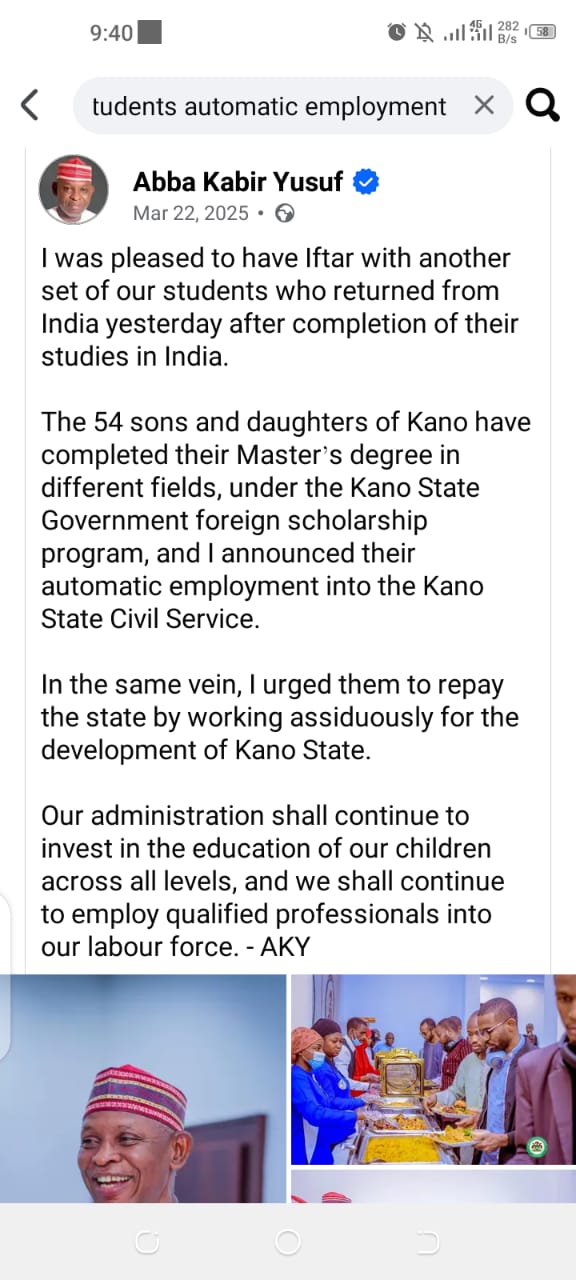
54 Kano students return from India, get automatic employment

By Hadiza Abdulkadir

Kano State Governor, Abba Kabir Yusuf, has announced the automatic employment of 54 indigenes of the state who recently completed their Master’s degrees in India under the state government’s foreign scholarship program.

The governor made the announcement during an Iftar gathering with the returning scholars, emphasizing the government’s commitment to investing in education and strengthening the state’s workforce.

Governor Yusuf urged the graduates to repay the state’s investment by contributing diligently to Kano’s development. He reaffirmed his administration’s dedication to providing educational opportunities and employing qualified professionals to enhance governance and public service.

India’s ex-prime minister Manmohan Singh passes away at 92

By Sulaiman Abdullahi

Manmohan Singh, the renowned economist and former Prime Minister of India, has passed away at the age of 92, according to local media reports on Thursday.

Singh, who served two consecutive terms as prime minister, was instrumental in steering India’s economic liberalization during his tenure as finance minister.

A respected economist-turned-politician, he also held the position of governor of India’s central bank.

The former leader had been ailing and was admitted to the All India Institute of Medical Sciences (AIIMS) in New Delhi, where he reportedly passed away late on Thursday.

Singh leaves behind a legacy of economic reforms and leadership that transformed India’s trajectory on the global stage.

Tinubu to host Indian PM Modi for bilateral talks in Abuja  

By Uzair Adam 

President Bola Ahmed Tinubu will host Indian Prime Minister Narendra Modi for a State Visit at the Presidential Villa in Abuja on Sunday.  

The Daily Reality gathered that this historic visit marks the first time an Indian prime minister has been to Nigeria since Dr. Manmohan Singh’s trip in 2007, during which a strategic partnership between the two nations was established.  

The Special Adviser to the President on Information and Strategy, Bayo Onanuga, disclosed this development in a statement on Saturday.  

According to Onanuga, the meeting aims to bolster ties between Nigeria and India. Both leaders will discuss avenues for collaboration across critical sectors. 

“Both leaders will exchange signed Memoranda of Understanding to enhance cooperation,” he stated.  

Prime Minister Modi is expected to arrive in Nigeria on Saturday ahead of the talks scheduled for Sunday.  

This visit underscores the commitment of both nations to deepening their longstanding bilateral relationship.

BOOK REVIEW: India in the Persianate Age 1000-1765

Author: Richard Eaton

Number of Pages: 489

Date of Publication: 2019

Publisher: University of California Press

In case you’re too lazy to read the book, it is all about the time when Islam was the dominant ruling religion in the Indian subcontinent from the sociopolitical, economic and military perspectives.

This is a very interesting book that, according to the author, challenges some preconceived narratives and stereotypes on the complex interactions between India and the Persian-speaking world during the medieval period.

The book takes a long view of the political dynamics of the Persianate age, discussing the emergence of the Mughal empire, its spread and culmination, and its interplay with other contemporary gunpowder empires: the Ottoman and the Safavid.

Naturally, any discussion on the emergence of the Mughal Empire must include a historical look at Timur, a controversial figure whom I believe many Western authors, unfairly criticize. Of course, there was an entire chapter dedicated to Abu al-Muzaffar Muhi-ad-Din Muhammad Bahadur Alamgir Aurangzeb Badshah al-Ghazi, under whose 49-year reign the Mughal empire reached its peak in terms of glory and geographical extent.

The author builds the bulk of his arguments upon a very deep historical background, and he closely examines the role of Persianate age in shaping religious and intellectual developments in India.

He also discusses the impact of Sufism on Indian society and explores how Persian texts played a crucial role in the spread of Islamic mysticism across the subcontinent. This way, the book provides insights into the assimilation of Persianate cultural practices into Indian religious traditions, such as the development of Persian-influenced styles of devotional poetry in languages like Urdu.

The author, Richard Eaton is an American historian at the University of Arizona.

Shamsuddeen Sani wrote from Kano, Nigeria.

Embracing diversity in faith: Reflections from Madina

By Dr. Muhsin Ibrahim

Years ago, when visiting a prominent Hindu temple in Himachal Pradesh, India, an Indian coursemate became excited at the sight of a white man worshipping there. I asked why. She told me it was pretty reassuring to see someone you didn’t expect to share your belief practising it.

As I walk through sites in Madina, including the Prophet’s mosque, I see the faces of people from far and near, dressed differently and speaking various languages. People from all nooks and crannies of the world visit this holy city. I couldn’t help but recall and, somehow, share my friend’s feelings.

Without a doubt, Islam and Christianity, unlike and above many other religions, have universal appeal. I have also been to several parts of the world. However, seeing a sea of people of different skin colours, heights, and sizes worshipping in unison is stunning and soothing.

There is inflation globally, and poverty is also on the increase. Still, people troop to Mecca and Madina to perform Umrah, the lesser Hajj, as if it were free. For many Muslims, especially those who have never come here before, nothing is expensive.

Although the feeling is indescribable, I can mention just one: visualizing what you have (very likely) heard about all your life about Prophet Muhammad (SAW) and his companions feels distinct and unique. It’s so serene and serendipitous – ma sha Allah.

May Allah accept our prayers and rescue our country, continent, and all that is beyond.

Dr. Muhsin Ibrahim, who is a Nigerian working in Germany, is currently on lesser hajj in Saudi Arabia.