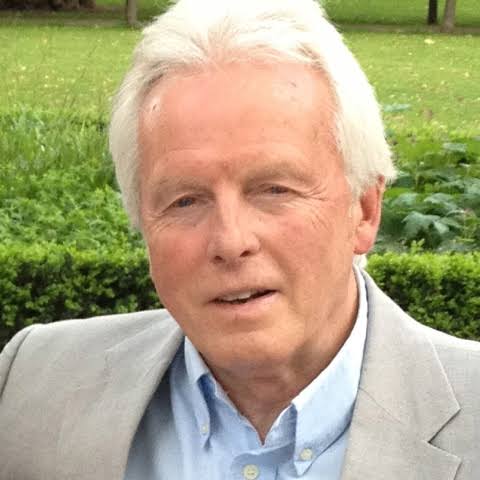
I first met Philip Jaggar in March 2008 at the School of Oriental and African Studies (SOAS) when I was engaged as the cinematographer for a visit, mediated by the British Government, of Sheikh Dr Qaribullah Nasir Kabara of Kano, to various places in the UK, including the University of London.
While I knew of Jaggar (although never having met him before), the rest of the team was pleasantly surprised by his total command of the Hausa language (and inner city Kano Hausa at that) – and his absolute refusal to respond to any question except in Hausa. The SOAS meeting brought together an impressive list of scholars to receive Sheikh Qaribullah. These included Graham Furniss, Dmitry Bondarev (specialist on Hausa handwritten Warsh Qur’anic manuscripts of Hausaland) and Philip Jaggar himself. It was a very pleasant encounter, full of banter.
My next encounter with him was later in November 2008, when I was commissioned to deliver a lecture at the Universität Hamburg. Jaggar had taught at the university, and I was honoured he attended my public lecture. Only two meetings, but he treated me like a long-lost friend, despite the eleven-year age gap between us. I was also elated when he told me of his interest in my works which at that time were beginning to gain traction in media and cultural studies. It was our last meeting, but very memorable for me due to his simplicity, love for Kano and absolute devotion to Hausa studies. He taught at Bayero University Kano from 1973-1976 and had pleasant memories of his experiences.
Jaggar’s most famous and highly acclaimed book is simply titled Hausa (John Benjamins, 2001). It was considered a classic comprehensive reference grammar of the Hausa language spread over sixteen chapters which together provide a detailed and up-to-date description of the core structural properties of the language in theory-neutral terms, thus guaranteeing its ongoing accessibility to researchers in linguistic typology and universals.
While Jaggar, or Malam Bala as he preferred to be addressed when he was in Kano, was known for his immense contributions to Hausa grammar, I interfaced with his work on the ‘maƙera’/blacksmith industry of Kano. Jaggar was the first to provide a comprehensive study of the blacksmith industry in Kano. His landmark book, The Blacksmiths of Kano City: A Study in Tradition, Innovation and Entrepreneurship in the Twentieth Century (Rüdiger Köppe, Cologne 1994), brought out the honour, dignity, creativity, aesthetics and the technology of the metalworking industry in the heart of Africa. The blurb of the book summarizes this amazing work:
“The present book examines the factors involved in the expansion, during the colonial and post-colonial periods, of a traditional pre-European craft. It discusses the art of blacksmithing in Kano City, northern Nigeria, and its eventual conversion into a modern metalworking industry. In doing so, it challenges the widely-held and simplistic assumption that such traditional professions declined before the economic and technological onslaught of colonialism.”
For me, the book provides a fascinating and ethnographic picture of the industrialization of the inner core city where I spent the early years of my life. It vividly brought to life the alleyways, the people and the entrepreneurial focus of the various wards in the city. This alone is enough to endear a reader to the book, even without the fascinating focus on the blacksmithing industry. I was able to snatch a copy in a bookstore at the University of Maiduguri in 2003 at ₦800 – barely 2€ now, but the publisher is currently selling it for 24€, about ₦12,000.
If, and only if, someone in the policy circles of the Kano State government of the day had taken note of the book, our maƙera would have received a boost and been incorporated into the development agenda of a national creating a synergy between its creative proto-industrialists and modernity.
When he celebrated his 75th birthday in 2020, many of his colleagues paid a lot of glowing tribute to him. Now that he has sadly passed away, those tributes remain etched in stone. He will be surely missed by hundreds of his colleagues and thousands of Hausa students who benefitted, directly or indirectly, from his extensive scholarship on the Hausa language.
Tribute to Philip Jaggar (2020) https://study.soas.ac.uk/tributes-to-philip-j-jaggar/
About Philip Jaggar https://study.soas.ac.uk/jaggar-hausa-champion-soas/
Various scenes with Phil Jaggar and the OP, as well as with Sheikh Dr Qaribullah Nasir Kabara’s team
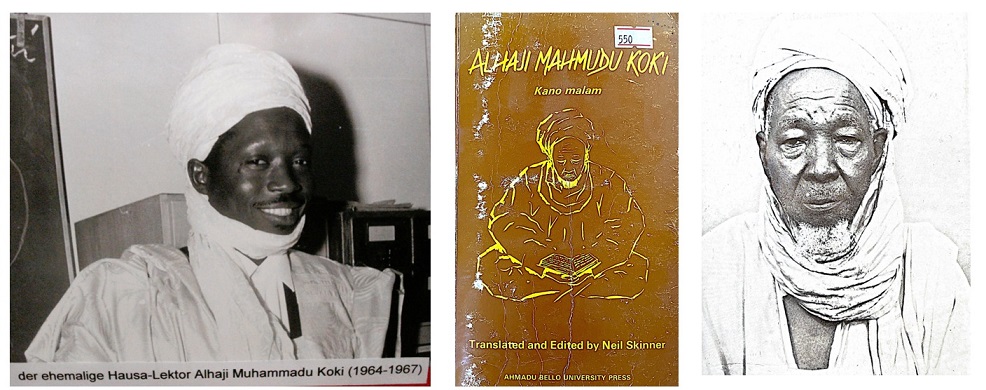
I was rummaging through my travel pictures when I came across a picture that I am sure has not been published anywhere. I saw it in a glass case at a ‘corridor museum’ at Universität Hamburg, Germany, on 2nd December 2008. I was excited because of its rarity. It was the picture that I am sure has not seen the light of day almost anywhere. I had vaguely heard about the man from my father, a writer, but did not pay attention then. Now he was there, smiling in all glory and right before me. I decided I would take the picture to show it to my father.
Edit: The man was Muhammad Ƙoƙi, the son of Alhaji Mahmud Ƙoƙi, the Kano Malam. His picture triggered my excitement about his father, Malam Mahmudu Ƙoƙi.
Malam Mahmudu was perhaps one of the most unsung and unknown critical literary figures in Hausa history. You can Google all you can. You won’t find him or his picture. Instead, you will be taken to Neil Skinner’s book, “Alhaji Mahmudu Ƙoƙi: Kano Malam” (ABU Press, 1977). I very much doubt if ABU Press itself has a copy. My copy is in excellent condition (except for a slightly scratched cover) since it was printed on shiny bond paper – and can therefore scan very well. I hesitate to do this for fear of copyright violation. I do wish ABU Press would consider retrieving a copy somewhere and reprinting it.
On return from Hamburg, I started looking for the book – and I was lucky to grab a copy at then ₦550 in January 2009. Now, some 14 years later, you can get a second-hand copy from the online store Abe Books for just $99 (cheap at ₦74,000 in 2023). At the moment, I don’t have any ‘kebura’ around me (since the ASUU strike was suspended!). Otherwise, I would offer mine for ₦50,000 for my copy!
Quite simply, it is a brilliant slice of Hausa history. Most significantly, it detailed the fieldwork done in the collection of data for Bargery’s Hausa Dictionary, whose full title is “A Hausa-English dictionary and English-Hausa vocabulary”.
Although mainly attributed to Rev. George Percy Bargery (1876-1966), an English missionary and linguist, the dictionary had significant input from Diedrich Hermann Westermann (1875-1956), a German missionary, Africanist, and linguist. The dictionary was published in 1934. The printed copy used to be available at ABU Bookshop, where a colleague of mine gifted me one he bought at the huge sum of ₦2,000 in ancient days, almost breaking his bank account!
The book was written/edited by Neil Skinner (1921-2015) at the request of Bargery’s son, Kenneth, to collect recollections of the elder Bargery while in northern Nigeria. Alhaji Mahmudu Ƙoƙi (1894–1976) was Bargery’s Chief Assistant in the preparation of the Dictionary and was the first choice to ask in 1967. As Skinner recollected, “I began recording some of his memories of Bargery. Listening to his vivid accounts of Kano in the first of the century, I formed the idea of putting together from Mahmudu’s lips some account of his own life.”
And what a fascinating life it was. Skinner continued, “As a son of the largest city of northern Nigeria, who had been born into the civil war of Aliyu and Tukur, M. Mahmudu saw the coming of the British, knew Waziri Giɗaɗo and Resident Temple, lived to see the end of the British rule and the Nigerian Civil War and, above all, had close contact with rulers and innovators, both Nigerian and British. He, therefore, seemed likely to have a tale worth recording for younger generation of Nigerians and those with an interest in Nigeria as it was and is. Mahmudu was a spectator of many great events and participant in not a few.”
And what a whirlwind tour of northern Nigeria it was in the early 20th century. Reading the book is like going back in a time machine. Everything was covered: economy, society, governance, culture, everything. As Neil Skinner stated, the book was told by Mahmudu himself – Skinner just edited it. It contained both fascinating and often disturbing details of days gone by. For me, for instance, I was traumatized by his account of the slave trade in Kano. As Mahmudu recalled,
“I used to see slaves being sold – with my own eyes! At Ƴan Bai, on the west of the [Kurmi] market. That was where they used to line them up and sit them down, with their feet sticking out, like this. Then it would be, ‘You there! Get up!’ And he would get up, and we would look him over well from top to bottom and say, ‘Walk a little!’ then he would do so until we told him to come back. He would do so, and we would say, ‘Right, go and sit down’ and put hand to pocket and take out a little money, perhaps a score of cowries or fifteen and give them to him. You would do this, whether you bought him or not. Then, if he saw someone selling groundnuts, he would call her over to get some saying he had been given the price for getting up to be inspected. That is how we have a proverb which says, ‘Tashi in gan ka ma na da ladanta’.”
Based on this disturbing account – in the heart of Africa – I wonder how many of our other proverbs have such creepy and dark origins? If you go to Ƴan Bai in Kurmi market in Kano, now you will only see mats, books and assorted goods.
Alhaji Mahmudu Ƙoƙi provides a rich tapestry of ethnographic details about how the Dictionary was compiled and the fact that the team of Bargery and his assistants insisted on seeing actual objects and their names before recording them. One wished they had an artist with them to sketch out many of the cultural artefacts that have all but disappeared now. It is good that the Bargery dictionary has been digitized and is available free online, thanks to the efforts of Hirokazu Nakamura of the Faculty of Human Science, Department of Human Sciences, Bunkyo University, Japan.
“Alhaji Mahmudu Ƙoƙi: Kano Malam” is comparable to “Baba of Karo” by Mary F Smith (wife of M.G. Smith, author of “Government in Kano, 1350 to 1950” amongst others, and which is available FREE online!). Published in 1954, “Baba of Kano” is an anthropological record of the Hausa people, partly compiled from an oral account given by Baba (1877-1951), the daughter of a Hausa farmer and a Koranic teacher. Baba’s reports were translated by Smith.
Books like these encourage us to seek out our own cultural history – visit those places mentioned, savour their historical aroma and note them as centres of excellence in discovering our past. By the way, Ƙoƙi is a ward in the city of Kano and right on the edge of the Kurmi market. If you are from the area, perhaps you may have heard of Alhaji Mahmudu from his grandchildren.
Don’t forget; this is not a review of the book but a memory jog on the old man, Alhaji Mahmudu Ƙoƙi, whose picture was honoured at a foreign university.
There is a composite collage of the picture I snapped in the Hamburg university museum of the son, the book and the father! as the latter appeared in the book.
Prof. Abdalla Uba Adamu can be reached via auadamu@yahoo.com.
Like a bolt of lightning, a key to open the freedom door dropped literally on my lap through the radio. In 1996 the government of Kano (Nigeria), where I live, was battling with Hausa creative fiction and public morals. One after the other, Islamic sheikhs came on the radio and condemned newly emerging Hausa creative fiction writers as being responsible for poor attention span in schools (and subsequent poor grades) and immorality. They did not indicate how many of the novels they had read, though. Their condemnations caught my attention, for it seems there was a reading culture among Hausa youth – something public culture kept lamenting as lacking among youth.
Reading culture is, of course, an environment where reading is championed, valued, respected, and encouraged. BUT it seems that the reading culture in Kano meant reading school textbooks (if available) and passing examinations. Reading culture? James Hadley Chase, Harold Robbins, Irvin Wallace, Agatha Christie, Denise Robbins, Nick Carter, Joan Collins, Wilbur Smith, et al., anyone? So why not Ado Ahmad, Balaraba Ramat, Ɗan Azumi Baba, Bilkisu Salisu Ahmed Funtuwa? All the objections against Hausa literature were based on the baseless Media Effects Theory, which believes that mass media influences the attitudes and perceptions of audiences.
I, therefore, decided to delve into this ‘problem’ further. It was to be a bridge between cultural studies (popular culture) and education (reading culture).
I eventually traced the production of Hausa novels to the City Business Center in the city of Kano under the proprietorship of Alhaji Abba Lawan Maiunguwa, a childhood friend. This led to Ado Ahmed Gidan Dabino, unarguably the most successful of Hausa novelists, and the forging of a life-long friendship based on respect. I spent about two years in the field, talking, recording, and unarchiving writers, critics and fans of the Hausa creative fiction.
The writers included Ahmad Mahmood Zaharadden Yakasai, Yusuf Muhammad Adamu, Ibrahim Saleh Gumel, Ɗan Azimi Babba Cheɗiyar Ƴan Gurasa, Aminu Abdu Na’inna, Badamasi Shu’aibu Burji, Hamisu Bature, Aminu Hassan Yakasai, Abdullahi Yahaya Mai Zare, Bala Muhammad Makosa, Bashir Sanda Gusau, Bala Anas Babinlata. Female authors of the period included Hauwa Aminu, Talatu Wada, Zuwaira Isa, Safiya A. Tijjani, Binta Bello Ɗanbatta, Binta Maiwada, Jummai Mohammed Argungu Karima Abdu D/Tofa, Bilkisu S. Ahmed, and the most outstanding of them all, Balaraba Ramat Yakubu.
Along the line, I developed the Hausa hooked glottal sound characters (Ƙ, ƙ, Ɗ, ɗ, Ɓ, ɓ) to help in proper Hausa writing on computer word processing programs using Fontographer software. But that is a story for another day. Next, I went to my dad, Muhammadu Uba Adamu (Kantoma), discussed with him my new-found direction and sought his blessings. He readily approved. Not surprising, considering he had always been a radical on his right. Further, my early contact with literature was from his library, as he studied Political History with English Literature as a minor. His approval, and even later, endorsement, gave me courage.
Finally, I summoned enough nerve (remember, it was not my field, and I was aware those ‘in the field’ jealously guard their turf) to write an article and send it to Ibrahim Sheme of the New Nigerian Weekly newspaper. It was titled “Hausa Literature in the 1990s”. It was published in their April 24 and May 1, 1999 issues. It created a tsunami of a reaction.
Unbeknownst to me, the debate about the merits (or lack of) of Hausa creative fiction had run its course in various Hausa language newspapers and magazines. Hawwa Ibrahim Sherif fired the first salvo in an interview with Ibrahim Sheme, published in Nasiha, on September 6 1991 (some eight years before my own article).
Following on from her views (and she was a writer herself), two camps emerged – those who did not see any merit in the novels, and those who believed in them, the latter, perhaps understandably, was made up of mainly authors themselves, such as Ado Ahmad Gidan Dabino, Yusuf Adamu, Kabiru Assada, etc. In 1998, Novian Whitsitt, an American student, even submitted a PhD thesis on Hausa creative fiction with a focus on Hajiya Balaraba Ramat Yakubu. His thesis was titled The Literature of Balaraba Ramat Yakubu and the Emerging Genre of Littattafai na Soyayya: A Prognostic of Change for Women in Hausa Society.” It was submitted to the African Studies Program University of Wisconsin-Madison.
You could therefore imagine the fire I came under; An Educationist was venturing into Hausa literary studies. Some accused me of being an ignoramus who knows nothing about Hausa literature (true), and others accused me of encouraging immorality (not true).
To get rid of my accused ignorance, I adopted two methods – both facilitated by my being a true believer in science and its methods. The first was rooted in the ethnology of Hausa cultural production. This approach was based on Victor Turner’s exposition of the ‘anthropology of experience’, itself based on Wilhelm Dilthey’s conception of ‘what has been lived through’. The approach enables the exploration of how people actually experience their culture and how those experiences are expressed in forms as varied as narrative, literary work, theatre, carnival, ritual, reminiscence, and life review. To get a closer look at the cultural production, it was necessary to be embedded in the process.
I started by identifying what was more or less a Bohemian cluster of Hausa fiction writers hanging out at City Business Center, Daneji, Kano city, along Sabon Titi. Then, I embedded myself into their cluster and observed what they were doing – inspiration for their stories, discussing plots for stories, typing, artwork, printing, marketing, etc. This went on for almost five years from 1998. As a result, I gained deep insights into their creativity and concerns. I also read quite a few of the fiction they produced to gain a more immersive experience.
In this process, I did not rely on secondary data but became a primary data gatherer myself. This came in good stead much later when I submitted a paper to a journal based in France. The editor wanted me to provide references for some of the narrative encounters. I pointed out that I was the reference and used Turner’s field study framework as a basis because I was there. The editor accepted, and eventually, the paper was published.
For the second method, I launched myself into a self-study of Critical Theory from the roots: to reflect on and critique society through literature. There were four varieties of such theory: new criticism, poststructuralism, psychoanalytic criticism, and Marxist theory. I delved into the first two, deeming that the other two do not apply to my data. I became a student of Jürgen Habermas and his “Structural Transformation of Public Sphere”, in which I see Islamicateness in expounding the boundaries of the public sphere. Stuart Hall and his critical works in cultural studies provided another roadmap to understanding the reception of media texts. Marshall Hodgson’s essay on the idea of “Islamicate” societies seemed to mesh perfectly well with my own sites of contestation of media production, distribution and consumption. Anthony Giddens and his Structuration provided an excellent introduction to Agency.
I thus refused to cage myself within Nigerian Hausaist (for which I am not one) delineation of Hausa studies into apparently mutually incompatible divisions of Literature (Adabi), Language (Harshe) and Culture (Al’ada). I said ‘apparently mutually incompatible’ because if you are versed or specialized in one, you are not expected to know much about the other. In other words, you should ‘stay behind the yellow line’!
And so, the battlelines were drawn, and for almost five years to 2004, New Nigerian Weekly and Weekly Trust pages were awash with what Ibrahim Sheme referred to as The Great Soyayya Debate. I was in the thick of it. But, since the debates were on pages of newspapers and therefore meant for the general readership, I focused on simply defending the right to write rather than the morals of the contents (for which, in my opinion, show cleanliness) or the grammatical sophistication of the writers. They have a right to write and thus write the rites to right the wrongs they perceive in society – after all, the genre is referred to as ‘adabi’ (reflection).
Only four people at Bayero University believed in what I was doing. Isma’ila Abubakar Tsiga, Sa’idu Ahmad Babura, Abubakar Adamu Rasheed and Ibrahim Bello-Kano – all from the Department of English and European Languages. Ibrahim Bello-Kano, or IBK as he is popularly referred to, was the Seminar coordinator in the Department of English and European Languages in 2001. He invited me to present a paper at their Departmental Seminar, which I agreed to and presented in January 2001. It was the first academic presentation of my research. I was understandably nervous because I was presenting something on new terrain to people fully trained and versed in it. However, the paper’s title, Tarbiyar Bahaushe, Mutumin Kirki and Hausa Prose Fiction: Towards an Analytical Framework, introduced something to the polemics besides just moral indignation.
However, soon enough, the massive success of Hausa fiction authors (despite scathing criticism from academic and public culture) emboldened them enough to migrate to the emergent Hausa video film industry. If there is one person to be credited with creating the Hausa film industry, it was a writer, the late Aminu Hassan Yakasai. He was both a novelist, a scriptwriter and a Hausa soap opera star. He and his collaborators, such as Bashir Mudi Yakasai and Salisu Galadanci, launched the first Hausa video film, Turmin Danya, in March 1990. This predated Nollywood’s Living in Bondage in 1992. Sunusi Burhan Shehu, a novelist, established a Hausa film magazine, Tauraruwa, and in a regular column in August 1999, created the term “Kanywood” to refer to the Hausa film industry. It is the first reference to a film industry in Africa and predated “Nollywood”, which was coined in 2002 by Norimitsu Onishi in a New York Times report.
In 1999 Sarauniya Films Kano released the catalytic video film that literally shaped the direction of the industry. It was Sangaya. It was, like most Hausa youth literature, mainly a love story. It was not the story that was significant about the film, however, but its soundtrack with catchy song and dance routines backed by synthesized sound samples of traditional Hausa instruments such as kalangu (talking drum), bandiri (frame drum) and sarewa (flute). The effect was electric on a youth audience seeking alternative and globalized—essentially modern—means of being entertained than the traditional music genre, which seemed aimed at either rural audiences or older urbanites. It became an instant hit. Indeed, the success of Sangaya was as momentous in the history of the Hausa video film industry as Living in Bondage was for the southern Nigerian video films. The Hausa video films that subsequently emerged were predominantly based on cloning Bollywood films and production characteristics – love triangles, gender rivalry, and choreographic song and dance routines. At least until 2007, when the system crashed after the leakage of a private steamy sex video of a popular actress. The entire entry was labelled bad, just like the literature industry. A new censorship regime was instituted that made film production difficult.
Internet became widely available late 1990s, and by 2000 it had become affordable. Before that, we had to rely on the National Universities Commission (NUC) switchbacks to access it. So when Nitel started offering it, we jumped on. Yahoo! Groups was launched in early 2001. A series of discussion boards formed the earliest reiteration of social networks, predating Facebook, which was created in 2004 but became available only in 2009 to us. Seizing the opportunity to create lively discussions, I formed three groups on the Yahoo! Groups platform: Finafinan Hausa, Littattafan Hausa, and Mawaƙan Hausa, from August 31 to November 15 2001. Finafinan Hausa was by far the liveliest.
By 2009 when the discussions whittled away, there were almost 25,000 postings on the board. Other boards did not fare too well. Further, between 2000 to 2009, I chaired thirteen Hausa video film award ceremonies, four of which were organized by Yahoo! Groups. The discussion board really popularized many of the Hausa video film stars. The University of Frankfurt in Germany even dedicated a Library Officer to join the groups and harvest all the comments as examples of public discourse on Hausa popular culture.
All these did not prevent me from participating in educational alphabet soup agency activities, so I was still rooted in Education. Criss-crossing the north, training education officials, writing reports no one read, and working out the next activity. Along the process, I became Head of the Department of Education – rather reluctantly, for I was enjoying fieldwork in cultural production and educational alphabet soup interventions (the latter helped to put additional plates on the table!).
In 1993 the late Prof. Mike Egbon of the Department of Mass Communication, Bayero University Kano, visited my office and asked me to help supervise his PhD student who was working on the transfer of communication education curriculum from the US to Nigeria. Between 1991 to 1992, I was a Fulbright Senior Research Scholar at the Center for Studies in Higher Education, University of California, Berkely. My work focused on the transnational transfer of education from the US to Nigeria, resulting in a book published in 1994 in New York. It was titled Living on a Credit Line: Reform and Adaptation in Nigerian University Curricula. It was my work in the US which I had been discussing at various places within the campus that attracted Mike Egbon, and he appointed me as co-supervisor and internal examiner to his student. Mike Egbon, then, was the one who opened the door for me to enter the Mass Communication department.
While all this was happening, a conference on Hausa video films was held in one of the northern Universities. The conference condemned the films, just as earlier on, the writers of Hausa fiction were also condemned. Many of these writers, using the cheap availability of video cameras, had transitioned from Hausa fiction to Hausa films and, in the process, attracted a lot of mainly non-indigenous Hausa into the industry. But because these elements use the Hausa language in their films and rely virtually exclusively on cloning Hindi cinema, all Hausa films were tarred with the same paintbrush. So the focus of the conference held somewhere in the north was to confirm how bad the films were from cultural perspectives.
However, in August 2002, a group of academicians and members of the Hausa entertainment industry in Kano got together to discuss the state of research on Hausa popular culture and media technologies, with particular reference to the Hausa films. It was meant to be a brainstorming session with various inputs from members overshadowed by the then-current crisis in the non-marketability of Hausa films due to condemnations from the public culture. Further, it was noted that there had been no systematic study of the phenomena from academic perspectives, at least by the practitioners themselves. A strong observation at this meeting was the increasing role of media technologies in popular culture and how Hausa urban communities are refining the concept of entertainment among the Hausa.
The group noted, with concern, a lack of local input into the systematized pieces of research showing the relationship between Hausa culture and popular media as a vehicle of cultural preservation and transmission. In this regard, it was noted some of the most significant advances in this area were made by our foreign Hausaist colleagues. All these researchers have published extensively on Hausa culture and language, and their works are heralded as authoritative accounts of Hausa popular media.
Thus, while the group acknowledged the immense contributions made by these foreign researchers, it saw these researches as challenges to stimulating local scholars into exploring other terrains of popular culture among the Hausa. As a result of these observations, the group suggested a series of activities aimed at creating collaborative opportunities for research between local researchers, practitioners of popular culture (literature, music, film, indigenous knowledge etc.) and international partners. A committee was formed to articulate all these into a conference, and I was made the Chairman of the Committee.
Eventually, on 3rd to 5th August 2003, we held the first-ever international conference on Hausa films in Kano, with the theme of Hausa Home Videos: Technology, Economy and Society. It was hugely successful, attracting presentations from US and Germany in addition to both local film practitioners and academicians. I, Yusuf Adamu and Umar Faruk Jibril edited the papers and a book with the same title as the conference was published in Kano in 2004. The resolution of the conference was to establish a Center for Hausa Cultural Studies. This was meant to be a think tank that would hold monthly events to promote Hausa cultural production in the internet age.
Later, tired of the constant criticisms against me from the film industry despite all my efforts (they believed that by focusing on culture, I was disparaging their art), I shifted my ethnographic focus to music, with a particular focus on the Rap genre which was trending at the time. This community of cultural producers – K-Boyz, Kano Riders, Lil’ TeAxy, BMERI, ClassiQ, Dr Pure, G-Fresh, Haddy, K-Arrowz, the late Lil’ Amir, etc. – proved more welcoming than filmmakers.
By 2004 I had attracted the attention of some colleagues overseas, particularly Brian Larkin in the US, Graham Furniss in the UK and Heike Behrend in Germany. I even wrote a visa approval letter for Heike Behrend, then Director, Institute of African Studies, University of Cologne, Germany, to come to Nigeria and conduct fieldwork on Hausa films. Heike Behrend was to later “adopt” me as her son. She is a brilliant ethnologist with a field experience in Kenya and Uganda, as detailed in her excellent book, Incarnation of an Ape. An autobiography of ethnographic research (2020), which itself is a textbook on the anthropology of experience. As she stated in a YouTube introduction to the book, “it was about reversing the perspective and showing how those I meant to ethnograph ethnographed me.”
Thus, when Graham Furniss was asked to nominate participants for a “Seminar on Media in Africa” in Nairobi, Kenya, organized by the International African Institute in August 2004, he nominated my name, and I was accepted. Again, in the same year, he was invited to Johannes Gutenberg University, Mainz, Germany (plainly referred to as the University of Mainz) to participate in the 8th International Janheinz Jahn Symposium “Creative Writing in African Languages: Production, Mediation, Reception”. It was to be held at the Centre for Research on African Literatures, Johannes Gutenberg University Mainz, 17-20 November 2004. Graham had too many engagements for the period and suggested to the organizers that I should be invited – something they accepted. I received an invitation to participate in the conference.
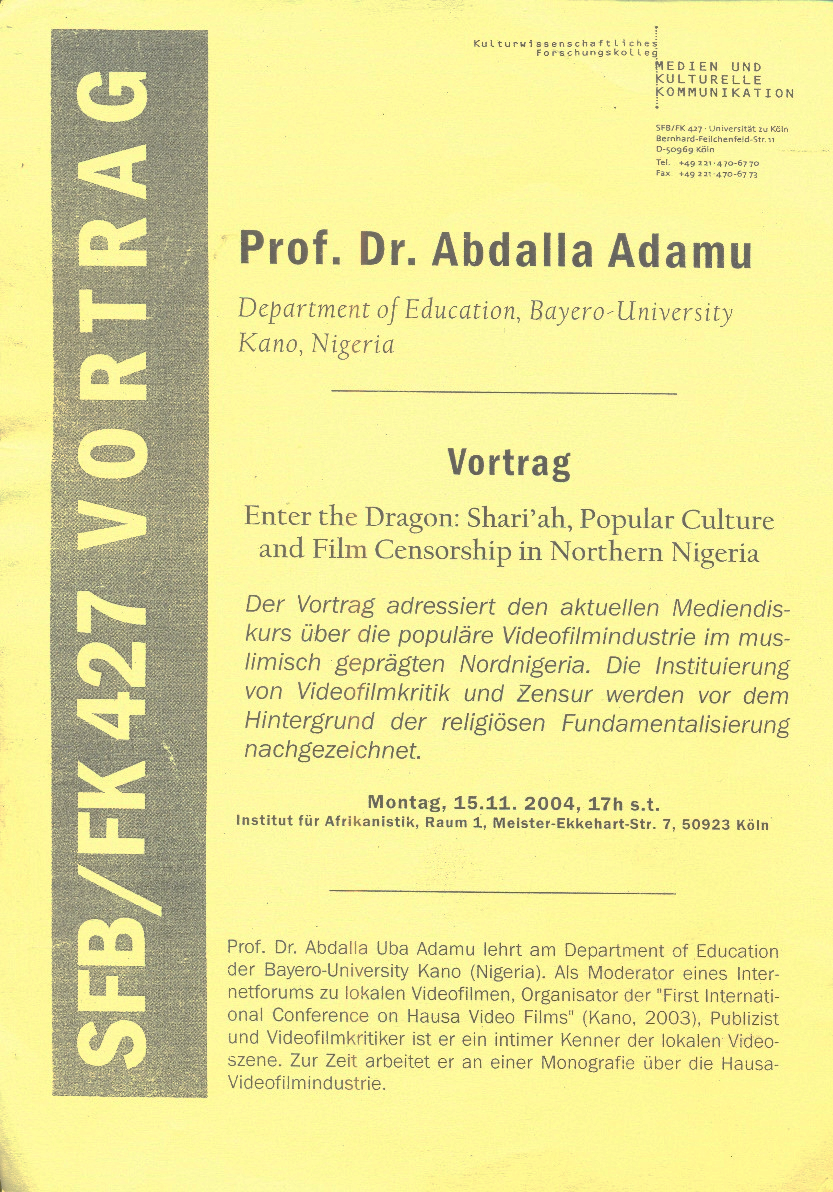
At the first event in Nairobi, I met Heike Behrend, who was also invited, and during an off-conference interaction over a cup of expresso (her favourite rendering of coffee!!) I informed her of my coming trip to Mainz for a conference. She immediately extended an invitation for me to come to the University of Cologne on my way to Mainz and present a seminar to doctoral students on any topic I like. This I did on November 15 2004 and presented a paper to the students. It was titled “Enter the Dragon: Sharī’ah, Popular Culture and Film Censorship in northern Nigeria.”
Vortrag
Note, from the poster, that I was still in the Department of Education. When I returned to Nigeria, I met Dr Gausu Ahmad, then Head of the Department of Mass Communication BUK, who insisted on the paper being presented at their own Departmental Seminar. Before that, I was already teaching Advanced Research Methods to postgraduate students and Online Journalism at all levels. Further, I was already working with a doctoral student in the Department. Unknown to me, Dr Gausu had already recommended my employment as a Part-Time lecturer in the Department of Mass Communication. A letter to that effect was eventually sent to me in November 2005. Earlier, the Department had requested my transfer from Education, but the Vice-Chancellor at the time refused.
The visit to Germany in 2004 was the beginning of a series of travels to various universities as a visiting lecturer/professor/guest speaker etc., in media and cultural production. These included the US (University of Florida, Gainesville; Rutgers State University of New Jersey; Barnard College, Columbia University), UK (School of African and Oriental Studies), Switzerland (University of Basel), Germany (Freie University, Berlin; University of Mainz; University of Freiburg; University of Cologne, University of Hamburg; Humboldt University), South Africa (University the Witwatersrand), and Cameroon (University of Yaoundé).
In November 2008, I was once more invited to Germany for an event. After my event at the University of Hamburg, one of the participants, Nina Pawlak from the Department of African Languages and Cultures, University of Warsaw, Poland, approached me and asked if I would like to visit Poland for three months as a Visiting Professor. I delightfully accepted. The funding was to come from the European Union under the program of The Modern University – a comprehensive support program for doctoral students and teaching staff of the University of Warsaw as part of Sub-measure 4.1.1 “Enhancing the educational capacity of a higher education institution” of the Human Capital Operational Programme, of the EU. After all the paperwork was done, I was eventually offered the Visiting Professor position at the Department of African Languages and Cultures, University of Warsaw, Poland, from March 1 to May 31 2012. I taught two courses: Transnationalism and Identity in African Popular Culture and Oral Traditions in Local and Global Contexts.
Prof. Abdalla Uba Adamu wrote from the Department of Information and Media Studies, Bayero University Kano, Nigeria. He is, among many other things, the former Vice-Chancellor of the National Open University of Nigeria (NOUN). He can be reached via auadamu@yahoo.com.
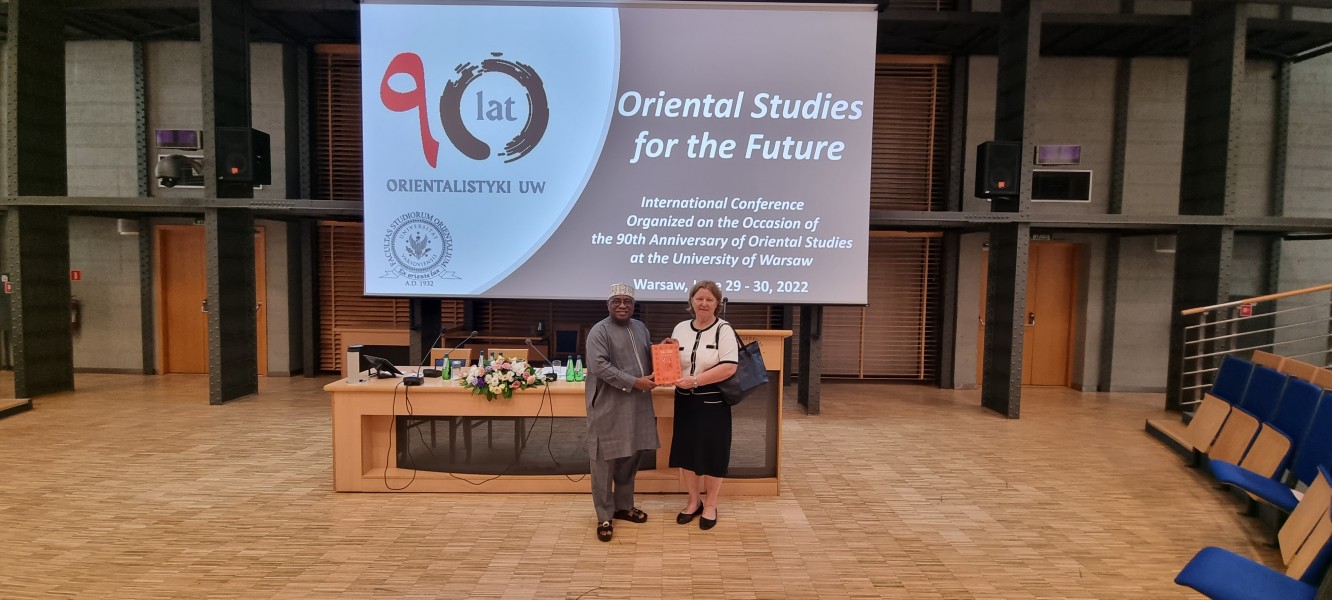
The academic world will never cease to amaze me. Let us look at just one example. Take an invitation to present a paper at an international event, as I was in June 2022. This particular event was the 90th commemoration of the establishment of Oriental Studies at the University of Warsaw, Poland. About 30 of us were invited, mainly from Europe and Asia, to share experiences on our various studies on orientalism from 29th to 30th June 2022.
The trip was daunting for me, to begin with. It started with an hour flight on Qatar Airways to Abuja from Kano (my base). I spent another hour or so on the ground at Abuja before taking off for the six-hour flight to Doha, Qatar. I spent over four hours meandering around the terminal at Doha, waiting for the connecting flight to Warsaw. Eventually boarded the five-hour flight from Doha to Warsaw. All told, about 17 hours journey time. Arrived at the hotel jetlagged, weary and disoriented.
Off the following day to the University of Warsaw for the two-day conference scheduled at 9.00 p.m. each day. And it was right on the dot, with welcoming remarks by Prof. Piotr Taracha, the Dean of the Faculty of Oriental Studies UW, followed by an address to the conference by Prof. Alojzy Z. Nowak, the Rector of UW. These were followed by two keynote addresses, then appreciation of retiring members of the university community who had been there for over 50 years, including my host, Prof. dr. hab. Nina Pawlak (that’s how distinguished academic titles are labelled in most Eastern European universities). Let’s see what the letters mean; prof stands for professor, while dr is the doctor. To be a hab, however, requires extra efforts.
To be awarded the academic degree of doktor habilitowany (habilitation), the candidate must have remarkable scientific or artistic achievements; submit a habilitation book which contributes to the development of a given scientific discipline; receive a favourable assessment of their output, pass a habilitation examination and deliver a favourably assessed habilitation lecture. It is after all this that they become professors.
Nina Pawlak received her PhD in 1983 (Constructions expressing spatial relations in the Hausa language), habilitation in 1995 (Syntactic Markers in Chadic) and professorship in 2007. Thus entitled to prof. dr. hab. status. The habilitation is a post-doctoral experience that is highly formalized, represented by a separate thesis or a compendium of outstanding work in the area that can be evaluated as making an original contribution to knowledge. It takes between four to ten years to complete. Its public presentation is something like an inaugural lecture before a professorship. In most cases, the habilitation is the qualification needed for someone to supervise doctoral students. So far, in Africa, only Al-Azhar University in Cairo seems to offer this route to university scholarship.
It is the habilitation qualification that will determine one’s path to professorship, but the publications required for skipping it to become a professor directly have to be more outstanding than the habilitation publication. This process shows rigorous respect for original contribution to knowledge in European scholarship. One can still be referred to as prof. dr. in recognition of their scholarship, without the hab. For instance, I was recognized as so by the European Union award of a grant to teach at the University of Warsaw in 2012. The prof. dr. title, used in mainland Europe and some Asian universities, acknowledges scholarship, even without the region-specific hab.
Now back to the Conference. No ‘Chairman of the Occasion’, or Lead Paper presenter, nor ‘Royal Father of the Day’, etc. Just presentations. Now that brings me to my wonderment about the academic process. After over 17 hours of flight time (and same hours returning back), like everyone else, I was given 20 minutes (which included being harassed five minutes to the end by the moderator) to present my paper titled The Trans-Oriental Express: Receptivity and Cinematic Contraflows in African Popular Culture, and 10 minutes allowed for discussions – and that’s it!
Thus, you spend weeks on fieldwork and data synthesis, spend hours being ferried from one location to another, and stay for days cooped up in a dingy hotel room (wistfully thinking about your own spacious personal living space!) eat some unusual and often very expensive food. All for 20 minutes of fame! This has been a recurring pattern in all the conferences I had attended.
So, what is it about, at least international scholarship, that people would rather read what you wrote than listen to you? In Nigeria, paper presenters tend to ramble way beyond their allocated time. Often, the moderator of your session is worried about stopping you because you are a ‘big’ man, even if you are talking out of point. I remember one case in which the ‘Guest Speaker’ was reminded that his time was up as per the ‘program of event’ (sic). He adamantly refused to heed the time and insisted that since he was the main ‘event’, he would only stop when he finished reading the booklet of his lecture, which was 32 pages! Thank God for Smartphones – people just ignored him and shifted their attention to their WhatsApp messenger and came back to earth only after someone started clapping to signal their relief at the conclusion of the presentation!
Perhaps it is time for us as Nigerian academics to move from this dense didactic approach to presenting papers – where you are often expected to give ‘theoretical framework’, ‘research questions’, ‘methodology’ (to appear ‘Scientific’ even if there is no Science in your conclusions) before you get to the actual data itself. And most annoying, you are also expected to give totally useless ‘recommendations.’ I had arguments with moderators and participants in Nigeria on the last point where I am asked about my ‘recommendations’ after my presentations. I often reply that I don’t have any recommendations – I present my data and my interpretation. How it goes is up to you. For instance, what can I recommend to a person who based their own narrative creativity on intertextual appropriation, thus creating a meta-narrative? That it has happened is fascinating enough. That I brought it to your attention is sufficient enough in knowledge discourses. In wider international scholarship, participants are more interested in exploring other aspects of your data.
I think our approach to conference presentations in Nigeria has vestiges of the didactic educational experiences we were grilled through. Under such an academic ecosystem, all research is geared toward policy and governance. It is time for a paradigm shift – cut down the number of minutes on presentation, and focus on the epistemological virtues of the presentation! Oh, and cut-off the prof’s microphone when he seems about to torture his audience beyond his allocated 15 to 20 minutes!
Prof. Abdalla Uba Adamu is the former Vice-Chancellor of the National Open University of Nigeria (NOUN). He can be reached via auadamu@yahoo.com.
The Hausa-speaking community on social media, especially Facebook and Twitter, is today celebrating World Hausa Day for the seventh time.
However, Nigeria’s Twitter ban early this year has reduced much of the day’s celebration on the microblogging site.
The day was first introduced and celebrated in 2015, courtesy of concerned social media users such as Jamila Kabiru Fagge, Abdulbaki Jari, Bashir Ahmad, Salihu Tanko Yakasai, Faisal Abdullahi, Ila Bappa, Maryam Ado, others. The objective was to promote the Hausa language, its development and the challenges it faces as one of the major languages in West Africa.
The day allows Hausa users to come up and post witty Hausa sayings and make corrections as to how the language is used in conformity with its orthographical rules.
Hausa is one of the most spoken languages in Africa. It is spoken in about 30 African countries, with over 100 million speakers.
The language gathers momentum each day as several renowned media organisations broadcast in it. For example, media houses like the BBC, VOA, DW, Radio France International and the like broadcast in the Hausa language.
However, some social media users lament some challenges that the Hausa language and its people face today.
For example, Nurudeen Dauda wrote the following in his article: “Our people almost regarded begging as [a] profession. All well-meaning Hausas should and or must make [a] serious effort towards discouraging our people from begging. After all, we are not the only people suffering from poverty in Nigeria. It is among all!”
Sunday, 8th of August, 2021 was a black day for the family of Malam Isah Abba Adamu, the BBC Hausa Service, its listeners, Kano people, the Hausa community in London, and the Hausa community globally over the sudden death of the Kano-born, renowned broadcaster, Malam Isa Abba Adamu. He was the first Black person to have headed the BBC Hausa Service. He was also the Executive Editor of BBC Africa Service.
Malam Abba Adamu has made an enormous contribution in the Hausa language policy formulations, which are policies put forward by ethnologists for language sustenance against language attrition (waning and death). For example, it’s a well-known fact that the Hausa Service has contributed a lot in the lexical modernisation of some new words to Hausa, especially the recent computer terminologies: kwamfuta, na’ura maikwakwalwa, megawati, etc.
Nowhere has late Isa contributed than in areas of translation. Millions of Hausa users will miss his voice, translation skills and interpretative nuance, especially from English news and reports to their exact Hausa versions.
Stations like BBC Hausa (in which Malam Isa was a figurehead and contributor) have attracted many non-Hausa speakers to news in Hausa. This has contributed to the increase in the Hausa speech community. Ethnologue estimated that over 47 million people now use the Hausa language as second language users. Language prestige is another factor in language development because a language attracts more users worldwide. The Hausa language enjoys high patronage as one of the most widely used mediums in the world. People such as the late Malam Isa are among the factors responsible for the prevalent use of the language in Nigeria and all over the world, where it’s used for literacy and information dissemination.
Lastly, the BBC Hausa is also involved in Hausa corpus planning. This involved creating a standard variety of language in spelling and grammar. BBC Hausa uses the Kano dialect in its broadcasts as it’s considered more standard even though with some modifications.
Late Malam Isa Abba Adamu will be remembered for his sonorous voice and more for his catchphrase during broadcasts: “Ana sauraron Sashen Hausa na BBC ne daga tsakiyar London, ni kuma nine Isa Abba Adamu.”
May the Lord in His infinite mercy forgive Malam Isa Abba Adamu and grant him Jannatul Firdaus, amin.
Salisu Yusuf writes from Katsina. He can be contacted via salisuyusuf111@gmail.com.
How far would you go in order to be forgiven? Would you send a text message? A letter? Flowers, or a gift? Would you track down the person you hurt and beg them to forgive you, even if it required a two-month journey?
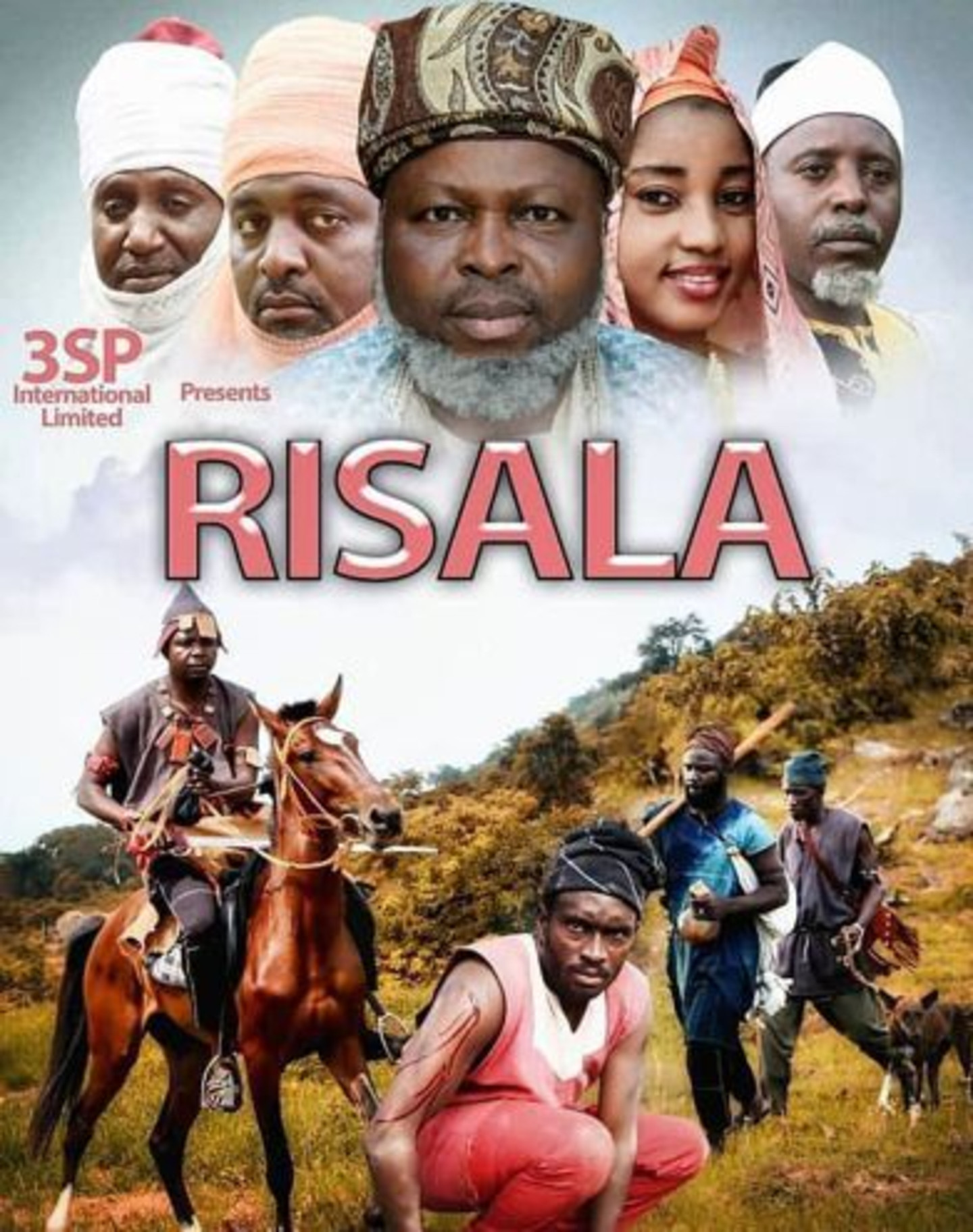
For Zakariyya, the hero of Abubakar Shehu’s Hausa-language film Risala, his desire to be forgiven for eating fruit from a stranger’s farm sends him on a week-long journey on foot to the village of Baihan to ask the farm’s owner to absolve him of his sin. Throughout this journey, he encounters unsavoury characters, is repeatedly beaten up, almost dies of thirst, finds a fortune and loses it, and ultimately meets the love of his life.
Zakariyya is the perfect hero: modest, handsome, determined, faithful, never straying from his morals. Even when he is accused of being a robber, beaten, and insulted by the village’s men, he remains calm and only defends himself by explaining the misunderstanding. When they realize their mistake, he simply forgives them and moves on without holding a grudge. His character seems so genuinely good; it makes you wonder if you would admire him or be annoyed by his constant perfection if you knew him in real life. Surely there must be something that makes him angry or tempts him to sin? However, his strength of character throughout the movie is reminiscent of noble mythical or legendary characters known to Western audiences, such as Robin Hood. This is further reinforced by the pre-colonial setting when modern amenities were not yet present in Nigeria.
When Zakariyya finally encounters the farm’s owner, he appears unwilling to forgive him at first. Yet, because Zakariyya is such a noble person, he senses the opportunity to marry off his daughter to a worthy man. So he proposes to Zakariyya that he marry his ugly, deformed daughter Ummulkhair (sometimes also referred to as Ummu Salma). Zakariya, being the modest man he is, immediately accepts Ummulkhair and promises to treat her well. However, when we see her, she turns out to be exceptionally beautiful.
We learn that the farm’s owner in Baihan has been looking for a suitable husband for his lovely daughter for quite some time, yet every man he has encountered was too enamoured with her beauty, which he considers superficial. Thus, to test Zakariyya’s good faith, he tells him his potential wife is horrendously ugly. The fact that Zakariyya still vows to marry her proves he is not a superficial man and that he is truly worthy of marrying her. In the end, he is rewarded for all his troubles with a beautiful wife. Zakariyya questioning his wife’s integrity by asking her about her relationship with her parents proves he is still not superficial and really is interested in marrying a righteous woman, not just an attractive one.
The fact that Ummulkhair’s beauty is treated as a detriment to her father, resulting in her spending most of her life indoors, as well as her treatment as a prize or commodity for a man (especially her virginity), is unsettling to feminist viewers, yet reminiscent of Western fairy-tales such as Sleeping Beauty, Rapunzel, Snow White, etc., as well as being very fitting for a story set several centuries ago. While Zakariyya’s “test” of his wife before accepting her reeks of sexism, it is probably a very realistic portrayal of the treatment women faced (and continue to face) in many societies.
Another theory about Ummulkhair with regards to the many fairy-tale and magic-like elements in Risala is that she is, in fact, not conventionally attractive and that it is Zakariyya’s reward for being a good man that she appears beautiful to him. This theory can be discounted because, after revealing herself to him, Ummulkhair tells Zakariyya she was barred from leaving the house because of her beauty, so apparently, she really is beautiful and not ugly. However, disregarding this, one could come up with a hypothesis:
Before unveiling her to see her for the first time, Zakariyya says, “everything created by God is beautiful. Only people make distinctions between the good and the ugly.” Perhaps, Ummulkhair is somehow cursed with an ugly outer appearance, and Zakariyya’s words acted as a spell that lifted the curse and made her appear beautiful to only him. So, because his heart is pure and he has good intentions, he sees a beautiful face instead of an “odd-looking” one and instead of a hunchback, he sees a striking woman. Because he is deserving, he sees the beauty in her while others do not. Had he approached the situation differently, perhaps thinking, “poor me, to be stuck with an unattractive bride”, she would have appeared ugly to him.
Ultimately, regardless of the specifics of Zakariyya’s marriage, the message is clear: Those who are good-hearted and seek forgiveness for their sins will be rewarded for it. As such, Risala is a very wholesome film worth watching for its retro charm reminiscent of fairy tale films or Bible stories and its interesting storyline. In addition, the acting and editing manage to steadily capture the viewer’s attention, something unfortunately not always a given in Kannywood cinema as it is still a developing industry and production quality is often low.
While I consider Risala to be one of the better Hausa films I have seen, do not expect a lot of character development since Zakariyya is a perfect hero right from the start and other, more sinister characters like the robber Gambo die before they get a proper chance at reform. There is also some slightly unnecessary bloodshed coupled with overly dramatic and unrealistic special effects reminiscent of low-budget Japanese anime. On the other hand, the music may not be to everyone’s taste (especially Western audiences), but I found it rather pleasant and meshed well with the action rather than distracting the viewer. Subtitles for the final song would have been helpful for non-Hausa speakers, but the song was still fascinating and enjoyable, especially the dancing and colourful Hausa clothing. Overall, while the film could have easily been condensed into one part instead of two, the storyline is gripping, and the acting is done well. I would recommend this film to anyone new to Kannywood cinema.
India Biró is a student at the Institute of African Studies and Egyptology, University of Cologne. She can be reached via ibiro@smail.uni-koeln.de.