Hausa Culture

Hula: A symbol of cultural, religious, and social status in Hausaland

By Umar Aboki

The traditional Hausa cap, also known as “Hula,” is recognised for its intricate embroidery and is often worn with traditional Hausa attire. It has a long history in Hausa land, originating as a common and traditional male garment and later evolving into a symbol of cultural, religious, social, and even political status.

Many people associate any man they see wearing a Hula with being a Muslim or Hausa or both. Yusuf Ahmad, a traditional Hausa cap seller, believes that wearing a Hausa cap is a sign that indicates someone is a Hausa man and a Muslim, and that wearing a Hausa cap is what completes a man’s decency. 

Yusuf added that the older generation of Hausa men like to wear tall Hausa caps, while the new generation prefersshorter ones. And when people come to buy caps, they mostly ask for the cheaper and lighter ones; it is the rich men who usually ask for the Zanna-Bukar and other heavier ones.

There are various types of traditional Hausa caps, including “Zanna-Bukar”, “Damanga”, “Zita”, “Maropiyya”, “Zulum” and “mu-haɗu-a-banki”. They are distinguished by factors such as the materials used to make them, their place of origin, the wearers, and their purposes, among other considerations. However, the most popular and widely worn is the “Zanna-Bukar”. Overall, the hula has evolved from being merely a piece of headwear to a symbol of cultural identity and belonging within the Hausa community and beyond. 

Malam Khamilu, a resident of Yahaya Gusau Road, Kano, claims that he wears Hausa caps frequently, especially the Zanna-Bukar. He says it is very special to him and he got his own tailor-made, specially for himself. He also considers his cap a part of his identity as a Hausa-Fulani man and a Muslim.

The Hula is not limited to being worn only within Hausa communities. It is worn by men in many populations in North Africa, East Africa, West Africa, South Asia, and the Middle East.

Zulyadaini Abdullahi Adamu, a Hausa cap knitter and seller, says he wears his Zanna-Bukar or Damanga daily, and he knits the Zanna-Bukar, Damanga and PTF, then sells them at prices ranging from eight thousand to thirty thousand Naira, and that people come to buy them from Jigawa, Maiduguri and other states and places.

Men throughout the African diaspora also wear it. Within the United States and other foreign countries, it has become primarily identified with persons of West African heritage, who wear it to show pride in their culture, history, and religion. Dauda Ibrahim Dachia, a Northern Nigerian staying in Tirana, Albania, claims to wear his traditional Hausa cap overseas, but not all the time. He usually wears it on Fridays, during Eid celebrations, or during cultural events.

It was written in an article by the Centre de l’ldentité et de la culture Africanes titled ‘The Khada Habar: A traditional hat in a Hausa environment’ that “wearing a hat is a mark of respect for oneself, above all, according to Mr. Adéyèmi “when you don’t wear a hat, traditional dress is not complete”, he insists, “it reflects a disconnect between man and his own culture”.

Muhammadu Sa’idu, another resident of Kano, claims to wear the Zanna-Bukar frequently, usually to events. He says that anytime he wears it, people respect him a lot. He also has a ‘Damanga’ but prefers wearing the Zanna-Bukar. In his case, he doesn’t usually associate Hula with the Hausa tradition or Islam.

 Sa’id Salisu Muhammad, a Hausa cap washer at Gaɗon ƙaya, says he wears traditional Hausa caps a lot, especially the Zanna-Bukar. He says that a typical Hausa man always wears the Hula to work, events and other places, so they have to always bring them in for washing. He also notes that people bring in Zanna-Bukar the most, followed by the lighter ones such as the “Maropiyya” and “Zita”.

The Hula also serves as a means for people to fit into Hausa communities, as they are seen as a symbol of identity, and provide a sense of belonging. Musa Abdulrazaq, a young man from Kaduna who studies in Kano, says anytime he is in Kano, a place where the Hausa culture is evident and vibrant, wearing the traditional Hausa cap is very important to him. Although he doesn’t wear it much back at home, he understands that it is a vital part of the culture in Kano, so he regularly wears his Hula to fit in with the people of Kano and feel at home.

However, not everyone from outside the Hausa community feels the need to identify with the Hausa people. Umar Ahmad, a Fulani man who visits Kano but has been staying here for about two years, says he doesn’t wear the traditional Hausa caps. Instead, he maintains his Fulani cap. And when asked, he said he does indeed associate the Hula with Islam and Hausa tradition.

Umar Aboki wrote via umaraboki97@gmail.com.

Hausa digital neologisms

By Prof. Abdalla Uba Adamu 

Let me start with a context. It happened on June 27, 2024, Gabon’s Show on YouTube.

“Zarmalulu no work” was an expression uttered by TikTok influencer Sayyada Sadiya Haruna, describing the state of her marriage to another TikToker, Abubakar Ibrahim, a Hausa Rapper based in Kano, northern Nigeria, and known by the stage name G-Fresh Alamin. She used the expression during her interview with Hadiza Aliyu Gabon, a Kannywood (Hausa cinema of northern Nigeria) film actress, in an episode of Gabon’s YouTube Show, “Gabon,” on June 27, 2024. Haruna used the expression to inform Gabon and her viewers that G-Fresh was impotent on their wedding night, using ‘Zarmalulu’ as a social code for his non-performing reproductive organ.   

The expression, which quickly became a meme referring to the male sexual organ and its (dis)abilities, became a trending term in Hausaphone social media counterculture, and G-Fresh, usually full of swagger and macho posturing, was highly ridiculed and his swagger deflated, as it were. In this process, Haruna has provided males with an easy way of explaining their erectile dysfunction to either their partners or their healthcare provider in a less embarrassing and amusing way. The use of the term openly reveals a growing vocabulary of erotic neologisms in Hausa social media and reflects the emergence of what I refer to as Hausa digital counterculture.

This media incidence – which received massive views, significantly improving Gabon’s financial standing – reflects one of the fascinating aspects of language development within the context of media anthropology. I am pretty sure that Margaret Mead, the doyen of cultural anthropologists, would have welcomed social media and its potential in studying digital natives. Safer, too. With the increasing creation of conventional and alternative communities on social media, a new discipline has emerged to enable people to study others without the necessity of being in the same physical space and time with them. So, what exactly is “media anthropology”? 

Media anthropology is the ethnographic and critical study of how media—especially digital and social media—are embedded in the cultural, social, political, and economic lives of people. It is a subfield of anthropology that examines how people create, utilise, interpret, and are influenced by media in their daily lives. It blends the traditional ethnographic methods of anthropology—such as participant observation and in-depth interviews—with the analysis of media technologies and content.

My initial focus was on Hausa literature and its transformations – from physical print to online publishing, then to the film industry – encompassing feature films and distribution through tapes, CDs, DVDs, and YouTube series. I then moved on to music, from griot wordsmiths to rap and hip hop. It was all pretty exciting. Then, social media made its entrance and created multiple new entries into the field. 

As a media anthropologist, I immerse myself in communities—both online and offline—to understand how people engage with digital media. For this study, I focused primarily on Facebook as a social network. Hundreds of communities were created on Facebook—mainly by young people—that discuss a wide range of topics, providing a rich source of data concerning youth subcultures and how social networks offer a subversive template for creating new identities and expressions. 

As I swing from one community to another – using Robert Kozinet’s Netnographic methods – I began to notice a new pattern of language usage among young Hausa online digital natives. Then I started gathering new words and expressions that offer alternative meanings to their conventional ones. For the most part, they tended to be innocuous, while hiding a deeper, often darker meaning, and are essentially communicated to ingroup members of the communities. Quite rapidly enough, some of the words began to take on a new urban lexicon on their own. 

A typical example is “capacity,” an innocuous word that means exactly what it says: maximum production or containment. Yet, digital natives have turned it into “kafasiti” to indicate an urban cool, swagger, ability, capability, “arrived”, etc. The word is now used in multiple forms and contexts to refer to attainment of either distinction or class (“Alaji, wallahi an baza kafasiti a bikin nan”). 

But, then, old words have always had new meanings in Hausaphone urban language use. For instance, “shege” is literally a bastard in Hausa, but recontextualised to mean “an expert” or “outstanding.” “Mugu” (bad) became an adjective for extremities (“mugun kyau”, extreme beauty). “Arne” (pagan) transformed into contemporary “bro” (kai arne, yaya dai/yo, bro, wazzup?). “Kwaro” (insect) translates into a tenacious, usually studious person. For southern Nigerians, “Aboki” is an imagined insult referring to any northerner, whether Hausa or not, rather than “friend,” its actual meaning. 

Hausa digital natives utilise the unconventionality of the social media they inhabit to create neologisms that often reflect hidden, dark, or altered meanings, frequently dealing with in-group lexicons. After trawling through various sites and TikTok videos, I was able to gather approximately 35 neologisms and incorporate them into a paper I am still working on. 

Looking at these digital coinages and the transformation of words, I was struck by the fact that many of them refer to bawdy or sexually suggestive language along the entire sexual preference spectrum. They tend to be more common in social networks (e.g., Facebook, WhatsApp, Telegram, Signal), where interactions are mainly conversational, than in visual social media (e.g., TikTok, Instagram). The reason is that visuality often identifies the person easily, and in Kano, an Islamicate state in northern Nigeria, this could lead to prosecution on moral grounds. On social networking sites, users often use aliases instead of their real names. Such anonymity gives them the freedom to express their thoughts and use these neologisms in their correct grammatical sense. The sentences are meaningful only to in-group members, within or outside the online communities. 

Examples include “Malam Zakari da almajirai biyu”, referring to the male reproductive organs. “Kaya” (load, baggage) referring to trophy (girl, money, etc), “tarkon alƙali” (judge’s trap/jailbait) for pedophilic behaviour, royal rumble (orgy) and murfi (cover) referring to lesbian activity.

As I noted, over 70% of the neologisms in my collection were bawdy and sexually slanted. Their creators chose the anonymity of online communities not only to create new coinages but also to perpetuate them, without any fear of social labelling or prosecution. Some of these words will gradually become part of conventional social usage, along with their attendant meanings. There is no stopping them. Their very existence highlights another way social media is influencing our culture, language, and traditions. 

But, what do you think – good, bad, indifferent? Whatever your feeling, what can we do about it? Hausa is not the only language facing this, though. A recent book by Adam Aleksic, Algospeak: How Social Media Is Transforming the Future of Language” (July 15, 2025), reveals the international nature of this phenomenon through “algorithmic speech”. As the blurb indicates:

“From ‘brainrot’ memes and incel slang to the trend of adding ‘-core’ to different influencer aesthetics, the internet has ushered in an unprecedented linguistic upheaval. We’re entering an entirely new era of etymology, marked by the invisible forces that drive social media algorithms. Thankfully, Algospeak is here to explain. As a professional linguist, Adam Aleksic understands the gravity of language and its use: he knows how it has evolved and changed, how it reflects society, and how, in its everyday usage, we carry centuries of human history on our tongues…New slang phrases emerge and go viral overnight. Accents are shaped or erased on YouTube. Grammatical rules, loopholes, and patterns surface and transform language as we know it. Our interactions, social norms, and habits—both online and in person—shift into something completely different.”

No, I don’t have “eCopy” to Acibilistically share. You gotta buy the original print copy if you are interested in the way in which social media usage transforms contemporary language. I can give you the cover of the book for free, though!

Arewa24 TV: A call for moral responsibility 

By Abbas Datti

I am worried by the increasing broadcast of music videos featuring women in revealing, indecent dressing by the popular Arewa24 television station. In sum, it has reached a tipping point where women featured in music videos are sometimes half-naked, in a provocative, obscene dressing. 

Considering its audience, Arewa24, whose programming is widely accessible to viewers of all ages, must be subjected to public scrutiny for continuously airing content that contradicts the Hausa culture and traditional values of our society.

Many of these music videos not only portray women in revealing clothing but also promote gestures and themes that are inappropriate for family viewing. The consistent exposure to such content, especially during prime time when children and young adults are most likely to be watching, raises serious questions about Arewa TV’s commitment to ethical broadcasting and social responsibility. Most of those video songs are being shown during prime time.

Our society, rich in religious moral character and cultural pride, has always upheld values that protect the dignity and modesty of individuals, particularly women. The portrayal of women in such a demeaning and objectifying manner is not only an affront to Hausa Fulani’s traditions but also sends the wrong message to younger generations.

We call on the National Broadcasting Commission (NBC) and other censorship regulatory bodies to urgently investigate some content being aired by the Arewa TV station. Strict measures should be taken to ensure that all media platforms operate within the boundaries of decency, respect, and cultural sensitivity. 

Furthermore, there is a pressing need for media houses to adopt self-regulation policies and prioritise programming that promotes positive values and Hausa cultural identity. Our religion and cultural heritage must not be compromised in the name of entertainment.

The time to act is now. Authorities must rise to the occasion and safeguard the moral fabric of the Hausa people from further extinction.

Abbas Datti writes from Kano via abbasdatti448@gmail.com.

Wearing the turban, bearing the burden: The enormous task before the new Galadiman Kano

By Huzaifa Dokaji

The promotion of Wamban Kano Munir Sanusi as Galadiman Kano today, May 2, 2025, marks an important moment in the history of Kano’s sarauta institution. More than a ceremonial instalment, it is the continuation of a title whose symbolic and administrative significance has long anchored the cohesion of Kano; first as a kingdom, and since the nineteenth century, as an emirate. This moment is charged with expectation, arriving at a time Kano Emirate is caught in a vortex of political contestation, juridical uncertainty, and generational transition. It will be the day a man who is both brother and foster son to a former Galadima, and son-in-law to another, assumes such an important office.

The title of Galadima, derived from the Kanuri galdi-ma, meaning “chief of the western front,” emerged during the administrative reforms of Kano’s second Hausa ruler, Sarki Warisi dan Bagauda, in the 11th century. Over time, it evolved into one of the most powerful and senior princely offices across Hausa land. Until Emir Abdullahi Maje Karofi (1855-1882) appointed his son Yusufu as Galadima, the title had traditionally been reserved for the king’s/emir’s uncle, eldest brother or closest male kin: typically someone older and therefore unlikely to succeed to the throne. 

Elsewhere, I have argued that Maje Karofi’s deviation from this established custom was one of the remote causes of the Kano Civil War of 1893. In essence, the appointment of a son to such a crucial position, naturally altered the institutional role of the Galadima, who historically functioned as a check on the emir’s authority. This explains Maje Karofi’s decision to depose his brother Abdulkadir, for expressing growing concern over certain decisions and practices at court the latter deemed inappropriate.

As demonstrated by the reigns of Galadiman Kano Daudu, Atuma, and the Fulani-era Galadimas Maje Karofi and Tijjani Hashim, the office has often wielded influence that paralleled or even eclipsed that of the king/emir. Until the 19th century, titles like Dan Ruwatan Kano were accorded to the kinsman or son of the galadima, while Dan Darman Kano was reserved for his cognatic kinsman.

Traditionally, the Galadima served as vizier, head of civil administration, and head of his own mini-palace, independent of the Emir’s court. Court praise-singers aptly describe bearers of the title as Daudu rakumin Kano, the camel that bears the city’s burden; Daudu gatan birni, the protector of the city; and Rumfa sha shirgi, the palace’s dust heap where disputes are deposited and resolved. In recent times, no one embodied such praise and function as the late Galadiman Kano Tijjani Hashim.

Widely regarded as the archetype of the modern Galadima, Tijjani Hashim redefined the office in an era when the sarauta was stripped of formal political power. He transformed it into a bastion of accessible influence, strategic mediation, and public service. His residence functioned as a daily court of appeals, open to aristocrats, commoners, and royal slaves alike. He was the man to whom a poor student could turn for a scholarship, a merchant for capital, a civil servant for promotion, a politician for sponsorship, and a broken family for reconciliation.

Tijjani Hashim died in 2014 and was succeeded by the charismatic Abbas Sanusi, whose reign as Galadima was cut short by a protracted illness. Abbas Sanusi was a disciplined and astute administrator, widely respected for his command of the emirate’s bureaucratic machinery. Yet his tenure was constrained by declining health, which limited his capacity to perform some of Galadima’s traditional roles, particularly inter-familial diplomacy. It is from Abbas Sanusi that the title now transitions to his younger brother, Alhaji Munir Sanusi, marking a rare case of intergenerational and intra-familial continuity, even by the standards of Kano’s dynastic politics. Their relationship was not merely fraternal; it was paternal.

Abbas raised Munir from infancy, shaping his worldview and instilling in him the refined fadanci he has mastered and discreetly used to his advantage. Adding further symbolic weight is the fact that Munir is married to Hajiya Mariya Tijjani Hashim, daughter of the very man whose name has become synonymous with the Galadima title in recent memory. Thus, the new Galadima stands at the confluence of two great legacies—bound by blood to Abbas, and by marriage to Tijjani.

Born on January 12, 1962, Munir Sanusi Bayero was the last son of Emir Sir Muhammad Sanusi I to be born in the Kano palace. Raised by his late brother, Galadima Abbas Sanusi, he later married his second cousin, Hajiya Mariya, a union that has continued to epitomise royal love and companionship. Alhaji Munir Sanusi received his primary education at Gidan Makama Primary School and his secondary education at Government Secondary School Dambatta from 1976 to 1981. He later obtained a degree in Mechanical Engineering from the Indian Institute of Technology in New Delhi.

Galadima Munir Sanusi’s career commenced in the Kano State Ministry of Social Welfare, Youth, and Sports, where he served as a Transport Officer from 1989 to 1991. He later joined Daula Enterprises Co. Ltd, Kano, from 1991 to 1993. He currently sits on the board of several companies, including Tri-C3 and Unique Leather Finishing Co. Ltd, the second-largest exporter of leather in West Africa. 

In 2014, the Emir of Kano, Khalifa Muhammad Sanusi II, appointed him as Dan Majen Kano and pioneer Chief of Staff to the Emir in the Kano Emirate. He was elevated to the position of Danburam Kano in 2016 and Wamban Kano and district head of Bichi in 2024. Today, he assumes the prestigious title of Galadiman Kano.

Galadima Munir’s loyalty to Emir Muhammadu Sanusi II has earned him considerable admiration within and beyond Kano. When the Emir was deposed in March 2020 and exiled to Loko in Nasarawa State, Munir not only followed him into banishment but remained by his side through Lagos and back to Kano. Now that the Emir has rewarded that loyalty with the emirate’s highest princely office, Munir faces a challenge no less noble than the title he inherits.

For one, loyalty is only one pillar of what I call “the burdens of the Galadima”. The office demands generosity, accessibility, discretion, and the ability to shoulder the hopes of a people whose faith in the sarauta system is repeatedly tested. Here lies Galadima’s greatest trial. Like his predecessors, he must cultivate a public image as a patron of the weak, a reconciler of royal, noble, and common feuds, and a figure of last resort to both the high and the low. He must embody rumfa sha shirgi in practice: bearing the burdens of others, not just out of obligation, but with discernment, sincerity, and grace. His word must be his bond, for zancen Galadima kamar zancen Sarki ne: the word of the Galadima is expected to be final, unwavering, and free of bitterness.

The task becomes all the more urgent against the backdrop of Kano’s current emirship crisis. While Emir Muhammadu Sanusi II’s return has been celebrated in many quarters, it remains the subject of intense legal and political contestation. In this precarious climate, the Galadima must go beyond ceremonial visibility. He must be the Emirate’s anchor, bridging palace factions and translating the noble project of restoring the sarauta back to its sense to the wider public. Galadima Munir’s early efforts at reconciling estranged branches of the royal family and diffusing internal tensions suggest a promising political instinct. But history demands more than instinct; it demands an ethic of honour and sustained human investment.

To become a Galadiman Kano today is not merely to wear a turban. It is to accept a lifetime project of prioritising the interest of the Sarauta and the talakawa over one’s. It is knowing that one’s home inevitably becomes a revolving court and one’s influence becomes public trust. Any failure to wield it generously, the memory of that failure will linger far longer than any quiet success.

Alhaji Munir Sanusi ascends the title of Galadima with the wind of history at his back and the shadows of giants before him. He is son and brother to a Galadima, and son-in-law to the most revered of them. If he can merge these legacies with his quiet resolve and proven loyalty, he may yet restore the Galadima as the most vital conduit between the emirate and its people.

The title awaits its meaning, Kano welcomes its new Galadima.

Allah ya kama, Raba musu rana da hazo

Allah ya taya riko, Daudu kwatangwalon giye.

Allah ya taimaki, tomo jiniyar gari

Huzaifa Dokaji writes from New York and can be reached via huzaifadokaji@gmail.com.

The Spirit of Kano Photo Competition

By Prof. Abdalla Uba Adamu

For some weeks, I had been involved in judging a photo competition themed “Spirit of Kano”. One way or another, I was made the “Chief Judge” by the Curator, Dr. Shuaib Sani Shuaib, Executive Director, Makuba Center for Arts and Culture, Kano. He is also the Curator for Global Shapers Community, Kano Hub. Overall financial support was also provided by Engr. Anas Yazid Balarabe, who is also the founder of the cooperative. 

As an amateur photographer with a deep and intense interest in art and the aesthetics of the environment, coupled with a fanatical advocacy for the best State on this side of the Milky Way Galaxy, I was honored to be appointed the Chief Judge. However, since it was an open competition and open voting, I designed the judgement criteria for the photos,which were used to judge the 100 or so entries by other judges. Photographers were urged to send pictures that, in their view, capture the “Spirit of Kano”. Many people participated, and many photos were sent. 

These entries were beautifully shot and captured the Spirit of Kanawa and Kananci. They were all beautiful. However, I judged them based on what the images conveyed about Kano in various visual ways—history, architecture, food, clothing, urban life, historiography, etc. For me, choosing the best three was really difficult because there was so much beauty and talent in each photograph—faces, places, spaces. The entire collection was a riot of colorful visual poetry that describes Kano. 

Each picture in the entries has unique features and communicates the dynamism of both urban and rural Kano. Thousands of words could be woven around each picture that communicate the vibrancy of Kano. My selection cuts across history, trade and lived-in experiences. I would have loved to see some architectural shots – the ones I saw were mainly Emir of Palace pictures (Ƙofar Kudu or thereof). A few shots of ‘mansions’ and ‘haciendas’ would have given an evolutionary trajectory of the Spirit of Kano, in addition to the alleyways and gidan kara.

Four judges trudged through the 100 or so entries and made their choices. These were then further pooled by common choice from each judge to pare down the selection to six, on which the final judgment of three was made. To ensure a fair and transparent selection process, the top three winners were chosen based on a combination of judges’ evaluations and public voting. The final ranking was determined by taking an average of the judges’ scores and the public vote ranking in which the winners emerged. Very transparent. Further, everything was done online. 

The final judgment of the top three (shown here) truly deserves it. The winners, based on the highest scores, along with their prizes, were:

1- Muhamad Sani Abbas (₦250,000)

2- Alamin Mohammed (₦150,000)

3- Aisha Suleiman Halili (₦100,000)

Muhammad Sani Abbas’s best picture was of a young greengrocer measuring a customer’s order in a local market. The intensity of his face captured everyone’s imagination and admiration. The photo of the boy is a bookmark on Kano and its commerce—never too young to start. It was indeed a beautiful shot. 

Alamin Mohammed took second place. Interestingly, the picture also shows another young lad galloping on a horse in full ‘royal’ regalia. Frozen in time, the horse rider captures Kano’s ancient tradition and royal heritage. 

Third place went to a composite study of the Kano Emir’s palace guards (Dogarai) from a truly sensitive POV. The winner, Aisha Halilu’s portrait of a shadowed Dogari, makes the maximum use of light and shadows to accentuate the beauty of the setting. The Dogari, with his back to the camera, clearly was not the focus of the shot but the far houses he was gazing at—a contrast between the traditional Hausa architecture of the palace and the post-modern bungalows he was gazing at. 

A picture by Ahmad Sufi, which I voted for, did not win, but that’s alright; after all, it was aggregate scores that mattered. I didn’t place it number one, but I had expected it to be at least number three. The outcome only highlights the high quality of the visual appeal of the photos entered in the competition. 

The one that did not make it on my list was a market scene with an Arab (at least the guy looks like an Arab but dressed in Babbar Riga) holding on to a camel. Far in the distance is a communication tower. To me, the pictures talk volumes about migration, cultural adaptation, trans-Saharan road networks and contemporary communication – all visually encapsulating what Kano has been for centuries and those to come. 

I think it is wonderful that an NGO of young, committed individuals could come up with this. It should be the purview of the Kano State History and Culture Bureau. A letter was sent to the Kano State Government requesting partnership/sponsorship, but there was no response at all. Even the prize money was sourced by Dr. Shuaibu, showing a commitment to Kano far greater than many of us. 

What could the next steps be? Perhaps an annual event? Or a regionalisation of the competition? For instance, it would be fantastic to see the “Spirit of Zazzau”, followed by Rano, Daura, Katsina, Gobir, and so on, all the way to Niamey. This way, we could have an annual Spirit of Hausa Kingdoms as visual poetry, encouraging young people to appreciate the historical, cultural, and aesthetic qualities of their environment. 

The Kano durbar UNESCO inscription: Beyond the jubilations

By Salim Yunusa

The formal inscription of the annual Kano Durbar by the United Nations Educational, Scientific, and Cultural Organization (UNESCO) on its Representative List of Intangible Cultural Heritage of Humanity is a welcome development to not just Kano but Nigeria as a whole. The nomination, adopted on the 6th of December, 2024, in Paraguay, at the 19th session of UNESCO’s Intergovernmental Committee for the Safeguarding of the Intangible Cultural Heritage, makes it the 8th element to be inscribed from Nigeria. UNESCO is a specialised agency of the United Nations that promotes peace and security through international cooperation in education, science, culture, and communication.

According to many sources, the Kano durbar is the world’s largest procession of colourful horses. It has evolved with the history, religion, culture, and tradition of the Kano people over time. It is usually done to mark the Islamic holidays of Eid-el-Fitr and Eid-el-Adha, among other special celebrations. While other similar durbars are carried across almost all Northern Nigerian cities such as Zaria, Katsina, Bauchi, Gombe, Hadejia, Maiduguri and Sokoto, the Kano durbar stands out due to the sheer number of participants, tourists, spectators and days of celebrations.

This global recognition is a significant milestone, celebrating one of Nigeria’s most vibrant cultural festivals. Renowned for its majestic horse parades, traditional regalia, and music, the Kano Durbar reflects Northern Nigeria’s cultural pride and rich heritage. While the jubilations over this achievement are justified, it is essential to explore the opportunities and responsibilities that come with the UNESCO inscription.

 Beyond the celebrations, stakeholders must now prioritise preservation, promotion, and leveraging this global acknowledgement to foster tourism, break down stereotypes, and drive cultural and economic development in Kano and Northern Nigeria as a whole.

Kano—and Northern Nigeria as a whole—is a goldmine of culture and tradition preserved for ages, although these are currently under threat of extinction. The Dye Pits of Kofar Mata, founded in 1498 and spanning five centuries, are at risk of becoming extinct due to disrepair and unsustainable practices in recent times. The walled city of Kano is gradually disappearing to give way to commercial structures along the busy roads of Kano. There is a growing threat of climate change eroding sites like Dala Hills, Gidan Makama and others due to neglect. Sustainable protection and preservation of sites like this must be done for future generations.

This particular UNESCO inscription underscores the need to preserve the Kano Durbar for future generations through strategic documentation and archiving of the festival’s history, rites, and performances. High-quality visual content and written materials can help maintain its essence while creating accessible records for global audiences. This will effectively engage the youth, which is vital to ensure the tradition remains dynamic.

In addition, effective and efficient collaboration between the Kano Emirate council, non-governmental organisations (such as MACOBA, UNESCO, Global Shapers, etc.) and government agencies (NICO, Ministry of Arts and Culture, Tourism Development, etc.) is necessary to provide funding, technical support, and regulations that safeguard the festival’s cultural integrity.

In a state like Kano, boasting the highest population in the country and being the most populous in Northern Nigeria, the Kano Durbar has the potential to become a cornerstone of Nigeria’s cultural tourism, becoming a blueprint for other durbars across the region. To achieve this, a well-coordinated tourism strategy is essential. This could include partnering with airlines, hotels, and tour operators to create attractive travel packages for domestic and international tourists. Marketing campaigns highlighting the Durbar as a unique travel experience should be launched across social media platforms and international media outlets. Collaborations with influencers and travel bloggers can also amplify its appeal.

Furthermore, enhancing the visitor experience is key. Infrastructure around festival venues should be improved, with better roads, accommodations, and festival-specific amenities. Creating dedicated viewing platforms and cultural villages can also enrich the experience for attendees, making the Durbar more accessible and enjoyable.

Beyond cultural pride, the inscription opens doors for economic development. Investments in Durbar-themed merchandise, souvenirs, and artisanal crafts can generate revenue for local communities. E-commerce platforms can facilitate the sale of these items to a global audience.

Additionally, recognising the festival as an international heritage can attract global partnerships and funding for sustainable development initiatives in the region. Furthermore, technology offers endless possibilities to promote the Kano Durbar. Virtual reality (VR) and augmented reality (AR) experiences can bring the Durbar to audiences unable to attend physically. Comprehensive online platforms can offer ticket sales, merchandise, and interactive content, ensuring year-round engagement with the festival. These digital initiatives can transform the Durbar from a localised event into a global cultural phenomenon.

Finally, the festival could serve as a hub for cultural exchange, inviting participants from other regions and countries to share their traditions and learn about the Durbar, fostering mutual respect and understanding. It could be so much more, with proper organisation and intention by the stakeholders involved.

The UNESCO inscription of the Kano Durbar is a momentous achievement that places the festival on the global stage. However, this recognition comes with responsibilities. By preserving its legacy, harnessing its tourism potential, and leveraging technology and cultural exchange, stakeholders can transform the Durbar into a beacon of Nigeria’s cultural excellence. Beyond the jubilations lies an opportunity to turn this acknowledgement into a catalyst for cultural pride, unity, and economic development. The time to act is now.

Salim Yunusa writes from Abuja, Nigeria and can be reached at syunusa@gmail.com.

Usmanu Danfodiyo University announces virtual symposium on Hausa culture, religion

By Sabiu Abdullahi 

The Vice Chancellor of Usmanu Danfodiyo University, Sokoto, Prof. L.S. Bilbis, has invited the general public to a virtual symposium titled “FINAFINAN HAUSA DA ZAMANTAKEWAR MAGIDANTA: INA AKA DOSA?”

The symposium, scheduled for July 10, 2024, at 10:00 AM West Central Africa time, will explore the intersection of Hausa culture and religion. 

Featuring in the event are Prof. A.M. Bunza, Prof. I.A. Malumfashi, Sheikh Aminu Ibrahim Daurawa, Ado Ahmad Gidan Dabino, and Dr. Hadiza Salihu Koko.

Prof. Abdallah Uba Adamu will chair the cultural event. 

The virtual symposium can be accessed via Zoom using the meeting ID: 619 7601 3625 and passcode: 632535. 

The university invites all interested individuals to join the virtual symposium and engage in the discussion on Hausa culture and religion. 

However, no further details on the specific topics or themes to be discussed have been provided.

Dear Muslim wife, you are not a liability

By Salihi Adamu Takai 

Women in the Hausa community shouldn’t remain as they were in the 90’s. They don’t have to be so conservative — refusing to delve into the reflection of the life of smartness. Islam has a lot for women, and in fact, they are mostly recognised more than men in different perspectives. So, women are expected to use the opportunity Islam gives them. 

Before Prophet Muhammad (SAW) married his first wife, Khadijah, she was a wealthy businesswoman who employed men to run some of her businesses. She was inspired by the Prophet’s trustworthiness when she hired him to lead the business, which made her propose to him for marriage. The Prophet married her. 

The Khadija’s adventure in her life of being a businesswoman and the first wife of the Prophet was a challenge to the Muslim women who think that marriage is only the means to become a liability. If the Prophet’s wife could be such a businesswoman in those days, the reason for dumping our women is very outrageous. 

This could also apply to paying the dowry for marriage. Islam makes brideprice the sine qua non of marriage and says it is the right of the wife, not her parents or guardians. It is the wife’s privilege to have capital in her matrimonial house. The dowry can help her run a business while living as the wife.

Almighty Allah decreed paying for a dowry in the Qur’an, Chapter 4, verse 4, in which He says: “Give women ˹you wed˺ their due dowries graciously. But if they waive some of it willingly, then you may enjoy it freely with a clear conscience.”

Thus, dowry could serve as a form of security for the wife to use in the marital home or even upon marriage breakdown. Therefore, if that’s the case, it would be better for women to use the money for business.

Women should stop feeling dependent on their marital homes. They must be innovative and collaborate with their husbands to improve their lives.

During the Prophet’s lifetime, it was reported that the wife of the Prophet’s companion used to help her husband with some work on his farm when he was sick to get what they could. Islam is concerned about the chastity of women, so women should dress decently.

Salihi Adamu Takai wrote via salihiadamu5555@gmail.com.

Adam A. Zango and matters arising in Kannywood

By Usman Abdullahi Koli, ANIPR

Adamu Abdullahi Zango, also known as Prince Zango, is a famous Kannywood figure. Adam has been acting in Hausa films for over 20 years. Zango is a multi-skilled individual who acts, sings, produces, and directs films while introducing new faces to the screens. However, despite his immense contributions, he has been a victim of accusations, controversies, and rumours, but they all turned out to be a bunch of false claims in the end. 

One of the major problems dragging the Hausa film industry back is enmity. No matter how talented an actor is, if he is not in the circle of those who consider themselves owners of the industry or if his stardom is at its peak, he is always regarded as worthless. An adage states that “united we stand, divided we fall.” The level of unity and support for one another in Kannywood is below expectations. 

Perhaps only in Kannywood do actors receive financial support when they come out crying in videos, exposing what they are going through. Such behaviour is contrary to other entertainment industries, where actors and actresses frequently check on colleagues and offer helping hands without disseminating the act on social media.   

Some years ago, in his philanthropic effort to give back to society, Zango promised to give out millions of Nairas to orphans in Kaduna. People from the industry and outside started saying he could only make promises without implementing them. This, among other factors, contributed immensely to the current reality Zango is facing in the industry. People don’t usually appreciate him or keep quiet about issues that affect him directly, turning his life into a topic of discussion every single time. 

Adam did not have the opportunity to attend higher education, but his zeal to actualise the ambitions of young people inspired him to sponsor a high number in Kaduna, Jos, and Kano States. The possession of assets, valuables, and material things by all those who work in WhiteHouse Family, an entertainment venture owned by Zango, is a testimony that he is full of kindness, selflessness, open-mindedness, and what he has never made him proud. 

What Zango is currently going through I don’t see it as depression, as claimed by many. There are people he wholeheartedly helped and trusted but turned against him. Additionally, he is facing a lot of trouble on social media from those who dislike him and are always fabricating lies about him. Yes, silence is not gold. He is supposed to speak up in his defence since no one is willing to stand up for him. The best one could do for the woman he loves is to marry and confide in her. What kills faster than a bullet is a betrayal from a life partner, and the bond of trust ends without a second thought. 

Many accused Zango of frequent marriages and serving his wives with hot breakfast (divorce) in short periods. As revealed by him, the truth of the matter is that most times, the failure of wives to be submissive, respectful, and faithful is glorified by our religion. Zango has been hiding the facts about what led him to divorce his wives from public space, but the ranting from near and far is unbecoming and unbearable. He has decided to let the hen out of the cage. Keeping some issues hidden is better, as exposing them is like adding salt to an injury. 

Furthermore, most of the films produced by Zango were created by local writers, not copies of Bollywood or Hollywood stories. The movie contributed to portraying real Hausa norms and values, cultures and traditions, dressings and foods, shelters and festivals while maintaining the religious injunctions. The languages used are authentic Hausa, along withidioms, styles, and proverbs, making it easier for children to learn. 

Despite dressing in Western attire in some movies, Zango still maintains the moral compass of Hausa and Islam. Factually, nobody can boldly point out where Adam is seen in a fantasy scene with women in films. Other characters have done worse than Zango in movies and feel that doing so is normal, without minding the repercussions on their families or people who took them as role models. By the way, who is morally upright in Kannywood? 

In summary, I have been an advocate for Kannywood, as I have written about misunderstandings between Rarara and former Governor Ganduje and the decision of MOPPAN to dismiss Rahama Sadau, among other topics in the Hausa entertainment industry. It should be noted that stakeholders and characters in Kannywood should see themselves as one family because commendation to one affects the rest and vice versa. People need to reciprocate kindness with kindness. Fans and mentees of artists should learn to respect each other by supporting themselves and resolving issues through dialogue. 

Adam Zango needs to control himself, especially in moments of anger, and stop making decisions at those times. He has faced worse situations before and stood firm. He can do it again. Let him consult relatives and trusted friends before taking any bold steps in his life. Finally, as a celebrity and a mirror to a limitless number of people, Adam Zango should ignore the negative comments, criticisms, and disrespectful and abusive words of followers on social media platforms. If he gives them no time to reply, they will have no choice but to stop. 

Kannywood has never had a gifted actor like Adam Zango in its history. He should cherish his God-given talent, be more focused and optimistic, and keep pouring out the best in him in both acting and music. Anything related to his personal life should be private, as antagonists always look for weak points or where he does wrong to attack him. He should remember that he is a son, father, and someone others admire. His words and actions, whether good or bad, would be replicated by them. 

Usman Abdullahi Koli wrote via mernoukoli@gmail.com.

Salute to a Woman of Substance: Hajiya (Dr) Hafsatu AbdulWaheed, D.Litt., Honoris causa

By Prof. Abdalla Uba Adamu

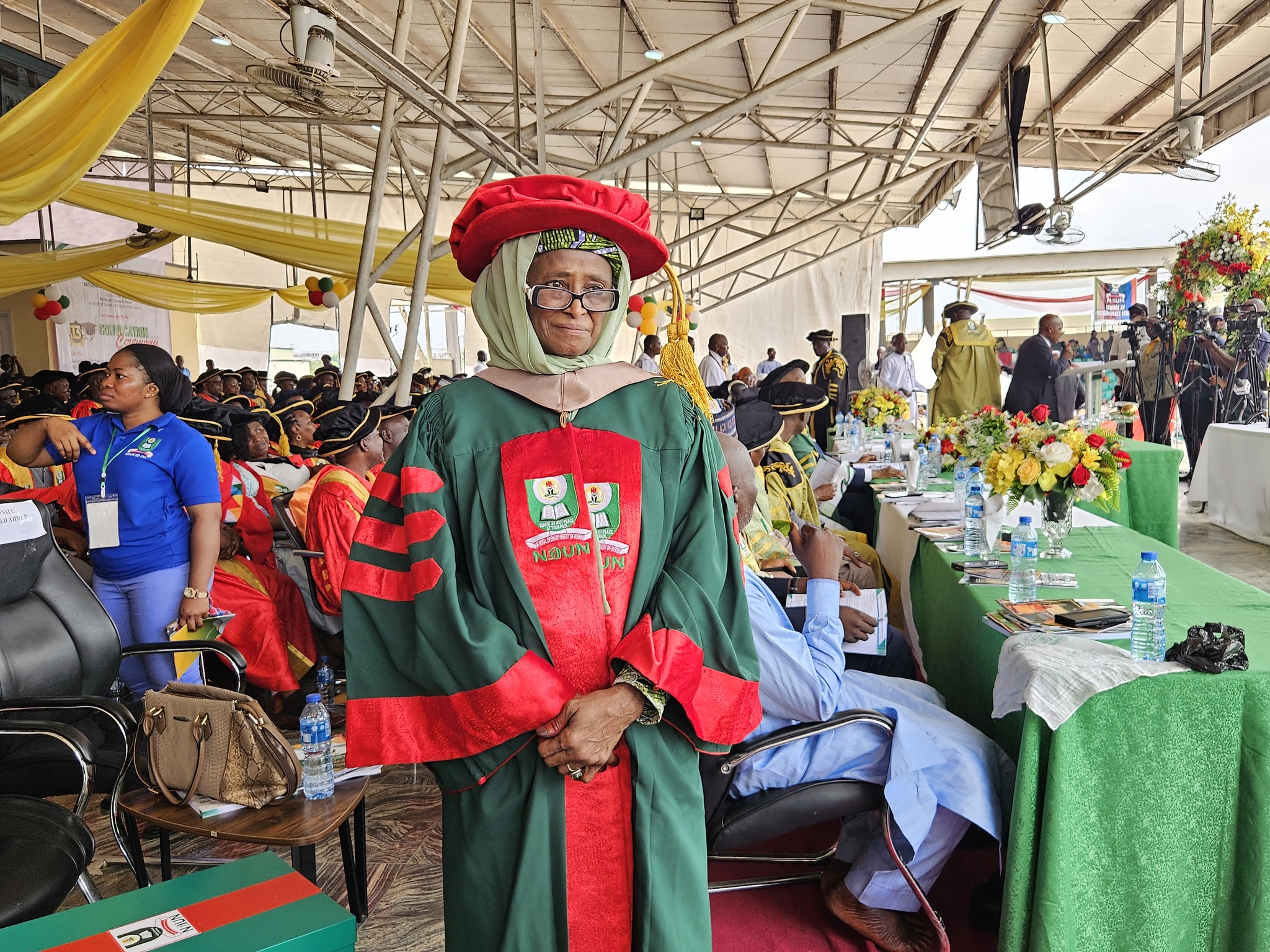
She has done it again. She first did it in 1974/80. In 2024, she repeated it. The feat that no female northern Nigerian has ever performed. Hajiya Hafsatu Abdul Waheed (b. 1952, Kano, northern Nigeria) was the first woman creative fiction writer from northern Nigeria to be published in any language, although hers was in Hausa.

On 13th April 2024, she became the first female Muslim northern Nigerian to be honoured with D.Litt. (Honoris Causa “for the sake of the honour”) doctorate degree from a no less institution than the biggest online university in Africa, the National Open University of Nigeria (NOUN). This was at the 13th Convocation Ceremony of the university held on 13th April 2024 in Abuja, the main headquarters of the university.

In a way, Ms. AbdulWaheed represents a paradox. She is not Hausa or Hausa-Fulani. She is Fulani, pure and simple. She learnt Hausa only outside her family home, in school, but at home, it was Fulfulde all the way. Yet her creative writing has always been in Hausa, with the exception of one book of poetry in English and the recently published collection of short stories titled Sharo. Nothing in Fulfulde, though.

The common historical narrative on literary development in northern Nigeria was that a literary competition to encourage the reading culture among Hausa youth was organized by the Northern Nigerian Publishing Corporation (NNPC) in 1978. One of the entries, which was also one of the winners, was “So Aljannar Duniya” by Hafsatu Abdul Waheed. It was in the Hausa language. However, it would appear, according to Hafsatu herself, that she wrote the novel in 1972, and it was published in 1974.

It was, quite simply, the most radical novel in Hausa literary history. Even “Ƙarshen Alewa Ƙasa” by Bature Gagare (who died in 2002), an unconventional novel, , published in 1982 (as a result of a literary competition organized by the then Federal Department of Culture, Ministry of Social Welfare and Culture) did not come close. Curiously, they contrasted each other. Gagare’s novel is about the lost glory of the ‘original’ Hausa people—the Maguzawa. Hafsatu’s novel is about breaking the Pulaaku—the Fulani code of behaviour. Both Hafsatu and Gagare became spokespersons of their ethnicities.

So Aljannar Duniya is brash, bold, audacious, trenchant, and unapologetic. It is a declaration of war against Pulaaku. It was unarguably the first Fulani feminist tract written in Hausa. Hafsatu’s style and critique of tradition might be compared with those of Bilkisu Salisu Ahmed Funtuwa and Balaraba Ramat Yakubu. However, there are quite a few differences.

Despite its pioneering boldness, So Aljannar Duniya is difficult to read. Perhaps that was because the author started writing it while still in secondary school! Its narrative is often jumbled and non-linear. Understandable. It was written in anger, so words tend to wobble, but the message is clear. This is more so because it is ethnographic. Hafsatu wove a story around her sister, of course, a Fulani, who had every intention of marrying an ‘alien’—an Arab from Libya. So Aljannar Duniya is, therefore, a true story, spiced up by fictional elements to convey a message. As I said before, it is a feminist tract.

Balaraba Rama Yakubu, however, writes in a deeply engaging mature and absorptive style with plenty of hooks. For instance, “Wa Zai Auri Jahila?”, which I consider her best novel, is dark and deeply disturbing narrative of what in contemporary feminist Woke world would be considered an injustice to women, especially young girls in a traditional African society.

Although Novian Whitsitt, who did his PhD on Balaraba’s novels, referred to it as ‘feminist’ I disagreed with him. I labelled her works ‘womanist’, after Alice Walker’s short story, ‘Coming Apart’ (1979). As explained elsewhere, “a womanist is committed to the survival of both males and females and desires a world where men and women can coexist while maintaining their cultural distinctiveness.” This inclusion of men provides women with an opportunity to address gender oppression without directly attacking men (Adamu 2003). Balaraba reflects this in her novels, especially “Alhaki Kwikuyo” (translated by Aliyu Kamal and published by Blaft Books in India). Can’t say much about Bilkisu Funtuwa’s books, though, as I have never read any.

But Hafsatu AbdulWaheed is a feminist—at least as portrayed in So Aljannar Duniya. The plot revolves around a young Fulani lady who wants to marry an ‘alien’ (Arab) from Libya. In real life, Hafsatu’s elder sister. Their parents rejected the idea. The plot of the novel does away with the Fulani Pulaaku and introduces a brash, assertive, loud and anti-establishment heroine, Boɗaɗo, who, armed with a degree in Pharmaceutical Sciences, comes back to her village to set up a drug store (called Chemists in Nigeria, a bit like Walgreens) and introduces her fiancé—all un-lady like behaviours in the Fulani mindset.

Thus, she discards the Fulani munyal (self-control), semteende (modesty) and hakkillo (wisdom)—central components of Pulaaku—and declares, openly, her love for an “alien” in her auntie’s presence! The opening dialogue from the novel sets the pace in which Boɗaɗo, speaking, informs her aunt:

(Hau) Aure! Inna ni fa na gaya muku ba zan auri kowa ba sai wanda nake so. Kun san zamani ya sake.

(trans) Marriage! Aunty, I have told you that I will only marry the man I love. You know times have changed.

Such direct confrontation in a Fulani village was uncommon and reflects the author’s autobiographical rebellion against tradition. Her aunt—delegated to mediate in these matters on behalf of the protagonist’s mother—is shocked. As she lamented:

(Hau) Mhm! Wannan zamani, Allah Ya saukaka. Yarinya ki zauna kina zancen auren ki, sai ka ce hirar nono da mai. Don haka fa ba ma son sa ɗiyar mu makarantar boko. In kun yi karatu sai ku ce kun fi kowa. Me kuka ɗauke mu ne?

(trans) Mhm. These are difficult times. May Allah save us. Listen to you talk about your marriage as if you are talking about milk and butter. That is why we don’t want to send our daughters to school. After you finish, you feel superior to everyone. What do you take us for?

A battleground and the rules of engagement have been established—female empowerment through education—and Hafsatu chose the most conservative arena: a Fulani settlement, considered generally more trenchant about Pulaaku than urban Fulani. Additionally, the novel’s subtext of rebellion against arranged and forced marriage underscores Hafsatu’s acerbic demand for personal choice in marital affairs by women. It was a template for rebellion.

Another contrast between Hafsatu’s So Aljannar Duniya and Balaraba’s Wai Zai Auri Jahila? is in the choice of careers. Hafsatu chose Pharmacy for her protagonist, while Balaraba made her own a nurse. Pharmacy was a profession in the period, and by making her character a pharmacist, she thrusts Boɗaɗo into a man’s world to compete equally with men. Balaraba, on the other hand, by making her character a nurse instead of a doctor, maintains the womanist ethos of an achieving woman in a male-dominated society, fitting in with career stereotypes of women in caring professions.

The success of So Aljannar Duniya sent a message to the budding Hausa literati to pick up their pens and set to work—thus spawning a genre which t revolutionized the Hausa literary landscape in contemporary times.. Furthermore, the combined effects of the harsh economic realities of the 1980s (the decade of military coups and counter-coups in Nigeria) ensured reduced parental responsibility in the martial affairs of their children. Therefore, fantasy, media parenting, especially Hindi films, anti-authority and a loud, persistent message from bursting testosterones in a conservative society that sees strict gender separation combined to present Hausa youth with soyayya (romance) as the central template for creative fiction. It was a safety valve to repressed sexuality.

Hafsatu’s radicalism, however, did not end at rebellion against arranged or forced marriage for women. At one stage she declared to run for the office of the Governor of Zamfara State. This was provoked by a statement by the sitting governor that there were no educated women in the state. To prove him wrong, she decided to campaign for his chair! She even made posters, but was asked by her father to stop. At least, she had made a statement. Furthermore, her real-life echoes Boɗaɗo’s—she was also married to an ‘alien’ from the Middle East (a Syrian). Incidentally, it was a marriage that took her to Gusau, the Zamfara State capital, and I had the pleasure of meeting her late husband, Malam Ahmad Abdul Waheed, during a British Council “Intensities in Ten Cities” Islamophobia tour on 9th July 2003. Both Hafsatu and her husband were born and raised in Kano. It was his career that took them to Gusau.

In literary circles, she also has a voice. For one, she used to assiduously attend every single literary convention anywhere it was held. As part of ANA Kano activities, we were together in Niamey and Maraɗi in Niger Republic at various times to attend international conventions of Hausa writers. She never tired of attending and actively participating. Wonderful enough, she often went with her children and grandchildren, showing them the way. It is little wonder that some of these children became well-celebrated in their chosen professions—for they had a strong role model at home. A good example is her eldest daughter, Kadaria Ahmad, the award-winning journalist who owns and runs the NOW FM radio station in Lagos.

Thus, the recognition of the pioneering efforts of Hafsatu AbdulWaheed by the National Open University of Nigeria (NOUN) on 13th April 2024 during the university’s 13th Convocation was a salute not only to the resilience of feminist women but also to all Hausa language writers of both genders. As far as I know, she was the first female Muslim Fulani (or Hausa) writer to be so honoured by any university in Nigeria. She has, therefore, entered the history books. She is truly a woman of substance.

References.

Adamu, Abdalla Uba. “Parallel Worlds: Reflective Womanism in Balaraba Ramat Yakubu’s Ina Son Sa Haka.” JENDA: A Journal of Culture and African Women Studies, no. 4 (2003). https://bit.ly/3Q2gNlY.

Whitsitt, Novian. Kano Market Literature and the Construction of Hausa-Islamic Feminism A Contrast in Feminist Perspectives of Balaraba Ramat Yakubu and Bilkisu Ahmed Funtuwa. PhD dissertation, University of Wisconsin, 2000.