Fulani

Arewa Community Germany disowns Berlin “Hausa International Protest,” warns against divisive messaging

By Muhammad Sulaiman

The Arewa Community Germany has formally disassociated itself from a video circulating online about a so-called “Hausa International Protest” organised by Hausa Tsantsa Development Association, staged in Berlin.

In a letter addressed to Nigeria’s Consul General in Frankfurt, Ambassador Yakubu A. Dadu, the group said it had no role in organising or endorsing the demonstration and warned that the protest’s message conflicts with its core values.

The association, represented by Alhaji Tijani Garba, Dr. Ummah Aliyu Musa and Buhari Abubakar, stressed that it was founded on the principle of unity among all northern Nigerian peoples. It noted that Hausa, Fulani, Kanuri, Tiv, Nupe and other groups share a common heritage, adding that the organisation “does not draw lines” between northerners and will not support any activity that promotes ethnic profiling or elevates one group above another.

According to the statement, the Berlin protest risks fueling division and misunderstanding among Arewa communities in the diaspora, where the group says cohesion is especially important. The association reaffirmed its focus on cooperation, peaceful engagement and presenting a positive image of Northerners living in Germany.

The Arewa Community Germany also cautioned the public against linking its name to the protest, emphasising that any event involving the association will be announced through its official channels.

The group concluded by reaffirming its stance on harmony, mutual respect and a united Arewa identity.

Bashir Ahmad faults The Herd for “dangerous” stereotyping of Fulani herders

By Muhammad Abubakar

Former presidential aide Bashir Ahmad has criticised the newly released Netflix film The Herd, arguing that it reinforces harmful stereotypes about Fulani herders and the wider Arewa region. In a post shared on social media, Ahmad said the problem is not the film’s focus on banditry, which he acknowledged is a tragic reality, but its “dangerously inaccurate” portrayal of an entire ethnic group.

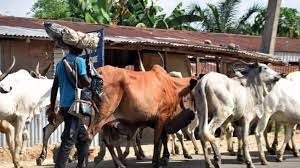
Ahmad pointed to a scene in the movie’s teaser in which herders suddenly pull out guns and abduct travellers, describing it as a misleading depiction that paints all Fulani herders as violent criminals. He stressed that while some bandits are indeed Fulani, the vast majority are innocent and among the worst affected by insecurity, having lost their cattle, livelihoods and loved ones.

He warned that such portrayals in international films risk shaping global perceptions in damaging ways, fuelling suspicion and discrimination against innocent people. “That is how stigma is created,” he said, noting that millions of viewers may come to believe that every Fulani herder is a terrorist.

Ahmad faulted the filmmakers for failing to conduct adequate research or engage stakeholders, security experts, victims and pastoralist groups before tackling such a sensitive national issue. He also suggested that the Nigerian Film Corporation, led by Ali Nuhu, should have provided better guidance to avoid what he described as “damaging portrayals.”

He concluded by calling for responsible storytelling that condemns criminals without casting “a shadow of suspicion over millions of innocent herders,” warning that Nigeria’s fragile security situation should not be worsened by divisive media content.

Benue: The noise, the blood, and the silence that matter

By Oladoja M.O

Benue bleeds again. A recent massacre in Yelewata village, where at least 100 to 150 lives were claimed, cast a shadow over headlines, but smothered the deeper truth of decades-long sorrow. As images flash across social media in real time, outrage erupts. But near-instant outrage often substitutes for understanding. And in Benue, where tragedy is almost normalised, such performative empathy does more harm than good.

A Land on Fire, not for the First Time. This is not a one-off disaster. The roots go deep:

The 2001 Zaki‑Biam, where Nigerian soldiers massacred hundreds of Tiv civilians, razing villages in a brutal military reprisal, the 2016 Agatu Massacre, where more than 300, possibly up to 500, villagers were slaughtered during herders‑farmers clashes, leaving thousands displaced, the Odugbeho 2021, where suspected Fulani herders killed at least 40 residents in Agatu LGA, part of a continued wave of violence. In April 2022, over 25 were murdered in coordinated herder attacks on farming communities in Goma, up till this latest carnage, where victims were shot and burned in their homes, echoing a tragic pattern.

Between 2015 and March 2023 alone, 5,138 lives were lost across Benue in herder‑farmer attacks. Under President Buhari’s term, Benue became a killing field; 6,000 killed, 2 million displaced. The Humanitarian Crisis has been ongoing under the surface of fleeting headline moments.

The tragedy is not fodder for political stunts. The moment a video goes online, hashtags spiral: blaming the President, vilifying the government, and stirring political gain. But very few pause to ask: who suffers most in these cycles of condemnation? The dead do not return. The displaced families do not reclaim their farms. The real loss is in our silence, our unwillingness to grasp the whole before pointing fingers. Yes, government leaders, state and federal, bear responsibility.

The 2017 anti‑open grazing law in Benue was well-meaning. However, it remains a paper tiger: characterised by uneven enforcement, a lack of ranches, and feeble federal support. President Tinubu’s speeches and increased defence budgets amount to little on the ground when arms still flow, and security forces remain under-resourced. And when political opponents oversimplify the conflict as mere religious persecution or ethnic cleansing, nuance is lost.

At the heart of all these disputes is a struggle over scarce resources, including land, water, and natural resources, as well as grazing routes, which is exacerbated by climate change. Historically, grazing corridors existed. However, escalating population growth, farmland encroachment, and desertification have reduced these spaces. Compounding this: centuries-old migration, religious and ethnic tensions, cattle rustling, and political exclusion of Fulani groups. Each side bears accumulated grievances; farmers over burnt crops, herders over stolen cattle.

This is fundamentally communal, not merely political. Solutions must be rooted in non‑kinetic, non‑violent engagement. Dialogue tables must sit Fulani herders alongside Tiv farmers and local officials. Traditional leaders, ranchers, security services, and federal authorities must all negotiate a win-win framework, including grazing reserves, clear land-use maps, property rights enforcement, and swift justice for perpetrators. Yes, bring the perpetrators to book. Those profiting from killing, whether herders or cartels supplying arms, must face speedy consequences. However, we cannot rely solely on force. We need intelligence systems, community policing, and legal reform. We need peaceful co-management of land and water.

It’s time for Nigerians to shift from hashtag empathy to hard-won solidarity. Unleashing threads of blame on social media while clicking “share” does little for grieving widows or orphaned children. 

Recording a burn-out home instead of rescuing a trapped neighbor is the hallmark of a self‑absorbed age. 

Public discourse must evolve from political opportunism to intellectual empathy. From performance to purpose. When presidents speak, let’s demand substance: “Where are the ranches? Where is land‑use reform? Who funds security at the village level?”

We demand action, but not at the cost of conscience. We must hold leaders accountable while still listening. Civil society must stop yelling into empty rooms, and start negotiating into full ones.

A practical roadmap might include;

Reviving grazing reserves with clear boundaries, monitored jointly by local farmers and herders, enforcement of anti-grazing laws, backed with ranching incentives and federal support, swift prosecution of killers, with community courts supported by federal justice, strengthening local security, with trained village vigilantes under lawful guidelines. Climate adaptation, planting trees, building dams, restoring soil to reduce migration pressure, and, more importantly, promoting inter‑communal peace‑building through youth exchanges, shared markets, and local councils.

If Nigeria continues to allow Benue’s blood to stain its conscience, we’ll face another generation hardened by loss, distrust, and rage. A country that waits for television headlines before honouring its fallen has already forgotten them. Benue’s suffering needs more than outrage; it needs us: grounded, knowledgeable, purposeful. We must reject hollow political theatre and demand real solutions. Because beneath the noise and the blood, lies an entire community crying for justice, and silence is not an option.

Oladoja M.O writes from Abuja and can be reached at: mayokunmark@gmail.com.

The birth of Fufore Emirate in Adamawa State 

By Zayyad I. Muhammad

No emirate, its Emir’s stool, or palace comes into existence without the foundation of law and authority, coupled with the community’s request, acceptance, loyalty, and support. This straightforward process involves the people’s demand, legislative endorsement, and executive approval.

The creation of the two new emirates and five chiefdoms by Governor Ahmadu Umaru Fintiri was guided by two principles: first, the community’s request and demand, and second, the provisions of the Adamawa State Chiefs (Appointment and Deposition) Law 2024, which has been formally gazetted and is now part of the state’s statutory framework. Without this law, the governor would lack the power and legal authority to fulfil the community’s requests.

The Fufore Emirate was established based on the demands of the 12 districts and their people. For those suggesting that Gurin, Malabu, and Ribadu or any other districts were coerced into joining the Fufore Emirate, consider the example of Zumo and Song. They chose not to join the new Yungur Chiefdom and remained with the Adamawa Emirate, while Gurin, Malabu, and Ribadu opted to be with Fufore. It’s straightforward: in a democracy, you get what you ask for.

Governor Fintiri didn’t simply wake up one morning and declare, “Let there be Fufore Emirate,” and it came into existence. It was the product of requests, demands, negotiations, mutual understanding, and the backing of law and authority.

There is a popular saying that one cannot cry more than the bereaved. Up to this moment, most of the noise about the creation of the Fufore Emirate is coming from people outside the 12 districts.

None of the 12 districts—Ribadu, Daware, Bengo, Verre, Nyibango, Kofsopah, Malabu, Malabu Kofa, Mayoine, Gurin, Beti, and Wuro Sham.—has filed a petition or challenged the creation of the Fufore Emirate or their inclusion in it. In fact, the heads of all 12 districts were the first to pledge their allegiance and pay homage to the new Lamido of Fufore, His Royal Highness Alhaji Sani Ahmadu Ribadu.

On behalf of the 12 district heads, the District Head of Malabu was both emphatic and unwavering in his expression of loyalty and support for the new Emirate during the reception of the new Emir in Fufore.

The Fufore Emirate, like any other emirate in Nigeria, is a product of law—established by the Adamawa State House of Assembly and gazetted in Adamawa. The emergence of the new Fufore Emirate, its Emir, and the allegiance and support of all 12 district heads and their subjects are outcomes of law, clear legal provisions, government authority, negotiation, and the people’s requests and demands. These are the fundamentals of tradition, custom, and democracy. 

Let us allow the citizens, friends, and neighbours of the Fufore Emirate to celebrate, as this expansion of horizons will foster development and strengthen unity, prosperity, and peace.

Zayyad I. Muhammad writes from Abuja via zaymohd@yahoo.com.

The Fulani Identity: Tradition, misconception, and the truth

By Hassan Abdulkadir

The Fulani are traditionally a nomadic, pastoralist trading people across the dry hinterlands of their domain. They are the largest nomadic ethnic group in the world, inhabiting several territories over an area larger than the continental United States.

The Fulani follow a code of behaviour known as “PULAAKU,” which encompasses patience, self-control, discipline, prudence, modesty, respect for others (including foes), wisdom, foresight, personal responsibility, hospitality, courage, and hard work.

It wouldn’t be fair to judge an entire faith, religion, or tribe by the actions of a few aberrant individuals. It is more just to evaluate them based on the scriptures and teachings of the faith or the traditions and conventions of the tribe. 

History has shown that some of the greatest massacres committed on this planet were by individuals like Adolf Hitler, a European Jewish Christian. However, his actions were never equated with his religion or tribe. 

Similarly, Benito Mussolini and Menachem Begin, who were responsible for numerous atrocities, were not judged by their faith or tribe. Yet, when a single Fulani or Muslim individual commits an act of terrorism, the entire religion (Islam) or tribe (Fulani) is unjustly blamed.

Moreover, the most infuriating aspect of this situation is that many of these individuals are brainwashed and used by heartless people who are not Fulani. For example, videos circulating online vividly demonstrate this is true. In one instance, an arrested Fulani man explains how much the masterminds paid him after abducting someone. 

The amount given to the Fulani men is not even a quarter of the ransom collected, yet they are still blamed. It’s important to note that some of them are forced into this due to intimidation and life threats by the gangsters. These masterminds exploit the Fulani and Bedouins because they know the bush well. 

For God’s sake, as educated, wise, and prudent individuals, how can anyone believe that the people they consider inept could successfully carry out such complex operations without being caught? They can’t even perfectly operate phones. This is unfair. Such acts require logic, strategies, and prudence. However, due to biased perspectives, Nigerians are generalising the entire tribe instead of targeting the deceived and manipulated individuals among them.

Candidly, the truth must be trumpeted. When our southern brothers say “Hausa-Fulani,” they’re not referring to the tribe but to a Muslim or Northerner, whom they consider terrorists, bandits, and so on. Meanwhile, in some parts of the southern region of this country, there are places where humans are slaughtered like animals. Generalising the Fulani as bandits and terrorists is truly unfair and unjust.

All the calamities this country, especially the North, has been facing—such as insecurity, insurgency, banditry, terrorism, and critical hardship—are not due to the Fulani people but are the result of politics, business, and the selfishness of our unpatriotic and tyrannical politicians.

I urge the youth to be patriotic, equip themselves with adequate and pure knowledge, and engage in politics. The rich also have a crucial role to play by sponsoring these energetic youths in politics for the betterment of our country and for the coming generations to flourish.

May Nigeria prosper and thrive, amin.

Hassan Abdulkadir wrote via hassanabdulqadeerabubakar@gmail.com.

From Ruga to Artificial Intelligence: A mother’s lexicon of love

By Prof. Abdalla Uba Adamu

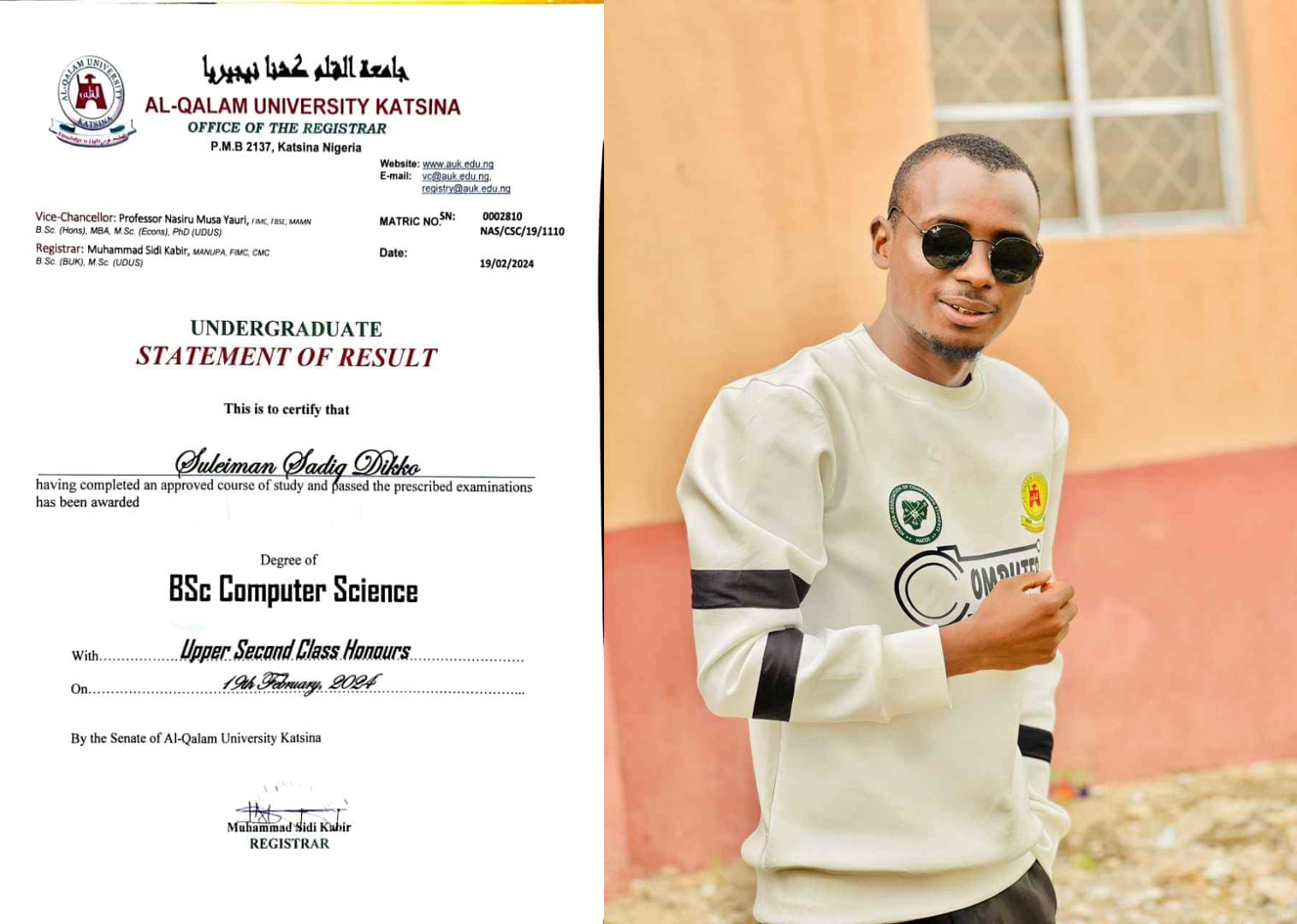
You might have remembered the post. March 8, 2023, to be precise. It was on International Women’s Day in 2023. It was about Sadiq, the fura hawker, and his wonderful mother, the fura seller at Bayero University, Kano. It was about love, faith, and sacrifice.

A simple Fulani woman sells fura so nourishing, fresh, and delicious that she could be given a slot in any restaurant at Harvard University—not the tree shade she occupies—and is often harassed at Bayero University. She does not sell fura because she needs the money. She sells it because she does not want to be idle. She is wealthy. Very wealthy. No mansions with a sea of workers at her beck and call. No fancy cars. No holiday retreats to the Seychelles. Simple meals. No crabs, oysters, lobsters, or caviar. No shopping in Paris and Dubai. Just cows. Many cows. Her lifeblood. She was willing to sell some of the cows to pay for her son’s education because, as a mother, she believed in him. She loves him and was willing to sacrifice her heritage—the cows—to ensure a sustainable future for him.

The son, Sadiq, has his head in the sky. He wants to fly, to be a pilot. The cost of the training at the Nigerian College of Aviation Technology, Zaria, in northern Nigeria, was more than ₦7 million. “No problem,” says the woman who lives in a hut with no electricity and draws her water from a well in a land that is not hers. “I can sell my cows for you to become a pilot.”

Unfortunately, Sadiq could not make the student pilot selection tests. Undeterred, she paid for his next choice—Computer Science at Al-Qalam University, Katsina, also in northern Nigeria. What made her a heroine was her sheer determination to see that he was educated. Human resource development at its most anthropological best—more sophisticated than the theories of Robert Owen, Charles Babbage, and Frederick Winslow Taylor, the credited proponents of the discipline. In this single but simple act of sacrifice, we see the power of love and the power of a woman who is not educated in any fancy school but the massive school of life. Yet, she knows, as a mother, the value of human capital development and is willing to sacrifice what she has to actualize it for her child.

At Al-Qalam, Sadiq was no slouch. His mother had sold a few cows to pay for his school fees for four years and also gave him spending money. He invested it in a fura business in Katsina—no doubt bringing Katsinawa the best fura they would ever taste from Kano! He did so to sustain himself throughout his college years without burdening his mother for upkeep money. He even employed some fellow students as his distributors. Extremely outspoken, he was the perfect candidate for the presidency of the Computer Science Students Association of the college, to which he ascended after being the Vice-President II of the association.

Back in Kano, he became a youth activist. He encouraged the formation of the Kano State Nomadic Fulɓe Youth Association in 2018. This was a coalition of all Fulani youth who had some form of education, especially higher education, and could therefore demand integration into society and better attention from politicians for their kraals. Ironically, considering that the power, hegemony, and control are actually in the hands of the Fulani—and have been so since 1807. This created a linguistic anomaly for the Fulɓe youth: those in power claim to be Fulɓe and although they have voices, they care less about Fulani causes. Those who speak Fulfulde and care more about Fulani causes are voiceless in the larger scheme of things.

Sadiq’s Fulɓe Youth felt the only way to gain attention to the plight of the Fulani was to align themselves with a political party. They chose a party not in power, the New Nigeria Peoples Party (NNPP), because they felt they would be listened to. Ironically, the All Progressives Congress (APC), which was in power, would have worked for them because of the “ability to speak Fulfulde” factor, since the then Governor of Kano, Dr. Abdullahi Umar Ganduje, is a genuine “I can speak Fulfulde” Fulɓe. But they chose the NNPP and its gubernatorial candidate, Eng. Abba Kabir Yusuf. They believed in him and devoted themselves to his cause.

During Engineer Abba Yusuf’s campaigns in 2019, a lyricist named Tijjani Gandu composed a political song for him titled, “Abba Gida Gida Abba”/Abba in every home. This actually became more or less Abba Kabir Yusuf’s nickname. With a catchy chorus and hook, it was perhaps the most iconic political song in Kano’s popular culture, even eclipsing “Kwankwaso Dawo Dawo”/ (Kwankwaso re-contest). Someone even had White kids somewhere in the US or Europe dancing to the chorus on social media!

Sadiq and Fulɓe Youth came up with a brilliant plan: map out all the Fulani kraals (Ruga) in Kano using their GPS coordinates in Google Maps to obtain data for easy access to the Fulani kraals (which he pluralizes as ‘Rugage’). Using satellite mapping, it would be relatively easy to determine access, population, and the level of development in each Ruga, which would be effective for campaigning, as well as for other uses—health and vaccination campaigns, schooling drives, etc. Next, the Fulɓe Youth under Sadiq came up with a slogan to campaign for Abba Kabir Yusuf: “Abba Ruga Ruga Abba,” deliberately rhyming with Abba Gida Gida Abba. They were even able to negotiate access to the man himself, i.e., Abba Kabir Yusuf. But it all came to naught.

Sadiq continued his studies, finishing in the autumn of 2023. Everyone knew he was excellent, and when Al-Qalam held a convocation ceremony last year for only First Class students, everyone who knew Sadiq expected him to be among those honored. Alas, it was not to be. However, Sadiq scored a Second Class Upper in Computer Science—perhaps a first for a fura hawker who lives in a kraal.

With such brilliant results in computer science and a committed social philosophy of uniting all Fulani youth in all kraals on a peace mission, it remains to be seen whether his mother’s sacrifice has been in vain. Being the son of a nobody, he lacks access to ‘big people’ who will give him a job. But Sadiq is not one to give up easily. His mind is too sharp, too restless to trudge from one office to another with a large brown envelope carrying his CV and looking for a job in futility.

I won’t be surprised if he uses these attributes to design an Artificial Intelligence routine that would perfect milk production—thus giving us better fura. Who knows? Harvard University might even invite him to open the first AI Restaurant in the world. Before then, as he faces his NYSC in May 2024, it would be a shame to waste his organizational skills. SA on Fulbe Youth? Why not? After all, the kraals also need development and attention—and not only during elections either.

Sadiq is what he is now—a unique, proud, hardworking, and brilliant Fulɓe youth advocate—because of his mother’s love and dedication. An ordinary mother, not the daughter of a “big man” or “important people,” just ordinary, but with an extraordinary commitment to love and sacrifice—and without being a social parasite.

Allah’s blessings for eternity to all mothers of the world on this day of re-embrace of Sadiq’s mother and her lexicon of love.

Prof. Abdalla Uba Adamu can be contacted via auadamu@yahoo.com.

Miyetti Allah vigilante group as a potential disaster

By Professor Abdussamad Jibia 

Those of us from Jibia LGA of Katsina state have been mourning for the past ten days. Last week, bandits launched an attack on the Kukar Babangida community of Jibia LGA. The infamous guests had visited Kukar Babangida many times, but this is probably the worst. They killed the ward head, Alhaji Haruna, along with nine others. 

Kukar Babangida is located about 15 kilometres from Jibia on the Jibia-Katsina highway. It was called Kukar Zaure until sometime during the administration of General Babangida when he launched the annual tree-planting campaign at the village. On that occasion, the then Emir of Katsina, Alhaji Muhammad Kabir Usman, renamed it Kukar Babangida. Of course, for a local community to be validly renamed, it must have the blessing of the emirate. In its case, Kukar Zaure was renamed by the Emir himself. The annual tree planting campaign was a very good practice of military regimes that politicians have abandoned for no apparent good reasons.

Magaji Zaure, which is his traditional title, refused to relocate to either Katsina or Jibia as many of his colleagues have done. He has always stated that abandoning his people and running away would be a breach of trust. This time around, he paid the supreme price. If you have been following my writeups for the past eight years, you would understand the kind of frustrations our communities have been subjected to with respect to insecurity. Lives have been lost, women and girls disgraced, people kidnapped for ransom, farmers displaced from their farmlands and communities occupied.

This introduction would only tell you how badly in need people like me are for a solution to the problem of insecurity. That is why my curiosity was piqued when I came across a video clip yesterday.

The clip, which is obviously a news item from a Hausa service of one of those big foreign radio stations, is about the launching of a vigilante group by the Miyetti Allah Kautal Hore Association. The activity, which took place in Nasarawa state, featured a parade by the new recruits in their uniform, a fashion parade by Fulani youth and an interview with the President of the Miyetti Allah group, one Alhaji Bello Abdullahi Bodijo. Very senior police officers also graced the occasion.

According to Alhaji Bodijo, the aim of establishing the group is to assist regular security forces to “peacefully” arrest criminals without killing the innocent. Asked whether or not they have obtained Government approval to establish the group, he only expressed hope that the Federal Government and its security forces would give them the necessary recognition. “We shall also help Nigerian Governors to tackle the problem of insecurity”. 

In Nasarawa state alone, Alhaji Bodijo stated they will recruit 4,000 members. First, they have already screened 2140 selected from different (Fulani) families. He promised to end the security problem in Nasarawa state in six months. While stating they have their traditional sticks, Alhaji Bodijo pledged to seek Government approval to obtain weapons allowed by law.

First, let me commend the Miyetti Allah group for their concern about the insecurity problem bedevilling Nigeria and, for the first time, admitting the contribution of their kinsmen to the problem. That most of the bandits operating in the North West and North Central states are Fulani is not debatable. This became well known during the time of Buhari when he directed Governors in the North West geopolitical zone to dialogue with bandits. All the bandits’ leaders that met with Governor Masari were Fulani, and they are well known, with some of them still moving unscathed even when the Federal Government is spending billions of Naira of taxpayers’ money on insecurity.

With the resolve and non-cowardly nature of Fulani, I do not doubt that if the all-Fulani group decide to face their criminal kinsmen, banditry will come to an end in a very short time. But are they ready to do it?

Miyetti Allah Kautel Hore group has itself been criticised for aiding and abetting criminality on several occasions. Perhaps the best known for this accusation is the immediate past Governor of Benue state. We can also recall that at a point in time, a Zamfara state commissioner of Police issued a warning to the Miyetti Allah group to bring an end to banditry in the state or face the wrath of the law.

The tone of Alhaji Bodijo does not suggest that the Miyetti Allah group is ready to face the criminal elements among their kinsmen, fire for fire. In fact, he mentioned the name of a hardened criminal in the North West and stated that they are ready to partner with people like him to end insecurity. But Alhaji Bodijo has a reply for me if he wants it. What is news about partnering with bandits if the Government, with its security forces and an obligation to protect lives and property, has dialogued with them several times? 

But come. Why Nasarawa state? Does the Governor have any interest in the new Miyetti Allah project? Politicians can be unpredictable. Many of them have been accused of using ethnic militia for their political agenda. Governor Abdullahi Sule should come clean on this.

Or does the Nasarawa project have anything to do with the “innocent” herdsmen killed by the military sometime in 2022? We are aware that the Horijo, Mallam Sanusi Lamido Sanusi, visited both President Buhari and President Tinubu to seek compensation for his tribesmen even though he has never done so with respect to the many innocent people killed by criminals suspected to be of Fulani descent. How are we sure that this project is not about revenge?

Assuming revenge is not the first idea. If an incident like the one in question happens again, can we rule out a confrontation between an armed Miyetti Allah vigilante group and the Nigerian Air Force? If the group has branches in all states of the Federation or at least the Northern states, would that not be a major disaster?

By the way, this is Nigeria, a multiethnic and multireligious nation. Any security outfit to be recognised by the Government at the state or Federal level must not be ethnically biased. While Fulani herdsmen (Fulanin daji as they are called) have a very good knowledge of the forest because of the nature of their occupation, the collaborators of forest-based bandits are usually hidden in the cities. The victims of banditry are mostly people in the villages, and they can tell the different ways in which bandits attack.  All these mean that an unbiased vigilante group must be composed of different categories of people, not just people with knowledge of the forest.

My advice for MACBAN is to modify their approach. Reach out to other interest groups and form an all-inclusive vigilante group. Government should do the screening with inputs from Miyetti Allah Kautel Hore and other law-abiding groups. 

Recognising the new group without modification is a potential disaster for Nigeria.

Professor Abdussamad Umar Jibia wrote from Kano. He can be reached via aujibia@gmail.com.

FUYODA condemns attacks on innocent Fulani commuters by Birom terrorists in Heipang

By Muhammad Idris

The attention of the Association of Fulbe Youths Development Association, Plateau State, under the leadership of AY Umar has been drawn to an unfortunate incident that took place at Heipang Village (located at Plateau State Airport) Barikin Ladi Local Government Area on Sunday 06/08/2023 between the hours of 7pm and 8pm.

Facts at our disposal reveals that some criminals gangs strongly believed to be from Birom Armed Militias groups attacked and killed the innocent FULANI Citizens while they were returning home from the popular cattle market in Bukuru, Jos South, LGA, Plateau state.

Victims of the incident were Umar (adult ‘m’ from Barikin ladi) who was killed and Yakubu (adult ‘m’) from Bokkos sustained gun shot injury and currently receiving treatment in hospital.

Moreso, Yusuf Bibbi (20yrs) and Abdulrahman Bibbi were also ambushed around KwallDistrict of Bassa LGA, when they were going to fetch water for domestic use about 7:00Pm, on Monday 7th August 2023. Both of them sustained enjury and they are receiving medical treatment.

Similarly, another attack was carried out on innocent fulani commuters while returning from the same cattle sometimes in June 2023, involved in the incident were Muazu Aliyu (adult from Barkin), Aminu Goma from Barkin were wounded and one other killed.

Few days later another Fulani commuters were attacked in the same area while coming back from the same market.

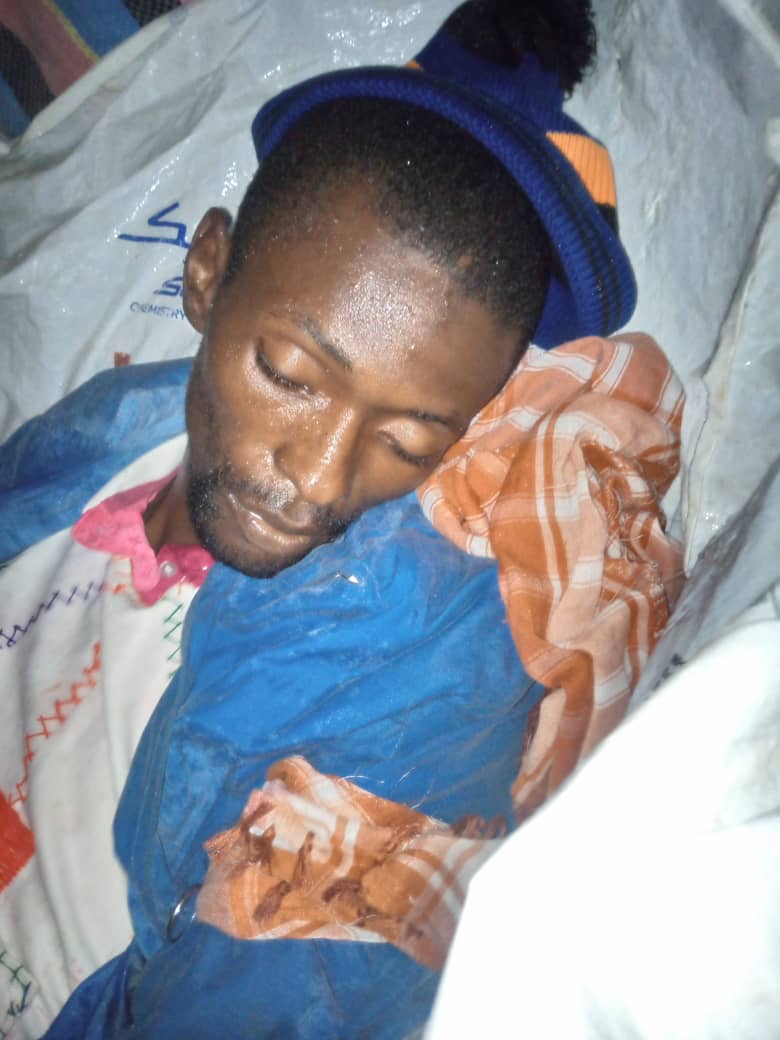
Furthermore, one Alhaji Auwalu Shanono of Barkin Ladi was murdered on his way to inspect his herds on Sunday 16th April 2023 by the same armed men suspected to be Berom militias in between Plateau State Polytechnic and Airport, Barkin Ladi, Plateau state. His dead body was recovered with about 10 bullets wounds on it and his bike stolen away. All these were reported to security agencies including the Police and Operation Safe Heaven and all promised were make to take serious action but nothing was done to date while the trend continued not mitigated.

This Association has noticed that, this unprovoked act of criminality has been in practiced for decades although was tackled by former Commader Sector Seven Barkin Ladi when he took necessary security measures around the area sometimes in 2018.

While drawing the attention of all stakeholders, The President Federal Republic of Nigeria, Plateau state Government, the media, international organisations and observers, civil society organisations, religious leaders, Christians Association of Nigeria,(CAN) Jamaatul Nasrul Islam (JNI), Miyetti Allah Kautal Hore, Miyetti Cattle Breeders Association of Nigeria (MACBAN), TABITAL PULAAKU International, FUDECO, that this incident has resurged and is going on unabated in a time when state Government and security agencies have told the world that all necessary measures have been taken to bring lasting peace on the Plateau state.

It is in view of the above we urged the above mentioned stakeholders and any other interested party to note this developments and further requests as a matter of urgency fetch out the killers in Hipang.

To share more light on the trend is that these Birom Militias gangs do used to pin down on the Federal road Junction of Hipang community fully armed and thereby shut on citing any car carrying Fulani men on the road.

We therefore called on the plateau state Government to act on the issues of security, so that peace shall return to the Plateau state.

We wish to reaffirm that pastoralists are bonafide citizens of Nigeria and Plateau state and hence deserve the protection of their lives and properties as enshrined in the constitution of the Federal Republic of Nigeria and International convention and treaties, United Nations and African Union and ECOWAS treaties for the protection of rights of persons and their properties.

We also wish to call on the Fulani youths to show calmness, resilience and eschew all forms of taking the law into their hands and as well have faith that the government will take necessary action in curtailing this trend.

We further wish to state that the enemies of peace should be aware that Fulanis are Nigerians and citizens of Plateau state and therefore, no amount of blackmail and intimidation will make them leave their homes. The ethnic cleansing and profiling that had been ongoing against the Fulanis in the cover story of terrorists to derail the truth in the Plateau must be stopped as a matter of urgency to forestall further breakdown of law and order across the state.

As an association, we reaffirm our unalloyed loyalty to the federal Republic of Nigeria.

Muhammad Idris
FOYUDA Publicity Secretary
08/08/2023.

Majma’al Bahrain: Arabs in Kano II – the sequel

By Prof. Abdalla Uba Adamu

My posting about MU Adamu’s 1968 paper on the influence of Arabs on Kano culture, economy and religious practices has ignited a few responses of personal nature from some readers interested in their own interconnected life stories. This is a follow-up and update.

I think it is wonderful that we begin to interrogate our past so that we can appreciate our present in order to make better plans for the future. We were all besotted with this implausible concept of ‘Hausa-Fulani’ that we tend to ignore other genetic tributaries that constitute the Hausa genetic pool, especially in Kano. Such Majma’al Bahrain is either unknown to many or ignored. Bringing it out means that the ethnic picture of the Hausa is more than the mingling of the Fulani genes with the Hausa – there were dashes of Arab in there thrown for good measure.

For the most part, the Arab voices had been silent. I think it is time for them to voice out their life histories in conversations with their elders. Not to further divide a monolithic Hausa society but demonstrate how the Hausa have been developing into distinct, absorptive people. Clearly, then Hausa is not a language but a people. Ask any individual in Kano with ‘Fulani’ or ‘Arab’ ancestorial roots, and they will tell you they are Hausa, ‘even though my grandmother is Fulani/Arab/Russian/Greek, etc.’

Let’s split hairs here. Having different languages but the same skin colour – whether you are black, white, brown, yellow or (if an alien) green, and submitting to the same central, national governing authority makes you ‘ethnic’. Having the same attributes but without recognition of national authority, only blood and kinship ties make you ‘tribal’. Separation across skin colour is a race, not an ethnic issue. Arabs are a separate race from Africans. So, what happens when the racial divide is crossed (bred)? Will a new ‘race’ emerge?

The Arabs’ contributions to the economy and culture of Kano are far more than any other ethnic group, including the Fulani. Consider the Yemeni alone and their massive contributions to the animal skin trade in northern Nigeria. Initially ‘imported’ as Italian trade agents from Yemen in the early 20th century, they have now become domesticated to the Hausa society. Yes, they are light-skinned, and quite a few speak Arabic; but the mid-generations have lost the Arabic language. As a ‘minority’ group, they intermarried with local African women and their offspring contributed to the sustainable development of culture and life in Hausa societies without the consciousness of being ‘the other’. What are then the cultural specificities that tie them to the Arab world? Can it be in dress, language, food, existential rites and rituals (birth, living, death)? How do theirs – if at all present – differ from those of the Hausa?

Then consider the Lebanese and their input into the goods and products found in various Kano markets – including their influence all over West Africa. They are less integrative with their African hosts but have been linguistically domesticated, and for all intents and purposes, many self-identify as Hausa and retain some living rituals (e.g., food habits). This is an area initially mapped out by Sabo Albasu’s monumental groundbreaking research, “The Lebanese in Kano” (which is based on his 1989 doctoral thesis), and unfortunately, not much else was done on such a scale by other people. I wish he could update and re-print it, as now, more than ever, is the time for it.

The Sudanese, more than the other Arabs, had integrated more effectively into northern Nigerian Hausa communities, perhaps due to the gradation in their skin colours – from extremely dark to extremely light – than either the Tripolitanians, Yemeni, Lebanese or Syrians/Jordanians, whose clearly light skins made them stand out in any group. Establishing themselves in the city of Kano at Sudawa (Sudanese settlement), they formed part of the identity of the Kano city populace.

The Sudanese influence was also more intellectual. While they were instrumental in trade, their main contribution was in education. For instance, when the School for Arabic Studies – undoubtedly the Oxford of Arabic Studies in Nigeria – was established in 1934, it was to Sudan that inspiration was sought, including the teachers. Even what later became Bayero University Kano was first headed by Abdullahi el-Tayyeb, a Sudanese. No talk of Sudan itself being a destination for studies at all levels by northern Nigerians. You don’t see such rush for education in Lebanon or Yemen.

While rummaging through the caverns of an old abandoned hard drive, I came across a booklet that Kantoma (Muhammad Uba Adamu) had asked me to extract from his “Confluences and Influences” as a standalone paper (presented in 1998) and later with additional material, as a booklet. We named it “The Presence of Arabs in Kano”. Lack of funding prevented its publication, but I was able to get it published as a paper in a book project. A link to the paper is given at the end of this posting.

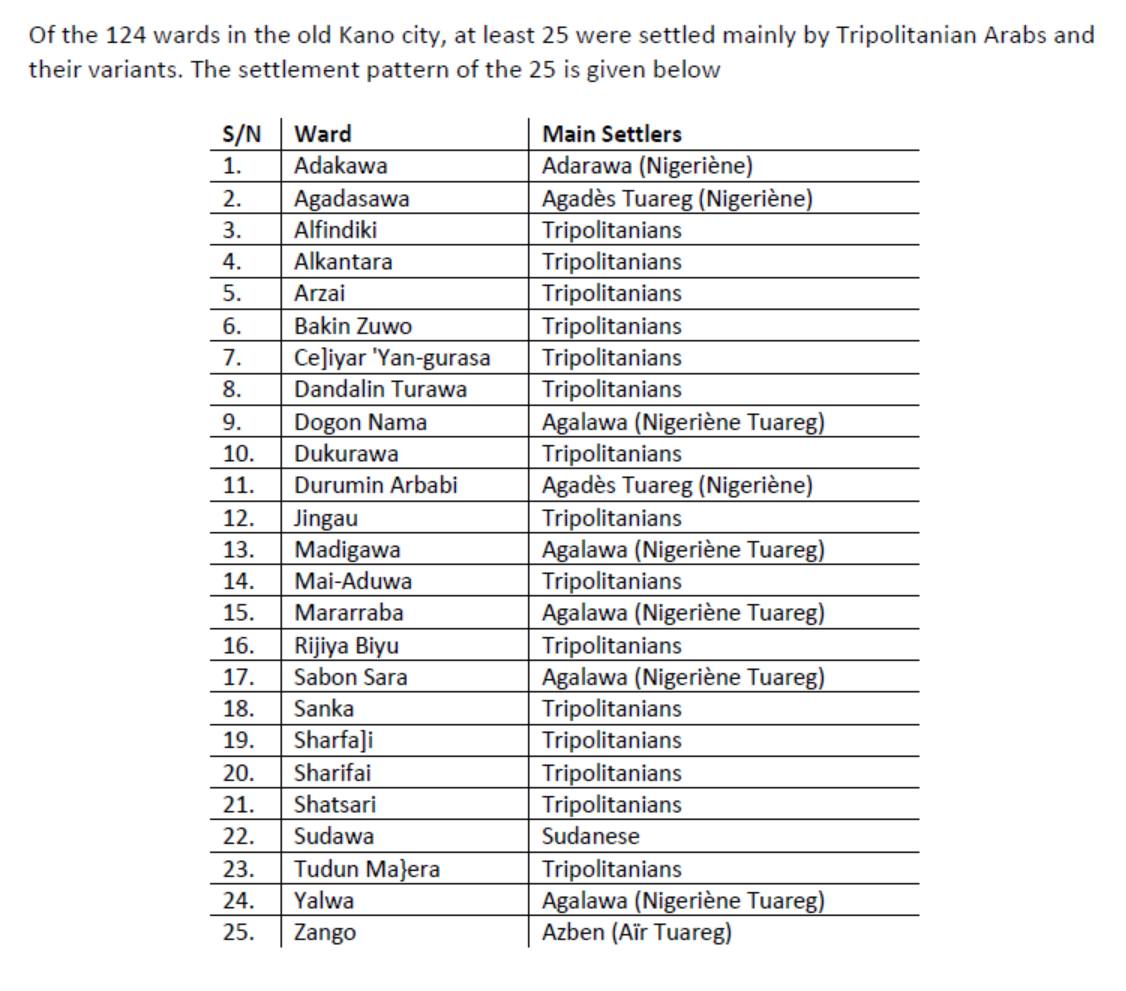
For those interested, I have included the table (from the paper attached) of the 25 Arab-dominated Kano inner city wards. I did this because not many would have the time to read 43 pages of the paper!

Adamu, Abdalla Uba. 2014. The presence of Arabs in Kano. In A.I. Tanko & S. B. Momole (Eds.). Kano: Environment, Society and Development (pp. 125-164). London & Abuja: Adonis & Abbey Publishers.

Or: https://shorturl.at/dgzW0

On Southern Nigeria’s selective outrage

By Suleiman Ahmed

In Nigeria, an election period is like watching a classic Series for the umpteenth time. You know how it’s going to play out, but it doesn’t make it any less fascinating. The most entertaining episode, of this Series, after the presidential election, of course, is the debate leading up to the Lagos gubernatorial election.

Firstly, the Yorubas must perform a ritual of agonisingly re-iterating the exact same thing: that Lagos is not a “no man’s land.” This is quickly followed by an outcry from the non-Yoruba, Lagos-based (mostly southern) Nigerians. They argue that, as Nigerians, every inch of land in the country, belongs to all Nigerians. That any attempt to deprive them of this right is ethnic bigotry. But how true is this? And do they practise what they preach? Let’s go down memory lane.

A few years ago, when the federal government suggested to some (southern) state governors to provide grazing lands to cattle farmers (who’re predominantly Fulanis) to grow their herds; to control herder-farmer clashes in parts of the country, many of the governors rejected this proposal. (Mostly) Southern Nigerians also took to social media to applaud the governors for refusing fellow Nigerians access to Nigerian lands.

Dangerous words like “invaders” and “take over” were recklessly deployed to stoke ethnic tension. No one cared to remember that these people, too, were Nigerians and therefore were entitled to own land and do business anywhere in Nigeria.

Now, in 2023, it’s election time again, and this same divisive rhetoric is being deployed, albeit in different circumstances. The same people who once championed an anti-Fulani campaign that ensured their fellow countrymen from the north couldn’t get lands in their own country are now complaining of being othered by Yorubas in Lagos. So, I’m asking: why is it ok for them to own lands and freely do businesses, have some influence on who becomes governor in “another man’s land,” but at the same time, see no contradiction in telling northern Muslim cattle farmers to return to the north, to look for land, because “the south does not belong to them?” Why are you concerned that the Fulanis “will take over your land” but are now getting triggered because the Yoruba people feel the same way towards you?

They wanted the land for free

When I first shared my thoughts on this topic on my Facebook Page, some interlocutors argued that the reason for the southern governor’s pushback was that the federal government wanted the land free of charge.

“Free,” in this context, is debatable. When an industry such as cattle farming wants the land for its activities, it’s not usually a mere hectare or two. A reasonable size would be hundreds to thousands of hectares. The size and complexity of such a project is not something private individuals can execute without support from the government.

Therefore, it was not out of order for the federal government to step in to help with things like making the land available and then building the infrastructure needed for the place to function properly. After which interested parties can be invited to come in and rent/buy spaces to set up shop. These farmers were clearly going to pay taxes to local authorities and generally operate the same way market stall owners do in places like Kano, Lagos or Aba.

Having said that, let’s say, for the sake of argument, I agree that the federal government wanted the state government to give “free” land to the cattle farmers; why was the response not: “bring more money!” Or “let’s have a better financial agreement?” We didn’t hear of any such request — of a better (financial) offer, from the southern governors. Instead, what we got from them, and many southern Nigerians, were: “the Fulanis should go back to the north and ask for land there,” “this is a plan by the Fulani government to take over our land and hand it over to their people,” and many other unpleasant, divisive comments. The protest from the south was a clear message to those cattle farmers from the north. It was made known, loud and clear, that their land was in the north and not in the south. What happened to being a Nigerian citizen with full rights anywhere in Nigeria?

We can’t be comfortable with othering and divisive languages when it involves the Fulanis and then suddenly become appalled when they’re deployed against a different group of people. It doesn’t work that way. We cannot, on the one hand, say things like Idoma land, Ijaw land, Tiv land, Igbo land, or Niger Delta land (or Niger Delta oil) and then throw tantrums when Yoruba people say Lagos is Yoruba land. You’re clearly not appalled at any injustice. You’re only now concerned because you are at the receiving end of it. What you’re practising is Selective Outrage (apologies to Chris Rock), and it is hypocritical.

Suleiman Ahmed is a writer and the author of the socio-political novel, Trouble in Valhalla. He tweets from @sule365.