EFCC

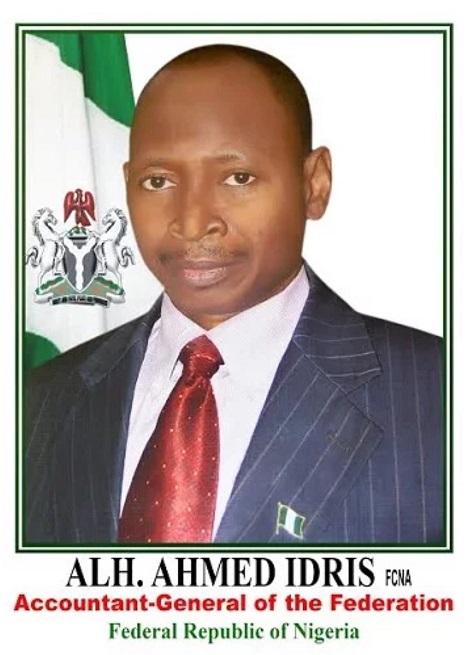
FG suspends Ahmed Idris as Accountant General

By Uzair Adam Imam 

The Federal Government has suspended the Accountant General of the Federation, Mr Ahmed Idris, over the allegations by the Economic and Financial Crimes Commission (EFCC) for laundering over N80 billion.

The Minister of Finance, Budget and National Planning, Mrs Zainab Ahmed, disclosed this in a statement signed Wednesday, May 18th, 2022.

The statement read in part, “following your recent arrest by the Economic and Financial Crimes Commission (EFCC) of allegations of diversion of funds and money laundering, I write to convey your suspension from work without pay effective 18th May 2022.

“This is to allow proper and unhindered investigation into the serious allegations in line with Public Service Rules 030406.”

The Daily Reality reported that Idris was arrested by the EFCC over N80billion fraud Monday, May 16th 2022.

Just In: EFCC nabs Nigeria’s accountant-general

By Muhammad Sabiu

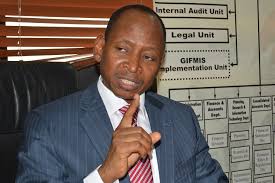
Ahmed Idris, Nigeria’s Accountant-General, has reportedly been arrested on suspicion of money laundering and misappropriation of state monies.

According to sources familiar with the situation, Mr Idris was apprehended in Kano by men of the Economic and Financial Crimes Commission (EFCC) on Monday evening and is being taken to Abuja, Nigeria’s capital, for questioning.

According to sources who spoke with news reporters, the EFCC has been looking into a case of at least N80 billion in public funds being diverted through fake contracts.

According to investigators, the firms utilized to launder the monies were linked to family members and acquaintances of the accountant-general.

Mr. Idris, who was appointed by President Buhari on June 25, 2015, was said to have been avoiding honouring a series of invitations from the anti-graft agency.

The source was quoted as saying, “We kept inviting him but he kept dodging us. We were left with no choice than [sic] to keep him under watch and arrest him.”

However, the spokesperson for the EFCC did not comment on the matter as he could not be reached.

EFCC probes political parties’ finances, seeks INEC’s assistance

By Muhammad Sabiu

The Economic and Financial Crimes Commission (EFCC) has begun a quiet probe into the finances of the country’s 18 political parties and presidential candidates.

This came after applicants vying for various political posts in the parties paid exorbitant fees for expressions of interest and nomination papers.

As a result, in a letter, with reference number CB.3383/EFCC/HOPS/HQ/VOL.1/28, titled, ‘Investigation activities’,  the anti-corruption organization has requested that the Independent National Electoral Commission provide it with the bank accounts and other financial information of political parties.

It also demanded that the managing directors of Access Bank and Polaris Bank disclose information on the 14 accounts held by the All Progressives Congress, the Peoples Democratic Party, and another group suspected of being linked to the opposition party.

The ruling APC sold presidential forms for N100 million, while the main opposition party sold them for N40 million. In addition, APC governorship candidates paid N50 million, while those declaring for the Senate, House of Representatives, and state legislatures paid N20 million, N10 million, and N2 million, respectively, for their nomination and declaration of interest forms.

The PDP, on the other hand, sold gubernatorial forms for N21 million, Senate forms for N3.5 million, House of Representatives forms for N2.5 million, and state Houses of Assembly forms for N600,000.

While the minor parties paid lower rates for their forms, many Nigerians were outraged by the hefty nomination fees required by the two leading parties, which Transparency International described as a kind of money laundering.

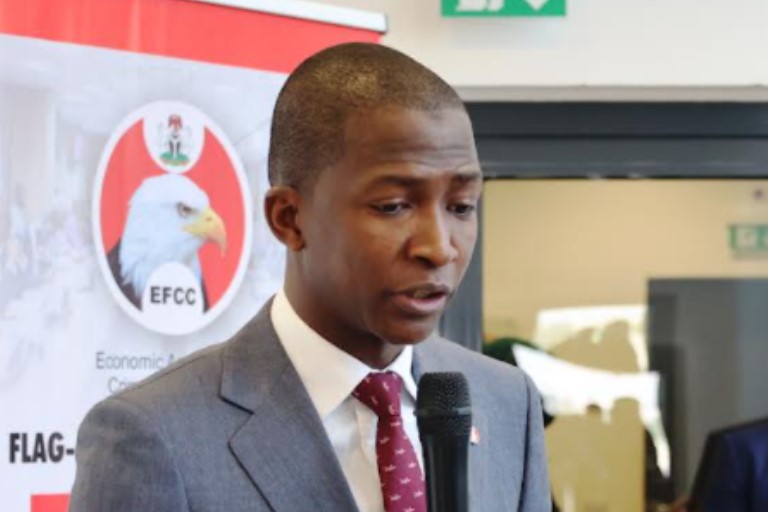
Last week, on Channels Television’s Politics Today, EFCC Chairman Abdulrasheed Bawa hinted that the agency will monitor campaign finances, particularly the authenticity of monies used to acquire nomination forms ahead of the 2023 general elections.

Navy handed 13 suspected oil thieves in Port Harcourt to EFCC

Ibrahim Nasidi Saal

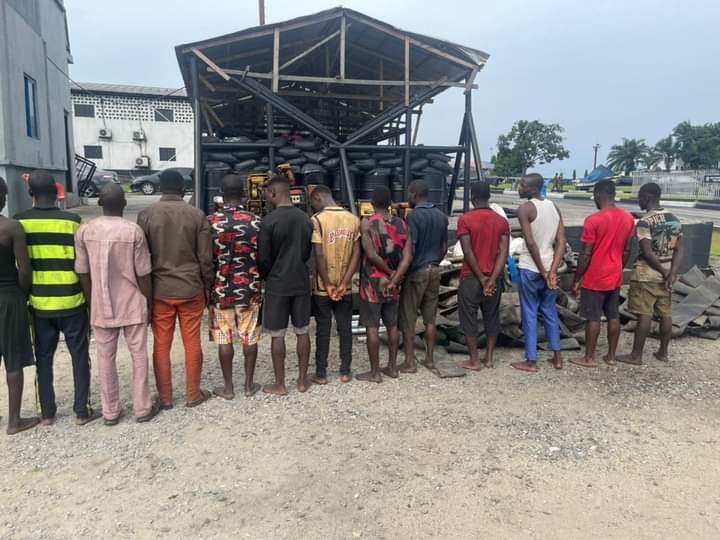
Operatives of the Port Harcourt’s Zonal Command of the Economic and Financial Crime Commission, EFCC, have commenced an investigation of 13 suspected oil thieves handed over to it by the Nigerian Navy.

The suspects were handed over Wednesday, May 4, 2022, by the Nigerian Naval Ship, NNS Pathfinder, Rumuolumeni, Port Harcourt, Rivers State, for allegedly dealing in petroleum products without appropriate licences.

The suspects are Goodnews Wilfred, Gabriel Awadis, Monday Anja, Sylvanus Benson, Timothy Rufus, Appolos Awajis, Tombari Lede, Ebirene Ebirene, Friday Aaron, Ataije Ebirene, Ibrahiim Attah, Shuaibu Magaji and Odeon Emmanuel.

Court jails internet fraudster in Abuja

By Ibrahim Nasidi Saal

Justice M.N. Mayana of the Federal Capital Territory, FCT, High Court Abuja, has convicted and sentenced Daniel Prosper Nwabueze to one-year imprisonment for a romance scam.

Nwabueze was arraigned on a one-count charge bordering on impersonation. That is contrary to Section 320(b) of the Penal Code, Laws of the Federation (Abuja), 1990 and punishable under Section 322 of the same Laws.

Nwabueze pleaded guilty to the charge.

Based on his plea, prosecution counsel, Joyce Audu, prayed the court to convict and sentence him accordingly. However, defence counsel: Anoture Akpofure and Rachel Ogbebor pleaded that the court temper justice with mercy “as the accused is a first-time offender and has shown remorse”.

Border Patrol Team hands over suspects arrested with $285,000, CFA18.9m to EFCC

By  Ibrahim Nasidi Saal

The Joint Border Patrol Team, comprising Nigerian security operatives, on Thursday, April 28, 2022, handed over the duo of Ismail Ajibade and John Adewumi, a Beninoise, arrested with $285,000 (Two Hundred and Eighty-five Thousand Dollars) and CFA 18, 925,000 (Eighteen Million Nine Hundred and Twenty-five CFA) to the EFCC, for further investigation and possible prosecution. 

The suspects were arrested on April 15, 2022, by officers of the JBPT whilst on a routine patrol along the Ilashe/Ihambo axis of Ogun State. 

While handing over the suspects, A. Adamu, who led the team, said Ajibade, who is a driver, received the foreign currencies from one Taiwo Hassan in Ogun State.

Adamu added that Ajibade was on his way to convey the same to Adewumi, who had been directed to deliver the monies to one Oladimeji in the Benin Republic when they were intercepted. 

Wanted Nigerian church founder arrested by EFCC over wire fraud

By Muhammad Sabiu

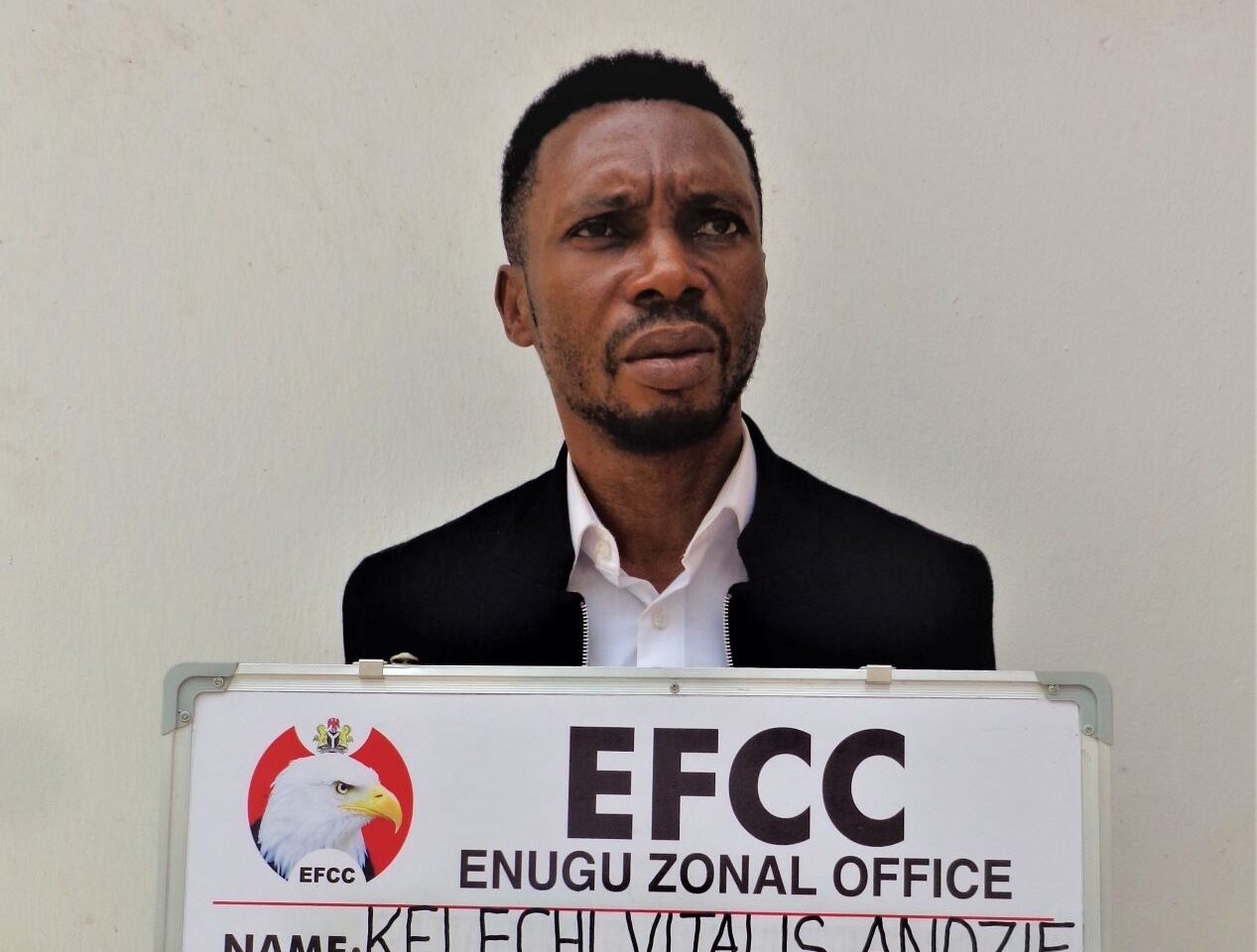
The founding pastor of Praying City Church in Owerri, Imo State’s capital, Kelechi Vitalis Anozie, has been detained by the Economic and Financial Crimes Commission (EFCC).

The suspect, who was said to have been nabbed on March 10, 2022, is on the Federal Bureau of Investigation’s watch list in the United States (FBI).

Anozie was apprehended after intelligence linked him to criminal conspiracy, wire fraud, and money laundering, according to EFCC spokesman Wilson Uwujaren.

Valentine Iro, Ekene Ekechukwu (alias Ogedi Power), Bright Azubuike (alias Bright Bauer Azubuike), and Ifeanyi Junior are alleged to have collaborated with Anozie.

EFCC partners with NYSC to fight corruption

By Ahmed Deedat Zakaria

The Economic and Financial Crimes Commission (EFCC) signed a Memorandum of Understanding with the National Youth Service Corps (NYSC). The MoU aims at a partnership that combats financial crimes. 

The EFCC Chairman, Abdulrashid Bawa, received the Director-General of NYSC, Major-General Shuaibu Ibrahim, at the EFCC headquarters in Abuja on Monday, February 21, where the MoU was signed. 

Addressing the audience at the event, Mr Bawa said the document is important as it will guide the two agencies on what is expected of them.

“We are delighted to have you. NYSC has been part of us from the beginning, as we have always had the opportunity of welcoming corps members to help us in one area or another where we have gaps in our staff, even though the sensitivity of what we do requires trained officers, but they are actually helping us a lot,” he said.

Bawa also commended the role of corps members in the fight against corruption.

“Corps members are agents of enlightenment. I want to assure you that our collaboration will address fraudulent acts, and I assure you that we will continue to sensitize members of the public on the dangers of corruption,” he said.

On the other hand, Ibrahim asked for the support of EFCC in arresting online scammers attempting to defraud unsuspecting Corps Members and the public. 

“All of us have to fight corruption for the sake of our country, and I can assure you that the NYSC will play its part as enshrined in the MoU,” he said.

EFCC arraigns lawyer for fraud

By Ahmad Deedat Zakari


The Economic and Financial Crimes Commission, EFCC, arraigns a female lawyer for money laundering.


The lawyer, identified as Anumati Stella Ojojevwe, was arraigned before Hon. Justice Okon Abang of the Federal High Court, Warri on Monday.
The EFCC disclosed this on their verified Facebook account.


According to the EFCC, ” Ojevwe was arraigned on a 14-count charge of money laundering. The defendant is alleged to have received the sum of 105, 000, 000 ( One Hundred and Five Million) from SA-FX Global Investment.”

Designing a New Nigeria: On governance and cultural considerations

By A.F. Sesay

When we talk of politicians, we speak about them like aliens or spirits from the evil forest. People came with their own beliefs, attitudes, approaches to life, and different perspectives on divine justice and the torture in Hell. We talk of them like we do of cold, callous people whose race is bent on inflicting the greatest damage possible on the human race. But wait…who are these politicians?

Let’s keep the answer in the brain and move on to something urgent: the design of governance experience. Do we see this as something we all could do better? Should leaders and followers look at governance from the lens of user experience design? I think they should!

If every product, starting from the Constitution to the Curriculum, was designed with the people they will affect in mind. I am sure the outcomes would be different. Hardly anybody is going to look at the current Constitution and Curriculum and say: Yes, these were designed with empathy, love and responsiveness to the needs of the citizens.

If the guy who presses the button at the Electricity House has the empathy to think that somebody is going out of business with every touch of the red button, a baby is dying in the hospital, an investor is packing his bag to leave Nigeria for good, a boy is missing vital lessons because he can no longer cope with doing his assignment in the dark, a family is exposing their lives to carbon monoxide generated by generators and so on.  If he had ever approached his work like a user experience designer, many problems could have been solved by now.

If the northerner or southerner stealing from the public treasury realizes that with every kobo stolen, a citizen dies and that this corruption-induced death is agnostic of region, religion or tribe, we wouldn’t need an Economic and Financial Crimes Commission (EFCC). Likewise, if every contractor realized that every badly-designed road is a graveyard for his fellow citizens, then potholes will become history.

If every Nigerian who had the opportunity to lead ten people or more or even less realized that these micro leadership tasks are a microcosm of the overall leadership output of the nation, then the nation’s leaders will be as upright as we want them. Suppose every employer knew that every right violated is the beginning of bad governance. In that case, the next commander-in-chief will make it a personal duty to provide the enabling ground for every citizen to thrive.


When every day becomes a reminder of the responsibility we all have as leaders in our various capacities, we will witness the birth of the ‘beautyful ones’ (apologies to Armah). There will be thoughtful and resourceful leaders in every cranny on the road to building a great nation.  


If every young person on Twitter and Facebook knew that every tweet or post could potentially destroy a life, fake news would be reduced to the barest minimum, even if it looks like a “catching cruise”. If every journalist knew that every fake report opens bigger wounds and increases the pain point of his readers, then nobody would invest millions in fact-checking. As a result, we all would have had less cause to verify the news and have fewer regrets for sharing harmful and divisive content.

We will be mentally ready to ask the right questions when we start seeing this all as a design problem and not just some issues caused by aliens or foreign species. And let’s know that INEC cannot give us what culture has deprived us of.

While scratching the surface for the past 60 years has given some temporary relief, the question of how far have we come and how many more years can we afford this mediocrity in governance here and across the continent?


We have ousted leaders we hate too much. We have brought in our tribesmen and “starmen” to power and opened doors to stupendous wealth for kinsmen. But in truth, the problems have compounded. So, it’s not an election problem; it’s culture, design and system that we have to work on.

Talking alone won’t win us good leaders. In the same vein, we can’t insult the elected into good governance. They have to want to. And the only way that happens is vision and a culture that makes it difficult for people to be bad at the top.

At the mention of Nigeria, everybody becomes an expert. But most of these experts only hit the surface, compounding the problem with false claims, unverified and alternative truths, faulty assumptions, stereotypes, bigotry, and received “wisdom”.

We have got to wake up and smell the coffee. There is a design problem out here. Until we are heavy on researching root causes and being genuinely interested in knowing all the whys of the problem, until we see ourselves beyond the just-a-citizen mindsets to the mindset of restless inventors, these problems are only growing bigger and more complex regardless of who is at the top.

We have to build a research culture and replace that with false assumptions and stereotypes. Until we see the governance products of today as collective input of everybody who played a role, no matter how little, until the people in power (from Local Government to Federal Government)  create a mechanism to capture feedback and continual improvement regularly, we will still have to come to these basics many years later.

Go to the archives and read headlines of the 70s and 80s and compare them to today’s headlines. You will observe a pattern that will shock you. In short, the design process is faulty, but we are finding it difficult to rethink the process because thinking itself will require an effort that we are not yet ready for.

A.F. Sesay sent this article via amarasesay.amir@gmail.com.