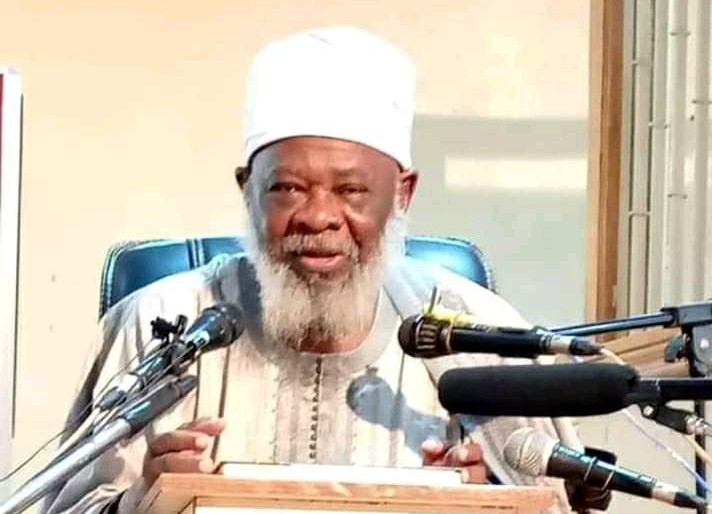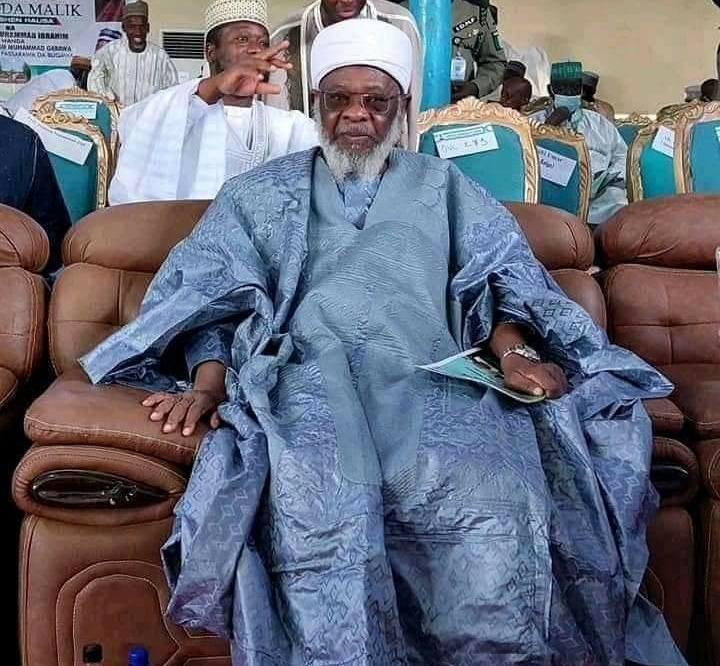
Reminiscences of Dr Ahmad Bamba BUK
Professor Salisu Shehu
حَدَّثَنَا إِسْمَاعِيلُ بْنُ أَبِي أُوَيْسٍ، قَالَ حَدَّثَنِي مَالِكٌ، عَنْ هِشَامِ بْنِ عُرْوَةَ، عَنْ أَبِيهِ، عَنْ عَبْدِ اللَّهِ بْنِ عَمْرِو بْنِ الْعَاصِ، قَالَ سَمِعْتُ رَسُولَ اللَّهِ صلى الله عليه وسلم يَقُولُ ” إِنَّ اللَّهَ لاَ يَقْبِضُ الْعِلْمَ انْتِزَاعًا، يَنْتَزِعُهُ مِنَ الْعِبَادِ، وَلَكِنْ يَقْبِضُ الْعِلْمَ بِقَبْضِ الْعُلَمَاءِ، حَتَّى إِذَا لَمْ يُبْقِ عَالِمًا، اتَّخَذَ النَّاسُ رُءُوسًا جُهَّالاً فَسُئِلُوا، فَأَفْتَوْا بِغَيْرِ عِلْمٍ، فَضَلُّوا وَأَضَلُّوا “. قَالَ الْفِرَبْرِيُّ حَدَّثَنَا عَبَّاسٌ قَالَ حَدَّثَنَا قُتَيْبَةُ حَدَّثَنَا جَرِيرٌ عَنْ هِشَامٍ نَحْوَهُ.
Narrated `Abdullah bin `Amr bin Al-`As:
“I heard Allah’s Apostle saying, “Allah does not take away the knowledge, by taking it away from (the hearts of) the people, but takes it away by the death of the religious learned men till when none of the (religious learned men) remains, people will take as their leaders ignorant persons who when consulted will give their verdict without knowledge. So they will go astray and will lead the people astray.”
My first sight of Dr. Ahmad Bamba was 37 years ago in 1984 in the UMMAH MOSQUE at the Old Campus, Bayero University, Kano where I just got registered as a pre-degree student and had begun to familiarize and acclimatize with the people, routines, events and the environment in the University. Although the Central Mosque in Bayero University, Kano would always be the first sight of any visitor or newly arriving student to the University, having been strategically located near the Main Gate, the Ummah Mosque may be the first place of worship for the new resident (on-campus) student because, in its own case, it is sandwiched between the hostels and the two major and oldest Faculties of the University- The Faculty of Arts and Islamic Studies ( FAIS) and the Faculty of Education. Because of its lively nature and vibrancy-series of nasihas, ta’alims, Qur’anic study circles and Tajweed, Arabic classes and even sometimes, very hot intra-faith dialogues and debates that may sometimes prolong from Isha to Fajr Prayer time, the Ummah Mosque, therefore, would always easily capture every newly arriving young Muslim student who might have arrived the University full of curiosity as well as, enthusiasm and zeal to learn. We, therefore, easily got hooked up to the Ummah Mosque. We would only be seen at the Central Mosque, most surely on Fridays for the Jumu’ah prayer.
It was quite rare to see non-students’ faces at the Ummah Mosque except during Zuhr and Asr prayers when some visitors and some lecturers might be around to join the congregation. There was, however, a non-student face that was very familiar in the Ummah Mosque most especially, during Zuhr prayer and seldom during Maghrib. That was Dr. Ahmad Muhammad Ibrahim Bamba. He would certainly be the first lecturer students that used to regularly attend congregational prayer in the Ummah Mosque would be familiar with because of his regular presence. Of course, another very regular face was Professor M. D.Sulaiman of the History Department. As it were, and as earlier stated, the Mosque was very close to the Faculty of Arts and Islamic Studies where Dr. Ahmad belonged. He would easily come down to join the students’ prayer congregation and there was never an instance that he made any attempt or overtures to lead the prayer or say a word. The nasihas, the ta’alims, and sometimes the debates would be taking place in his presence and to his hearing but he would not utter a word. The situation in the Mosque could actually sometimes be rancorous but it would never stop him from coming. He would, certainly, however, observe his nawafil, and would make his way out. I had a feeling but was unable to ask him, that perhaps his regularity in the Ummah Mosque was not just for the purpose of observing the regular prayer but also to keep close contact and relationship with the students for the purposes of Tarbiyyah h. It was later when I became an Imam in the mosque that I realized that he used to invite or approach imams/leaders in the Mosque to make corrections politely or offer some advice/suggestions, as the case may be.
My first countenance of Dr. Ahmad in the Ummah Mosque reminded me of my first IRK Teacher in the Teachers’ College -Sheikh Yahya Abdul’Azeez, a fully bearded Pakistani Sheikh who was to teach me again –Kitab al -Tauheed, Bulugh al-Maram and Al-Nahwu al-Wadhih in Gwallaga Mosque in Bauchi in 1984, after he transferred his services to Bauchi College of Arts and Science (BACAS). That was shortly before I got admission into Bayero University, Kano. The two were the two fully bearded Sheikhs I first met in life. On my first sight of Sheikh Dr. Ahmad in the Ummah Mosque, the memories of Sheikh Yahya Abdul’Azeez suddenly came back to my mind. At that time, Sheikh Dr. Ahmad was certainly in his late 40s while I was just beginning the third decade (early twenties) of my life as a young undergrad. More strikingly, however, the sights of the two gentlemen present to the heart a mien of piety that sometimes made you think of the countenances of the Sahaba, or so we used to think as young people that still had some elements of naivety in our thoughts.
Our admiration of Sheikh Dr. Ahmad was ceaseless whenever he came and prayed with us in the Ummah Mosque and left. But our interaction with him was no more than the Salam and typically, he would wave at you and made his way out or extend his hand for a shake when you happened to be very close to him. The first time I ever had a conversation with him or heard him spoke to me was when I was appointed as an Imam in the Mosque, which was later to become my class where I taught Tajweed for about three years up to graduation in 1988. I was certainly the youngest of the Imams, a second deputy after Sheikh Sani from Zaria. With the benefit of early background in Qur’anic learning from home, one’s mastery, so to say, of reading the Qur’an could easily be discovered. So, right from my first year I got appointed as one of the deputy Imams. The substantive Imam then, was the late Malam Usman Muhammad, the Chief Imam of Laranto, Jos, who was undergoing the Diploma in Arabic, Hausa and Islamic Studies.
Still, with the vestiges of adolescent exuberance and obsession for a fashionable and smart appearance, my wardrobe had more of the fashionable shirts and trousers of the time (TOBI shirts/jeans and HARA trousers) than kaftans. Invariably, therefore, the Imam in me would most of the time lead prayers in the said kinds of fashionable shirts and trousers in the Ummah Mosque. I led the Maghrib prayer one day. After the prayer, Sheikh Dr. Ahmad Bamba called me and held my hand to the outside of the Mosque. In his typical gentle manner and way he said, “Liman, yaya kokari”. I replied, “Alhamdulillah”, with a mix of exciting and nervous mien. He then said to me, “Toh liman ga karatu mai kyau, amma kuma kullum ana mana sallah kai babu hula?”. With a sigh of relief, I said , ” Na Gode Mallam, in sha Allah, za a gyara.”. It was both an awesome and joyful moment for me. But what was most instructive was the fact that that simple and gentle counsel not only made me appreciate that I was no longer just an ordinary student on campus but I was treading the path of spiritual leaders, it also changed my life in terms of personal dispositions and appearance on campus and beyond.
A second experience with Sheikh Dr. Ahmad Bamba made me a witness to his magnanimity. It was in the case of attending his Hadith class for students offering Islamic Studies as Special Honours. I was not one, so I could not register for that course. I offered Islamic Studies as a subsidiary course, but I was interested in attending his Special or rather advanced Hadith class. All my friends and classmates- Professor Salihu Lawal Malumfashi (present Dean of the School of Continuing Education and one of the Darul Hadith Imams), Alhaji Bashir Sheshe (now a Permanent Secretary, Ministry of the Federal Capital Territory, Abuja), Dr. Ahmad Maigari Dutisin -ma (Department of Islamic Studies, Usmanu Dan Fodiyo University, Sokoto), Professor Usman Sani Abbas (Department of Islamic Studies, BUK) to mention just a few were all encouraging me to just enter the class and that they were sure Malam would not send me out. On the second or third lecture day, I joined some of these mates while being very scary. I sat in the class with some bit of nervousness. Sheikh entered the class, conducted his lesson and alhamdulillah, he did not send me out. He definitely saw me, and he definitely knew that I was not duly registered for that course because it was a small class of fewer than 15 students. Later, I want to believe that one of those classmates of mine approached him and spoke to him about me, and Malam graciously permitted. By virtue of my Imamship in Ummah Mosque, I was already a familiar face to him. With a deep sense of appreciation, I must say that that opportunity was my first experience with not only some of the basic and essential rudiments of Ilm al-Hadith but was also the greatest inspiration for deeper and more advanced study of the field.
After graduation in 1988 and having left for the national youth service scheme to far away Bendel State (now Edo and Delta) I did not only cease to benefit from the Special Hadith class of Sheikh Dr. Ahmad but also lost sight of him for about a couple of years. I got intellectually and personally reconnected with him when I returned to Bayero University, Kano in 1991. I came back to pursue Masters in Educational Psychology. Graciously, that presented yet another opportunity for, in a way, to continue to drink from the fountain of the knowledge of Hadith that Sheikh Dr. Ahmad Bamba personified. That was the year Sheikh Dr. Ahmad Bamba started his very awesome, weekly/weekend Hadith Ta’alim Sessions, beginning with Sahih al-Bukhari in the BUK Central Mosque and subsequently Darul Hadith Mosque, a teaching cum admonishment exercise that he continued to conduct uninterruptedly with a great sense of passion, vigour, consistency and rare faith and commitment for THIRTY (30) SOLID YEARS up to the end of his life. Although I was not chanced to be present at the first and second sessions, I would want to remember that I was there in the third session.
In the Hadith Ta’alim Sessions, we did not only learn the texts of the Hadiths and elements of Mastalahul Hadith but we also learnt to be much more committed to Sunnah in terms of faith and practice. Quite instructively also, we learnt lots and lots and lots of the Aqwal ( wise or sayings) of the salafs, many aspects of Usul al-Fiqh (Islamic Jurisprudence), Qaw’id al-Fiqh (Jurisprudential principles and maxims) and many Islamic religious and Jahiliyyah poetries (Qasa’id and Shu’ara’ al-Jahiliyyah). I would not, therefore, end this paragraph without recalling one stanza of a poem that Sheikh Dr. Bamba used to quote very frequently, in his constant admonishment on the obligation to hold and cling tenaciously to the Sunnah of the Prophet (صلي الله عليه وسلم). That is: “دعوا كل قول عند قول محمد فما ءامن في دينه كمغامر
It would be pertinent to mention here, perhaps also to inform those who might not know that Sheikh Dr. Ahmad Bamba did not only contribute to the knowledge of Hadith through the Ta’alim Sessions. He also contributed to it through authorship. Within the first three years after the commencement of the Sahih al Bukhari lessons one of his very scholarly Hadith works was released. That was his Takhreej and Tahqeeq work on Imam al-Bukhari’s “Juz al-Qira’ah Khalf al-Imam. It was a book that I unhesitatingly bought a personal copy and ‘voraciously’ read cover to cover within a couple of days.
For Sheikh Dr. Ahmad Bamba, it was a life well spent. Thirty solid years of uninterrupted teaching the Hadiths of the Prophet (s.a.w) was not just a monumental intellectual and scholarly contribution but was evidence of true love of and for our Beloved Prophet Muhammad صلي الله عليه وسلم. This reminds me of the saying of one of the Hadith scholars, quoted by the late Sheikh Muhammad Nasiruddeen al–Albani in his Sifat Salat al-Nabiyy that: اهل الحديث هم اهل الرسول وان: لم يصحبوا نفسه أنفاسه صحبوا.
The death of our most honourable Sheikh Dr. Ahmad Muhammad Ibrahim Bamba is certainly a tragic loss to the world of knowledge and Da’awah as rightly and as clearly alluded to in the Hadith above, with which we opened this tribute. Our closing words would only be fervent and sincere and hearty prayers for him.
إنا لله وإنا إليه راجعون
إنَّ للهِ ما أخذ وله ما أعطى وكلُّ شيءٍ عنده بأجلٍ مسمًّى.
اللهم اغفر لدكتور احمد، وارفع درجتَه في المهديين، واخلفه في عقبه في الغابرين، واغفر لنا وله يا ربّ العالمين، وافسح له في قبره، ونوّر له فيه
وآخر دعوانا ان الحمد لله رب العالمين
All praise is due to Allah, Lord of the Worlds. May His Peace and Blessings be upon our Beloved Prophet Muhammad صلي الله عليه وسلم.