Dangote Cement

Dangote Cement surges with 15.2% Pan-African sales growth, record profits, unstoppable expansion

By Uzair Adam Imam

In the nine months leading up to September 30, 2023, Dangote Cement has reported a remarkable 15.2 percent increase in its pan-African sales volumes, reaching 8.5 million metric tons (Mt) compared to the 7.4 million Mt in the same period in 2022.

Pan-African volumes represent the sales volume from Dangote Cement plants located outside Nigeria.

These figures were revealed in the company’s unaudited results on the Nigerian Exchange (NGX) portal. The surge in volumes was primarily driven by exceptional sales performances in key locations.

The Dangote Cement Plant in Senegal saw a substantial 66.9 percent increase in sales, while the Dangote Cement Plant in Congo reported a 60.5 percent surge in volumes.

Dangote Cement Zambia experienced an 18 percent increase, with Ghana and South Africa following closely at 15.5 percent and 18.5 percent growth, respectively. Ethiopia and Tanzania also contributed to the positive trend with 6.5 percent sales volume increases.

Furthermore, Dangote Cement noted a 20.5 percent increase in profit before tax, rising from N335.9 billion to N404.89 billion, while the profit after tax increased by 30.2 percent, from N213.10 billion to N277.55 billion.

Arvind Pathak, the Chief Executive Officer of Dangote Cement, commented on the results, stating, “This positive nine-month result reflects our strong value proposition, enhanced operational efficiency, and our commitment to cost containment in the face of rising inflation. Group revenue reached ₦1,514.6 billion, with EBITDA reaching an all-time high of ₦662.8 billion, marking a
28.5 percent increase.”

He also highlighted the impressive growth of the company’s pan-African operations, which contributed 41.9 percent to Group volumes, with a record revenue growth of 103.9 percent and EBITDA growth of 255.4 percent.

Pathak emphasized that the growth was a result of sustained demand across the regions in which Dangote Cement operates.

Looking ahead, Pathak expressed optimism about the company’s future, particularly with
the final stages of a new grinding plant in Cote d’Ivoire nearing completion.

He reaffirmed the company’s commitment to delivering quality cement products to
its customers and expressed confidence in a strong finish to the year.

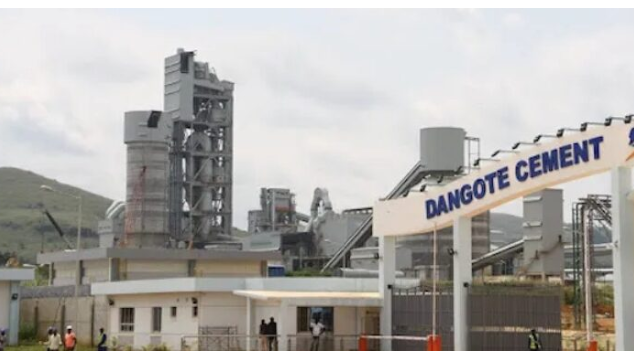
Dangote Cement is Africa’s leading cement producer with a capacity of 52.0 million metric tons across the continent. Through strategic investments, the company has not only eliminated Nigeria’s dependence on imported cement but has also transformed the nation into an exporter, serving neighboring countries as well.

Dangote Cement’s extensive operations include plants in Cameroon, Congo, Ghana, Ethiopia, Senegal, Sierra Leone, South Africa, Tanzania, and Zambia, in addition to its prominent presence in Nigeria.

Dangote Cement appoints new MD

By Aisar Fagge

The Dangote Cement Plc. has Thursday appointed Arvind Pathak as the group Managing Director with effect from 1st March, 2023.

The news was relayed to journalists in a corporate disclosure made available to the Nigerian Exchange Ltd. by Edward Imoedemhe, the company’s acting Secretary/General Counsel.

It was gathered that the Pathak appointment was prompted by the retirement of Michel Puchercos from from the group Managing Director/CEO.

The statement reads in part: “The appointment of Arvind Pathak will be included in the agenda at the next Annual General Meeting for ratification by the shareholders in accordance with the Companies and Allied Matters Act.

“The Board would like to thank Michel Puchercos for his commitment and contributions to the Board and wishes him well in his future endeavours, while welcoming Arvind Pathak back to the Dangote family and wishing him success in his new role,” the company said.

Before his appointment, Pathak worked as MD and CEO of Birla Corporation Ltd. and was described as the experienced and hardworking person.

It was gathered that Pathak is also the former Chief Operating Officer and Deputy Group Managing Director of Dangote Cement Plc.

Dangote cement trains 40 Kogi women on fashion design

By Aisar Fagge

There has been great excitement among women in Obajana community, Kogi State when no fewer than 40 women sponsored by Dangote Cement Plc. were graduated from skills acquisition training school on Thursday.

The women learnt fashion and design and were advised to be self-reliant on it.

The Daily Reality gathered that the training was meant to address the biting economic hardship prompted by job scarcity and unemployment in the country through job creation.

Mr JV Gungune, the Plant Director, of Dangote Cement Plc, Obajana, while speaking at the graduation ceremony, said, “even though the job creation scheme aptly fits into the company’s vision and mission, it cannot do it alone, nor can it employ everyone.”

He also pleaded with the beneficiaries to put the skills and equipment provided by the company into proper use, adding that the beneficiaries should count themselves lucky to have been selected and trained.

The women also expressed happiness and gratitude to the President of the Dangote Group, Alh. Aliko Dangote.

The traditional rulers of the various communities commended the company and described the development as a huge intervention.

Also speaking, his Royal Highness, the Olu-Apata, Oba Dr Frederick D.O. Balogun, expressed appreciation and pledged his community’s continuing support for the company.

Obajana (Dangote) plant invasion: Implications for public-private partnerships in Nigeria (II)

By Tordue Simon Targema

At a time like this, Public-Private Partnership is undoubtedly the surest blueprint for economic prosperity in Nigeria. This explains why Prince Abubakar Audu, the visionary Executive Governor of Kogi State in 2002 invited the Dangote Industries Ltd. to the State to partner on cement production, a venture that has been so far productive and economically rewarding to both the State and Dangote Industries Ltd., and indeed, Nigerians at large.

It thus smacks of apparent permittivity for the State Government to wake up today, over 20years after the deal was struck with Dangote Industries Ltd. and shut down the Company on the grounds of alleged illegal acquisition.

Apart from the physical damage that this dastardly act will incur the Company, it is also important to consider the bad signal it sends to prospective investors preparing to go into public-private partnerships with governments at all levels.

At the moment, calls are rife for governments in Nigeria to privatize moribund ventures and hands-off their operations in the interest of productivity. NNPC has just been privatised with the registration of the NNPCL, so also are calls for privatization of other assets that gulp billions in annual budgets without tangible results.

Yet, it is at a time like this that Governor Yahaya Bello and the Kogi State House of Assembly consider it most appropriate to wield their sledge hammer on Obajana Cement Company and shut it down in the most primitive manner possible.

A statement by the company’s management indicates that the invasion by armed vigilante groups has caused enormous damage on the plant ranging from physical destruction of the Company’s assets to wounding about 26 staff among other scores of incurred damages.

The report of death of a staff that was shot during the invasion cannot be substantiated at the moment, and appears as an exaggeration to attract public sympathy to the Company. It must be noted at this point that Dangote Industries Ltd. cannot be absolved completely of sharp practices in the course of its operations.

Just recently, the Benue State Internal Revenue Service shut down Dangote Cement Plant in Gboko due to the unwillingness of the Company to remit due taxes to Benue State. Like the current saga at Obajana, a war of words trended between State officials and the Company’s management over claims and counter claims regarding remittance of taxes.

Prior to the incident and until recently, the road around the plant was a terrible nightmare to commuters plying the busy Katsina Ala – Makurdi federal highway which leaves many wondering how serious Dangote Industries Ltd. is with its corporate social responsibility.

The road around Savannah Sugar Company in Numan, Adamawa State is equally a nightmare, so much such that commuters would always ask whether it is customary to Dangote companies to live roads around their plants terribly devastated.

A visit to Obajana where the cement factory is situated leaves one wondering if at all it hosts a company of that magnitude, as no meaningful development project commensurate to the company’s prestige can be spotted around.

One would have expected critical interventions of the Company in basic infrastructures of the town such as educational institutions, healthcare facilities, road networks, water and other critical infrastructure as part of the company’s compensation to the host community for the concomitant environmental effects occasioned by its operations.

This is not the case at Obajana which is but a glorified village remitting billions into Dangote’s coffers, even as Dangote Industries Ltd. is among the most renowned donors doing what one would regard as “Father Christmas” to places that it has no investments!

Another critical question worthy to ask pertains to who owns the remaining 10% of the Company’s shares due to Kogi State as provided in the agreement transferring ownership of the Company to Dangote Industries Ltd.

This question is crucial as the Company in its reaction to the invasion claimed 100% ownership of the plant, even as existing laws stipulate that a State is entitled to 10% equity shares of such investments within its domain, 5% of which belong to the indigenes while the remaining 5% to the State Government.

One must also be curious to ask if all taxes rightfully due to the Kogi State Government are being remitted as at when du. Recall the incident at the Gboko cement factory! These are critical questions that must be carefully interrogated as one wraps his head around the current crisis at Obajana.

Notwithstanding all these, however, given the strategic position of the Obajana cement factory in Nigeria’s economic sphere especially with regards to cement production, distribution and consumption, the consequences of shutting it down at the moment can best be imagined.

Consequently, it behoves on the State Government and management of the Company to shelve their swords and immediately return to the discussion table to resolve the crisis within the shortest possible time in the interest of all and sundry. It is worthy to note that Public-Private Partnership benefits all parties wherever it exists.

Kogi State Government and the Dangote Industries Ltd. should have known this better. In this regard, efforts must be made to strengthen existing partnerships and encourage new ones to emerge exponentially.

Individuals and groups going into such agreements with governments must, as a matter of necessity, exhibit the highest sense of responsibility by constantly dialoguing with government agents towards addressing all grey areas that might arise on a regular basis to ensure peace and tranquillity in the course of their operations.

In doing this, impunity and arrogance must be avoided and business operations must thrive purely based on mutual understanding and corporate best practices in line with existing legal frameworks.

In a similar way, governments going into agreements with private investors must be prepared to respect their fundamental rights and privileges, and must desist from all primitive and draconian acts that are capable of causing untold damage to such investments.

This is necessary if industrial harmony must be attained in jointly owned ventures for greater economic prosperity of Nigeria and her component states.

Tordue Simon Targema writes from the department of Journalism and Media Studies, Taraba State University, Jalingo. Email: torduesimon@gmail.com
Obajana (Dangote) plant invasion: Implications for public-private partnerships in Nigeria (I)

By Tordue Simon Targema

Last week, the Obajana Cement Plant came under siege by armed vigilante groups from the Kogi State Government, acting on the orders of the State House of Assembly who stormed the Company to seal it and ground its operations.

This was followed by war of words between the Kogi State Government and Dangote Industries Ltd. on the establishment, acquisition, ownership and legal rights of operations of the company.

The House of Assembly premised its decision to seal the Company over its management’s refusal to appear before a public hearing on petitions bothering on the acquisition of the Company by Dangote Industries Ltd. This, the House considered arrogant and hence, had to wield its sledge hammer on the Company to serve as deterrent to it, and indeed, other investors in the State.

Reports also indicate that the Company’s management had earlier shunned a Commission of Inquiry set up by the State Government to investigate petitions bothering on its acquisition and operations by Dangote Industries Ltd.

This scenario is unfortunate and regrettable, especially as Nigeria grapples with untold economic hardships and paucity of vibrant private companies that will provide adequate buffers to the nose-diving economy, create job opportunities and mop up the teaming jobless youth that have littered her streets today.

But the fundamental questions lingering on several minds since this crisis erupts, however, are: why did Dangote Industries Ltd. snub the Kogi State Government and House of Assembly, giving rise to this preventable misfortune? If Dangote Industries Ltd. is innocent of the allegations, why evade a Commission of Inquiry and a House of Assembly public hearing that would have provided the best platforms for the Company to exonerate itself?

Again, Why allow the crisis to degenerate to this level, despite the numerous warning signals? Does it mean that the Company operates without a proactive conflict management strategy to arrest this sort of obvious conflict prompters and nib them in the bud?

These questions continue to beg for answers, and have caused many to accuse the operators of Dangote Industries Ltd. of arrogance and blatant disregard to constituted authorities within their operational domains.

Beyond these, however, the behaviour of the Kogi State Government and its operatives suggest that someone somewhere wants to “cash out” from the Company, and has decided to use this brute invasion as the best means of actualising the selfish ambition. Yes, available records have provided sufficient proofs to this effect.

To start with, most of the claims contained in the report of the Commission of Inquiry chaired by the Head of Service to the State Government, Mrs. Folashade Ayoade are utterly mischievous and amusing.

The Committee, for instance, could neither interact with any of the four government representatives that interfaced with Dangote Industries Ltd. to transfer ownership of the Company from the State Government to Dangote in 2002, nor interact with the Company’s management team; yet, concluded its report and made damning recommendations based on selective documentary evidence!

Curiously, the agreement that facilitated transfer of the Company which was duly signed by the then Executive Governor of Kogi State, late Prince Abubakar Audu has been “invalidated” by the Committee on the grounds that it lacks “consideration” 20 years later!

To claim in 2022 that an agreement signed and implemented since 2002 lack consideration is funny, given that the same agreement has been guiding operations of the Company all this while.

Notably, this agreement which the Committee invalidates is explicit in its terms regarding ownership of the Company when it states that: “the State, being the sole owner of the Company hereby offers, and DIL (Dangote Industries Limited), accepts the transfer of 90% of the total shareholding in the Company.”

This transfer was made in the light of the State Government’s apparent inability to adequately exploit the huge mineral deposits.

The agreement notes categorically in this regard that: “in order to actualise the aspiration of the State and its people to exploit and utilize the abundant minerals for establishment in the State of cement manufacturing plant, the State has invited DIL to consider equity participation in the project.”

Clearly, Dangote Industries Ltd. was not an intruder in Kogi State on cement exploration tour ab-initio, but was duly invited by the State Government to help actualize the goal of adequately exploring and mining mineral deposits in the State under a well-articulated equity regime.

So far, the Company has done well on several fronts such as its enormous contribution to the country’s GDP and provision of employment opportunities. The huge financial investment of Dangote Industries Ltd. into the Company gave it life in 2008 when it finally commenced operations after about 20years of its conception in 1992.

At the moment, Obajana Cement Company is the biggest cement plant in Sub-Saharan Africa, with a nameplate production capacity of about 16.5 million metric tonnes per annum across its five production lines.

With sufficient fuel- gas, coal and diesel- the five cement mills are expected to produce 7000, 000kg of cement each per day. When one considers maintenance and circumstantial stoppage of five days per month, the loss of even a day of production is such a huge pain that management of the Company could not afford to risk.

Presently, due to gas and coal shortage that is being experienced across the country occasioned by flooding, only two to three out of the five production lines can run simultaneously. In this circumstances, a shutdown of the Company by the State Government is least envisaged, and is capable of wrecking untold hardships on the Company’s investments.

It is worthy to note that Obajana Cement Plant provides gainful employment to over 3,000 staff. This is apart from casual workers, cleaners and other private individuals who have business dealings with the Company.

With this manpower capacity, the rippling effect that the Company portends to the economies of both Kogi State and Nigeria at large can be best imagined. Yet, even with this production capacity, the cost of cement in Nigeria is excessively high and continues to rise at an alarming rate given the economic uncertainties of the time.

At the moment, a 50kg bag of cement costs around 3,500 to 4,200. One wonders what the implications of shutting down the largest production plant would be on the supply and price of the product within the shortest possible time, not to mention the thousands of people that are most likely to lose their decent means of livelihoods should the unfortunate crisis linger on.

To be continued

Tordue Simon Targema writes from the department of Journalism and Media Studies, Taraba State University, Jalingo. Email: torduesimon@gmail.com