Covid-19

Leading with power and influence: The role of a teacher in a changing world

By Aminu Rabiu Kano

If there is one vexing question that has continuously engaged the attention of stakeholders worldwide, it is certainly about the future of a classroom teacher in the ever-changing global world. No doubt, the role of a teacher is critical in building and sustaining a healthy and responsible society. Indeed, the future of any thriving community rests in the teacher’s pivotal role to progressively impart valuable lessons and skills to children. But then the world is fast evolving, from one era to another, thereby altering the modus operandi of several human activities, teaching and learning inclusive.

In the 21st century, the world has witnessed so much transformation in virtually every aspect of human life, with technology leading the way into a more digital world. The change brought upon by the technological revolution has had a tremendous impact on every facet of human interaction. Recently, the Covid-19 pandemic has shocked the entire world as physical human interactions were curtailed, thereby bringing a paradigm shift in man’s understanding of his environment.

Specifically, the education sector is affected by the changes constantly happening in and around the world. Naturally, this raises serious questions about the role of a teacher. As globally recognized, a teacher everywhere possesses some latitude of power and influence, which earns him respect in society. But since the world is witnessing tremendous changes that have never been seen before, some urgent questions arise that are pertinent to a teacher’s continued relevance.

On the one hand, a teacher is expected to help students learn by imparting knowledge and setting up a situation in which students can and will learn effectively. While on the other hand, he (teacher) is faced with the daunting task of introducing a novel, pragmatic approach to learning to be at par with changes in the world. While the task is enormous, it is still humanly possible for a teacher to deliver his primary functions while at the same time leading with power and influence.

Research by Kappa Delta Pi (2015) discovered that little value occurs in any classroom without excellent teacher preparation to lead students. This implies that the leadership skills possessed by a particular teacher have a tremendous impact on learning outcomes. A teacher, in this context, is equated with a senior policymaker whose ability to lead the way for progressive policies and handle complex issues has a direct impact on the happiness of a vast number of people.

A teacher is thus not seen as a leader with limited influence and power but a leader of all students, of people large and small. Therefore, teacher leadership is an inescapable reality. In essence, I am saying that in a bid to maintain and even augment their relevance in a changing world, teachers must possess some leadership skills to meet students’ demands.

Secondly, for teachers to remain relevant and influential in a fast-changing world, they must be an agent of change. But in order not to misunderstand change with fashion, a teacher must do some research to be able to glean the source, nature, character, prospects, and challenges of any change mantra. This means understanding the politics of change and collaborating with like minds in pushing for a progressive change in all aspects of human life. By so doing, the teacher extends the reach of his leadership empire beyond the four walls of a classroom.

Thirdly, for a teacher to continue wielding enormous power and influence, he must do all he can to produce students who not only keenly observe but clearly understand what is happening around them. Therefore, the onus is on the teacher to train his students and imbue them with the mindset of identifying problems in their immediate society and investing their efforts towards solving them. In this light, skills such as critical thinking and problem-solving are pivotal.

Finally,  a teacher can only lead with power and influence in a changing world if he is adaptable. Adaptability in this context implies the readiness and ability of the teacher to receive, internalize, support, and promote positive changes. Therefore, as the world moves to a digital era, the teacher must embrace technology to deliver lessons. For instance, the Covid-19 pandemic has resulted in the closure of schools and other institutions of learning, thereby disrupting academic activities. This notwithstanding, in some climes, teachers resorted to using technology for lessons delivery. By way of advice, a teacher must leverage technological gadgets to produce students with a digital mindset.

Aminu Rabiu Kano is a political and public affairs commentator. He can be reached via arabiukano@gmail.com.

On transitioning to a four-day working week of teachers in Kaduna

By Safiyanu Ladan

The Kaduna state government has directed teachers in public schools to transit to four days working in a week, which the state adopted last year.

In line with the new arrangement, the teachers will now work from Monday to Thursday instead of Monday to Friday regular routine.

This development has generated a lot of condemnation across the state, as many people fear that it will further cripple the already fragile education system.

According to these critics, Governor El-Rufai had come up with stringent education policies ranging from competency tests for primary school teachers, which saw the sacking of thousands of primary school teachers, to the closure of schools due to the covid-19 pandemic and insecurity.

These aforementioned measures have invariably affected the impartation of knowledge and created a considerable gap that requires concerted effort to fill.

Staying at home during this period created an overwhelming experience for children and parents. It has also affected the way they learn. Having learnt that the future of their children’s education is at stake, parents were left with no other option than to hire private tutors for their wards, as the resumption date was still sketchy.

Noted for being a hub of intellectual activities in Northern Nigeria, the state has recently grappled with reduced access to classroom education due to those challenges.

And now, with this government’s directives of transiting the teacher’s working days to four in a week in place of the regular working days is tantamount to reducing the access to classrooms that has a far reached negative impacts on students.

Given the foregoing, the decision of the government to make teachers in public schools resort to four days working is ill-fated.

Safiyanu Ibrahim wrote from Kaduna via uncledoctor24@gmail.com.

Why, as a man, I fight period poverty, menstruation stigma

By Bilyaminu Idris Ndasadulau

I believe in collective action, responsibility and collaboration. That’s why I joined as a man to fight against period stigmatisation and period poverty. It’s everyone responsibility, not only the females.

Menstruation matters to me. Thus, I consider any form of stigma associated with menstruation a social abuse and crime against women. Unfortunately, millions of women and girls continue to live in period poverty around the world without any support from the government to end the problem. We need to address the issue collectively. That’s why in 2019, I started online research studies on health matters, and I found out many women and girls need pads, but they cannot afford them, which can often lead to girls not attending school and also unhygienic practices. 

So in 2020, we initiated the “Rescue A Girl” project, which aims to end the stigma and discrimination and focus on enhancing, from the grassroots, adequate education, health and gender equality, which is a key to achieving the Sustainable Development Goals agenda. 

In the same year, during the COVID-19 pandemic, we launched the project on International Girl Day. We outreached to different schools and communities where we educated and impacted over 350 women and girls with free sanitary pads.

After our 2020 project report, we understand that sanitary pads are not the best solution to end period poverty and financial inequality worldwide. So we design a sustainable solution strategy to support these women and girls through reusable pads products. Which is very affordable and also help in economic empowerment to produce these materials and sell them. At the same time, our approach will be a sustainable solution to end period poverty and increase available good health hygiene aids for women and girls. 

In late 2021, we decided to push the sustainable solution to reality, where we visited and trained almost 1000 women and girls in different marginalised places. While we also raise awareness to improve knowledge and practices of menstrual hygiene management, especially for the local residents and school girls.

This effort was supported by Connected Development in collaboration with ShareYourself Organization from the USA. Through this project, we build transparency data of impact to ensure our partners and the public can see the sustainability of our work. So we can gain more support around the world. 

This project targets 2000 women and girls just for the 2021 goal. Still, it is a life continuation work to ensure we reduce the high rate of women and girls facing period poverty and lack of MHM knowledge. While we also empower them to become self economic independent and minimise environmental waste caused by sanitary pads. 

We will keep pushing the Rescue A Girl project as a movement to ensure policymakers, government, NGOs and individuals all play their role through taking it as a responsibility and commitment to change the policies and mindsets to support these vulnerable living survivors. 

The experience we gained throughout this health project was unique. We travelled to slums; we met a lot of young housewives and girls, and we built confidence brought hope and a smile on their faces.         

You can reach Idris Bilyaminu Ndasadu’Lau via bilyaminuidrisndasadulau@gmail.com.

Lagos declares end of COVID-19 fourth wave

By Muhammad Sabiu


Akin Abayomi, the Lagos State Commissioner for Health, claims that a steady decline in COVID-19 case positive has signalled the end of the state’s fourth wave.


On Saturday, Mr Abayomi made the announcement via his verified Twitter account @ProfAkinolaAbayomi, while presenting the state’s COVID-19 report for January 20.


According to the News Agency of Nigeria (NAN), the state notified the start of the fourth wave on December 7 as the virus’s daily infection rate increased.


According to Mr Abayomi, COVID-19 infection positivity rates have decreased from 29.3 percent on December 21 to 1.9 percent on January 20.


According to him, bed capacity utilization is currently at 2%, with a death rate of 0.71 percent.


On the reporting date, 46 additional infections were confirmed, bringing the total number of COVID-19 illnesses in the state to 98,284.


Since the start of the epidemic in the state, 1,023, 203 sample tests have been performed, he said.


To further minimize the transmission of the virus, Mr Abayomi recommended residents be vaccinated and continue to follow non-pharmaceutical approaches.

Covid-19 and the parody of nose(face) mask usage in Kano

By Hussaina Sufyan Ahmed

When the coronavirus, also known as COVID-19, broke out in Nigeria in 2019, things changed, and lifestyles metamorphosed.

The virus moved from an imported case and elitist pattern to community transmission; its fatality rate stood at 2.8%, while the country recorded an upsurge of about 52% of total cases of the transmission of the virus even during the short lockdown.

The preventive measures of the virus popped out, hence the dissemination of awareness through media outlets – radio and television jingles, set up programs, sensitisation workshops, newspaper pages and even films.  

The use of facemasks, hand sanitisers and hand wash basins also became common. In addition, the practice of distance communication strengthened: no handshake, no hugs and no body contacts except with those already tested negative.

The spread of the coronavirus in Nigeria started as a sceptical phenomenon. Some towns and villages found it hard to believe a global plague could affect Africans directly. This notion is a myth that has lived in Africa for donkey years.

Some Africans believe that the Black man can hardly contact the virus because of melanin pigment in their veins, which preserves the dark skin. Therefore, for these Africans, the Black man is super strong and has immunes that fight against global pandemics and illnesses. However, with the strictness in lockdown worldwide for a year, many Nigerians and Africans who never believed Covid-19 existed were left to believe in it, hence the use of nose masks.

The nose masks market became a target for most traders. The high demand it continued to attract made it seem like the coronavirus never subsided, and this example is visible in Kano state. Nose masks became the equilibrium product of that time; demand, supply and price at active points.

The Nigeria Center for Disease Control (NCDC) reported that the total Covid-19 cases in Kano remained at seventy-three from 22nd of April to 24th of April, during the initial stage of the outbreak. These infection statistics remained at seventy-seven from the 25th of April 2020. However, there was no report from the 25th to the 27th of April 2020. This caused a gap in the state’s record of the infected and non-infected.

The reactionary steering that emanates after an opinion article is released might be expected as this introduction is achieved. So, what is next?

The rise in theft and immorality is relative; however, what is not relative is the understanding of societal norms and inscriptions. The use of nose masks has increasingly seen to the less spread of the virus. What is, however, not really questioned is the increase in crime and immorality in Kano state following the adoption of nose masks.

It is uncommonly common to find out that cheating in marriages grows by the day in Nigeria. This is because many marriages lack communication, leading to the partners engaging in extramarital relationships. However, this article is not about the reasons why couples cheat on each other, but about the narrative the nose(face)mask pushes in achieving the aim of stopping the spread of the virus.

The population of men who visit Ado Bayero Mall, Kano, is seven times higher than that of ladies. They go to woo ladies. They begin with the “I am married” and end up with “be my girlfriend” or “be my wife”. However, the girlfriend narrative is not pushed to a lady in need of marriage. It is to a lady who wants to have the fun of the relationship.

These men use nose(face) masks to shield their identity. This is not to say they are not helping reduce the spread of Covid-19, but what happened to the disapproval of vast Nigerians in accepting the coming of this virus? So, the concept of maintaining extramarital affairs with nose(face) masks is relatable and, at the same time, unrelatable. It all depends on the aim, be it to help not spread the virus or spread the virus.

The women population at the Mall is exemplary in front of the exit gate. This is because more stern security personnel man the entrance gate, so as a pedestrian or one who has no business with entering, you can only go about daily transactions in front of the exit gate.

Females who stand in front of the exit gate pass coded messages to ladies who pass through. Research showed that your nose(face) mask indicates that you want your identity shielded, so the prototype is “shielding your face is a sign that you are in for some business transactions”. This caused some people to halt the use of facemasks except during the entrance of the Mall. This is to kill the notion that they want their identities hidden from some actions they might not be proud of to be seen doing.

Since shyness is part of faith, there is a need to be shy in welcoming transactions that people will stigmatise. However, this is done in the Covid-19 era, and it makes it more serious as we need to curb the virus.

“I seek for a lady that I will take home as I am into women only. Are you game?” This was a question from a woman in a car on nose(face) masks to one of the researchers.

Over time, phone snatching and theft have increased in crowded and isolated areas of Kano state. The increase in phone snatching shows the negative side of nose(face) masks. Some of these perpetrators use nose(face) masks to shield their identities. This helps them curb the spread of Covid-19, of course, but also helps put people in despair over the loss of their treasured asset – their smartphones.

The preventive measures of Covid-19 in Kano have grown more serious as the count of infected people has reduced due to the massive increase in the purchase of nose(face) masks. But then, what about hand sanitisers to match up with this patronage? Personal research discovers that hand sanitisers have gained a decrease in demand. This is to say that the hand sanitisers market does not match up in equilibrium with the purchase of nose(face) masks anymore.

It is important to know that this article should help share the “use nose masks” tag, but the writer will not support the use of the masks while the market of hand sanitisers continue to grow low. So, there is a need to encourage hand sanitisers while the increase in the nose(face) masks increases.

Hussaina Sufyan Ahmed wrote from Kano via sufyanhussainaahmed@gmail.com.

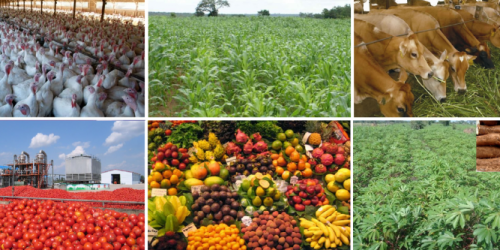
Improving Nigeria’s economy through agriculture

By Abdullahi Adamu

Nigeria’s economy has not been in good shape for the past five years and first went into recession in 2016. Then, in 2020, in the wake of the COVID-19 pandemic, it plunged into another recession – its worst in four decades. As a result, it recorded a gross domestic product contraction of 3.62 per cent in the third quarter of 2020.

There’s been a lot of uncertainty about where people should invest, mainly due to policy inconsistencies. This cut across various economic sectors. The poor performance of different sectors of the economy, especially the agricultural sector, has created uncertainty and unemployment. In addition, the recurring farmer-herder crisis has hurt agriculture in the country.

However, can agriculture be used to reduce the high rate of poverty and unemployment in Nigeria? Absolutely! Agriculture has the potential to reduce the high rate of poverty and unemployment in the country by employing millions of Nigerians across the agriculture value chain.

Take cassava processing as an example. Nigeria is the largest cassava producer in the world. There is much to gain from knowing the value chain of cassava, starting from production to processing and then marketing. Cassava, just like yam, is a root and tuber crop.

However, unlike yam, it can grow in relatively poor soil and low rainfall areas. Cassava and its by-products have various uses. It can be processed into starch: the cassava starch used for making paper and textiles. It can be processed into flour to make cakes, bread and biscuits. It can be processed into chips usable for animal feed. It can be processed into ethanol, which is used as bio-fuel when combined with additives. Cassava is also processed into fructose, used in the industry for sweetening fizzy drinks.

In Nigeria, we produce over 50 million tons of cassava every year, and over 26 states out of the 36 states in Nigeria produce the crop. Therefore, if we embrace good agricultural practices, the production, processing, and marketing of cassava can serve as a good tool to reduce the country’s high rate of poverty and unemployment.

It is also important to note that the most considerable portion of the population of Nigeria is the youth. The percentage of youth (age 15 – 35) among the unemployed population is 55.4 per cent. So, with increased youth involvement in agriculture, the sector can reduce youth unemployment.

Agriculture is the easiest and fastest route to empower the most vulnerable, especially the youth. However, it also needs improvement in the micro and macroeconomics of the country.

It is imperative to turn around the economic fortunes of Nigeria through the agricultural revolution, especially in the face of dwindling revenue to the governments due to the global financial crisis aggravated by the COVID-19 pandemic.

The country needs to sustain the present agricultural revolution tempo and bring about social engineering that will inspire more young people and women to engage in mechanised farming.

Abdullahi Adamu wrote via nasabooyoyo@gmail.com.

Garba Shehu, Lai Mohammed, other top gov’t officials reportedly test positive for COVID-19

By Muhammad Sabiu

An exclusive report by Premium Times has indicated that top Nigerian government officials and many aides of President Muhammadu Buhari have contracted the deadly coronavirus disease.

The officials who are said to have contracted the virus include Malam Garba Shehu, Buhari’s spokesperson; Alhaji Lai Mohammed, the Minister of Information and Culture; Yusuf Dodo, the President’s Aide-de-camp (ADC); Aliyu Musa, his Chief Security Officer (CSO).

Mr Shehu responded to the enquiry sent to him seeking more information on the reported news of them contracting the disease, adding that he did not know the status of the other persons mentioned.

“I have no confirmation of the cases you mentioned, but yes I have been afflicted by the mild variant of the COVID-19. I felt okay from the beginning, maybe because one had received all three jabs, and right now, I feel 100 per cent. I just finished my hour-long running exercise.

“But the strange thing about this ailment is that it is the scientists, not you, that will say you are okay. Right now, I’m taking my prescriptions and isolating, and would go back for a test to ascertain if the virus is still here or it has left me. Thanks for your goodwill,” the presidential spokesperson, Garba Shehu told Premium Times in a text message.

The infected officials, according to the newspaper publication, are currently receiving medical care.

When the results of their polymerase chain reaction (PCR) testing came back positive, the afflicted officials were said to have been removed from the cabinet meeting on Wednesday.

Amidst this ravage of the virus at the State House, there is still no official statement about the matter as the President’s status of the virus is also unknown.

FG revises international travel protocol to tackle Omicron

By Uzair Adam Imam

As one of the measures in tackling the deadly virus of Covid-19 Omicron, the Federal Government Friday has announced a revision of its International Travel Protocol which was said to be effective from Sunday, December 5, 2021.

Boss Mustapha, the Secretary to the Government of the Federation (SGF) and Chairman, Presidential Steering Committee (PSC) on COVID-19, made the disclosure in a statement.

The statement stated that the said revised protocol was aimed at further reducing the risk of importation and exportation of COVID-19.

Mustapha said: “All passengers arriving in Nigeria are expected to provide evidence of and comply with COVID-19 Polymerase Chain Reaction (PCR) test to be done within 48 hours before departure; post-arrival day 2 COVID-19 PCR test; self-isolation for seven days (for unvaccinated and partially vaccinated individuals); and day seven post-arrival exit PCR test (for unvaccinated and partially vaccinated individuals).

“All out-bound passengers are required to provide either of the following documentation: valid evidence of full vaccination against COVID-19; negative PCR test result within 48 hours from the time (of) boarding.”

He added that the review of the protocol was based on science, national experience, and global developments.

Meanwhile, he also assured, “Nigerians that government would continue to monitor global and specific country situations with a view to taking necessary measures.”

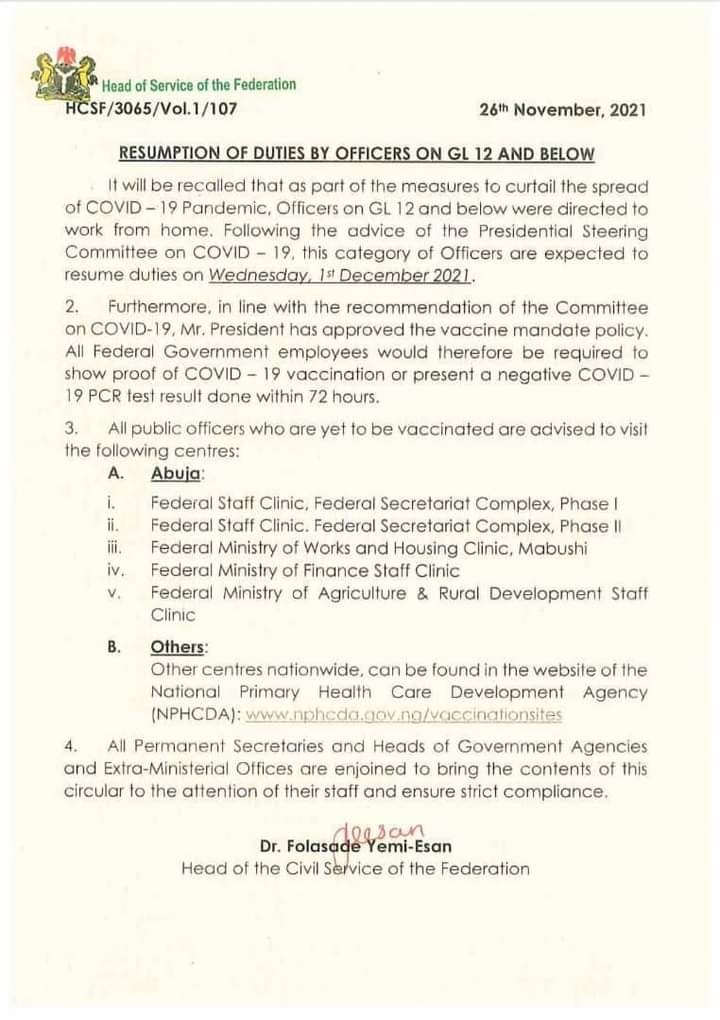
COVID-19: FG directs civil servants from level 12 and below to resume work

By Sumayyah Auwal Ishaq

The Nigerian government has directed federal civil servants from Grade Level 12 and below to resume full duties on Wednesday December 1, 2021.

The Head of the Civil Service of the Federation, Dr. Folashade Yemi-Esan, gave the directive in a circular on Friday in Abuja. Dr. Yemi-Esan, further said that President Muhammadu Buhari has approved the vaccine mandate policy to all Federal Government employees.

The new development follows a recommendation by the Presidential Taskforce (PTF) on COVID-19, urging workers to resume full working hours and days.

COVID-19: Nigeria records deaths and new infections

By Hussaina Sufyan Ahmad

The Nigeria Centre for Disease Control (NCDC) on Friday morning via it’s official website has announced the new toll of Covid-19 cases recording two deaths and 87 new cases of in the country.

The NCDC website said 87 new infections on Thursday was as a result of the infectious decrease from the 209 infections reported of on Wednesday.

The Public Health Institute added that the new infections were recorded across seven states of the federation and the Federal Capital Territory (FCT) on Thursday.

“Zamfara – 29, FCT – 25, Rivers – 11, Kano – 8, Bauchi – 5, Gombe – 4, Lagos – 3 and Taraba – 2.”

“While the latest report includes zero cases from Delta, Edo, Sokoto and Taraba States. Taking the country’s total confirmed cases to 212,446. However, 204,047 of those infected have recovered while 2,902 have died.