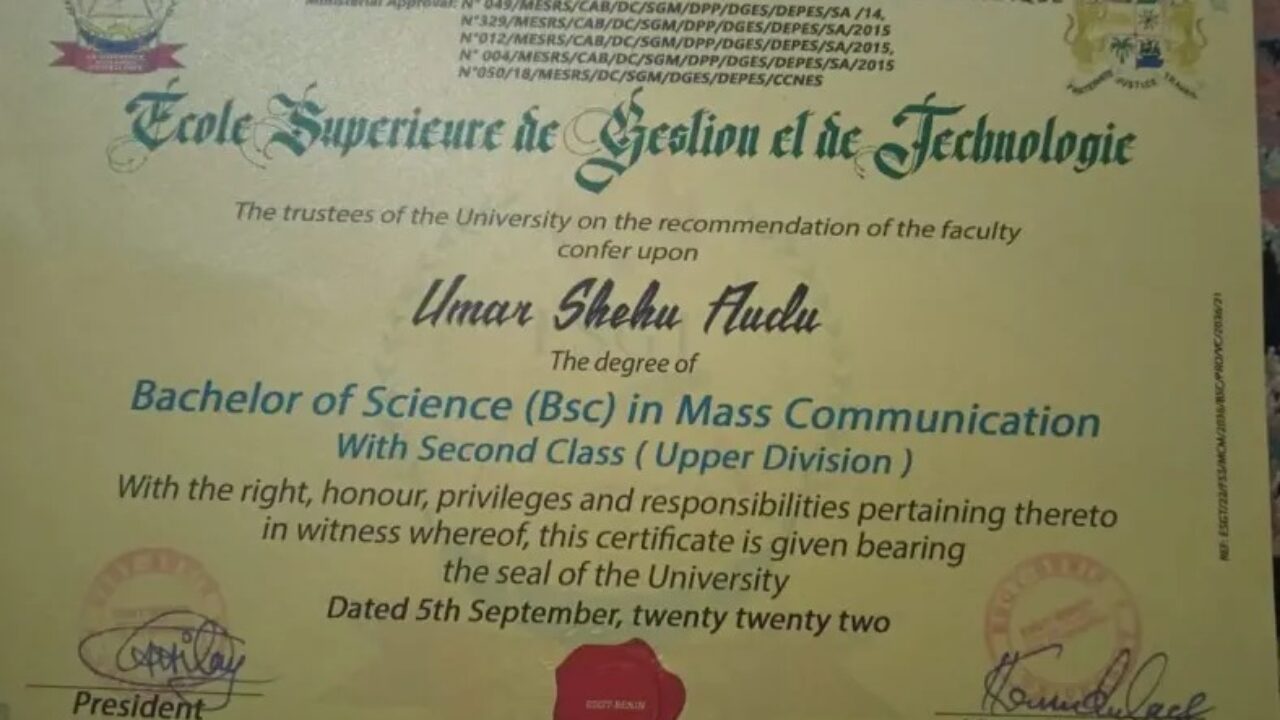
Cotonou degree

Revisiting the FG’s decision on Togo, Cotonou degree certificates

By Ukasha Rabiu Magama

The issuance of fake certificates, both within Nigeria and abroad, is not a new phenomenon. Many institutions globally face accusations of awarding certificates to undeserving candidates. Therefore, the case of Cotonou should not be singled out or become a focal point of public discussion.

While many institutions accused of such scandals in Nigeria vehemently deny the claims to protect their prestige, instances of fake certificate awards are prevalent. The consequences of counterfeit certificates awarded by Nigerian institutions are evident across various sectors, including the military, medical profession, education, agriculture, engineering, commerce, and politics.

The detrimental impact is reflected in Nigeria’s current challenges, such as a compromised democratic atmosphere, a corrupt educational system, unqualified medical personnel, an unorganised defence system, and widespread insecurity. 

The proliferation of WAEC, NECO, and JAMB miracle centres in Nigeria’s corrupt educational system contributes to the emergence of fake police and military officers, incompetent leaders, and escalating security challenges.

Banning Cotonou and Togo degree certificates might not be optimal, considering that Nigerian institutions must be held accountable. Fake certificate issues extend beyond international borders, with corruption being a pervasive challenge in Africa. Eliminating corruption is a formidable task, and scrutiny is warranted not only for the exposed journalist but also for individuals who acquire certificates through illegal means in Nigeria.

It is imperative for authorities to investigate how the journalist obtained his certificates in just six weeks and to allow the implicated institutions to present their case. Acknowledging the evident disparities among the three countries, Benin Republic and Togo have three three-year first-degree systems, unlike Nigeria, which has a maximum of 4-5 years.

Globally, the minimum time required to acquire a degree certificate is three years. Also, in Cotonou and Togo, this standard isn’t compromised. Meanwhile, not everyone who went to school or graduated from the suspended institutions bought certificates, and not every school in Togo or Benin Republic was involved in buying, selling, or awarding fake certificates.

Therefore, there is a need for the federal government of Nigeria to reverse its decision to suspend the degree programs in Togo and Cotonou and or arrest the journalists and the management of EGST University involved in such ungodly acts to face the wrath of the law. The allegation of buying, selling, and awarding fake certificates is not only peculiar to the Benin Republic and Togo but has also been alleged here in Nigeria.

In recent years, Ahmadu Bello University Zaria, Lagos State University, Imo State University, and the University of Jos were accused of selling and awarding fake certificates to undeserving candidates. The point here is, why did the federal government of Nigeria fail to sanction or suspend those institutions if it wanted to curb corruption in its educational system? Therefore, addressing this issue requires a comprehensive approach and a fair examination, not just suspending innocent institutions and maintaining the global standard in awarding degree certificates. 

To this end, the Students Union Government of the Institute Superirieur de Formation Professionelle are here to draw the attention of the federal government of Nigeria to reverse its decision to suspend Togo and Cotonou degree programs. On the other hand, it calls on the government to thoroughly investigate whether the said journalist followed a legal process in obtaining his degree from the accused certificates.

Ukasha Rabiu Magama wrote an opinion of Adamade Peter Adamade, National President of ISFOP University’s Alumni.

The dangers of the ‘Cotonou Certificate’

By Zayyad I. Muhammad

The excellent investigative report by the Daily Nigerian and the subsequent suspension of accreditation of degree certificates from Beninese and Togolese universities by the federal government of Nigeria has put a dent in every certificate genuinely or ill-obtained from institutions in these West African countries and some other African countries. This includes certificates from Eastern Africa as well.

The urge for these certificates, particularly among young Nigerians, is simply the price we pay for our inclination toward seeking easy solutions and allowing personal interests to override the national image.

One interesting aspect of the Cotonou ‘easy’ certificates is that they predominantly attract young people from Nigeria’s ‘semi-middle’ class and lazy individuals from wealthy families. For them, obtaining a bachelor’s degree often involves pursuing studies at Benin or Togo universities, which admit anyone can pay for the desired degree.

Another unfortunate aspect is that someone who obtains a bachelor’s degree in less than two months can easily secure a job in a sector involving life and death, make critical decisions in vital areas of Nigerian public life, or lead a group of competent individuals who have diligently earned their certificates. We hope there are no doctors, pharmacists, engineers, etc., practising in Nigeria who obtained their certificates through ‘crooked ways’ from Benin, Togo, etc. However, Nigeria’s professional and regulatory bodies should have prevented them from gaining entry.

Fake certificates pose a serious threat to the nation. This issue would be treated as a ‘war’ against the country in more developed countries. The Nigerian government should suspend accreditation from these countries and take decisive action to shut down these irresponsible institutions targeting Nigeria and punish the perpetrators.

However, Nigeria shouldn’t throw away the baby with the bathwater; some individuals have obtained certificates from reputable institutions in these African countries. Nigeria should address the issue from both ends—domestically and with these countries. Domestically, authorities must address why our young people opting for universities abroad. The answer lies in our universities being plagued with incessant strikes, some lecturers being unnecessarily sadistic, and sometimes foreign certificates being undeservedly celebrated.

Secondly, serene learning environments are attractive; some of Nigeria’s university lecture classrooms and theatres are overcrowded and in poor condition. In contrast, foreign universities provide beautiful and appealing learning spaces. Additionally, it raises questions about why graduating from a private university in Nigeria is often easier than a public university, especially when many lecturers at private universities are the same individuals teaching at public universities.

To address the issue at its source in these African countries, Nigeria should leverage its diplomatic influence in West Africa, compelling these nations to mandate that private universities adhere to established standards and penalise offenders. Those implicated should face legal consequences, as certifying unqualified individuals is akin to warring Nigeria’s human resources development and socio-economic sectors.

Fake degree certificates from Benin and Togo involve two actors: the institutions in those countries and their collaborators in Nigeria. Moreover, fake degrees are not confined to Benin and Togo; they are a global issue. According to a report by the Academic Credentials Evaluation Institute, Inc. (ACEI Global), based in Los Angeles, CA, USA, on December 2, 2023, Israeli police arrested 40 Israeli doctors, medical interns, and pharmacists who had presented false credentials to Israel’s Health Ministry. These individuals are suspected of purchasing medical and pharmacy degrees from three universities in Armenia despite never completing studies at those institutions—St. Tereza Medical University, Haybusak University, and Mkhtiar Gosh Armenian-Russian International University. The report also highlights controversies surrounding Punjab Technical University (PTU), India, including the issuance of fake degrees, leading to the arrest of four administrators for aiding failed students in passing.

If someone has genuinely obtained their degree from Benin or Togo, the current controversy has cast a shadow over it, and it may take some time to restore its credibility.

Zayyad I. Muhammad writes from Abuja via zaymohd@yahoo.com.

Neo-liberalism and Cotonou degree alternative

By Dr Kabiru Danladi Lawanti

The whole Cotonou degree is criminal and all those involved need to be fished out and punished. Some people might see us as harsh or maybe insensitive for saying this. 

There are things we cannot say in public, but one needs not to be prophet of doom to predict that Nigeria cannot withstand this onslaught and will eventually crash. 

Our desperate quest for certification through whatever means led us to this situation. Parents are desperate to have their kids in the university, some even underage (we saw 15, 16 and 17 year olds being pushed to universities), whose mental capacity is too elementary to grasp or cope with challenges of university education.

The crises in higher education and the adoption of neo-liberal policies that have no place in a developing country like ours also contributed to this confusion. Consequences of commodification of knowledge is enormous in a country with no strong institutions to checkmate excesses and greed of capitalists. The results is the proliferation of degree mills all over.

Adoption of neo-liberal policies means cutting funding for public services like education, health and sanitation. Nigerian public universities suffer from these policies. Funding was cut, citing many reasons. The results is restrictions in admissions. When you have many applying to enter university and the slots are few, universities have to admit based on quota. Therefore, few can be admitted.

Parents, in their desperate efforts to get their children into universities, started sending their kids to some African countries for bachelor’s degrees – Uganda, Benin Togo, Ghana, Sudan, Niger Republic, etc. 

Another reason is the dichotomy between degree and HND. Many people affected by stagnation in their places of work because of HND opted for a way to have a degree that can help them get promoted. Many went for the Cotonou degree. Since it is acceptable by MDAs or they made it acceptable, most of them started trooping to these mushroom universities to obtain these degrees to get promoted.

Then we have people who can’t cope with rigorous nature of our public university system. I know a lot who not only failed exams, but are withdrawn from diploma programmes, but appear after 6 months with a degree from these degre milling centres. Others could not pass UTME therefore unqualified to enter public universities. Cotonou degree provide an alternative.

The last, in my opinion, are those running from ASUU strike. Many parents justify purchasing the Cotonou degree because of the unending industrial disputes in the public universities.

I don’t want to talk about the “motor park gang” led by former minister of education Adamu Adamu and his National Universities Commission (NUC) executive secretary, who bastardised the university system for only God knows why. They have killed what remained of our public university system.

Lastly, some of our private universities are not any different from the “Cotonou universities”.

President Bola Tinubu needs to do a lot more to rescue the situation. I like how the Minister of Education, Prof. Tahir Mamman, handles the situation. But sincerely, the students of these dubious universities, their agents, officials from Federal Ministry of Education, NUC and the other places need to be rounded up, arrested and punished according to our laws.

Kabiru Danladi Lawanti, PhD, wrote from the Department of Mass Communication, ABU Zaria, via kblondon2003@yahoo.com.

List of 18 foreign universities FG banned over allegations of issuing fake degrees

By Abdurrahman Muhammad

Following the report of how the Daily Nigerian journalist obtained a university degree from Cotonou in six weeks and participated in the NYSC scheme, the Federal Government of Nigeria, through the Ministry of Education, had on Tuesday, January 2, 2024, suspended the evaluation and accreditation of degree certificates from Togo and Benin Republic universities.

In a statement on its website, the National University Commission labelled the blacklisted foreign universities as ‘degree mills.’

The statement reads in part, “The under-listed “degree mills” have not been licensed by the Federal Government and have therefore been closed down for violating the Education (National Minimum Standards, etc.) Act of the Federation of Nigeria, 2004.”

The affected institutions include five universities from the United States, three from the Republic of Benin, six from the United Kingdom, and three from Ghana.

Below is the list of the 18 foreign universities the Federal Government banned from operating within its borders.

1. University of Applied Sciences and Management, Port Novo, Republic of Benin or any of its other campuses in Nigeria.

2. Volta University College, Ho, Volta Region, Ghana or any of its other campuses in Nigeria.

3. The International University, Missouri, USA, Kano and Lagos Study Centres, or any of its campuses in Nigeria.

4. Collumbus University, UK, operating anywhere in Nigeria.

5. Tiu International University, UK, operating anywhere in Nigeria.

6. Pebbles University, UK, operating anywhere in Nigeria.

7. London External Studies UK operating anywhere in Nigeria.

8. Pilgrims University operating anywhere in Nigeria.

9. West African Christian University operating anywhere in Nigeria.

10. EC-Council University, USA, Ikeja Lagos Study Centre.

11. Concept College/Universities (London) Ilorin or any of its campuses in Nigeria.

12. Houdegbe North American University campuses in Nigeria.

13. Irish University Business School London, operating anywhere in Nigeria.

14. University of Education, Winneba Ghana, operating anywhere in Nigeria.

15. Cape Coast University, Ghana, operating anywhere in Nigeria.

16. African University Cooperative Development, Cotonou, Benin Republic, operating anywhere in Nigeria.

17. Pacific Western University, Denver, Colorado, Owerri Study Centre.

18. Evangel University of America and Chudick Management Academic, Lagos.