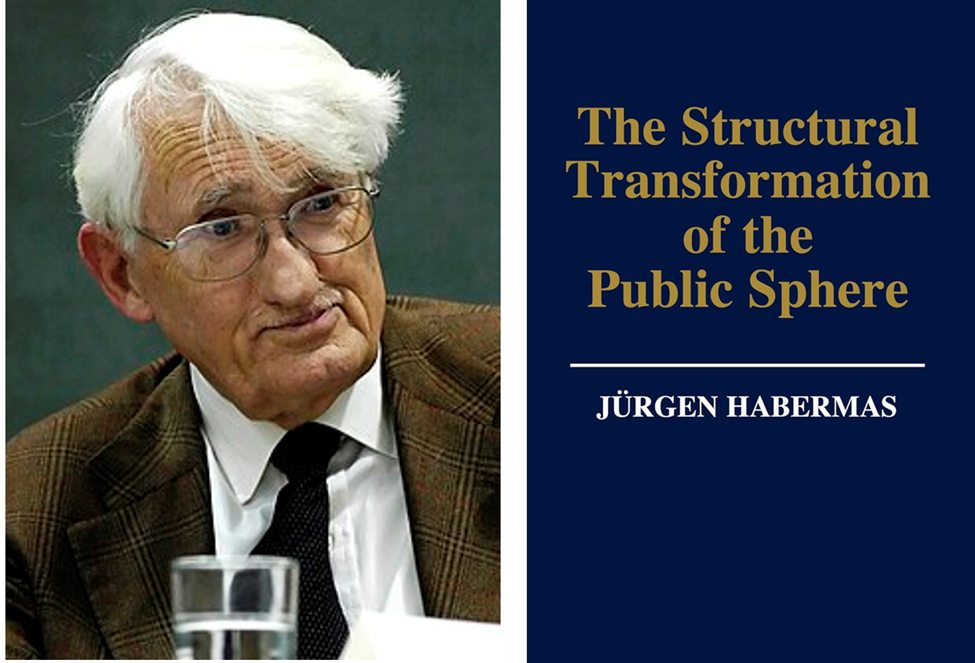
Jürgen Habermas | A Tribute
By Prof. Abdalla Uba Adamu
On Saturday, March 14, 2026, Dr Muhsin Ibrahim shared a newspaper report with me announcing the passing of Jürgen Habermas. The German philosopher died at the age of ninety-six in Starnberg, an affluent town in Upper Bavaria. Muhsin was well aware of how deeply I had drawn on Habermas’s theory of the structural transformation of the public sphere in my research on Muslim Hausa media cultures.
His passing marks the end of an era in critical social theory. Habermas’s work on communication, rationality, and society made him one of the most influential philosophers of the late twentieth and early twenty-first centuries, as well as a major intellectual figure in postwar Germany.
Many Africanists did not initially read Habermas directly. Rather, they encountered his ideas through mediated theoretical engagements in the writings of scholars such as Brian Larkin. I myself first became aware of the public–private sphere debate as part of the broader Frankfurt School theoretical repertoire in Larkin’s studies of media culture in northern Nigeria. His work contributed significantly to later “post-public sphere” discussions by demonstrating how Habermasian insights could be adapted to different social, cultural, and technological environments.
Of Habermas’s many publications, the one that proved most decisive for me was The Structural Transformation of the Public Sphere: An Inquiry into a Category of Bourgeois Society. Originally published in German in 1962 and translated into English by Thomas Burger (with the assistance of Frederick Lawrence) in 1989, it is an extraordinarily dense text. One often needs the guidance of someone already conversant with its arguments to appreciate its analytical elegance.
I was fortunate to own a copy—purchased for me in the pre-digital era by Gillian Belben, then Director of the British Council in Kano. I read it several times before fully grasping how powerfully it provided a framework for understanding public reactions to Hausa films and the emergence of censorship debates.
Habermas’s study retraces the historical emergence of the bourgeois public sphere as a communicative domain distinct from the state, in which private individuals could assemble to discuss matters of common concern. By analysing the transformations of this sphere, he recovered a concept of enduring importance for social and political theory. In simplified terms, the argument draws attention to differentiated social spaces—those of the home and those of the wider public—and to the ways in which each structures particular forms of discussion and social interaction.
I relied heavily on this analytical distinction when I presented my first international seminar at the Institut für Afrikanistik, University of Cologne, on November 15, 2004. Titled “Enter the Dragon: Shari’a, Popular Culture and Film Censorship in Northern Nigeria,” the seminar explored how Hausa films often rendered visible aspects of domestic life traditionally regarded as private, thereby provoking moral anxieties and regulatory responses. By destabilising the boundary between the two spheres, Hausa cinema helped produce new forms of mediated public debate. A dramatic illustration of this dynamic emerged in the widely discussed Hiyana scandal of 2007, in which a private act became publicly circulated, with far-reaching cultural consequences.
The communicative arena that Habermas conceptualised as the bourgeois public sphere appears today in a historically transformed guise within the networked environments of social media. In Muslim societies such as those of northern Nigeria, digital platforms have intensified the long-standing negotiation between domestic moral order and public cultural expression.
Conversations once confined to living rooms, mosque courtyards, or informal viewing gatherings now unfold in algorithmically structured yet widely accessible communicative spaces. These interactions do not reproduce Habermas’s ideal of rational-critical debate in any straightforward manner. Rather, they reveal plural, affective, and technologically mediated publics in which questions of religious legitimacy, gendered visibility, and cultural authority are continually contested. Social media, therefore, represent not the revival of the bourgeois public sphere but a new phase in its structural transformation — what might tentatively be described as a “third space.”
The world of critical social theory will undoubtedly feel the loss of Jürgen Habermas. Yet his conceptualisation of the public–private divide will continue to shape scholarly reflections on media, communication, and cultural change for years to come.
Readers interested in further discussions of the public–private debate in Islamic contexts may consult:
Kadivar, Mohsen. 2003. An Introduction to the Public and Private Debate in Islam. Social Research 70 (3): 659–680.
