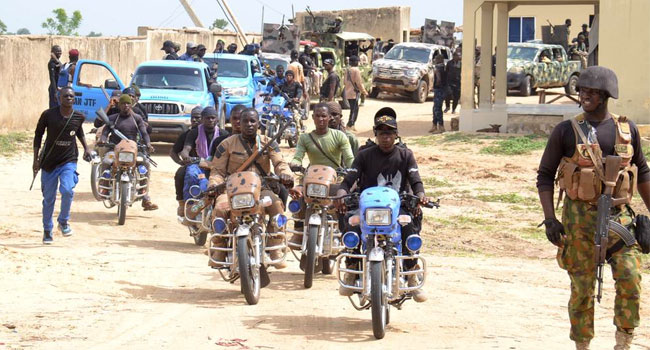
Civilian JTF

FUDMA shut down as students protest killing of mate

By Abdullahi Mukhtar Algasgaini

The Federal University Dutsinma (FUDMA) in Katsina State has been closed following violent protests by students over the alleged killing of one of their colleagues.

Reports indicate that two students were shot by members of the Civilian Joint Task Force (CJTF) operating in the area.

It was claimed that the CJTF members mistakenly shot the students, believing they were bandits’ informants.

One student died on the spot, while the other was injured and has since received medical attention.

In response to the incident, students took to the streets of Dutsinma, protesting violently. They blocked roads, set tyres on fire, and vandalized property.

The protests escalated, reaching the Dutsin-Ma–Katsina highway, where the students clashed with security forces.

Military and police personnel arrived to restore order, using a diplomatic approach to calm the situation without resorting to force.

The university’s Senate announced the closure of the institution, with students directed to go on a one-week mid-semester break starting from Monday, February 24, 2025.

The Vice-Chancellor, Prof. Armaya’u Hamisu Bichi, urged students to vacate the campus by 6:00 p.m. the same day.

The Katsina State Police Public Relations Officer, DSP Abubakar Sadiq, confirmed the incident, stating that an official statement would be issued soon.

FUDMA student shot dead by civilian JTF member in Katsina

By Abdullahi Mukhtar Algasgaini

A 400-level student of the Federal University Dutsin-Ma (FUDMA), Saidu Abdulkadir, 25, was fatally shot by a member of the Civilian Joint Task Force (CJTF) in Dutsin-Ma, Katsina State.

The incident occurred around 11:06 a.m. when Abdulkadir, a Department of Agricultural Extension student, and motorcycle rider Abubakar Yusuf, 40, were stopped by CJTF personnel.

After allegedly failing to comply, one operative opened fire, injuring both.

Abdulkadir later died at Orthopedic Hospital, Katsina, while Yusuf is receiving treatment.

The Katsina State Police Command has launched an investigation and reinforced security in the area.

Two female suspects arrested over Borno suicide attacks

By Uzair Adam Imam

According to authorities, two female suspects have been arrested in connection with the detonation of improvised explosive devices (IEDs) in Gwoza local government area of Borno State on Saturday.

A local government official confirmed that 30 female suicide bombers were sent to Gwoza to detonate IEDs at different locations within the area. However, only four suicide bombers had carried out the attack so far.

One of the female bombers, who came from the Pulka axis, detonated the IED at a checkpoint, killing herself, a soldier, and a civilian JTF member. The women were said to have entered Gwoza from different locations, including Pulka and the Mandara mountains.

Security operatives are currently on the lookout for the remaining would-be suicide bombers to prevent further disasters. The source explained that one of the female bombers that came from Pulka axis was responding to military interrogation at the checkpoint when she panicked and detonated the IED.

The Borno State government has condemned the attacks and vowed to continue the fight against insurgency. The governor of Borno State visited the victims of the bomb blast and reiterated the government’s commitment to ending the insurgency.

The investigation is ongoing, and security operatives are working to prevent further attacks in the region.

Civilian JTF: A remedy the Northwest needs

By Adamu Bello Mai-Bodi

The success stories emanating from the Boko Haram epicentre in Nigeria’s north-eastern states, particularly Borno and Yobe, must not be separated from the combination of unwavering military operations and the assistance given by the tactically planned Civilian Joint Task Force (CJTF). CJTF is a local group founded in 2013 to support the Nigerian military’s operations against extremists and defend local populations from attacks like the ones currently taking place in Kaduna, Niger, Sokoto, Zamfara and Katsina.

Recent events in Nigeria reveal that the region’s indigenes primarily carry out terror activities. The Northwest is no exception. To put an end to this brutality, the authorities in the Northwest should take a page out of Borno State’s book and organize a local militia to work alongside the military. Locals know their communities’ lows and highs, nooks and crannies way better than military personnel. Therefore, involving them would boost the chances of conquering non-state actors and their partners in crime.

The people of Hausa land have a history of bravery and, if given a chance, many will volunteer to work in the task force to bring respite to and rid their community of murderous bandits. On this note, Nigerian authorities should give Northwest people a chance to work with the military and salvage the region. In addition, the loose group should possess basic weapons and must have female members to help with handling women and children. When this is done, I’m optimistic about having Borno-esque results.

The going is now rough in the Northwest, and the people are willing to fight back, but the constituted authorities don’t allow that. This region is densely populated. Every state can recruit at least thirty thousand vigilantes and pay each member a twenty-thousand naira incentive per month. Notwithstanding, authorities should be very observant during the recruitment of this recommended vigilante group to avoid engaging the bandits’ Trojan horses.

Gathering intelligence would be easier with the CJTF in place. The locals hired would quickly identify criminals and their enclaves, resulting in more successful security operations. Apart from increasing security, another positive aspect of the CJTF concept is that it provides people with temporary jobs to keep them occupied and provide food for their families. Instead of governments and individuals paying large sums of money as ransom to bandits, the money could be utilized to pay vigilantes a monthly stipend.

Adamu Bello Mai-Bodi writes from Azare, Bauchi State. He can be reached via admabel86@gmail.com.