Christians

Religion and the 2023 presidential election: A quick take

By Muhsin Ibrahim

Religion was central to Bola Tinubu’s emergence as the APC’s candidate for the 2023 presidential election. We discussed the issue as if it would not end. Since the 1993 annulled election of Abiola/Kingibe (both Muslims), no major candidate and his running mate have ever come from the same religion until now: Tinubu/Shettima (both Muslims). But, as the election approaches (we are, in fact, counting hours), only a few people talk about that. However, religion will play a significant role in the voting pattern.

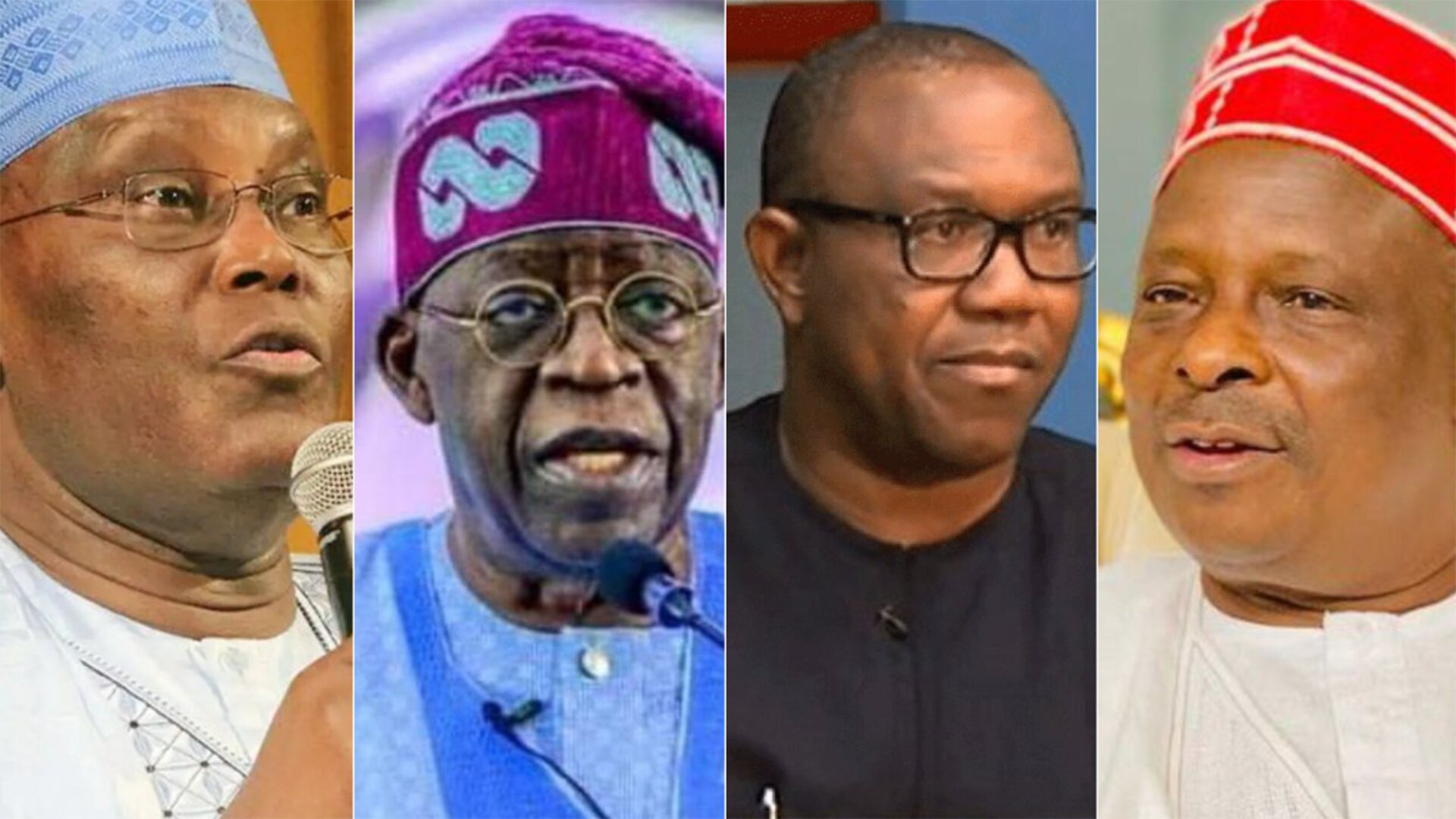
The wild popularity of Labour Party’s Peter Obi on social media and his appeal to foreign media has something to do with his religion. I know this may sound controversial, but it is so. The three other front candidates are Muslims, while Obi is Christian. Besides this, I can’t see a glaring difference between him and NNPP’s Engr. Rabiu Musa Kwankwaso per se.

Tinubu and PDP’s Atiku Abubakar are in their 70s, while Kwankwaso and Obi are in their 60s. The four leading candidates are stinking rich and belong to 1% of the Nigerian elite. Interestingly, the candidates represent Nigeria’s so-called major ethnolinguistic groups of Yoruba, Hausa and Igbo, alias WAZOBIA.

Though, there is a parallel between Obi and Tinubu. Many people will vote for them because of their religious identities. I learned that many churches, especially in the North, had ordered their members to vote for Obi. Likewise, the faith-based civil liberties organisation Muslim Rights Concern (MURIC) recently “reminded Northern Muslims of their promise to support a Southern Muslim [i.e. Tinubu] in the 2023 presidential election”.

Given the above, I agree with some observers and analysts that Obi may surprise his critics, such as myself, in the upcoming election. The votes from his Christian brethren and others supporting him for other reasons will make a difference. However, Tinubu has many more advantages – being APC the ruling party and his decades-old political footprints, among others.

Anyway, we hope for the best and pray for peaceful elections. But, please, stay away from violence. Your safety should be your most treasured possession. No politician or political party is worth dying for.

With love from a disenfranchised Nigerian citizen.

Muhsin Ibrahim works and lives in Cologne, Germany and can be reached via muhsin2008@gmail.com.

Pastor faces backlash for bringing AK-47 to church

By Ahmad Deedat Zakari

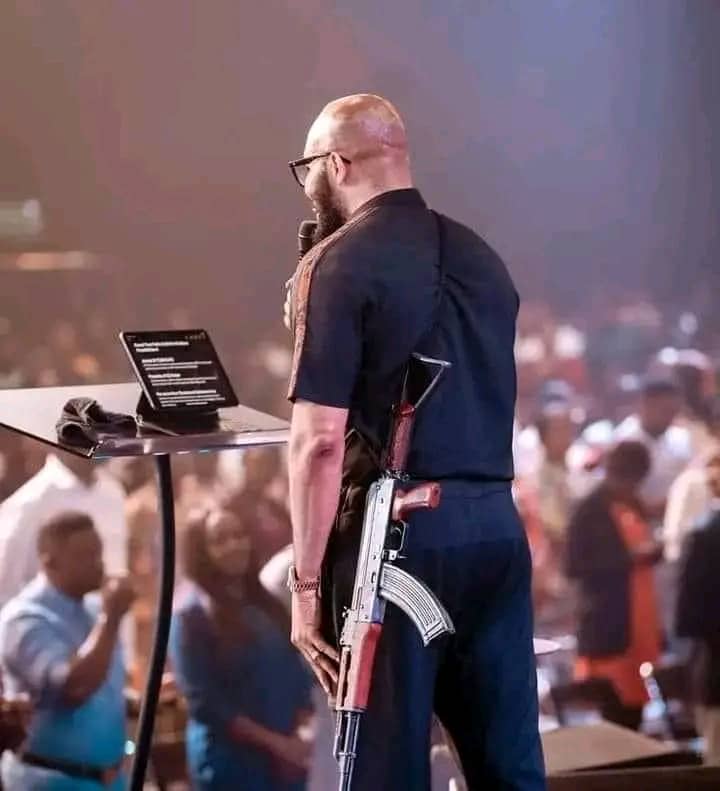
The presiding pastor of an Abuja church, Pastor Uche Ugbe, has brought himself to great disrepute and backlash after he took gun to the church on Sunday.

Pastor Ugbe, while on the altar addressing christian faithfuls, had an AK-47 dangling from his shoulder.

He was reported to have said he came to church prepared because some people are looking for his trouble

However, his action do not sit well with many Nigerians and they have taken to different social media platforms to lambast him.

Abdullahi O. Haruna, a journalist and public affairs analyst, described his action as insensitive.

Haruna said, “Yes, he is not a security guy,
He is a pastor wielding unabashedly this weapon of death, to a congregation that had children, exuberant youths, not minding the sensitivity. He reigns with such impunity. Don’t worry, this is Nigeria. Anything goes…”

Another Facebook user, Nasir Muhammad Salis, said, “I can’t fathom the high level of panic or tension some people will ignite in the country if this was Sheikh Gumi or Sheikh Pantami. But now, they are ignoring it. I don’t see, in my view, any justification for this childish dramatic action!”

Other persons have described him as silly, childish and attention-seeking.

As at the time of writing this report, the Christian Association of Nigeria (CAN), is yet to comment on the illegal possession of firearm by the pastor.

Interestingly, the Nigerian Police Force has also been conspicuously silent on the issue.

Bingham University bans students from using phones

By Ahmad Deedat Zakari

Bingham University Nassarawa has banned the use of smartphones in the institution. 

The Registrar, Dr Esther J Dyaji, disclosed the development in an internal memoir on Wednesday. 

According to Dr Gyaji, the phones of defaulters of the ban would be confiscated while they face appropriate sanctions. 

The memoir reads, “Following repeated abuse in the use of smartphones in contravention of section 5.14 subsection i, ii and iii of the students’ handbook, the use of smartphones is hereby prohibited with immediate effect. Violators of this would have their phones confiscated and face appropriate sanctions.”

Bingham University is a private missionary university owned by the Evangelical Church Winning All (ECWA). It was founded in 2005.

CPS condemns Christian leaders for criticising Muslim-Muslim ticket

By Uzair Adam Imam

The Centre for Promotion of Shari’ah (CPS) expressed worries over the utterances of some prominent Christian political and religious leaders concerning the Muslim-Muslim ticket.

The centre was also dismayed by the numerous social, political and economic challenges bedevilling the Muslim Ummah in the country.

This was contained in a communiqué signed by Aminu Inuwa Muhammad, the centre National Coodinator, at the end of a one-day stakeholders meeting in Abuja.

It said, “Current developments in the political landscape of Nigeria have become a source of serious concern to CPS and the general Muslim Ummah in the country.

“The decision of some parties in the choice of presidential candidates and their respective running mates has attracted unguarded statements from some religious and political leaders, a development that has worsened the already tense political situation,” it added.

The centre also called on the Muslims to vote for the political parties and candidates who will ensure justice and protection of their rights and interests.

“Muslims in Nigeria need to properly organise themselves in order to take full advantage of their obvious demographic strength during the 2023 elections.

“Muslims need to pursue proactive measures towards countering the negative profiling in the media as well as the moral drift and mischief prevalent in the social media.”

Dangers of entrusting religious leaders with sex education responsibility

By Aishat M. Abisola

A few weeks ago, I read that the federal government ordered the Nigerian Education Research and Development Council (NERDC) to remove sex education from the basic school curriculum. This decision was made by the Minister of Education, Mallam Adamu Adamu.

This followed the call by experts that sex education should be placed in the hands of parents and religious institutions so that it would not be taught in schools in ways that would not further “corrupt” young children with phones and access to technology.

Adamu stated that since Nigeria is a religious country, morals and values should be taught in Mosques and Churches, adding that it would bring up children with strong morals and reduce the rate of out-of-school children.

When I read this, I was shocked for many reasons. First of all, the introduction of sex education into the basic education curriculum is still recent, and most schools are not even implementing it.

When I was in secondary school, my classmates and I were mainly taught about the biological and chemical aspects of reproduction, not the elements concerning sex and sexuality.

Secondly, how are they sure that sex education has not benefited the youths who are barely taught about it in schools?

Sex education can be defined as teaching and learning about a myriad of topics related to sex and sexuality. It dives into the values and beliefs regarding these topics. It helps people gain skills they will need to navigate their relationships with themselves, their partners, and their community and helps them manage their sexual health.

Sex education can be taught anywhere, in one’s house, school, community setting with trusted individuals, or online. As I stated earlier, I was not taught much about sex education in secondary school.

Luckily, my parents were there to answer my questions on sexual education and even imparted helpful knowledge that has helped me a lot in many ways.

When I learnt more about sex education and focused on what my parents taught me, I learned more about myself, my body, and how I could improve in terms of mental and physical health.

Despite common misconceptions that sex education corrupts children when taught about it at school, sex education can be more beneficial than you might expect. The full description of what sex education entails is as follows:

Human Development

This involves human anatomy, puberty and how it will affect them both physically and mentally, sexual orientation (the different types of sexual orientations), and gender identity (what it means to be male or female).

Relationships

Relationships consist of Interpersonal relationships such as family, friendships, romantic relationships, and relationships with healthcare practitioners.

Personal Skills

This involves areas surrounding communication, boundaries, negotiations, and decision-making.

Sexual Health

Sexual education covers the areas that deal with sexual health, like sexually transmitted diseases, Birth Control, and pregnancy.

Society and Culture

This involves Media Literacy, Shame, and stigmatisation associated with sex and sexual education, the way that power, identity, and oppression can affect sexual wellness and reproductive freedom.

But besides all this, my main concern is how sex education is so callously put in the hands of religious leaders and institutions.

Most parents can be trusted to impart their knowledge about sex education to their children so they are more aware and careful.

On the other hand, religious leaders and institutions cannot be trusted in the same way.

Historically and in recent times, both religious leaders and religious institutions have been known to use children’s lack of sexual knowledge against them in ways most foul.

Priests, pastors, and Imams have preyed on young children entrusted to them by unsuspecting parents.

The more commonly known religious institution to do so are the Catholics, but other religious institutions and their leaders have done the same.

In some Islamiyah (Islamic religious learning academies), Imams have inappropriately touched young children they were supposed to care for.

Some examples would be a French Catholic church that was reported after discovering that its clergy and lay members had sexually abused at least 330,000 children over the past 70 years.

Another example would be a young girl from Lagos whom a Friar sexually abused at her parish church. In 2020, an Imam had taped himself raping a five-year-old girl, and earlier this year, in July, another Imam was arrested for the sexual abuse of seven children.

In October this year, another Imam was arrested for sexually assaulting an 11-year-old. Men (Women as well) who are placed into positions of power are more often than not predators who seek to prey on those weaker than them.

These days, anyone can become an Imam or a pastor. Because of the relaxed nature in discerning whether someone is an actual man/woman of god or whether they can be trustworthy in a position of power, many people get hurt.

Young children should not be placed in their care, nor should they be allowed to discuss sex education with them.
For all we know, they could teach these young and highly impressionable children wrong things and could hurt them badly in the long run.

Statistics have shown that when children have been sexually abused, there is a high likelihood that they will go on to commit the same injustices that were performed on them.

Ultimately, it will perpetuate a cycle of pain and torment.

Appropriately trained sexual education professionals should be tasked with training children on what they need to know about sex education from a young age. This way, they will learn more about their bodies and the best way to know if what is being done to them is right or wrong.

Along with this, their community should also take care of children.

If more than one eye is trained on a child, then any odd behaviour will be noted and told to their parents so that they can take the proper actions necessary.

With these two in hand, parents won’t need to rely on religious leaders or religious institutions to teach children about sex education when children are more likely to be abused by them.

Perhaps then, the government will have more trust in the education system instead of leaving such a delicate and complicated matter in the hands of people who would instead make matters worse than fix anything.

Children are blank canvasses, and teaching them the right things will make lovely and ethereal colours glow on their canvas, but teaching them in the wrong manner will damage it.

Children are the hopes and future of their parents and forefathers; It is with them that a legacy of peace, faith, and kindness is ensured.

I hope whoever reads this takes my words to heart and acts righteously for these children who might be led astray due to improperly placed trust.

Aishat M. Abisola is a member of the Society for Health Communication, Wuye District, Abuja, via Aishatmohd02@gmail.com.

Paradigmatic Shift in Literary Ignorance: Ajami on Naira Reloaded

By Prof. Abdalla Uba Adamu

As we enter into the ‘will they, will they not’ mode of uncertainty typical of Nigerian public culture about the change of Nigerian higher currency denominations announced by the Central Bank of Nigeria (CBN) on 25th October 2022, my mind went back to an article I wrote on 16th April 2007. This was in the wake of the removal of “Arabic inscriptions” on the Nigerian currency (the Naira) on 28th February 2007 in the new currency notes that removed the Ajami (Hausa written in Arabic script) writing that indicated the denomination of the respective currency note and replaced with the Latin alphabet. This is a ‘remix’ of that posting on the then-popular platforms of Blogspot. Mine was called Nishadin Hululu (Hausa Popular Culture).

The full historical overview of how the Arabic “script” came to become part of the essentially northern Nigerian Muslim Hausa educational package is given in Manuscript Learnability and Indigenous Knowledge for Development – Hausa Ajami in Historical Context. A version is available at https://bit.ly/3zoi7XN.

I rarely bother to visit Nigerian “Naija” websites on the web or any other group of politically motivated Nigerians. I know what I will find – the usual vituperative tirade against northern Nigerians, Muslims, Hausa, ad nauseum. Southern Nigerians have three fundamental articles in their crusade against northern Nigeria: Islamic fanaticism, conservative feudalism and their weird perception of the “born to rule” syndrome held by the ‘northerners’. No matter how many groups of Nigerians you interact with, these three form the main focus of the divide in Nigeria. They are the main reasons why Nigerian “unity” is virtually impossible.

I doubt if there is any other group of Africans who hang out their dirty ethnic laundry like Nigerians. Although, I accept, for the most part, such ranting is probably not personal; they are basically religious – the Christian versus Muslim divide, rather than any feeling of superiority of one ethnic group over the other. Any such feelings of superiority are part of a religious template that sees the acquisition of education as the central criteria for judging the value of a whole people. Thus education, not religion, is the central fulcrum around which the Nigerian nation wobbles.

Southern Nigerians acquired education through Christian Missionary activities from about 1849. Such education became the mainstay of acquiring Westernized modernity. Inevitably Western education brought by Christian missionaries to Nigeria became equated with Western Christian values. For the most part, Christian southern Nigerians are happy with this because it makes them “civilised” – in the absence of any cherished antecedent cultural values. Thus, any other worldview is considered barbaric.

Northern Nigerians, specifically the Hausa and the Kanuri, acquired education through conversion to Islam since 1250 and even earlier in the Kanuri kingdom. The constant eddy of scholars from north African learning centres throughout the 14th to 17th centuries ensured a sustained scholastic tradition in Muslim northern Nigeria. Muslim northern Nigerians, therefore, had a longer exposure to the concept of formalised learning and literacy than southern Nigerians. Universal basic education was indeed introduced around 1464 in the city of Kano when new methods of indigenising the Arabic script to Hausa phonology were created. This led to the creation of a novel way of writing out the Hausa language in a script that young scholars will understand. This method of indigenising Arabic script to the Hausa language became “Ajami”. It became one of the main ways of educating young pupils in northern Nigeria. Do you remember all those “Almajirai” you see in northern Nigerian cities? Well, most are fluent in Ajami writing. Currently, the most prominent modern Hausa political singer (though not the most talented or likeable), Dauda “Rarara” Adamu Kahutu, has an extensive catalogue of his songs, all written in Ajami which he reads as he records in the studio.

Ajami, therefore, is any literacy strategy in which any language is written in Arabic. Over 50 languages are currently written in the script. First, let us look at the parallel sphere. If any African language is written in Latin characters, it can be called Ajami. Ajami is not Islamic; any more than the Latin alphabet is Christian.

However, in a new era of reform, CBN decided to remove the “Arabic” script from the Nigerian currency in new currency notes launched on 28th February 2007. The removal of the Ajami script on the Nigerian currency reflected Nigeria’s deep-rooted religious divide because the Arabic script was seen as religious – and Nigeria is considered a secular country. This equates Arabic with Islam – ignoring the vast number of Arab Christians throughout the Middle East.

The logic of the removal of what the Nigerian economic establishment calls “Arabic inscription” on the Nigerian currency given by the Nigerian Government was premised on using a Latin inscription that is available to all Nigerians (even if in mutually exclusive languages), rather than an exclusive script tied down to a particular religious culture. According to the then Governor of CBN, Professor Chukwuma Soludo, during a sensitisation visit to the Sultan of Sokoto,

“I will also like to inform you that the removal of the Arabic inscription on the notes is not targeted at any group or religion but rather to promote our language and cultural heritage…As you can see, Naira is the symbol of our nationalism and our pride. It is pertinent to let you understand that Arabic is not one of our national languages, and it was inscribed on the notes forty years ago because the majority of people then could read it in the northern part of the country to the detriment of their counterparts in the South (ThisDay, 16th February 2007, posted to the web 19th February 2007 at https://bit.ly/3TQ4FEw.

Similarly, the CBN issued a rebuttal to the controversies by stating that the “de-ajamization” was to “conform (to) Section 55 of the 1999 Constitution, which recognises four languages, English, Hausa, Ibo and Yoruba as medium of conducting government businesses.” After all, as they claimed, after forty years of Western education, most people in Nigeria should be able to recognise Roman inscriptions. This, we believe, can strengthen our unity by ensuring equity and fairness. Indeed, the replacement was done in national interest and the desire to comply with the Constitution of the country.”

But how can national unity be attained when a large proportion of the country is still marginalised? To prevent this marginalisation, the British colonial administration introduced the Ajami letters on the first Nigerian modernised currencies, well aware of the large education gap – and therefore, the ability to read and understand Latin characters on the country’s currency notes. An example was the £1 note.

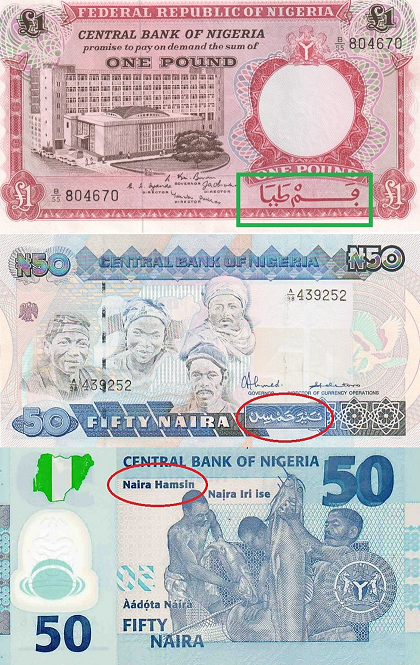
Fam daya” was prominently written to enable those literate in Ajami, but not the Latin alphabet, to identify the currency.

Interestingly, the main argument was that the presence of Ajami on Nigerian currency was seen to the “detrimental” to southern Nigerians (who presumably do not understand it) – yet the inclusion of the Latin alphabet is not seen as detrimental to non-Roman literate northern Nigerians (mainly Muslim Hausa, who presumably do not understand it). In this warped logic, it is, therefore, easier to alienate Muslim Hausa northern Nigerians than southern Nigerians, especially since a Christian was the President of the country (and a Christian Governor of the Central Bank facilitated the alienation). Of course, when a Muslim becomes the President, the arguments might be revisited – and reversed, which another subsequent Christian president will also revisit, and so on endlessly. Farooq Kperogi actually imagined a nightmare scenario that might come out of this in 2022 at https://bit.ly/3TOt2T1.

The inclusion of the script on the Nigerian currency by the British colonial administration was an acknowledgement of the rich literary heritage of a vast number of people in Nigeria who could not read the Latin script– and not a strategy to impose Islam on anyone in Nigeria. Indeed, the British colonial administration had no reason to propagate Islam. Yet on the currencies circulated by the same administration, the “Arabic inscription” was conspicuously present. This was maintained until 2007 when the despised Arabic inscription was removed and replaced with the much-loved Latin ‘inscription’. An example with ₦50 illustrates this.

The ₦50 with the ‘Arabic inscription’ of Ajami merely indicates that it is fifty naira in Hausa. In the redesigned ₦50, the Roman name for the Hausa was ‘naira hamsin’ instead of the Ajamized ‘hamsin’ in the old note. Yet, ‘hamsin’ means fifty in Arabic! So, like it or not, Arabic remains on the naira. To get rid of it, you have to get rid of the Hausa language entirely since about almost 45% of Hausa words are based on the Arabic language.

Further, other multicultural countries pay such homage to multiple literacies in their currency notes. The Indian currency, for instance, has 15 language scripts, including Urdu (Ajami) – despite Arabic not being part of its national languages.

And while not explicitly stated, the links made by the Nigerian economic establishment with Arabic to Islam seem to be part of a move to “de-Islamize” Nigeria – scoring a cheap point, particularly in the way most northern Nigerian states re-introduced Islamic Shari’a in their governance from 1999 led by Zamfara State, and the earlier issue of Nigeria’s membership of the Organization of Islamic Countries (OIC) in January 1986, which the Nigerian Christian (as well as Marxist Muslim) groups were against.

We look forward to the new currency notes in December 2022.

Prof. Abdalla Uba Adamu wrote from the Department of Information and Media Studies, Bayero University Kano, Nigeria. He is, among many other things, the former Vice-Chancellor of the National Open University of Nigeria (NOUN). He can be reached via auadamu@yahoo.com.

CAN is trying to create artificial food scarcity, worsen hardship – MURIC 

By Uzair Adam Imam

Investigations by the Muslim Rights Concern (MURIC) revealed that there had been massive purchases and hoarding of paddy rice across the country by the suspected members of the Christian Association of Nigeria (CAN). 

A statement by the MURIC chairman, Kano State Chapter, Mallam Hassan Sani Indabawa, disclosed on Friday, calling on the Nigerian authorities to look into what it described as the ‘unwholesome attitude by the Christian association. 

The Muslim body also revealed that CAN is deliberately trying to create artificial food scarcity to discredit the Federal Government by making its efforts in the agriculture sector look like a failure. 

The statement read, “Series of investigations conducted by MURIC has revealed a disturbing trend of massive purchase of paddy rice across the rice producing belt, cutting across the three northern agricultural ecological zones of the country. Several reports from the field established that a huge number of strange people are massively buying the commodity in bulk in Kebbi, Niger, Benue, Kaduna, Kano, Jigawa, Bauchi and Yobe states.

 “The eight northern states account for over 70% of the rice being produced in the country. Nigeria is currently the largest producer of rice in Africa with a production capacity of 5.0m metric tonnes per annum.

“With the onset of the current harvest season, the unusual high demand for the commodity has already spiked the price upwards, aiming for the roof. While farmers may be happy with a good price, however, the rush for the mass purchase of the commodity is enough to raise some genuine concerns.

 “Farmers and other stakeholders noticed an organized and coordinated purchase of the commodity in large quantity. From Kebbi State, down to Gashua in Yobe State, the story of the influx of people, mainly Christians, is the same. They came for massive purchases of tons of rice, both milled and paddy.

CAN make the purchase in large quantity

“Our investigations further point to a high likelihood of the Christian Association of Nigeria (CAN) being involved in this orchestrated mass purchase of rice produced for all Nigerians particularly because the buyers in large quantities are all Christians. They come with their weighing scale and tons of money. It is very suspicious.

 “Apart from the existing aggregating centers, new ones have emerged where the commodity is bought at a higher price. This has already made the price of the commodity to jump up at an alarming rate.

“While farmers and local dealers are happy with the new buyers, many are, alarmed by the disturbing trend. Many of the “new rice merchants” admitted to have been mobilized for the exercise. While it is obvious that the ordinary farmer is happy that he is getting ready buyers, the discerning mind must ask the question: Why are they all Christians?

CAN is plotting against Nigeria, Muslims

“The questions begging for answers are: What is the game plan of CAN? Why is the Christian body desperate to make the bulk purchase and hoard the commodity? And why at this crucial time, a few months to the general elections? Their action has already created unnecessary fear and anxiety, as no one is sure of CAN’s motive.

“Is CAN deliberately trying to create artificial scarcity, or is the Christian umbrella body preparing for a worst-case scenario? Or is it trying to discredit the Federal Government by making its efforts in the agriculture sector look like a failure? We all know how food is being weaponized in modern conflicts. Is CAN driving Nigerians to a stage when everyone will be forced to go to church for before they can get rice to buy?

“We call on the Nigerian authorities to look closely into this desperate move. Both the apex body of Nigerian farmers, the Apex Farmers Association of Nigeria (AFAN) and the Rice Farmers Association of Nigeria (RIFAN) admitted to the unusual demand and the unprecedented hike in the price of the commodity at the peak of this year’s harvest season. 

“The Federal Government should do the needful by preparing adequately and timely to forestall possible hunger due to mischievous hoarding of this essential commodity by some evil forces. FG can evolve a counter-purchase plan to save Nigerians from the Shylock merchants in CAN. We warn CAN to eschew any diabolical plan it may have with the massive purchase of the commodity,” the statement added.

MURIC: Muslims blocked from RCCG camp to make transactions, check exams

By Uzair Adam Imam

The Muslim Rights Concern (MURIC) frowned at the Redeemed Christian Church of God (RCCG) decision to block Muslims from entering its camp to make a bank transaction or any other business in the camp located along the Lagos-Ibadan expressway.

MURIC also claimed that RCCG thwarts Muslims from entering the camp to check their WAEC, JAMB and other examinations.

Prof. Ishaq Akintola who frowned at the development disclosed this in a statement Monday and also demanded the relocation of examination centres from the RCCG camp.

“Our office has been inundated with complaints from Nigerian Muslims who have been denied access into the Lagos-Ibadan expressway camp of the RCCG.

“Among the complainants are Muslims who registered for the Joint Admissions Matriculation Board (JAMB), the West African Examinations Council (WAEC) as well as other examinations.

“Attempts by the candidates to enter the RCCG camp in order to check their examination centres are always rebuffed by RCCG security men who turn them back at the gates with clear messages that Muslims are persona non grata inside the camp.

“The second group of Muslims who are not allowed to enter are those who opened bank accounts in some of the banks located inside the camp like Eco Bank, Unity, Guaranty Trust Bank, FCMB, United Bank for Africa, Zenith and Access Bank. This ugly trend has been on for quite some time but the complaints have increased in number recently.

“It is even more interesting to note that those behind this obnoxious practice are Yoruba Christians while the victims are Yoruba Muslims. Those who talk about religious tolerance being rampant in Yorubaland have therefore missed the point.

“But the difference is the case in matters concerning religion where they operate as Christian or Muslim groups or as corporate entities. The same Christian teacher who lives in the same house with many Muslims without any problem is the same teacher who will snatch the hijab from the head of a female Muslim student in the school.

“Simply put, there is no religious tolerance in Yorubaland. That is the truth, the whole truth and nothing but the truth.

“The RCCG camp saga cited above is one good example. RCCG has used opportunities at its disposal to build a big camp on Lagos-Ibadan expressway. It has also equipped the camp with necessary infrastructural facilities including a university, schools, clinics, banks, residential houses.

“MURIC acknowledges the right of RCCG to do all these but at the same time members of the public should be given access to them. Failure to allow that access robs RCCG of an important quality and role in social relations, namely, neighbourliness and service to the people. Afterall many other entities have such facilities and keep them open to the public.

“As a way forward, we demand, first and foremost, the relocation of all public examination centres from the RCCG camp. This camp should be delisted by WAEC, JAMB, NECO and other examination bodies for practising religious apartheid.

“Any individual or institution that applies to examination bodies to host examinations must give access to the public, particularly the candidates. Anything to the contrary is arbitrary and alien to the culture of education. A situation whereby candidates of a particular religion are shut out of the premises of the examination venue is unfair, unjust and unacceptable by any standard.

“We advise Muslims to stop going inside the RCCG camp. It is private property where Muslims are not welcome. Muslims residing in the vicinity should patronise banks and other business concerns located outside the camp.

“However, we warn that banks and other business concerns located within RCCG camp may start losing their Muslim customers if they continue within RCCG camp. Our advice to the banks id to engage RCCG authorities in dialogue on this matter,” Akintola said.

On the unity of the elites and the disunity of the masses in Nigeria

By Hassan Ahmad

Isn’t it surprising that despite the widespread public outcry, there is no real effort by any arm of government, traditional rulers or influential individuals to resolve lingering strike action by university teachers? This is just one of numerous simple but logical questions we should ask ourselves. 

As diverse as Nigeria is culturally, religiously, regionally, and even developmentally, her elites are the most united people you can find. But this unity managed to be sustained with a price: making sure the masses were united in hunger, unemployment, insecurity, lack of good education, access to poor amenities and others too numerous to mention. 

For instance, only ignorance would make Christians in Plateau revolt against Ja’iz bank’s reconstruction of the Terminus market based on a PPP agreement with the state government. While a Christian-dominated government sees its benefits, the common Christian masses wouldn’t see it that way. 

Isn’t it poverty that makes the northern Muslim send his child to the city to be fed by the public under the façade of pursuing Islamic knowledge? This same man would use all his energy to defend a politician from his region because he doesn’t want another man from another area to be his president.

Then you’ll have another set of educated and informed masses. The elites use this set as defenders. They are the intermediaries between the elites and the ordinary people and serve as their social media warlords. They defend their misdoings and praise their good acts no matter how unsatisfying. These people are stuck on a narrow path. They are not meant to be offered jobs in “juicy” government organizations and parastatals according to the design made by the elites. 

President Buhari, in his Sallah message, mentioned, “We don’t have jobs in government anymore. With technology, governments are becoming smaller, nimble and efficient”. He did not lie, but the truth remains that there will always be jobs for the children of the elites. 

What is more frightening is that you’ll find even the educated folks among the masses fighting the shackles of poverty not to better themselves and show a pathway to others but to belong to the elite class and continue with the abysmal state of dualism. 

In making sure they create a small world for themselves and their progeny, the elites put aside their differences – religion, region or political affiliation. This, in no small measure, makes them comfortable. They know that no matter who is at the helm of affairs, their businesses, investments, properties and status remain intact and unchallenged. 

Hence, a business mogul from Kano can go to Lagos to establish a refinery without being uneasy about it. Likewise, another owner of a travelling company from the east can have his vehicles go round the country to fetch him money. Again, a Northern governor can give out his daughter in marriage to the son of a South-Western governor. 

But then, when you come down to the masses, the tomato seller from the North is the number one victim of regional tension in the South. So also, the Igbo trader who finds his way to the remotest village in the North becomes the victim of religious tension—forgetting that they are all victims of misrule and deliberate segregation from the elites. 

As the situation grows further, it becomes more dangerous from the masses killing their relatives in the northeast in the name of establishing an Islamic caliphate to those killing their brothers in the southeast as separatists and bandits from the northwest terrorizing the poverty-ridden villagers.  

In all these, while the masses are the perpetrators, the masses are also the victims. But things have already gone so bad. The elites, too, are not guaranteed safety if the advancing motorcade of the C-in-C can be attacked. 

At this stage, the elites are under necessary, if not compulsory, reciprocity to make Nigeria stable again. The country has done so much for them in the past. The chickens are back home to roost. There is no need to point fingers at each other. 

To do this, the government must make sure that social justice prevails over any sentimental arrangements that have been in place. The government must understand that there is too much illiteracy and poverty in the land, and since they are the primary tools that lead to criminality, efforts must be made to curb them. 

The next administration can be said to be the most important in the history of our country. It mustn’t get it wrong. 

To the masses, we should understand that we are at a crossroads. As we can see in our country’s situation, we need not be begged not to sell our votes. You can sell your votes at the expense of your safety. If things go south, the elites have places to go around the globe in their private jets. You and I will be left to face our deaths in the hands of exciting gun-wielding criminals. Some of us were already asked to take arms and defend ourselves in Zamfara and Katsina states. The handwriting is already written on the wall. 

So please, don’t sell your votes and vote wisely. 

Hassan Ahmad Usman is a student of economics at the Federal University of Lafia. He can be reached on basree177@gmail.com or 77hassan.a.u@gmail.com.

Tinubu-Shettima joint ticket and politics of religion in Nigeria

By Babatunde Qodri

The heated arguments for and against Bola Tinubu and Kashim Shettima’s joint ticket started when the presidential candidate of the ruling All Progressives Congress (APC) paid a courtesy visit to President Muhammadu Buhari in his hometown, Daura, Katsina State. The party’s flag bearer hinged his decision on the expedient need to perpetuate the stay of the ruling party in power. But, laudable as it may seem to APC lovers, Nigerians outside the ruling camp have faulted the decision citing likely consequences.

However, this short piece was inspired by a passionate conversation between one of my mentors and me. He frustratingly shared his view on the joint ticket, stressing that it is at variance with the country’s mood, especially regarding religion. According to him, the ticket became inevitable for the ruling party bent on winning elections without minding the implications for the people. He added it’s unarguably a design for electoral victory and will be tested at the polls. I agree with him.

Nigeria is a religiously polarized entity managed by politicians who deploy religion as a tool for political advantage. In a glaringly fragile country like ours, one would expect that every political decision should be underscored by the religious sensibilities of the people, at least for peace. But instead of politicians to consider this, they go about politics that stands detrimental to the country. This is what the APC Muslim-Muslim ticket suggests.

This is not to pander to the sentiments of some religious bigots whose outcry is rooted in what they stand to benefit from the calculation. Instead, it’s instructive to note that every political calculation that disregards the need for balance must be challenged. Of course, nations of the world develop without recourse to some silly religious sentiments. However, we need to be reminded that Nigeria, giving its very foundations, has been tied to religion, a consideration that political players must pay attention to.

Some might want to remind me of the June 12 1993, presidential election. Others might also talk about the 1979 election involving Azikwe-Audu and Awolowo-Umeadi combinations. Even in Nigeria of those innocent years, this presidential election ended in favour of Shehu Shagari, who used Alex Ekweme as his running mate. Nigeria is dreadfully divided along religious lines, thanks to our putrid politics. What about those who have justified the Tinubu-Shettima ticket based on competence? I have this answer for them.

Nigeria is a generously blessed country. We have Muslim technocrats who can do well in politics, so there are intelligent Christian politicians. The late President Musa Yar’adua, during his brief time in the office, used Goodluck Jonathan while Jonathan partnered with Namadi Sambo. These running mates did all they could in the course of serving their principals. If not for a decision made in response to the threat posed by influential candidates such as Atiku Abubakar (PDP), Peter Obi (LP) and Rabiu Kwankwanso (NNDP), what else explains the hypocrisy of the APC Muslim-Muslim ticket? Whatever it means to you, this decision would negatively affect the country in the following ways.

There would be an ethnoreligious tension in the country. There is no denying that ethnicity is inevitably bound to religion here. Our politics is deeply situated in religion and ethnic affiliations. Hence, people vote for a party based on how much such attunes to their religious and ethnic sentiments. And any political decision that trivializes these fundamentals might be thrashed away, and the country journeyed into needless rancour.

Plus, the ticket will hamper the chances of the ruling party in 2023. Some have argued that it’s not a threat since most votes come from the North, a region that overwhelming installed Buhari’s regime. Those people need to be told that such a point is stale in the context of reality today. Is this nice for the country in the long run? 2023 isn’t far.

Finally, a Muslim-Muslim ticket in a country beset by systemic killings and other vices inspired by religious sentiments isn’t an excellent idea. If our politics continue to disregard the fundamental polarity of Nigeria in terms of region and religion, then I am afraid the result won’t be friendly at all. However, all this is a reflection of Nigeria’s political retrogression. We need a new order where people will be convinced by neither region nor religion as the basis to choose who should lead them. I hope we get there soonest.

Babatunde qodri wrote via babatundelaitan@gmail.com.