Benin Republic

Tinubu praises military for halting coup in Benin

By Abdullahi Mukhtar Algasgaini

President Bola Ahmed Tinubu has praised Nigeria’s military for swiftly intervening to protect democracy in the Republic of Benin following an attempted coup on Sunday.

The action came at the formal request of the Beninese government, which faced an uprising led by Colonel Pascal Tigri.

The coup plotters seized the national broadcaster, announced the overthrow of President Patrice Talon, and suspended democratic institutions.

Acting on two urgent requests from Benin’s Foreign Ministry, President Tinubu, as Commander-in-Chief, authorized the deployment of Nigerian Air Force fighter jets.

The jets entered Beninese airspace to help dislodge the plotters from the TV station and a military camp where they had regrouped.

Nigeria also deployed ground forces to support the protection of constitutional order.

Nigeria’s Chief of Defence Staff, General Olufemi Oluyede, confirmed that all requests were fulfilled, with Nigerian forces now on the ground in Benin under Beninese command authority.

After loyalist forces, assisted by Nigeria, regained control and restored constitutional order, President Tinubu commended the armed forces.

He stated they had acted within the ECOWAS Protocol on Democracy and Good Governance, helping to stabilize a neighboring country and upholding democratic values.

“Today, the Nigerian armed forces stood gallantly as a defender and protector of constitutional order,” Tinubu said. “Nigeria stands firmly with the government and people of the Republic of Benin.”

Gunfire in Cotonou as Benin coup attempt fails, presidency maintains control

By Uzair Adam

Witnesses reported gunfire in Benin’s economic capital, Cotonou, on Sunday after a military group claimed they had ousted President Patrice Talon.

The president’s office, however, confirmed that he was safe and that the regular army was regaining control of the situation.

“This is a small group of people who only control the television,” a presidency spokesperson told AFP.

“The city and the country are completely secure. It’s just a matter of time before everything returns to normal.

”Earlier on Sunday, soldiers identifying themselves as the “Military Committee for Refoundation” (CMR) appeared on state television, announcing that they had removed Talon from office. The broadcast was later cut.

A military source confirmed that the situation was under control and that the coup plotters had not seized the presidential residence or offices.

Access to some areas, including the presidency and state television, was temporarily blocked, while other parts of the city, including the airport, remained unaffected.

Residents continued their daily activities amid the heightened security presence.President Talon, 67, a former businessman known as the “cotton king of Cotonou,” is scheduled to leave office in April next year after ten years in power.

His tenure has been marked by significant economic growth alongside rising jihadist violence.West Africa has seen several coups in recent years, including in Niger, Burkina Faso, Mali, Guinea, and most recently, Guinea-Bissau.

Benin itself has experienced multiple coups and attempted coups since gaining independence in 1960.

Talon has been praised for advancing Benin’s economy but faces criticism from opponents who accuse him of authoritarian tendencies.

With his term ending next year, the ruling party is preparing to contest the elections against a moderate opposition, while the main opposition party has been barred from the race.

Nigeria, Benin Republic reach trade deal to boost regional economic integration

By Sabiu Abdullahi

Nigeria and the Benin Republic have reached a significant agreement on a joint trade framework aimed at removing cross-border trade barriers, promoting economic growth, and strengthening ties between both nations.

The agreement was sealed during a high-level meeting held on Saturday, August 2, 2025, at the Ministry of Economy and Finance in Cotonou.

The session brought together top officials, Customs leaders, and trade experts from the two countries, all focused on improving the efficiency of cross-border trade.

Nigeria’s Minister of Industry, Trade, and Investment, Mrs. Jumoke Oduwole, described the new framework as a strategic advancement in West Africa’s quest for regional economic development.

“This agreement signals strong political will from both countries to pursue a progressive and inclusive trade relationship,” she stated.

She recalled the recent meeting between Presidents Bola Ahmed Tinubu and Patrice Talon at the West African Economic Summit, where both leaders signed a preliminary Memorandum of Understanding (MoU) and directed their technical teams to turn political agreements into real progress.

“Our joint commitment is to dismantle barriers, improve logistics, and ensure that trade becomes a tool for job creation and regional prosperity. The Heads of Customs of both nations have demonstrated commendable synergy, which we are expanding through four thematic working groups covering trade facilitation, enforcement, data sharing, and infrastructure,” she added.

Mrs. Oduwole also noted that Nigeria is positioning itself to transition from a regional trading hub to a global player in shaping equitable trade systems.

Comptroller-General of Customs, Adewale Adeniyi, MFR, assured that the Nigeria Customs Service is fully prepared to implement the agreement in line with the country’s trade agenda.

“What we have witnessed today is the culmination of intensive technical meetings between Nigeria and Benin Customs officials over the past 48 hours. We’ve developed a joint framework that reflects our Presidents’ shared vision for economic growth,” he said.

He disclosed that both countries are planning to sign a formal Memorandum of Understanding based on the framework by early 2026.

Addressing the role of Customs in improving trade processes, CGC Adeniyi said measures have been outlined to ensure corridor-based trade solutions, which will promote transit and transshipment activities and reduce the bureaucratic delays affecting small and medium businesses.

“We’re committed to removing trade barriers that hinder local businesses. New trade corridors have been identified, and connectivity between our systems has already been activated,” he added.

He also expressed gratitude to the Director-General of Benin Customs, Mrs. Adidjatou Hassan Zanouvi, for her support, particularly for Benin’s endorsement of Nigeria’s leadership role at the World Customs Organisation (WCO) Council meeting in Kinshasa, Democratic Republic of Congo.

Both delegations later toured the Cotonou Port to review existing operations and identify areas for modernisation. They also visited the Seme-Krake Joint Border Post, demonstrating their commitment to closer coordination and regional integration through joint border management.

This new agreement marks a major milestone in the trade relations between Nigeria and Benin and is expected to promote growth, transparency, and innovation across both economies.

Attempted coup thwarted in Benin Republic, senior commander, ex-minister arrested

By Uzair Adam

Authorities in the Benin Republic have foiled an attempted coup, leading to the arrest of a former sports minister and a senior military commander.

The plot was allegedly scheduled for Friday, according to a statement from Elonm Metonou, the special prosecutor at Benin’s financial crimes and terrorism court.

On Tuesday night, Oswald Homeky, the former sports minister, was apprehended while handing over six bags of cash, totaling 1.5 billion West African CFA francs (approximately $2.5 million), to Djimon Dieudonne Tevoedjre, the commander of the republican guard and head of security for President Patrice Talon.

The transaction occurred around 1:00 am, and the cash was reportedly transported in Homeky’s Toyota Prado, which bore fake license plates.Prosecutors revealed that the funds were part of a broader conspiracy involving Homeky and Olivier Boko, a businessman and longtime friend of President Talon.

Boko, who was separately arrested on Monday in Cotonou, had recently signaled his intentions to run for the presidency in 2026, when Talon’s second term concludes.

Investigations indicate that Homeky and Boko paid the military commander to ensure no resistance from the republican guard during the planned coup.

Authorities also uncovered that the suspects had opened a bank account under the commander’s name in Côte d’Ivoire on August 6, as part of their preparation.

The arrests come amidst increasing criticism of President Talon’s administration, with detractors accusing him of undermining democratic institutions.

Investigations are ongoing as authorities work to apprehend other individuals involved in the conspiracy.

Since 2020, West Africa has witnessed a wave of military coups and attempts, with Benin now joining the list of nations grappling with threats to its political stability.

Metonou emphasized that efforts are underway to ensure justice is served and to prevent future attempts at destabilizing the country.

The dangers of the ‘Cotonou Certificate’

By Zayyad I. Muhammad

The excellent investigative report by the Daily Nigerian and the subsequent suspension of accreditation of degree certificates from Beninese and Togolese universities by the federal government of Nigeria has put a dent in every certificate genuinely or ill-obtained from institutions in these West African countries and some other African countries. This includes certificates from Eastern Africa as well.

The urge for these certificates, particularly among young Nigerians, is simply the price we pay for our inclination toward seeking easy solutions and allowing personal interests to override the national image.

One interesting aspect of the Cotonou ‘easy’ certificates is that they predominantly attract young people from Nigeria’s ‘semi-middle’ class and lazy individuals from wealthy families. For them, obtaining a bachelor’s degree often involves pursuing studies at Benin or Togo universities, which admit anyone can pay for the desired degree.

Another unfortunate aspect is that someone who obtains a bachelor’s degree in less than two months can easily secure a job in a sector involving life and death, make critical decisions in vital areas of Nigerian public life, or lead a group of competent individuals who have diligently earned their certificates. We hope there are no doctors, pharmacists, engineers, etc., practising in Nigeria who obtained their certificates through ‘crooked ways’ from Benin, Togo, etc. However, Nigeria’s professional and regulatory bodies should have prevented them from gaining entry.

Fake certificates pose a serious threat to the nation. This issue would be treated as a ‘war’ against the country in more developed countries. The Nigerian government should suspend accreditation from these countries and take decisive action to shut down these irresponsible institutions targeting Nigeria and punish the perpetrators.

However, Nigeria shouldn’t throw away the baby with the bathwater; some individuals have obtained certificates from reputable institutions in these African countries. Nigeria should address the issue from both ends—domestically and with these countries. Domestically, authorities must address why our young people opting for universities abroad. The answer lies in our universities being plagued with incessant strikes, some lecturers being unnecessarily sadistic, and sometimes foreign certificates being undeservedly celebrated.

Secondly, serene learning environments are attractive; some of Nigeria’s university lecture classrooms and theatres are overcrowded and in poor condition. In contrast, foreign universities provide beautiful and appealing learning spaces. Additionally, it raises questions about why graduating from a private university in Nigeria is often easier than a public university, especially when many lecturers at private universities are the same individuals teaching at public universities.

To address the issue at its source in these African countries, Nigeria should leverage its diplomatic influence in West Africa, compelling these nations to mandate that private universities adhere to established standards and penalise offenders. Those implicated should face legal consequences, as certifying unqualified individuals is akin to warring Nigeria’s human resources development and socio-economic sectors.

Fake degree certificates from Benin and Togo involve two actors: the institutions in those countries and their collaborators in Nigeria. Moreover, fake degrees are not confined to Benin and Togo; they are a global issue. According to a report by the Academic Credentials Evaluation Institute, Inc. (ACEI Global), based in Los Angeles, CA, USA, on December 2, 2023, Israeli police arrested 40 Israeli doctors, medical interns, and pharmacists who had presented false credentials to Israel’s Health Ministry. These individuals are suspected of purchasing medical and pharmacy degrees from three universities in Armenia despite never completing studies at those institutions—St. Tereza Medical University, Haybusak University, and Mkhtiar Gosh Armenian-Russian International University. The report also highlights controversies surrounding Punjab Technical University (PTU), India, including the issuance of fake degrees, leading to the arrest of four administrators for aiding failed students in passing.

If someone has genuinely obtained their degree from Benin or Togo, the current controversy has cast a shadow over it, and it may take some time to restore its credibility.

Zayyad I. Muhammad writes from Abuja via zaymohd@yahoo.com.

List of 18 foreign universities FG banned over allegations of issuing fake degrees

By Abdurrahman Muhammad

Following the report of how the Daily Nigerian journalist obtained a university degree from Cotonou in six weeks and participated in the NYSC scheme, the Federal Government of Nigeria, through the Ministry of Education, had on Tuesday, January 2, 2024, suspended the evaluation and accreditation of degree certificates from Togo and Benin Republic universities.

In a statement on its website, the National University Commission labelled the blacklisted foreign universities as ‘degree mills.’

The statement reads in part, “The under-listed “degree mills” have not been licensed by the Federal Government and have therefore been closed down for violating the Education (National Minimum Standards, etc.) Act of the Federation of Nigeria, 2004.”

The affected institutions include five universities from the United States, three from the Republic of Benin, six from the United Kingdom, and three from Ghana.

Below is the list of the 18 foreign universities the Federal Government banned from operating within its borders.

1. University of Applied Sciences and Management, Port Novo, Republic of Benin or any of its other campuses in Nigeria.

2. Volta University College, Ho, Volta Region, Ghana or any of its other campuses in Nigeria.

3. The International University, Missouri, USA, Kano and Lagos Study Centres, or any of its campuses in Nigeria.

4. Collumbus University, UK, operating anywhere in Nigeria.

5. Tiu International University, UK, operating anywhere in Nigeria.

6. Pebbles University, UK, operating anywhere in Nigeria.

7. London External Studies UK operating anywhere in Nigeria.

8. Pilgrims University operating anywhere in Nigeria.

9. West African Christian University operating anywhere in Nigeria.

10. EC-Council University, USA, Ikeja Lagos Study Centre.

11. Concept College/Universities (London) Ilorin or any of its campuses in Nigeria.

12. Houdegbe North American University campuses in Nigeria.

13. Irish University Business School London, operating anywhere in Nigeria.

14. University of Education, Winneba Ghana, operating anywhere in Nigeria.

15. Cape Coast University, Ghana, operating anywhere in Nigeria.

16. African University Cooperative Development, Cotonou, Benin Republic, operating anywhere in Nigeria.

17. Pacific Western University, Denver, Colorado, Owerri Study Centre.

18. Evangel University of America and Chudick Management Academic, Lagos.

MURIC hails FG for suspending degrees from Benin, Togo

By Abdurrahman Muhammad

An Islamic human rights organisation, the Muslim Rights Concern (MURIC), has commended the Federal Government (FG) for suspending the accreditation of degrees obtained from the Republic of Benin and Togo. 

The ban on accreditation followed the discovery of irregular and fraudulent practices in the admission and course programs of some universities in the two countries.

MURIC’s commendation came through a statement issued by its Executive Director, Professor Ishaq Akintola, on Wednesday, 3rd January 2024. 

He said:

“A laudable move was made yesterday by the Federal Government (FG) when it suspended the accreditation of degrees from the Republic of Benin and Togo for their irregularities and fraudulent practices” (FG Suspends Accreditation Of Degree Certificates From Benin Republic, Togo – Channels TV).

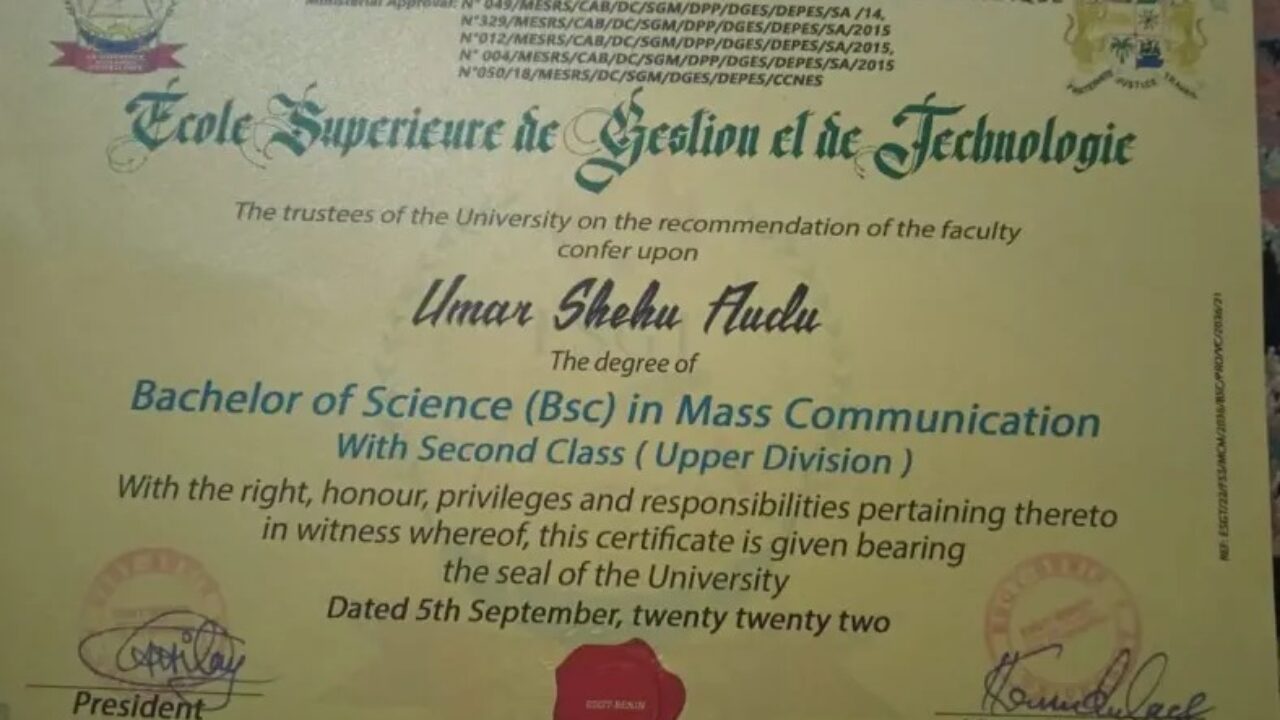
“It will be recalled that Umar Audu, an investigative journalist of Daily Nigeria newspaper, reported recently that he bagged a degree within six weeks of being admitted into one of such universities and also served as a corper in the National Youth Service Corps (NYSC) with the certificate obtained. The undercover journalist received both the transcript and certificate of the Ecole Superieure de Gestion et de Technologies (ESGT), Cotonou, Benin Republic, after six weeks only.

 It was this story that prompted FG to ban the accreditation of certificates obtained from universities in those countries (https://dailynigerian.com/undercover-how-daily-nigerian/). 

“MURIC lauds FG for banning those fraudulent certificates. The holders of such fake credentials pose a grave danger to the lives of Nigerians and the quality of public service, too. 

“We charge the ministries of education at both federal and state levels to be wary of holders of such certificates. Those found to have been employed with them should be shown the way out. Furthermore, the security agencies should fish out those behind the fraudulent admissions within Nigeria. Those are agents of the fake tertiary institutions in faraway Benin and Togo. They should be made to face the full wrath of the law.

“We demand an investigation into circumstances surrounding the clearance letter issued by the Federal Ministry of Education, which confirmed that the university (ESGT) is on the ministry’s list of accredited institutions. It was this letter which enabled NYSC to accept 51 fake graduates to serve in the scheme.  On its own part, NYSC authorities must take necessary action on the 51 fake corpers from ESGT who are serving illegally. They must be flushed out. 

“We also advise gullible but innocent Nigerians who have obtained the certificates to quickly set the machinery in motion to correct the anomaly. They should upgrade themselves by seeking authentic university admission either within or outside the country.

“Education may be the key to technological breakthrough and the concomitant industrial progress, but half-baked education and fake certificates are deadly dynamites in the system which is capable of destroying everything that may have been achieved.

“Before we draw the curtain, we find the undercover journalist equally worthy of encomiums. He went underground to unearth this educational fraud. He put his life on the line for the sake of his country. Umar Audu is worthy of emulation by his colleagues in the Fourth Estate of the Realm.”

NYSC: A case of poor data management

Ishaka Mohammed

In a recent report by DAILY NIGERIAN, a reporter called Umar Audu worked under cover and obtained a degree certificate from Cotonou in Benin Republic within six weeks instead of four years, and the National Youth Service Corps (NYSC) mobilised him for the mandatory national service. 

Although the report contains a lot of disturbing revelations, only one thing surprises me. The said Umar Audu is a genuine graduate in mass communication who participated in the NYSC scheme from 2018 to 2019. Yet, the agency mobilised him again in 2023 and captured his fingerprints without catching him for multiple registrations. It’s scary to realise such poor data management in a scheme which, since its creation, has been headed mostly by high-ranking military officers.

Concerned Nigerians have discussed the benefits of data harmonisation and the effects of its neglect. One of the numerous consequences of scattered data in Nigeria is the presence of people receiving multiple salaries from government ministries, agencies or departments. This is widespread in the same country where millions of citizens, regardless of their qualifications, battle with unemployment, hence suffering from poverty and hunger. With a standard database management system, the suffering of Nigerians can be reduced significantly. 

I sometimes wish that Nigeria would be a country with mandatory registration of children at birth. I dream of a country where every birth certificate would contain the bearer’s national identification number (NIN), which would be the chief of the eligibility criteria for free or affordable basic and secondary education, SIM registration, admission to tertiary institutions, employment, visa or passport application, etc.

I imagine a nation with a central database management system which makes everybody’s identification number and fingerprints verifiable. My ideal country is where every government ministry, agency or department can verify anyone’s date of birth, level of education, employment history, etc., using the person’s fingerprints. With all these in place, it would be impossible for one to simply outsmart a federal government agency just like Umar Audu did.

By the way, I commend everyone involved in that investigation. Stories of illegal Cotonou degrees can no longer be called baseless rumours. I’ve heard of similar racketeering in Kogi State but have yet to obtain any tangible proof.

Is this inflation a global problem?

By Salisu Yusuf

I was discussing with a friend who’s an auto broker and an arbitrage specialising in buying and selling goods from Benin Republic, Niger Republic and Nigeria. Our topic of discourse was the so-called global inflation put forward recently by the pro-government campaigners to defend our economic limbo.

From around 2000 to date, he argued cogently, the prices of goods and services were stable and fixed in Niger, Benin and Saudi Arabia – the economic reference points and benchmarks of our so-called economic analysts. They depend blindly on the economic malfeasance that befalls our country. The only change, he argued, is the exchange rate of our Naira to any foreign monetary denominator as our Naira plunges daily in value due mainly to our poor economic managers.

For example, around 2000, the tokunbo golf car was sold at 800,000 CFA Francs. Each 1000 CFA francs was exchanged then at ₦600. So, around that time, you could buy the car brand at around ₦768,000. Today, the same car is sold at the same 800,000 CFA francs. What only changes is the rate of exchange due to the Naira depreciation. Each 1000 CFA francs is exchanged at ₦960 instead of ₦600. So, the same car sold at ₦768,000 is now sold at ₦1.7m in the Benin Republic. 

Moreover, a bag of rice that could be purchased at 18,000 CFA francs, equivalent to ₦10, 800, for the CFA francs, was sold at a lower rate. Today, the same bag of rice is sold at the same price of 18 CFA francs as two years ago, but at a high price of around ₦22,080 because of the Naira devaluation.

Some people measure this so-called global inflation theory with the price of a meal in  Saudi Arabia. A friend once told me that a meal in a Saudi Arabian restaurant could cost you ₦5000, whereas ₦1000 could buy you a meal in Nigeria. I laughed at his low-level economic analysis. The ₦5000 Saudi meal is only realised if you exchange it for our depreciated Naira. If you calculate the number of Saudi Riyals exchanged for the ₦5000 is a low amount for a  person living in Saudi Arabia. In other words, the Saudi Riyal is only valuable if, and only if it’s changed to Naira! This is the same economic scenario I explained earlier in the CFA francs/naira ratio. 

The rate of exchange between Naira and Riyal, CFA Francs/ Naira, explains the economic limbo being faced by our country. This further illustrates the Federal Government’s resolve to increase the Hajj value-added tax from 5 per cent to 15 per cent. Moreover, it also hints at the government’s Hajj subsidy removal – hence, the exponential rise in 2022 Hajj fares to nearly ₦2.5m for the participating Nigerian pilgrims.

In the Niger Republic, prices of commodities are stable and fixed, as they do not fluctuate like in Nigeria. This is because President Bazoum manages the economy well; the government implements a protectionist economic policy, where Nigeriene goods are protected against their Nigerian counterparts through restrictions against export or putting high tariffs and handicaps placed through import quotas. Though many Nigerienes export petroleum in massive quantity from Nigeria, President Bazoum has restricted exporting of gas to Nigeria and restricts its consumption internally. Defaulters are taxed. Sometimes the products and their means of transportation are confiscated by gendarmes. 

Meanwhile, the high inflation rate has affected the price of our internal commodities. For instance, the gas imported from Niger is much cheaper than ours in Nigeria. Daily, hundreds of motorcycle riders import the Nigeriene gas on a large scale without paying any import tariff. Antithetically, Nigerian petroleum products are being exported into Niger without paying for excision to the Federal Government because of the border closure. 

Therefore, smugglers from, especially Niger, play their trump cards as they usually export our products freely, sell them in CFA francs at an exponential price in Niger, come back to our border and exchange the CFA into Naira, rebuy our commodities and go back to sell at a bargain price.

While we expect Mr President to cap up his swansong with a socio-economic legacy, we are daily disappointed that the man will finally end his tenure as a colossal failure, a disappointment to a poor talaka that stood blood, toil, tears and sweat to vote for this man.

Salisu Yusuf wrote from Katsina via salisuyusuf111@gmail.com.