Banditry

Ensuring security through private sectors’ initiatives

By Mukhtar Ya’u Madobi

Subject to its wider ramifications, the burden of maintaining security is too cumbersome to be single-handedly by a solitary institution in a heterogeneous country like Nigeria.

Thus, the multi-stakeholders’ approach is often more necessary where there is a rise in security challenges. Therefore, security should be a collective effort of the government plus other state and non-state actors, including the private sectors.

The word ‘security’ simply implies the protection of the lives and properties of people from various forms of threat. It occupies the highest level of priority in the hierarchy of responsibility by the government as one of the core values that the state cherishes as non-negotiable and that does not admit compromise.

The contribution of private sectors in ensuring security can be rendered through various channels, including the construction of security facilities, donations of logistics to security services and providing equipment at their disposal during emergency response situations such as fire outbreaks, accidents, building collapse and natural disasters such as flooding, earthquake, etc.

Other alternatives include community participation in securing their locality in collaboration with police, i.e. the neighbourhood watch or vigilante group, involvement of religious and traditional leaders in disputes resolution among their followers and services provided by the business enterprises to their host communities through corporate social responsibility (CSR) initiatives.

To that effect, the role being played by the famous Civilian Joint Task Forces (Civilian JTF), through collaboration with the security agencies in countering the violent extremism of Boko Haram terrorists in the North-East (Borno), is very commendable. Such volunteer groups provided invaluable intelligence that led to the uncovering of many deadly terrorist cells and their subsequent elimination.

Now that the terrorists are surrendering, community leaders, civil society groups and NGOs have a greater job to embark on sensitizing the mindsets of the public in de-radicalization, rehabilitation and reintegration of the repentant terrorists into society. This will go a long way in maintaining the security of lives and properties of people.

It is noteworthy that the CSR initiatives of the Aliko Dangote Foundation donated 150 operational vehicles to the Nigeria Police Force in 2018, which was described as the single most significant gift ever by a private sector operator to the police.

In the Niger Delta region, where the problem of insecurity is mainly attributed to the feeling of anger and frustration by host communities due to negligence of CSR initiatives, the oil companies have turned a good leaf by changing the narratives.

Multinational corporations are now actively involved in providing infrastructural facilities such as schools, hospitals, roads, and water supply to their host communities. In the long run, they also designed a special scholarship scheme for the indigenes. They are provided with tuition fees and reading and learning materials to further enhance their educational careers. This initiative has undoubtedly contributed immensely to reducing the militants’ activities and other security tensions in the oil-rich Niger Delta region.

Moreover, several societal figures and organizations were known for their efforts in constructing and rehabilitating security outfits across the country. Recall that, immediately after the #EndSARS protests in which several lives of both civilians and security personnel were lost, many properties were destroyed, police stations looted, their firearms carted away and subsequently destroyed.

The giant private sector-led Coalition Against COVID-19 (CACOVID) procured new equipment for police officers and pledged to rebuild the burnt police stations destroyed during the civil unrest to restore security to the affected locations across the country.

Even the traditional institutions were not left out as Oba (Alhaji) Dauda Ajolola Adebimpe Akinfolabi of Ayedade Local Government Area of Osun State built a divisional police headquarters and the office for the Nigeria Security and Civil Defence Corps (NSCDC) office. The monarch noted that the gesture was necessary to protect his people and ensure safety in his community, considering the rising insecurity in the country.

In addition, private security companies are also part and parcel of the security architecture of every country. The responsibility of a private security guard is ‘securing the lives and properties of the client’. The client may be an individual, organization, private institution, government, etc. However, experience has shown that guards can perform additional functions other than just protecting the lives and properties of the client.

Their large number and widespread presence make them a critical part of the security system of the nation. The NSCDC is the ultimate regulator of all private guard companies in Nigeria and has so far licensed over 1000 companies. Almost all residences, offices, schools, shopping malls, parks etc., especially in the city, are staffed by private guards securing their location. To that effect, their number has even exceeded that of the entire Police Force in the country.

Therefore, the government and the security agencies can take advantage of this opportunity to collaborate with private guard companies, especially in areas of intelligence gathering and sharing, training and joint task operations towards securing the country from the activities of criminal forces.

Sequel to that, Nigeria’s Policy Framework and National Action Plan for Prevention and Countering Violent Extremism, produced by the Office of the National Security Adviser (ONSA), retired Major General Babagana Monguno have succinctly acknowledged the role of the prominent private sector in national security.

As they say, Emergency Management is everyone’s business.

Mukhtar sent this piece from Kano. He can be contacted via ymukhtar944@gmail.com.

Security forces kill several bandits in Kaduna

By Hussaina Sufyan Ahmad

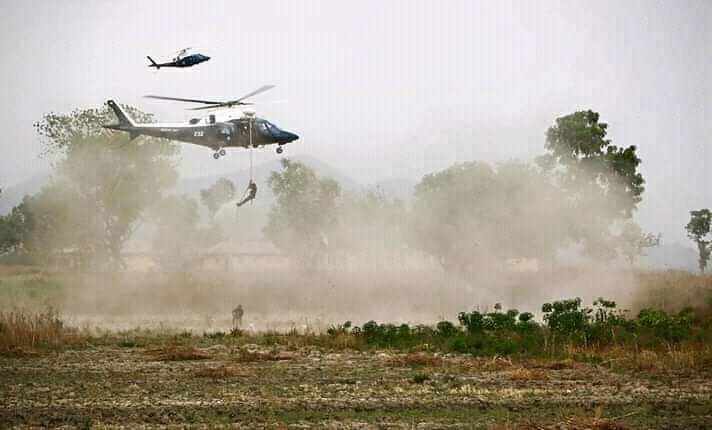
It has been reported that security forces have killed several bandits and destroyed their camps during clearance operations at Igabi and Chikun Local Government Areas of Kaduna State.

The State Commissioner for Internal Security and Home Affairs, Samuel Aruwan, on Friday, said the clearance operations were planned to conducted in Faka, Katuka, Barebari and Maguzawa general areas, spanning Chikun and Igabi LGAs.

According to him, an unconfirmed number of bandits were however later neutralised by a Nigerian Air Force attack helicopter after they were sighted on the high ground across the Maguzawa River.

Kebbi gov’t confirms release of 30 abducted students

By Muhammad Sabiu

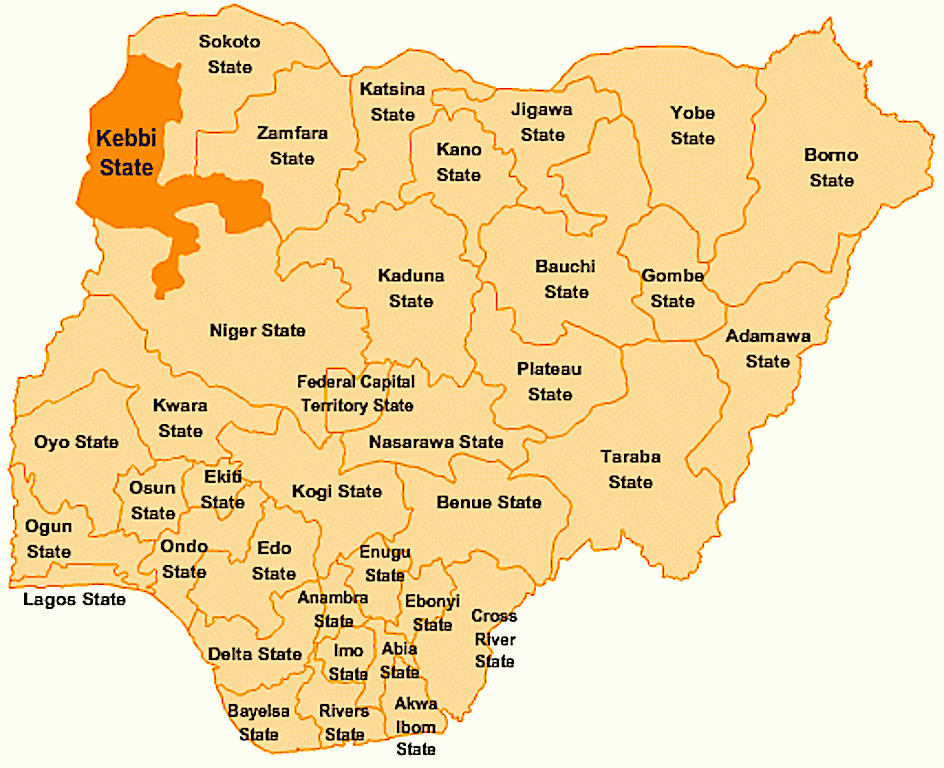
The Kebbi State Government has on Thursday confirmed the release of about 30 students of the Federal Government College, Yauri, who were in June abducted by the terrorists operating in northwest Nigeria.

The confirmation came in a statement made available to journalists by Yahaya Sarki, the spokesperson to Governor Atiku Bagudu of Kebbi State.

Recall that even as of the time of the abduction, the exact number of the kidnapped students was unknown. This makes it impossible for the government to confirm the number of students still in captivity after the release of the said 30.

Confirming the release, Mr Sarki wrote, “Today Thursday, the 21st of October, 2021 thirty (30) students of the Federal Government College, Birnin Yauri have arrived Birnin Kebbi, the Kebbi State capital following their release, while efforts are still continuing to secure the release of the remaining.”

He added that the students would “undergo medical screening and support while being reunited with their families.”

Although, unlike other northwestern states that have perpetually been suffering from kidnappings and killings by terrorists, Kebbi State also faces the same menace.

Matso-Matso Jibia and their unfair treatment

By Prof. Abdussamad Umar Jibia

It is now one and a half months since the Nigerian Telecommunication Commission (NCC) issued an order to all telecommunication companies to shut down their telecommunication sites in Zamfara state. According to the information released by Nigeria’s telecommunication regulator, it did so at the instance of the Zamfara State Government. The shutdown, according to the NCC boss was necessary to “enable relevant security agencies to carry out the required activities towards addressing the security challenge in the state”.

Soon after, a number of local governments in Katsina state, including mine, were shut down at the request of the Katsina State Government.

Although I had my reservations about the order, I kept my comments to myself and remained hopeful. This is for two reasons. One. I decided to believe that the decision was taken in good faith after due consultations and brainstorming among Government and security officials on the ground. In civilized societies such collective decisions are respected not necessarily because they are the best but because of the blessings associated with numbers.

My other reason was to avoid being misunderstood. Since banditry started in Jibia/Batsari area it has affected many of my near and distant relations. But despite that and the fact that all of us, including most of the direct victims, supported and voted in this Government, many people believe that we have no reason to criticize the present Government even if constructively. If you are kidnapped, killed, raped or injured the person you should blame is yourself or your Governor but not the central Government. I know the kind of negative reactions I receive from such people just for narrating that a bandits’ operation has taken place in my local government. That has not prevented me from saying my mind anyway.

It is almost two months now and so far, as far as I know, none of the known bandits’ kingpins has been killed or arrested. Is that because their locations are unknown? I don’t think so. When Government was looking for them to sign a peace accord, they were easily located. In fact, if Government sources are anything to go by, the Governors have their telephone numbers and they were always in touch.

“Since the bandits are isolated inside the forest, is it not easier to bombard them?” I am only repeating a question a journalist asked one of the Governors. The answer, please don’t laugh was, “They hide inside caves”.

Like that journalist, I also thought that the security agents had already identified the bandits’ locations and all that remained was to launch rains of attacks within the two weeks they requested. Alas! Here we are. Tens have just been killed in Sokoto state. In other states like mine, the stories are not different. However, the news does not travel quickly because of the telecommunications shutdown. I heard someone insinuate that to be the reason the Government asked for telecommunications cut.

Of course, some of the Governors like Aminu Masari are vividly helpless. We saw how he went around begging service chiefs to come and help him deal with bandits. In the end, when the kind of help he was looking for was not forthcoming, he started telling the people to acquire arms and defend themselves. Do you blame him?
Yes. I blame him for not buying the weapons and distributing them to the people. Most of the victims of banditry are villagers who are struggling to eat. Where does my Governor expect them to get the money to buy AK47 rifles?

But if I may ask, whose policy is it to burn the houses of suspected bandits but not to kill or arrest them? Again, how do you identify a bandit in order to arrest, kill or burn their houses? I wrote severally that the bandits living in communities should be identified and summarily tackled and I have no regret for saying it.

However, some of the activities of local vigilantes and security forces in the Jibia/Batsari axis leave much to be desired. Over the past month, many houses in selected villages were burnt to ashes and personal effects were taken away by local vigilantes backed by regular security forces. To my dismay, no bandit was said to be arrested or killed in the operations. In fact, as far as I know, no bandit was identified and declared wanted. This raises concern about the sincerity of those who carried out the attacks. Are they actually fighting banditry or is it banditry with another face?

I am particularly worried about one of the villages whose story I know very well. Matso-Matso is a small settlement about two kilometres from Zandam in Jibia local government. Matso-Matso villagers are some of the early victims of banditry. Their resistance to banditry is what led to the assassination of their Imam in 2016. The Imam, who doubles as my maternal uncle, had the habit of gathering people every Thursday to recite the complete Qur’an and pray against bandits’ activities. This led to his attack by a group of bandits on August 7, 2016. The following week, I led a delegation of the villagers to meet the Emir of Katsina and the Commissioner of Police. If PC Usman Abdullahi or the head of his CID are reading this they will bear witness that they promised to launch a raid to arrest the five key suspects identified by the villagers. On their part, the villagers promised to arrest Jatau (not real name) the principal suspect and hand him over to the police dead or alive whenever they set eyes on him.

Neither the police raided nor did the villagers set eyes on Jatau before the infamous peace agreement Governor Masari sealed with the criminals in November of that year. To their disappointment, Jatau came to their village with a full Police escort and they were told that they had no option but to accept him since the Governor had forgiven him and signed a peace agreement with him. After all, they were told, he was their “brother” from a neighbouring village in the Batsari Local Government Area.

With Government in it, the villagers had no choice. They were totally demoralized. They realized their limited power and had to submit. Many times the bandits would come with their cattle and devour their farm produce but they had nowhere to report. The village was attacked several times but calling the regular security forces was a waste of time. The only choice Matso-Matso villagers had was to be paying Jatau, the killer of their Imam to be protecting them against other gangs. And it has been working very well.

Matso-Matso also falls on a major bandits’ route from the forest to the eastern part of Jibia LGA. The armed bandits thus made it a habit to branch and rest in the village and the villagers had no power to repel them.
That is the village in which no less than 28 houses were burnt down by local vigilante and their military backers because “all the people there are bandits”. Meanwhile, Jatau, the leader of bandits in Jibia and Batsari LGA has not been arrested.

My call on Governor Masari, Chief of … (sorry, I don’t even know who to call upon now). Okay, whosoever is in charge should find a more scientific way of identifying bandits living in rural communities and neutralizing them. The advice given by the Chairman, Jibia People’s Forum, which I agree to, is to launch an unexpected house to house search for weapons and the like in the villages. As for the townships, I believe they have by now heeded the advice of the Governor and acquired sufficient rifles.

Anarchy….. Allah Ya kyauta!

Professor Abdussamad Jibia can be contacted via aujibia@gmail.com.

US to help Nigeria fight banditry

By Uzair Adam Imam

The United States Principal Deputy National Security Advisor, Jon Finer, said US government will help Nigeria fight against banditry.

He made this known on Monday during a press round table discussion held in Abuja, assuring Nigeria their full support to carry on the mission.

It is obvious that insecurity in Nigeria is one of the major problems that lingers for a very long time, more especially in some Northwest states.

Mr. Finer added that: “We’ll provide technical assistance for justice programming, much of which is dedicated to help Nigeria get a turnaround at this time of banditry challenges, and we will continue to provide programmes like that to help the country.


“I think we’ve made clear our expectations on how the firefighters are going to be use in a right way,” he said. Read More

Bandits hit by hunger, now demand food as ransom, resident confirms

By Muhammad Sabiu

Reports coming from Kaduna State in north-western Nigeria have indicated that, due to hunger, bandits now collect cooked food as a ransom for kidnapped victims instead of money.

“It has been reported that bandits operating in the Birnin Gwari Local Government Area of Kaduna State are demanding cooked food as a ransom for kidnapped victims,” Punch Newspapers tweeted.

This is coming after an order banning some commercial activities in the state was imposed in order to curb the activities of the bandits.

A youth leader from Birnin Gwari communities confirmed to Daily Trust that they had seen changes since after the imposition of the state government’s order.

He said, “There is relative peace around Damari, Kuyello, and Kutemashi because the bandits have stopped attacking our communities. They usually stay in the forest and seize food items mostly cooked ones from vendors.”

The violent activities of bandits in Kaduna State had been so rampant despite authorities’ repeated vow to curb the menace.

Bandits kill nurse, others in Zamfara

By Hussaina Sufyan Ahmad

The story of the bandits’ attack on Saturday evening killing at least three people, including a humanitarian staff nurse working with Medicine San Frontiers (MSF), has been widely reported on social media.

The victims were all travelling within Zamfara State inside a commercial vehicle.

The MSF nurse, Hassan Muhammad, was returning to his work station in Shinkafi town when the bandits opened fire on the vehicle he was in on the Shinkafi – Kaura Namoda road.

The two other deceased identified are Dahiru Scamper and Musa Moriki, the driver of the vehicle.

One of the injured, Shuaibu Buti, is currently receiving treatment at the General Hospital in Moriki.

A friend of the slain health worker, Usamah Abubakar, confirmed the circumstances of Mr Muhammad’s death.

“Hassan lived a life of service to humanity and God, as a life saving professional. For the much time I knew him, he was a very humble, calm and honest person,” Mr Abubakar said.

Shinkafi is one of the local government areas most plagued by bandits’ attacks in Zamfara State.

Zamfara: Government directs restoration of telecom services in Gusau

By Sumayyah Auwal Ishaq

The Government of Zamfara State has directed for the restoration of telecommunications services within the state capital of Gusau with effect from today, Friday, 1st October, 2021.

According to the State Governor’s Special Adviser on Public Enlightenment, Media and Communications, Mr. Zailani Bappa, the restoration of the service at the state capital becomes imperative following the tremendous success recorded in the fight against banditry in the state and to ease the hardship faced by both the private and public sectors of the state.

Mr. Bappa further stated that the “Government finds it necessary to ease the tight measure after the recorded success desired of it which has no doubt destabilised the syndicate of criminals terrorising the state leading to the successes recorded against them by the security operatives”

We have arrested 2000 bandits’ informers—Zamfara gov’t

By Muhammad Sabiu


Following the ban placed on telecommunication services and other commercial activities in Zamfara State due to incessant killings and kidnappings, the government on Thursday says about 2000 suspected informers assisting bandits have been apprehended.


Ibrahim Dodara, Zamfara State Commissioner for Information, disclosed this during a press conference in Kaduna.


Mr Dosara was quoted as saying, “The government has set up a situation room where complaints are being received to ensure prompt action.


He added that the terrorists are being eliminated by troops and have been hit by acute hunger due to the ban placed on commercial activities in the state.


“Many bandits have been neutralised by the army. Most of them are forced to eat raw food like millet because they have been cut off from their collaborators in town,” he said.


Based on the reports coming from the state in recent weeks, there has been tremendous success in the area of the fight against the terrorists in north-western Nigeria.

Gunmen kidnap former minister, Solomon Ewuga, in Jos

By Hussaina Sufyan Ahmad

Solomon Ewuga, the former Minister of the Federal Capital Territory, has been kidnapped.

Ewuga, who also served as a Senator, was kidnapped in the late hours of Wednesday in Plateau State.

The former Senator, who represented Nasarawa North Senatorial district from 2011-2015, was returning home when the gunmen waylaid and abducted him.

His abduction is coming after the gruesome killing of the husband of former Minister of Information Prof Dora Akunyili, Dr Chike Akunyili, was reported.