Banditry

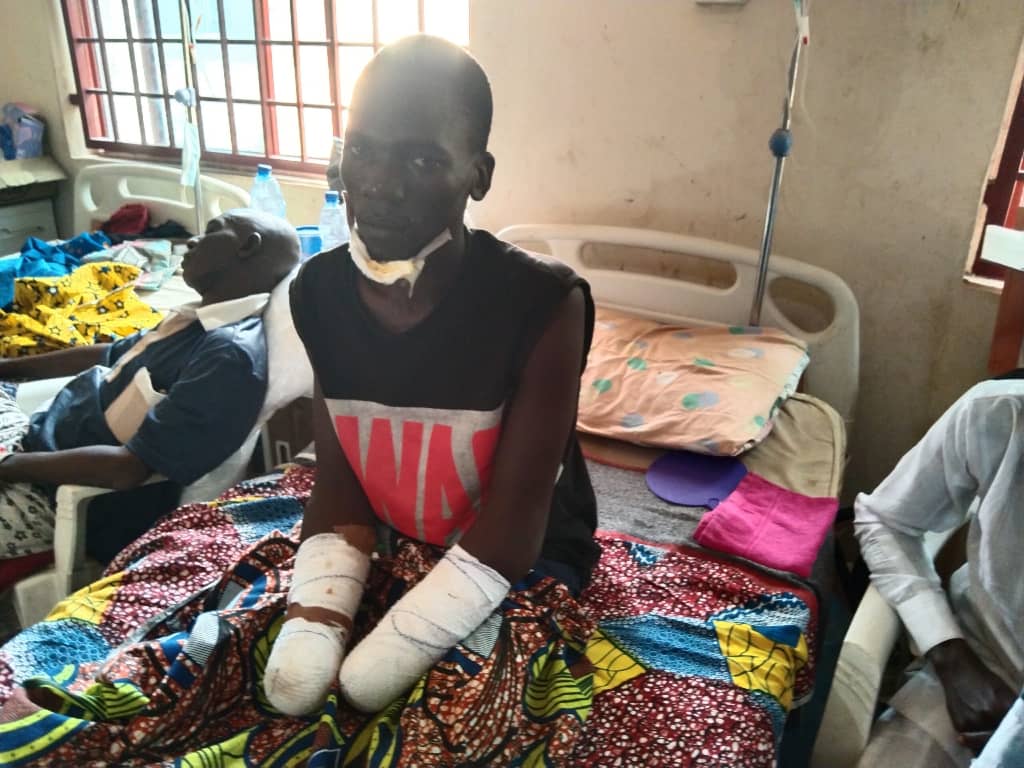
How bandits stripped me naked, cut off my two hands – Mechanic

By Uzair Adam Imam

A 25-year-old mechanic, Yahaya Muhammad Galadima, has recounted how he got his two hands cut off by unknown gunmen Tuesday on his way back from Agbabo along Rukubi before Yeluwa in Nassarawa State.

Galadima was reported to have been attacked while returning home from Rukubi after fixing a client’s J5 vehicle.

Narrating the incident, Galadima said that the incident occurred around 8 pm on Tuesday.

He said, “It happened around 8 pm on Tuesday night. I was with one of my boys, Salisu Haruna, who followed me to Rukubi, in Doma Local Government Area of the state. We went there on my motorcycle to work in one of my customer’s houses as his J5 had developed some mechanical fault.

“While on our way back from Agbabo along Rukubi before Yeluwa, all of a sudden, we were ambushed. Before we knew what was happening both of us felt off my motorcycle and my boy sustained some injuries on his left leg. However, they didn’t hurt my boy.”

He added that after they succeeded in stopping them, “They started shooting sporadically into the air, asking that I should give them money. I immediately handed over all the money I had on me, including his mobile phone.”

He also disclosed that after they had inflicted several matchete wounds on him, they snatched his motorcycle.

“Before asking them what was wrong, they cut off my two hands,” he added.

Asked if his boy was also attacked, Galadima explained saying, “My boy was not hurt at all. He was watching helplessly how they cut off my hand.”

The victim is currently receiving medical care at the Dalhatu Araf Specialist Hospital, in Lafia Local Government.

ASP Nansel Ramhan, the Nasarawa State Police Public Relations Officer, said the command was yet to be informed about the unfortunate incident.

Insecurity and food insecurity In Nigeria

By Safiyanu Ladan

Banditry and kidnapping for ransom have created a sense of fear in many farming communities in North-Western and Central parts of the country. Alas, thousands of farmers are left with no other options than to leave and abandon their farmland uncultivated for some years now for safer and more secure environments, mainly as refugees, in urban areas.

The displacement of farming communities by bandits as a result of incessant attacks which prevented them from tilling their farmland, the abrupt cessation of rainfall, the increase in the price of farm inputs, among others, are listed as the major factors that affect food production in Northern Nigeria.

This has significantly been attributed to the hiking in the price of agricultural produce and will ultimately lead to food insecurity.

In July this year, an official of the United Nations Dr Rhoda Dia, was reported to have warned that an estimated 13 million people in northern Nigeria face the risk of acute food insecurity in the next few months.

The Project Manager, United Nations Development Program – Global Environment Facility (UNDP – GEF), in charge of the Resilient Food Security Project, said the warning had become imperative because the country is facing growing levels of acute food insecurity due to decades of insecurity across the country, saying that the insecurity had resulted in increasing poverty and economic crises.

She, however, stated that the situation had been worsened by the COVID-19 pandemic and, recently, the series of clashes between farmers and herders.

According to an agriculturist, the insecurity we’re facing now, especially in the North-Western part of Nigeria, has dramatically affected crop production and will go a long way in enabling food insecurity.

The fact that most of the agricultural activities in northern Nigeria are done by peasant farmers who live in rural areas and have been subjected to unprecedented attacks almost daily by bandits is alarming.

In many aspects, insecurity has affected food production. Naturally, this can be associated with the increase in food price, even though there are other factors like the Covid-19 pandemic, as we can see in other countries. But, still, our peculiar problem that aggravated the situation is the issue of banditry.

While lamenting the security situation, some farmers in one of the most troubled states said bandits had captured more than 30% of their farmlands.

Given the foregoing, the food insecurity is imminent, and it’s so glaring that there’s nothing the government can do about it as it has failed the country.

Safiyanu Ladan writes from Zaria via uncledoctor24@gmail.com.

Insecurity: Reengaging ‘Yan Sa-Kai and the need for caution in Zamfara

By Suleman Ahmad Tudu

One of the immediate decisions of Gov Bello Matawalle’s administration was disbanding the vigilante group popularly known as Yan Sa Kai as one of the conditions for dialogue with bandits in his efforts to bring a solution to the decade of bloodshed in Zamfara state. The dialogue has recorded some early successes in almost a year of its initiation.

Unfortunately, despite being given this ample opportunity for the bandits to completely lay down their arms and embrace a lasting peace, some of them refused to subscribe to the dialogue. They continue launching and intensifying their deadly attacks on communities—killing, kidnapping and rapping women unabated, taking advantage of the vacuum created by disbanding their sworn enemies, the Yan Sa Kai.

Some negative implications of disbanding the Yan Sa Kai are that many communities that gallantly resisted bandits before the disbandment have now submitted to them. Palaces that were no-go-areas to bandits before have now become accessible to them. As a result, the morale of many vigilante members has been killed. The bandits have also taken advantage of the dialogue to deceive the government and get many resources. They kidnap many people, including school children, for ransom to procure more arms.

But we can honestly understand the justifications behind the disbandment of Yan Sa Kai in the first place as a sine qua non for dialogue to thrive. The activities of this group have fuelled the crisis for their jungle justices—extrajudicial killings and ethnic profiling of criminals. All Fulanis are bandits to the Yan Sa Kai, which is wrong!

Now that Gov Matawalle has reversed his decision to reactivate the Yan Sa Kai in the fight against terrorism (banditry), which is very good, there is a need for a caution in the recruitment, administration, and operations of the about to be born-again group. We need Yan Sa Kai guided by rules of engagements, monitored by security forces and coordinated by established authority. We need Yan Sa Kai with some basic military training and improved weaponry, not the locally fabricated, non-cartridge guns, bow and arrows that cannot match the arsenal of the terrorists.

Achieving this requires efficiency right from the recruitment process. Government should not simply dust off the list of the previous members without scrutiny to fish out those whose morale has been killed or no longer believe in the course of the group. Liaising with traditional institutions will be an effective way only if those who have cases to answer are side-lined in the process. Government should also not mistake recruiting members of the born-again vigilante group from the communities that were adjudged to have wholly submitted to bandits before or during the dialogue initiative. These measures could help avoid enlisting bad eggs who would compromise or sabotage the group’s activities.

Training of the carefully selected and thoroughly profiled members of the group will go a long way in shaping their mindsets and inculcating in them the rules of engagements, discipline, command, control and coordination. It will also mend their relationship with the security forces with which they should work together as a team. This can be possible within at least a month of rigorous training.

Granted that Yan Sa Kai knows the bandits, their collaborators and hideouts better than the security forces, yet storming weekly markets in the name of hunting bandits or their collaborators is a flawed strategy that has to be changed. They used to carry extrajudicial killings during such operations that sometimes affect innocent people. This time around, the group’s approach should be offensive by jointly reaching out to the bandits’ enclaves together with security forces now and then. And if the group has to defend and hunt, the defence should be restricted to every member’s immediate community while the hunt should be on the checkpoints to be placed in strategic places. 

While NO suspect deserves to be (extrajudicially) killed but arrested and prosecuted accordingly, I can command that any civilian seen wielding an AK-47 rifle should be “shot at sight” as ordered by President Muhammadu Buhari!

May Allah grant us everlasting peace in Zamfara and Nigeria at large. Amin.

Suleman Ahmad Tudu wrote from Nasarawa Mailayi of Birnin Magaji local government, Zamfara state. He could be reached via suleatudu@gmail.com.

Terrorist bandits kill 2 soldiers, one police officer, 13 civilians in Kebbi

By Muhammad Sabiu

At least 16 individuals were reported dead in a suspected bandits’ attack in Kebbi State’s Danko Wasagu Local Government Area on Friday.


Two soldiers, a police officer, and 13 people were murdered in the attack at Dankade village, according to the state’s police spokesperson, Nafi’u Abubakar.


The police spokeswoman further refuted reports on various news outlets that the incident resulted in 50 deaths.


Mr Abubakar, who confirmed the amount to the News Agency of Nigeria (NAN), said the incident happened on Friday at 3.00 p.m.


He claimed that suspected bandits from Zamfara infiltrated the community and terrorized civilians and security officers.


When the police patrol squads learned of the incursion, they mobilized to the village and engaged them in a gunfight, killing one of our officers and two army officers.


According to Mr Abubakar, the bandits also set fire to some homes.

Road to 2023: A race to inherit a weak system

By Nusaiba Ibrahim Na’abba

As Northern Nigeria continues to be engulfed by violent activities of terrorists by the day, the thoughts of dreadful terror acts of the famous Sunni Ali of Songhai who conquered the old, widely acknowledged historic city of Timbuktu keeps reappearing on my mind. The likes of late Muhammad Yusuf, late Abubakar Shekau and most recently Bello Turji and Dogo Gide, including some of the ‘unknown’ alleged sponsors of these activities, are no different than Sunni Ali – ‘tyrannical, cruel and merciless’.

The only probable difference is that the miniature Sunni Ali’s of our time live under the protection of a democratically elected government that vowed to protect our lives. This system we all thought would salvage us from the brink of destruction. With all the high hopes for this salvation purposely adopted to elect President Buhari into office, it is under his watch that in 2018, the Nigerian army gave an order to halt the near-arrest of late Abubakar Shekau in the depths of Sambisa Forest.

While at secondary school, it used to be quite fascinating to read and learn about the legends of some of the most powerful kings in Africa. Timbuktu’s Mensah Musa, Usmanu Bin Fodio of Sokoto, the rulers of Ghana’s Asante Kingdom and their powers on their followers, especially their strength, have always remained interesting references for their followers, especially history scholars and political leaders around the world. From leadership structure, means of sustenance, warfare and particularly military strength devoid of politicking have remained exemplary and worthy of emulation as legends have primarily documented.

Inherent in today’s Nigeria, a ravaging systemic corruption, unambitious leadership, lack of education prospects contributing to a staggering number of unemployed youths (some even throwing their hats in the ring and retiring from the state of being called youths), poor security apparatuses and myopic economic vision that continues to increase our foreign debt figures without pans of paying back. Not even the vibrancy of our historic leadership structure is being inculcated in the ‘democratic system’ we (African countries) borrowed from our colonial bosses.

Nigerians are already hopeless as the nation races towards the 2023 general elections. About two months back, I went shopping in Abubakar Rimi market (alias Sabon Gari market). All I could hear filling up the sky were words of hopelessness about the state of our dear Nigeria. “I would rather lose my voter’s card than to elect anyone in 2023”, “Our leaders will not make heaven, I tell you,” and “I’m just hoping to make it to next year alive; we are not celebrating anything” among many unending agonies. 

It is no coincidence that the President himself vindicated these agonies in an interview NTA aired on January 8, 2022. He warned his political party that “the opposition Peoples Democratic Party (PDP) could win the 2023 presidential election and return to power, if the All Progressives Congress (APC), does not settle crises that have stymied the party”. Of course, a speech of such nature and coming from the President is subject to multiple interpretations from analysts, experts, particularly politicians and lay-Nigerians. However, the President has undoubtedly depicted a lack of confidence in his party to exacerbate an already hopeless situation. His first thought is PDP winning elections to continue from where they stopped – over a decade of misrule.

Indeed, it is pretty late that Nigerians realize that both APC and PDP are birds of a feather that flock together. During an interview with Talk to Aljazeera on February 15 2015, then-presidential candidate General Buhari highlighted the weakness of PDP’s 16-year-misrule. He, specifically, lamented on the rising insecurity and the deteriorating economy as oil prices dropped significantly. A year later, when he had a similar discussion with the same Aljazeera on his visit to Qatar in early 2016, he tried to admit that he hasn’t failed Nigerians – as Boko Haram held some strategic places in the outskirts of Maiduguri. Over the years of his administration, we now fully understand who has failed Nigerians the most.

Like every race to a general election in Nigeria, we all scale through hurdles and hitches. However, what is particular about the 2023 general elections is that it showcases the real wielders of the entire Nigerian system – the elites. Indeed aspiring candidates are fully aware of problems they will undoubtedly inherit from their predecessors. They also know that they may worsen existing situations in most cases. Thus, they shall race through rising insecurity than ever before, calls for secession from the Eastern part of the country, deteriorating economy, a staggering number of unemployed youths and out of school children, dilapidated schools, bloodshed, brain drain of medical personnel, weak security apparatuses, widely acknowledged electoral violence and, to cap it all, systemic corruption.

Since Nigeria’s return to democracy in 1999, every political aspirant has been fully aware of the problems ahead of them, but they always divert followers’ attention by being optimistic. This is why it was pretty easy for most Nigerians to succumb to President Buhari’s change agenda.

Be it as it may and with almost nothing to redeem ourselves, expectations are meagre as the race to 2023 heats up. It’s no longer news that the country’s entire political economy continues to suffer in the hands of the few ‘powerful’. The masses do not wield enormous influence in the system that steers the affairs of Nigeria. So, we absolutely cannot change the country’s political structure without owning the system. Therefore, there is no confidence or trust in the election processes with ‘inconclusive elections’ that have come to stay with us since they favour the wielders of the system. 

Nonetheless, we will remain optimistic that Nigeria will prosper as a united and incorruptible country no matter what it takes. This storm shall pass. Borrowing from the words of South Africa’s Apartheid icon Nelson Mandela, “I am fundamentally an optimist. Whether that comes from nature or nurture, I cannot say. Part of being optimistic is keeping one’s head pointed towards the sun, one’s feet moving forward. There were many dark moments when my faith in humanity was sorely tested, but I could not give myself up to despair. That way lays defeat and death”.

Nusaiba Ibrahim Na’abba is a master’s student from the Department of Mass Communication, BUK. She is a freelance writer and researcher. She can be reached via nusaibaibrahim66@gmail.com.                                     

Kidnappers cart away many traders on Kaduna highway

By MMuhammad Sabiu

Suspected bandits kidnapped an unknown number of traders from Birnin Gwari Local Government in Kaduna State on Wednesday.

According to a witness, the gunmen blocked the roadway between Birnin Gwari and Kaduna at Unguwar Yako bush, where the traders were taken.

According to the source, the abducted people were among dozens of people travelling on business from Birnin Gwari and nearby areas in Niger State to Kano.

The source was quoted as saying, “We were travelling in a convoy with security escorts but they (bandits) abducted those who moved ahead of the convoy, which made them easy preys for the bandits.“We came and met about four empty vehicles, while seeing the bandits moving into the forest with the captives.

The soldiers are tracing them, we are stranded at a dangerous spot in the forest (Unguwar Yako) while the security escorts are chasing to rescue the abducted traders.”

As of the time of filing this report, police in Kaduna have not released an official statement on the incident.

MURIC condemns Zamfara killings, condoles Governor Matawalle

By Muhammad Abdurrahman

About fifty-eight (58) people were reported killed in an attack by terrorists in Zamfara State on Tuesday, January 4, 2022. Meanwhile, an Islamic human rights organisation, the Muslim Rights Concern (MURIC), has sent a message of condolence to the state governor, Bello Muhammad Matawalle.           

In the condolence message made available to journalists on Monday, January 10, 2022, Professor Ishaq Akintola, MURIC’s director, described the killings as callous, disheartening, horrific and barbaric.

The message reads:

“About fifty-eight (58) people were reported killed in a three-day reprisal attack by terrorists in Zamfara State which began on Tuesday, 4th January 2022 and lasted till Thursday. 6th January 2022. About 300 terrorists on motorcycles stormed eight villages in the Anka Local Government Area of the state on Tuesday and another ten villages in the Bukkuyum district on Wednesday and Thursday. They killed at random.

“We strongly condemn these killings. They are callous, cowardly, disheartening, horrific and barbaric. We call on the security agencies to leave no stone unturned in apprehending the perpetrators. They must be held accountable. People who turn children, wives and husbands into orphans, widows and widowers respectively overnight are heartless beasts. They deserve no mercy.

“The killings are believed to be reprisal attacks carried out in revenge for terrorists killed during air raids by the Nigerian military fighter jets last week. The air raids reportedly killed some leaders of the terrorist groups as well as tens of their foot soldiers.

“This killing of unarmed civilians should not discourage the military. It merely shows that the bandits are feeling the pressure. We call for more pounding from the air. Terrorists must have no place to hide. They must be hounded from pillar to post until they all surrender or they are totally eliminated. Nigeria will not be defeated by sadistic renegades, rebellious subjects and enemies of peace.

“MURIC commiserates with the governor of Zamfara State, Bello Muhammad Matawalle, over the horrific killings. We also condole with members of the state executive, the traditional rulers and the good people of the state. Our hearts bleed for the bereaved families. May Allah have mercy on the direct victims and give their families the fortitude to bear the losses.”

Military: Bandits should have no space to breathe

By Kabir Mukhtar Galadanchi

It gladdens our hearts how our brave military has been intensifying offensives and operations to root out bandits and banditry in the North-West, particularly in Zamfara and Sokoto, to bring back normalcy and peace to the banditry ravaged states and communities in northern Nigeria.

The military’s recent Ariel bombardments and ground offensive that resulted in the elimination of some bandits’ leaders have boosted the fight against banditry and the confidence of all the concerned stakeholders adamantly and consistently speaking about the rising level of banditry and general insecurity in the region.

In the past weeks, many notorious bandits’ leaders and other terrorists who specialised in kidnapping for ransom and killing innocent civilians were sent to their Maker. Thanks to the well-coordinated aerial bombardment by some section of the NAF launching successful aerial attacks and unleashing serious damage to the now jittery and fear-stricken bandits running for their lives to avoid the currently sustained military bombardments and offensives.

The elimination of notorious Alhaji Auta scared other bandits’ leaders to be on their heels, especially the ferocious Bello Turji, the de factor governor-cum-administrator in those areas. He collects taxes and imposes rules which all must obey to save their souls. This is an embarrassment to our leaders and our security forces, to say the least, and has become a usual trend that is still occurring unabated.

Bello Turji has continued to dare the authorities and positioned himself as a somewhat invincible and unchallengeable criminal that can do and undo whatever he so desires in the communities he’s unleashing his inhumane activities and savagery.

But the recent killing of Alhaji Auta has sent jittery and panic into his camp. He’s now coming to terms with the reality and shamelessly calling and appealing for dialogue and conciliation.

Our military must not in any way give this vermin a space to breathe and must not relent in sustaining those assaults until Bello Turji and his bloodthirsty lieutenants are eliminated. Instead, the military should give them their deserved justice with the barrel of their guns, aerial attacks or through whatever lethal way that will ensure their permanent neutralisation.

Nobody can deny that the unconditional release of some 52 captives by Turji resulted from the intensified military assaults. Eliminating him (Turji) will send fear to hundreds of notorious bandits leaders operating in Zamafara, Sokoto, and Katsina and reduce their activities.

Credible reports have it that Duna Baleri, Dogo Gide, and a host of other bandits leaders are now hiding and running from their devilish camps to avoid our military’s ongoing pressure and offensives. We pray that their nemesis will soon catch up with them in no distant time inshaAllah.

While saluting our military’s efforts, bravery and gallantry, we also pray that they should continue to be determined, persistent, and maintain doggedness in flushing and neutralising these enemies of the state that made life hellish and turbulent through their primitive violence and atavistic barbarism.

On our part as civilians, let us unite and confront this huge challenge collectively without sentiment or regard to religious, ethnic and political affiliations and underpinnings. Let us also cooperate with the military in providing credible information that will help them uncover and eliminate these evils once and for all.

Kabir Mukhtar Galadanchi wrote from Katsina. He can be contacted via kmgaladanchi20@gmail.com.

Nigerian military, please, don’t back down

By Mallam Musbahu Magayaki

I write to commend and appreciate the unmeasurable feats of the Nigerian military personnel and other sub-security agencies for their bid to ensure that two of the well-known wanted bandits, Alhaji Auta and Kachalla Ruga, have met their waterloo. They spent many years operating their egregious activities of the gruesome killing of innocent people without regard to the principle of natural justice.


However, they were killed by a Nigerian Air Force aircraft, under operation Hadarin Daji, at Gusami forest and Tsamre village in Birnin Magaji Local Government Area of Zamfara State. Nevertheless, at this point, as they (bandits) reach their cul-de-sac, our adventurous security personnel should not relent unless they spare them all.


Undoubtedly, the death of these two kidnap kingpins is a severe blow to their bandits’ like-minded abhorrent individuals. As such, more triumphant efforts to fish them out of their territories should now be re-engineered by both military personnel and vigilante units who work inexhaustibly day-in-day-out to safeguard the lives and personal possessions of Nigerians.


Yet, there is a need for the government of the federation, specifically the security sector, to organize orientation sessions with security agencies to be fully informed about the assigned task that they have sworn to do of protecting and upholding the country’s constitution. Because we live in a country where some of its countrymen portray sabotage as a virtuous way to satisfy their narrow-minded desires. As a result, they will devote all of their useless energy to changing the great sense of our security personnel to compromise the country’s state of peacefulness.


Moreover, security personnel should be fully equipped with sophisticated weapons techniques to finish off these ruthless humans (bandits) and frequent motivational incentives that would boost their morale to serve uncompromisingly. They should also be retrained in modern battle strategy. A famous West African proverb says, “When the music changes, so does the dance.” It is high time the government changed all its tactics against these despicable fellows.


Mallam Musbahu Magayaki Writes from Sabon Fegi, Azare.Bauchi State. He can be reached via musbahumuhammad258@gmail.com.

Addressing the menace of insecurity for a better Nigeria

By Yaseera Muhammad Bello 

Given the indisputable fact that Nigeria is currently trekking on the part of degeneration due to the menace of insecurity that grows daily, some questions have been scalding my tongue, seeking honest answers. What perpetuates insecurity in Nigeria? What machinery drives the brutal car of insecurity that has been killing innocent people in my fatherland? Who is to blame?

An undeniable, albeit unfortunate, fact about Nigeria today is that we read news of devastation on our national dailies for over seven years. The reports we hear on our radio stations and televisions revolve around the menace of terrorism. And it’s an inevitable fact that until we unearth the indices that hamper insecurity in Nigeria, we cannot live a life full of happiness and serenity. That being said, what are the factors that ignited the flame of insecurity in Nigeria?

Despite our portions of blame, our leaders are to be counted as the bedrock of igniting insecurity in the country. This is because we have long been electing incompetent leaders who cannot render their services effectively for the nation’s good. And this is because of the affinity we share with them when they are put into the offices. And at the end, when things fall apart, we’ll be barking like dogs seeking a peaceful society.

On the other hand, unemployment is another worrisome factor that vigorously plays a role in watering Nigeria’s black tree of insecurity. Most of our youths today in Nigeria have nothing to do but join groups that commit despicable acts. And this is mainly due to their state of unemployment perpetuated by the virulent animosity among our tribes. This is strictly said, having seen how tribalism has been hindering youths from getting job opportunities in the count. And at the end of the day, the youths have no choice but to join the horrific menace of insecurity that bedevilled our nation.

Furthermore, corruption in Nigeria, like all the other potent factors dittoed responsible for Nigeria’s insecurity, has its portions of blame. It’s now becoming rampant and our daily meal in the country. Corruption ignites numerous perplexities impeding us, including the threatening menace of insecurity. When leaders become corrupt, they fail to give security personnel adequate arms and support to fight terrorist groups and other factors that might threaten the safety of the citizens. 

Undoubtedly, until we put competent leaders into the offices irrespective of one’s tribe, religion or any affiliation, alleviate unemployment and stamp out corruption in the country, we will still wallow in the muddy water of insecurity. 

Yaseera Muhammad Bello writes from Gombe state is a student of Science Laboratory Technology (SLT), Gombe State University (GSU). She can be reached via misseerahbello@gmail.com.