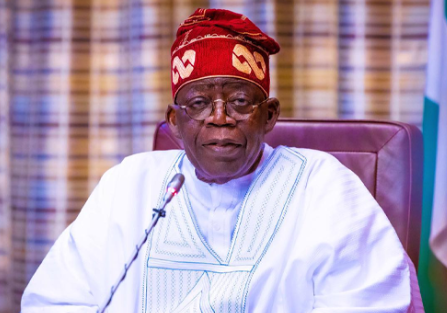
Asiwaju Bola Ahmed Tinubu

Tinubu promises better days for Nigerians in 2025

By Uzair Adam 

President Bola Ahmed Tinubu expressed optimism about brighter prospects for Nigerians in 2025 in his New Year message. 

He highlighted economic improvements, such as reduced fuel prices, strengthened foreign reserves, and increased foreign investments, and attributed them to his administration’s efforts.  

Tinubu acknowledged challenges like high food and drug costs and pledged to tackle inflation, aiming to lower it from 34.6% to 15%. 

He announced plans to expand credit access by establishing a National Credit Guarantee Company to begin operations by mid-2025 to boost economic growth and support underserved groups.  

The president called for unity, urging Nigerians to avoid divisive tendencies and remain focused on building a prosperous nation. 

He reaffirmed his commitment to reforms, emphasising his goal of achieving a one trillion-dollar economy.

Tinubu ranked third in global corruption and crime list for 2024

By Abdullahi Mukhtar Algasgaini

The Organized Crime and Corruption Reporting Project (OCCRP), an organisation focused on investigating global corruption and crime, has announced the list of the top individuals involved in corruption for the year 2024. Nigerian President Bola Ahmed Tinubu ranks third on this list.

OCCRP conducted this selection by gathering votes from people around the world to identify those who have significantly promoted corruption, dishonesty, and increasing poverty in their countries.

In this year’s list, President Tinubu secured the third position, following the former president of Indonesia, Joko Widodo. The president of Kenya, William Ruto, received the most votes. 

However, the prestigious “Person of the Year” award was given to former Syrian President Bashar al-Assad, who is said to have fled to Russia after years of plundering his country’s wealth.

Will renaming the University of Abuja to Yakubu Gowon University ease congestion for FCT residents?

By Adamu Abdullahi 

As Nigeria’s capital city, FCT Abuja needs a university other than the University of Abuja, established in 1988, to cater to the increasing number of people seeking university education within the territory and in Nigeria at large.

Establishing the Federal Capital Territory University of Science and Technology, Abaji would provide the legal framework to close the knowledge gap in science and technology.

FCT is the fastest-growing city in Africa, with only one federal university and no single polytechnic. The FCT find it challenging to study, yet the federal government has only a name to change in the federal capital instead of commissioning the one that the weed snake has taken over. 

What reduction of congestion will change the educational sector of FCT? Will the rename accommodate our prospective admissions seeker seeking to study for their ambitious course? Has the renamed university had all the courses that will interact with the international community to study in Nigeria?

Universities can be viewed as brands, much like corporations. Just as corporate brands maintain their identities over time, educational institutions rely on stable branding for recognition and credibility. 

A troubling precedent is set when university names are changed impulsively—particularly to honour politicians. This practice undermines the integrity of these institutions and can create significant confusion, particularly in the global context.

For instance, renaming the University of Abuja to Yakubu Gowon University raises several important concerns. Many foreign employers and academic institutions may now struggle to recognise the new name, which could impact their perceptions of the institution’s legitimacy and reputation.

The sudden name change may also confuse prospective employers, who might not be familiar with the new name but have been aware of the previous branding.

Moreover, graduates of these renamed institutions face a unique dilemma. They are handed Certificates that no longer align with the name they are familiar with from their years of study. This disconnect between the institution they attended and the name that appears on their degrees can lead to questions about the validity of their education and qualifications. 

It can also complicate further academic pursuits and job applications, as they may confront scepticism from potential employers or institutions unaware of the name change.

In essence, this practice of renaming universities to immortalise political figures can have far-reaching consequences. It disrupts the continuity and coherence of an educational brand built over the years, potentially diminishing the value of the degrees it confers and creating unnecessary barriers for its graduates in the competitive global job market.

Adamu Abdullahi wrote via nasabooyoyo@gmail.com.

The lost glory of Kano’s textile industry

By Salihi Adamu Takai

I was at Zakir Naik’s lecture on “The True Religion on Earth,” which concluded in the last few days, standing with brothers Uzairu and Abul-Khair, medical students at King Ceasor University, Uganda. As I was standing in my full Hausa dress with a match-colour cap, an old man saw me

“Assalamu alaikum”, the man greeted me. He was interested in discussing my dress with me. He asked me, “Are you a Nigerian?” I replied, “Yes, I am.” He said, “You must be from Kano State.” Yes, I am from Kano. “Masha Allah,” he said, excitedly.

As I was fully attentive to him, he told me how he knew Kano and its relevance in Islamic history in Uganda. He told me he knew about Kano in two ways: its impact on Islamic history in Uganda and its being the centre of commerce for decades back then. 

“I have constantly visited Kano for thirty years since the state retained its centre of commerce. I exported textiles from there to Uganda, which we found so cheap. In those days, there were many mills producing cotton fabrics. The Trans-Saharan trade fueled Kano’s textile industry, bringing cotton and other raw materials from North Africa”, the man reminisced. 

This meeting taught me a lot of knowledge, which I could say is of non-fortune because I understood that my state has missed what can’t be recovered quickly. 

Gradually, the things the state was known for started to escape from it — right from when it lacked a well-focused leader who could maintain what it had then — thinking that a title could be helpful in the future. 

The headline is the “Reform Tax Bill,” which President Bola Ahmed Tinubu proposed to the National Assembly. The bill aims to favour a state with many factories. Unfortunately, Kano is no longer such a state. The industries established by colonial masters and maintained by the founding fathers have been neglected and abandoned by northerners. The textile industry has declined, relying on importation. So unfortunate!

Salihi Adamu Takai wrote via salihiadamu8888@gmail.com.

Debunking the claim that 90% of Nigerians support the controversial tax reform bill

By Adamkolo Mohammed Ibrahim

The Truth Behind Nigeria’s Controversial Tax Reform Bill

Professor Taiwo Oyedele, Chairman of the Presidential Committee on Fiscal Policy and Tax Reforms, recently claimed that 90% of Nigerians support the contentious tax reform bills currently before the National Assembly. This claim is not only misleading but also contradicts the palpable opposition across various sectors of the country. As a university lecturer, researcher, public policy critic, and advocate of public accountability, I find it imperative to refute these unfounded assertions with facts and context.

Professor Oyedele and his team have lauded the proposed tax reform bill as a transformative framework, but it has sparked nationwide outrage, including on social media platforms. Far from the purported overwhelming support, the bill faces staunch opposition from key stakeholders across Nigeria, particularly in the 19 states in northern Nigeria. Among those voicing their discontent are the 19 northern governors, traditional rulers such as emirs, religious organisations, youth groups, business associations, and a myriad of concerned citizens, both in real life and on social media platforms.

Nigeria’s Vice President, Senator Kashim Shettima, who also chairs the National Economic Council (NEC), offered a particularly significant perspective. In alignment with the collective stance of northern governors (drawing from his deep understanding of the region as a proud son of the northeast of Nigeria) and other national stakeholders, he emphasised the importance of ensuring inclusivity and fairness in the proposed tax reform process. 

The Vice President firmly advised against submitting the bill to the National Assembly without wider consultations. During one of NEC’s monthly sessions, a unanimous decision was reached: the bill should be halted to ensure no region or demographic is marginalised in our democratic process. Despite this well-articulated stance, the President disregarded this advice and pushed ahead with the submission of the bill. This move has understandably deepened mistrust and resentment.

Critics argue that the tax reform bill is structured to disproportionately benefit Lagos State to the detriment of 35 other states and the Federal Capital Territory. For northern governors, this directly threatens their ability to sustain basic governance functions, including the payment of salaries and provision of essential services. Governor Babagana Zulum of Borno State is one of the most vocal opponents, warning that the bill if passed, would cripple northern states economically.

Such criticisms are not baseless. Deep inequalities mark Nigeria’s economic landscape, and any policy perceived to exacerbate these disparities inevitably meets with resistance. The tax reform bill appears to reinforce these fears, offering no clear mechanisms to balance its purported benefits with the realities of Nigeria’s diverse socio-economic terrain.

Questionable Survey Claims

Professor Oyedele’s assertion of a 90% approval rating for the bill demands rigorous scrutiny. According to his statement, the survey involved over 3,000 participants, a mix of online and offline respondents, with approval rates ranging from 76% among passive readers to 100% among in-person attendees. These figures raise more questions than they answer.

Who exactly were the survey respondents? What methodology was employed? How representative was the sample of Nigeria’s diverse population? What strategies were used for data collection and analysis? These critical details remain conspicuously absent, leaving the legitimacy of the survey in serious doubt.

Nigerians deserve transparency in policymaking. If this survey indeed reflects national sentiment, Professor Oyedele and his committee should publish the raw data, methodology, and results for independent verification. If they have not done so, this can only be interpreted as an attempt to mislead the public using propagandistic executive intimidation and push through an agenda that lacks popular support.

The Case for Wider Consultation

The NEC’s earlier recommendation to halt the bill and engage in broader consultations was wise and democratic. Policymaking in a pluralistic society like Nigeria requires inclusivity, transparency, and sensitivity to regional and socio-economic disparities. By bypassing these principles, the federal government risks deepening the divisions that have long plagued the nation.

Wider consultation is not just a procedural formality but a necessity. It allows for the incorporation of diverse perspectives, ensuring that no part of the country feels short-changed. Given the widespread criticism of the bill, particularly from regions like the North that stand to lose the most, the government’s failure to heed this advice represents a glaring lapse in leadership.

Furthermore, President Bola Ahmed Tinubu’s policy direction, particularly concerning the contentious tax reform bill, raises critical questions about his government’s approach to governance and inclusivity, especially regarding the northern region of Nigeria. It is a region that not only demonstrated overwhelming support for his candidacy in the 2023 general election but also provided the majority of the votes that secured his presidency.

In the 2023 presidential election, President Tinubu garnered a significant 8,794,726 votes, with the northern region contributing the bulk of this figure. Northern voters cast over 4.9 million votes — approximately 55.7% of his total votes — in his favour. These numbers highlight the region’s decisive role in his electoral victory. Yet, it is disheartening to observe the implementation of policies that appear inimical to the socio-economic interests of this same region.

The adage “do not bite the finger that feeds you” is not only a moral maxim but a practical guide for leadership in a diverse democracy like Nigeria. Unfortunately, recent government actions, particularly the insistence on the controversial tax reform bill, seem to disregard this wisdom. The northern region, often referred to as the agricultural and cultural heartland of the nation, stands to bear the brunt of these policies. Stakeholders, including northern governors, traditional rulers, and socio-political groups, have consistently voiced their opposition, warning that the bill could exacerbate regional inequities and economic hardships.

Rather than recognising and addressing these legitimate concerns, the administration appears determined to forge ahead. This approach not only undermines the trust of a region that played a pivotal role in President Tinubu’s electoral success but also risks alienating key stakeholders whose support is crucial for national stability. It is worth noting that governance is a reciprocal relationship; the trust and support of the people should be met with policies that prioritise their welfare and reflect their collective aspirations.

Every action or inaction in politics has consequences, and the grievances of the northern region should not be underestimated. Leaders must remember that political capital is not an endless resource; it must be replenished through equitable and inclusive governance. President Tinubu’s administration must demonstrate its commitment to Nigeria’s unity and progress by re-evaluating policies that could harm the very citizens whose votes propelled him to power.

The northern region’s contribution to President Tinubu’s mandate was not a token gesture but a profound expression of trust and hope in his leadership. To erode that trust through policies perceived as neglectful or exploitative is to undermine the very foundation of the democratic pact. As the government moves forward, it must prioritise consultation, transparency, and equity to ensure that all regions of the country, especially the North, feel represented and valued. Anything less would not only be a betrayal of the region’s support but a potential threat to the unity and stability of the nation.

The Way Forward

To restore public trust and ensure equitable governance, the Federal Government must take the following steps:

  1. Publish the Survey Data: Nigerians have the right to scrutinise the data underpinning claims of popular support for the bill. Transparency is non-negotiable.
  2. Engage Stakeholders: Governors, traditional rulers, religious leaders, youth organisations, business associations, students, and other demographics must be actively involved in refining the bill. Their insights are crucial for crafting a policy that benefits all Nigerians.
  3. Reassess the Bill: The tax reform must be revisited to address its perceived regional biases. Mechanisms should be introduced to ensure that no state or region is disproportionately disadvantaged.
  4. Strengthen Regional Equity: Any reform should prioritise clear, open, transparent, unambiguous, and sincere equitable distribution of resources and revenue, balancing the needs of economically vibrant states like Lagos with those of less developed regions.
  5. Promote Public Dialogue: The government should organise town hall meetings and public forums across all geopolitical zones to educate citizens about the bill and solicit their input. Relying solely on the National Assembly’s public hearings will not be sufficient to ensure broad-based participation and understanding.

Therefore, the claim that 90% of Nigerians support the tax reform bill distorts reality. The widespread opposition from across Nigeria, including key voices in northern governance, traditional institutions, and civil society, underscores the contentious nature of this legislation. Rather than pushing ahead with a deeply flawed policy, the Federal Government must prioritise inclusivity, transparency, and equity in its approach to fiscal reform.

Cherry-picked survey results, lofty rhetoric, or political propaganda will not silence Nigerians. Democracy thrives on accountability, and the people deserve nothing less than policies that genuinely reflect their collective will and serve their common good. Professor Oyedele and his committee must heed this call, for the integrity of Nigeria’s democratic process and the future of its fiscal stability depends on it.

Adamkolo Mohammed Ibrahim, a Lecturer at the Department of Mass Communication, University of Maiduguri, wrote in from Pompommari Sabon-Fegi, Damaturu, Yobe State, and can be reached via adamkolo@unimaid.edu.ng.

ACF takes step toward tax reforms with new committee

By Abdullahi Mukhtar Algasgaini

The Arewa Consultative Forum (ACF) has established a Tax Reform Committee to tackle the challenges of taxation in Nigeria, especially the four proposed tax bills currently undergoing legislation. 

The committee, chaired by Senator Ahmed Muhammad Makarfi, former Governor of Kaduna State, comprises members with diverse expertise in finance, law, taxation and economics.

Other members of the committee include:

Dr. Mansur Mukhtar former Minister of Finance, Dr. Yerima Ngama, former Minister of State Finance, Joe-Kyari Gadzama SAN, Prof. Kabir Isa Dandago, Gambo Hamza, Kabiru M Ahmed, Mouftah Baba-Ahmed, Tajuddeen A Dantata, Chris Umar SAN and Abdullahi Ali Gombe, mni

The establishment of the Tax Reform Committee is a significant step towards addressing the tax challenges facing the region and Nigeria as a whole. 

The committee’s recommendations are expected to contribute to developing a more effective tax system in the country.

Tax Reform Bill: A path to equity and unity!

By Zayyad I. Muhammad

Taxation is not merely a tool for generating revenue; it is a cornerstone for fostering national balance and ensuring the collective survival of all citizens. Recognizing this, with wisdom, Nigeria has exempted many essential goods and services such as agricultural produce, fertilizers, certain baby products, and healthcare items from taxation or VAT. This policy ensures that food items like rice, maize, sorghum, millet, beans, and meat—produced in states like Kano, Borno, Adamawa, Taraba, etc —can reach markets in Enugu, Lagos, and Port Harcourt, where they are accessible to Nigerians at reasonable prices.

Conversely, products such as fertilizers, agricultural machinery, baby items, and healthcare essentials manufactured in industrial hubs like Aba, Ibadan, Warri, and Lagos, etc., remain affordable across the country, including the northern states, because they are VAT-exempt. This interconnected economic framework fosters interdependence among states and promotes equitable access to essential goods, irrespective of geographic location.

However, the current discourse surrounding the proposed tax reform bill, particularly its provisions on VAT, has raised concerns about fairness and equity. Rather than serving as a unifying mechanism, the proposed VAT contributions and their sharing formula have become a source of tension, with some Nigerians—especially from the North—perceiving the system as skewed in favour of economically dominant states like Lagos. This perception has fueled suspicions, leading to terms like “Lagos colonialism” being used to describe the perceived imbalance in resource allocation and benefit distribution in the new VAT bill if passed into law by two chambers of the National Assembly 

To address these concerns, the tax reform bill must be designed to generate revenue and reflect the principles of fairness, inclusivity, and Nigeria’s complex politics.

Taxation policies should be a tool for strengthening national unity, ensuring that every Nigerian, regardless of region or state, feels an equitable share of the nation’s prosperity. There is no need to rush to nowhere- the government must patiently engage in transparent dialogue and adopt a balanced approach that considers the diverse economic contributions and needs of all states. 

One key reason the North rejected the bills is that President Tinubu’s administration is facing growing suspicion among many Northerners due to certain policies, programs, and appointments. This is a troubling development for a government that, before coming to power, proudly counted the North as its political stronghold and key support base.

Such distrust is damaging not only to the administration’s credibility but also to national unity. To maintain the confidence of all Nigerians, it is crucial for the government to address these concerns transparently, ensuring that its actions reflect inclusivity and fairness. Economics and politics often intertwine. When political backlash outweighs economic benefits, retreat and consultation are essential.

The Tinubu government must strive to deliver on its promises while fostering trust across all states and demographics, particularly among those who believe in its leadership.

In essence, taxation should not be seen as a divisive tool but as a bridge that connects the unique strengths of each state and region, fostering a truly united and prosperous Nigeria.

 Zayyad I. Muhammad writes from Abuja via zaymohd@yahoo.com.

Nigeria and the U.S.: Economic allies or political pawns?

By Haroon Aremu

After fierce contention between Vice President Kamala Harris and Donald Trump for the next occupant of the White House, with the latter emerging victorious, President Bola Ahmed Tinubu’s congratulatory message to the President-elect reignited intense discussion about the relationship between both nations. 

The president’s eagerness to strengthen ties between Nigeria and the United States raises questions. Has the partnership between both countries truly benefited Nigeria? Or was Mr. President’s call merely another political courtesy? These questions prompt us to examine the nature of Nigeria’s relationship with the U.S., its economic implications, and the broader political dynamics at play.

Nigeria and the U.S. have maintained a long-standing economic relationship. Nigeria is one of America’s top trading partners in Africa. In 2019, bilateral trade between the two nations exceeded $10 billion, and the U.S. remains Nigeria’s largest foreign investor, particularly in the oil and gas sector. 

However, Nigeria’s economy continues to struggle, primarily due to its overreliance on oil. With global shifts toward renewable energy, including in the U.S., Nigeria must diversify its economy to remain competitive and avoid being left behind.

Critics argue that while the U.S.-Nigeria partnership has brought some benefits, these advantages are not felt equally across the population. The wealth generated from trade and investment remains largely concentrated in the oil sector, leaving many Nigerians excluded from broader economic gains. The promise of diversification remains largely unfulfilled, and the average citizen continues to bear the brunt of the country’s dependence on oil.

The political dynamics of the U.S. and Nigeria share striking similarities, particularly in their recent elections. Both the 2020 U.S. election between Donald Trump and Joe Biden and Nigeria’s 2023 election, where Bola Tinubu contested mainly against Peter Obi and Atiku Abubakar, were “reportedly” marred by allegations of fraud, electoral manipulation, and identity politics. Just as many Americans questioned the integrity of their electoral process, Nigerians also faced concerns over corruption and electoral malpractice.

However, Nigeria can learn from the U.S. by adopting reforms that promote a certain level of transparency, credibility, and inclusiveness in its electoral system, as witnessed in 2024. While the U.S. system has its challenges, its efforts to ensure a fair and free election through checks and balances offer valuable lessons for Nigeria, which must work to eliminate corruption and build public trust in the electoral process. 

These reforms will help create an electoral system that reflects the people’s will and ensures fair participation. 

Transparency, accountability, and the active participation of civil society will be vital to improving Nigeria’s elections and ensuring the people’s will is genuinely reflected in government.

Nigeria’s economy faces pressing challenges, including over 30% inflation and a soaring unemployment rate. The country’s dependence on oil exports makes it vulnerable to global market fluctuations. 

The need for diversification has never been more urgent. Nigeria must expand into agriculture, technology, and manufacturing sectors to create a more sustainable and resilient economy.

While U.S.-Nigeria partnerships in agriculture, technology, and infrastructure development have created some jobs, the benefits are often limited. Without proper policies and management, the economic gains from these partnerships fail to reach those who need them most. Corruption hinders inclusive growth, with the wealth generated by foreign investments rarely benefiting the broader population.

The U.S. has provided substantial aid to Nigeria over the years, including over $125 million in COVID-19 assistance and various health initiatives, such as PEPFAR, which has improved healthcare access. 

Educational programs have also significantly impacted Nigerian schools, providing millions of books and teaching resources. However, critics argue that much of this aid addresses immediate needs without addressing the deeper, systemic issues that hinder long—term development, such as corruption, poor governance, and institutional inefficiency.

Though aid has brought short-term relief, Nigeria must push for real, lasting change. Relying on external assistance alone is not enough without addressing the root causes of poverty, unemployment, and economic instability. 

Development cannot be achieved through aid alone—it requires internal reforms and institutional strengthening.

To President Bola Ahmed Tinubu, Nigeria is at a critical juncture. It faces significant economic challenges, including the risk of recession, but the partnership with the United States offers an opportunity to stimulate growth, attract investment, and create jobs. 

While the World Bank acknowledges Nigeria’s efforts through macro-fiscal reforms like unifying exchange rates and phasing out gasoline subsidies, these changes must be carefully managed to minimize short-term negative impacts on vulnerable groups. 

Scaling up social protection programs, investing in critical sectors such as education, healthcare, and infrastructure, and promoting economic diversification into areas like agriculture, technology, and manufacturing are essential to reducing reliance on oil and ensuring long-term stability. 

The World Bank’s $2.25 billion funding through the RESET program can enhance revenue mobilization, improve governance, and foster private sector growth.

Nigeria must strengthen its dialogue with the U.S., showcase investment opportunities, and deepen cooperation on security. Moving forward, Nigeria must prioritize real, actionable partnerships that deliver sustainable benefits to its people, avoid actions akin to political fraternization, and focus on inclusive development. 

The world is watching, and now is the time for decisive action to secure Nigeria’s future.

Haroon Aremu Abiodun, author of Youth Service for National Stability: A Corpers’ Chronicle, advocates for national development, has received an award from PRNigeria Center, and is an investigative research journalist. He can be reached at exponentumera@gmail.com.

Tax reform bill: What the North needs to do

By Bilyamin Abdulmumin, PhD

Passing bills in Nigeria (and apparently everywhere else) has a tradition of generating controversies. For instance, the Petroleum Industry Act (PIA) endured decades of rejection before finally passing into law. When the Electoral Act 2022 was signed into law, the opposition went agog, crying to high heaven. Similarly, when the Social Media Bill was passed, it was seen as proof of a government obsession with suppressing dissent.

The reform that is now raising the dust is the Tax Reform Bills. Days after sending the bills to the national assembly, the nineteen governors of the northern states convened in Kaduna to oppose them, describing them as anti-North. The Federal Executive Council (FAC) also backed the northern governors. However, like the vigour with which subsidy removal was pursued, the president insisted on proceeding with the reform.

Northern governors fear amending VAT to a derivation-based model will diminish their states’ revenue contributions. Governor Yahya, the NGF chairperson, notes that companies remit VAT based on their headquarters, not where goods and services are consumed. Consequently, while MTN services consumed in Kano generate VAT for Lagos, Kano’s allocation decreases despite the consumption.

This reform is a dream come true for the state where the plants and industries are sited; unfortunately, for the state’s bottom rock in terms of industries, it is a crying face to them.

 While seeking redress to the proposed bill, it is also better to take charge; no more time is needed for the North to dust off all the moribund infrastructure, pass and implement industrial policies, continue with the uncompleted, and maintain the few industries in the region than now. 

There are plenty of them in Kano; notwithstanding Karota revenue, Abba Kabir Yusuf needs to rise to industrious revenues. Dangote’s Tomato processing industry is said not to be meeting expectations and optimism.

In Zamfara, a once peaceful and serene area, Dauda Lawal needs to recall all the companies aground and those existing only in paper, e.g., fertiliser plants by his predecessor Mutawalle. Apart from raising revenue, industrialisation benefits in Zamfara are numerous, combating even the insecurities that bedevil the state (through job opportunities in the long run).

In Kaduna, Uba Sani needs to continue with the Malam El-rufai’s exploit, maintaining and upgrading Olam Nigeria and a host of economic initiatives.

In Kebbi state, the comrade Dr. Nasir Idris Kauran Gwandu needs to extend his widely recommended administration to continue the ongoing legacies of  Senator Abubakar Atiku Bagudu, like the bioethanol mega plant, maintaining and promoting already established ones ( e.g., GB Food tomato processing plant and WACOT). 

Ironically, the southern states (especially the west), where the proposed bill is set to favour, are upping the ante. Lagos, for instance, is making unprecedented investments in energy generation.

The interest in remodelling the proposed Tax Reform Bills is not enough; it is a wake-up call for the North to raise the bar regarding regional industrialisation.

Bilyamin Abdulmumin, PhD, wrote via bilal4riid13@gmail.com.

Concerned Academics Forum opposes proposed tax reform bills

By Abdullahi Sulaiman

The Concerned Academics Forum (CAF) has rejected the proposed tax reform bills under consideration by the National Assembly. In a letter to Senate President Godswill Akpabio, CAF warned of the socio-economic repercussions, calling them regressive and harmful to ordinary Nigerians.

According to the letter, the proposed bills disproportionately burden low- and middle-income earners through increased direct and indirect taxes. CAF argues that this would exacerbate poverty, raise living costs, and stifle economic growth, particularly in the informal sector.

The forum expressed disappointment over the lack of adequate social safety nets to cushion vulnerable citizens from the impact of these reforms. They also criticised the government for its insufficient efforts to address tax evasion and systemic corruption, calling instead for greater enforcement of existing tax laws.

Furthermore, CAF highlighted concerns about the adverse effects the tax reforms could have on education and research, warning of reduced funding for public universities and limitations on academic progress.

In their letter, CAF outlined key recommendations, including the adoption of a progressive taxation system, stronger measures to combat tax evasion, efficient use of public funds, and prioritisation of essential public services like healthcare and education.

The forum urged lawmakers, civil society organisations, and Nigerians at large to reject the proposed reforms and advocate for a more equitable and inclusive tax structure.

CAF’s position reflects its commitment to advancing social justice and economic sustainability in Nigeria. The group has called for a consultative approach to policy formulation that engages diverse stakeholders to ensure fairness and inclusivity.

The debate over the proposed tax reforms remains contentious. Various sectors express concerns about their potential impact on the Nigerian populace.