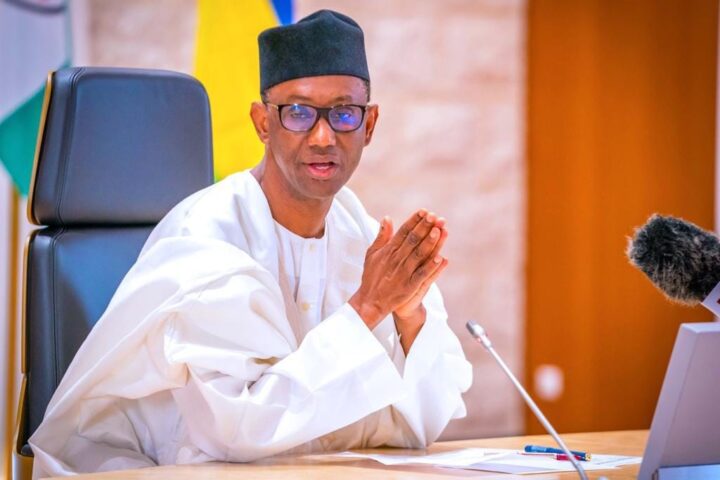
Asiwaju Bola Ahmed Tinubu

Prof. Abdullahi Shehu Ma’aji: Pioneering a new era for the North West Development Commission

By Sadiq Mukhtar

Nigeria’s North-West region, comprised of seven states (Jigawa, Kaduna, Kano, Katsina, Kebbi, Sokoto, and Zamfara), has long faced significant socioeconomic challenges, including poverty, insecurity, inadequate infrastructure, and limited access to essential services. Recognising the urgent need for intervention, the Nigerian government, through the North-West Development Commission (NWDC) Act, 2024, provided the legislative framework for the Commission’s operations, powers, and functions.

In 2024, under His Excellency, President Senator Bola Tinubu’s administration, the NWDC governing board was formally unveiled, ushering in a new era of development for the region. At the forefront of this ambitious initiative is Prof. Abdullahi Shehu Ma’aji, whose appointment as the pioneer Managing Director and Chief Executive Officer reflects his impressive track record and the immense confidence placed in him by the national leadership. Retained even after a rigorous review of nominees, Prof. Ma’aji’s selection underscores his reputation as a transformative leader poised to tackle the longstanding challenges of the North-West region.

On February 11, 2025, Prof. Ma’aji delivered his inaugural address as the pioneer Managing Director of the NWDC. He set the tone for his administration and outlined a bold vision for the future of the North-West region. He began by acknowledging President Bola Ahmed Tinubu’s trust in him and reaffirmed his commitment to revitalising the region.

His speech reflected a profound understanding of the socioeconomic realities faced by the North-West region, encompassing poverty, education, and healthcare challenges, as well as agricultural stagnation, energy deficits, and environmental degradation. Despite these obstacles, he emphasised that the region also holds tremendous potential, including vast natural resources, a resilient population, and a rich cultural heritage. His clear message was that with strategic leadership, genuine collaboration, and a commitment to accountability, the North-West region can become a beacon of inclusive growth and sustainable development. 

He outlined his four key priority areas for the NWDC:

  1. Infrastructure Development – Upgrading our roads, bridges, and power supply to boost economic activity and improve our quality of life.
  2. Economic Growth & Job Creation – Supporting small businesses, fostering innovation, and revitalising agriculture to create jobs and drive industrial growth.
  3. Human Capital Development – Investing in education, agriculture, healthcare, and technical skills training to prepare our workforce for the modern economy.
  4. Transparency & Good Governance – Enforcing strong anti-corruption measures and ensuring all projects are carried out in a collaborative and accountable manner.

The MD also emphasised that Nigeria’s future lies in harnessing the strength of its workforce – especially by promoting technical skill acquisition. He underscored the need to empower the North-West youth through vocational and digital training, aligning our education system with the demands of the modern economy to create lasting job opportunities. He reaffirmed his commitment to a leadership approach rooted in transparency, innovation, and impact-driven policies. 

His vision for transformation extends beyond policy rhetoric. His leadership is anchored in practical solutions and result-driven strategies. His extensive background in development studies, social policy, and community engagement has equipped him with the practical insights needed to drive impactful change. 

His foresight in innovation was evident during his tenure as the Dean of Student Affairs of the Federal University of Technology Minna (FUT Minna), where he established a University Media FM. This pioneering initiative highlights his commitment to technological advancement, youth engagement, and innovative education.

Prof. Ma’aji believes that the North-West region can only reclaim its position as a dynamic economic hub through transparency, innovation, unity, and visionary leadership. The NWDC represents a vital opportunity to reverse decades of neglect and bring tangible change to communities. 

Under his leadership, the Commission will conduct comprehensive needs assessments, develop a robust strategic plan, and implement effective policies to revitalise key sectors like agriculture, infrastructure, and education. By leveraging modern technology, innovative financing models, and a collaborative approach, transformative change is within reach.

At a time when visionary leadership is crucial to overcoming longstanding developmental challenges, Prof. Abdullahi Shehu Ma’aji stands out as a transformative figure at the helm of the North West Development Commission. His unique blend of academic rigor, professional expertise, and ethical leadership sets the stage for the region’s revival.

As NWDC embarks on its ambitious mission to address poverty, insecurity, and infrastructural decay, the good people of the North West region remain hopeful that under Prof. Ma’aji’s guidance, a new chapter of growth, prosperity, and resilience is well within reach.

Sadiq Mukhtar, PhD writes from the Kano Municipal Local Government Area of Kano State via abubsadiq@gmail.com.

Buhari, El-Rufai, Amaechi absent at APC NEC meeting

By Abdullahi Mukhtar Algasgaini

The ruling All Progressives Congress (APC) leaders gathered at the party’s headquarters in Abuja for the National Executive Committee (NEC) meeting.

Armed security officers, including soldiers, in collaboration with other security agencies, barricaded all roads leading to the venue on Blantyre Street. Vehicle and pedestrian movement around the area was restricted, and journalists were denied access to the venue. 

However, APC spokesperson Felix Morka released a list of accredited journalists for the event on Wednesday morning.

Among those who arrived early for the meeting were members of the National Working Committee (NWC), state party leaders, former Zamfara State Governor Abdulaziz Yari, Minister of Budget and National Planning Atiku Bagudu, and Deputy Speaker of the House of Representatives Benjamin Kalu.

Governors from Edo, Benue, Ondo, Ekiti, Kaduna, Jigawa, Nasarawa, Yobe, Niger, Lagos, Kogi, Ogun, Imo, Deputy Governor of Ebonyi, and former governors of Kogi, Kebbi, Niger, Zamfara, and Plateau also attended.

Notable absentees at the NEC meeting included former President Muhammadu Buhari, former Kaduna State Governor Nasir El-Rufai, and former Rivers State Governor and ex-Minister of Transport Rotimi Amaechi.

Party leader, President Bola Tinubu, Vice President Kashim Shettima, Senate President Godswill Akpabio, and Speaker of the House of Representatives Tajudeen Abbas arrived at the meeting around 12 PM. The party’s national chairman, Abdullahi Ganduje, presided over the meeting.

This was the first NEC meeting since Tinubu assumed office as president in May 2023, following a party high-level meeting held at the Presidential Villa in Abuja.

Some party stalwarts, including El-Rufai and former Deputy National Chairman of the APC Salihu Lukman, have expressed concerns about the ruling party’s lack of internal democracy.

Review without a review

By Abubakar Idris Misau

Part (I)

In his natural quest and curiosity, it’s enticing that man wants to understand everything about all things – even though it’s an obviously unattainable goal. Observing, reading, speculating, conspiring, discussing, studying, manipulating, theorising…, in answering an “if” question of history, the man hardly provides a strictly wrong or right answer. This is simply because anything could be anything. Everything is just within the spectrum of possibility. What “if”, for example, Nigeria was colonised by the Spaniards?; Is a question that can be answered from multiple dimensions.

Reviewing the autobiography of the Former Head of State and Commander-in-Chief of the Armed Forces of the Federal Republic of Nigeria, General Ibrahim Badamasi Babangida (IBB), titled A Journey in Service, is an inexhaustible assignment.

On a lighter note, borrowing the easiest yet [at least in ruffling feathers] most effective text analysis, a style often used by the critics of Sheikh Fantami and or his works, let us by taking a glance at the title of the memoir furiously carry our pens and jump into action. After all, we’ve heard hearsays much enough to take a side. Phew…

Firstly, they say he confirmed the victory of the renowned 1993 Presidential election by the business mogul Chief Moshood Kashimawo Olawale (MKO) Abiola. And, in a gentlemanly manner, this evil genius made no attempt to contest the annulment that occurred under his watch, prioritising peace instead. He expressed regret and sought forgiveness.

Is that right?! 

Well, he can say that. He is such a nice guy [in Donald J. Trump’s voice]. I like him. He’s a successful guy, a really successful guy.

Meanwhile, based on what we know about the man if not for his health status, Badamasi, a maestro in rhetoric, would definitely make an excellent graduate assistant (GA) in my University’s Department of Political Science. Though a GA for a start, the author of ‘A Journey in Service’ would most certainly be awarded his MSc the day he resumes, his PhD in a week, and attaining readership is a possibility within a month. By the time he is to be crowned with the professorship title during the immediate convocation, naturally, our character would be too humble not to request to be re-nicknamed the political GOAT – for, many steps ahead of Maradona, he is clearly the combination of Ronaldo, Messi, and Mbappe.

In the court of analysis, however, the one crucial question we ask whenever we put history on trial is whether to judge our subjects by their ideals or the outcomes of their actions. Give it a look: While politicians insist that they stand for democracy and human rights (thus, better than soldiers), the argument of the uniform men is not any weaker; they are the nationalists whose role it is to restore order, fight corruption, and wage war against indiscipline – by sometimes risking their own lives (hence, the right patriots to lead). The whole debate sounds so sweet and convincing that one is tempted to suggest a system of government or constitutional arrangement that allows for a tenure for one and another for the other – continually.

Leaning towards social critics, however, it is hard to believe either side. For if for nothing, their actions contradict the gospels they preach. Even to compound that, most of the military-era soldiers are now politicians in their own rights. Recall, for instance, it’s a fact known to many that when G-34 (which, among other groups, was to become the People’s Democratic Party (PDP)), was established by some Nigerian politicians, one of their aims was to form a movement with a force capable of extinguishing military governance, for good, once and for all. 

With Alex Ekwueme (the first elected Vice President (1979-1983) and Professor Jerry Gana (who previously served as a Minister) as the first Chairman and Secretary of the PDP, respectively, it’s laughable that retired soldiers not only joined but ended up hijacking the party to make one of them the presidential candidate and later the first president in Nigeria’s fourth republic. So, who is who? Who are we to believe? Who are we to blame? Who is deceiving who? Who is the actual heroic champion of the power? Are the politicians ready? Can we even see any difference between the civilians and the soldiers?

Once pictured as a civilian vs military dichotomy, transmuted to a South vs North dichotomy, the ‘June 12’ incident, nobody ever sees it as a Muslim vs Christian dichotomy. However, it was a power heist involving friends – with MKO at the receiving end.

In my view, ours is a zero-ideology political arena. I especially expect Marxists (hoping we still have them) to agree with me here: the bunch of unforgiving capitalists who rule[d] Nigeria, death or alive, soldiers or politicians, whatsoever, have no regard for the ordinary citizens in their mind. Quote me.

Part II

Helen Keller, the blind, deaf American human rights activist, disability advocate, and excellent writer, said, “The country is governed for the richest, for the corporations, the bankers, the land speculators, and for the exploiters of labor.”

As a Nigerian (socially between the working and middle classes) with my vision and hearing still intact, Alhamdulillah, I can’t see or hear anything different. Thus, I am so fed up with hearing “democracy was r*ped” or “A and B were dictators.” What wasn’t r*ped, and who wasn’t a dictator fisabilLahi? Is it Fulgencio Batista or Fidel Castro? 

In case it isn’t clear as [and appearing for] what it is, we may well take another look. In the interest of democracy and development, take the most recent samples to the nearest laboratory. Tell me, for I genuinely want to understand: of what importance was it to the North when their son was the president, or to the South when their own was helming the boat (oh, yacht)?

All military Heads of State and democratically elected Presidents aside, the relationship between Babangida and Abiola was for a very long time so good that some historians and analysts were perplexed by what unfolded before them after the annulment: the bitterness, the chaos, the deaths, and then the silence. With not much to hold on to, conspiracy theorists took to the street with “the General knows the politician very well, so…” But since he was elected by his countrymen, in a process seen by many to be free and fair, that makes no sense whatsoever. 

Close to the above is another contention, shared by the legendary historian, Max Siollun, in his ‘Soldiers of Fortune’, that MKO wouldn’t have been as successful without the role played by his soldier President friend IBB. So, if it was, as explained by a friend recently, a case of two elephants fighting whence the grasses suffer, so be it. However, suffice is to say that it was never about the sold dichotomies. It can’t be about anything to do with talaka. It was all about their own interests. They are the very same people, birds of the same feather, two sides of a single coin.

Wonderful! I also forget other issues such as the assassination of Dele Giwa, the execution of Mamman Vatsa, and his refusal to appear before the Oputa Panel – the Nigerian 2001-commissioned Human Rights Violation Commission. Here, I think we must content ourselves with just one question, since our sources indicate that he expressed hope for the resolution of the Giwa mystery and seems to deliberately avoid the barysphere. My question, albeit odd, is not directed towards the author: Now that we have the other side of the story, are Nigerian human rights activists – including journalists and lawyers – on par with IBB? I only wish Chief Gani Fawehinmi (SAN) were alive. The book would have made an excellent exhibit… May his soul rest in peace.

In conclusion, the words of a “rebel” came to mind. I have yet to encounter a better description of Nigeria and its people than the one found in ‘Because I am Involved’ by the first president of the former Republic of Biafra, Chukwuemeka Odumegwu Ojukwu. It was this Oxford-educated Nigerian military officer who remarked, “Our leaders are pseudo leaders; our intellectuals are pseudo-intellectuals; our professionals are pseudo professionals; while our occupations are pseudo occupations. Our middle class is pseudo middle class; our elite are pseudo elite; our socialists, Marxists, liberals, and even our conservatives are often very much pseudo.” 

Standing on the shoulders of William Shakespeare, our nation resembles a theatre, with players performing upon its stage while some manage the script and many observe with delight. From NSA-Canada to USAID-Boko H*ram, and now to the June 12 saga, we exemplify ‘one day, one drama’. Moreover, as can be readily deduced, Ojokwu was indeed a pseudo-rebel, just as this writer is a pseudo-writer.

To be continued!

Abubakar Idris Misau writes from Katsina, Nigeria. He studied Forestry and Wildlife at the University of Maiduguri and can be reached at abubakaridrismisau@gmail.com.

I inherited N8.9bn debt as APC chairman — Ganduje

By Anwar Usman

The National Chairman of the All Progressives Congress, Dr Abdullahi Umar Ganduje, said on Wednesday that when he assumed office, he found an N8.9 billion debt from the previous leadership.

The former Kano State governor made this known in Abuja, where he was speaking at the ongoing National Executive Committee meeting of the APC.

He stated that the expenses were incurred during pre-election legal battles, election cases, and appeals for legislative, governorship, and presidential elections.

He explained, “The current NWC inherited debts and legal liabilities amounting to N8,987,874,663, arising from various legal engagements.”

The former Governor explained that Professor Abdul Kareem Kana (SAN), the National Legal Adviser, has been working to alleviate the debt burden.

He pleaded, “We still passionately appeal to the National Executive Committee to intervene accordingly”.

In attendance were President Bola Tinubu, Vice President Kashim Shettima, Senate President Godswill Akpabio, Speaker of the House of Representatives Tajudeen Abbas, state governors, NWC members, and other party chieftains.

Tinubu praises Zuriel Oduwole’s 2025 Nobel Peace Prize nomination

By Hadiza Abdulkadir

Young education advocate Zuriel Oduwole has been nominated for the 2025 Nobel Peace Prize for her efforts to promote girls’ education worldwide. 

The 22-year-old filmmaker and activist has spent over a decade championing access to education, meeting with world leaders to push for policies that keep girls in school.

Oduwole, who was born in the United States to Nigerian and Mauritian parents, began her advocacy at the age of 10 through documentary filmmaking. 

Oduwole’s work has influenced discussions on education policy and earned her numerous accolades, including the Forbes Woman Africa Young Achiever Award.

While the Nobel Committee does not disclose nominations, news of Oduwole’s recognition has sparked widespread praise. If she wins, she would become one of the youngest recipients of the prestigious award. 

The 2025 Nobel Peace Prize laureate will be announced in October, and the official ceremony will be held in December in Oslo, Norway.

The metaphor of self in Ibrahim Babangida’s A Journey of Service: An Autobiography

By Bashir Uba Ibrahim, PhD

Etymologically, the terms “autos”, “bios”, and “graphein” are Greek forms. While the former stands for “self”, the “bio” represents “life”, and the “graphein” which diachronically and morphologically changes over time to “graphy,” means “to write”. Thus, autobiography is a self-written narration of one’s own life. 

According to Celluni, “All men, whatever be their condition, who have done anything of merit, if so, be they men of truth and good repute, should write the tale of their life with their own hand”. Thus, the recent 420-page memoir launched by the former military Head of State, Ibrahim Badamasi Babangida, on Thursday, 20th February 2025, is a typical instance of a self-written account of one’s own life experiences.

Babangida’s A Journey of Service: An Autobiography is highly anticipated due to the author’s role as one of Nigeria’s most controversial, if not enigmatic, military leaders. His perceptive ingenuity and cunning leadership style earned him the nickname “Maradona” or “evil genius.” Thus, his reign was marked by numerous seemingly unforgettable controversies and troubles, ranging from the mysterious death of journalist Dele Giwa, the failed coup of Mamman Vatsa and his subsequent execution, Gideon Okar’s bloody failed coup, the Structural Adjustment Programme (SAP), the OIC palaver, and above all, the 1993 June 12 saga. 

As noted by Lejunre (1975), the supreme value of autobiography lies in its nature as a product of the writer’s self, the private realm of his reflective self that informs the bios and graphein, with which they interact to form a text as a discourse about his existence, particularly emphasising the development of his own life and personality. Therefore, as an autobiographical text, A Journey in Service represents a personal account of its author.

In addition, Babangida, in this book, makes a striking revelation, submissions and confessions that left some of its readers in a deep shudder and bewilderment. For instance, about the June 12 saga, an election that was annulled in broad daylight by him, he writes that on June 23rd, 1993, he left Abuja for Katsina to commiserate with the Yar’adua family over the death of their patriarch, Musa Yar’adua, the father of Major General Shehu Yar’adua and the late Nigerian president Umar Musa Yar’adua when “a report filtered to me that the June 12 elections had been annulled” (pp-275). He thus shifts blame to former Head of State General Sani Abacha, who was then his Chief of Defence Staff, the accusation which some people view as not only baseless but rather a joke and a scapegoat as succinctly captured in the book “But annulment was only a component of series of other options. But to suddenly have an announcement made without my authority was, to put it mildly, alarming. I remember saying: ‘These nefarious inside’ forces opposed to the elections have outflanked me! I would later find out that the forces led by General Sani Abacha annulled the election. There and then, I knew I was caught between a devil and deep blue sea” (pp-275).  

Therefore, Abacha served as a whipping boy or a fall guy, thus taking the blame. This is where the need for thanatography- a death writing comes up. Had Abacha been alive, the people would like to hear his side of the story on this saga, or had it been possible to write from the grave, thanatographically, his submission will help in striking a balance. Therefore, it is probable to say that Babangida’s autobiography, A Journey of Service, is just a metaphor of self that conceptually and schematically treatises his life journey from his early years, school years in Wushishi and Bida, early military career as a young officer to Nigerian civil war and NDA teaching years, mounting the saddle of leadership as the military head of state and the challenges that follow. 

In short, this autobiography is timely as it emerges in an era where one of MKO Abiola’s disciples, who fought for the cause of June 12, which led to his exile, is ruling the country. Meanwhile, the public’s eagerness to hear Babangida’s perspective after 32 years since the incident, along with numerous intricate mysteries, controversies, and decisions that characterised his regime, makes the book’s readership thought-provoking. 

However, my prediction is that the book will be subjected to various interpretations, re-readings, and misinterpretations depending on the perspective of its readers. Therefore, critics of this autobiography or memoir may approach it with the intention of deconstructing it, as the autobiographical activity (by Babangida) is also a form of deconstruction, evident through the narrative account and the self-writing upon the subject self.         

Dr Bashir Uba Ibrahim writes from the Department of English and Literary Studies, Sule Lamido University, Kafin Hausa. He can be reached via bashirubaibrahim@gmail.com.

Autobiographies as constructed narratives: Reflections on General Ibrahim Badamasi Babangida’s “A Journey in Service”

By Ibraheem A. Waziri 

On February 20, 2025, Nigeria marked a pivotal moment in its historical and literary landscape by launching A Journey in Service, the autobiography of General Ibrahim Badamasi Babangida, the nation’s former Military Head of State. Held at the Transcorp Hilton Hotel’s Congress Hall in Abuja, the event drew an illustrious crowd: President Bola Tinubu, former Presidents Yakubu Gowon, Abdulsalami Abubakar, and Goodluck Jonathan, alongside business magnates Aliko Dangote and Abdulsamad Rabiu. 

Beyond the fanfare and the nearly N17.5 billion raised for the IBB Legacy Centre—mistakenly dubbed a presidential library in early reports—the memoir’s release reignites a profound discussion about autobiographies. Far from being vessels of absolute truth, such works are meticulously crafted narratives designed to logically articulate an author’s perspective while justifying their actions and thoughts—past, present, and future. Babangida’s A Journey in Serviceembodies this, offering a lens to explore the constructed essence of autobiographical storytelling.

Autobiographies are, by design, subjective endeavours, distinct from impartial chronicles. They weave personal accounts from memory, intent, and selective disclosure, often prioritising coherence over unvarnished fact. Babangida, who governed Nigeria from August 27, 1985, to August 26, 1993, remains a divisive figure. Known for deft political manoeuvres—earning monikers like “Maradona” for his agility and “evil genius” for his cunningness—he oversaw a tumultuous era marked by economic upheaval and democratic setbacks. His most infamous act, the annulment of the June 12, 1993, presidential election—widely deemed Nigeria’s freest at that time, won by Moshood Abiola—has haunted his legacy for 31 years. 

Nigerians anticipated A Journey in Service as a chance for clarity or confession, yet its launch reveals a narrative sculpted to reflect Babangida’s self-perception. He acknowledges Abiola’s victory, a move Tinubu hailed as “unusual courage,” but frames the annulment as an unauthorised act by General Sani Abacha and other officers while he was in Katsina, sidelined by circumstance. This selective disclosure suggests not a full unveiling but a justification, repositioning him as a constrained leader rather than complicit.

This subjectivity underscores a broader truth: books, especially memoirs, filter reality through hindsight, bias, and audience expectation. Babangida’s 420-page work, reviewed by former Vice President Yemi Osinbajo, promises insights into his eight-year tenure—economic reforms like the Structural Adjustment Programme (SAP), infrastructure feats, and banking deregulation—yet sidesteps a complete reckoning. 

Critics highlight glaring omissions: no confession regarding the October 19, 1986, assassination of journalist Dele Giwa by a parcel bomb widely linked to his regime; no accounting for the $12.4 billion Gulf War oil windfall, per the 1994 Pius Okigbo report; and no remorse for the executions of coup plotters like Mamman Vatsa in 1986 and Gideon Orkar in 1990. Babangida’s claim that he feared Abiola’s assassination if he took office—a speculative justification—casts him as a reluctant actor amidst a military cabal, absolving himself of agency. As much as the revelations, these silences illustrate how A Journey in Service constructs a narrative that defends, rather than fully discloses, a deliberate choice aligning with autobiographical norms.

The memoir’s role as a legacy-building tool further amplifies its constructed nature. Launched as Babangida, now 83 (born August 17, 1941), nears life’s twilight, and Nigeria approaches the 2027 elections, the event doubled as a fundraising spectacle for the IBB Legacy Centre. Billion-naira pledges from Dangote, Rabiu, and others—totalling N17.5 billion per ThisDay—underscored Babangida’s enduring clout 31 years after stepping down. 

The title A Journey in Service reframes his rule as a patriotic endeavour, softening the authoritarian edges of his “evil genius” persona. By admitting Abiola’s win while distancing himself from the annulment’s execution, he crafts a complex portrait: a transformative leader navigating chaos, appealing to admirers who credit him with modernisation while mitigating critics’ ire over economic hardship and political repression. This duality reflects a narrative engineered to reconcile his past with the statesman image he seeks today, extending its influence beyond the page into Nigeria’s political present.

The historical context of Babangida’s tenure enriches this analysis. His regime followed a series of military coups, inheriting a nation battered by oil-dependent economics and factional strife. The SAP, intended to liberalise the economy, sparked inflation and unrest, while his annulment catalysed protests and deepened ethnic divides, paving the way for Abacha’s reign. A Journey in Service likely glosses over these ripple effects, emphasising achievements—like the Third Mainland Bridge or Abuja’s development—to counterbalance failures. This selective memory mirrors how autobiographies prioritise legacy over accountability, inviting readers to weigh Babangida’s narrative against Nigeria’s collective experience.

Reactions to the memoir underscore its status as perspective, not fact. Tinubu, a June 12 activist turned president, praised its candour as setting “records properly,” perhaps reflecting political pragmatism. Afenifere, a pan-Yoruba group, rejected it as too late to mend the annulment’s “ogbonge damage,” echoing Yoruba grievances. Activists accused Babangida of exploiting Nigeria’s accountability vacuum, a sentiment rooted in decades of unresolved justice. Literary scholar Pius Adesanmi, were he alive, might have called it a “textual performance,” blending truth and theatre. These responses reveal a fragmented reception: the book’s narrative is interpreted through readers’ biases, not universally embraced as truth, highlighting the elusive nature of autobiographical authority.

However, this constructed nature does not diminish the value of A Journey in Service; rather, it enhances its complexity. It provides a window into Babangida’s mind: his rationalisations, regrets, and aspirations amid a career of calculated risks. At the launch, Goodluck Jonathan urged the preservation of such narratives to enrich Nigeria’s political archive, calling for the institutionalisation of personal histories. 

Readers, however, must approach it sceptically, recognising it as one voice in a cacophony of perspectives—those of June 12 activists, SAP victims, and silenced journalists. Its significance lies not in claiming absolute truth but in sparking reflection and debate, compelling Nigerians to confront the ambiguities of their history. For youth, as commentators suggest, it offers leadership lessons—resilience and adaptability—albeit through a self-justifying lens that demands critical parsing.

Comparatively, A Journey in Service fits a global tradition of autobiographical narrative-building. Nelson Mandela’s Long Walk to Freedom blends triumph with curated humility, while Barack Obama’s Dreams from My Father navigates identity with selective introspection. With its wit (per Osinbajo’s review) and strategic candour, Babangida’s work joins this lineage, tailoring Nigeria’s military past to a personal saga. Its launch timing—amid economic woes and democratic flux—amplifies its relevance, positioning Babangida as a commentator on leadership in crisis, a narrative thread justifying his past while influencing future discourse.

In conclusion, autobiographies like A Journey in Service are not absolute truths but woven narratives serving their authors’ ends. Launched on February 20, 2025, Babangida’s memoir—through selective revelations, strategic omissions, and legacy-driven intent—justifies actions like the annulment while shaping his present stature and future remembrance. 

As Nigerians grapple with its contents, it stands as a testament to storytelling’s power: not a final word, but a provocation to question, analyse, and seek broader truths it skirts. In a nation wrestling with its past—where military rule, economic policy, and democratic betrayal remain raw—such narratives are vital, not for certainty, but for the conversations they ignite, urging a deeper reckoning with history’s many voices.

Ibraheem A. Waziri wrote from Zaria.

Nigeria should turn its abandoned assets into revenues

By Zayyad I. Muhammad

The Federal Government of Nigeria owns thousands of abandoned and incomplete buildings, roads, dams, electricity, etc, projects, vast tracts of unused land, thousands of obsolete and unserviceable vehicles, and millions of scrap machines and equipment scattered across the country. These assets, though neglected, represent significant untapped potential that could be leveraged to generate much-needed revenue.

Both the federal and state governments need additional funds to finance developmental and humanitarian programs and sustain ongoing projects and programs. The solution to this financial challenge may lie in the assets that have been left to deteriorate. By auctioning some of these assets, commercializing others through private sector participation, and completing abandoned projects, the government can unlock substantial revenue streams.

For instance, Nigeria has thousands of kilometers of abandoned or dilapidated federal highways. Rehabilitating and conventionalizing these roads through private sector involvement would improve infrastructure and generate revenue for the government. This approach would shift the financial burden from the public purse to private investors, who would fund the construction or rehabilitation of the roads and recoup their investments through tolling.

In 2022, the Federal Government introduced the Highway Development and Management Initiative (HDMI), a commendable program that identified 19 federal highways for rehabilitation and tolling. However, recent reports suggest that the current Minister of Works, Senator David Umahi, has become a bottleneck to the initiative.

As Bismarck Rewane, Managing Director of Financial Derivatives Company Limited (FDC), noted, “This idea was thwarted with the entrance of the current Federal Minister of Works, who came into the picture, first as a catalyst and next as a spoiler.”

The President Bola Ahmed Tinubu administration should prioritise reviving schemes to convert abandoned properties, highways, lands, vehicles, machinery, and other assets into sustainable revenue streams. However, the process must be meticulously planned, transparent, and supported by robust legislation and institutions. Given Nigeria’s history of failed concessions and partnerships, neither private sector players nor international investors will be willing to participate without these safeguards.

Failures include the Lekki-Epe Concession, Ajaokuta Steel Company’s 2004 concession to GSHL (revoked in 2008), Lagos-Ibadan Expressway’s 2009 concession to Bi-Courtney (revoked in 2012), and the Nigerian Ports Concession program, where operators failed to meet obligations due to weak enforcement and oversight. Another case is the ALSCON concession to UC Rusal, leading to ownership disputes and legal battles.

To succeed, the government must learn from past mistakes and create an enabling environment that fosters trust and accountability. By doing so, Nigeria can transform its abandoned assets into a goldmine of opportunities, driving economic growth and development for the benefit of all.

Zayyad I. Muhammad writes from Abuja via zaymohd@yahoo.com.

BUK awards honorary doctorates to A. A. Rano, Col. Sani Bello

By Hadiza Abdulkadir

Bayero University, Kano (BUK) celebrated a significant milestone on February 15, 2025, by conferring honorary Doctorate Degrees on Colonel Sani Bello, former Military Administrator of Kano State, and Alhaji Auwalu Abdullahi Rano, CEO of A. A. Rano Group of Companies, during its 39th Convocation.

The honorary degrees recognised their exceptional contributions to education and socio-economic development in Kano State and Nigeria. 

President Bola Ahmed Tinubu, represented by Minister of State for Education, Professor Suwaiba Ahmad Sa’id, praised the honourees and reaffirmed the government’s commitment to human capital development through education.

BUK’s Vice Chancellor, Professor Sagir Adamu Abbas, highlighted the graduation of 3,400 students, including 295 from the Dangote Business School and 275 PhD graduates, with 176 achieving First Class Honours. 

Pro-Chancellor Dr. Nasiru Yusuf Gawuna encouraged graduands to uphold the university’s reputation, noting BUK’s recent ranking of 43rd in Africa by the 2025 Times Higher Education World University Rankings, inspiring them to strive for excellence and service to humanity.

BUK awards Borodo, others with Emeritus Professorships at 39th convocation

By Hadiza Abdulkadir

Bayero University Kano (BUK) celebrated its 39th Convocation by conferring Emeritus Professorships on Professor Garba Dahuwa Azare, Professor Julius Afolabi Falola, and Professor Musa Borodo for their significant contributions to academia.

The ceremony featured President Bola Ahmed Tinubu, who was represented by Minister of State for Education Professor Suwaiba Ahmad Sa’id. Before her appointment, Sa’id was also a member of the Bayero University, Kano, staff.

Tinubu congratulated the honourees and graduates, emphasised the importance of education in fostering national progress, and assured ongoing support for the education sector to boost global competitiveness.

BUK Vice Chancellor, Professor Sagir Adamu Abbas, praised the awardees as influential figures in shaping the nation and celebrated the graduation of 3,400 students, including 176 who achieved First Class Honours.

Pro-Chancellor Dr. Nasiru Yusuf Gawuna encouraged graduates to become ambassadors of the university, noting BUK’s recent ranking of 43rd among African universities. The conferral of Emeritus Professorships reaffirms BUK’s commitment to honouring excellence in education.